Romans 14:2

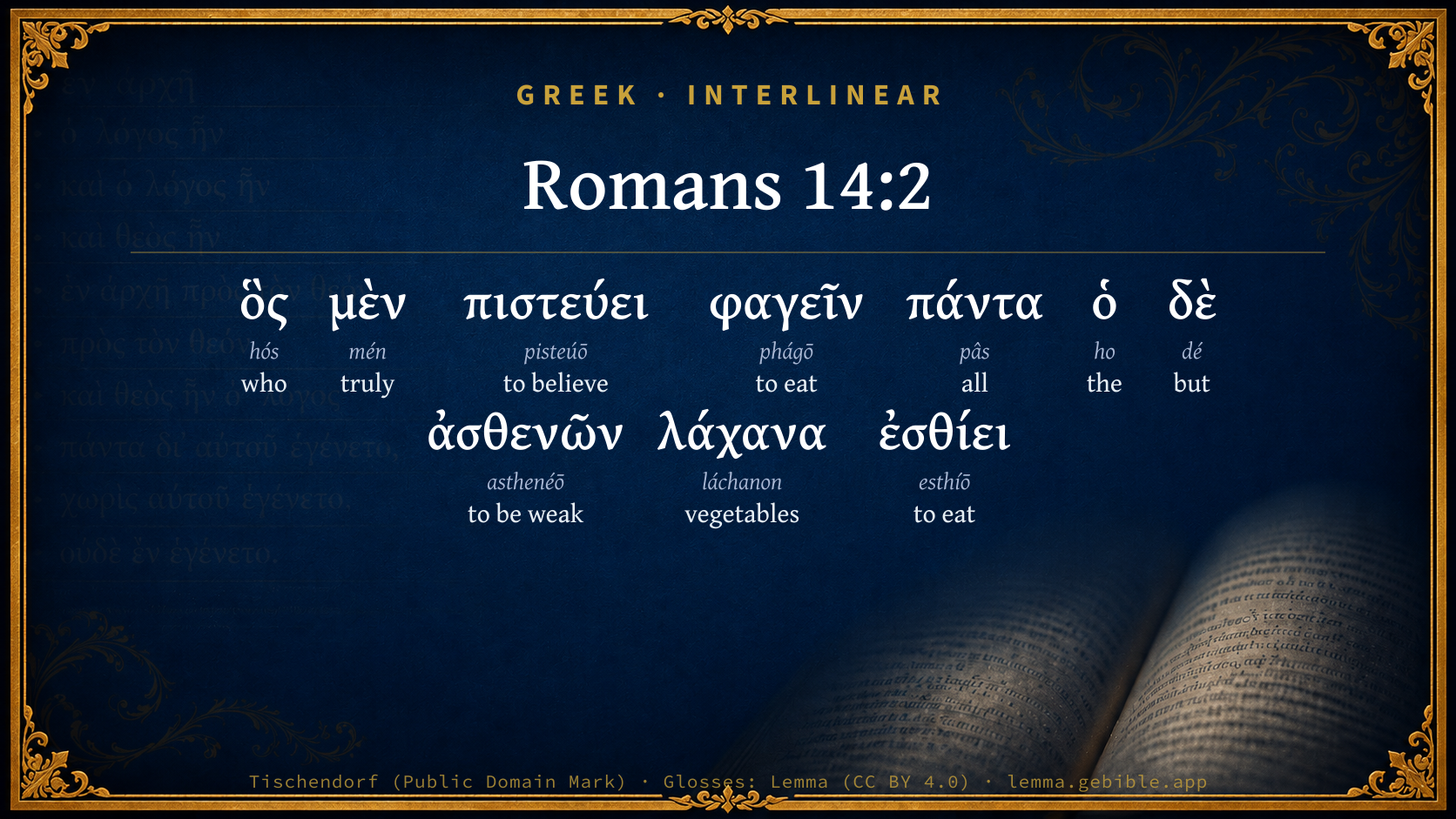
Greek (Tischendorf 8th ed.) Romans 14:2 appears in the Greek New Testament. The text above is from the Tischendorf 8th edition. Each word links to its Strong’s number and a concise gloss. Click any word for its full Thayer’s Greek Lexicon entry.
Download image
Cite this verse

Romans 14:2 (World English Bible). Public Domain. Lemma interlinear Bible study tool, https://lemma.gebible.app/v/romans/14/2.

Show BibTeX & RIS
BibTeX
RIS
English Translation
One man has faith to eat all things, but he who is weak eats only vegetables.
World English Bible · Public Domain
Download a study sheet

One document with this verse’s original text, its word-by-word gloss line, the meaning frame, cross-references with their text, attributed commentary, and full source and license credits — printable, and it pastes into notes with its structure intact.

This verse Autodidact and up

Study sheet (.html) Plain text (.txt)

A passage Seminary Student

Up to 50 verses in one chapter. A passage sheet keeps up to 6 commentary sources and 12 cross-references per verse, in the order this page ranks them, and says so on the sheet whenever that leaves anything out. Ask for a single verse and you get the Autodidact verse sheet above.

Everything on this page stays free to read, with no account — the sheet is a download of what is already on screen, not access to it.

Want to remove ads? Support Godless Engineer
Compare translations 3

The same verse in 3 English versions, stacked beneath the original-language interlinear above. Click any original word for its lexicon entry.

Each is an independent rendering of the whole verse — the interlinear is not word-aligned to these translations.

Highlighted words mark where these versions differ — a whole-verse word diff, not a word-by-word alignment.

  • World English Bible Public Domain
    One man has faith to eat all things, but he who is weak eats only vegetables.
  • King James Version Public Domain
    For one believeth that he may eat all things: another, who is weak, eateth herbs.
  • unfoldingWord Literal Text CC BY-SA 4.0
    One person believes to eat anything, but the one being weak eats vegetables.

unfoldingWord Literal Text — © unfoldingWord, licensed CC BY-SA 4.0. Word-aligned USFM3 via Door43 (git.door43.org/unfoldingWord/en_ult).

Versions to compare (up to 4)

3 of 4 selected

Show all 19 translations

Every available English version of this verse, each an independent rendering of the whole verse.

  • World English Bible Public Domain
    One man has faith to eat all things, but he who is weak eats only vegetables.
  • Berean Standard Bible Public Domain
    For one person has faith to eat all things, while another, who is weak, eats only vegetables.
  • Majority Standard Bible Public Domain
    For one person has faith to eat all things, while another, who is weak, eats only vegetables.
  • King James Version Public Domain
    For one believeth that he may eat all things: another, who is weak, eateth herbs.
  • American Standard Version (1901) Public Domain
    One man hath faith to eat all things: but he that is weak eateth herbs.
  • Revised Version (1885) Public Domain
    One man hath faith to eat all things: but he that is weak eateth herbs.
  • Geneva Bible (1599) Public Domain
    One beleeueth that he may eate of all things: and another, which is weake, eateth herbes.
  • Douay-Rheims (1899) Public Domain
    For one believeth that he may eat all things: but he that is weak, let him eat herbs.
  • Young's Literal Translation Public Domain
    one doth believe that he may eat all things -- and he who is weak doth eat herbs;
  • Literal Standard Version CC BY-SA 4.0
    one believes that he may eat all things—and he who is weak eats herbs;
  • Unlocked Literal Bible CC BY-SA 4.0
    One person has faith to eat anything, another who is weak eats only vegetables.
  • unfoldingWord Literal Text CC BY-SA 4.0
    One person believes to eat anything, but the one being weak eats vegetables.
  • Darby Bible Public Domain
    One man is assured that he may eat all things; but the weak eats herbs.
  • World Messianic Bible Public Domain
    One man has faith to eat all things, but he who is weak eats only vegetables.
  • Webster's Bible Public Domain
    For one believeth that he may eat all things: another, who is weak, eateth herbs.
  • Free Bible Version CC BY-SA 4.0
    One person may believe they can eat anything, while another whose trust is weak only eats vegetables.
  • Bible in Basic English Public Domain
    One man has faith to take all things as food: another who is feeble in faith takes only green food.
  • Text-Critical English NT CC BY 4.0
    One person believes that he may eat anything, but he who is weak eats only vegetables.
  • Tyndale New Testament (1534) Public Domain
    One beleveth that he maye eate all thinge. Another which is weake eateth earbes.

Literal Standard Version (2020), Covenant Press — licensed CC BY-SA 4.0. Text via the HelloAO Bible API (eBible.org). Unlocked Literal Bible (unfoldingWord) — licensed CC BY-SA 4.0. Text via the HelloAO Bible API (eBible.org). unfoldingWord Literal Text — © unfoldingWord, licensed CC BY-SA 4.0. Word-aligned USFM3 via Door43 (git.door43.org/unfoldingWord/en_ult). Free Bible Version, Dr. Jonathan Gallagher — licensed CC BY-SA 4.0. Text via the HelloAO Bible API (eBible.org).

Word by word

More ways to search: Search by grammar → Find every occurrence → Compare this word →

Practice this passage: Drill this verse → Learn its vocabulary →

About this verse

These counts appear in no published source. They are computed here, from the morphology-tagged text and Lemma’s own curated glosses. What Lemma adds →

10
words
10
distinct lemmas
Pauline Epistles
section

Notable vocabulary

The rarest word here is λάχανα vegetables G3001 — appearing just 4 times in the whole Greek New Testament.

Shared distinctive vocabulary

λάχανα vegetables G3001 occurs in 4 verses of the Greek New Testament. Also found in:

Cross-references

13

Topical passages linked to Romans 14:2 in the Treasury of Scripture Knowledge — connected by theme and wording, ordered by reader-vote popularity; previews shown in the World English Bible.

  • 1 Timothy 4:4 For every creature of God is good, and nothing is to be rejected, if it is received with thanksgiving.
  • Proverbs 15:17 Better is a dinner of herbs, where love is, Than a fattened calf with hatred.
  • Romans 14:14 I know, and am persuaded in the Lord Jesus, that nothing is unclean of itself; except that to him who considers anything to be unclean, to him it is unclean.
  • Romans 14:22–23 Do you have faith? Have it to yourself before God. Happy is he who doesn't judge himself in that which he approves.
  • Galatians 2:12 For before some people came from James, he ate with the Gentiles. But when they came, he drew back and separated himself, fearing those who were of the circumcision.
  • Genesis 9:3 Every moving thing that lives will be food for you. As the green herb, I have given everything to you.
  • 1 Corinthians 10:25 Whatever is sold in the butcher shop, eat, asking no question for the sake of conscience,
  • Titus 1:15 To the pure, all things are pure; but to those who are defiled and unbelieving, nothing is pure; but both their mind and their conscience are defiled.
  • Hebrews 13:9 Don't be carried away by various and strange teachings, for it is good that the heart be established by grace, not by food, through which those who were so occupied were not benefited.
  • Hebrews 9:10 being only (with meats and drinks and various washings) fleshly ordinances, imposed until a time of reformation.
  • Daniel 1:12 Prove your servants, I beg you, ten days; and let them give us pulse to eat, and water to drink.
  • Genesis 1:29 God said, "Behold, I have given you every herb yielding seed, which is on the surface of all the earth, and every tree, which bears fruit yielding seed. It will be your food.
  • Daniel 1:16 So the steward took away their dainties, and the wine that they should drink, and gave them pulse.

Cross-references courtesy of OpenBible.info (CC BY 4.0).

Commentary

Notes on Romans 14:2 from classic Christian and Jewish commentators (each source and its license shown beneath its notes). The classic Christian expositions comment on the surrounding passage and are grouped to its opening verse, so a note may address several verses; the Jewish commentaries on the Tanakh (Rashi and others) are per-verse, so they appear only where the commentator wrote on this verse.

Lemma curates 59 commentaries, every one of them public domain or Creative Commons licensed, each selected and text-cleaned for this edition rather than reprinted as found. About our sources →

Joseph Benson's Commentary

Rom 14:2-4. For one believeth that he may eat all things — A converted Gentile, who rightly understands his Christian liberty, is firmly persuaded that he may eat any kind of food indifferently, though forbidden by the ceremonial law, (blood excepted, of which see on Act 15:20,) without sin. Another, who is weak — A believing Jew, not thoroughly informed of his Christian liberty; eateth herbs — Namely, for fear lest he should offend by eating any meat forbidden by the law, or which was not killed in a legal manner. See Lev 17:10-14; Dan 1:8. Let not him that eateth — That makes use of his liberty to eat any thing that is wholesome indifferently; despise him — As over-scrupulous or superstitious; that eateth not — That forbears the use of such kind of food as is forbidden by the law. And let not him which eateth not — Who, from a scrupulous conscience, abstains from many kinds of food; judge him that eateth — Censure him as profane, or as taking undue liberties. For God hath received him — Acknowledges both the one and the other for his servant, on account of their common faith in Christ, and in the truths and promises of his gospel. This is a powerful argument for our conversing in a friendly manner, and holding communion with those who differ from us in opinion, on some points of lesser importance in religion. Who art thou — Whether weaker or stronger; that judgest another man’s servant — One over whom thou hast no power. To his own master he standeth or falleth — He must abide by Christ’s judgment only, to whom it belongs either to acquit or condemn him. Yea, he shall be holden up — If he offends in no greater points than these in debate among you, he shall be upheld in his Christian profession, and established to eternal salvation. For God is able to make him stand — And certainly will do it, if he continue to act conscientiously and uprightly.

Joseph Benson's Commentary on the Old and New Testaments (1811–1818) — public domain. Text from a community e-Sword module.

Tyndale Open Study Notes

Tyndale Open Resources

14:2 The weak in faith apparently believed that they should eat only vegetables. Their conviction probably stemmed from a concern to maintain Jewish ritual purity in the midst of a pagan culture. These Jewish Christians were following the lead of Daniel and his friends, who refused to eat the rich food and wine that the king of Babylon offered them (Dan 1:3-16). Other Jewish sources reveal that pious Jews often restricted their diets in pagan cultures because they could never be sure that meat had been slaughtered according to Jewish requirements.

Tyndale Open Study Notes — © Tyndale Open Resources, licensed CC BY-SA 4.0. Text via the HelloAO Bible API.

Bengel's Gnomon

Johann Albrecht Bengel

Rom 14:2. Πιστεύει, believes) This word has a more direct sense in the predicate; the participle ἀσθενῶν conceals, as it were, the weakness of him who eats herbs.—λάχανα, herbs) vegetable food (in preference to meats, Rom 14:21), which we have the most undoubted liberty to eat, Gen 9:3.

Bengel's Gnomon of the New Testament — English translation (T&T Clark, Edinburgh, 1860) — public domain. Text from a community e-Sword module.

Meyer's Critical & Exegetical Commentary

Heinrich August Wilhelm Meyer

Rom_14:2. More particular discussion of the subject, and in the first place, exhibition of the first point of difference between the two parties.

ὃς μέν] without a corresponding ὃς δέ, instead of which there is at once put the definite ὁ δὲ ἀσθ.: the one (i.e. the strong) believes, etc.; but the weak, etc. Comp. Kühner, ad Xen. Anab. ii. 3. 15; Fritzsche, ad Marc. p. 507.

πιστεύει φαγεῖν πάντα may mean: he is convinced that he may eat all things, so that the notion ἐξεῖναι is implied in the relation of the verbal notion to the infinitive (Lobeck, ad Phryn. p. 753 f.; Buttmann, neut. Gr. p. 235); so Tholuck, Borger, and older interpreters. But more agreeable to the τῇ πίστει, Rom_14:1, and to the contrast ὁ ἀσθεν., is the rendering: he has the confidence, the assurance of faith, to eat all things; Winer, p. 302 [E. T. 405]. Comp. Dem. 866. 1, and generally Krüger, § 61. 6. 8. To supply ὥστε (van Hengel) is in accordance with the sense, but unnecessary.

λάχανα] excludes, according to the connection, all use of flesh, not merely that of Levitically unclean animals, or of flesh sacrificed to idols, or on feast and fast days,limitations of which nature are introduced by most interpreters (including Reiche, Köllner, Neander, Tholuck, Philippi). The weak in faith eats no flesh, but vegetables are his food. Comp. Wieseler in Herzogs Encyklop. XX. p. 595.

Meyer — Critical and Exegetical Commentary on the New Testament — English translation by Peter Christie, edited by Frederick Crombie (T&T Clark, 1880) — public domain. Text from a community e-Sword module.

Expositor's Greek Testament

ed. W. Robertson Nicoll

Rom 14:2 . ὃς μέν : cf. Rom 14:5 , Rom 9:21 . πιστεύει φαγεῖν πάντα : has confidence to eat all things. See Winer, p. 405. Gifford quotes Demosthenes, p. 88: προέσθαι δὲ τὴν προῖκʼ οὐκ ἐπίστευσεν : “he had not confidence, i.e. , was too cautious, to give up the dowry”. This use of πιστεύειν shows that πίστις to Paul was essentially an ethical principle; the man who was strong in it had moral independence, courage, and originality. ὁ δὲ ἀσθενῶν λάχανα ἐσθίει : it is impossible to suppose that Paul here is “writing quite generally”; he must have had a motive for saying what he does, and it can only be found in the fact that he knew there were Christians in Rome who abstained from the use of flesh.

The Expositor's Greek Testament, edited by W. Robertson Nicoll (1897–1910) — public domain. Text from a community e-Sword module.

Hodge's Commentary on Romans, Ephesians & First Corinthians

Charles Hodge

Rom_14:2

For one believeth he may eat all things: another, who is weak, eateth herbs ὃς μὲν πιστεύει φαγεῖν πάντα does not mean, one believeth he may eat all things; much less, he that believeth eats all things, but, one has confidence to eat all things. Instead of ὃς μέν being followed by ὁ δέ, one eats all things, another eats herbs, Paul says, ὁ δὲ ἀσθενῶν, he who is weak eateth herbs. This is an illustration of the weakness of faith to which the apostle refers in Rom_14:1. It was a scrupulousness about the use of things considered as unclean, and with regard to sacred days, Rom_14:5. There were two sources whence the early Christian church was disturbed by the question about meats. The first, and by far the most important, was the natural prejudices of the Jewish converts. It is not a matter of surprise that, educated as they had been in a strict regard for the Mosaic law, they found it difficult to enter at once into the fall liberty of the gospel, and disencumber their consciences of all their early opinions. Even the apostles were slow in shaking them off; and the church in Jerusalem seems to have long continued in the observance of a great part of the ceremonial law. These scruples were not confined to the use of meats pronounced unclean in the Old Testament, but, as appears from the Epistles to the Corinthians, extended to partaking of anything which had been offered to an idol; and, in these latter scruples, some even of the Gentile converts may have joined. The second source of trouble on this subject was less prevalent and less excusable. It was the influence of the mystic ascetic philosophy of the East, which had developed itself among the Jews, in the peculiar opinions of the Essenes, and which, among the Christian churches, particularly those of Asia Minor, produced the evils which Paul describes in his Epistles to the Colossians (Col_2:10-23,) and to Timothy (1Ti_4:1-8,) and which subsequently gave rise to all the errors of Gnosticism. There is no satisfactory evidence that the persons to whom Paul refers in this passage were under the influence of this philosophy. The fact that they abstained from all meat, as seems to be intimated in this verse, may have arisen from the constant apprehension of eating meat which, after having been presented in sacrifice, was sold in the marketplace, or which had in some other way been rendered unclean. Every thing in the context is consistent with the supposition that Jewish scruples were the source of the difficulty; and as these were by far the most common cause, no other need be here assumed.

Charles Hodge — Commentary on Romans (1835), First Corinthians (1857), and Ephesians (1856) — public domain. Text from a community e-Sword module.

Geneva Bible (1599)

Geneva Bible translators

Knows by faith.

He propoundeth for an example, the difference of meats, which some thought was necessarily to be observed as a thing prescribed by the Law (not knowing that it was taken away) whereas on the contrary side, such as had profited in the knowledge of the Gospel, knew well that this schoolmastership of the Law was abolished.

Geneva Bible (1599) marginal notes — public domain. Text via Bolls.life.

Jamieson, Fausset & Brown

Robert Jamieson, A. R. Fausset & David Brown

one believeth that he may eat all things--See Act 10:16.

another, who is weak, eateth herbs--restricting himself probably to a vegetable diet, for fear of eating what might have been offered to idols, and so would be unclean. (See Co1 8:1-13).

Jamieson, Fausset & Brown — Commentary Critical and Explanatory on the Whole Bible (1871) — public domain (CC PDM 1.0). Text via the HelloAO Bible API.

Adam Clarke's Commentary

Verse 2. One believeth that he may eat all things] He believes that whatsoever is wholesome and nourishing, whether herbs or flesh-whether enjoined or forbidden by the Mosaic law - may be safely and conscientiously used by every Christian.

Another, who is weak, eateth herbs.] Certain Jews, lately converted to the Christian faith, and having as yet little knowledge of its doctrines, believe the Mosaic law relative to clean and unclean meats to be still in force; and therefore, when they are in a Gentile country, for fear of being defiled, avoid flesh entirely and live on vegetables. And a Jew when in a heathen country acts thus, because he cannot tell whether the flesh which is sold in the market may be of a clean or unclean beast; whether it may not have been offered to an idol; or whether the blood may have been taken properly from it.

Adam Clarke's Commentary on the Bible (1810–1826) — public domain. Text from a community e-Sword/MySword module.

John Calvin's Commentaries

2. Let him who believes, etc. What Erasmus has followed among the various readings I know not; but he has mutilated this sentence, which, in Paul’s words, is complete; and instead of the relative article he has improperly introduced alius — one, “One indeed believes,” etc. That I take the infinitive for an imperative, ought not to appear unnatural nor strained, for it is a mode of speaking very usual with Paul. He then calls those believers who were endued with a conscience fully satisfied; to these he allowed the use of all things without any difference. In the mean time the weak did eat herbs, and abstained from those things, the use of which he thought was not lawful. If the common version be more approved, the meaning then will be, — that it is not right that he who freely eats all things, as he believes them to be lawful, should require those, who are yet tender and weak in faith, to walk by the same rule. But to render the word sick, as some have done, is absurd.

John Calvin's Commentaries (1540-1563) — public domain. Text from the Calvin Translation Society English edition (1840s-50s) via the Christian Classics Ethereal Library (ccel.org). Calvin's coverage is partial (roughly two-thirds of the Bible); uncommented books and verses are honest gaps, never fabricated. The 19th-century editor's footnotes and remarks are omitted so the notes are faithfully Calvin's own voice.

Ellicott's Commentary for English Readers

(2) Believeth that he may . . .—Rather, perhaps, hath confidence to eat all things. His faith is strong enough to prevent his conscience from becoming uneasy.

A Bible Commentary for English Readers, edited by Charles John Ellicott (1878–1897) — public domain. Text from a community e-Sword module.

The Cambridge Bible for Schools and Colleges

gen. ed. J. J. S. Perowne

2. This difference may be explained by the different quality and aspect of the controversies. In Galatia the question was of primary principle; at Rome and Corinth it was, on the whole, of secondary practice. How to be justified before God was the Galatian problem. How the justified should live was, at least in the main, the problem at Rome and Corinth. For there is no proof that the “weak brethren” differed from the “strong” on the great principle of Justification by Faith. Their error was that the path of duty, laid before the justified, included a moral obligation on the obedient children of God to abstain from certain sorts of food and to keep the Mosaic feasts. All the Roman Christians agreed that the justified must not lie nor steal; but the “weak brethren” held that, in the same way, they must not taste “unclean” food, nor neglect the festivals. The error in Galatia affected the very principle of the work and grace of Christ; the error at Rome did not, at all necessarily, do so. St Paul was thus perfectly consistent in writing Gal_1:6-9, and Rom_14:1-10.

2. believeth that he may eat] Lit. believeth to eat; i.e. has faith which leads him to see that sorts of food are no longer a matter of religious scruple.

who is weak] i.e. in his faith. See on Rom_14:1.

eateth herbs] This is given as an extreme case. Anxious scrupulosity would adopt vegetarianism as the simplest solution of the questions raised by the Mosaic precepts, complicated by the possible “defilement” of animal-food by idol-sacrifices.

The Cambridge Bible for Schools and Colleges (gen. ed. J. J. S. Perowne; Cambridge University Press, 1878–1918) — public domain. Text from a community e-Sword module.

John Gill's Exposition

For one believeth that he may eat all things,.... He is fully persuaded in his mind, that there is nothing in itself common, or unclean; that the difference between clean and unclean meats, commanded to be observed by the law of Moses, is taken away; and that he may now lawfully eat any sort of food; every creature of God being good, and none to be refused, because of the ceremonial law which is abrogated, provided it, be received with thanksgiving, and used to the glory of God:

another who is weak eateth herbs; meaning not one that is sickly and unhealthful, and of a weak constitution, and therefore eats herbs for health's sake; but one that is weak in the faith, and who thinks that the laws concerning the observance of meats and drinks are still in force; and therefore, rather than break any of them, and that he may be sure he does not, will eat nothing but herbs, which are not any of them forbidden by the law: and this he did, either as choosing rather to live altogether on herbs, than to eat anything which the law forbids; or being of opinion with the Essenes among the Jews, and the Pythagoreans among the Gentiles, who thought they were to abstain from eating of all sorts of animals.

John Gill's Exposition of the Whole Bible (1746–1763) — public domain (CC PDM 1.0). Text via the HelloAO Bible API.

Trapp's Complete Commentary

John Trapp

2 For one believeth that he may eat all things: another, who is weak, eateth herbs.

Ver. 2. Eateth herbs] Rather than meats forbidden by the law, Dan 1:11. The ancient Latins were as well paid of herbs to eat, as if they had had all manner of dainties. Green herbs were both food and medicine to them. Holus ab Vegetables from ολον.

John Trapp, A Commentary or Exposition upon All the Books of the Old and New Testament (1647–1656) — public domain. Text from a community e-Sword module.

Albert Barnes' Notes on the Bible

For one believeth - This was the case with the Gentiles in general, who had none of the scruples of the Jew about the propriety of eating certain kinds of meat. Many of the converts who had been Jews might also have had the same view as the apostle Paul evidently had while the great mass of Jewish converts might have cherished these scruples.

May eat all things - That is, he will not be restrained by any scruples about the lawfulness of certain meats, etc.

Another who is weak - There is reference here, doubt less, to the Jewish convert. The apostle admits that he was “weak,” that is, not fully established in the views of Christian liberty. The question with the Jew doubtless was, whether it was lawful to eat the meat which was offered in sacrifice to idols. In those sacrifices a part only of the animal was offered, and the remainder was eaten by the worshippers, or offered for sale in the market like other meat. It became an inquiry whether it was lawful to eat this meat; and the question in the mind of a Jew would arise from the express command of his Law; Exo 34:15. This question the apostle discussed and settled in 1Co 10:20-32, which see. In that place the general principle is laid down, that it was lawful to partake of that meat as a man would of any other, “unless it was expressly pointed out to him as having been sacrificed to idols, and unless his partaking of it would be considered as countenancing the idolators in their worship;” Rom 14:28. But with this principle many Jewish converts might not have been acquainted; or what is quite as probable, they might not have been disposed to admit its propriety.

Eateth herbs - Herbs or “vegetables” only; does not partake of meat at all, for “fear” of eating that, inadvertently, which had been offered to idols. The Romans abounded in sacrifices to idols; and it would not be easy to be certain that meat which was offered in the market, or on the table of a friend, had not been offered in this manner. To avoid the possibility of partaking of it, even “ignorantly,” they chose to eat no meat at all. The scruples of the Jews on the subject might have arisen in part from the fact that sins of “ignorance” among them subjected them to certain penalties; Lev 4:2-3, etc.; Lev 5:15; Num 15:24, Num 15:27-29. Josephus says (Life, Section 3) that in his time there were certain priests of his acquaintance who “supported themselves with figs and nuts.” These priests had been sent to Rome to be tried on some charge before Caesar: and it is probable that they abstained from meat because it might have been offered to idols. It is expressly declared of Daniel when in Babylon, that he lived on pulse and water, that he might not “defile himself with the portion of the king’s meat, nor with the wine which he drank;” Dan 1:8-16.

Albert Barnes' Notes on the Bible (1834–1885) — public domain. Text from a community e-Sword/MySword module.

Haydock's Catholic Bible Commentary

Eat all things. Viz. without observing the distinction between clean and unclean meats, prescribed by the law of Moses: which was now no longer obligatory. Some weak Christians, converted from among the Jews, as we here gather from the apostle, made a scruple of eating such meats as were deemed unclean by the law: such as swine’s flesh, &c. which the stronger sort of Christians did eat without scruple. Now the apostle, to reconcile them together, exhorts the former not to judge or condemn the latter, using their Christian liberty; and the latter to take care not to despise, or scandalize their weaker brethren, either by bringing them to eat what in their conscience they think they should not: or by giving them such offence, as to endanger the driving them thereby from the Christian religion. (Challoner) --- For one that is not so weak, but well instructed, believeth, is persuaded, that he may eat all things, the distinction of clean and unclean meats being no longer obligatory under the new law of Christ. He that is weak, and not convinced of this Christian liberty, let him eat herbs, or such things as he esteems not forbidden. It is likely some of them abstained many times from all manner of flesh, lest they should meet with what had been offered to idols, or lest something forbidden by the law might be mixed. (Witham)

George Leo Haydock (1774–1849), Haydock's Catholic Family Bible and Commentary, 1859 edition — public domain. Excludes Psalms (Douay-Rheims chapter numbering differs from Protestant) and Deuterocanonical books (Catholic canon only).

Matthew Poole's English Annotations

One believeth that he may eat all things; i.e. one that is informed aright of his Christian liberty, is fully persuaded, and that upon good grounds, that he may eat any thing that is wholesome, though forbidden by the ceremonial law; that there is now no difference of clean and unclean meats: see Mat 15:11; Act 10:12-15.

Another, who is weak, eateth herbs; i.e. he that (as before) is weak in faith, and not so well informed, such a one, for fear of offending God by eating any thing that is forbidden, will rather content himself with the meanest diet. The meaning is not, as if any, in those times, thought it lawful only to eat herbs, and so abstained altogether from other meats; but they would rather satisfy themselves with herbs, and other fruits of the earth, in which the law of Moses made no difference, than eat meats that were forbidden, or not cleansed from blood, or offered to idols, &c.: see Dan 1:8.

Matthew Poole's English Annotations on the Holy Bible (1683–1685) — public domain. Text from a community e-Sword/MySword module.

Whedon's Commentary on the Bible

Daniel D. Whedon

2. He may eat all things—That is, according with the apostle’s own opinion, that all eatables were equally innocent.

Eateth herbs—Plainly under the supposition that herbs alone are morally innocent. This is a different case from those who abstain from meats offered to idols only, or from those who abstain from meats that may have been touched by Gentile hands.

Daniel D. Whedon (gen. ed.), Commentary on the Old and New Testaments (1874–1909) — public domain. Text from a community e-Sword module.

The Pulpit Commentary

Vers. 2, 3. One believeth that he may eat all things (literally, believeth to or, hath faith to eat all things), but he that is weak eateth herbs. Let not him that eateth despise him that eateth not; and let not him which eateth not judge him that eateth: for God hath received him. "He that eateth" is the one that has faith to eat all things; and it is against contempt on his part of the weak in faith that the admonition is mainly directed throughout the chapter. (cf. also Rom_15:1) But the weak require an admonition too. Their temptation was to judge those who indulged in freedom which to themselves appeared unlawful; and here, in ver. 5, the apostle gives such as did so a sharp reproof. There is a tone of indignation in his su tiv ei o krinwn ; reminding us of his tone towards the Judaists in Galatia, who would have crippled Christian liberty. "God hath received him" refers evidently, as appears from its position and from the following verse, to him that eateth. God hath received him to himself in Christ, whosoever may sit in judgment on him. We observe that the verb proselabeto is the same as in ver. 1 and in Rom_15:7.

The Pulpit Commentary (1880–1919), ed. H.D.M. Spence-Jones & Joseph S. Exell — public domain. Text from a community e-Sword module.

John Wesley's Explanatory Notes

All things - All sorts of food, though forbidden by the law.

John Wesley, Explanatory Notes Upon the Whole Bible (1754–1765) — public domain. Text via the GEBible commentary corpus.

Burkitt's Expository Notes on the New Testament

William Burkitt

Here the apostle declares the ground of difference that was between them; namely, the difference of meats. One thought all meats to be lawful under the gospel; another, rather than eat any meats forbidden by the law, will eat only herbs.

Where observe, How the church of God, in all ages, has been strangely divided about little and indifferent things. What jars and stirs were there between the eastern and western churches about the observation of Easter; about celebrating the Lord’s supper with leavened or unleavened bread! And, verily, the fatal evils which our hot contentions have occasioned amongst ourselves, only about indifferent rites and ceremonies, tears of blood are not sufficient to bewail.

Observe next, The apostle’s exhortation to the two contending parties, not to vilify or set at nought one another, condemning each other as humorous and scrupulous, much less as obstinate and wilful; but especially, not upon this occasion to separate from, or break communion with, each other. Let not him that eateth all kinds of meats despise him that through weakness durst not eat of any.

As if the apostle had said, "Whilst there is error in our understandings, weakness in our judgments, narrowness in our faculties, differences will arise in the church of God: but take care that where there is not compliance, that yet there may be peace. Despise not, judge not one another."

Observe lastly, the reason offered by the apostle, why they should receive their weak brother; because God hath received him. God, that is most holy, and hateth sin, receiveth such; therefore so must you, if you please God. Why should you refuse to hold communion with such as hold communion with God?

William Burkitt's Expository Notes on the New Testament (1700–1703) — public domain. Text from a community e-Sword module.

McGarvey & Pendleton's Commentaries

J. W. McGarvey

One man hath faith [believes he has the liberty or right] to eat all things: but he that is weak eateth herbs . [We are familiar with the universal Jewish scruples with regard to swine's flesh and meat offered to idols; but there were some who refined their diet to far greater extremes--to the "mint, anise and cummin" standard. A sect called Therapeutæ had a regimen thus described by Philo: "Wine is not introduced. . . and the table bears nothing which has blood, but there is placed upon it bread food, and salt for seasoning, to which also hyssop is sometimes added as an extra sauce for those who are delicate in their eating." However, the abstinence here mentioned was most widely practiced by all scattered Jews. Knowing that any meat bought in Gentile markets was open to question and liable to be unclean, they, being unable to purchase clean meat as prepared by Jewish butchers, abstained from all meat and ate only those things (classed as herbs by the apostle) which they could trace from natural growth to use on their tables. (See Dan 1; Tobit 1:10, 11.) Josephus' "Life," Sec. 3, mentions certain priests who fed solely on figs and dates.]

J. W. McGarvey (with Philip Y. Pendleton), Commentaries on the New Testament (The Fourfold Gospel, 1914; Acts; and the epistles) — public domain. Text from a community e-Sword/MySword module.

The People's New Testament

B. W. Johnson

2. For one believeth, etc. The apostle now names one of those differences of opinion that had made trouble. Differences had risen over food. The flesh of animals offered in idol sacrifices was offered in the markets, and one buying could not always be sure that he did not get it. Others, Jewish Christians, or of Judaizing tendencies, believed it wrong to eat any food forbidden by the law. Perhaps others believed, like the Essenes, that the regenerate man should eat only vegetables, like the primitive race in Eden. Hence, for one or all of these causes, some thought meat ought to be abstained from entirely. Disputes arose over the difference.

B. W. Johnson's The People's New Testament with Notes (1889–1891) — public domain. Electronic text from the Christian Classics Ethereal Library (CCEL) ThML edition.

Cambridge Greek Testament for Schools and Colleges

2. ὃς μὲν κ.τ.λ. The absence of connecting particle shows that this is an illustration of the principle.

ὃς μὲν—ὁ δὲ ἀ. Cf. Blass, p. 145. πιστεύει, has faith to, so far as to—no |[270] to this use; Act 15:11 the only other case of inf. after π. is different. Giff. qu. Dem. Onet., p. 866, προέσθαι δὲ τὴν προῖκ’ οὐκ ἐπίστευσεν.

[270] | parallel to

λάχανα ἐσθίει, i.e. refuses to eat meat. This is the only clear evidence that an ascetic vegetarianism existed among the Christians of this time. It is very remarkable that S. Paul should choose this form of asceticism as his illustration; and the reason must be sought in special conditions at Rome. The practice may have been due mainly to the imitation of contemporary asceticism (cf. von Dobschütz, op. cit[271], p. 93 f., Lietzmann, Romans, p. 65). But it is conceivable that these influences may have been at least reinforced by the difficulty in which Christians found themselves of avoiding εἰδωλόθυτα (cf. 1 Corinthians 8). For tender consciences a solution was ready, in the avoiding of animal food altogether; cf. the wide statement 1Co 8:13. The whole argument shows that it is not a case of sects imposing rules on others, but of private scruples and practice. See Introd. p. xxx.

[271] op. cit. opus citatum

Cambridge Greek Testament for Schools and Colleges (Cambridge University Press, 1896; 21 vols, various authors incl. Carr, Maclear, Plummer, Farrar, Lumby, Moule, M. R. James, Simcox) — public domain. Text from a community e-Sword module.

Alford’s Greek Testament

Henry Alford

2.] The ὃς μέν, the strong in faith, so indicated by what follows, is opposed to ὁ δὲ ἀσθενῶν (not to be taken ὁ δὲ, ἀσθενῶν, κ.τ.λ.), by which τὸν ἀσθενοῦντα of ver. 1 is resumed.

πιστεύει φαγεῖν, either believes that he may (ἐξεῖναι) eat,—or ventures to eat. The latter is favoured by ref. Acts, πιστεύομεν σωθῆναι, ‘we trust to be saved;’ though that also may be expanded into ‘we believe that we shall be saved,’ as E. V.

λάχ. ἐσθ.] See remarks introductory to this chapter.

Henry Alford, The Greek Testament (1849–1861) — public domain. Text from a community e-Sword module.

International Critical Commentary

2. The Apostle proceeds to describe the two classes to which he is referring, and then (ver. 3) he gives his commands to both sides.

ὄς μὲν ̣ ̣ ̣ ὁ δὲ ἀσθενῶν. With the variation in construction cf. 1Co 12:8-10; Mar 4:4; Luk 8:5. The second ὁ is not for ὃς, but is to be taken with ἀσθενῶν.

πιστεύει, ‘hath faith to eat all things’; his faith, i.e. his grasp and hold of the Christian spirit, is so strong that he recognizes how indifferent all such matters in themselves really are.

λάχανα ἐσθίει, ‘abstains from all flesh meat and eats only vegetables.’ Most commentators have assumed that St. Paul is describing the practice of some definite party in the Roman community and have discussed, with great divergence of opinion, the motive of such a practice. But St. Paul is writing quite generally, and is merely selecting a typical instance to balance the first. He takes, on the one side, the man of thoroughly strong faith, who has grasped the full meaning of his Christianity; and on the other side, one who is, as would generally be admitted, over-scrupulous, and therefore is suitable as the type of any variety of scrupulousness in food which might occur. To both these classes he gives the command of forbearance, and what he says to them will apply to other less extreme cases (see the Discussion on p. 399).

International Critical Commentary — older volumes (1896–1929), various authors — public domain. Text from a community e-Sword module.

Vincent's Word Studies in the New Testament

Marvin R. Vincent

Believeth that he may eat [πιστευει φαγειν] . The A. V. conveys the sense of having an opinion, thinking. But the point is the strength or weakness of the man's faith (see ver. 1) as it affects his eating. Hence Rev., correctly, hath faith to eat.

Herbs (lacana). From lacainw to dig. Herbs grown on land cultivated by digging : garden - herbs, vegetables. See on Mr 4:32; Luk 12:42.

Marvin R. Vincent, Word Studies in the New Testament (1887–1900) — public domain. Text from a community e-Sword/MySword module.

Godet's Commentaries

Frédéric Louis Godet

Vv. 2. The meaning of πιστεύειν, to believe, is determined by its opposition to ἀσθενῶν, being weak: “who has a faith firm enough to be able to eat anything without scruple.”

Eateth herbs, that is to say, nothing else.

Frédéric Louis Godet — Commentaries on Luke, John, Romans, and 1 Corinthians — English translation (T&T Clark, Edinburgh, 1870s–1890s) — public domain. Text from a community e-Sword module.

Lesson kit

Teaching starters — assembled from the data on this page, not authored interpretation. Every prompt links to the verse data it draws on. Edit before teaching.

Romans, in the Pauline Epistles, opens this verse with 10 words (10 distinct Greek lemmas). Its most distinctive word is láchanon (“vegetables”). A historical commentator’s framing appears above. Read the whole chapter for the surrounding context.

Discussion questions

  1. What does “vegetables” (láchanon) contribute to the verse as a whole?
  2. How does Matthew 13:32, which shares the word «vegetables», read alongside this verse?
  3. These translations render this verse differently; the difference is in the English rendering, not the original. What questions does that raise?
  4. Compare how Joseph Benson's Commentary and Tyndale Open Study Notes read this verse. Where do they agree or differ?

Things to notice

Reading settings

Reading text

Shown beneath each verse's original-language words.

Old Testament
Old Testament edition

Read the OT as the Masoretic Hebrew (MT) or the Greek Septuagint (LXX).

English shown for the Greek Septuagint (in the Hebrew ↔ Greek comparison).

Comparing translations? Open the Compare panel on any verse page to stack up to four side by side.