
Daniel 1:7

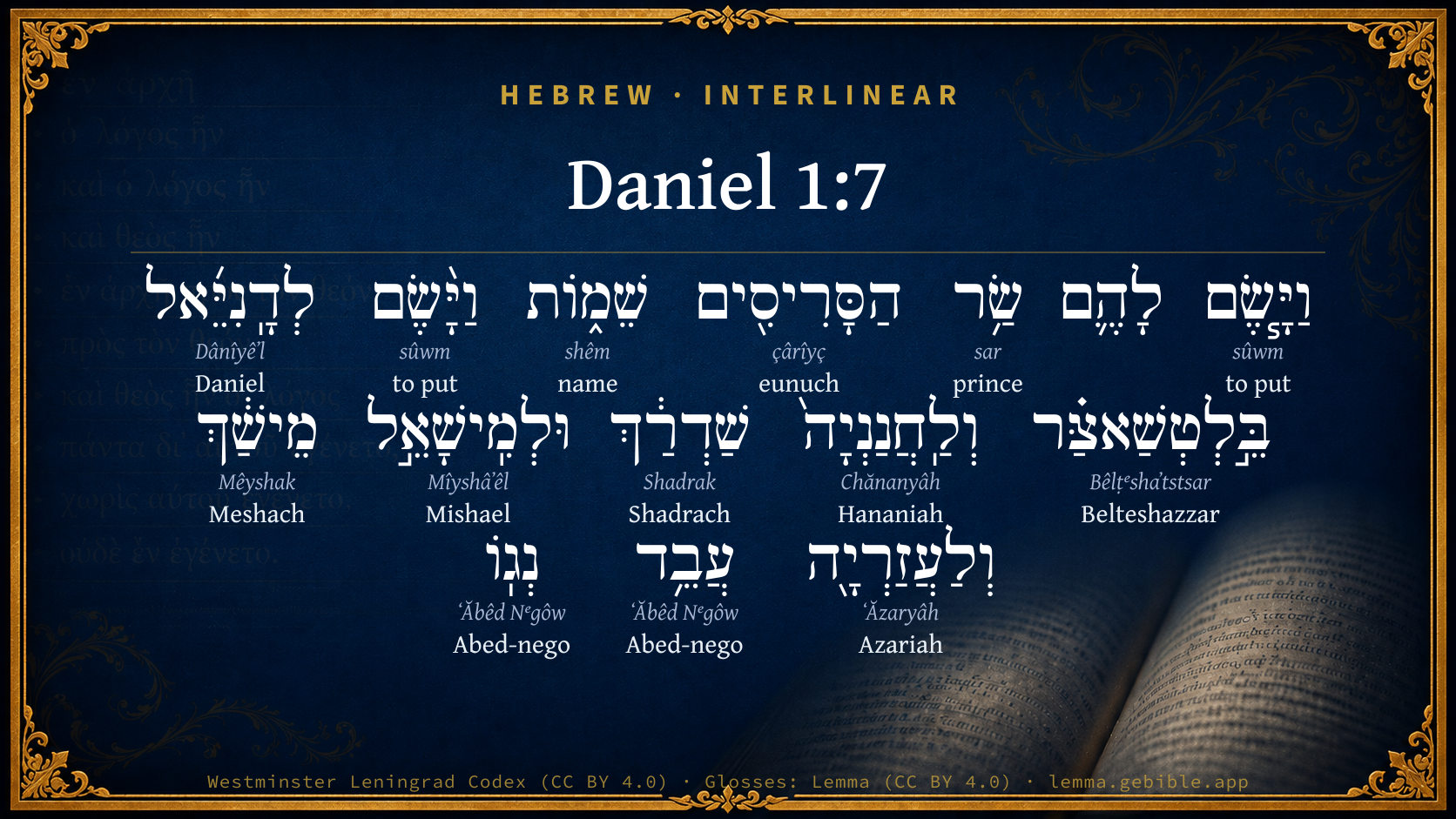
Hebrew (Westminster Leningrad Codex) Daniel 1:7 appears in the Hebrew Old Testament. The text above is from the Westminster Leningrad Codex. Each word links to its Strong’s number, a concise gloss, and parsing drawn from the Open Scriptures Hebrew Bible morphology. Click any word for its full Brown-Driver-Briggs (BDB) entry.
Download image
Cite this verse

Daniel 1:7 (World English Bible). Public Domain. Lemma interlinear Bible study tool, https://lemma.gebible.app/v/daniel/1/7.

Show BibTeX & RIS
BibTeX
RIS
English Translation
The prince of the eunuchs gave names to them: to Daniel he gave [the name of] Belteshazzar; and to Hananiah, [of] Shadrach; and to Mishael, [of] Meshach; and to Azariah, [of] Abednego.
World English Bible · Public Domain
Highlights
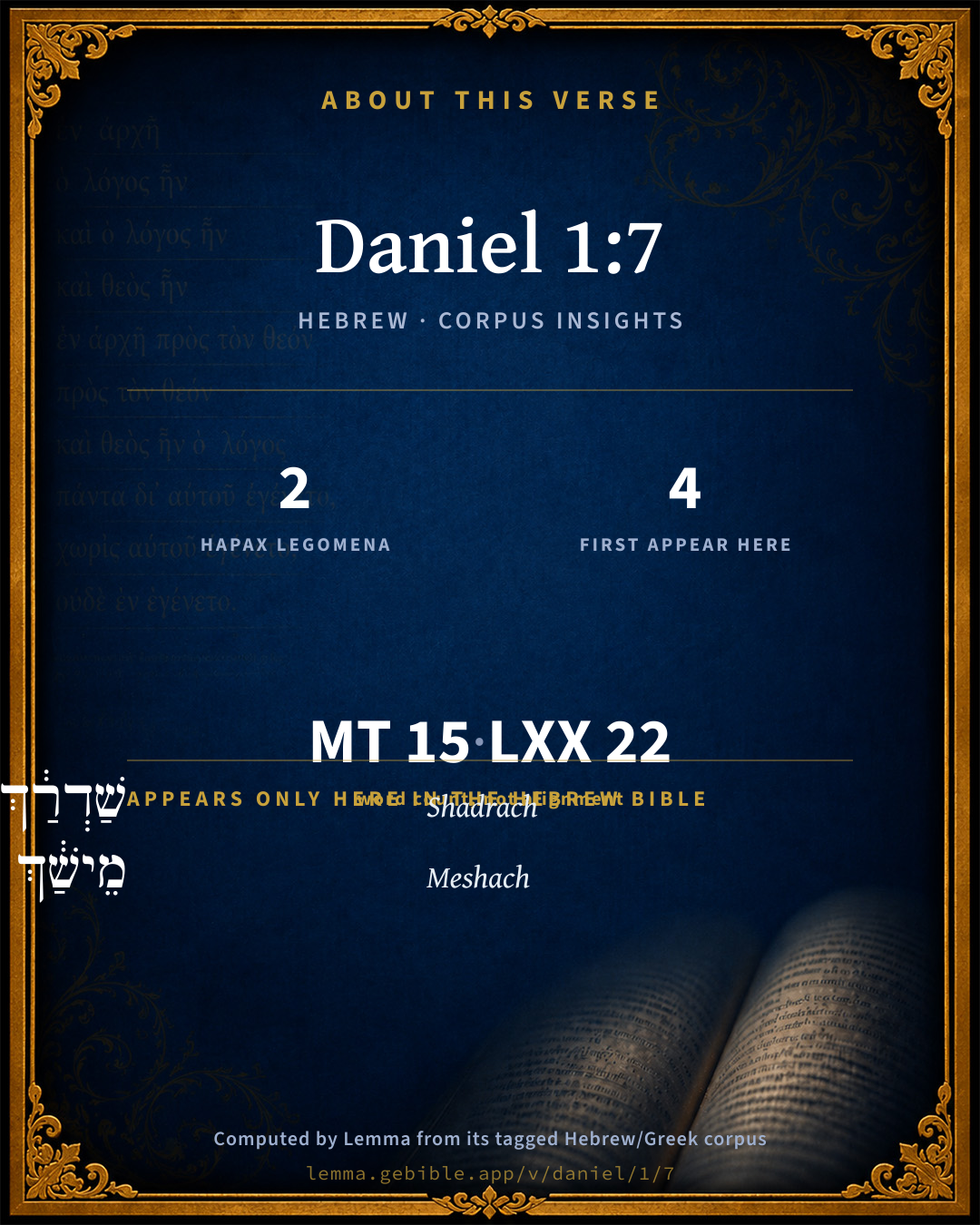
  • 2 hapax legomena — only here in the Hebrew Bible
  • 4 first appearances in the Hebrew Bible
Full analysis ↓
Download a study sheet

One document with this verse’s original text, its word-by-word gloss line, the meaning frame, cross-references with their text, attributed commentary, and full source and license credits — printable, and it pastes into notes with its structure intact.

This verse Autodidact and up

Study sheet (.html) Plain text (.txt)

A passage Seminary Student

Up to 50 verses in one chapter. A passage sheet keeps up to 6 commentary sources and 12 cross-references per verse, in the order this page ranks them, and says so on the sheet whenever that leaves anything out. Ask for a single verse and you get the Autodidact verse sheet above.

Everything on this page stays free to read, with no account — the sheet is a download of what is already on screen, not access to it.

Want to remove ads? Support Godless Engineer
Compare translations 3

The same verse in 3 English versions, stacked beneath the original-language interlinear above. Click any original word for its lexicon entry.

Each is an independent rendering of the whole verse — the interlinear is not word-aligned to these translations.

Highlighted words mark where these versions differ — a whole-verse word diff, not a word-by-word alignment.

  • World English Bible Public Domain
    The prince of the eunuchs gave names to them: to Daniel he gave [the name of] Belteshazzar; and to Hananiah, [of] Shadrach; and to Mishael, [of] Meshach; and to Azariah, [of] Abednego.
  • King James Version Public Domain
    Unto whom the prince of the eunuchs gave names: for he gave unto Daniel the name of Belteshazzar; and to Hananiah, of Shadrach; and to Mishael, of Meshach; and to Azariah, of Abednego.
  • unfoldingWord Literal Text CC BY-SA 4.0
    The chief of the officials gave them names: Daniel he called Belteshazzar, Hananiah he called Shadrach, Mishael he called Meshach, and Azariah he called Abednego.

unfoldingWord Literal Text — © unfoldingWord, licensed CC BY-SA 4.0. Word-aligned USFM3 via Door43 (git.door43.org/unfoldingWord/en_ult).

Versions to compare (up to 4)

3 of 4 selected

Show all 18 translations

Every available English version of this verse, each an independent rendering of the whole verse.

  • World English Bible Public Domain
    The prince of the eunuchs gave names to them: to Daniel he gave [the name of] Belteshazzar; and to Hananiah, [of] Shadrach; and to Mishael, [of] Meshach; and to Azariah, [of] Abednego.
  • Berean Standard Bible Public Domain
    The chief official gave them new names: To Daniel he gave the name Belteshazzar; to Hananiah, Shadrach; to Mishael, Meshach; and to Azariah, Abednego.
  • Majority Standard Bible Public Domain
    The chief official gave them new names: To Daniel he gave the name Belteshazzar; to Hananiah, Shadrach; to Mishael, Meshach; and to Azariah, Abednego.
  • King James Version Public Domain
    Unto whom the prince of the eunuchs gave names: for he gave unto Daniel the name of Belteshazzar; and to Hananiah, of Shadrach; and to Mishael, of Meshach; and to Azariah, of Abednego.
  • American Standard Version (1901) Public Domain
    And the prince of the eunuchs gave names unto them: unto Daniel he gave `the name of' Belteshazzar; and to Hananiah, `of' Shadrach; and to Mishael, `of' Meshach; and to Azariah, `of' Abed-nego.
  • Revised Version (1885) Public Domain
    And the prince of the eunuchs gave names unto them: unto Daniel he gave the name of Belteshazzar; and to Hananiah, of Shadrach; and to Mishael, of Meshach; and to Azariah, of Abed-nego.
  • Geneva Bible (1599) Public Domain
    Vnto whome the chiefe of the Eunuches gaue other names: for hee called Daniel, Belteshazzar, and Hananiah, Shadrach, and Mishael, Meshach, and Azariah, Abednego.
  • Douay-Rheims (1899) Public Domain
    And the master of the eunuchs gave them names: to Daniel, Baltassar: to Ananias, Sidrach: to Misael, Misach: and to Azarias, Abdenago.
  • Young's Literal Translation Public Domain
    and the chief of the eunuchs setteth names on them, and he setteth on Daniel, Belteshazzar; and on Hananiah, Shadrach; and on Mishael, Meshach; and on Azariah, Abed-Nego.
  • Literal Standard Version CC BY-SA 4.0
    and the chief of the eunuchs sets names on them, and he sets on Daniel, Belteshazzar; and on Hananiah, Shadrach; and on Mishael, Meshach; and on Azariah, Abed-Nego.
  • Unlocked Literal Bible CC BY-SA 4.0
    The chief official gave them names: Daniel he called Belteshazzar, Hananiah he called Shadrach, Mishael he called Meshach, and Azariah he called Abednego.
  • unfoldingWord Literal Text CC BY-SA 4.0
    The chief of the officials gave them names: Daniel he called Belteshazzar, Hananiah he called Shadrach, Mishael he called Meshach, and Azariah he called Abednego.
  • Darby Bible Public Domain
    And the prince of the eunuchs gave them names: to Daniel he gave [the name] Belteshazzar, and to Hananiah, Shadrach, and to Mishael, Meshach, and to Azariah, Abed-nego.
  • World Messianic Bible Public Domain
    The prince of the eunuchs gave names to them: to Daniel he gave the name Belteshazzar; to Hananiah, Shadrach; to Mishael, Meshach; and to Azariah, Abednego.
  • Webster's Bible Public Domain
    To whom the prince of the eunuchs gave names: for he gave to Daniel the name of Belteshazzar; and to Hananiah, of Shadrach; and to Mishael, of Meshach; and to Azariah, of Abed-nego.
  • Free Bible Version CC BY-SA 4.0
    The chief eunuch gave them new names: Daniel he called Belteshazzar, Hananiah he called Shadrach, Mishael he called Meshach, and Azariah he called Abednego.
  • Bible in Basic English Public Domain
    And the captain of the unsexed servants gave them names; to Daniel he gave the name of Belteshazzar, to Hananiah the name of Shadrach, to Mishael the name of Meshach, and to Azariah the name of Abed-nego.
  • JPS Tanakh (1917) Public Domain
    And the chief of the officers gave names unto them: unto Daniel he gave the name of Belteshazzar; and to Hananiah, of Shadrach; and to Mishael, of Meshach; and to Azariah, of Abed-nego.

Literal Standard Version (2020), Covenant Press — licensed CC BY-SA 4.0. Text via the HelloAO Bible API (eBible.org). Unlocked Literal Bible (unfoldingWord) — licensed CC BY-SA 4.0. Text via the HelloAO Bible API (eBible.org). unfoldingWord Literal Text — © unfoldingWord, licensed CC BY-SA 4.0. Word-aligned USFM3 via Door43 (git.door43.org/unfoldingWord/en_ult). Free Bible Version, Dr. Jonathan Gallagher — licensed CC BY-SA 4.0. Text via the HelloAO Bible API (eBible.org).

Word by word

More ways to search: Search by grammar → Find every occurrence → Compare this word →

Practice this passage: Drill this verse → Learn its vocabulary →

שַׁדְרַ֔ךְ
Shadrak
H7714
“Shadrach”
Noun, Proper
Part of Speech
Noun
Type
Proper
Full BDB Definition

Origin: probably of foreign origin

TWOT: None

Shadrach = "royal" or " the great scribe" - the godly friend of Daniel whom Nebuchadnezzar renamed Shadrach; one of the three friends who with Daniel refused to make themselves unclean by eating food from the king's table which went against the dietary laws which God had given the Jews; also one of the three who were thrown into the fiery furnace for refusing to bow down to a graven image of Nebuchadnezzar and who were saved by the angel of the Lord
  1. וַיָּ֧שֶׂם sûwm H7760 “and · to put” Conjunction + Verb, Qal, Sequential Imperfect, 3rd Person, Masculine, Singular
  2. שַׂ֥ר sar H8269 “prince of” Noun, Common, Masculine, Singular, Construct
  3. הַסָּרִיסִ֖ים çârîyç H5631 “the · eunuchs” Particle, Definite Article + Noun, Common, Masculine, Plural, Absolute
  4. שֵׁמ֑וֹת shêm H8034 “names” Noun, Common, Masculine, Plural, Absolute
  5. וַיָּ֨שֶׂם sûwm H7760 “and · to put” Conjunction + Verb, Qal, Sequential Imperfect, 3rd Person, Masculine, Singular
  6. לְדָֽנִיֵּ֜אל Dânîyêʼl H1840 “to/for · Daniel” Preposition + Noun, Proper
  7. בֵּ֣לְטְשַׁאצַּ֗ר Bêlṭᵉshaʼtstsar H1095 “Belteshazzar” Noun, Proper
  8. וְלַֽחֲנַנְיָה֙ Chănanyâh H2608 “and · to/for · Hananiah” Conjunction + Preposition + Noun, Proper
  9. וּלְמִֽישָׁאֵ֣ל Mîyshâʼêl H4332 “and · to/for · Mishael” Conjunction + Preposition + Noun, Proper
  10. מֵישַׁ֔ךְ Mêyshak H4335 “Meshach” Noun, Proper
  11. וְלַעֲזַרְיָ֖ה ʻĂzaryâh H5838 “and · to/for · Azariah” Conjunction + Preposition + Noun, Proper
  12. עֲבֵ֥ד ʻĂbêd Nᵉgôw H5664 “Abed-nego” Noun, Proper
  13. נְגֽוֹ ʻĂbêd Nᵉgôw H5664 “Abed-nego” Noun, Proper

About this verse

These counts appear in no published source. They are computed here, from the morphology-tagged text and Lemma’s own curated glosses. What Lemma adds →

15
words
12
distinct lemmas
Prophets
section

Notable vocabulary

2 hapax legomena — words that appear only here in the entire Hebrew Bible:

  • שַׁדְרַ֔ךְ Shadrach H7714
  • מֵישַׁ֔ךְ Meshach H4335

First appearance in Scripture

These words make their first canonical appearance in the Hebrew Bible here:

  • בֵּ֣לְטְשַׁאצַּ֗ר Belteshazzar H1095
  • שַׁדְרַ֔ךְ Shadrach H7714
  • מֵישַׁ֔ךְ Meshach H4335
  • עֲבֵ֥ד Abed-nego H5664

Shared distinctive vocabulary

בֵּ֣לְטְשַׁאצַּ֗ר Belteshazzar H1095 occurs in 2 verses of the Hebrew Bible. Also found in:

Grammatical profile

  • 2 verbs
  • 12 nouns
  • 1 preposition

Verb forms

  • וַיָּ֧שֶׂם Qal · Sequential Imperfect
  • וַיָּ֨שֶׂם Qal · Sequential Imperfect

Repetition

Words recur within this verse — often emphatic in Hebrew:

  • וַיָּ֧שֶׂם to put H7760 ×2
  • עֲבֵ֥ד Abed-nego H5664 ×2

Hebrew & Septuagint length

In English translation the verse runs 32 words from the Hebrew and 24 from the Septuagint (LXX English) — closely comparable.

A rough comparison of the two English renderings, which tokenize alike — not a word-level alignment.

Word counts can differ between the Hebrew and the Greek without any difference in meaning — e.g. the Hebrew direct-object marker אֵת has no separate Greek word, and Greek often adds the article ὁ.

In the original languages it is 15 Hebrew tokens and 22 Greek tokens — but the two are counted differently (Hebrew bundles its prefixes and suffixes into one token; the Greek is in lemma form), so that isn’t a like-for-like length.

Cross-references

10

Topical passages linked to Daniel 1:7 in the Treasury of Scripture Knowledge — connected by theme and wording, ordered by reader-vote popularity; previews shown in the World English Bible.

  • Daniel 5:12 because an excellent spirit, and knowledge, and understanding, interpreting of dreams, and showing of dark sentences, and dissolving of doubts, were found in the same Daniel, whom the king named Belteshazzar. Now let Daniel be called, and he will show the interpretation.
  • Daniel 4:8 But at the last Daniel came in before me, whose name was Belteshazzar, according to the name of my god, and in whom is the spirit of the holy gods: and I told the dream before him, [saying],
  • Daniel 2:49 Daniel requested of the king, and he appointed Shadrach, Meshach, and Abednego, over the affairs of the province of Babylon: but Daniel was in the gate of the king.
  • 2 Kings 23:34 Pharaoh Necoh made Eliakim the son of Josiah king in the room of Josiah his father, and changed his name to Jehoiakim: but he took Jehoahaz away; and he came to Egypt, and died there.
  • 2 Kings 24:17 The king of Babylon made Mattaniah, [Jehoiachin's] father's brother, king is his place, and changed his name to Zedekiah.
  • Daniel 1:3 The king spoke to Ashpenaz the master of his eunuchs, that he should bring in [certain] of the children of Israel, even of the seed royal and of the nobles;
  • Genesis 41:45 Pharaoh called Joseph's name Zaphenath-paneah; and he gave him Asenath, the daughter of Potiphera priest of On as a wife. Joseph went out over the land of Egypt.
  • Daniel 1:10–11 The prince of the eunuchs said to Daniel, I fear my lord the king, who has appointed your food and your drink: for why should he see your faces worse looking than the youths who are of your own age? so would you endanger my head with the king.
  • Daniel 2:26 The king answered Daniel, whose name was Belteshazzar, Are you able to make known to me the dream which I have seen, and the interpretation of it?
  • Daniel 3:12–30 There are certain Jews whom you have appointed over the affairs of the province of Babylon: Shadrach, Meshach, and Abednego; these men, O king, have not regarded you: they don't serve your gods, nor worship the golden image which you have set up.

Cross-references courtesy of OpenBible.info (CC BY 4.0).

Hebrew and Greek witnesses Masoretic Hebrew ↔ Greek Septuagint

The same verse in the two great witnesses to the Old Testament, shown verse-for-verse.

These are two independent witnesses, not word-aligned to each other, and the Septuagint is shown in lemma (dictionary) form.

Hebrew Daniel 1:7 Masoretic · Westminster Leningrad Codex

וַיָּ֧שֶׂם לָהֶ֛ם שַׂ֥ר הַסָּרִיסִ֖ים שֵׁמ֑וֹת וַיָּ֨שֶׂם לְדָֽנִיֵּ֜אל בֵּ֣לְטְשַׁאצַּ֗ר וְלַֽחֲנַנְיָה֙ שַׁדְרַ֔ךְ וּלְמִֽישָׁאֵ֣ל מֵישַׁ֔ךְ וְלַעֲזַרְיָ֖ה עֲבֵ֥ד נְגֽוֹ

The prince of the eunuchs gave names to them: to Daniel he gave [the name of] Belteshazzar; and to Hananiah, [of] Shadrach; and to Mishael, [of] Meshach; and to Azariah, [of] Abednego.

World English Bible · Public Domain

Greek LXX Daniel 1:7 Septuagint · lemma form

καί ἐπιτίθημι αὐτός ὁ ἀρχιευνοῦχος ὄνομα ὁ μέν δανιηλ βαλτασαρ ὁ δέ ανανιας σεδραχ καί ὁ μισαηλ μισαχ καί ὁ αζαριας αβδεναγω

And the chief of the eunuchs gave them names: to Daniel, Baltasar; and to Ananias, Sedrach; and to Misael, Misach; and to Azarias, Abdenago.

LXX2012 (modern English Septuagint) · Public Domain

On this verse, The Pulpit Commentary discusses the Septuagint’s reading. Read the note in Commentary ↓

Hebrew: Westminster Leningrad Codex (CC BY 4.0). Greek: Septuagint (public domain); English from LXX2012 (modern English Septuagint) (Public Domain). How the Septuagint differs from the Hebrew →

Commentary

Notes on Daniel 1:7 from classic Christian and Jewish commentators (each source and its license shown beneath its notes). The classic Christian expositions comment on the surrounding passage and are grouped to its opening verse, so a note may address several verses; the Jewish commentaries on the Tanakh (Rashi and others) are per-verse, so they appear only where the commentator wrote on this verse.

Lemma curates 59 commentaries, every one of them public domain or Creative Commons licensed, each selected and text-cleaned for this edition rather than reprinted as found. About our sources →

Trapp's Complete Commentary

John Trapp

Dan 1:7 Unto whom the prince of the eunuchs gave names: for he gave unto Daniel [the name] of Belteshazzar; and to Hananiah, of Shadrach; and to Mishael, of Meshach; and to Azariah, of Abednego.

Ver. 7. Unto whom the prince of the eunuchs gave names.] Not without the command of the king, {Dan 5:12} as desirous to naturalise them, and by changing their right names, which had the names of God in them, El and Jah, to make them forget their religion; but that was better rooted than to be so easily razed out, though these new names were shrewd temptations to apostasy and idolatry, as being compounded by the names of the Babylonish gods, and means to make them honourable among the Chaldeans.

John Trapp, A Commentary or Exposition upon All the Books of the Old and New Testament (1647–1656) — public domain. Text from a community e-Sword module.

Ibn Ezra

Rabbi Abraham ibn Ezra

[Daniel 1:7] Vayasem (וַיָּשֶׂם - And [the chief officer] set/gave): Just as Pharaoh gave Joseph the name Zaphenath-paneah [Genesis 41:45]. And Rav Saadia [Gaon] said: that Bel [in Belteshazzar] is a Chaldean name/word, and likewise -Tzar [as in Belteshazzar, Nebuchadnezzar]. And similarly [names like] Nebuchadnezzar, Belshazzar, Sheshbazzar [contain these elements]. And the name Bel is explicitly [linked by Nebuchadnezzar himself when he says about Daniel/Belteshazzar] “according to the name of my god” [Daniel 4:5]. And [Saadia also states that] Shadrach [and] Meshach are Chaldean language [names]. And the Gaon [Saadia] said that Nego [in Abed-nego] is like Nebo [the name of a Babylonian deity], but [this is asserted] without proof.

Ibn Ezra on the Tanakh — English translations: “Sefaria Community Translation” (CC0 1.0 (public-domain dedication)); “Yalkut, Sifsei Chachomim Chumash, Metsudah Publications, 2009” (CC BY 4.0); and “Commentary of Ibn Ezra on Isaiah - trans. by M. Friedlander, 1873” (public domain). Text via Sefaria.

Geneva Bible (1599)

Geneva Bible translators

That they might altogether forget their religion: for the Jews gave their children names, which might ever put them in remembrance of some point of religion: therefore this was a great tentation and a sign of servitude, which they were not able to resist.

Geneva Bible (1599) marginal notes — public domain. Text via Bolls.life.

Jamieson, Fausset & Brown

Robert Jamieson, A. R. Fausset & David Brown

gave names--designed to mark their new relation, that so they might forget their former religion and country (Gen 41:45). But as in Joseph's case (whom Pharaoh called Zaphnath-paaneah), so in Daniel's, the name indicative of his relation to a heathen court ("Belteshazzar," that is, "Bel's prince"), however flattering to him, is not the one retained by Scripture, but the name marking his relation to God ("Daniel," God my Judge, the theme of his prophecies being God's judgment on the heathen world powers).

Hananiah--that is, "whom Jehovah hath favored."

Shadrach--from Rak, in Babylonian, "the King," that is, "the Sun"; the same root as in Abrech (Gen 41:43, Margin), inspired or illumined by the Sun-god."

Mishael--that is, "who is what God is?" Who is comparable to God?

Meshach--The Babylonians retained the first syllable of Mishael, the Hebrew name; but for El, that is, GOD, substituted Shak, the Babylonian goddess, called Sheshach (Jer 25:26; Jer 51:41), answering to the Earth, or else Venus, the goddess of love and mirth; it was during her feast that Cyrus took Babylon.

Azariah--that is, "whom Jehovah helps."

Abed-nego--that is, "servant of the shining fire." Thus, instead of to Jehovah, these His servants were dedicated by the heathen to their four leading gods [HERODOTUS, Clio]; Bel, the Chief-god, the Sun-god, Earth-god, and Fire-god. To the last the three youths were consigned when refusing to worship the golden image (Dan 3:12). The Chaldee version translates "Lucifer," in Isa 14:12, Nogea, the same as Nego. The names thus at the outset are significant of the seeming triumph, but sure downfall, of the heathen powers before Jehovah and His people.

Jamieson, Fausset & Brown — Commentary Critical and Explanatory on the Whole Bible (1871) — public domain (CC PDM 1.0). Text via the HelloAO Bible API.

Adam Clarke's Commentary

Verse 7. Unto whom the prince of the eunuchs gave names] This change of names, Calmet properly remarks, was a mark of dominion and authority. It was customary for masters to impose new names upon their slaves; and rulers often, on their ascending the throne, assumed a name different from that which they had before.

דניאל DANIEL signifies "God is my Judge." This name they changed into בלטשאצר BELTESHATSTSAR; in Chaldee, "The treasure of Bel," or "The despository of the secrets (or treasure) of Bel."

הנניה HANANIAH signifies, "The Lord has been gracious to me," or "He to whom the Lord is gracious." This name was changed into שדרך SHADRACH, Chaldee, which has been variously translated: "The inspiration of the sun;" "God the author of evil, be propitious to us;" "Let God preserve us from evil."

מישאל MISHAEL signifies "He who comes from God." Him they called מישך MESHACH, which in Chaldee signifies, "He who belongs to the goddess Sheshach," a celebrated deity of the Babylonians, mentioned by Jeremiah, Jer 25:26.

עזריה AZARIAH, which signifies "The Lord is my Helper," they changed into אבד נגו ABED-NEGO, which in Chaldee is "the servant of Nego," who was one of their divinities; by which they meant either the sun, or the morning star; whether Jupiter or Venus.

The vicious pronunciation of this name should be carefully avoided; I mean that which lays the accent on the first syllable, and hurries to the end, without attending to the natural division of the word Abed-Nego.

Adam Clarke's Commentary on the Bible (1810–1826) — public domain. Text from a community e-Sword/MySword module.

The Cambridge Bible for Schools and Colleges

gen. ed. J. J. S. Perowne

7. And the prince of the eunuchs gave names unto them: unto Daniel he gave, &c.] as R.V. ‘Prince’ (Heb. sar, i.e. here, governor, superintendent, 1Ki_9:22 [‘rulers’], 1Ki_22:26) is a synonym of the rab of Dan_1:3 (cf. Gen_37:36 with Jer_39:9). The practice of giving a person a new name, when admitted into the public service of a foreign country, is well attested in the case of Egypt (see not only Gen_41:45, but also Erman, Life in Ancient Egypt, p. 517 f.), and was probably usual elsewhere. There is an example, though it is not quite parallel, quoted from the reign of the Assyrian king, Esarhaddon, when Neco’s son was made viceroy of Athribis under the Assyrian name of Nabu-uǎêzib-anni (‘Nebo saves me’). In the present instance the change has the effect in each case of obliterating the name of God: Daniel, ‘God is my judge’; Ḥananiah, ‘Yah is gracious’; Mishael, ‘Who is what God is?’; Azariah, ‘Yah hath holpen.’

Belteshazzar] i.e. balâṭsu-uṣur, ‘protect his life!’; probably elliptical for Bêl-balâṭsu-uṣur, ‘Bel, protect his life!’ The name (which recurs Dan_2:26, Dan_4:8-9; Dan_4:18-19, Dan_5:12) is quite distinct from Belshazzar (see on Dan_5:1).

Shadrach] Of uncertain meaning, but explained plausibly by Friedr. Delitzsch as Shudur-Aku, ‘the command of Aku’ (Aku being the Sumerian equivalent of Sin, the Semitic name of the Moon-god); cf. the proper name Kibît-Ishtar, ‘the word, or command, of Ishtar.’

Meshach] Explained by Delitzsch, somewhat less satisfactorily, as a hybrid word, partly Hebrew and partly Babylonian, properly Mîsha-Aku, ‘Who is what Aku is?’, cf. Mishael above, and the Babylonian names Mannu-ki-Rammân, ‘Who is like Rammân (Rimmon)?’, and Mannu-ki-ilu, ‘Who is like God?’

Abed-nego] generally recognized as a corruption of ‘Abed-nebo, ‘servant of Nebo’ (Isa_46:1). Proper names, compounded with ‘Abd (or ‘Ebed), ‘servant,’ are common in most Semitic languages; and, though it is not the usual word for servant in Babylonian, Babylonian names compounded with it occur. Indeed, the name Abed-nebo itself has been found in a bilingual (Assyr. and Aram.) inscription (Schrader, KAT[183][184] ad loc.); it is also, as Prof. Bevan remarks, met with as that of a heathen Syrian long after the Christian era (Cureton’s Ancient Syriac Documents, p. 14).

[183] AT. Eb. Schrader, Die Keilinschriften und das A. T., ed. 2, 1883 (translated under the title The Cuneiform Inscriptions and the O.T. 1885, 1888). The references are to the pagination of the original, which is given on the margin of the English translation.

[184] Eb. Schrader, Die Keilinschriften und das A. T., ed. 2, 1883 (translated under the title The Cuneiform Inscriptions and the O.T. 1885, 1888). The references are to the pagination of the original, which is given on the margin of the English translation.

The Cambridge Bible for Schools and Colleges (gen. ed. J. J. S. Perowne; Cambridge University Press, 1878–1918) — public domain. Text from a community e-Sword module.

John Gill's Exposition

Unto whom the prince of the eunuchs gave names,.... Other names, Chaldee names, according to the names of the gods of that country, for honour and glory, as Saadiah observes; which was done either to make them more acceptable to the court and courtiers of the king of Babylon; and to show that they were his servants, and naturalized subjects; and chiefly to cause them to forget the names their fathers gave them, and out of hatred to them, having all of them in them the names of the true God, El or Jah; and, most of all, that they might forget the God of their fathers, whose names they bore. This prince of the eunuchs seems to be the same with the master of the eunuchs, Ashpenaz, before mentioned, so Jacchiades; but some take him to be another person: what he did in changing the names of these four Hebrew youths was not his own idea and by his own authority, but by the order of the king; Dan 5:12,

for he gave unto Daniel the name of Belteshazzar; which signifies "Bel hath hid and treasured"; or Bel's treasurer, or the keeper of his treasures; see Dan 1:2. Bel was the chief idol of the Chaldeans, Isa 46:1, and Daniel was named according to him, as Nebuchadnezzar himself says, Dan 4:8 and differs but in one letter from the name of a successor of his, Belshazzar, Dan 5:1, hence Daniel is thought by Broughton, and others, to be the Belesis of Diolorus Siculus: or it may be he had this name given him from "beltis" or "baaltis" (u), a queen and goddess of the Babylonians, and may be compounded of that and "azer":

and to Hananiah of Shadrach; which some interpret a "tender pap", or "breast": others, the "king's messenger", or "the messenger the sun". The word "rach" signifies a "king" with the Chaldeans, as it did with the Egyptians, as may be observed in the word "abrec", the king's father, in Gen 41:43 and is used by them of the sun, the prince of planets, whom they worshipped: others, "the inspiration of the sun", their idol. Hillerus (w) explains it of fire, the object of their adoration:

and to Mishael of Meshach; or; "of Shach", which was a name of a god or goddess of the Chaldeans, they worshipped; at the celebration of whose feast they were when Babylon was taken by Cyrus:

and to Azariah of Abednego; or "a servant, or worshipper of Nego". The word signifies "shining brightness": which some understand of fire worshipped by them; others of the bright planet Venus; and others of Lucifer, or the morning star. Saadiah takes it to be the same with Nebo, by a change of a letter, which was a god of the Chaldeans; see Isa 46:1.

(u) Vid Euseb. Praepar. Evangel. l. 1. p 38. &. l. 9. c. 41. p. 456. (w) Onomast. Sacr. p. 924.

John Gill's Exposition of the Whole Bible (1746–1763) — public domain (CC PDM 1.0). Text via the HelloAO Bible API.

Albert Barnes' Notes on the Bible

Unto whom the prince of the eunuchs gave names - This practice is common in Oriental courts. “The captive youths referred to in the notes on Dan 1:5, in the Turkish court also receive new names, that is, Mahometan names, their former names being Christian.” - “Pict. Bible.” It is “possible” that this changing of their names may have been designed to make them forget their country, and their religion, and to lead them more entirely to identify themselves with the people in whose service they were now to be employed, though nothing of this is intimated in the history. Such a change, it is easy to conceive, might do much to make them feel that they were identified with the people among whom they were adopted, and to make them forget the customs and opinions of their own country. It is a circumstance which may give some additional probability to this supposition, that it is quite a common thing now at missionary stations to give new names to the children who are taken into the boarding-schools, and especially the names of the Christian benefactors at whose expense they are supported. Compare the same general character, for this change of names may have been, that the name of the true God constituted a part of their own names, and that thus they were constantly reminded of him and his worship. In the new names given them, the appellation of some of the idols worshipped in Babylon was incorporated, and this might serve as remembrancers of the divinities to whose service it was doubtless the intention to win them.

For he gave unto Daniel the name of Belteshazzar - The name Belteshazzar (בלטשׁאצר bêlṭesha'tstsar) is compounded of two words, and means according to Gesenius, “Bel’s prince;” that is, he whom Bel favors. “Bel” was the principal divinity worshipped at Babylon (notes, Isa 46:1), and this name would, therefore, be likely to impress the youthful Daniel with the idea that he was a favorite of this divinity, and to attract him to his service. It was a flattering distinction that he was one of the favorites of the principal god worshipped in Babylon, and this was not improbably designed to turn his attention from the God whose name had been incorporated in his own. The giving of this name seemed to imply, in the apprehension of Nebuchadnezzar, that the spirit of the gods was in him on whom it was conferred. See Dan 4:8-9.

And to Hananiah, of Shadrach - The name “Hananiah” (חנניה chănanyâh) means, “whom Jehovah has graciously given,” and is the same with Ananias (Greek, Ανανίας Ananias), and would serve to remind its possessor of the name of “Jehovah,” and of his mercy. The name Shadrach (שׁדרך shadrak), according to Lorsbach, means “young friend of the king;” according to Bohlen, it means “rejoicing in the way,” and this last signification is the one which Gesenius prefers. In either signification it would contribute to a forgetfulness of the interesting significancy of the former name, and tend to obliterate the remembrance of the early training in the service of Jehovah.

And to Mishael, of Meshach - The name “Mishael” (מישׁאל mı̂yshâ'êl) means, “who is what God is?” - from מי mı̂y “who,” שׁ sha “what,” and אל ēl “God.” It would thus be a remembrancer of the greatness of God; of his supremacy over all his creatures, and of his “incomparable” exaltation over the universe. The signification of the name “Meshach” (מישׁך mêyshak) is less known. The Persian word ovicula means a little sheep (Gesenius), but why this name was given we are not informed. Might it have been on account of his beauty, his gentleness, his lamb-like disposition? If so, nothing perhaps would be better fitted to turn away the thoughts from the great God and his service to himself.

And to Azariah, of Abednego - The name “Azaziah” (עזריה ‛ăzaryâh) means, “whom Jehovah helps,” from עזר ‛âzar “to help,” and יה yâh, the same as “Jah” (a shortened form of Jehovah, יהוה yehovâh), This name, therefore, had a striking significancy, and would be a constant remembrancer of the true God, and of the value of his favor and protection. The name Abed-nego (עבד נגו ‛ăbêd negô) means, “a servant of Nego,” or perhaps of “Nebo” - נבו nebô. This word “Nebo,” among the Chaldeans, probably denoted the planet Mercury. This planet was worshipped by them, and by the Arabs, as the celestial scribe or writer. See the notes at Isa 46:1. The Divine worship paid to this planet by the Chaldeans is attested, says Gesenius, by the many compound proper names of which this name forms a part; as Nebuchadnezzar, Nebushasban, and others mentioned in classic writers; as Nabonedus, Nabonassar, Nabonabus, etc. This change of name, therefore, was designed to denote a consecration to the service of this idol-god, and the change was eminently adapted to make him to whom it was given forget the true God, to whom, in earlier days, he had been devoted. It was only extraordinary grace which could have kept these youths in the paths of their early training, and in the faithful service of that God to whom they had been early consecrated, amidst the temptations by which they were now surrounded in a foreign land, and the influences which were employed to alienate them from the God of their fathers.

Albert Barnes' Notes on the Bible (1834–1885) — public domain. Text from a community e-Sword/MySword module.

Haydock's Catholic Bible Commentary

Baltassar, or as Chaldees ((Calmet) or Masorets. (Haydock)) pronounce, Beltesasar, "the treasurer of Baal." The names were changed to testify their subjection, (Calmet) and that they might embrace the manners of the Chaldees. (Menochius) --- The new names alluded to the sun. (Calmet)

George Leo Haydock (1774–1849), Haydock's Catholic Family Bible and Commentary, 1859 edition — public domain. Excludes Psalms (Douay-Rheims chapter numbering differs from Protestant) and Deuterocanonical books (Catholic canon only).

Matthew Poole's English Annotations

Names; that is, other names: this was done by the subtle instigation of Satan, that they might renounce their names received in circumcision, by assuming names imposed relating to the idol gods, being a profanation and a further degree of their apostacy; for Daniel had

the name of Belteshazzar, or Baltasar, from the great Babylonian idol Baal or Bel, &c. This was by the king’s command, and herein he put forth an act of his sovereignty. Thus Adam, Gen 2:19,20. Thus Pharaoh did, Gen 41:45; he gave

Joseph the name of Zaphnath-paaneah. And Pharaohnechoh changed the name of

Eliakim, Josiah’s son, to Jehoiakim, 2Ki 23:34. And the king of Babylon turned the name of

Mattaniah to Zedekiah, 2Ki 24:17. The Lord changed the name of

Sarai to Sarah, of

Abram to Abraham, of

Jacob to Israel. Thus the Lord changed

Simon’s name to Cephas or Peter, Mar 3:16.

Matthew Poole's English Annotations on the Holy Bible (1683–1685) — public domain. Text from a community e-Sword/MySword module.

The Pulpit Commentary

Unto whom the prince of the eunuchs gave names; for he gave unto Daniel the name of Belteshazzar; and to Hananiah, of Shadrach; and to Mishael, of Meshach; and to Azariah, of Abednego. The only thing to be noted in regard to the versions is that, with the exception of the Peshitta, all of them identify the name of Daniel with that of the last King of Babylon. Both are called Baltasar or Baltassar in the Vulgate, the LXX, and Theodotion. The difference made in the Peshitta is not the same as that in the Hebrew; the prophet is called Beletshazzar, and the king Belit-shazzar. This would indicate something wrong. The Greek versions render Abed-nego jAbdenagw, which also the Vulgate has. This habit of changing the names of those who entered their service prevailed among Eastern potentates. Joseph became Zaph-nath-paaneah. (Gen_41:45) Not only did those about the court receive new names, but, not infrequently, subject monarchs, as token of subjection, were newly named, as Jehoiakim, who had formerly been Eliakim. Professor Fuller mentions the case of the Egyptian monarch Psammetik II, whose name as subject of Asshur-bani-pal was Nabo-sezib-ani. Not only so, but monarchs of their own will changed their names with changed circumstances; thus Pal in Babylon is Tiglath-pileser in Nineveh. Still in modern times this is continued in the head of Roman Catholic Christendom, who has for the last twelve centuries always assumed another than his original name on ascending the papalthrone. With members of a monarch"s court this is easily intelligible. The desire was to have names of good omen; a foreign name might either be meaningless or suggest anything but thoughts full of good omen. In considering these names, there are certain preliminary facts we must bear in mind. In the first place, there is a great probability that all the names had a Divine element in them, that is, contained as an element the name of a Babylonian god. The great mass of the names of Baby-Ionian and Assyrian officials had this. Next, it is by no means improbable that, at the hands of the Jewish scribes, the names have sustained some considerable change, more especially as regards the Divine element. The Jewish scribe had few scruples as to altering a name when there was anything in it to hurt his sensibilities. It is horrible to him that Jonathan, the son of Gershom, the son of Moses the great lawgiver, should be the originator of the false temple at Dan, and so he inserts a nun, and changes Moshe, "Moses," into "Manasseh." The scribe that copied out 2 Samuel, coming to the name of Jerubbaal, cannot endure to chronicle the fact that a judge in Israel ever bore the name of the abomination of the Zidonians as part of his name, and altered it to Jerubesheth. So we have in the same book Ishbosheth for Ethbaal, and Mephibosheth for Meribbaal. With a foreign potentate it is different; but in the case of a Jew there always was a tendency to blink such an awkward fact as bearing a name with heathen elements, by a slight change. The name given to Daniel is, in the Massoretic text, Belteshazzar. From the fact that in the Septuagint, Theodotion, and the Vulgate, we have the king Belshazzar and Daniel, as Babylonian magician, called by the same name," Baltasar," and when in the Peshitta, the difference is very slight, and not always maintained, we, for our part, are strongly inclined to believe both names to have been the same. Professor Bevan ("The Book of Daniel," 40) is quite sure that the author did not understand the meaning of the name given to Daniel. He (Professor Bevan) derives the name from Balat-zu-utzur, "Protect thou his life." Professor Fuller, with as great plausibility, makes it Bilat-sarra-utzur, "Beltis protects the crown." If that be the true derivation, then Nebuchadnezzar could quite correctly say that he was called after the name of his god. Still more accurate would this statement be if the name were Belshazzar. But an uneasy suspicion crosses our mind.

Does the author of Daniel ever attribute to Nebuchadnezzar the words on which Professor Bevan grounds his charge? The words are not in the Septuagint. Thus Professor Bevan never admitting the possibility of the name Belteshazzar having been modified from something else, although the evidence of the versions points most distinctly to that, and although he candidly admits it to have taken place in regard to Abed-nego assumes an etymology for it, as if it were the only possible one, which it is not; and on the ground of this etymology, and on the assumption that certain words were in the original text of Daniel, which are yet not in the Septuagint, he concludes that the author of Daniel did not know the meaning of the name he had given to his hero. Surely this is special pleading. If there has been any tampering with the name or modification of it, then Professor Bevan"s assumption falls to the ground, and his argument with it; but there seems every probability that there has been such modification, and the effect of such modification would be to deface the name of the heathen divinity in the name if there were such. Further, if Professor Fuller"s etymology may be maintained, again Professor Bevan"s assumption falls to the ground. These two arguments do not conflict. A Jewish scribe, ignorant of ancient Assyrian, might easily introduce a modification which, despite his intention, did not remove all heathen divinity from the name, only changed the divinity. If the original text of Daniel did not contain the phrase in the fourth chapter, "according to the name of my god," then again Professor Bevan"s assumption is proved groundless, and his argument without value. The phrase in question is not in the Septuagint, and therefore it is, to say the least, suspicious. It has no such intimate connection with the context as to show it part of the text; it is just such a phrase as would be put on the margin as a gloss, and get into the text by blunder of a copyist. It may be observed that Professor Bevan merely follows Schrader, alike in his derivation and deduction; but he, not Schrader, had before him continually the Septuagint version of Daniel, and he, not Schrader, is commentator on Daniel. And to Hananiah of Shadrach. This name is explained by Dr. Delitzsch as being a modified transliteration of Shudur-aku, "the command of Aku" (the moon-deity). With this Schrader agrees. There is always the possibility of the name having undergone a change. On the other hand, as the name of the deity, Aku, does not appear in Scripture, the Puritanic scribe might be unaware of its presence here. And to Mishael of Meshach. This name has caused great difficulty; it is consonantally identical with "Hesheeh," the name of one of the sons of Japhet. Dr. Delitzsch would render it Me-sa-aku, "Who is as Aku." Schrader"s objections to this are, that in the first place the Babylonian form would be Mamm-ki-Aku. And next, that there would not likely be a simple translation of the Hebrew name into Assyrian, but rather the giving a new name altogether. This second objection is valueless, for Pharaoh-Necho did not wholly change the name of Eliakim when he set him on the throne; since Jehovah may be regarded as the equivalent of El. The fact that "Meshach" is so like "Mcshech" points to intentional modification, and, therefore, to the presence in the name of the designation of a Babylonian god likely to be known to the Jews, such as Merodach, whose name was known to the Jews by its occurrence in the names Evil-Merodach and Merodach-Baladan, and actually as a divinity in Jer_50:2. Such is Lenormant"s hypothesis ("La Divination," p. 178) which would render it Misa-Mero-dash, "Who is as Merodach a suggestion certainly open to Schrader"s first objection. And to Azariah of Abed-nego. It has long been recognized that this name is a modification of Abed-Nebo. This identification is rendered all the more probable, that in New Hebrew and Aramaic Naga meant the planet "Venus," that is, "Nebo" The consonants are correct for this, but the vocalization is purposely wrong, in order to avoid the heathen name. If the author of Daniel was an obscure Jew, living in Palestine during the days of Epiphanes, whoa the influence of Babylon had disappeared, and its language had ceased to be studied, is it not strange that he should devise names which so accurately represent those that were in Babylon? One has only to read the Book of Judith, in all likelihood the product of the Epiphanes period (Konig, "Einlcitung," 480), to see the wild work that Palestinian Jews of that time made of Babylonian names.

The Pulpit Commentary (1880–1919), ed. H.D.M. Spence-Jones & Joseph S. Exell — public domain. Text from a community e-Sword module.

John Wesley's Explanatory Notes

Gave names - That is, other names, relating to the idol-gods. Belteshazzar - So Daniel had the name of Belteshazzar, from the great Babylonian idol Baal or Bell. This was by the king's command, and herein he put forth an act: of his sovereignty.

John Wesley, Explanatory Notes Upon the Whole Bible (1754–1765) — public domain. Text via the GEBible commentary corpus.

Scofield Reference Notes

C. I. Scofield

Belteshazzar

i.e. the king’s leader, or attendant. Dan 2:26; Dan 4:8; Dan 4:9; Dan 4:18; Dan 4:19; Dan 5:12. Identical in meaning with Belshazzar.

The Scofield Reference Bible (1917 edition), notes by C. I. Scofield — public domain. Text from a community e-Sword module.

Rashi

Rabbi Shlomo Yitzchaki (Rashi)

Belteshazzar He named him after the god of Babylon, which was called Bel, as it is said (4: 5): “whose name is Belteshazzar, like the name of my god.” Teshazzar is the Aramaic expression denoting wisdom.

Rashi on the Tanakh — English translations: “The Judaica Press complete Tanach with Rashi, translated by A. J. Rosenberg” (CC BY 4.0); “Pentateuch with Rashi's commentary by M. Rosenbaum and A.M. Silbermann, 1929-1934” (public domain); “The Metsudah Tanach series, Lakewood, N.J” (CC BY 4.0); and “The Book of Joshua, Metsudah Publications, 1997” (CC BY 4.0). Text via Sefaria.

Lesson kit

Teaching starters — assembled from the data on this page, not authored interpretation. Every prompt links to the verse data it draws on. Edit before teaching.

Daniel, in the Prophets, opens this verse with 15 words (12 distinct Hebrew lemmas). Its most distinctive word is Shadrak (“Shadrach”). A historical commentator’s framing appears above. Read the whole chapter for the surrounding context.

Discussion questions

  1. How does “Shadrach” (Shadrak) shape what this verse is saying?
  2. 2 words here appear nowhere else in the Hebrew Bible. Why might the author reach for such rare wording?
  3. 4 words make their first appearance in Scripture here. What does this debut establish?
  4. How does Daniel 10:1, which shares the word «Belteshazzar», read alongside this verse?
  5. What does the repetition of “to put” (2× in this one verse) do in this verse?
  6. These translations render this verse differently; the difference is in the English rendering, not the original. What questions does that raise?
  7. «וַיָּ֧שֶׂם» is a Qal Sequential Imperfect verb. How does that grammatical form shape the action described?
  8. Compare how Trapp's Complete Commentary and Ibn Ezra read this verse. Where do they agree or differ?

Things to notice

  • 2 words in this verse appear nowhere else in the Hebrew Bible.
  • 4 words make their first canonical appearance in Scripture here.
  • This verse counts 15 Hebrew ↔ 22 Greek words.
  • These translations choose different wording for 7 words in this verse.
  • “to put” occurs 2× in this single verse.

Reading settings

Reading text

Shown beneath each verse's original-language words.

Old Testament
Old Testament edition

Read the OT as the Masoretic Hebrew (MT) or the Greek Septuagint (LXX).

English shown for the Greek Septuagint (in the Hebrew ↔ Greek comparison).

Comparing translations? Open the Compare panel on any verse page to stack up to four side by side.