
2 Chronicles 11:1

Hebrew (Westminster Leningrad Codex) 2 Chronicles 11:1 appears in the Hebrew Old Testament. The text above is from the Westminster Leningrad Codex. Each word links to its Strong’s number, a concise gloss, and parsing drawn from the Open Scriptures Hebrew Bible morphology. Click any word for its full Brown-Driver-Briggs (BDB) entry.
Download image
Cite this verse

2 Chronicles 11:1 (World English Bible). Public Domain. Lemma interlinear Bible study tool, https://lemma.gebible.app/v/2-chronicles/11/1.

Show BibTeX & RIS
BibTeX
RIS
English Translation
When Rehoboam was come to Jerusalem, he assembled the house of Judah and Benjamin, one hundred eighty thousand chosen men, who were warriors, to fight against Israel, to bring the kingdom again to Rehoboam.
World English Bible · Public Domain
Download a study sheet

One document with this verse’s original text, its word-by-word gloss line, the meaning frame, cross-references with their text, attributed commentary, and full source and license credits — printable, and it pastes into notes with its structure intact.

This verse Autodidact and up

Study sheet (.html) Plain text (.txt)

A passage Seminary Student

Up to 50 verses in one chapter. A passage sheet keeps up to 6 commentary sources and 12 cross-references per verse, in the order this page ranks them, and says so on the sheet whenever that leaves anything out. Ask for a single verse and you get the Autodidact verse sheet above.

Everything on this page stays free to read, with no account — the sheet is a download of what is already on screen, not access to it.

Want to remove ads? Support Godless Engineer
Compare translations 3

The same verse in 3 English versions, stacked beneath the original-language interlinear above. Click any original word for its lexicon entry.

Each is an independent rendering of the whole verse — the interlinear is not word-aligned to these translations.

Highlighted words mark where these versions differ — a whole-verse word diff, not a word-by-word alignment.

  • World English Bible Public Domain
    When Rehoboam was come to Jerusalem, he assembled the house of Judah and Benjamin, one hundred eighty thousand chosen men, who were warriors, to fight against Israel, to bring the kingdom again to Rehoboam.
  • King James Version Public Domain
    And when Rehoboam was come to Jerusalem, he gathered of the house of Judah and Benjamin an hundred and fourscore thousand chosen men, which were warriors, to fight against Israel, that he might bring the kingdom again to Rehoboam.
  • unfoldingWord Literal Text CC BY-SA 4.0
    And Rehoboam came to Jerusalem, and he assembled the house of Judah and Benjamin, 180,000 chosen who do battle, to fight against Israel, to bring back the kingdom to Rehoboam.

unfoldingWord Literal Text — © unfoldingWord, licensed CC BY-SA 4.0. Word-aligned USFM3 via Door43 (git.door43.org/unfoldingWord/en_ult).

Versions to compare (up to 4)

3 of 4 selected

Show all 18 translations

Every available English version of this verse, each an independent rendering of the whole verse.

  • World English Bible Public Domain
    When Rehoboam was come to Jerusalem, he assembled the house of Judah and Benjamin, one hundred eighty thousand chosen men, who were warriors, to fight against Israel, to bring the kingdom again to Rehoboam.
  • Berean Standard Bible Public Domain
    When Rehoboam arrived in Jerusalem, he mobilized the house of Judah and Benjamin—180,000 chosen warriors—to fight against Israel and restore the kingdom to Rehoboam.
  • Majority Standard Bible Public Domain
    When Rehoboam arrived in Jerusalem, he mobilized the house of Judah and Benjamin—180,000 chosen warriors—to fight against Israel and restore the kingdom to Rehoboam.
  • King James Version Public Domain
    And when Rehoboam was come to Jerusalem, he gathered of the house of Judah and Benjamin an hundred and fourscore thousand chosen men, which were warriors, to fight against Israel, that he might bring the kingdom again to Rehoboam.
  • American Standard Version (1901) Public Domain
    And when Rehoboam was come to Jerusalem, he assembled the house of Judah and Benjamin, a hundred and fourscore thousand chosen men, that were warriors, to fight against Israel, to bring the kingdom again to Rehoboam.
  • Revised Version (1885) Public Domain
    And when Rehoboam was come to Jerusalem, he assembled the house of Judah and Benjamin, an hundred and fourscore thousand chosen men, which were warriors, to fight against Israel, to bring the kingdom again to Rehoboam.
  • Geneva Bible (1599) Public Domain
    And when Rehoboam was come to Ierusalem, he gathered of the house of Iudah and Beniamin nine score thousande chosen men of warre to fight against Israel, and to bring the kingdome againe to Rehoboam.
  • Douay-Rheims (1899) Public Domain
    And Roboam came to Jerusalem, and called together all the house of Juda and of Benjamin, a hundred and fourscore thousand chosen men and warriors, to fight against Israel, and to bring back his kingdom to him.
  • Young's Literal Translation Public Domain
    And Rehoboam cometh in to Jerusalem, and assembleth the house of Judah and Benjamin, a hundred and eighty thousand chosen warriors, to fight with Israel, to bring back the kingdom to Rehoboam.
  • Literal Standard Version CC BY-SA 4.0
    And Rehoboam comes to Jerusalem, and assembles the house of Judah and Benjamin—one hundred and eighty thousand chosen warriors—to fight with Israel, to bring back the kingdom to Rehoboam.
  • Unlocked Literal Bible CC BY-SA 4.0
    When Rehoboam arrived in Jerusalem, he assembled the house of Judah and Benjamin, 180,000 chosen men who were soldiers, to fight against Israel, to restore the kingdom to Rehoboam.
  • unfoldingWord Literal Text CC BY-SA 4.0
    And Rehoboam came to Jerusalem, and he assembled the house of Judah and Benjamin, 180,000 chosen who do battle, to fight against Israel, to bring back the kingdom to Rehoboam.
  • Darby Bible Public Domain
    And Rehoboam came to Jerusalem; and he assembled the house of Judah and Benjamin, a hundred and eighty thousand chosen men apt for war, to fight against Israel, that he might bring the kingdom again to Rehoboam.
  • World Messianic Bible Public Domain
    When Rehoboam had come to Jerusalem, he assembled the house of Judah and Benjamin, one hundred eighty thousand chosen men who were warriors, to fight against Israel, to bring the kingdom again to Rehoboam.
  • Webster's Bible Public Domain
    And when Rehoboam had come to Jerusalem, he gathered of the house of Judah and Benjamin a hundred and eighty thousand chosen men who were warriors, to fight against Israel, that he might bring the kingdom again to Rehoboam.
  • Free Bible Version CC BY-SA 4.0
    When Rehoboam arrived in Jerusalem, he gathered the men from the households of Judah and Benjamin— 180,000 chosen warriors—to go and fight against Israel to bring the kingdom back to Rehoboam.
  • Bible in Basic English Public Domain
    And Rehoboam came to Jerusalem, and got together the men of Judah and Benjamin, a hundred and eighty thousand of his best fighting-men, to make war against Israel and get the kingdom back for Rehoboam.
  • JPS Tanakh (1917) Public Domain
    And when Rehoboam was come to Jerusalem, he assembled the house of Judah and Benjamin, a hundred and fourscore thousand chosen men, that were warriors, to fight against Israel, to bring the kingdom back to Rehoboam.

Literal Standard Version (2020), Covenant Press — licensed CC BY-SA 4.0. Text via the HelloAO Bible API (eBible.org). Unlocked Literal Bible (unfoldingWord) — licensed CC BY-SA 4.0. Text via the HelloAO Bible API (eBible.org). unfoldingWord Literal Text — © unfoldingWord, licensed CC BY-SA 4.0. Word-aligned USFM3 via Door43 (git.door43.org/unfoldingWord/en_ult). Free Bible Version, Dr. Jonathan Gallagher — licensed CC BY-SA 4.0. Text via the HelloAO Bible API (eBible.org).

Word by word

More ways to search: Search by grammar → Find every occurrence → Compare this word →

Practice this passage: Drill this verse → Learn its vocabulary →

וּשְׁמוֹנִ֥ים
shᵉmônîym
H8084
“and · eighty”
Conjunction + Adjective, Cardinal number, Both, Plural, Absolute
Part of Speech
Conjunction + Adjective
Type
Cardinal number
Gender
Both
Number
Plural
State
Absolute
Full BDB Definition

Origin: mult from H8083

TWOT: 2411b

eighty, fourscore - eighty (as cardinal number) - eightieth (as ordinal number) - in combination with other numbers
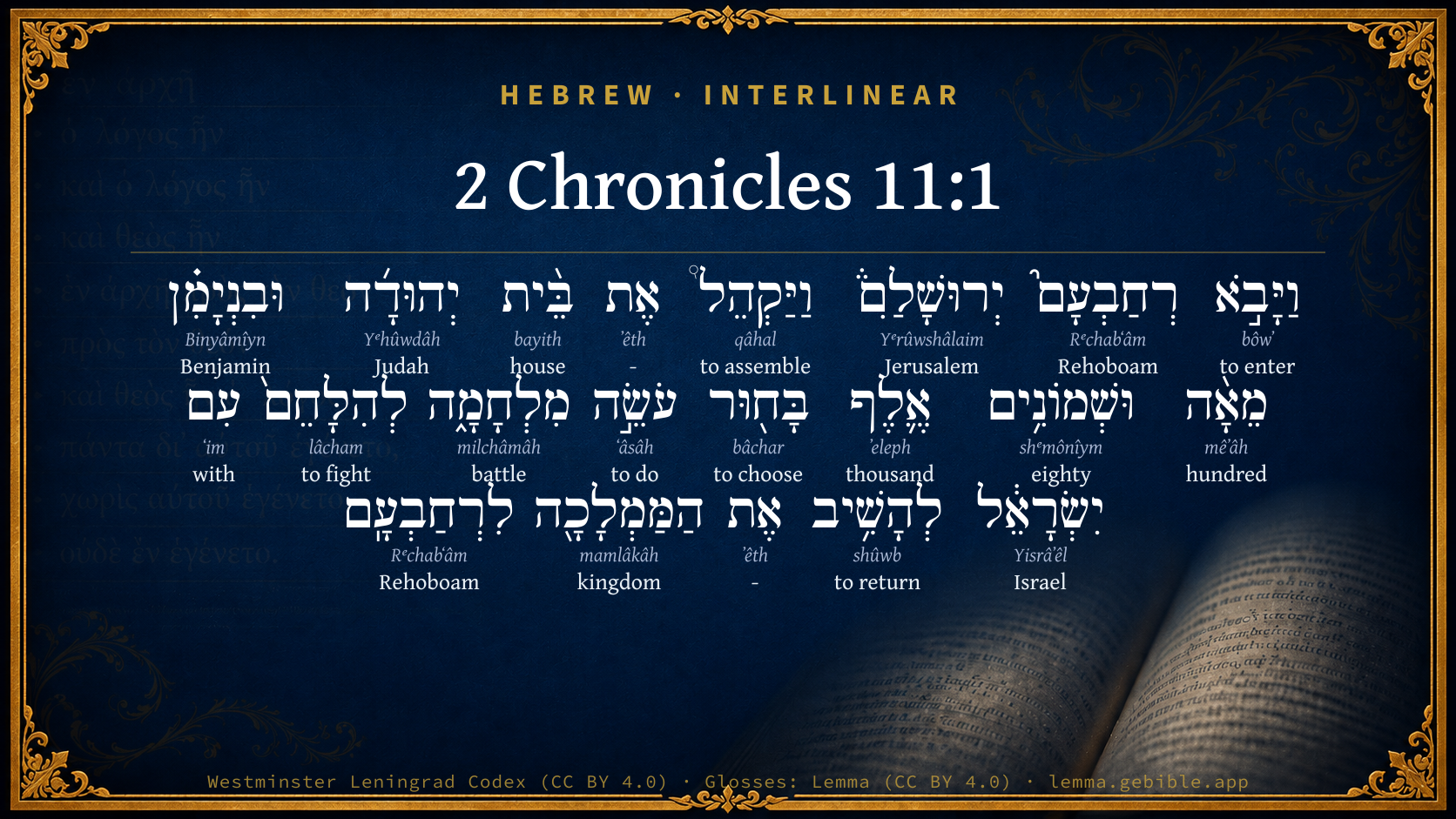
  1. וַיָּבֹ֣א bôwʼ H935 “and · to enter” Conjunction + Verb, Qal, Sequential Imperfect, 3rd Person, Masculine, Singular
  2. רְחַבְעָם֮ Rᵉchabʻâm H7346 “Rehoboam” Noun, Proper
  3. יְרוּשָׁלִַם֒ Yᵉrûwshâlaim H3389 “Jerusalem” Noun, Proper
  4. וַיַּקְהֵל֩ qâhal H6950 “and · to assemble” Conjunction + Verb, Hiphil, Sequential Imperfect, 3rd Person, Masculine, Singular
  5. אֶת ʼêth H853 “-” Particle, Direct Object
  6. בֵּ֨ית bayith H1004 “house of” Noun, Common, Masculine, Singular, Construct
  7. יְהוּדָ֜ה Yᵉhûwdâh H3063 “Judah” Noun, Proper
  8. וּבִנְיָמִ֗ן Binyâmîyn H1144 “and · Benjamin” Conjunction + Noun, Proper
  9. מֵאָ֨ה mêʼâh H3967 “hundred” Adjective, Cardinal number, Both, Singular, Absolute
  10. אֶ֛לֶף ʼeleph H505 “thousand” Adjective, Cardinal number, Both, Singular, Absolute
  11. בָּח֖וּר bâchar H977 “chosen” Verb, Qal, Participle Passive, Masculine, Singular, Absolute
  12. עֹשֵׂ֣ה ʻâsâh H6213 “doing” Verb, Qal, Participle Active, Masculine, Singular, Construct
  13. מִלְחָמָ֑ה milchâmâh H4421 “battle” Noun, Common, Feminine, Singular, Absolute
  14. לְהִלָּחֵם֙ lâcham H3898 “to fight” Preposition + Verb, Niphal, Infinitive Construct
  15. עִם ʻim H5973 “with” Preposition
  16. יִשְׂרָאֵ֔ל Yisrâʼêl H3478 “Israel” Noun, Proper
  17. לְהָשִׁ֥יב shûwb H7725 “to return” Preposition + Verb, Hiphil, Infinitive Construct
  18. אֶת ʼêth H853 “-” Particle, Direct Object
  19. הַמַּמְלָכָ֖ה mamlâkâh H4467 “the · kingdom” Particle, Definite Article + Noun, Common, Feminine, Singular, Absolute
  20. לִרְחַבְעָֽם Rᵉchabʻâm H7346 “to/for · Rehoboam” Preposition + Noun, Proper

About this verse

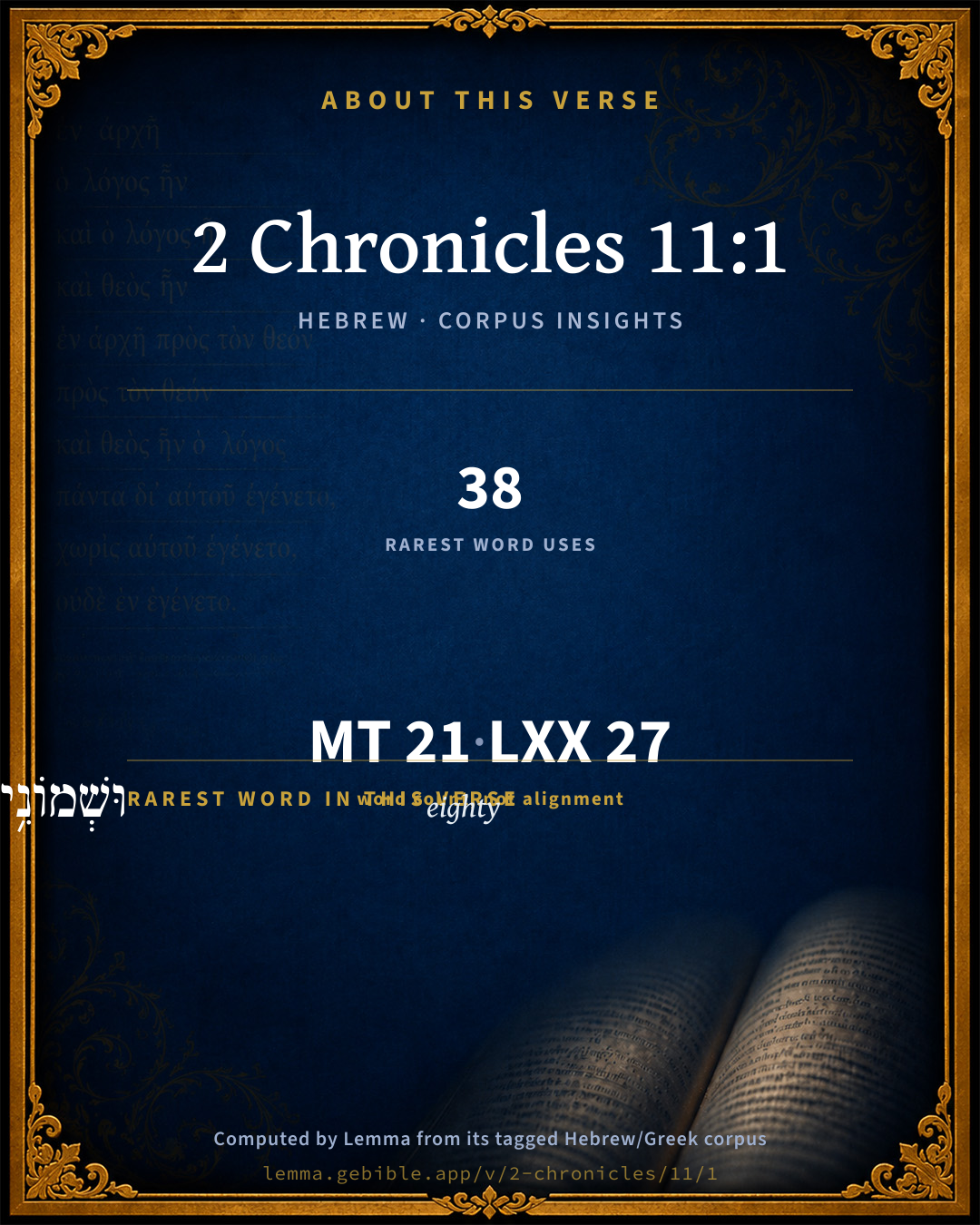
These counts appear in no published source. They are computed here, from the morphology-tagged text and Lemma’s own curated glosses. What Lemma adds →

21
words
19
distinct lemmas
Historical
section

Shared distinctive vocabulary

וּשְׁמוֹנִ֥ים eighty H8084 occurs in 37 verses of the Hebrew Bible. Also found in:

Grammatical profile

  • 6 verbs
  • 9 nouns
  • 3 adjectives
  • 1 preposition
  • 2 particles

Verb forms

  • וַיָּבֹ֣א Qal · Sequential Imperfect
  • וַיַּקְהֵל֩ Hiphil · Sequential Imperfect
  • בָּח֖וּר Qal · Participle Passive
  • עֹשֵׂ֣ה Qal · Participle Active
  • לְהִלָּחֵם֙ Niphal · Infinitive Construct
  • לְהָשִׁ֥יב Hiphil · Infinitive Construct

Repetition

A word recurs within this verse — often emphatic in Hebrew:

  • רְחַבְעָם֮ Rehoboam H7346 ×2

Hebrew & Septuagint length

In English translation the verse runs 34 words from the Hebrew and 33 from the Septuagint (LXX English) — closely comparable.

A rough comparison of the two English renderings, which tokenize alike — not a word-level alignment.

Word counts can differ between the Hebrew and the Greek without any difference in meaning — e.g. the Hebrew direct-object marker אֵת has no separate Greek word, and Greek often adds the article ὁ.

In the original languages it is 21 Hebrew tokens and 27 Greek tokens — but the two are counted differently (Hebrew bundles its prefixes and suffixes into one token; the Greek is in lemma form), so that isn’t a like-for-like length.

Cross-references

4

Topical passages linked to 2 Chronicles 11:1 in the Treasury of Scripture Knowledge — connected by theme and wording, ordered by reader-vote popularity; previews shown in the World English Bible.

  • 1 Kings 12:21–24 When Rehoboam was come to Jerusalem, he assembled all the house of Judah, and the tribe of Benjamin, a hundred and eighty thousand chosen men, who were warriors, to fight against the house of Israel, to bring the kingdom again to Rehoboam the son of Solomon.
  • Psalms 33:10 Yahweh brings the counsel of the nations to nothing. He makes the thoughts of the peoples to be of no effect.
  • Psalms 33:16 There is no king saved by the multitude of a host. A mighty man is not delivered by great strength.
  • Proverbs 21:30–31 There is no wisdom nor understanding Nor counsel against Yahweh.

Cross-references courtesy of OpenBible.info (CC BY 4.0).

Hebrew and Greek witnesses Masoretic Hebrew ↔ Greek Septuagint

The same verse in the two great witnesses to the Old Testament, shown verse-for-verse.

These are two independent witnesses, not word-aligned to each other, and the Septuagint is shown in lemma (dictionary) form.

Hebrew 2 Chronicles 11:1 Masoretic · Westminster Leningrad Codex

וַיָּבֹ֣א רְחַבְעָם֮ יְרוּשָׁלִַם֒ וַיַּקְהֵל֩ אֶת בֵּ֨ית יְהוּדָ֜ה וּבִנְיָמִ֗ן מֵאָ֨ה וּשְׁמוֹנִ֥ים אֶ֛לֶף בָּח֖וּר עֹשֵׂ֣ה מִלְחָמָ֑ה לְהִלָּחֵם֙ עִם יִשְׂרָאֵ֔ל לְהָשִׁ֥יב אֶת הַמַּמְלָכָ֖ה לִרְחַבְעָֽם

When Rehoboam was come to Jerusalem, he assembled the house of Judah and Benjamin, one hundred eighty thousand chosen men, who were warriors, to fight against Israel, to bring the kingdom again to Rehoboam.

World English Bible · Public Domain

Greek LXX 2 Chronicles 11:1 Septuagint · lemma form

καί ἔρχομαι ροβοαμ εἰς ἰερουσαλήμ καί ἐκκλησιάζω ὁ ἰούδας καί βενιαμίν ἑκατόν ὀγδοήκοντα χιλίας νεανίσκος ποιέω πόλεμος καί πολεμέω πρός ἰσραήλ ὁ ἐπιστρέφω ὁ βασιλεία ὁ ροβοαμ

And Roboam came to Jerusalem; and he assembled Juda and Benjamin, one hundred and eighty thousand young men fit for war, and he waged war with Israel to recover the kingdom to Roboam.

LXX2012 (modern English Septuagint) · Public Domain

On this verse, Haydock's Catholic Bible Commentary discusses the Septuagint’s reading. Read the note in Commentary ↓

Hebrew: Westminster Leningrad Codex (CC BY 4.0). Greek: Septuagint (public domain); English from LXX2012 (modern English Septuagint) (Public Domain). How the Septuagint differs from the Hebrew →

Commentary

Notes on 2 Chronicles 11:1 from classic Christian and Jewish commentators (each source and its license shown beneath its notes). The classic Christian expositions comment on the surrounding passage and are grouped to its opening verse, so a note may address several verses; the Jewish commentaries on the Tanakh (Rashi and others) are per-verse, so they appear only where the commentator wrote on this verse.

Lemma curates 59 commentaries, every one of them public domain or Creative Commons licensed, each selected and text-cleaned for this edition rather than reprinted as found. About our sources →

Matthew Henry's Commentary

How the ten tribes deserted the house of David we read in the foregoing chapter. They had formerly sat loose to that family (Sa2 20:1, Sa2 20:2), and now they quite threw it off, not considering how much it would weaken the common interest and take Israel down from that pitch of glory at which it had arrived in the last reign. But thus the kingdom must be corrected as well as the house of David. 1. Rehoboam at length, like a bold man, raises an army, with a design to reduce the revolters, Ch2 11:1. Judah and Benjamin were not only resolved to continue their allegiance to him, but ready to give him the best assistance they could for the recovery of his right. Judah was his own tribe, that owned him some years before the rest did; Benjamin was the tribe in which Jerusalem, or the greatest part of it, stood, which perhaps was one reason why that tribe clave to him. 2. Yet, like a conscientious man, when God forbade him to prosecute this design, in obedience to him he let it fall, either because he reverenced the divine authority or because he knew that he should not prosper if he should go contrary to God's command, but instead of retrieving what was lost would be in danger of losing what he had. It is dangerous undertaking any thing, but especially undertaking a war, contrary to the will of God. God calls him (Ch2 11:3), Rehoboam the son of Solomon, to intimate that this was determined for the sin of Solomon, and it would be to no purpose to oppose a decree that had gone forth. They obeyed the words of the Lord; and though it looked mean, and would turn to their reproach among their neighbours, yet, because God would have it so, they laid down their arms. 3. Like a discreet man, he fortified his own country. He saw it was to no purpose to think of reducing those that had revolted. A few good words might have prevented their defection, but now all the forces of his kingdom cannot bring them back. The think is done, and so it must rest; it is his wisdom to make the best of it. Perhaps the same young counsellors that had advised him to answer them roughly urged him to fight them, notwithstanding the divine inhibition; but he had paid dearly enough for being advised by them, and therefore now, we may suppose, his aged and experienced counsellors were hearkened to, and they advised him to submit to the will of God concerning what was lost, and to make it his business to keep what he had. It was probably by their advice that, (1.) He fortified his frontiers, and many of the principal cities of his kingdom, which, in Solomon's peaceable reign, no care had been taken for the defence of. (2.) He furnished them with good stores of victuals and arms, Ch2 11:11, Ch2 11:12. Because God forbade him to fight, he did not therefore sit down sullenly, and say that he would do nothing for the public safety if he might not do that, but prudently provided against an attack. Those that may not be conquerors, yet may be builders.

Matthew Henry's Commentary on the Whole Bible (1708–1710) — public domain (CC PDM 1.0). Text via the HelloAO Bible API.

The Cambridge Bible for Schools and Colleges

gen. ed. J. J. S. Perowne

1. he gathered of] R.V. he assembled.

Ch. 2Ch_11:1-4 (= 1Ki_12:21-24). Shemaiah forbids Civil War

The Chronicler here omits the elevation of Jeroboam to be king over Israel (1Ki_12:20).

The Cambridge Bible for Schools and Colleges (gen. ed. J. J. S. Perowne; Cambridge University Press, 1878–1918) — public domain. Text from a community e-Sword module.

Trapp's Complete Commentary

John Trapp

2Ch 11:1 And when Rehoboam was come to Jerusalem, he gathered of the house of Judah and Benjamin an hundred and fourscore thousand chosen [men], which were warriors, to fight against Israel, that he might bring the kingdom again to Rehoboam.

Ver. 1-4. See on 1Ki 12:21-24.

John Trapp, A Commentary or Exposition upon All the Books of the Old and New Testament (1647–1656) — public domain. Text from a community e-Sword module.

The Biblical Illustrator

Joseph S. Exell

2Ch_11:1-4

Ye shall not go up, nor fight against your brethren.

The restraints of Divine providence

I. Restraints made unmistakably clear.

II. Restraints merciful in design.

III. Restraints timely made.

IV. Restraints implicitly heeded. (J. Wolfendale.)

Uninsured preparations

Pity it is that God seems to allow us to go to such costs and then stops us just at the last moment. "Ye shall not go up." There is pity in the arrangement, but it is not on the side of God. It is a pity that we did not consult God before we called the enemy together. He will be consulted at one end. He wishes to be consulted at the beginning, but if we will not consult Him there, we must consult Him at the end. Our preparations amount to nothing if they are not inspired. All our education comes to smoke and wind if it be not an education derived from the altar and enriched with the wisdom of God. Send out a hundred and fourscore thousand chosen men from academy and college and university, loaded with the blank cartridges of ten thousand certificates and testimonials; if the Lord is not in it He will send them all back again until He calls for their aid. (J. Parks, D. D.)

The Biblical Illustrator, edited by Joseph S. Exell (c. 1880s–1900s) — public domain. Text from a community e-Sword module.

The Preacher's Complete Homiletical Commentary

Joseph S. Exell (gen. ed.)

CRITICAL NOTES.] Rehoboam forbidden to war (2Ch_11:1-4). This section a repetition in abbreviated form of 1Ki_12:21-24. Remainder of chapter new matter. Rehoboam fortifies many towns (2Ch_11:5-12); receives accessions from Israel (2Ch_11:13-17); and takes many wives and concubines (2Ch_11:18-23).

2Ch_11:1-4.—The forbidden war. Fight to crush the rebellion. Fourscore thousand about one-third of Judah’s number under Joab’s levy (2Sa_24:9). Shem. (1Ki_12:22-24); all Israel in Judah and Benjamin now united together.

2Ch_11:5-12.—Defensive measures. Jerusalem, a judicious step, unlike northern kings, who shifted their capital. Built, repaired and fortified; fifteen given. Beth., Et., and Tek. near together, a little south of Jericho, on way to Hebron. 2Ch_11:7. Beth-zur, a strong position about five miles north of Hebron, on route between that place and Jerusalem. It played an important part in the wars of the Maccabees (1Ma_4:29-61; 1Ma_6:7-26, &c.) [Speak. Com.]. Shoca, now Sumeikeh, three-and-a-half hours south-west of Jerusalem. Adul (Jos_15:35). 2Ch_11:8. Gath. Exact site not known. Mares. (Jos_15:44). Its importance appears in the invasion of Zerah (ch. 2Ch_14:9); and from 1Ma_5:66; 2Ma_12:35. Modern name Marash. Ziph. Two of this name in Judah (Jos_15:24-55). This famous in David’s history (1Sa_23:14-24; 1Sa_26:2-25). Exact site appears to be the modern Til Zif, about three miles south of Hebron [Speak. Com.]. 2Ch_11:9. Ador., Adora or Dora, now Dora, west of Hebron (Jos_15:24). Lackish, now Um-Lakish. Azekah (Jos_10:10). 2Ch_11:10. Zor. (1Ch_2:53), now Surah; and Aij., now Yalo, further north than other cities here mentioned. Both in territory originally assigned to Dan (Jos_19:41-42), but afterwards absorbed into Judah [Speak. Com]. Judah and Benjamin, now the designation of southern kingdom (cf. 2Ch_11:12; 2Ch_11:23). 2Ch_11:11. Oil, odoriferous; wine, sweet, used by ancient Jews and modern Arabs; healthy and useful in hot climates (cf. Psa_104:15).

2Ch_11:13-17.—Accessions. Left, ejected from their office because they would not minister to Jeroboam’s calves, who appointed priests not Levites. Suburbs (cf. Num_35:1-8). High places, i.e., Dan and Bethel (cf. 1Ki_12:28-33); a kind of contemptuous description as not equal to temple at Jerusalem, only on a level with those in other parts. 2Ch_11:15. Devils, a term sometimes used for idols in general (Lev_17:7); here applied distinctively to the goat-deities, which were probably worshipped chiefly in the northern parts of the kingdom, where the heathen Canaanites still abounded [Jamieson]. 2Ch_11:17. Strengthened by numbers and moral tone of excellent subjects; but sad change noted in king next chapter.

2Ch_11:18-23. Rehoboam’s wives and children. Jerimoth not given among legitimate sons of David, hence son of concubine. Read David and of Abihail. Mother as well as father of Mah. is given. Daughter of E., probably “grand-daughter,” since an actual daughter of E. must have been too old to be a fit wife for Rehoboam. 2Ch_11:20. Daughter, grand-daughter of Abs. (cf. ch. 2Ch_13:2). 2Ch_11:21. Threescore (cf. Son_6:8 and 2Ch_13:21). 2Ch_11:22. Chief, though not eldest of his sons. Affection for M. led him to violate the law. Wisely, prudently with calculation (Exo_1:10). Many wives. Rehoboam careful to please his sons by making them governors of fortresses, and “sought for them a multitude of wives” (marg.); perhaps from cities over which they were set. In Persia and Turkey, younger princes, until lately, were shut up in the harem during their father’s lifetime; and to prevent competition, were blinded or killed when their brother ascended the throne. In former country the old practice of dispersion through the country, like Rehoboam, has been again revived [Jamieson].

HOMILETICS

THE RESTRAINTS OF DIVINE PROVIDENCE.—2Ch_11:1-4

Events concerning kingdom of Judah chiefly given after revolt of ten tribes. Rehoboam determined to enter disaffected provinces; but divine decree gone forth, the army overawed, dispersed, and the king obliged to submit.

I. Restraints unmistakably clear. “The word came to Shem.,” and was spoken “unto Rehoboam.” Prophets gave no uncertain sound in either kingdom. Divine interposition most clear. No visions, no voices now; but around and in us as we fight in life, a power above the wiles and schemes of men, secret, invisible influences, deep impressions, and mysterious thoughts, amounting almost to divine revelations, to check or prompt. “Thou shalt not go up.”

II. Restraints merciful in design. “Nor fight against your brethren.” Nations and tribes bound by natural ties; man-kinned (mankind) should help each other. “Quarrel with your faults and not with our fellow-men,” was the motto of Otho II., Emperor of Germany. “Man’s inhumanity to man” is great. If Alexanders, Cæsars, and Napoleons were not restrained, the world would become a pandemonium. God careful of human life and human weal, prevents disgrace, mischief, and bloodshed. Men seek to destroy peace, injure reputation and property. “Revenge is wild justice,” says Bacon. “Say not thou I will recompense evil; but wait on the Lord and he shall save thee.”

III. Restraints timely made. God times events and interpositions; permits much show and great progress, as in Jeroboam’s preparations. Why restrained when army assembled, everything ready and about to march with every prospect of success? Has God been consulted? Education, preparations, and enterprises of no avail, if not for him. A thousand forces may be enlisted, simply to be sent home again! We may form our programme, set an object in view, adapt our means and arrange time to attain it. Just when attainment near, lo! deprivation, disappointment. “A man’s heart deviseth his way: but the Lord directeth his steps.”

IV. Restraints implicitly heeded. The prophet represented God. The event could not be changed. “They hearkened,” disbanded, and went home. Another power beside Judah and Israel must be recognised. Folly to resist, to fight against God! Motives, arguments, to acquiesce in arrangements of Providence are unanswerable. “Let the potsherd strive with the potsherds of the earth,” but “woe unto him that striveth with his Maker.”

DEFENSIVE MEASURES.—2Ch_11:5-12

Rehoboam forbidden to aggress, undertakes to defend the frontiers of his kingdom. “He built cities for defence.” The verb denotes fortification of cities; “partly,” says Hengstenberg, “because in the case of a city already in existence, the building must necessarily have been restricted to the fortification of it, and partly because the term city, in its fullest extent, involves the idea of fortification.”

I. He protected against great dangers.

1. From the attack of Israel. Disruption of tribal unity brought danger and enemies within. Israel restless and allied with Egypt.

2. From Egyptian bondage. From this quarter greatest danger. Out of fifteen cities all but three, on southern or western frontier. “And now, for the first time since the Exodus, Judah was once more threatened with an Egyptian bondage” [Stanley].

II. He displayed great Wisdom

1. In retaining the capital. “Rehoboam dwelt in Jerusalem” (2Ch_11:5). Unlike kings of Israel, who shifted their capital from place to place for convenience and policy, he perceived importance of retaining hold on the city of David. This central fortress surrounded by a chain of fortresses, in part to carry out the designs of his father, in part to increase his strength.

2. In fortifying the kingdom. Reduced by secession, he sought to keep what he possessed. He rebuilt, garrisoned, and provided with arms and stores to stand a siege. If we cannot attack, we can perhaps build; if not recover lost privileges, we may defend what we have. “That good thing (goodly deposit) which was committed unto thee, keep (guard, cf. 1Ti_6:20) by the Holy Ghost, which dwelleth in us” (2Ti_1:14).

III. He illustrated great principles. Under these measures are hidden powerful principles in human life.

1. The power of conscience. Accused of doing wrong, he now fears further mischief. A guilty conscience gives timidity, creates a panic, and expects retaliation when “no man pursueth.” “Suspicion always haunts the guilty mind.”

2. The tendency to aggressive war. Jeroboam took similar precautions to Rehoboam (1Ki_12:25). Kings ambitious and plunge into war. “He that is of a proud heart stirreth up strife.” Who can tell the strifes and wars thus created?

“Towns turned to ashes, fanes involved in fire!

These deeds the guilt of rash ambition tell.”

2. Lack of faith in God. This leads to self-sufficiency, mischievous enterprises and failure. In personal salvation and national deliverances, weak is an arm of flesh. “Some remember (trust, glory in remembrance of) chariots, and some remember horses, but we will remember the name of the Lord our God” (Psa_20:7).

CONSCIENTIOUS SCRUPLES.—2Ch_11:13-17

Jeroboam, afraid of reunion of the tribes, took measures to make separation final. He introduced calf-worship in Bethel and Dan, two distinct places at opposite ends of his kingdom. He selected priests from the lowest of the people, thus weakened his kingdom and caused many worthy men to migrate to Judah, who, faithfully attached to the worship of Jehovah, could not conscientiously bow to idols.

I. In refusing to worship idols. They remembered the injunction, “Thou shalt not bow down thyself to them, nor worship them.” Daniel’s companions were steadfast.

II. In braving the results of their conduct. The wrath of the king, and the ridicule of the tribes; ejection from their office, persecution and exile. “The emperor commands thee to do sacrifice,” said the Proconsul to Cyprian; “therefore consult for thy welfare.” “I am a Christian,” was the heroic reply; “and I cannot sacrifice to your gods; do, therefore, what you are commanded; as for me, in so just a cause there needs no consultation.”

III. In seeking to worship God according to conscience. They desired a purer worship and sought a more convenient place; left their suburbs and their possessions, and came to Judah and Jerusalem. (Pilgrim Fathers.) In the conduct of these priests and people we have—

1. A conscience to acknowledge. Some in authority do not recognise it. Conscience the vicegerent of God, omnipotent, can never be crushed. Kings may control movements of body, but never alter convictions of soul. Neither fraud nor force can make good men disobey behests of conscience.

2. A precedent to follow. Men may urge customs of the people and fashions of the nation; expediency and personal obligations to superiors; the dangers of singularity and terrible penalty of our choice, but we must be faithful: “Dare to do right.” “We ought to obey God rather than men.”

THE STRENGTH AND ATTRACTION OF A KINGDOM.—2Ch_11:3; 2Ch_11:13-17

I. In the unity of its Subjects. By blood Benjamin more closely related to Ephraim than Judah. All traditions of Benjamin antagonistic to Judah. Now estrangement and feud ceased. Religious and political capital established on border line. Two tribes unite, and prepare for defence. Danger unites all ranks together. (Elizabeth and Spanish Armada.)

II. In the purity of its worship. Benjamin attached to temple worship. Priests and Levites migrated in large numbers to the southern kingdom for purer worship and safety. Recognition of God greater security than armies and fleets; moral vigour more attractive than extensive trade.

III. In the righteousness of its rule. Wise to strengthen cities and defend forts; better to consolidate the throne in rectitude. Numbers give physical strength, but just concessions and righteous laws support and safeguard the nation. Jeroboam’s kingdom weakened, Rehoboam’s strengthened.

THE FAMILY AND DOMESTIC POLICY OF REHOBOAM.—2Ch_11:18-23

Danger past, indulgence began. The domestic policy of Rehoboam might be worldly wise, but it was sinful.

I. The family was founded in disobedience to God. The royal harem inferior to his father’s, equally in violation of the law.

1. In multiplying wives. (a) For himself; (b) For his sons. Wives not strangers, but daughters of Israel, and of family of David, yet forbidden. “Neither shall he multiply wives to himself.”

2. In choice of a favourite son. He set aside eldest son, preferred Abijah in fondness for his mother. Solomon had divine warrant, but in destining youngest for kingdom the king violated the law (Deu_21:15-16). “They have set up kings, but not by me; they have made princes, and I knew it not.”

II. The family was governed by worldly policy. “He dealt wisely”—i.e., with deep and calculating policy (Exo_1:10). “Rehoboam’s wisdom was shown—

1. In dispersing his other sons instead of allowing them to remain together in Jerusalem, where they might have joined in a plot against Abijah, as Adonijah and his brothers did against Solomon (1Ki_1:5-10).

2. In giving his sons positions which might well content them, and prevent them from being jealous of Abijah” [Speak. Com.]. Rivalry prevented, public peace and safety secured, not by worldly sagacity and bestowment of patronage. Trust in God and loyalty to his commands the best policy.

HOMILETIC HINTS AND SUGGESTIONS

2Ch_11:13-16. The duty of Protestants. This will lead me to set before you—I. The conduct of Protestants in that day.

1. In it they bore testimony against the reigning abominations;

2. They steadfastly adhered to the service of their God;

3. They renounced all for conscience sake. II. Our duty as Protestants at the present day.

1. We should realise our own religious principles;

2. We should show their superior efficacy to sanctify the heart and life. Address those

(1) Who are conforming to this world; and

(2) Those who are like the Israelites, setting their hearts fully to seek the Lord their God [C. Simeon].

2Ch_11:16.

1. God the object of search. The sublimest and most needful in creation. The foundation of all religion and strength.

2. The search sincere. Heart, all the heart thrown into it.

3. The search steadfast. The heart fixed, determined, purposed. No hesitancy, wandering, and half-heartedness. “Qui tradiderunt cor suum, who delivered up their hearts to seek the Lord; to run any hazard rather than violate conscience. Such were the English exiles in Queen Mary’s days, from whom Stephen Gardiner vowed so to stop sending of all supplies that for very hunger they should eat their own nails, and then feed on their fingers’ ends; but ‘threatened folk live long,’ and before these banished men were brought to that bill of fare, the Bishop was eaten up of worms” [Trapp].

These verses describe the condition of the northern kingdom in Jeroboam’s time.

1. Disgraced by calf-worship.

2. Lacking the principal thing. Seats of worship, no true sanctuaries, for the ark, the symbol of God’s presence wanting. Not “the house of God,” but “a house of high places.”

3. Weakened by emigration. Innovations drove the best from the country. The king went from bad to worse.

2Ch_11:17. Three years, &c. Temporary Religion. This a brief description of the spirit of his reign. I. Period of profession. By apostasy of ten tribes, and the belief that the thing proceeded from God as a punishment for Solomon’s idolatry, the king brought to reflection and obedience. This only temporary. When kingdom sufficiently fortified, and he thought himself secure, he forsook the law of Jehovah, and all Israel with him (ch. 2Ch_12:1). Many fall away, some before, and others after three years of profession. “Ye did run well, who did hinder?” II. The period of apostasy. In prosperity or security. When no dangers nigh. In heart unfaithful, though external worship undisturbed (ch. 2Ch_29:28). High places, monumental stones and idols, disfigured the land. Apostasy more grievous than before. The first three years walked in the way of David; in the fourth year, decline which neutralised all advantages of immigration, and in the fifth year punishment by invasion and success of Shishak (2Ch_12:2). Such the course of life!

2Ch_11:18-22. A Family Record. In which we find—

1. Kindred mixed together. All three wives of David’s family, and his own kindred.

2. Partiality displayed. “Rehoboam loved Maachah” (2Ch_11:22) for beauty or conformity to his wicked practices.

3. Numbers in abundance. “Eighteen wives and threescore concubines, and begat twenty-and-eight sons and threescore daughters.” The family a divine institution, should be the best of kingdoms and a type of heaven.

ILLUSTRATIONS TO CHAPTER 11

2Ch_11:1-5. Ye shall not go. Little can we at the beginning of an action guess at God’s intention at the conclusion [Bishop Hall]. It is one of the greatest praises of God’s wisdom that he can turn the evil of men to his own glory [Ibid.].

2Ch_11:13-15. Worship cast off. Whatever is morally wrong cannot be politically right [Burke]. We never do evil so thoroughly and cordially as when we are led to it by a false principle of conscience [Pascal].

“Not thou, O Lord, from us, but we

Withdraw ourselves from thee”

[French].

2Ch_11:14-16. Left, &c. The good men in a kingdom counteract the tendency to anarchy and disruption. “Righteousness exalteth a nation.” The guarantee of a nation’s progress and stability is to be found, not in the invincibility of its armies, not in the vastness of its commerce, not in the genius, the learning, or the wealth of its citizens, but in the sound morality and religious sentiment of the people [Dr. Thomas].

The Preacher's Complete Homiletical Commentary (gen. ed. Joseph S. Exell; Funk & Wagnalls, c. 1892) — public domain (pre-1929). A full-Bible homiletical/sermon-outline anthology covering 65 of 66 books (2 John is absent from the source module). Text from a community e-Sword module.

The Annotated Bible

Arno C. Gaebelein

III. THE HISTORY OF THE KINGS OF JUDAH:EVENTS LEADING UP TO THE CAPTIVITY

1. Decline and Apostasy under Rehoboam, Abijah and Asa

CHAPTER 11 Rehoboam’s Reign

1. The forbidden war (2Ch 11:1-4)

2. The national defence (2Ch 11:5-12)

3. Jeroboam’s wickedness and Rehoboam’s strength (2Ch 11:13-17)

4. Rehoboam’s family (2Ch 11:18-23)

The provocation to go to war with the tribes which had revolted was great. Rehoboam was ready to start the civil war. He gathered 180,000 men of Judah and Benjamin to fight against Israel and to restore the tribes to his kingdom. Shemaiah, the man of God, the prophet in Judah, received a message from the LORD, which he faithfully delivered. “Ye shall not go up, nor fight against your brethren; return every man to his house, for this thing is done of me.” It required courage to deliver such a message in the midst of the great preparations for war. Rehoboam and the people obeyed and did not go to war. They must have realized that if they disobeyed they would have fought against God. And the LORD also blessed the king and his people for believing the Word and being obedient. He always blesses when there is obedience. He built and fortified fifteen cities. “He fortified the strongholds, and put captains in them and store of victuals and of oil and wine.” In several places he put shields and spears. Thus he made ready for a possible invasion from the side of Egypt, for Jeroboam, his rival, had been there. Rehoboam’s fears were well founded, as we shall find in the next chapter.

Then there was a great exodus of priests and Levites from the domain of Jeroboam. As we learned from 1Ki 12:25-33, Jeroboam established a wicked worship, setting up two golden calves at Beth-el and Dan. The priests he made were taken, not from the sons of Levi, but from the lowest of the people (1Ki 12:31). The true priest and Levites who had remained with him were cast off from executing their holy and God-given office. He also had priests “for the devils.” The Hebrew word translated “devils” means “hairy ones” and “goats.” In Egypt the sacred goat was worshipped and Jeroboam’s worship was patterned. The priests and Levites who were driven away by Jeroboam strengthened the Kingdom of Judah. They had a wholesome influence upon the otherwise weak son of Solomon. “They made Rehoboam, the son of Solomon, strong.” They all walked in the way of David and Solomon for three years. Most likely fear had much to do with it. We read nothing of turning to the LORD and seeking His face.

His family record is given. Mahalath is mentioned as his wife, a daughter of Jerimoth, probably the son of one of David’s concubines (1Ch 3:9). Then he took Maacah, a granddaughter of Absalom. According to Josephus, Maacah’s mother was Tamar, the daughter of Absalom (2Sa 14:27). He had many wives and concubines. The polygamous tendencies of his father and grandfather were thus indulged by him, and in all probability his apostasy started from this sin. But he acted wisely and dispersed all his children throughout the whole country. Having twenty-eight sons and many more daughters, there were great possibilities of conspiracies, which he avoided by scattering them in different directions.

Arno C. Gaebelein, The Annotated Bible (1913–1922) — public domain. Text from a community e-Sword module.

Tyndale Open Study Notes

Tyndale Open Resources

11:1-4 Shemaiah’s prophetic intervention averted immediate civil war among Israel’s tribes, but the summary of Rehoboam characterizes his reign as one of continual warfare with Jeroboam (12:15). Civil war characterized the first fifty years of the divided kingdom, until the time of Omri.

Tyndale Open Study Notes — © Tyndale Open Resources, licensed CC BY-SA 4.0. Text via the HelloAO Bible API.

Geneva Bible (1599)

Geneva Bible translators

That is, the half tribe of Benjamin: for the other half was gone after Jeroboam.

Meaning the ten tribes which rebelled.

Geneva Bible (1599) marginal notes — public domain. Text via Bolls.life.

Adam Clarke's Commentary

CHAPTER XI

Rehoboam raises an array, purposing to reduce the ten tribes;

but is prevented by Shemaiah the prophet, 1-4.

He builds several cities of defense, and fortifies others,

5-12.

The priests and Levites being turned out by Jeroboam, come to

Rehoboam, 13, 14.

Jeroboam's gross idolatry, 15.

The pious of the land join with Judah, and strengthen the

kingdom of Rehoboam, 16, 17.

His wives, concubines, and numerous issue, 18-21.

He places his own sons for governors in the different

provinces, 22, 23.

NOTES ON CHAP. XI

Verse 1. Gathered of the house of Judah] See this account 1Kg 12:21-24, and the notes there.

Adam Clarke's Commentary on the Bible (1810–1826) — public domain. Text from a community e-Sword/MySword module.

Ellicott's Commentary for English Readers

XI.

(1) And when Rehoboam.—And Rehoboam came . . . and he gathered. The chronicler omits 1Ki_12:20, which relates the call of Jeroboam to the throne of Israel. The present verse is a slightly abridged form of 1Ki_12:21.

The kingdom.—Mamlâkâh. Kings, m’lûkâh.

A Bible Commentary for English Readers, edited by Charles John Ellicott (1878–1897) — public domain. Text from a community e-Sword module.

John Gill's Exposition

And when Rehoboam was come to Jerusalem,.... After he had been at Shechem, and had given his answer to the request of the men of Israel, upon which they revolted from him: this and the three following verses are the same with Kg1 12:21. See Gill on Kg1 12:21.

.

2 Chronicles 11:5

ch2 11:5

ch2 11:5

ch2 11:5And Rehoboam dwelt in Jerusalem,.... The metropolis of Judah, and the capital city of his kingdom:

and built cities for defence in Judah; that is, rebuilt, enlarged, and fortified them; for otherwise they were built before, though neglected before the revolt of the ten tribes; but now it became necessary to make them more capacious and strong, to protect his people, and defend himself against Israel; for though he was forbid to act offensively, and therefore contented himself to abide in Jerusalem, and not go forth to war; yet he might lawfully put himself into a condition of defence.

John Gill's Exposition of the Whole Bible (1746–1763) — public domain (CC PDM 1.0). Text via the HelloAO Bible API.

Haydock's Catholic Bible Commentary

Chosen. Septuagint, "young," (Haydock) as the Hebrew term also signifies. (Tirinus) --- His. Hebrew, "the kingdom again to Roboam."

George Leo Haydock (1774–1849), Haydock's Catholic Family Bible and Commentary, 1859 edition — public domain. Excludes Psalms (Douay-Rheims chapter numbering differs from Protestant) and Deuterocanonical books (Catholic canon only).

Matthew Poole's English Annotations

Of this verse, and verses 2-4, See Poole "1Ki 12:21".

Matthew Poole's English Annotations on the Holy Bible (1683–1685) — public domain. Text from a community e-Sword/MySword module.

Dummelow's Commentary on the Holy Bible

J. R. Dummelow

Reign of Rehoboam (continued)

This chapter repeats the substance of 1Ki_12:21-24, and adds much information relating to Rehoboam's buildings, the withdrawal of the Levites from the kingdom of Jeroboam, and Rehoboam's marriages.

5. Built cities] Of the towns named in the following vv. Beth-lehem, Tekoa, Beth-zur, Adoraim, Ziph, and Hebron, were in the hill-country of Judah; Etam, Shoco, Adullam, Mareshah, Azekah, Zorah and Aijalon, were in the lowlands, whilst Gath (a Philistine city, which in Solomon's reign was independent) and Lachish were in the maritime plain. The fortification of these places was intended to guard the Judæan frontier on the side of Egypt, with which country Jeroboam had had friendly relations: 2Ch_10:2.

14. Cast them off] When Jeroboam made priests from all the tribes indifferently, the Levites lost their privileged position as the only legitimate priestly tribe.

15. Devils] lit. 'he-goats,' the deities that were worshipped being supposed to assume the forms of these animals, like the Greek Satyrs and the Roman Faunus.

18. Jerimoth] not included in the list in 1Ch_3:1-9, so that he was probably the son of a concubine. And Abihail] RV 'and of 'Abi-hail': Abihail being the wife of Jerimoth and mother of Mahalath. 20. Daughter] probably 'granddaughter': see 2Sa_14:27 and 2Sa_13:1.

Abijah] The 'Abijam' of 1Ki_15:1.

23. He dealt wisely] By acting as here described he sought to secure the tranquil succession of the son whom he had chosen as his heir: cp. 2Ch_21:3. Desired] probably for his sons.

J. R. Dummelow, A Commentary on the Holy Bible (Macmillan, 1909) — public domain. Text from a community e-Sword module.

The Pulpit Commentary

The first four verses of this chapter would have been better placed as the conclusion of the previous chapter. They correspond with 1Ki_12:21-24; and they tell how Rehoboam was restrained from making bad worse, in a hopeless attempt to recover the seceding ten tribes, by war that would have been as bloody as foredoomed to failure. "The word of the Lord" to this intent came to the Prophet Shemaiah, and through him to Rehoboam. The remaining verses of the chapter are new matter, and belong to Chronicles alone. They tell how Rehoboam set to work to fortify his towns, or rather many of them (vers. 5-12); how he received priests and others from the kingdom of the ten tribes (vers. 13-17); and, last and worst, of the wives and concubines he took (vers. 18-23).

He gathered of the house of Judah and Benjamin. The parallel (1Ki_12:21) says more distinctly, "The house of Judah with the tribe of Benjamin." They of Jeroboam (2Ch_10:16) had flung it at Judah: "Now, David, see to thine own house." Rehoboam, of course, does this very thing. For the first time,formally, Benjamin is now introduced as throwing in its lot with Judah, and the acted prophecy of Ahijah is seen fulfilled; the chiefest of the tribes, and the tribe that came of the youngest and most petted of old Jacob"s sons, are now wedded to the end. The tribe of Benjamin lay hemmed in between Ephraim, to which it had once much leaned, and to which (as Benjamin was the blood-uncle of Ephraim) it was more closely related, and Judah, with which it had once been at variance. (2Sa_2:12-32 2Sa_3:1-27 2Sa_20:1) But exactly on the border-line of Judah and Benjamin rose the city Jerusalem and the temple (Jos_15:8 Jos_18:16; Jer_20:2) and, beyond doubt, this fact had helped to bring about the much more friendly feeling, if not absolutely close union, that now for some time had existed between these two tribes in their contiguous allotments. A hundred and four-score thousand chosen men, which were warriors. According to Joab, in David"s time the men able to bear arms of Judah alone were five hundred thousand (2Sa_24:9) Compare the numbers in the next reign, (2Ch_13:3) and, later on still, in Jehoshaphat"s. (2Ch_17:14-18) Both of these show that Abijah and Jehoshaphat respectively had improved the time given to training much larger armies, whereas now Rehoboam was taken by surprise.

Vers. 1-4, 5-17, and 23.

The discipline that resulted in obedience, accompanied with right and earnest endeavour.

The homiletic treatment of this chapter centres round two suggestions.

I THE SIMPLE AND PROMPT OBEDIENCE OF REHOBOAM, IN CERTAIN RESPECTS, TO THE DIVINE MESSAGE OF PROHIBITION. Of which obedience on the part of Rehoboam we may notice:

1. That it compared favourably with the conduct of those who, being bidden and encouraged in every way to go up to war, and to possess a certain goodly land, refused; and, being commanded not to go up, insisted on going, (Deu_1:26, Deu_1:43) to their discomfiture and defeat.

2. That the mere pride of war must have gone far to make such obediencedifficult.

3. That the somewhat juster pride of earnest desire to undo, if possible, his own mischievous doing, and to restore a united nation, must have contributed still further to the difficulty of that obedience.

4. And it is very possible that a sensitive shame in the presence of thoseyoung counsellors who had helped to mislead him, but who for certain never offered to help bear the blame of the consequences, may have added some contribution to the difficulty of obedience. Yet Rehoboam"s obedience was apparently prompt and unquestioning. Terrible recent experience had not been thrown away, but had so far gained some wisdom for him. And the prophet"s distinct announcement that the Lord had recognized and adopted the situation as one for his intervening and overruling providence, must have lent consolation to a truly penitent disposition, saved from remorse had there been tendency thereto, while in no way palliating the sin of either king or people.

II THE EARNEST AND RIGHT ENDEAVOURS OF REHOBOAM TO SHEPHERD ALL THE BETTER HIS LESSER FLOCK, HIS REDUCED KINGDOM. This was witnessed to in three leading and typical directions.

1. Rehoboam uses all the means o/an outward kind that may strengthen the things that remain. " Cities, and fences, and strongholds, and forts, and stores of food, and all armour are seen to and supplied.

2. It was of deeper significance that he received only too gladly, welcomed out of a true faith then at least, all the priests and Levites who found indeed that Israel was not the place and Jeroboam not the master for them. To have the recognition of religion, the faith of religion, the presence of the practical ministries and ministers of religion, is the salt of the earth, the health of a people, the conserving of the soundness of civil society. Sin, and a grievous tale of it, were the woe of even Judah; but its core was never quite unsound, and its perpetuity was never broken; while rottenness was the very core of Israel, and Jeroboam and their staff was to be broken absolutely.

3. The true, the devout, the pious of the country, those who "set their hearts to seek the Lord God," were likewise received and welcomed at the true altar, at Jerusalem the city of the great King, with their sacrifices and offerings, renewing in the steps of their priests and ministers. We can imagine them pouring up to the city of their solemnities, like the regular health-bringing waters of some tidal river for Judah, who often mourned and was desolate and bereaved; but for themselves, to the drawing of fresh spiritual life, deeper faith, added strength of hope, kindled joy and love, as they offered their sacrifices, paid their vows, and frequented their temple. People and king were strengthened, as thus "they walked in the way of David and Solomon." We could wish it were written without the ominous, ill-sounding qualification of" three years." These things are certainly very observable of Rehoboam at this time, that a remarkable change had come over, not the spirit of his dream, but of his real working life. We hear no more of his young counsellors. They had been found out, and now were no longer clung to, even as "favourites" to whom royalty iniquitously insisted on showing partiality. We recognize no further indications of the hectoring and insolent spirit in which Rehoboam had allowed himself to answer the not unreasonable representations of those who had addressed him on the subject of lightening their acknowledged burdens. We learn of his desire and the beginning of his preparation to attempt to recover the nevertheless irrecoverable. He is divinely prohibited, and that, no doubt, to the saving of greater harm. He acquiesces in the prohibition, and with intensified zeal applies himself to the care of his diminished dominions. He would defend them from outer assault; and they are also the resort and the refuge and the religious home they should be, for all the upright in all the land. From our sight in this one chapter Rehoboam vanishes, emulating steadily for three years the best portions of the examples of his fathers David and Solomon. Unhappily, the end was not yet.

HOMILIES BY W. CLARKSON Vers. 1-4.

Fighting against brethren.

Rehoboam might have alleged some very strong reasons in defence of the proposed war (ver. 1). He might have pleaded that the tribes had no constitutional or moral right to revolt and secede, and that their secession would seriously and even fatally weaken Israel, and expose it to the mercy of her powerful and unscrupulous neighbours. But the word of the Lord came authoritatively to him, "Ye shall not go up," etc., and the strife was stayed. These words may teach or remind us of .

I THE UNSEEMLINESS OF DOMESTIC STRIFE. It is not only such murderous violence as darkened the history of the first human family, and such bitter strife as that which too often divides brothers and sisters into plaintiffs and defendants; it is also the unforgiven offence, or the interminable dispute, which keeps their lives apart, or makes cold the hearts that should be warm with love; and it is also the daily bickerings, accusations, contentions, which come beneath the Divine displeasure. It is not only the presence of strife, it is the absence of love; it is the want of kindness, considerateness, charity, sweetness of look and of tone, which gives dissatisfaction to him who is ever saying, "As I have loved you, love one another.

II THE PAINFUL INCONGRUITY OF CHURCH DISSENSIONS. Apart from all ecclesiastical controversy, in regard to which there may be honest difference of opinion and of action without any real bitterness of heart, there is often found within the borders of the same Christian community a difference which hardens into a dissension. It is here that the strong, decisive command, against which is no appeal, should be heard, "Ye shall not fight against your brethren." We may not be able to define in language the exact difference between allowable and honourable and even commendable defence of the true and wise in Christian thought and method on the one hand, and a reprehensible and unchristian dissension on the other hand. But if" our eye be single," and our Master"s cause be dearer to our heart than our own preferences, we shall know where the difference lies, and we shall heed the prohibition of the text, and the injunction of the apostle, "Be at peace among yourselves". (1Th_5:13)

III THE PECULIAR INIQUITY OF FRATRICIDAL WAR. How pitiful the sight of the armies of Judah arrayed against the armies of Israel; the children of Abraham and Isaac and Jacob seeking one another"s life, shedding one another"s blood! The people of God turning their weapons against each other, weakening the forces of righteousness, helping to extinguish the light that was in the world. Well might the prophetic word be uttered, "Ye shall not fight," etc. The Divine Father of the human family has, since then, looked down on many a sad and shameful fratricidal war wars in which father and son, brother and brother, have met in deadlycontest on the battlefield; wars in which the hearts of those united by the strongest bonds have been inflamed against one another by the fiercest passions. Surely negotiation and concession should be carried to the very last conceivable point before men "go up and fight against their brethren." But it may be said that the words point to

IV THE WRONGNESS OF ALL WAR THAT IS ANYWISE AVOIDABLE. And so, indeed, they do. For are we not all brethren? are we not all "members one of another"? Are we not, whatever our nationality may he, children of the same heavenly Father, possessors of the same spiritual nature, fellow-sufferers from the same great spiritual malady, fellow-strugglers against the same spiritual foes, fellow-travellers to the same solemn future? May we not all be the redeemed of the same Divine Saviour, workers in the same holy fields of usefulness, occupants of the same heavenly home? Is it well that we who are brethren, that we who, beneath our superficial distinctions, are so closely and deeply united to one another, that we should be planning one another"s destruction, be rejoicing in one another"s discomfiture, be exercising our utmost art and putting forth our utmost skill to shed one another"s blood? To all those who would enter lightly or needlessly into war, comes the strong and solemn prohibition, "Ye shall not fight against your brethren. C.

HOMILIES BY T. WHITELAW

Vers. 1-4.

A warlike expedition hindered.

I THE KING"S ARMY.

1. Whence collected. From Judah and Benjamin, or that portion of the latter which adhered to Judah.

2. Its place of rendezvous. Jerusalem, the metropolis of the southern kingdom. It was intended that the king"s forces should proceed from the capital.

3. The number of its force. A hundred and eighty thousand men a contingent of the army of Judah.

4. The character of its soldiers. "Chosen men, which were warriors;" picked veterans, because of the importance and difficulty of the expedition upon which they were about to be despatched.

5. The work for which it was designed. "To fight against Israel against the ten or nine and a half northern tribes who had lately belonged to the same empire with them, and were still of the same race.

6. The ultimate aim of the expedition. To reduce Israel to subjection. Politically viewed, it was not wrong to aim at the conquest of Israel; only Rehoboam would have done well had he sat down calmly and considered whether he was able, with the help of one or two tribes at most, to overcome ten, with a population vastly larger and equally inured to war with those acknowledging his sway. (Luk_14:32) Religiously examined, it is not so certain Rehoboam was pursuing a legitimate aim, seeing that under him, no less than under his father, the unbroken empire had forsaken Jehovah and declined into idolatries, which declension, besides, was the primal cause of the disruption that had taken place.

II JEHOVAH"S INTERDICT.

1. Through whom conveyed. "Shemaiah the man of God." This prophet appears to have belonged to Judah, (2Ch_12:15) and resided in Jerusalem; unlike Ahijah, whose home was in Ephraim. (1Ki_11:29)

2. To whom delivered. "Rehoboam King of Judah, and to all Israel in Judah and Benjamin." The Divine message was no doubt spoken in the palace to the king and his pnnces, and through them published to the assembled warriors.

3. In what terms issued.

(1) A prohibition: "Ye shall not go up" upon this expedition, "nor fight against your brethren;

(2) a command: "Return every man to his house;" and

(3) a reason: "For this thing is done of me," saith the Lord. Thus to Rehoboam by Shemaiah, as to Jeroboam through Ahijah, was the intimation given that the disruption of the kingdom exactly accorded with the Divine purpose.

4. How received. In sub-minion and with obedience. Whether this prompt compliance with Heaven"s will was due, on the part of Rehoboam, his princes, and his army, to religion, humanity, or worldly policy, is not said by the Chronicler. They may have felt it would be dangerous to fight against God; or been touched by the consideration that the Israelites were, after all, their brethren; or calculated that prudence would be the better part of valour, seeing it was not self-evident they would succeed in their enterprise.

LESSONS.

1. The sinfulness of war, especially of civil war.

2. The paramount authority of God in civil and political, no less than inprivate and religious, affairs.

3. The presence of God"s finger in all social and national movements, in theestablishment and overthrow of kings, in the permitting or hindering (as his wisdom determines) of civil strife, etc.

4. The wisdom of obeying God. W.

The Pulpit Commentary (1880–1919), ed. H.D.M. Spence-Jones & Joseph S. Exell — public domain. Text from a community e-Sword module.

John Wesley's Explanatory Notes

Rehoboam is forbidden to fight against Israel, ver. 1-4. He secures the two tribes, ver. 5-12. The priests and Levites resort to him, ver. 13-17. His wives and children, ver. 18-23.

John Wesley, Explanatory Notes Upon the Whole Bible (1754–1765) — public domain. Text via the GEBible commentary corpus.

Kretzmann's Popular Commentary

Paul E. Kretzmann

Rehoboam’s Army and Forts

v. 1. And when Rehoboam was come to Jerusalem, after fleeing from Shechem, he gathered of the house of Judah and Benjamin an hundred and fourscore thousand chosen men, which were warriors, veteran soldiers, to fight against Israel, that he might bring the kingdom again to Rehoboam, he wanted to make the rebels submit to his authority by force of arms.

v. 2. But the word of the Lord came to Shemaiah, the man of God, saying,

v. 3. Speak unto Rehoboam, the son of Solomon, king of Judah, and to all Israel in Judah and Benjamin, that is, the entire assembled army, saying,

v. 4. Thus saith the Lord, Ye shall not go up nor fight against your brethren, for such they were, in spite of their rebellion. Return every man to his house; for this thing is done of Me, the rebellion had been accomplished by His express permission. And they obeyed the words of the Lord, and returned from going against Jeroboam. The army, fearing the divine prohibition, dispersed, and the king was obliged to submit.

v. 5. And Rehoboam dwelt in Jerusalem, which continued to be the capital of the southern nation, and built cities for defense in Judah, since he, in the present weakened state of his kingdom, feared both the northern tribes and other powerful neighbors.

v. 6. He built even Bethlehem, and Etam, and Tekoa, as outposts of Jerusalem toward the south,

v. 7. and Beth-zur, and Shoco, and Adullam,

v. 8. and Gath, and Mareshah, and Ziph,

v. 9. and Adoraim, and Lachish, and Azekah, all these cities being toward the south. west, toward Egypt, and in the west, toward Philistia,

v. 10. and Zorah, and Aijalon, cities originally belonging to Dan, but now to Benjamin, near the northern border of his dominion, and Hebron, the ancient city in the south central part of the Judean country, which are in Judah and in Benjamin fenced cities.

v. 11. And he fortified the strong holds, making use of their natural location in making them strong fortresses, and put captains in them, experienced commanders, and store of victual, and of oil and wine, military stores sufficient to enable the garrison to withstand a siege.

v. 12. And in every several city he put shields and spears, and made them exceeding strong, able to withstand the offensive of a strong attacking force, having Judah and Benjamin on his side, these two tribes, as a political division, forming his nation. In all this the promise of God to David was fulfilled; for He had assured him the continuation of his dynasty on the throne of Judah.

Paul E. Kretzmann, Popular Commentary of the Bible (1921–1924) — public domain. Text from a community e-Sword module.

unfoldingWord translationNotes

Door43 World Missions Community

the house of Judah and Benjamin

Here "house" is a metonym that represents a tribe or descendants and refers specifically to the soldiers from the tribes of Judah and Benjamin. AT: "all the soldiers from the tribes of Judah and Benjamin" (See: Metonymy)

180,000 chosen men

"one hundred and eighty thousand chosen men" (See: Numbers)

chosen men who were soldiers

"choice men who were soldiers." The phrase "chosen men" is an idiom that refers to elite soldiers who were skilled in battle. AT: "of the best soldiers" (See: Idiom)

translationWords

Rehoboam

Jerusalem

house

kingdom of Judah

Benjamin

kingdom of Israel

restore

kingdom

unfoldingWord translationNotes — © Distant Shores Media and the Door43 World Missions Community, licensed CC BY-SA 4.0. Source: git.door43.org/Door43/en_tn.

Rashi

Rabbi Shlomo Yitzchaki (Rashi)

and he assembled the house of Judah and Benjamin who were together on the border. Jerusalem belonged to both of them, and the Temple was built on their common border. In the section dealing with boundaries in Joshua, it explains how their border was shared. Our Rabbis also said (Yoma 12a, Meg. 26a, Zeb. 53b): A strip protruded from the territory of Benjamin and entered the territory of Judah, upon which the altar was built. Therefore, they were inseparable, and they are also mentioned close to one another.

Rashi on the Tanakh — English translations: “The Judaica Press complete Tanach with Rashi, translated by A. J. Rosenberg” (CC BY 4.0); “Pentateuch with Rashi's commentary by M. Rosenbaum and A.M. Silbermann, 1929-1934” (public domain); “The Metsudah Tanach series, Lakewood, N.J” (CC BY 4.0); and “The Book of Joshua, Metsudah Publications, 1997” (CC BY 4.0). Text via Sefaria.

Lesson kit

Teaching starters — assembled from the data on this page, not authored interpretation. Every prompt links to the verse data it draws on. Edit before teaching.

2 Chronicles, in the Historical, opens this verse with 21 words (19 distinct Hebrew lemmas). Its most distinctive word is shᵉmônîym (“eighty”). A historical commentator’s framing appears above. Read the whole chapter for the surrounding context.

Discussion questions

  1. The word shᵉmônîym carries the sense “eighty.” How does it shape the verse?
  2. How does Genesis 5:25, which shares the word «eighty», read alongside this verse?
  3. What does the repetition of “Rehoboam” (2× in this one verse) do in this verse?
  4. The translations on this page render this verse differently — a whole-verse word diff, not a word-by-word alignment. What might account for the different wordings?
  5. «וַיָּבֹ֣א» is a Qal Sequential Imperfect verb. How does that grammatical form shape the action described?
  6. Compare how Matthew Henry's Commentary and The Cambridge Bible for Schools and Colleges read this verse. Where do they agree or differ?

Things to notice

Reading settings

Reading text

Shown beneath each verse's original-language words.

Old Testament
Old Testament edition

Read the OT as the Masoretic Hebrew (MT) or the Greek Septuagint (LXX).

English shown for the Greek Septuagint (in the Hebrew ↔ Greek comparison).

Comparing translations? Open the Compare panel on any verse page to stack up to four side by side.