
2 Chronicles 19:8

Hebrew (Westminster Leningrad Codex) 2 Chronicles 19:8 appears in the Hebrew Old Testament. The text above is from the Westminster Leningrad Codex. Each word links to its Strong’s number, a concise gloss, and parsing drawn from the Open Scriptures Hebrew Bible morphology. Click any word for its full Brown-Driver-Briggs (BDB) entry.
Download image
Cite this verse

2 Chronicles 19:8 (World English Bible). Public Domain. Lemma interlinear Bible study tool, https://lemma.gebible.app/v/2-chronicles/19/8.

Show BibTeX & RIS
BibTeX
RIS
English Translation
Moreover in Jerusalem did Jehoshaphat set of the Levites and the priests, and of the heads of the fathers' [houses] of Israel, for the judgment of Yahweh, and for controversies. They returned to Jerusalem.
World English Bible · Public Domain
Download a study sheet

One document with this verse’s original text, its word-by-word gloss line, the meaning frame, cross-references with their text, attributed commentary, and full source and license credits — printable, and it pastes into notes with its structure intact.

This verse Autodidact and up

Study sheet (.html) Plain text (.txt)

A passage Seminary Student

Up to 50 verses in one chapter. A passage sheet keeps up to 6 commentary sources and 12 cross-references per verse, in the order this page ranks them, and says so on the sheet whenever that leaves anything out. Ask for a single verse and you get the Autodidact verse sheet above.

Everything on this page stays free to read, with no account — the sheet is a download of what is already on screen, not access to it.

Want to remove ads? Support Godless Engineer
Compare translations 3

The same verse in 3 English versions, stacked beneath the original-language interlinear above. Click any original word for its lexicon entry.

Each is an independent rendering of the whole verse — the interlinear is not word-aligned to these translations.

Highlighted words mark where these versions differ — a whole-verse word diff, not a word-by-word alignment.

  • World English Bible Public Domain
    Moreover in Jerusalem did Jehoshaphat set of the Levites and the priests, and of the heads of the fathers' [houses] of Israel, for the judgment of Yahweh, and for controversies. They returned to Jerusalem.
  • King James Version Public Domain
    Moreover in Jerusalem did Jehoshaphat set of the Levites, and of the priests, and of the chief of the fathers of Israel, for the judgment of the LORD, and for controversies, when they returned to Jerusalem.
  • unfoldingWord Literal Text CC BY-SA 4.0
    And also in Jerusalem Jehoshaphat appointed from the Levites and the priests, and from the heads of fathers for Israel, for the judgment of Yahweh, and for dispute. And they returned to Jerusalem.

unfoldingWord Literal Text — © unfoldingWord, licensed CC BY-SA 4.0. Word-aligned USFM3 via Door43 (git.door43.org/unfoldingWord/en_ult).

Versions to compare (up to 4)

3 of 4 selected

Show all 18 translations

Every available English version of this verse, each an independent rendering of the whole verse.

  • World English Bible Public Domain
    Moreover in Jerusalem did Jehoshaphat set of the Levites and the priests, and of the heads of the fathers' [houses] of Israel, for the judgment of Yahweh, and for controversies. They returned to Jerusalem.
  • Berean Standard Bible Public Domain
    Moreover, Jehoshaphat appointed in Jerusalem some of the Levites, priests, and heads of the Israelite families to judge on behalf of the LORD and to settle disputes. And they lived in Jerusalem.
  • Majority Standard Bible Public Domain
    Moreover, Jehoshaphat appointed in Jerusalem some of the Levites, priests, and heads of the Israelite families to judge on behalf of the LORD and to settle disputes. And they lived in Jerusalem.
  • King James Version Public Domain
    Moreover in Jerusalem did Jehoshaphat set of the Levites, and of the priests, and of the chief of the fathers of Israel, for the judgment of the LORD, and for controversies, when they returned to Jerusalem.
  • American Standard Version (1901) Public Domain
    Moreover in Jerusalem did Jehoshaphat set of the Levites and the priests, and of the heads of the fathers' `houses' of Israel, for the judgment of Jehovah, and for controversies. And they returned to Jerusalem.
  • Revised Version (1885) Public Domain
    Moreover in Jerusalem did Jehoshaphat set of the Levites and the priests, and of the heads of the fathers’ houses of Israel, for the judgment of the LORD, and for controversies. And they returned to Jerusalem.
  • Geneva Bible (1599) Public Domain
    Moreouer in Ierusalem did Iehoshaphat set of the Leuites, and of the Priests and of the chiefe of the families of Israel, for the iudgement and cause of the Lord: and they returned to Ierusale.
  • Douay-Rheims (1899) Public Domain
    In Jerusalem also Josaphat appointed Levites, and priests and chiefs of the families of Israel, to judge the judgment and the cause of the Lord for the inhabitants thereof.
  • Young's Literal Translation Public Domain
    And also in Jerusalem hath Jehoshaphat appointed of the Levites, and of the priests, and of the heads of the fathers of Israel, for the judgment of Jehovah, and for strife; and they turn back to Jerusalem,
  • Literal Standard Version CC BY-SA 4.0
    And also in Jerusalem, Jehoshaphat has appointed of the Levites, and of the priests, and of the heads of the fathers of Israel, for the judgment of YHWH, and for strife; and they return to Jerusalem,
  • Unlocked Literal Bible CC BY-SA 4.0
    Moreover, in Jerusalem Jehoshaphat appointed some of the Levites and the priests, and some of the heads of the ancestral houses of Israel, for carrying out judgment for Yahweh, and for the sake of disputes. They lived in Jerusalem.
  • unfoldingWord Literal Text CC BY-SA 4.0
    And also in Jerusalem Jehoshaphat appointed from the Levites and the priests, and from the heads of fathers for Israel, for the judgment of Yahweh, and for dispute. And they returned to Jerusalem.
  • Darby Bible Public Domain
    -- And moreover in Jerusalem did Jehoshaphat set some of the Levites and priests, and of the chief fathers of Israel, for the judgment of Jehovah and for causes. -- And they returned to Jerusalem.
  • World Messianic Bible Public Domain
    Moreover in Jerusalem Jehoshaphat appointed certain Levites, priests, and heads of the fathers’ households of Israel to give judgment for the LORD and for controversies. They returned to Jerusalem.
  • Webster's Bible Public Domain
    Moreover, in Jerusalem did Jehoshaphat set of the Levites, and of the priests, and of the chief of the fathers of Israel, for the judgment of the LORD, and for controversies, when they returned to Jerusalem.
  • Free Bible Version CC BY-SA 4.0
    Jehoshaphat also appointed in Jerusalem some of the Levites, priests, and family heads to act as judges regarding the law of Lord and to settle disputes. They were to have their courts in Jerusalem.
  • Bible in Basic English Public Domain
    Then in Jerusalem he gave authority to certain of the Levites and the priests and the heads of families of Israel to give decisions for the Lord, and in the causes of those living in Jerusalem.
  • JPS Tanakh (1917) Public Domain
    Moreover in Jerusalem did Jehoshaphat set of the Levites and the priests, and of the heads of the fathers' houses of Israel, for the judgment of the LORD, and for controversies. And they returned to Jerusalem.

Literal Standard Version (2020), Covenant Press — licensed CC BY-SA 4.0. Text via the HelloAO Bible API (eBible.org). Unlocked Literal Bible (unfoldingWord) — licensed CC BY-SA 4.0. Text via the HelloAO Bible API (eBible.org). unfoldingWord Literal Text — © unfoldingWord, licensed CC BY-SA 4.0. Word-aligned USFM3 via Door43 (git.door43.org/unfoldingWord/en_ult). Free Bible Version, Dr. Jonathan Gallagher — licensed CC BY-SA 4.0. Text via the HelloAO Bible API (eBible.org).

Word by word

More ways to search: Search by grammar → Find every occurrence → Compare this word →

Practice this passage: Drill this verse → Learn its vocabulary →

וְלָרִ֑יב
rîyb
H7379
“and · to/for the · strife”
Conjunction + Preposition, Determined + Noun, Common, Both, Singular, Absolute
Part of Speech
Conjunction + Preposition + Noun
Type
Common
Gender
Both
Number
Singular
State
Absolute
Full BDB Definition

Origin: from H7378

TWOT: 2159a

strife, controversy, dispute - strife, quarrel - dispute, controversy, case at law
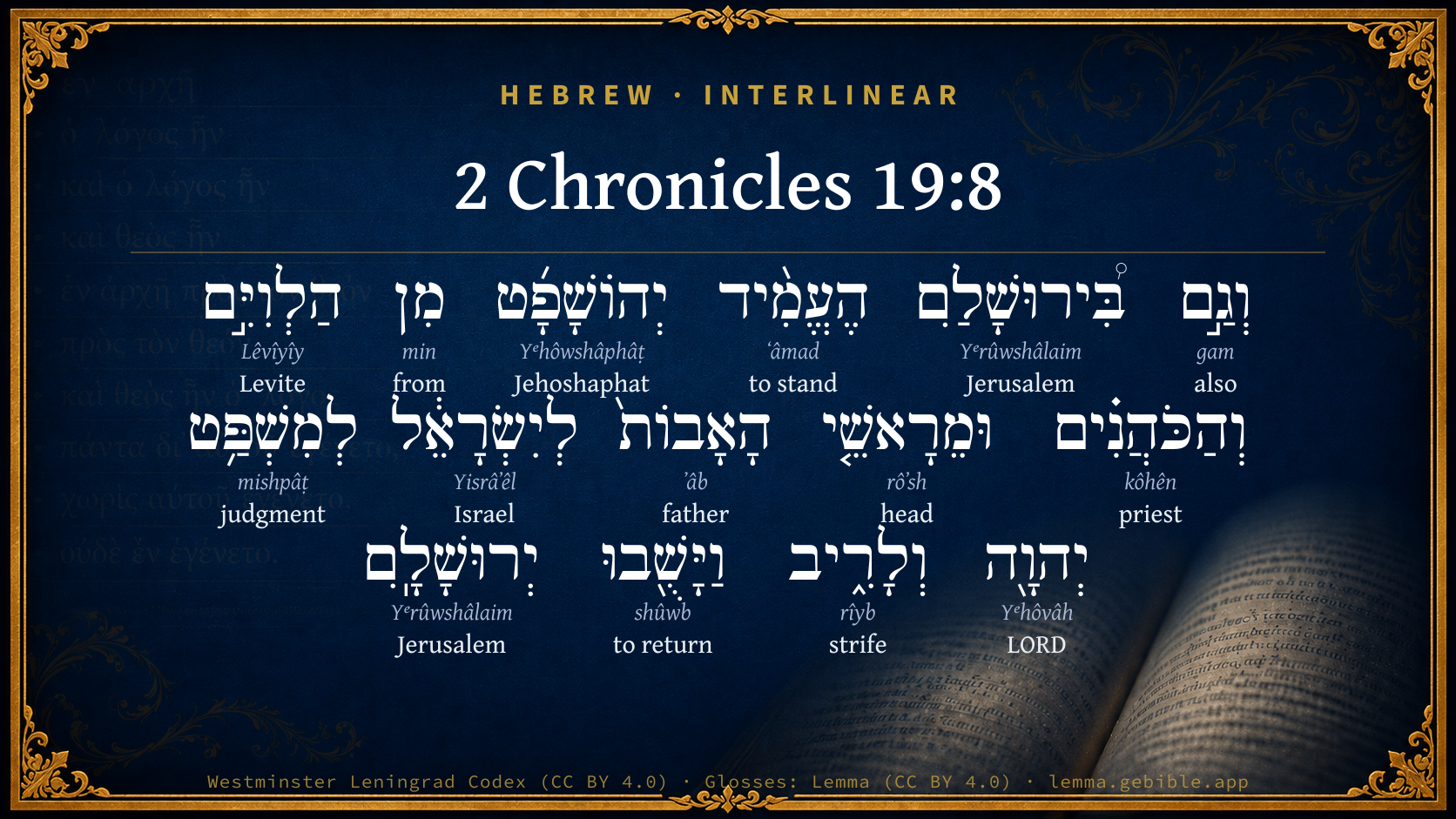
  1. וְגַ֣ם gam H1571 “and · also” Conjunction + Particle, Accusative
  2. בִּ֠ירוּשָׁלִַם Yᵉrûwshâlaim H3389 “in/at · Jerusalem” Preposition + Noun, Proper
  3. הֶעֱמִ֨יד ʻâmad H5975 “to stand” Verb, Hiphil, Perfect, 3rd Person, Masculine, Singular
  4. יְהוֹשָׁפָ֜ט Yᵉhôwshâphâṭ H3092 “Jehoshaphat” Noun, Proper
  5. מִן min H4480 “from” Preposition
  6. הַלְוִיִּ֣ם Lêvîyîy H3881 “the · Levites” Particle, Definite Article + Noun, Gentilic, Masculine, Plural, Absolute
  7. וְהַכֹּהֲנִ֗ים kôhên H3548 “and · the · priests” Conjunction + Particle, Definite Article + Noun, Common, Masculine, Plural, Absolute
  8. וּמֵרָאשֵׁ֤י rôʼsh H7218 “and · from · heads of” Conjunction + Preposition + Noun, Common, Masculine, Plural, Construct
  9. הָאָבוֹת֙ ʼâb H1 “the · fathers” Particle, Definite Article + Noun, Common, Masculine, Plural, Absolute
  10. לְיִשְׂרָאֵ֔ל Yisrâʼêl H3478 “to/for · Israel” Preposition + Noun, Proper
  11. לְמִשְׁפַּ֥ט mishpâṭ H4941 “to/for · judgment of” Preposition + Noun, Common, Masculine, Singular, Construct
  12. יְהוָ֖ה Yᵉhôvâh H3068 “LORD” Noun, Proper
  13. וַיָּשֻׁ֖בוּ shûwb H7725 “and · to return” Conjunction + Verb, Qal, Sequential Imperfect, 3rd Person, Masculine, Plural
  14. יְרוּשָׁלִָֽם Yᵉrûwshâlaim H3389 “Jerusalem” Noun, Proper

About this verse

These counts appear in no published source. They are computed here, from the morphology-tagged text and Lemma’s own curated glosses. What Lemma adds →

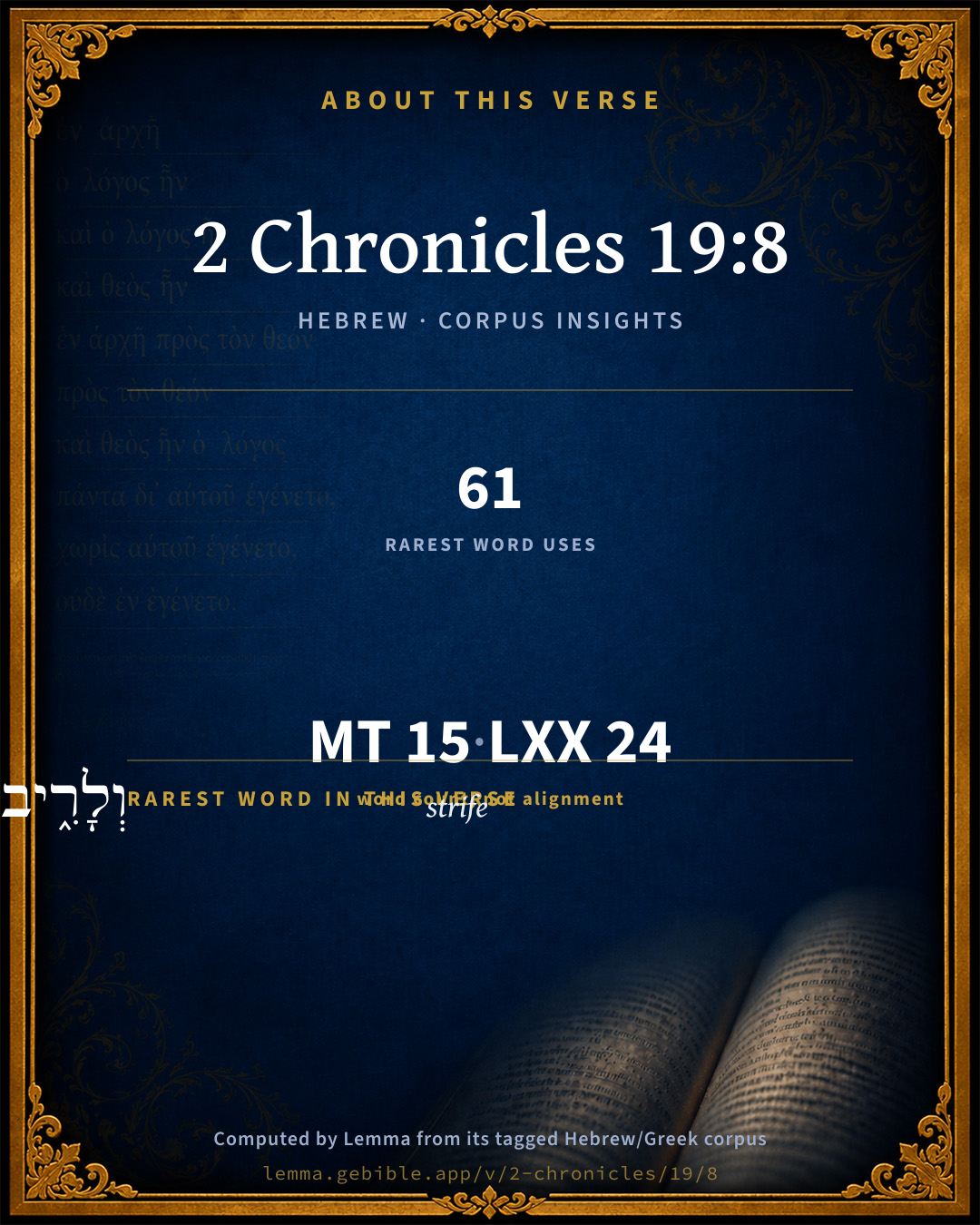
15
words
14
distinct lemmas
Historical
section

Grammatical profile

  • 2 verbs
  • 11 nouns
  • 1 preposition
  • 1 particle

Verb forms

  • הֶעֱמִ֨יד Hiphil · Perfect
  • וַיָּשֻׁ֖בוּ Qal · Sequential Imperfect

Repetition

A word recurs within this verse — often emphatic in Hebrew:

  • בִּ֠ירוּשָׁלִַם Jerusalem H3389 ×2

Hebrew & Septuagint length

In English translation the verse runs 34 words from the Hebrew and 30 from the Septuagint (LXX English) — closely comparable.

A rough comparison of the two English renderings, which tokenize alike — not a word-level alignment.

Word counts can differ between the Hebrew and the Greek without any difference in meaning — e.g. the Hebrew direct-object marker אֵת has no separate Greek word, and Greek often adds the article ὁ.

In the original languages it is 15 Hebrew tokens and 24 Greek tokens — but the two are counted differently (Hebrew bundles its prefixes and suffixes into one token; the Greek is in lemma form), so that isn’t a like-for-like length.

Cross-references

7

Topical passages linked to 2 Chronicles 19:8 in the Treasury of Scripture Knowledge — connected by theme and wording, ordered by reader-vote popularity; previews shown in the World English Bible.

  • 2 Chronicles 17:8–9 and with them the Levites, even Shemaiah, and Nethaniah, and Zebadiah, and Asahel, and Shemiramoth, and Jehonathan, and Adonijah, and Tobijah, and Tob-adonijah, the Levites; and with them Elishama and Jehoram, the priests.
  • Exodus 18:19–26 Listen now to my voice. I will give you counsel, and God be with you. You represent the people before God, and bring the causes to God.
  • Deuteronomy 17:8–13 If there arise a matter too hard for you in judgment, between blood and blood, between plea and plea, and between stroke and stroke, being matters of controversy within your gates; then shall you arise, and go up to the place which Yahweh your God shall choose;
  • Deuteronomy 21:5 The priests the sons of Levi shall come near; for them Yahweh your God has chosen to minister to him, and to bless in the name of Yahweh; and according to their word shall every controversy and every stroke be.
  • Deuteronomy 25:1 If there be a controversy between men, and they come to judgment, and [the judges] judge them; then they shall justify the righteous, and condemn the wicked;
  • 1 Chronicles 23:4 Of these, twenty-four thousand were to oversee the work of the house of Yahweh; and six thousand were officers and judges;
  • 1 Chronicles 26:29 Of the Izharites, Chenaniah and his sons were for the outward business over Israel, for officers and judges.

Cross-references courtesy of OpenBible.info (CC BY 4.0).

Hebrew and Greek witnesses Masoretic Hebrew ↔ Greek Septuagint

The same verse in the two great witnesses to the Old Testament, shown verse-for-verse.

These are two independent witnesses, not word-aligned to each other, and the Septuagint is shown in lemma (dictionary) form.

Hebrew 2 Chronicles 19:8 Masoretic · Westminster Leningrad Codex

וְגַ֣ם בִּ֠ירוּשָׁלִַם הֶעֱמִ֨יד יְהוֹשָׁפָ֜ט מִן הַלְוִיִּ֣ם וְהַכֹּהֲנִ֗ים וּמֵרָאשֵׁ֤י הָאָבוֹת֙ לְיִשְׂרָאֵ֔ל לְמִשְׁפַּ֥ט יְהוָ֖ה וְלָרִ֑יב וַיָּשֻׁ֖בוּ יְרוּשָׁלִָֽם

Moreover in Jerusalem did Jehoshaphat set of the Levites and the priests, and of the heads of the fathers' [houses] of Israel, for the judgment of Yahweh, and for controversies. They returned to Jerusalem.

World English Bible · Public Domain

Greek LXX 2 Chronicles 19:8 Septuagint · lemma form

καί γάρ ἐν ἰερουσαλήμ καταἵστημι ιωσαφατ ὁ ἱερεύς καί ὁ λευείτης καί ὁ πατριάρχης ἰσραήλ εἰς κρίσις κύριος καί κρίνω ὁ καταοἰκέω ἐν ἰερουσαλήμ

Moreover Josaphat appointed in Jerusalem some of the priests, and Levites, and heads of houses of Israel, for the judgment of the Lord, and to judge the dwellers in Jerusalem.

LXX2012 (modern English Septuagint) · Public Domain

On this verse, Adam Clarke's Commentary discusses the Septuagint’s reading. Read the note in Commentary ↓

Hebrew: Westminster Leningrad Codex (CC BY 4.0). Greek: Septuagint (public domain); English from LXX2012 (modern English Septuagint) (Public Domain). How the Septuagint differs from the Hebrew →

Commentary

Notes on 2 Chronicles 19:8 from classic Christian and Jewish commentators (each source and its license shown beneath its notes). The classic Christian expositions comment on the surrounding passage and are grouped to its opening verse, so a note may address several verses; the Jewish commentaries on the Tanakh (Rashi and others) are per-verse, so they appear only where the commentator wrote on this verse.

Lemma curates 59 commentaries, every one of them public domain or Creative Commons licensed, each selected and text-cleaned for this edition rather than reprinted as found. About our sources →

Jamieson, Fausset & Brown

Robert Jamieson, A. R. Fausset & David Brown

TO THE PRIESTS AND LEVITES. (Ch2 19:8-11)

set of the Levites . . . priests, and of the chief of the fathers of Israel--A certain number of these three classes constituted a supreme court, which sat in Jerusalem to review appellate cases from the inferior courts. It consisted of two divisions: the first of which had jurisdiction in ecclesiastical matters; the second, in civil, fiscal, and criminal cases. According to others, the two divisions of the supreme court adjudicated: the one according to the law contained in the sacred books; the other according to the law of custom and equity. As in Eastern countries at the present day, the written and unwritten law are objects of separate jurisdiction.

Next: 2 Chronicles Chapter 20

Jamieson, Fausset & Brown — Commentary Critical and Explanatory on the Whole Bible (1871) — public domain (CC PDM 1.0). Text via the HelloAO Bible API.

Trapp's Complete Commentary

John Trapp

2Ch 19:8 Moreover in Jerusalem did Jehoshaphat set of the Levites, and [of] the priests, and of the chief of the fathers of Israel, for the judgment of the LORD, and for controversies, when they returned to Jerusalem.

Ver. 8. Moreover, in Jerusalem did Jehoshaphat set.] He constituted the high senate or council of the Sanhedrim in the chief city; these were to judge in cases most intricate, according to Deu 17:8-9, and to receive appeals from inferior courts.

John Trapp, A Commentary or Exposition upon All the Books of the Old and New Testament (1647–1656) — public domain. Text from a community e-Sword module.

Joseph Benson's Commentary

2Ch 19:8. The chief of the fathers of Israel — Who were not priests, or Levites, but such persons of other tribes as were most eminent for their dignity, ability, and integrity. But whether these persons made up one court, called the sanhedrim, by which all causes, ecclesiastical and civil, were decided; or there were two distinct courts, the one ecclesiastical, consisting of the priests and Levites, the other civil, consisting of the chief of the fathers of Israel, it is not easy to determine. For the judgment of the Lord — For matters concerning the law and worship of God. For controversies — For matters of difference between man and man. When they returned — When Jehoshaphat and his company were returned to Jerusalem, he made this order concerning establishing judges there.

Joseph Benson's Commentary on the Old and New Testaments (1811–1818) — public domain. Text from a community e-Sword module.

Geneva Bible (1599)

Geneva Bible translators

The Priests and Levites, which should judge matters according to the word of the Lord.

Geneva Bible (1599) marginal notes — public domain. Text via Bolls.life.

Adam Clarke's Commentary

Verse 8. And for controversies, when they returned to Jerusalem.] Who were they that returned to Jerusalem? Some suppose that it means Jehoshaphat and his courtiers, who returned to Jerusalem after the expedition mentioned 2Ch 19:4: but if this were so, or if the text spoke of any person returning to Jerusalem, would not לירושלם lirushalem, TO Jerusalem, and not the simple word ירושלם Yerushalem, without the preposition, be used?

Learned men have supposed, with great plausibility, that the word וישבו vaiyashubu, "and they returned," should be written יושבי yoshebey, "the inhabitants," and that the words should be read, And for the controversies of the inhabitants of Jerusalem. That this was the original reading is very probable from its vestiges in the Vulgate, habitatoribus ejus, "its INHABITANTS;" and in the Septuagint it is found totidem verbis, Και κρινειν τους κατοικουντας εν Ἱερουσαλημ, And to judge the inhabitants of Jerusalem.

There is a clause in 2Ch 34:9 where we have a similar mistake in our version: And they returned to Jerusalem, where the false keri, or marginal note, directs it, in opposition to common sense and ALL the versions, to be read and they returned, which our translation has unhappily followed.

Adam Clarke's Commentary on the Bible (1810–1826) — public domain. Text from a community e-Sword/MySword module.

Ellicott's Commentary for English Readers

(8) Did . . . set.—Appointed some of the Levites.

Chief of the fathers.—Heads of the clans of families. (Comp. Exo_18:21-26; Deu_1:15-17, where the judicial functions of the family ‘chiefs are said to have been ordained by Moses.) The 6,000 Levites set apart by David to be writers (shôterîm) and judges (1Ch_23:4) appear to have been intended to act as their assessors, as being professional experts in the Law. In this measure, it is probable that David merely systematised traditional usage. Jehoshaphat re-organised the administration of justice throughout the country, and established a superior tribunal, or High Court of Appeal, in the capital, such as Deu_17:8-12 prescribe.

For the judgment of the Lord.—Comp. 2Ch_19:11 : “For every matter of Jehovah,” i.e., for all ecclesiastical as opposed to civil causes. The latter are here called “controversies” (rîbh, strife, litigation), and in 2Ch_19:11, “every matter of the king.”

When.—And. There should be a full-stop at “controversies.” “And they returned to Jerusalem” refers to the return of the Royal Commission of 2Ch_19:4. So Syriac and Arabic, which make the clause begin 2Ch_19:9 : “And he returned to Jerusalem, charged them, and said to them.”

A Bible Commentary for English Readers, edited by Charles John Ellicott (1878–1897) — public domain. Text from a community e-Sword module.

The Cambridge Bible for Schools and Colleges

gen. ed. J. J. S. Perowne

8. the chief of the fathers of Israel] R.V. the heads of the fathers’ houses of Israel.

for the judgment of the Lord, and for controversies] By the first expression the Chronicler no doubt refers to matters regarding which some decision could be found in the Law of the Lord (i.e. the Pentateuch). The second (“controversies”) probably means civil disputes for which arbitration rather than a strictly legal decision was suitable.

when they returned to Jerusalem] R.V. And they returned to Jerusalem. These words seem to be corrupt; read, and they (i.e. the judges appointed by Jehoshaphat) dwelt in Jerusalem. The most difficult cases could always be decided in Jerusalem, because the judges were always there.

The Cambridge Bible for Schools and Colleges (gen. ed. J. J. S. Perowne; Cambridge University Press, 1878–1918) — public domain. Text from a community e-Sword module.

John Gill's Exposition

And he charged them,.... The members of the court at Jerusalem:

saying, thus shall ye do in the fear of the Lord, faithfully, and with a perfect heart; judge righteously and impartially, as men fearing God, true to the trust reposed in them, and sincere and upright in heart and actions, having nothing else in view but the glory of God, and the good of men.

John Gill's Exposition of the Whole Bible (1746–1763) — public domain (CC PDM 1.0). Text via the HelloAO Bible API.

Albert Barnes' Notes on the Bible

The “fathers of Israel” are the heads of families; the chief of the fathers” are the great patriarchal chiefs, the admitted heads of great houses or clans. They were now admitted to share in the judicial office which seems in David’s time to have been confined to the Levites 1Ch 23:4.

For the judgment of the Lord, and for controversies - By the former are meant disputed cases concerning the performance of religious obligations. In “controversies” are included all the ordinary causes, whether criminal or civil.

When they returned to Jerusalem - Rather, “and they returned to Jerusalem,” a clause which if detached from the previous words and attached to 2Ch 19:9, gives a satisfactory sense.

Albert Barnes' Notes on the Bible (1834–1885) — public domain. Text from a community e-Sword/MySword module.

Haydock's Catholic Bible Commentary

And the. Heb. "of the Lord, and for disputes among the people among themselves, (H.) and they returned, (v. 4) or dwelt at Jerusalem." C. --- Sept. "to judge the inhabitants of," &c. Josephus (ix. 1.) says, "he returned." Syriac, "And being returned....he exhorted."

George Leo Haydock (1774–1849), Haydock's Catholic Family Bible and Commentary, 1859 edition — public domain. Excludes Psalms (Douay-Rheims chapter numbering differs from Protestant) and Deuterocanonical books (Catholic canon only).

Matthew Poole's English Annotations

The chief of the fathers of Israel; who were not priests and Levites, but such persons of other tribes as were most eminent for their dignity, ability, and integrity. But whether these persons made up one court, called the Sanhedrim, by which all causes ecclesiastical and civil were decided; or there were two distinct courts, the one ecclesiastical, consisting of the priests and Levites; the other civil, consisting of the chief of the fathers of Israel; belongs to another place to determine, and requires more words than the nature of this work can permit.

For the judgment of the Lord, i.e. for sacred matters concerning the laws, and worship, and service of God.

For controversies; for matters of difference between man and man.

When they returned to Jerusalem, i.e. when Jehoshaphat and his company were returned to Jerusalem, then he made this order concerning establishing judges there. But so this last clause may seem superfluous and tautological, being more than implied in the beginning of the verse. Or rather,

when they, i. e. the causes and controversies last mentioned, shall return, or be returned, to Jerusalem, i.e. when the causes shall be so difficult that the judges ordained in every city cannot determine them; or, when your brethren that dwell in every city shall come to you, as it is expressed, 2Ch 19:10, appealing from their city courts, to the great court or council at Jerusalem; of which See Poole "Exo 18:26"; See Poole "Deu 1:17"; See Poole "Deu 17:8". As for the phrase, not only persons, but things, are said to return, or be returned, as blood, 1Ki 2:33, and clouds, Ecc 12:2, and reproach, Hos 12:14. If it be further objected, that these causes were never brought to Jerusalem before, and therefore cannot be properly said to be returned thither; that may be answered both from the usage of our law, wherein such causes are said to be returned to Westminster, which never were there before; and from the use of Scripture, wherein sinners are commonly said to return to the Lord, though they had never been with the Lord in that sense before, but were estranged from God even from the womb till the time of their conversion. And the dust, i.e. man’s body, is said to return to the earth, Ecc 12:7, though it was never there before.

Matthew Poole's English Annotations on the Holy Bible (1683–1685) — public domain. Text from a community e-Sword/MySword module.

Whedon's Commentary on the Bible

Daniel D. Whedon

8. Jerusalem… Levites… priests… chief of the fathers — From this we need not suppose that no Levites, or priests, or chief fathers were made judges in the other cities. Probably the judges in every city were selected from one or all of these three classes. Comp. 2Ch_23:4; 2 Chronicles 2 Chronicles26:29, notes. But at Jerusalem was the supreme tribunal, to which cases came for final decision.

For the judgment of the Lord — Equivalent to “all matters of the Lord,” in 2Ch_19:11; that is, all matters pertaining to religion and the worship of Jehovah.

And for controversies — Civil suits, as distinguished from religions or ecclesiastical; called in 2Ch_19:11, “all the king’s matters.”

When they returned to Jerusalem — Rather, and they returned, etc.

That is, the king and his attendants, who went out (2Ch_19:4) from Jerusalem to settle the judicial interests of the kingdom, returned. This sentence ought to be connected with the verse immediately following.

Daniel D. Whedon (gen. ed.), Commentary on the Old and New Testaments (1874–1909) — public domain. Text from a community e-Sword module.

The Pulpit Commentary

This and the following three verses close the immediate subject by stating with some emphasis the reform in the metropolis itself, of the "supreme tribunal," as it has been called (Exo_18:19, Exo_18:20, Exo_18:26; Deu_17:9, Deu_17:10, Deu_17:12) composed of Levites, priests, and chief of the fathers of Israel; i.e. probably heads of the whole family that went by the same name. Of course every father was head of his own family, but only one (such as in modern times by primogeniture the eldest son) the representative head of the entire family, and under this expression is no doubt naturally set forth only those families that were of some relative consideration or distinction. For the judgment of the Lord, and for controversies. Considering the plainer distinction in the language of vex. 11, there can be no doubt that the words, "for the judgment of the Lord," do not intend simply to describe godly judgment, but point to dues payable to the Lord in some religious aspect: "Render to Caesar and to God the things that are God"s" (Mat_22:21; Mar_12:17; Luk_20:25) while the words, "and for controversies," point to the mutual strifes of the people. When they returned; Hebrew, "and they returned." It has been proposed to remove this clause so as to begin the next verse with it (and so the Revised Version shows as a clause by itself, "And they returned to Jerusalem"), and, to make this fit the better, the word did in the first line of the verse is changed into "had." It is, however, possible to render the clause, "And they dwelt in Jerusalem," which would make a far mere coherent sense, and would mark the permanence and stationariness of this chief court.

The Pulpit Commentary (1880–1919), ed. H.D.M. Spence-Jones & Joseph S. Exell — public domain. Text from a community e-Sword module.

John Wesley's Explanatory Notes

The fathers - Persons of other tribes eminent for their dignity, ability and integrity. But whether these persons made up one court, called the Sanhedrim, by which all causes ecclesiastical and civil were decided; or there were two distinct courts, the one ecclesiastical, consisting of the priests and Levites; the other civil, consisting of the chief of the fathers of Israel, it is not easy to determine. The Lord - For matters concerning the laws and worship, of God. Controversies - For matters of difference between man and man. When - When Jehoshaphat and his company were returned to Jerusalem, he made this order concerning establishing Judges there.

John Wesley, Explanatory Notes Upon the Whole Bible (1754–1765) — public domain. Text via the GEBible commentary corpus.

unfoldingWord translationNotes

Door43 World Missions Community

heads of the ancestral houses

Here "heads" is a metaphor for the most important part, and "houses" represents families. AT: "leaders of the ancient families" (See: Metaphor and Metonymy)

for carrying out judgment for Yahweh

The abstract noun "judgment" can be translated using the verb "to judge." AT: "for judging the people for Yahweh" or "for judging on Yahweh's behalf" (See: Abstract Nouns)

for the sake of disputes

"for settling disputes" or "for resolving arguments"

You must serve in reverence for Yahweh

The abstract noun "reverence" can be translated as a verb. AT: "You must serve while fearing Yahweh" or "You must serve while respecting Yahweh" (See: Abstract Nouns)

with your whole heart

Here "heart" represents the whole person. AT: "with your whole being" (See: Metonymy)

translationWords

appoint

Levi

priest

judge

faithful

perfect

heart

unfoldingWord translationNotes — © Distant Shores Media and the Door43 World Missions Community, licensed CC BY-SA 4.0. Source: git.door43.org/Door43/en_tn.

Rashi

Rabbi Shlomo Yitzchaki (Rashi)

And also in Jerusalem...set up judges even though he himself was in Jerusalem.

for the judgment of the Lord and for quarrels It is appropriate to use the term “judgment” (לְמִשְׁפַּט) concerning money matters, an example being (Num. 27:11) “and it shall be for the Children of Israel as a legal norm (לְחֻקַּת מִשְׁפָּט).” “And for quarrels” (וְלָרִיב) refers to capital cases and bodily injuries, an example being (Exod. 21:18) “And if men quarrel, etc.” (יְרִיבוּן).

Rashi on the Tanakh — English translations: “The Judaica Press complete Tanach with Rashi, translated by A. J. Rosenberg” (CC BY 4.0); “Pentateuch with Rashi's commentary by M. Rosenbaum and A.M. Silbermann, 1929-1934” (public domain); “The Metsudah Tanach series, Lakewood, N.J” (CC BY 4.0); and “The Book of Joshua, Metsudah Publications, 1997” (CC BY 4.0). Text via Sefaria.

Lesson kit

Teaching starters — assembled from the data on this page, not authored interpretation. Every prompt links to the verse data it draws on. Edit before teaching.

2 Chronicles, in the Historical, opens this verse with 15 words (14 distinct Hebrew lemmas). Its most distinctive word is rîyb (“strife”). A historical commentator’s framing appears above. Read the whole chapter for the surrounding context.

Discussion questions

  1. How does “strife” (rîyb) shape what this verse is saying?
  2. 2 Chronicles 17:8–9 shares this passage’s theme. How do the two illuminate each other?
  3. “Jerusalem” occurs 2× in this one verse. What is the effect of the repetition?
  4. These translations render this verse differently. What is at stake in choosing one wording over another?
  5. The verb «הֶעֱמִ֨יד» is Hiphil Perfect. How does its form color the action?
  6. Reading how Jamieson, Fausset & Brown and Trapp's Complete Commentary read this verse, where do the two commentators agree and where do they part?

Things to notice

Reading settings

Reading text

Shown beneath each verse's original-language words.

Old Testament
Old Testament edition

Read the OT as the Masoretic Hebrew (MT) or the Greek Septuagint (LXX).

English shown for the Greek Septuagint (in the Hebrew ↔ Greek comparison).

Comparing translations? Open the Compare panel on any verse page to stack up to four side by side.