
2 Chronicles 11:4

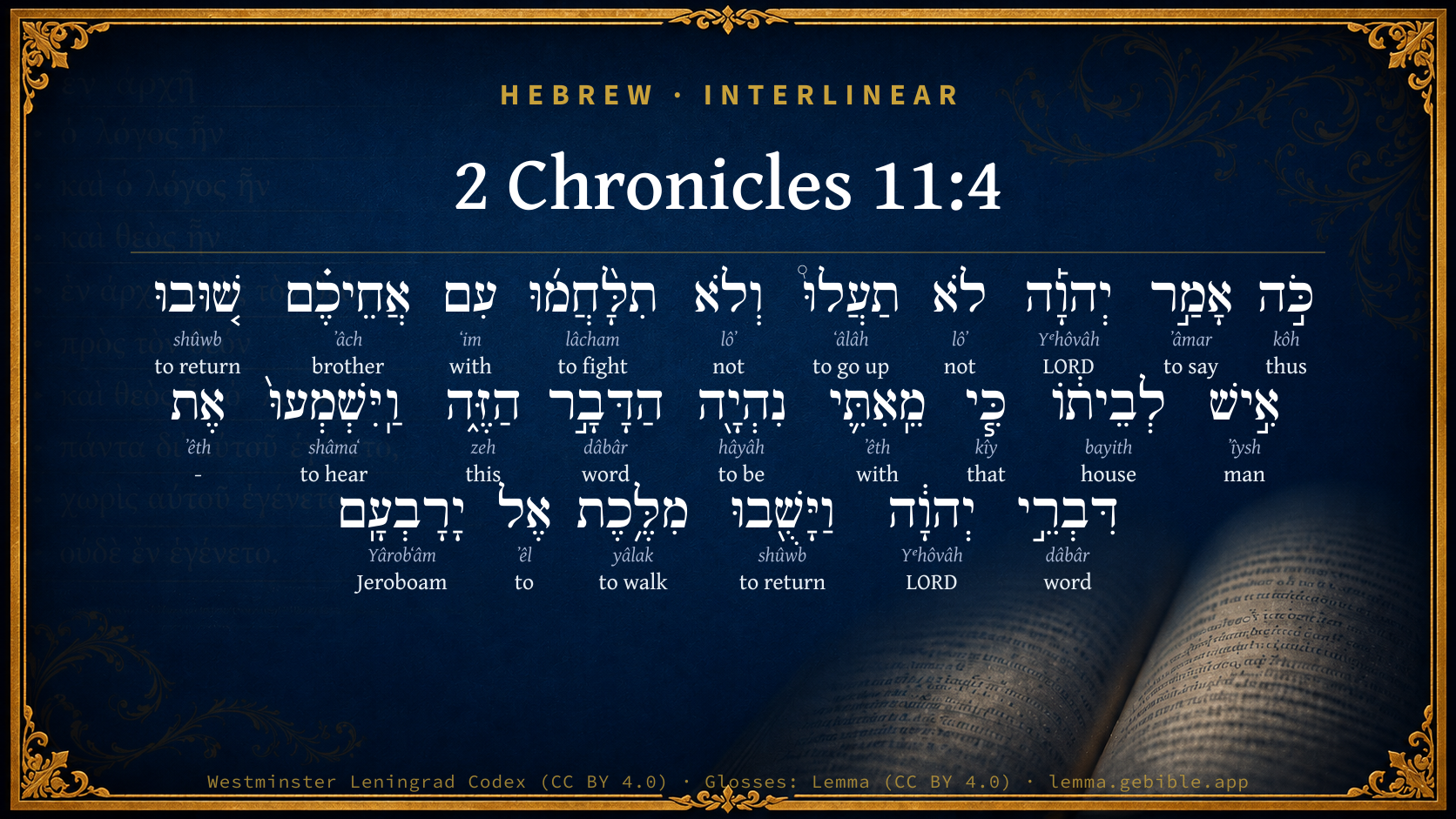
Hebrew (Westminster Leningrad Codex) 2 Chronicles 11:4 appears in the Hebrew Old Testament. The text above is from the Westminster Leningrad Codex. Each word links to its Strong’s number, a concise gloss, and parsing drawn from the Open Scriptures Hebrew Bible morphology. Click any word for its full Brown-Driver-Briggs (BDB) entry.
Download image
Cite this verse

2 Chronicles 11:4 (World English Bible). Public Domain. Lemma interlinear Bible study tool, https://lemma.gebible.app/v/2-chronicles/11/4.

Show BibTeX & RIS
BibTeX
RIS
English Translation
Thus says Yahweh, You shall not go up, nor fight against your brothers: return every man to his house; for this thing is of me. So they listened to the words of Yahweh, and returned from going against Jeroboam.
World English Bible · Public Domain
Download a study sheet

One document with this verse’s original text, its word-by-word gloss line, the meaning frame, cross-references with their text, attributed commentary, and full source and license credits — printable, and it pastes into notes with its structure intact.

This verse Autodidact and up

Study sheet (.html) Plain text (.txt)

A passage Seminary Student

Up to 50 verses in one chapter. A passage sheet keeps up to 6 commentary sources and 12 cross-references per verse, in the order this page ranks them, and says so on the sheet whenever that leaves anything out. Ask for a single verse and you get the Autodidact verse sheet above.

Everything on this page stays free to read, with no account — the sheet is a download of what is already on screen, not access to it.

Want to remove ads? Support Godless Engineer
Compare translations 3

The same verse in 3 English versions, stacked beneath the original-language interlinear above. Click any original word for its lexicon entry.

Each is an independent rendering of the whole verse — the interlinear is not word-aligned to these translations.

Highlighted words mark where these versions differ — a whole-verse word diff, not a word-by-word alignment.

  • World English Bible Public Domain
    Thus says Yahweh, You shall not go up, nor fight against your brothers: return every man to his house; for this thing is of me. So they listened to the words of Yahweh, and returned from going against Jeroboam.
  • King James Version Public Domain
    Thus saith the LORD, Ye shall not go up, nor fight against your brethren: return every man to his house: for this thing is done of me. And they obeyed the words of the LORD, and returned from going against Jeroboam.
  • unfoldingWord Literal Text CC BY-SA 4.0
    ‘Thus says Yahweh, “Do not go up and do not fight with your brothers. Return, each to his house, for from with me, this thing is.”’” And they listened to the words of Yahweh and returned from going against Jeroboam.

unfoldingWord Literal Text — © unfoldingWord, licensed CC BY-SA 4.0. Word-aligned USFM3 via Door43 (git.door43.org/unfoldingWord/en_ult).

Versions to compare (up to 4)

3 of 4 selected

Show all 18 translations

Every available English version of this verse, each an independent rendering of the whole verse.

  • World English Bible Public Domain
    Thus says Yahweh, You shall not go up, nor fight against your brothers: return every man to his house; for this thing is of me. So they listened to the words of Yahweh, and returned from going against Jeroboam.
  • Berean Standard Bible Public Domain
    that this is what the LORD says: ‘You are not to go up and fight against your brothers. Each of you must return home, for this word is from Me.’” So they listened to the words of the LORD and turned back from going against Jeroboam.
  • Majority Standard Bible Public Domain
    that this is what the LORD says: ‘You are not to go up and fight against your brothers. Each of you must return home, for this is My doing.’” So they listened to the words of the LORD and turned back from going against Jeroboam.
  • King James Version Public Domain
    Thus saith the LORD, Ye shall not go up, nor fight against your brethren: return every man to his house: for this thing is done of me. And they obeyed the words of the LORD, and returned from going against Jeroboam.
  • American Standard Version (1901) Public Domain
    Thus saith Jehovah, Ye shall not go up, nor fight against your brethren: return every man to his house; for this thing is of me. So they hearkened unto the words of Jehovah, and returned from going against Jeroboam.
  • Revised Version (1885) Public Domain
    Thus saith the LORD, Ye shall not go up, nor fight against your brethren: return every man to his house; for this thing is of me. So they hearkened unto the words of the LORD, and returned from going against Jeroboam.
  • Geneva Bible (1599) Public Domain
    Thus sayth the Lord, Ye shall not goe vp, nor fight against your brethren: returne euery man to his house: for this thing is done of me. They obeyed therfore the word of the Lord, and returned from going against Ieroboam.
  • Douay-Rheims (1899) Public Domain
    Thus saith the Lord: You shall not go up, nor fight against your brethren: let every man return to his own house, for by my will this thing has been done. And when they heard the word of the Lord, they returned, and did not go against Jeroboam,
  • Young's Literal Translation Public Domain
    Thus said Jehovah, Ye do not go up nor fight with your brethren, turn back each to his house, for from Me hath this thing been;' and they hear the words of Jehovah, and turn back from going against Jeroboam.
  • Literal Standard Version CC BY-SA 4.0
    Thus said YHWH: You do not go up nor fight with your brothers! Let each return to his house, for this thing has been from Me”; and they hear the words of YHWH, and turn back from going against Jeroboam.
  • Unlocked Literal Bible CC BY-SA 4.0
    'Yahweh says this, “You must not attack or make war against your brothers. Everyone must return to his own house, for I have caused this to happen.”'” So they obeyed the words of Yahweh and turned back from attacking Jeroboam.
  • unfoldingWord Literal Text CC BY-SA 4.0
    ‘Thus says Yahweh, “Do not go up and do not fight with your brothers. Return, each to his house, for from with me, this thing is.”’” And they listened to the words of Yahweh and returned from going against Jeroboam.
  • Darby Bible Public Domain
    Thus saith Jehovah: Go not up, nor fight with your brethren; return every man to his house; for this thing is from me. And they hearkened to the words of Jehovah, and returned from going against Jeroboam.
  • World Messianic Bible Public Domain
    ‘The LORD says, “You shall not go up, nor fight against your brothers! Every man return to his house; for this thing is of me.”’” So they listened to the LORD’s words, and returned from going against Jeroboam.
  • Webster's Bible Public Domain
    Thus saith the LORD, Ye shall not go up, nor fight against your brethren: return every man to his house: for this thing is done by me. And they obeyed the words of the LORD, and returned from going against Jeroboam.
  • Free Bible Version CC BY-SA 4.0
    ‘This is what the Lord says: Don't fight against your relatives. Every one of you, go home! For what has happened is down to me.’” So they obeyed what the Lord told them and did not fight against Jeroboam.
  • Bible in Basic English Public Domain
    The Lord has said, You are not to go to war against your brothers: let every man go back to his house, for this thing is my purpose. So they gave ear to the words of the Lord and were turned back from fighting against Jeroboam.
  • JPS Tanakh (1917) Public Domain
    Thus saith the LORD: Ye shall not go up, nor fight against your brethren; return every man to his house, for this thing is of Me.' So they hearkened unto the words of the LORD, and returned from going against Jeroboam.

Literal Standard Version (2020), Covenant Press — licensed CC BY-SA 4.0. Text via the HelloAO Bible API (eBible.org). Unlocked Literal Bible (unfoldingWord) — licensed CC BY-SA 4.0. Text via the HelloAO Bible API (eBible.org). unfoldingWord Literal Text — © unfoldingWord, licensed CC BY-SA 4.0. Word-aligned USFM3 via Door43 (git.door43.org/unfoldingWord/en_ult). Free Bible Version, Dr. Jonathan Gallagher — licensed CC BY-SA 4.0. Text via the HelloAO Bible API (eBible.org).

Word by word

More ways to search: Search by grammar → Find every occurrence → Compare this word →

Practice this passage: Drill this verse → Learn its vocabulary →

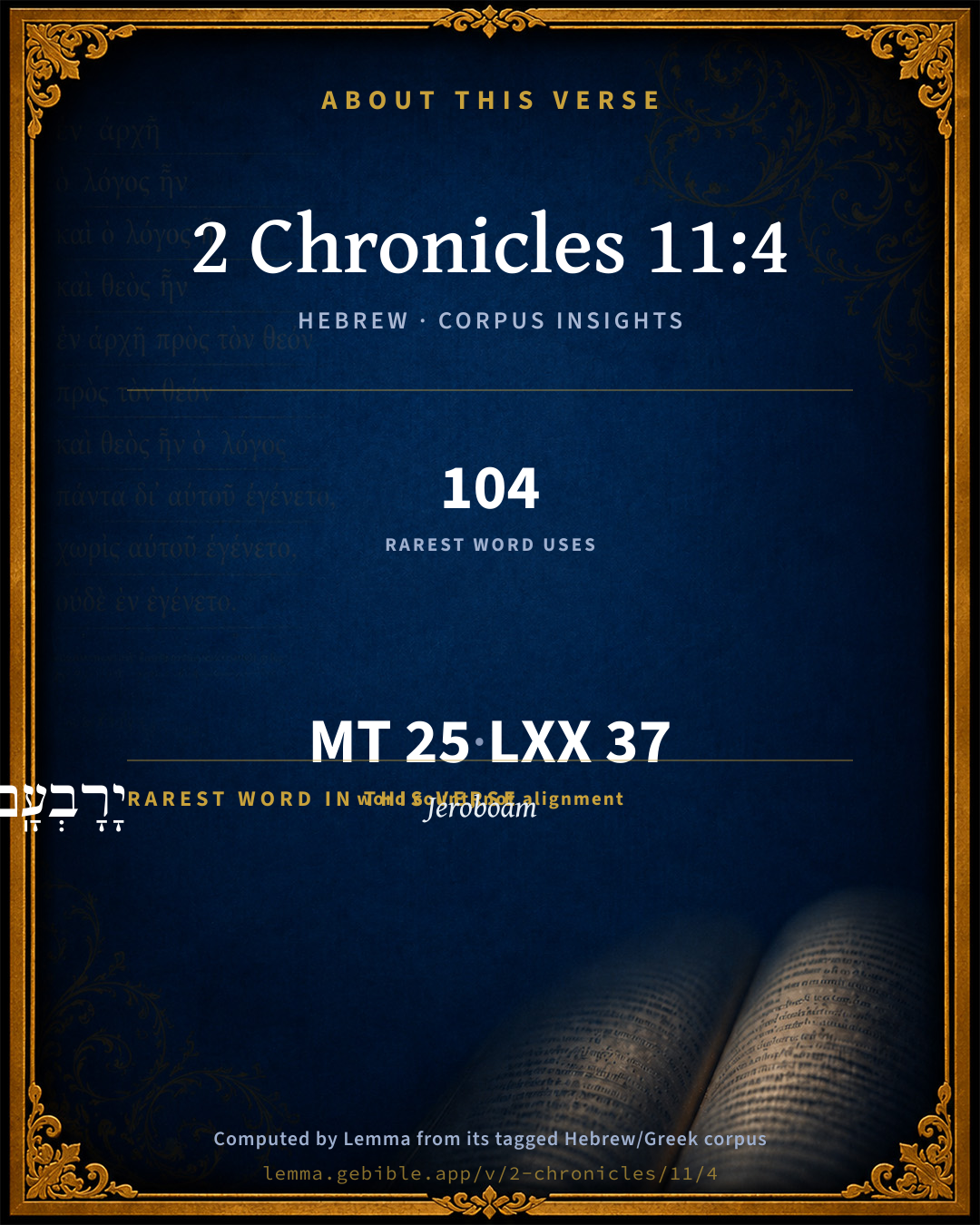
יָרָבְעָֽם
Yârobʻâm
H3379
“Jeroboam”
Noun, Proper
Part of Speech
Noun
Type
Proper
Full BDB Definition

Origin: from H7378 and H5971

TWOT: None

Jeroboam = "the people will contend" - the first king of the northern kingdom of Israel when the kingdom split at the death of Solomon and the 10 tribes split off from Judah and Benjamin and the kingdom under Solomon's son Rehoboam; idolatry was introduced at the beginning of his reign - the 8th king of the northern kingdom of Israel, son of Joash, and
  1. כֹּ֣ה kôh H3541 “thus” Adverb
  2. אָמַ֣ר ʼâmar H559 “to say” Verb, Qal, Perfect, 3rd Person, Masculine, Singular
  3. יְהוָ֡ה Yᵉhôvâh H3068 “LORD” Noun, Proper
  4. לֹא lôʼ H3808 “not” Particle, Negative
  5. תַעֲלוּ֩ ʻâlâh H5927 “to go up” Verb, Qal, Imperfect, 2nd Person, Masculine, Plural
  6. וְלֹא lôʼ H3808 “and · not” Conjunction + Particle, Negative
  7. תִלָּ֨חֲמ֜וּ lâcham H3898 “to fight” Verb, Niphal, Imperfect, 2nd Person, Masculine, Plural
  8. עִם ʻim H5973 “with” Preposition
  9. אֲחֵיכֶ֗ם ʼâch H251 “brothers · your” Noun, Common, Masculine, Plural, Construct + Suffix, Personal, 2nd Person, Masculine, Plural
  10. שׁ֚וּבוּ shûwb H7725 “return” Verb, Qal, Imperative, 2nd Person, Masculine, Plural
  11. אִ֣ישׁ ʼîysh H376 “man” Noun, Common, Masculine, Singular, Absolute
  12. לְבֵית֔וֹ bayith H1004 “to/for · house · his” Preposition + Noun, Common, Masculine, Singular, Construct + Suffix, Personal, 3rd Person, Masculine, Singular
  13. כִּ֧י kîy H3588 “that” Conjunction
  14. מֵֽאִתִּ֛י ʼêth H854 “from · with · me” Preposition + Preposition + Suffix, Personal, 1st Person, Common, Singular
  15. נִהְיָ֖ה hâyâh H1961 “to be” Verb, Niphal, Perfect, 3rd Person, Masculine, Singular
  16. הַדָּבָ֣ר dâbâr H1697 “the · word” Particle, Definite Article + Noun, Common, Masculine, Singular, Absolute
  17. הַזֶּ֑ה zeh H2088 “the · this” Particle, Definite Article + Pronoun, Demonstrative, Masculine, Singular
  18. וַֽיִּשְׁמְעוּ֙ shâmaʻ H8085 “and · to hear” Conjunction + Verb, Qal, Sequential Imperfect, 3rd Person, Masculine, Plural
  19. אֶת ʼêth H853 “-” Particle, Direct Object
  20. דִּבְרֵ֣י dâbâr H1697 “words of” Noun, Common, Masculine, Plural, Construct
  21. יְהוָ֔ה Yᵉhôvâh H3068 “LORD” Noun, Proper
  22. וַיָּשֻׁ֖בוּ shûwb H7725 “and · to return” Conjunction + Verb, Qal, Sequential Imperfect, 3rd Person, Masculine, Plural
  23. מִלֶּ֥כֶת yâlak H3212 “from · to walk” Preposition + Verb, Qal, Infinitive Construct
  24. אֶל ʼêl H413 “to” Preposition

About this verse

These counts appear in no published source. They are computed here, from the morphology-tagged text and Lemma’s own curated glosses. What Lemma adds →

25
words
21
distinct lemmas
Historical
section

Grammatical profile

  • 8 verbs
  • 8 nouns
  • 1 pronoun
  • 3 prepositions
  • 1 conjunction
  • 1 adverb
  • 3 particles

Verb forms

  • אָמַ֣ר Qal · Perfect
  • תַעֲלוּ֩ Qal · Imperfect
  • תִלָּ֨חֲמ֜וּ Niphal · Imperfect
  • שׁ֚וּבוּ Qal · Imperative
  • נִהְיָ֖ה Niphal · Perfect
  • וַֽיִּשְׁמְעוּ֙ Qal · Sequential Imperfect
  • וַיָּשֻׁ֖בוּ Qal · Sequential Imperfect
  • מִלֶּ֥כֶת Qal · Infinitive Construct

Repetition

Words recur within this verse — often emphatic in Hebrew:

  • יְהוָ֡ה LORD H3068 ×2
  • שׁ֚וּבוּ to return H7725 ×2
  • הַדָּבָ֣ר word H1697 ×2
  • לֹא not H3808 ×2

Hebrew & Septuagint length

In English translation the verse runs 39 words from the Hebrew and 44 from the Septuagint (LXX English) — closely comparable.

A rough comparison of the two English renderings, which tokenize alike — not a word-level alignment.

Word counts can differ between the Hebrew and the Greek without any difference in meaning — e.g. the Hebrew direct-object marker אֵת has no separate Greek word, and Greek often adds the article ὁ.

In the original languages it is 25 Hebrew tokens and 37 Greek tokens — but the two are counted differently (Hebrew bundles its prefixes and suffixes into one token; the Greek is in lemma form), so that isn’t a like-for-like length.

Cross-references

15

Topical passages linked to 2 Chronicles 11:4 in the Treasury of Scripture Knowledge — connected by theme and wording, ordered by reader-vote popularity; previews shown in the World English Bible.

  • Genesis 50:20 As for you, you meant evil against me, but God meant it for good, to bring to pass, as it is this day, to save many people alive.
  • 1 Kings 11:29–38 It happened at that time, when Jeroboam went out of Jerusalem, that the prophet Ahijah the Shilonite found him in the way; now [Ahijah] had clad himself with a new garment; and they two were alone in the field.
  • 2 Chronicles 10:15–16 So the king didn't listen to the people; for it was brought about of God, that Yahweh might establish his word, which he spoke by Ahijah the Shilonite to Jeroboam the son of Nebat.
  • 2 Chronicles 25:7–10 But there came a man of God to him, saying, O king, don't let the army of Israel go with you; for Yahweh is not with Israel, [to wit], with all the children of Ephraim.
  • 2 Chronicles 28:8–15 The children of Israel carried away captive of their brothers two hundred thousand, women, sons, and daughters, and took also away much spoil from them, and brought the spoil to Samaria.
  • Genesis 13:8 Abram said to Lot, "Please, let there be no strife between me and you, and between my herdsmen and your herdsmen; for we are relatives.
  • 2 Samuel 2:26 Then Abner called to Joab, and said, "Shall the sword devour forever? Don't you know that it will be bitterness in the latter end? How long shall it be then, before you bid the people return from following their brothers?"
  • 1 Kings 22:36 There went a cry throughout the host about the going down of the sun, saying, Every man to his city, and every man to his country.
  • Psalms 33:11 The counsel of Yahweh stands fast forever, The thoughts of his heart to all generations.
  • Hosea 8:4 They have set up kings, but not by me. They have made princes, and I didn't approve. Of their silver and their gold they have made themselves idols, That they may be cut off.
  • Acts 7:26 "The day following, he appeared to them as they fought, and urged them to be at peace again, saying, 'Sirs, you are brothers. Why do you wrong one another?'
  • 1 Corinthians 6:5–8 I say this to move you to shame. Isn't there even one wise man among you who would be able to decide between his brothers?
  • Hebrews 13:1 Let brotherly love continue.
  • 1 Peter 3:8 Finally, be all like-minded, compassionate, loving as brothers, tenderhearted, courteous,
  • 1 John 3:11–13 For this is the message which you heard from the beginning, that we should love one another;

Cross-references courtesy of OpenBible.info (CC BY 4.0).

Hebrew and Greek witnesses Masoretic Hebrew ↔ Greek Septuagint

The same verse in the two great witnesses to the Old Testament, shown verse-for-verse.

These are two independent witnesses, not word-aligned to each other, and the Septuagint is shown in lemma (dictionary) form.

Hebrew 2 Chronicles 11:4 Masoretic · Westminster Leningrad Codex

כֹּ֣ה אָמַ֣ר יְהוָ֡ה לֹא תַעֲלוּ֩ וְלֹא תִלָּ֨חֲמ֜וּ עִם אֲחֵיכֶ֗ם שׁ֚וּבוּ אִ֣ישׁ לְבֵית֔וֹ כִּ֧י מֵֽאִתִּ֛י נִהְיָ֖ה הַדָּבָ֣ר הַזֶּ֑ה וַֽיִּשְׁמְעוּ֙ אֶת דִּבְרֵ֣י יְהוָ֔ה וַיָּשֻׁ֖בוּ מִלֶּ֥כֶת אֶל יָרָבְעָֽם

Thus says Yahweh, You shall not go up, nor fight against your brothers: return every man to his house; for this thing is of me. So they listened to the words of Yahweh, and returned from going against Jeroboam.

World English Bible · Public Domain

Greek LXX 2 Chronicles 11:4 Septuagint · lemma form

ὅδε λέγω κύριος οὐ ἀναβαίνω καί οὐ πολεμέω πρός ὁ ἀδελφός σύ ἀποστρέφω ἕκαστος εἰς ὁ οἶκος αὐτός ὅτι παρά ἐγώ γίγνομαι ὁ ῥῆμα οὗτος καί ἐπιἀκούω ὁ λόγος κύριος καί ἀποστρέφω ὁ μή πορεύομαι ἐπί ιεροβοαμ

Thus says the Lord, You⌃ shall not go up, and you⌃ shall not war against your brethren: return every one to his home; for this thing is of me. And they listened to the word of the Lord, and returned from going against Jeroboam.

LXX2012 (modern English Septuagint) · Public Domain

Hebrew: Westminster Leningrad Codex (CC BY 4.0). Greek: Septuagint (public domain); English from LXX2012 (modern English Septuagint) (Public Domain). How the Septuagint differs from the Hebrew →

Commentary

Notes on 2 Chronicles 11:4 from classic Christian and Jewish commentators (each source and its license shown beneath its notes). The classic Christian expositions comment on the surrounding passage and are grouped to its opening verse, so a note may address several verses; the Jewish commentaries on the Tanakh (Rashi and others) are per-verse, so they appear only where the commentator wrote on this verse.

Lemma curates 59 commentaries, every one of them public domain or Creative Commons licensed, each selected and text-cleaned for this edition rather than reprinted as found. About our sources →

Ellicott's Commentary for English Readers

(4) Thus saith the Lord.—The words of the prophecy are reported as in 1Ki_12:24, omitting “the sons of Israel” after “your brethren.”

This thing is done of me.—Literally, from me became (arose) this matter; viz., of the revolt of the ten tribes. (Comp. 2Ch_10:15 : “For the cause was of God.”)

Words.—“Word,” Kings and the versions here, no doubt rightly, as this is the usual phrase. But comp. 1Sa_15:1.

From going against Jeroboam.—Kings, “To go away, according to the word of the Lord “—a tautology which the chronicler has avoided. The rest of the chapter is wanting in the Syriac and Arabic Versions, which have instead 1Ki_12:25-30; 1Ki_13:34; 1Ki_14:1-9, where they break off abruptly, without finishing Ahijah’s prophecy.

A Bible Commentary for English Readers, edited by Charles John Ellicott (1878–1897) — public domain. Text from a community e-Sword module.

The Cambridge Bible for Schools and Colleges

gen. ed. J. J. S. Perowne

4. is done of me. And they obeyed] R.V. is of me. So they hearkened unto.

The Cambridge Bible for Schools and Colleges (gen. ed. J. J. S. Perowne; Cambridge University Press, 1878–1918) — public domain. Text from a community e-Sword module.

Haydock's Catholic Bible Commentary

Will, to punish the disorders of Solomon, &c. See 3 Kings xii. 24., and Genesis xlv. 8. God knows how to draw good out of evil, without approving the misconduct of men. (Haydock)

George Leo Haydock (1774–1849), Haydock's Catholic Family Bible and Commentary, 1859 edition — public domain. Excludes Psalms (Douay-Rheims chapter numbering differs from Protestant) and Deuterocanonical books (Catholic canon only).

The Pulpit Commentary

This thing is from me; i.e. the punishing disruption; not the precedent causes with the entirety of historical events; this punishing and Wither, sing disruption is not to be "lightly healed" The man who did what caused it, the men who did what caused it, cannot thus each undo what they have done least of all undo it by the appeal of war. They and theirs will have, long as life lasts, as lives last, to go through the baptism of bitter suffering, and leave a heritage of the same for others. Wrought of God.

this thing is done of me." How much has God to do with the events and issues of our life? Speaking in the idiom of the ancient Hebrew writers, we should say Everything. Speaking after our modern fashion, we should say Much; and so much that we are altogether wrong and foolish if we do not take it into account. The words of the text, together with the context, suggest

I THAT GOD DOES MANY THINGS WHICH, ANTECEDENTLY, WE SHOULD NOT EXPECT HE WOULD DO. Who would have expected, apart from his own warnings, that he would bring about the rupture in the kingdom of Israel? How very preferable, in many ways, does it seem to us that that little kingdom should remain united and strong instead of becoming divided and weak! We should have thought that the Divine wisdom would devise some other punishment for Solomon"s vaingloriousness and defection, for Rehoboam"s childish folly, than that which the text tells us was wrought of him; there might have been, we should say, some personal humiliation or some temporary national calamity from which it would soon have revived. But so it was not to be. And though it may yet remain inexplicable, it is certain that this rending of the kingdom in twain was "of God." In the history of our race, in the course of Christianity, we have witnessed or have read of the same thing. Sometimes it has been in the fate of institutions. God has let some prosper that we should have expected him to bring to ruin, and others he has allowed to perish that we should have expected his interposition to save. And many times it has been the lives of men How often have we wondered that the bad and baneful life has not been shortened, that the noble and valuable life has not been spared! How difficult it has been to believe that this thing and that thing were "done of him"! Yet we know that the guilty do not live one day longer than he permits, and we know that "precious in the sight of the Lord is the death of his saints." We believe, though we cannot see, that God"s hand is on all the springs of human life, that he is directing everything, and that those issues which at the time, or long after the time, seemed strange and deplorable, will prove to have been kind and wise and just.

II THAT THE GUILTY SHOULD ASCRIBE TO HIM THE ISSUES OF THEIR FOLLY. Rehoboam"s senseless behaviour at Shechem had obviously much to do with the political disaster that followed. Yet Divine righteousness had so much to do with it that God said," This thing is done of me." Crime, vice, folly, sin, work out their issues in poverty, shame, sorrow, death. The moralist stands over the fallen culprit and says, not untruly, "You have brought this upon yourself; it is your own guilty hand that has brought you to the ground." Yet, with equal truth, and perhaps with greater wisdom and kindness, the prophet of the Lord comes to him and says, "This end of evil is of God; he has brought it about; it is the mark of his Divine displeasure; it is a summons to another and a better course." Conversely, we may add

III THAT THE GOOD SHOULD, AND DO, ATTRIBUTE TO HIM THE RESULTS OF THEIR ENDEAVOURS. If it is the action of God"s righteous laws, and in that way the working of his hand, that sin ends in misery and ruin, so is it on the other side. It is the outworking of Divine beneficence, it is the result of his wisdom and goodness, it is the consequence of his action, direct and indirect, that the fields are white unto the harvest, that the trees in the Master"s vineyard are bringing forth fruit, that the young people are growing up into wisdom and spiritual comeliness, that character is ripening for the heavenly garner, that life is opening out into immortality. "This thing," also, "is of him. C.

The Pulpit Commentary (1880–1919), ed. H.D.M. Spence-Jones & Joseph S. Exell — public domain. Text from a community e-Sword module.

Rashi

Rabbi Shlomo Yitzchaki (Rashi)

with your brothers Are they not your brothers, the sons of one man?

Rashi on the Tanakh — English translations: “The Judaica Press complete Tanach with Rashi, translated by A. J. Rosenberg” (CC BY 4.0); “Pentateuch with Rashi's commentary by M. Rosenbaum and A.M. Silbermann, 1929-1934” (public domain); “The Metsudah Tanach series, Lakewood, N.J” (CC BY 4.0); and “The Book of Joshua, Metsudah Publications, 1997” (CC BY 4.0). Text via Sefaria.

Lesson kit

Teaching starters — assembled from the data on this page, not authored interpretation. Every prompt links to the verse data it draws on. Edit before teaching.

2 Chronicles, in the Historical, opens this verse with 25 words (21 distinct Hebrew lemmas). Its most distinctive word is Yârobʻâm (“Jeroboam”). A historical commentator’s framing appears above. Read the whole chapter for the surrounding context.

Discussion questions

  1. What does “Jeroboam” (Yârobʻâm) contribute to the verse as a whole?
  2. Genesis 50:20 shares this passage’s theme. How do the two illuminate each other?
  3. “LORD” occurs 2× in this one verse. What is the effect of the repetition?
  4. These translations render this verse differently. What is at stake in choosing one wording over another?
  5. The verb «אָמַ֣ר» is Qal Perfect. How does its form color the action?
  6. Reading how Ellicott's Commentary for English Readers and The Cambridge Bible for Schools and Colleges read this verse, where do the two commentators agree and where do they part?

Things to notice

Reading settings

Reading text

Shown beneath each verse's original-language words.

Old Testament
Old Testament edition

Read the OT as the Masoretic Hebrew (MT) or the Greek Septuagint (LXX).

English shown for the Greek Septuagint (in the Hebrew ↔ Greek comparison).

Comparing translations? Open the Compare panel on any verse page to stack up to four side by side.