2 Chronicles 24:19

Hebrew (Westminster Leningrad Codex) 2 Chronicles 24:19 appears in the Hebrew Old Testament. The text above is from the Westminster Leningrad Codex. Each word links to its Strong’s number, a concise gloss, and parsing drawn from the Open Scriptures Hebrew Bible morphology. Click any word for its full Brown-Driver-Briggs (BDB) entry.
Download image
Cite this verse

2 Chronicles 24:19 (World English Bible). Public Domain. Lemma interlinear Bible study tool, https://lemma.gebible.app/v/2-chronicles/24/19.

Show BibTeX & RIS
BibTeX
RIS
English Translation
Yet he sent prophets to them, to bring them again to Yahweh; and they testified against them: but they would not give ear.
World English Bible · Public Domain
Download a study sheet

One document with this verse’s original text, its word-by-word gloss line, the meaning frame, cross-references with their text, attributed commentary, and full source and license credits — printable, and it pastes into notes with its structure intact.

This verse Autodidact and up

Study sheet (.html) Plain text (.txt)

A passage Seminary Student

Up to 50 verses in one chapter. A passage sheet keeps up to 6 commentary sources and 12 cross-references per verse, in the order this page ranks them, and says so on the sheet whenever that leaves anything out. Ask for a single verse and you get the Autodidact verse sheet above.

Everything on this page stays free to read, with no account — the sheet is a download of what is already on screen, not access to it.

Want to remove ads? Support Godless Engineer
Compare translations 3

The same verse in 3 English versions, stacked beneath the original-language interlinear above. Click any original word for its lexicon entry.

Each is an independent rendering of the whole verse — the interlinear is not word-aligned to these translations.

Highlighted words mark where these versions differ — a whole-verse word diff, not a word-by-word alignment.

  • World English Bible Public Domain
    Yet he sent prophets to them, to bring them again to Yahweh; and they testified against them: but they would not give ear.
  • King James Version Public Domain
    Yet he sent prophets to them, to bring them again unto the LORD; and they testified against them: but they would not give ear.
  • unfoldingWord Literal Text CC BY-SA 4.0
    And he sent among them prophets to bring them back to Yahweh. And they testified against them, but they did not listen.

unfoldingWord Literal Text — © unfoldingWord, licensed CC BY-SA 4.0. Word-aligned USFM3 via Door43 (git.door43.org/unfoldingWord/en_ult).

Versions to compare (up to 4)

3 of 4 selected

Show all 18 translations

Every available English version of this verse, each an independent rendering of the whole verse.

  • World English Bible Public Domain
    Yet he sent prophets to them, to bring them again to Yahweh; and they testified against them: but they would not give ear.
  • Berean Standard Bible Public Domain
    Nevertheless, the LORD sent prophets to bring the people back to Him and to testify against them; but they would not listen.
  • Majority Standard Bible Public Domain
    Nevertheless, the LORD sent prophets to bring the people back to Him and to testify against them, but they would not listen.
  • King James Version Public Domain
    Yet he sent prophets to them, to bring them again unto the LORD; and they testified against them: but they would not give ear.
  • American Standard Version (1901) Public Domain
    Yet he sent prophets to them, to bring them again unto Jehovah; and they testified against them: but they would not give ear.
  • Revised Version (1885) Public Domain
    Yet he sent prophets to them, to bring them again unto the LORD; and they testified against them: but they would not give ear.
  • Geneva Bible (1599) Public Domain
    And God sent Prophets amog the, to bring them againe vnto the Lord: and they made protestation among them, but they would not heare.
  • Douay-Rheims (1899) Public Domain
    And he sent prophets to them to bring them back to the Lord, and they would not give ear when they testified against them.
  • Young's Literal Translation Public Domain
    And He sendeth among them prophets, to bring them back unto Jehovah, and they testify against them, and they have not given ear;
  • Literal Standard Version CC BY-SA 4.0
    And He sends among them prophets, to bring them back to YHWH, and they testify against them, and they have not given ear;
  • Unlocked Literal Bible CC BY-SA 4.0
    Yet he sent prophets to them to bring them again to himself, Yahweh; the prophets testified against the people, but they refused to listen.
  • unfoldingWord Literal Text CC BY-SA 4.0
    And he sent among them prophets to bring them back to Yahweh. And they testified against them, but they did not listen.
  • Darby Bible Public Domain
    And he sent prophets among them to bring them again to Jehovah, and they testified against them; but they would not give ear.
  • World Messianic Bible Public Domain
    Yet he sent prophets to them to bring them again to the LORD, and they testified against them; but they would not listen.
  • Webster's Bible Public Domain
    Yet he sent prophets to them, to bring them again to the LORD; and they testified against them: but they would not give ear.
  • Free Bible Version CC BY-SA 4.0
    The Lord sent prophets to bring the people back to him and to warn them; but they refused to listen.
  • Bible in Basic English Public Domain
    And the Lord sent them prophets to make them come back to him; and they gave witness against them, but they would not give ear.
  • JPS Tanakh (1917) Public Domain
    Yet He sent prophets to them, to bring them back unto the LORD; and they admonished them, but they would not give ear.

Literal Standard Version (2020), Covenant Press — licensed CC BY-SA 4.0. Text via the HelloAO Bible API (eBible.org). Unlocked Literal Bible (unfoldingWord) — licensed CC BY-SA 4.0. Text via the HelloAO Bible API (eBible.org). unfoldingWord Literal Text — © unfoldingWord, licensed CC BY-SA 4.0. Word-aligned USFM3 via Door43 (git.door43.org/unfoldingWord/en_ult). Free Bible Version, Dr. Jonathan Gallagher — licensed CC BY-SA 4.0. Text via the HelloAO Bible API (eBible.org).

Word by word

More ways to search: Search by grammar → Find every occurrence → Compare this word →

Practice this passage: Drill this verse → Learn its vocabulary →

הֶאֱזִֽינוּ
ʼâzan
H238
“to hear”
Verb, Hiphil, Perfect, 3rd Person, Common, Plural
Part of Speech
Verb
Stem
Hiphil
Form
Perfect
Person
3rd Person
Gender
Common
Number
Plural
Full BDB Definition

Origin: a primitive root

TWOT: 57

to hear, listen - (Hiphil) - to hear, listen, give ear - to be obedient, harken - to hear or listen to prayers (of God)
  1. וַיִּשְׁלַ֤ח shâlach H7971 “and · to send” Conjunction + Verb, Qal, Sequential Imperfect, 3rd Person, Masculine, Singular
  2. נְבִאִ֔ים nâbîyʼ H5030 “prophets” Noun, Common, Masculine, Plural, Absolute
  3. לַהֲשִׁיבָ֖ם shûwb H7725 “to return · them” Preposition + Verb, Hiphil, Infinitive Construct + Suffix, Personal, 3rd Person, Masculine, Plural
  4. אֶל ʼêl H413 “to” Preposition
  5. יְהוָ֑ה Yᵉhôvâh H3068 “LORD” Noun, Proper
  6. וַיָּעִ֥ידוּ ʻûwd H5749 “and · to testify” Conjunction + Verb, Hiphil, Sequential Imperfect, 3rd Person, Masculine, Plural
  7. וְלֹ֥א lôʼ H3808 “and · not” Conjunction + Particle, Negative

About this verse

These counts appear in no published source. They are computed here, from the morphology-tagged text and Lemma’s own curated glosses. What Lemma adds →

10
words
8
distinct lemmas
Historical
section

Shared distinctive vocabulary

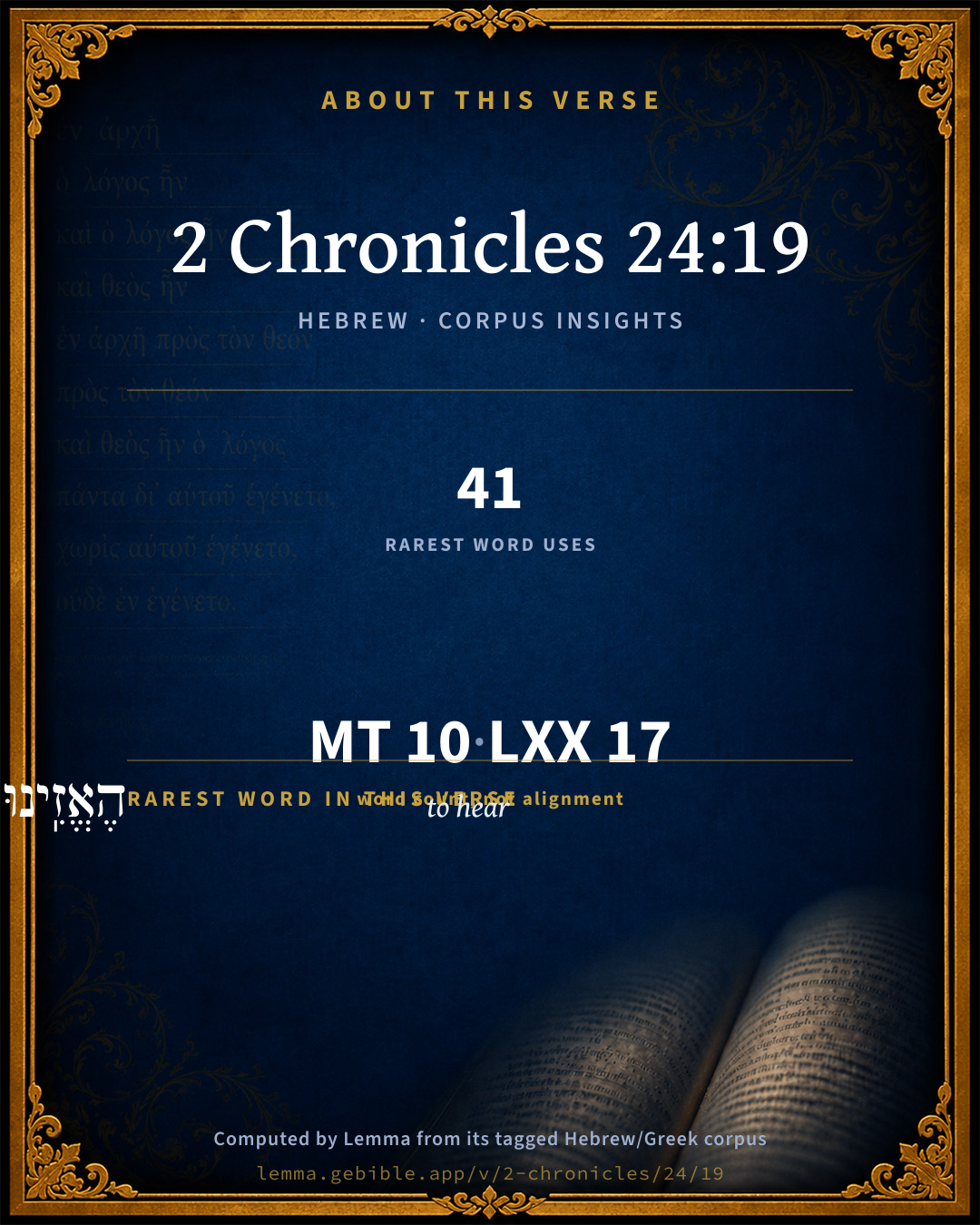
הֶאֱזִֽינוּ to hear H238 occurs in 41 verses of the Hebrew Bible. Also found in:

Grammatical profile

  • 4 verbs
  • 2 nouns
  • 3 prepositions
  • 1 particle

Verb forms

  • וַיִּשְׁלַ֤ח Qal · Sequential Imperfect
  • לַהֲשִׁיבָ֖ם Hiphil · Infinitive Construct
  • וַיָּעִ֥ידוּ Hiphil · Sequential Imperfect
  • הֶאֱזִֽינוּ Hiphil · Perfect

Hebrew & Septuagint length

In English translation the verse runs 23 words from the Hebrew and 25 from the Septuagint (LXX English) — closely comparable.

A rough comparison of the two English renderings, which tokenize alike — not a word-level alignment.

Word counts can differ between the Hebrew and the Greek without any difference in meaning — e.g. the Hebrew direct-object marker אֵת has no separate Greek word, and Greek often adds the article ὁ.

In the original languages it is 10 Hebrew tokens and 17 Greek tokens — but the two are counted differently (Hebrew bundles its prefixes and suffixes into one token; the Greek is in lemma form), so that isn’t a like-for-like length.

Cross-references

17

Topical passages linked to 2 Chronicles 24:19 in the Treasury of Scripture Knowledge — connected by theme and wording, ordered by reader-vote popularity; previews shown in the World English Bible.

  • 2 Kings 17:13–15 Yet Yahweh testified to Israel, and to Judah, by every prophet, and every seer, saying, Turn you from your evil ways, and keep my commandments and my statutes, according to all the law which I commanded your fathers, and which I sent to you by my servants the prophets.
  • 2 Chronicles 36:15–16 Yahweh, the God of their fathers, sent to them by his messengers, rising up early and sending, because he had compassion on his people, and on his dwelling-place:
  • Nehemiah 9:26 Nevertheless they were disobedient, and rebelled against you, and cast your law behind their back, and killed your prophets that testified against them to turn them again to you, and they committed awful blasphemies.
  • Psalms 95:7–8 For he is our God. We are the people of his pasture, And the sheep in his care. Today, oh that you would hear his voice!
  • Isaiah 28:23 Give you ear, and hear my voice; listen, and hear my speech.
  • Isaiah 42:23 Who is there among you who will give ear to this? who will listen and hear for the time to come?
  • Isaiah 51:4 Attend to me, my people; and give ear to me, my nation: for a law shall go forth from me, and I will establish my justice for a light of the peoples.
  • Isaiah 55:3 Turn your ear, and come to me; hear, and your soul shall live: and I will make an everlasting covenant with you, even the sure mercies of David.
  • Jeremiah 7:25–26 Since the day that your fathers came forth out of the land of Egypt to this day, I have sent to you all my servants the prophets, daily rising up early and sending them:
  • Jeremiah 25:4–5 Yahweh has sent to you all his servants the prophets, rising up early and sending them, (but you have not listened, nor inclined your ear to hear),
  • Jeremiah 26:5 to listen to the words of my servants the prophets, whom I send to you, even rising up early and sending them, but you have not listened;
  • Jeremiah 44:4–5 However I sent to you all my servants the prophets, rising up early and sending them, saying, Oh, don't do this abominable thing that I hate.
  • Matthew 13:9 He who has ears to hear, let him hear."
  • Matthew 13:15–16 For this people's heart has grown callous, Their ears are dull of hearing, They have closed their eyes; Or else perhaps they might perceive with their eyes, Hear with their ears, Understand with their heart, And should turn again; And I would heal them.'
  • Luke 11:47–51 Woe to you! For you build the tombs of the prophets, and your fathers killed them.
  • Luke 16:31 "He said to him, 'If they don't listen to Moses and the prophets, neither will they be persuaded if one rises from the dead.'"
  • Luke 20:9–15 He began to tell the people this parable. "A man planted a vineyard, and rented it out to some farmers, and went into another country for a long time.

Cross-references courtesy of OpenBible.info (CC BY 4.0).

Hebrew and Greek witnesses Masoretic Hebrew ↔ Greek Septuagint

The same verse in the two great witnesses to the Old Testament, shown verse-for-verse.

These are two independent witnesses, not word-aligned to each other, and the Septuagint is shown in lemma (dictionary) form.

Hebrew 2 Chronicles 24:19 Masoretic · Westminster Leningrad Codex

וַיִּשְׁלַ֤ח בָּהֶם֙ נְבִאִ֔ים לַהֲשִׁיבָ֖ם אֶל יְהוָ֑ה וַיָּעִ֥ידוּ בָ֖ם וְלֹ֥א הֶאֱזִֽינוּ

Yet he sent prophets to them, to bring them again to Yahweh; and they testified against them: but they would not give ear.

World English Bible · Public Domain

Greek LXX 2 Chronicles 24:19 Septuagint · lemma form

καί ἀποστέλλω πρός αὐτός προφήτης ἐπιστρέφω πρός κύριος καί οὐ ἀκούω καί διαμαρτυρέω αὐτός καί οὐ ἀκούω

yet he sent prophets to them, to turn them to the Lord; but they listened not: and he testified to them, but they obeyed not.

LXX2012 (modern English Septuagint) · Public Domain

Hebrew: Westminster Leningrad Codex (CC BY 4.0). Greek: Septuagint (public domain); English from LXX2012 (modern English Septuagint) (Public Domain). How the Septuagint differs from the Hebrew →

Commentary

Notes on 2 Chronicles 24:19 from classic Christian and Jewish commentators (each source and its license shown beneath its notes). The classic Christian expositions comment on the surrounding passage and are grouped to its opening verse, so a note may address several verses; the Jewish commentaries on the Tanakh (Rashi and others) are per-verse, so they appear only where the commentator wrote on this verse.

Lemma curates 59 commentaries, every one of them public domain or Creative Commons licensed, each selected and text-cleaned for this edition rather than reprinted as found. About our sources →

Trapp's Complete Commentary

John Trapp

2Ch 24:19 Yet he sent prophets to them, to bring them again unto the LORD; and they testified against them: but they would not give ear.

Ver. 19. Yet he sent prophets to them.] As God loveth to foresignify; such is his pity and patience.

And they testified against them: but they would not give ear.] The Vulgate rendereth it, Quos Protestantes illi audire nolebant: which Poynes {a} the Papist construeth thus, Whom those Protestants would not hear; and therehence, very doctor like, inferreth that it was foretold in the Old Testament that the Protestants were a malignant church, whereas Protestantes there is to be referred to prophets going before; and so it followeth better that the name of Protestants - though in contempt put upon the reformed churches by the Papists, by reason of their protestation against the Romish religion made at Spires above a hundred years since - yet is ancient and honourable; and that they were idolaters that would not give ear to those Protestants of old - as neither will they to this day - who called heaven and earth to witness against them.

{a} Preface to his book Of the Sacraments. Sic et Duacerises, Anglice

John Trapp, A Commentary or Exposition upon All the Books of the Old and New Testament (1647–1656) — public domain. Text from a community e-Sword module.

The Biblical Illustrator

Joseph S. Exell

2Ch_24:19-21

Yet He sent prophets to them, to bring them again unto the Lord.

Judahs apostasy

I. Prophetic denunciation of apostasy resented.

II. Zechariahs death was parallel with that of St. Stephen.

1. His offence was the denunciation of the sin of the leaders of Judah (Act_7:51-53).

2. Stoned as a blasphemer.

III. Contrast in the spirit of Judaism and Christianity--

1. Zechariahs last words: The Lord look on it and requite it.

2. Stephens: Lord lay not this sin to their charge.

IV. Reflections.

1. The value of a wise and true friend. Jehoiadas influence on Joash.

2. The necessity of a moral reformation as well as a political to secure permanent results in religious changes. The reformation under Joash was merely outward conformity.

V. The certainty that a faithful ministry implies the unpopularity of those who exercise it.

1. All the prophets suffered under Judaism (Mat_23:35; Luk_11:51).

2. Christ, Stephen, the apostles, the early Christians. Reformers all through history.

3. Human nature always the same. It hates those who attack its sins.

VI. The spirit that resents faithful reproof always entails retribution on itself (verse 23). To do wrong and refuse instruction is the greatest misfortune a man can suffer.

VII. The necessity to do right for dutys sake, without expecting gratitude or acknowledgment. (J. C. Geikie, D.D.)

The goodness of King Joash

1. In ten years from the death of Jehoiada, Joash was so utterly another man that you cannot recognise in him one feature of that godly disposition which distinguished his earlier years. He is a sad illustration of the deceitfulness of the human heart; of the weakness of the natural man; and of the perishing nature of that impulsive goodness which rests solely for its permanence upon the constraining influences of others.

2. Joash still represents a large class--persons of warm and susceptible feelings, acting habitually under impulse, of a temper of mind volatile, or pliable, or keenly sensitive, upon which impressions are easily made and as easily effaced.

3. Speaking as I am in a university city, I am reminded that I can point to no spot more suggestive than this of the evanescent quality of that light of the soul which is simply reflected, of that transient goodness which walks by sight and not by faith. How many young men have gathered here, filled with noble emulation, and strong in their own resolution to fulfil the purpose of their coming! And what has followed? First the whisper of the arch-tempter, You are free; eat, drink, and be merry. Then the sceptic, asking contemptuously, What is truth? The controversial humourist, commending his ingenious sophistries with insidious drollery. The listless idler, intruding his unwelcome presence upon the conventional hours of study. The voluptuary, putting his bottle to his companions, and filling them with shame for glory. The sinner in the city, whose house is in the way to hell. The tradesman with his offer of unlimited credit. The sordid moneylender, weaving his web of usury. These, and such as these, have made their obeisance, like the princes of Judah; and behold, Jehoiada is gone, and Joash has hearkened to them! He has left the God of his fathers. He cannot prosper, because God has forsaken him.

4. Oh, if I am to send my son to fight the good fight of faith, to wrestle against the powers of darkness, let me stablish him with this fact as the counterpoise and antidote to the delusions of the world--that he is now a responsible being. (Henry Drury, M.A.)

The Biblical Illustrator, edited by Joseph S. Exell (c. 1880s–1900s) — public domain. Text from a community e-Sword module.

Joseph Benson's Commentary

2Ch 24:19. Yet he sent prophets to them, to bring them again — God’s goodness was astonishing, in sending messengers to reclaim such a base people; whose wickedness was no less wonderful, in that they hearkened to the great men among them, rather than to those whom they knew to be true prophets of Jehovah.

Joseph Benson's Commentary on the Old and New Testaments (1811–1818) — public domain. Text from a community e-Sword module.

Geneva Bible (1599)

Geneva Bible translators

They took heaven and earth and all creatures to witness, that except they returned to the Lord, he would most grievously punish their infidelity and rebellion, Neh. 9:26.

Geneva Bible (1599) marginal notes — public domain. Text via Bolls.life.

Jamieson, Fausset & Brown

Robert Jamieson, A. R. Fausset & David Brown

Yet he sent prophets--Elisha, Micah, Jehu son of Hanani, Jahaziel son of Zechariah (Ch2 20:14), Eliezer son of Dodavah (Ch2 20:37), lived and taught at that time. But all their prophetic warnings and denunciations were unheeded.

Jamieson, Fausset & Brown — Commentary Critical and Explanatory on the Whole Bible (1871) — public domain (CC PDM 1.0). Text via the HelloAO Bible API.

Ellicott's Commentary for English Readers

(19) Yet.—And.

To them.—Among them.

And they testified against them.—Solemnly besought them, exhorted them in the name of God (Exo_20:21; 2Ki_17:13).

But they would.—And they did.

A Bible Commentary for English Readers, edited by Charles John Ellicott (1878–1897) — public domain. Text from a community e-Sword module.

The Cambridge Bible for Schools and Colleges

gen. ed. J. J. S. Perowne

19. he sent prophets] Cp. 2Ch_36:15.

to them] Rather, among them.

The Cambridge Bible for Schools and Colleges (gen. ed. J. J. S. Perowne; Cambridge University Press, 1878–1918) — public domain. Text from a community e-Sword module.

John Gill's Exposition

And they conspired against him,.... Consulted together to take away his life, and got the order of the king to do it:

and stoned him with stones at the commandment of the king in the court of the house of the Lord; where he had stood and reproved them; this they did before he went out, while in the temple; and if he is the same Zechariah, as some think, our Lord speaks of, he was slain between the temple porch and the altar, Mat 23:35; see Gill on Mat 23:35.

John Gill's Exposition of the Whole Bible (1746–1763) — public domain (CC PDM 1.0). Text via the HelloAO Bible API.

Haydock's Catholic Bible Commentary

Them. Calling heaven and earth to witness (C.) the unity of God. H. --- These prophets might have been performing their sacred commission ever since the reign of Josaphat; during which time Eliseus, Micheas, Jehu, and others, lived, C. xx. 14., and xviii. 27. C.

George Leo Haydock (1774–1849), Haydock's Catholic Family Bible and Commentary, 1859 edition — public domain. Excludes Psalms (Douay-Rheims chapter numbering differs from Protestant) and Deuterocanonical books (Catholic canon only).

The Pulpit Commentary

Prophets. The name of only one, Zechariah, as in next verse, is given (see by the side of this verse the emphatic and touching language. (2Ch_36:14-16)

The Pulpit Commentary (1880–1919), ed. H.D.M. Spence-Jones & Joseph S. Exell — public domain. Text from a community e-Sword module.

Lesson kit

Teaching starters — assembled from the data on this page, not authored interpretation. Every prompt links to the verse data it draws on. Edit before teaching.

2 Chronicles, in the Historical, opens this verse with 10 words (8 distinct Hebrew lemmas). Its most distinctive word is ʼâzan (“to hear”). A historical commentator’s framing appears above. Read the whole chapter for the surrounding context.

Discussion questions

  1. The word ʼâzan carries the sense “to hear.” How does it shape the verse?
  2. Genesis 4:23 shares the word «to hear» with this verse. How do the two illuminate each other?
  3. These translations render this verse differently; the difference is in the English rendering, not the original. What questions does that raise?
  4. The verb «וַיִּשְׁלַ֤ח» is Qal Sequential Imperfect. How does its form color the action?
  5. Reading how Trapp's Complete Commentary and The Biblical Illustrator read this verse, where do the two commentators agree and where do they part?

Things to notice

Reading settings

Reading text

Shown beneath each verse's original-language words.

Old Testament
Old Testament edition

Read the OT as the Masoretic Hebrew (MT) or the Greek Septuagint (LXX).

English shown for the Greek Septuagint (in the Hebrew ↔ Greek comparison).

Comparing translations? Open the Compare panel on any verse page to stack up to four side by side.