
2 Chronicles 25:10

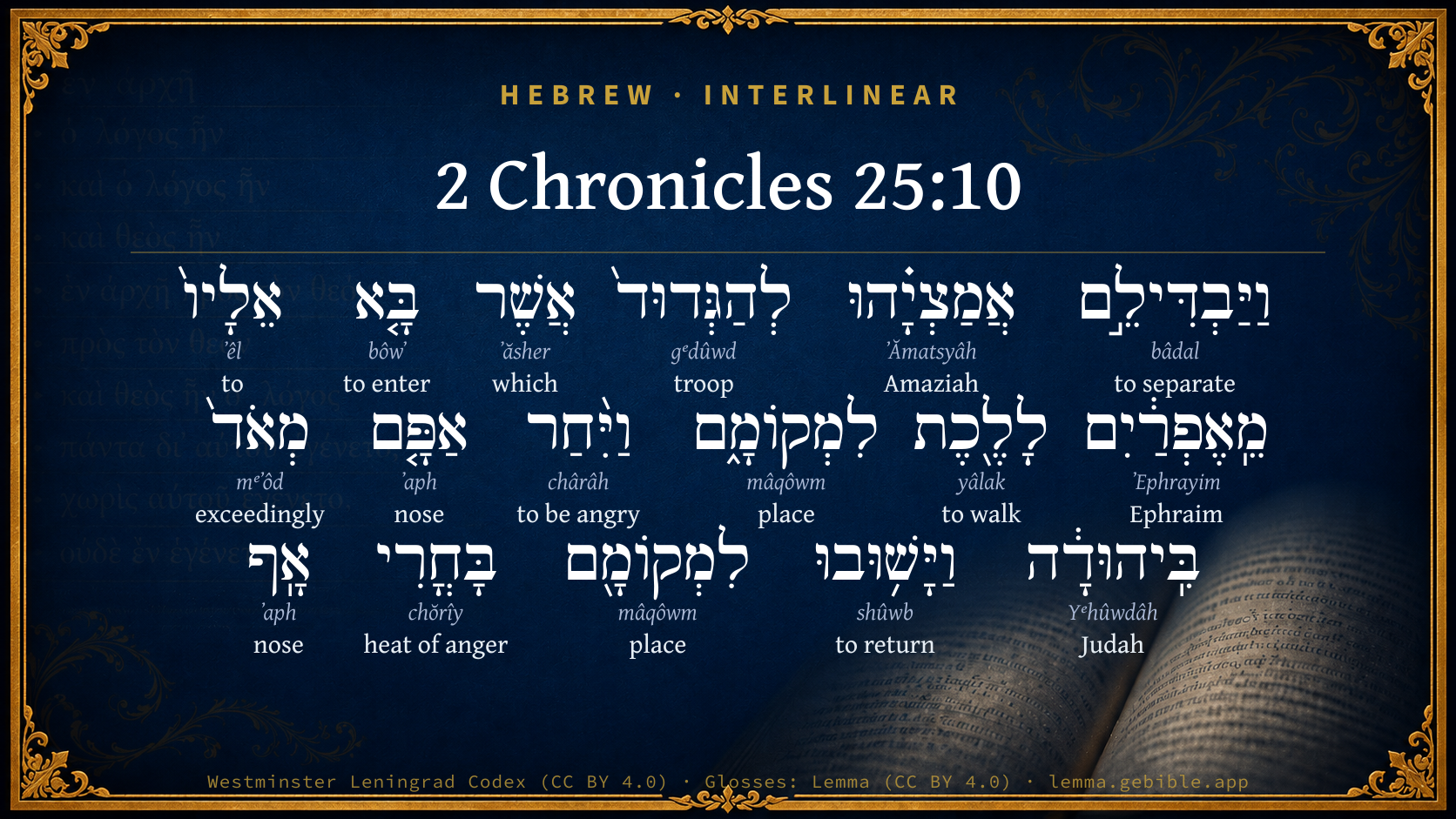
Hebrew (Westminster Leningrad Codex) 2 Chronicles 25:10 appears in the Hebrew Old Testament. The text above is from the Westminster Leningrad Codex. Each word links to its Strong’s number, a concise gloss, and parsing drawn from the Open Scriptures Hebrew Bible morphology. Click any word for its full Brown-Driver-Briggs (BDB) entry.
Download image
Cite this verse

2 Chronicles 25:10 (World English Bible). Public Domain. Lemma interlinear Bible study tool, https://lemma.gebible.app/v/2-chronicles/25/10.

Show BibTeX & RIS
BibTeX
RIS
English Translation
Then Amaziah separated them, [to wit], the army that had come to him out of Ephraim, to go home again: therefore their anger was greatly kindled against Judah, and they returned home in fierce anger.
World English Bible · Public Domain
Download a study sheet

One document with this verse’s original text, its word-by-word gloss line, the meaning frame, cross-references with their text, attributed commentary, and full source and license credits — printable, and it pastes into notes with its structure intact.

This verse Autodidact and up

Study sheet (.html) Plain text (.txt)

A passage Seminary Student

Up to 50 verses in one chapter. A passage sheet keeps up to 6 commentary sources and 12 cross-references per verse, in the order this page ranks them, and says so on the sheet whenever that leaves anything out. Ask for a single verse and you get the Autodidact verse sheet above.

Everything on this page stays free to read, with no account — the sheet is a download of what is already on screen, not access to it.

Want to remove ads? Support Godless Engineer
Compare translations 3

The same verse in 3 English versions, stacked beneath the original-language interlinear above. Click any original word for its lexicon entry.

Each is an independent rendering of the whole verse — the interlinear is not word-aligned to these translations.

Highlighted words mark where these versions differ — a whole-verse word diff, not a word-by-word alignment.

  • World English Bible Public Domain
    Then Amaziah separated them, [to wit], the army that had come to him out of Ephraim, to go home again: therefore their anger was greatly kindled against Judah, and they returned home in fierce anger.
  • King James Version Public Domain
    Then Amaziah separated them, to wit, the army that was come to him out of Ephraim, to go home again: wherefore their anger was greatly kindled against Judah, and they returned home in great anger.
  • unfoldingWord Literal Text CC BY-SA 4.0
    And Amaziah separated them, the troop that had come to him from Ephraim to go to their place. And their anger burned greatly against Judah, and they returned to their place in the burning of anger.

unfoldingWord Literal Text — © unfoldingWord, licensed CC BY-SA 4.0. Word-aligned USFM3 via Door43 (git.door43.org/unfoldingWord/en_ult).

Versions to compare (up to 4)

3 of 4 selected

Show all 18 translations

Every available English version of this verse, each an independent rendering of the whole verse.

  • World English Bible Public Domain
    Then Amaziah separated them, [to wit], the army that had come to him out of Ephraim, to go home again: therefore their anger was greatly kindled against Judah, and they returned home in fierce anger.
  • Berean Standard Bible Public Domain
    So Amaziah dismissed the troops who had come to him from Ephraim and sent them home. And they were furious with Judah and returned home in great anger.
  • Majority Standard Bible Public Domain
    So Amaziah dismissed the troops who had come to him from Ephraim and sent them home. And they were furious with Judah and returned home in great anger.
  • King James Version Public Domain
    Then Amaziah separated them, to wit, the army that was come to him out of Ephraim, to go home again: wherefore their anger was greatly kindled against Judah, and they returned home in great anger.
  • American Standard Version (1901) Public Domain
    Then Amaziah separated them, `to wit', the army that was come to him out of Ephraim, to go home again: wherefore their anger was greatly kindled against Judah, and they returned home in fierce anger.
  • Revised Version (1885) Public Domain
    Then Amaziah separated them, to wit, the army that was come to him out of Ephraim, to go home again: wherefore their anger was greatly kindled against Judah, and they returned home in fierce anger.
  • Geneva Bible (1599) Public Domain
    So Amaziah separated them, to wit, the armie that was come to him out of Ephraim, to returne to their place: wherefore their wrath was kindled greatly against Iudah, and they returned to their places with great anger.
  • Douay-Rheims (1899) Public Domain
    Then Amasias separated the army, that came to him out of Ephraim, to go home again: but they being much enraged against Juda, returned to their own country.
  • Young's Literal Translation Public Domain
    And Amaziah separateth them -- for the troop that hath come in unto him from Ephraim to go to their own place, and their anger doth burn mightily against Judah, and they turn back to their place in the heat of anger.
  • Literal Standard Version CC BY-SA 4.0
    And Amaziah separates them, of the troop that has come to him from Ephraim, to go to their own place; and their anger burns mightily against Judah, and they return to their place in the heat of anger.
  • Unlocked Literal Bible CC BY-SA 4.0
    So Amaziah separated the army that had come to him from Ephraim; he sent them home again. So their anger was greatly kindled against Judah, and they returned home in fierce anger.
  • unfoldingWord Literal Text CC BY-SA 4.0
    And Amaziah separated them, the troop that had come to him from Ephraim to go to their place. And their anger burned greatly against Judah, and they returned to their place in the burning of anger.
  • Darby Bible Public Domain
    Then Amaziah separated them, -- the troop that was come to him out of Ephraim, -- to go home again. And their anger was greatly kindled against Judah, and they returned home in fierce anger.
  • World Messianic Bible Public Domain
    Then Amaziah separated them, the army that had come to him out of Ephraim, to go home again. Therefore their anger was greatly kindled against Judah, and they returned home in fierce anger.
  • Webster's Bible Public Domain
    Then Amaziah separated them, to wit, the army that had come to him out of Ephraim, to go home again: wherefore their anger was greatly kindled against Judah, and they returned home in great anger.
  • Free Bible Version CC BY-SA 4.0
    So Amaziah dismissed the army he'd hired from Ephraim and sent them home. They became very angry with Judah, and returned home furious.
  • Bible in Basic English Public Domain
    So Amaziah, separating the armed band which had come to him from Ephraim, sent them back again; which made them very angry with Judah, and they went back burning with wrath.
  • JPS Tanakh (1917) Public Domain
    Then Amaziah separated them, to wit, the army that was come to him out of Ephraim, to go back home; wherefore their anger was greatly kindled against Judah, and they returned home in fierce anger.

Literal Standard Version (2020), Covenant Press — licensed CC BY-SA 4.0. Text via the HelloAO Bible API (eBible.org). Unlocked Literal Bible (unfoldingWord) — licensed CC BY-SA 4.0. Text via the HelloAO Bible API (eBible.org). unfoldingWord Literal Text — © unfoldingWord, licensed CC BY-SA 4.0. Word-aligned USFM3 via Door43 (git.door43.org/unfoldingWord/en_ult). Free Bible Version, Dr. Jonathan Gallagher — licensed CC BY-SA 4.0. Text via the HelloAO Bible API (eBible.org).

Word by word

More ways to search: Search by grammar → Find every occurrence → Compare this word →

Practice this passage: Drill this verse → Learn its vocabulary →

בָּחֳרִי
chŏrîy
H2750
“in/at · heat of anger of”
Preposition + Noun, Common, Masculine, Singular, Construct
Part of Speech
Preposition + Noun
Type
Common
Gender
Masculine
Number
Singular
State
Construct
Full BDB Definition

Origin: from H2734

TWOT: 736b

heat (of anger), burning (of anger)
  1. וַיַּבְדִּילֵ֣ם bâdal H914 “and · to separate · them” Conjunction + Verb, Hiphil, Sequential Imperfect, 3rd Person, Masculine, Singular + Suffix, Personal, 3rd Person, Masculine, Plural
  2. אֲמַצְיָ֗הוּ ʼĂmatsyâh H558 “Amaziah” Noun, Proper
  3. לְהַגְּדוּד֙ gᵉdûwd H1416 “to/for · the · troop” Preposition + Particle, Definite Article + Noun, Common, Masculine, Singular, Absolute
  4. אֲשֶׁר ʼăsher H834 “which” Particle, Relative
  5. בָּ֤א bôwʼ H935 “to enter” Verb, Qal, Perfect, 3rd Person, Masculine, Singular
  6. אֵלָיו֙ ʼêl H413 “to · him” Preposition + Suffix, Personal, 3rd Person, Masculine, Singular
  7. מֵֽאֶפְרַ֔יִם ʼEphrayim H669 “from · Ephraim” Preposition + Noun, Proper
  8. לָלֶ֖כֶת yâlak H3212 “to walk” Preposition + Verb, Qal, Infinitive Construct
  9. לִמְקוֹמָ֑ם mâqôwm H4725 “to/for · place · their” Preposition + Noun, Common, Masculine, Singular, Construct + Suffix, Personal, 3rd Person, Masculine, Plural
  10. וַיִּ֨חַר chârâh H2734 “and · to be angry” Conjunction + Verb, Qal, Sequential Imperfect, 3rd Person, Masculine, Singular
  11. אַפָּ֤ם ʼaph H639 “nose · their” Noun, Common, Masculine, Singular, Construct + Suffix, Personal, 3rd Person, Masculine, Plural
  12. מְאֹד֙ mᵉʼôd H3966 “exceedingly” Adverb
  13. בִּֽיהוּדָ֔ה Yᵉhûwdâh H3063 “in/at · Judah” Preposition + Noun, Proper
  14. וַיָּשׁ֥וּבוּ shûwb H7725 “and · to return” Conjunction + Verb, Qal, Sequential Imperfect, 3rd Person, Masculine, Plural
  15. לִמְקוֹמָ֖ם mâqôwm H4725 “to/for · place · their” Preposition + Noun, Common, Masculine, Singular, Construct + Suffix, Personal, 3rd Person, Masculine, Plural
  16. אָֽף ʼaph H639 “nose” Noun, Common, Masculine, Singular, Absolute

About this verse

These counts appear in no published source. They are computed here, from the morphology-tagged text and Lemma’s own curated glosses. What Lemma adds →

17
words
15
distinct lemmas
Historical
section

Notable vocabulary

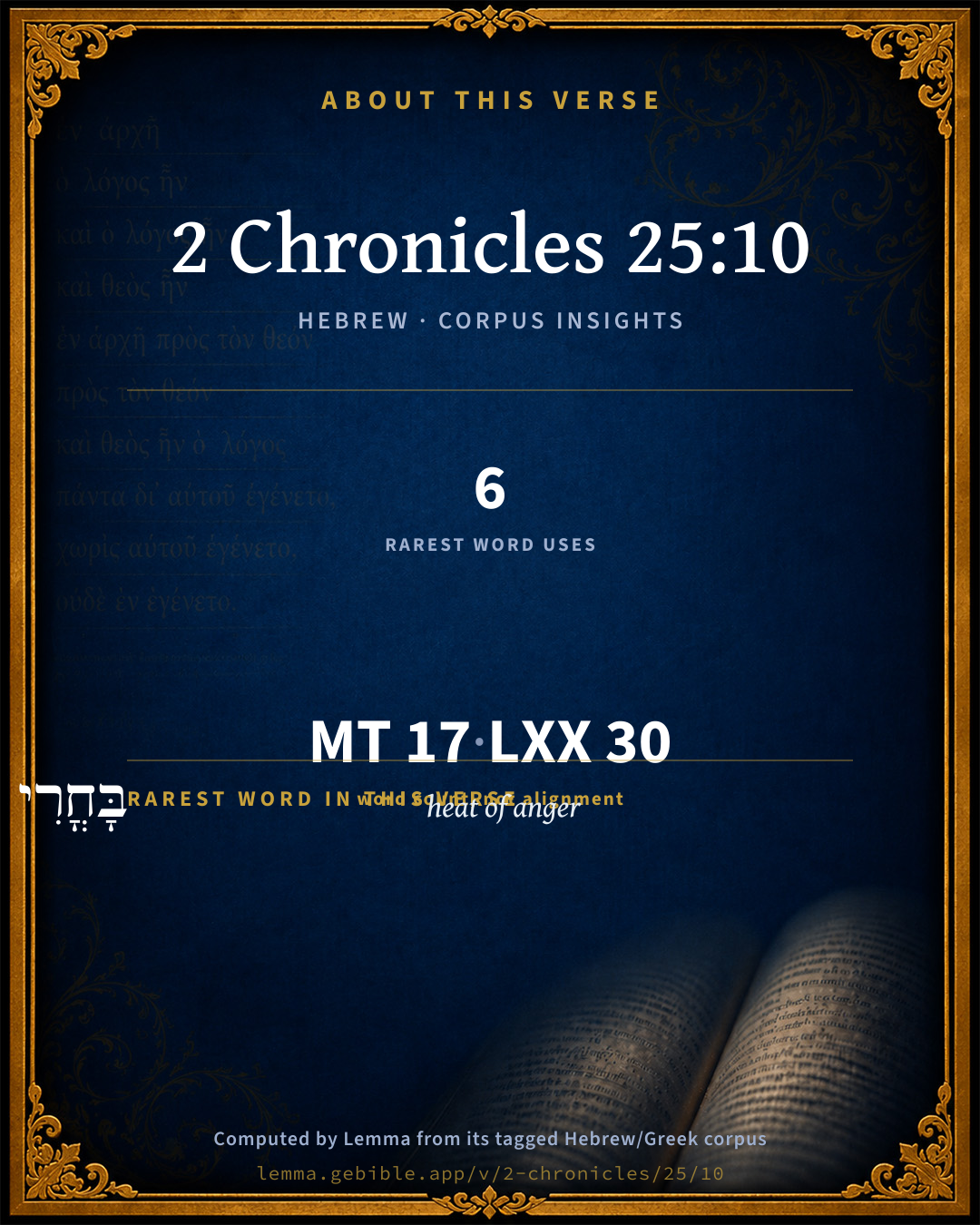
The rarest word here is בָּחֳרִי heat of anger H2750 — appearing just 6 times in the whole Hebrew Bible.

Shared distinctive vocabulary

בָּחֳרִי heat of anger H2750 occurs in 6 verses of the Hebrew Bible. Also found in:

Grammatical profile

  • 5 verbs
  • 9 nouns
  • 1 preposition
  • 1 adverb
  • 1 particle

Verb forms

  • וַיַּבְדִּילֵ֣ם Hiphil · Sequential Imperfect
  • בָּ֤א Qal · Perfect
  • לָלֶ֖כֶת Qal · Infinitive Construct
  • וַיִּ֨חַר Qal · Sequential Imperfect
  • וַיָּשׁ֥וּבוּ Qal · Sequential Imperfect

Repetition

Words recur within this verse — often emphatic in Hebrew:

  • לִמְקוֹמָ֑ם place H4725 ×2
  • אַפָּ֤ם nose H639 ×2

Hebrew & Septuagint length

In English translation the verse runs 35 words from the Hebrew and 36 from the Septuagint (LXX English) — closely comparable.

A rough comparison of the two English renderings, which tokenize alike — not a word-level alignment.

Word counts can differ between the Hebrew and the Greek without any difference in meaning — e.g. the Hebrew direct-object marker אֵת has no separate Greek word, and Greek often adds the article ὁ.

In the original languages it is 17 Hebrew tokens and 30 Greek tokens — but the two are counted differently (Hebrew bundles its prefixes and suffixes into one token; the Greek is in lemma form), so that isn’t a like-for-like length.

Cross-references

3

Topical passages linked to 2 Chronicles 25:10 in the Treasury of Scripture Knowledge — connected by theme and wording, ordered by reader-vote popularity; previews shown in the World English Bible.

  • 2 Samuel 19:43 The men of Israel answered the men of Judah, and said, We have ten parts in the king, and we have also more [right] in David than you: why then did you despise us, that our advice should not be first had in bringing back our king? The words of the men of Judah were fiercer than the words of the men of Israel.
  • 1 Kings 12:24 Thus says Yahweh, You shall not go up, nor fight against your brothers the children of Israel: return every man to his house; for this thing is of me. So they listened to the word of Yahweh, and returned and went their way, according to the word of Yahweh.
  • Proverbs 29:22 An angry man stirs up strife, And a wrathful man abounds in sin.

Cross-references courtesy of OpenBible.info (CC BY 4.0).

Hebrew and Greek witnesses Masoretic Hebrew ↔ Greek Septuagint

The same verse in the two great witnesses to the Old Testament, shown verse-for-verse.

These are two independent witnesses, not word-aligned to each other, and the Septuagint is shown in lemma (dictionary) form.

Hebrew 2 Chronicles 25:10 Masoretic · Westminster Leningrad Codex

וַיַּבְדִּילֵ֣ם אֲמַצְיָ֗הוּ לְהַגְּדוּד֙ אֲשֶׁר בָּ֤א אֵלָיו֙ מֵֽאֶפְרַ֔יִם לָלֶ֖כֶת לִמְקוֹמָ֑ם וַיִּ֨חַר אַפָּ֤ם מְאֹד֙ בִּֽיהוּדָ֔ה וַיָּשׁ֥וּבוּ לִמְקוֹמָ֖ם בָּחֳרִי אָֽף

Then Amaziah separated them, [to wit], the army that had come to him out of Ephraim, to go home again: therefore their anger was greatly kindled against Judah, and they returned home in fierce anger.

World English Bible · Public Domain

Greek LXX 2 Chronicles 25:10 Septuagint · lemma form

καί διαχωρίζω αμασιας ὁ δύναμις ὁ ἔρχομαι πρός αὐτός ἀπό ἐφράιμ ἀποἔρχομαι εἰς ὁ τόπος αὐτός καί θυμόω σφόδρα ἐπί ἰούδας καί ἐπιστρέφω εἰς ὁ τόπος αὐτός ἐν ὀργή θυμός

And Amasias separated from the army that came to him from Ephraim, that they might go away to their place; and they were very angry with Juda, and they returned to their place with great wrath.

LXX2012 (modern English Septuagint) · Public Domain

Hebrew: Westminster Leningrad Codex (CC BY 4.0). Greek: Septuagint (public domain); English from LXX2012 (modern English Septuagint) (Public Domain). How the Septuagint differs from the Hebrew →

Commentary

Notes on 2 Chronicles 25:10 from classic Christian and Jewish commentators (each source and its license shown beneath its notes). The classic Christian expositions comment on the surrounding passage and are grouped to its opening verse, so a note may address several verses; the Jewish commentaries on the Tanakh (Rashi and others) are per-verse, so they appear only where the commentator wrote on this verse.

Lemma curates 59 commentaries, every one of them public domain or Creative Commons licensed, each selected and text-cleaned for this edition rather than reprinted as found. About our sources →

Trapp's Complete Commentary

John Trapp

2Ch 25:10 Then Amaziah separated them, [to wit], the army that was come to him out of Ephraim, to go home again: wherefore their anger was greatly kindled against Judah, and they returned home in great anger.

Ver. 10. And they returned home in great anger.] Better that wicked persons be offended than that we have any unnecessary dealings with them, since we are sure to carry out of their company either guilt or grief.

John Trapp, A Commentary or Exposition upon All the Books of the Old and New Testament (1647–1656) — public domain. Text from a community e-Sword module.

Joseph Benson's Commentary

2Ch 25:10. Their anger was greatly kindled against Judah — Because they were both disgraced by this rejection, and disappointed of that spoil which they hoped to gain, whereas now they are sent away empty; for the hundred talents, probably, were given to their officers only to raise men for this service.

Joseph Benson's Commentary on the Old and New Testaments (1811–1818) — public domain. Text from a community e-Sword module.

Jamieson, Fausset & Brown

Robert Jamieson, A. R. Fausset & David Brown

separated them . . . the army . . . out of Ephraim . . . their anger was greatly kindled against Judah--Amaziah, who knew his position as the Lord's viceroy, complied with the prophet's counsel, and, consenting to forfeit the purchase money of the Israelitish soldiers, discharged them. Exasperated at this treatment, they resolved to indemnify themselves for the loss of their expected booty, and so on their return home they plundered all the towns in their way, committing great havoc both of life and property without any stoppage, as the king of Judah and his army had set out on their expedition (Kg2 14:7).

Jamieson, Fausset & Brown — Commentary Critical and Explanatory on the Whole Bible (1871) — public domain (CC PDM 1.0). Text via the HelloAO Bible API.

Adam Clarke's Commentary

Verse 10. They returned home in great anger] They thought they were insulted, and began to meditate revenge. See the notes on 2Kg 14:1-20, where almost every circumstance in this chapter is examined and explained.

Adam Clarke's Commentary on the Bible (1810–1826) — public domain. Text from a community e-Sword/MySword module.

Ellicott's Commentary for English Readers

(10) To wit, the army.—The troop (le prefixed, as sign of the accusative).

To go home again.—To go to their own place.

Home in great anger.—To their own place in a heat of anger (Isa_7:4). Obviously the dismissed force would be incensed at treatment which seemed to indicate distrust of their honour, and robbed them of the possible fruits of victory. On their way home they revenged themselves by plundering and slaughtering in the cities of Judah (2Ch_25:13).

A Bible Commentary for English Readers, edited by Charles John Ellicott (1878–1897) — public domain. Text from a community e-Sword module.

The Cambridge Bible for Schools and Colleges

gen. ed. J. J. S. Perowne

10. in great anger] R.V. in fierce anger.

The Cambridge Bible for Schools and Colleges (gen. ed. J. J. S. Perowne; Cambridge University Press, 1878–1918) — public domain. Text from a community e-Sword module.

John Gill's Exposition

And Amaziah strengthened himself, and led forth his people,.... To go to war with the Edomites; not discouraged by the dismission of the hired troops, but trusting in the promise and power of God, he went forth with boldness and intrepidity:

and went to the valley of salt, and smote of the children of Seir, ten thousand; the Edomites; so called, not because they were the posterity of Seir, but because they dwelt in Seir, from whence they drove the descendants of Seir, and dwelt in their stead; see Kg2 14:7.

John Gill's Exposition of the Whole Bible (1746–1763) — public domain (CC PDM 1.0). Text via the HelloAO Bible API.

Albert Barnes' Notes on the Bible

Such a dismissal could not fail to arouse great indignation. The Israelites would suppose themselves dismissed because their good faith was suspected. On the consequences of their indignation, see 2Ch 25:13.

Albert Barnes' Notes on the Bible (1834–1885) — public domain. Text from a community e-Sword/MySword module.

Matthew Poole's English Annotations

Their anger was greatly kindled against Judah; because they were both disgraced by this rejection, and disappointed of that prey and spoil which they hoped to gain, whereas now they were sent away empty; for the one hundred talents probably were given to their officers only to raise men for this service; that sum being otherwise too small to be distributed into so many hands.

Matthew Poole's English Annotations on the Holy Bible (1683–1685) — public domain. Text from a community e-Sword/MySword module.

The Pulpit Commentary

It appears that, though this contingent from Israel"s land was a hired force, yet for some reason their heart was in their calling, perhaps in anticipation of plunder. It may well be that they asked why they were discharged; and whether the right answer were given them, that the Lord dwelt not among them, or some wrong answer, it evidently did not improve matters, but rankled in their hearts till it found relief (vers. 13, 22), as they concluded that either their ability or fidelity, or both, were called in question. The "Speaker"s Commentary" very aptly cites the keen resentment and mortification that the Athenians are recorded to have felt in similar circumstances as told in Plutarch"s "Lives:" "Cimon," Separated them. This is the verb occurring several times in the first verses of Genesis 1. ( there it is always followed by the preposition yBe, when speaking of the separating of two things from one another. Though this be meant here, it is not what is exactly said, and the prefix preposition lbefore the substantive (dWdGhl) may, as Keil says, be regarded as designating the appositional accusative to that affixed in the shape of the pronoun "them" to the verb.

The Pulpit Commentary (1880–1919), ed. H.D.M. Spence-Jones & Joseph S. Exell — public domain. Text from a community e-Sword module.

John Wesley's Explanatory Notes

Anger kindled - Because they were both disgraced by this rejection, and disappointed of that spoil which they hoped to gain, whereas now they are sent away empty; for the hundred talents probably were given to their officers only to raise men for this service.

John Wesley, Explanatory Notes Upon the Whole Bible (1754–1765) — public domain. Text via the GEBible commentary corpus.

Lesson kit

Teaching starters — assembled from the data on this page, not authored interpretation. Every prompt links to the verse data it draws on. Edit before teaching.

2 Chronicles, in the Historical, opens this verse with 17 words (15 distinct Hebrew lemmas). Its most distinctive word is chŏrîy (“heat of anger”). A historical commentator’s framing appears above. Read the whole chapter for the surrounding context.

Discussion questions

  1. What does “heat of anger” (chŏrîy) contribute to the verse as a whole?
  2. Exodus 11:8 shares the word «heat of anger» with this verse. How do the two illuminate each other?
  3. “place” occurs 2× in this one verse. What is the effect of the repetition?
  4. These translations render this verse differently. What is at stake in choosing one wording over another?
  5. The verb «וַיַּבְדִּילֵ֣ם» is Hiphil Sequential Imperfect. How does its form color the action?
  6. Reading how Trapp's Complete Commentary and Joseph Benson's Commentary read this verse, where do the two commentators agree and where do they part?

Things to notice

Reading settings

Reading text

Shown beneath each verse's original-language words.

Old Testament
Old Testament edition

Read the OT as the Masoretic Hebrew (MT) or the Greek Septuagint (LXX).

English shown for the Greek Septuagint (in the Hebrew ↔ Greek comparison).

Comparing translations? Open the Compare panel on any verse page to stack up to four side by side.