2 Chronicles 18:25

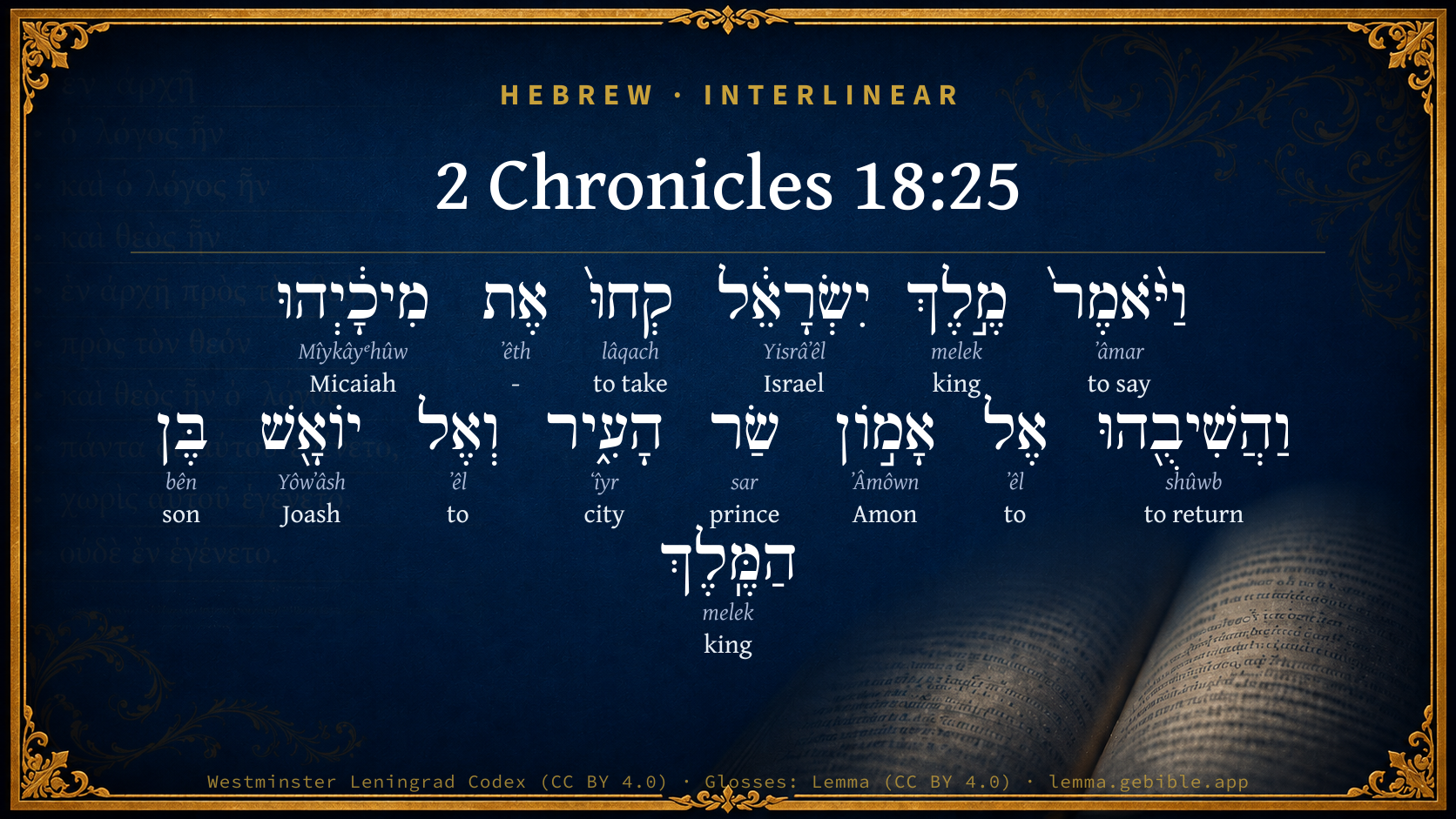
Hebrew (Westminster Leningrad Codex) 2 Chronicles 18:25 appears in the Hebrew Old Testament. The text above is from the Westminster Leningrad Codex. Each word links to its Strong’s number, a concise gloss, and parsing drawn from the Open Scriptures Hebrew Bible morphology. Click any word for its full Brown-Driver-Briggs (BDB) entry.
Download image
Cite this verse

2 Chronicles 18:25 (World English Bible). Public Domain. Lemma interlinear Bible study tool, https://lemma.gebible.app/v/2-chronicles/18/25.

Show BibTeX & RIS
BibTeX
RIS
English Translation
The king of Israel said, Take Micaiah, and carry him back to Amon the governor of the city, and to Joash the king's son;
World English Bible · Public Domain
Download a study sheet

One document with this verse’s original text, its word-by-word gloss line, the meaning frame, cross-references with their text, attributed commentary, and full source and license credits — printable, and it pastes into notes with its structure intact.

This verse Autodidact and up

Study sheet (.html) Plain text (.txt)

A passage Seminary Student

Up to 50 verses in one chapter. A passage sheet keeps up to 6 commentary sources and 12 cross-references per verse, in the order this page ranks them, and says so on the sheet whenever that leaves anything out. Ask for a single verse and you get the Autodidact verse sheet above.

Everything on this page stays free to read, with no account — the sheet is a download of what is already on screen, not access to it.

Want to remove ads? Support Godless Engineer
Compare translations 3

The same verse in 3 English versions, stacked beneath the original-language interlinear above. Click any original word for its lexicon entry.

Each is an independent rendering of the whole verse — the interlinear is not word-aligned to these translations.

Highlighted words mark where these versions differ — a whole-verse word diff, not a word-by-word alignment.

  • World English Bible Public Domain
    The king of Israel said, Take Micaiah, and carry him back to Amon the governor of the city, and to Joash the king's son;
  • King James Version Public Domain
    Then the king of Israel said, Take ye Micaiah, and carry him back to Amon the governor of the city, and to Joash the king's son;
  • unfoldingWord Literal Text CC BY-SA 4.0
    And the king of Israel said, “Take Micaiah and return him to Amon, the chief of the city, and to Joash, the son of the king,

unfoldingWord Literal Text — © unfoldingWord, licensed CC BY-SA 4.0. Word-aligned USFM3 via Door43 (git.door43.org/unfoldingWord/en_ult).

Versions to compare (up to 4)

3 of 4 selected

Show all 18 translations

Every available English version of this verse, each an independent rendering of the whole verse.

  • World English Bible Public Domain
    The king of Israel said, Take Micaiah, and carry him back to Amon the governor of the city, and to Joash the king's son;
  • Berean Standard Bible Public Domain
    And the king of Israel declared, “Take Micaiah and return him to Amon the governor of the city and to Joash the king’s son,
  • Majority Standard Bible Public Domain
    And the king of Israel declared, “Take Micaiah and return him to Amon the governor of the city and to Joash the king’s son,
  • King James Version Public Domain
    Then the king of Israel said, Take ye Micaiah, and carry him back to Amon the governor of the city, and to Joash the king's son;
  • American Standard Version (1901) Public Domain
    And the king of Israel said, Take ye Micaiah, and carry him back unto Amon the governor of the city, and to Joash the king's son;
  • Revised Version (1885) Public Domain
    And the king of Israel said, Take ye Micaiah, and carry him back unto Amon the governor of the city, and to Joash the king’s son;
  • Geneva Bible (1599) Public Domain
    And the King of Israel sayde, Take ye Michaiah, and cary him to Amon the gouernour of the citie, and to Ioash the Kings sonne,
  • Douay-Rheims (1899) Public Domain
    And the king of Israel commanded, saying: Take Micheas, and carry him to Amen the governor of the city, and to Joas the son of Amelech,
  • Young's Literal Translation Public Domain
    And the king of Israel saith, `Take ye Micaiah, and turn him back unto Amon head of the city, and unto Joash son of the king,
  • Literal Standard Version CC BY-SA 4.0
    And the king of Israel says, “Take Micaiah, and turn him back to Amon head of the city, and to Joash son of the king,
  • Unlocked Literal Bible CC BY-SA 4.0
    The king of Israel said to some servants, “You people seize Micaiah and take him to Amon, the governor of the city, and to Joash, my son.
  • unfoldingWord Literal Text CC BY-SA 4.0
    And the king of Israel said, “Take Micaiah and return him to Amon, the chief of the city, and to Joash, the son of the king,
  • Darby Bible Public Domain
    And the king of Israel said, Take ye Micah, and carry him back to Amon the governor of the city, and to Joash the king's son;
  • World Messianic Bible Public Domain
    The king of Israel said, “Take Micaiah, and carry him back to Amon the governor of the city, and to Joash the king’s son;
  • Webster's Bible Public Domain
    Then the king of Israel said, Take ye Micaiah, and carry him back to Amon the governor of the city, and to Joash the king's son;
  • Free Bible Version CC BY-SA 4.0
    The king of Israel ordered, “Place Micaiah under arrest and take him back to Amon the governor of the city and to my son Joash.
  • Bible in Basic English Public Domain
    And the king of Israel said, Take Micaiah and send him back to Amon, the ruler of the town, and to Joash, the king's son;
  • JPS Tanakh (1917) Public Domain
    And the king of Israel said: 'Take ye Micaiah; and carry him back unto Amon the governor of the city, and to Joash the king's son;

Literal Standard Version (2020), Covenant Press — licensed CC BY-SA 4.0. Text via the HelloAO Bible API (eBible.org). Unlocked Literal Bible (unfoldingWord) — licensed CC BY-SA 4.0. Text via the HelloAO Bible API (eBible.org). unfoldingWord Literal Text — © unfoldingWord, licensed CC BY-SA 4.0. Word-aligned USFM3 via Door43 (git.door43.org/unfoldingWord/en_ult). Free Bible Version, Dr. Jonathan Gallagher — licensed CC BY-SA 4.0. Text via the HelloAO Bible API (eBible.org).

Word by word

More ways to search: Search by grammar → Find every occurrence → Compare this word →

Practice this passage: Drill this verse → Learn its vocabulary →

אָמ֣וֹן
ʼÂmôwn
H526
“Amon”
Noun, Proper
Part of Speech
Noun
Type
Proper
Full BDB Definition

Origin: the same as H525

TWOT: None

Amon = "skilled workman" or " master workman" - a king of Judah, son of Manasseh - a governor of Samaria - a descendant of a servant of Solomon
  1. וַיֹּ֨אמֶר֙ ʼâmar H559 “and · to say” Conjunction + Verb, Qal, Sequential Imperfect, 3rd Person, Masculine, Singular
  2. מֶ֣לֶךְ melek H4428 “king of” Noun, Common, Masculine, Singular, Construct
  3. יִשְׂרָאֵ֔ל Yisrâʼêl H3478 “Israel” Noun, Proper
  4. קְחוּ֙ lâqach H3947 “take” Verb, Qal, Imperative, 2nd Person, Masculine, Plural
  5. אֶת ʼêth H853 “-” Particle, Direct Object
  6. מִיכָ֔יְהוּ Mîykâyᵉhûw H4321 “Micaiah” Noun, Proper
  7. וַהֲשִׁיבֻ֖הוּ shûwb H7725 “and · return · him” Conjunction + Verb, Hiphil, Imperative, 2nd Person, Masculine, Plural + Suffix, Personal, 3rd Person, Masculine, Singular
  8. אֶל ʼêl H413 “to” Preposition
  9. שַׂר sar H8269 “prince of” Noun, Common, Masculine, Singular, Construct
  10. הָעִ֑יר ʻîyr H5892 “the · city” Particle, Definite Article + Noun, Common, Feminine, Singular, Absolute
  11. וְאֶל ʼêl H413 “and · to” Conjunction + Preposition
  12. יוֹאָ֖שׁ Yôwʼâsh H3101 “Joash” Noun, Proper
  13. בֶּן bên H1121 “son of” Noun, Common, Masculine, Singular, Construct
  14. הַמֶּֽלֶךְ melek H4428 “the · king” Particle, Definite Article + Noun, Common, Masculine, Singular, Absolute

About this verse

These counts appear in no published source. They are computed here, from the morphology-tagged text and Lemma’s own curated glosses. What Lemma adds →

15
words
13
distinct lemmas
Historical
section

Notable vocabulary

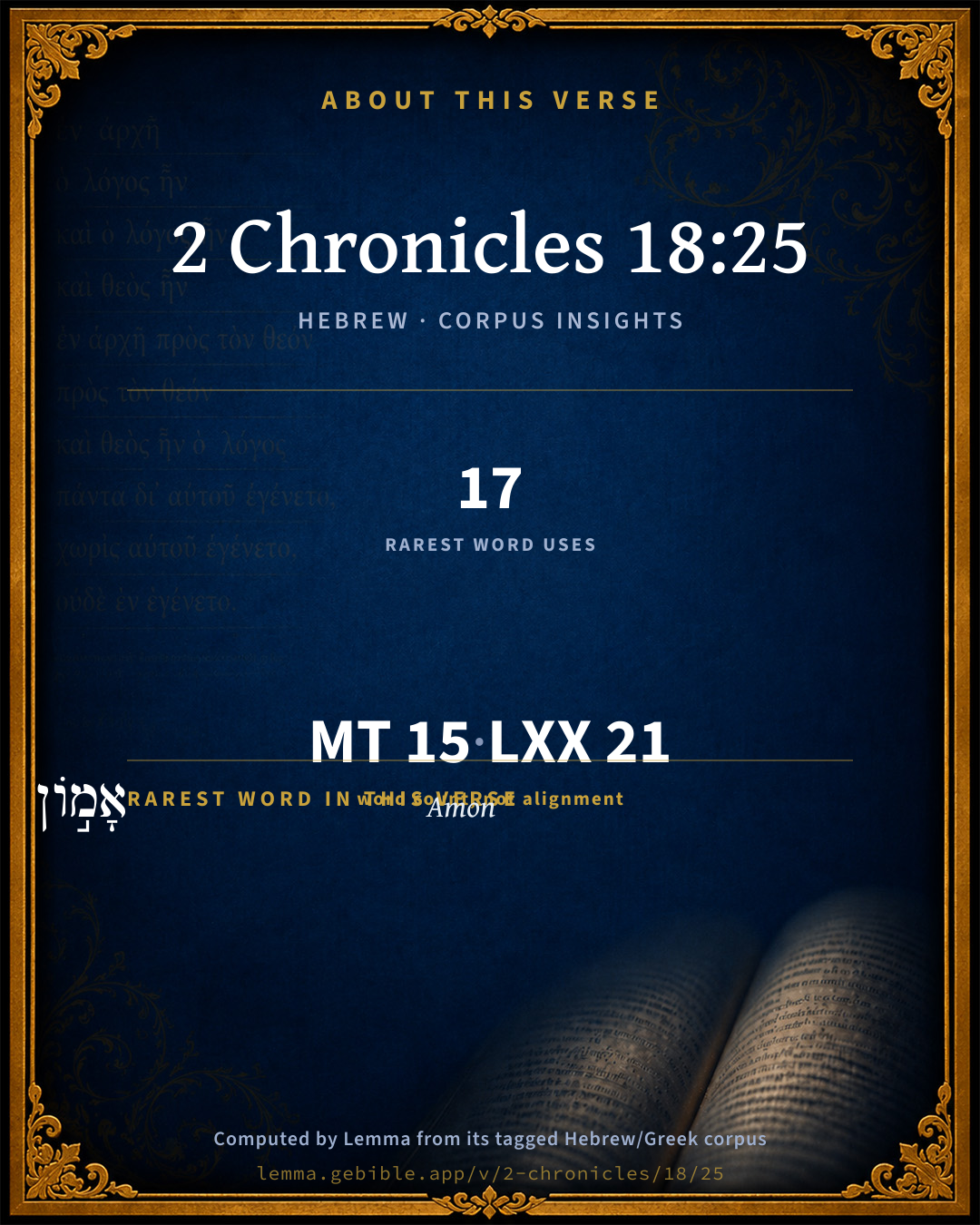
The rarest word here is אָמ֣וֹן Amon H526 — appearing just 17 times in the whole Hebrew Bible.

Shared distinctive vocabulary

אָמ֣וֹן Amon H526 occurs in 17 verses of the Hebrew Bible. Also found in:

Grammatical profile

  • 3 verbs
  • 9 nouns
  • 2 prepositions
  • 1 particle

Verb forms

  • וַיֹּ֨אמֶר֙ Qal · Sequential Imperfect
  • קְחוּ֙ Qal · Imperative
  • וַהֲשִׁיבֻ֖הוּ Hiphil · Imperative

Repetition

Words recur within this verse — often emphatic in Hebrew:

  • מֶ֣לֶךְ king H4428 ×2
  • אֶל to H413 ×2

Hebrew & Septuagint length

In English translation the verse runs 24 words from the Hebrew and 27 from the Septuagint (LXX English) — closely comparable.

A rough comparison of the two English renderings, which tokenize alike — not a word-level alignment.

Word counts can differ between the Hebrew and the Greek without any difference in meaning — e.g. the Hebrew direct-object marker אֵת has no separate Greek word, and Greek often adds the article ὁ.

In the original languages it is 15 Hebrew tokens and 21 Greek tokens — but the two are counted differently (Hebrew bundles its prefixes and suffixes into one token; the Greek is in lemma form), so that isn’t a like-for-like length.

Cross-references

5

Topical passages linked to 2 Chronicles 18:25 in the Treasury of Scripture Knowledge — connected by theme and wording, ordered by reader-vote popularity; previews shown in the World English Bible.

  • 2 Chronicles 18:8 Then the king of Israel called an officer, and said, Get quickly Micaiah the son of Imla.
  • 2 Chronicles 34:8 Now in the eighteenth year of his reign, when he had purged the land and the house, he sent Shaphan the son of Azaliah, and Maaseiah the governor of the city, and Joah the son of Joahaz the recorder, to repair the house of Yahweh his God.
  • Jeremiah 37:15–21 The princes were angry with Jeremiah, and struck him, and put him in prison in the house of Jonathan the scribe; for they had made that the prison.
  • Jeremiah 38:6–7 Then took they Jeremiah, and cast him into the dungeon of Malchijah the king's son, that was in the court of the guard: and they let down Jeremiah with cords. In the dungeon there was no water, but mire; and Jeremiah sank in the mire.
  • Acts 24:25–27 As he reasoned about righteousness, self-control, and the judgment to come, Felix was terrified, and answered, "Go your way for this time, and when it is convenient for me, I will summon you."

Cross-references courtesy of OpenBible.info (CC BY 4.0).

Hebrew and Greek witnesses Masoretic Hebrew ↔ Greek Septuagint

The same verse in the two great witnesses to the Old Testament, shown verse-for-verse.

These are two independent witnesses, not word-aligned to each other, and the Septuagint is shown in lemma (dictionary) form.

Hebrew 2 Chronicles 18:25 Masoretic · Westminster Leningrad Codex

וַיֹּ֨אמֶר֙ מֶ֣לֶךְ יִשְׂרָאֵ֔ל קְחוּ֙ אֶת מִיכָ֔יְהוּ וַהֲשִׁיבֻ֖הוּ אֶל אָמ֣וֹן שַׂר הָעִ֑יר וְאֶל יוֹאָ֖שׁ בֶּן הַמֶּֽלֶךְ

The king of Israel said, Take Micaiah, and carry him back to Amon the governor of the city, and to Joash the king's son;

World English Bible · Public Domain

Greek LXX 2 Chronicles 18:25 Septuagint · lemma form

καί εἶπον βασιλεύς ἰσραήλ λαμβάνω ὁ μιχαιας καί ἀποστρέφω πρός εμηρ ἄρχων ὁ πόλις καί πρός ιωας ἄρχων υἱός ὁ βασιλεύς

And the king of Israel said, Take Michaias, and carry him back to Emer the governor of the city, and to Joas the captain, the king's son;

LXX2012 (modern English Septuagint) · Public Domain

On this verse, Ellicott's Commentary for English Readers discusses the Septuagint’s reading. Read the note in Commentary ↓

Hebrew: Westminster Leningrad Codex (CC BY 4.0). Greek: Septuagint (public domain); English from LXX2012 (modern English Septuagint) (Public Domain). How the Septuagint differs from the Hebrew →

Commentary

Notes on 2 Chronicles 18:25 from classic Christian and Jewish commentators (each source and its license shown beneath its notes). The classic Christian expositions comment on the surrounding passage and are grouped to its opening verse, so a note may address several verses; the Jewish commentaries on the Tanakh (Rashi and others) are per-verse, so they appear only where the commentator wrote on this verse.

Lemma curates 59 commentaries, every one of them public domain or Creative Commons licensed, each selected and text-cleaned for this edition rather than reprinted as found. About our sources →

The Biblical Illustrator

Joseph S. Exell

2Ch_18:25-27

Then the king of Israel said, Take ye Micaiah.

Ahab and Micaiah; or the false and true in character

I. The power of the popular voice. We see the multitude accommodating itself to the wishes of the king. How easy and how congenial it is to human nature to float with the tide. As a rule it pays best to suffer yourself to be carried along by the current. Light things and feeble things can travel this way with small demand on strength and skill. But dead things and all manner of refuse go this way, too. There is something to be feared in a great popular cry. I have heard men say that they dreaded a crowd as much as they did a contagion. If men had as wholesome a fear of going with the stream because it is the stream, society would be healthier. Everybody is a fearful tyrant.

II. Here is one man opposed to the popular sentiment. He valued truth. Of Micaiah it may be said, as it was of another more illustrious, Of the people there were none with him. He esteemed truth to be more precious than gold or any other earthly consideration. He was a hero of no common mould. Men are often misunderstood by those who should know them best.

III. Men of such moral heroism have often to suffer for them principles. Suffering for conscience sake is not yet obsolete.

IV. Such men as Micaiah are morally brave and heroic because they are men of prayer. We are apt to take low views of the nature of prayer. It is more than simply an appointed means of telling God our wants, and of beseeching Him to supply. It is waiting upon God as a personal attendant waits upon his master with whom he converses, and from whose lips he receives commands and instructions. It is more than that, it is communion, fellowship, interchange of thought and sentiment. We may go a step further, and say it is a union of kindred minds--the Divine so flowing into the human that it becomes transformed, that Gods will and mind become its governing law. So life becomes one great connected prayer. A man who understands and enjoys this is one of the strongest and bravest of men. Stephen was such a man of prayer. A man of prayer is prepared to do deeds of holy heroism which put to the blush the vaunted deeds of chivalry.

V. A consciousness of moral weakness is closely allied to moral cowardice. Without a scruple Ahab put the life of Jehoshaphat in jeopardy to save his own. Conscience makes cowards of us all. What a noble tribute was that which was paid to Havelock and his pious soldiers more than once during the Indian Mutiny! When our army was hard pressed, or some specially perilous work had to be done, the command was given, Call out Havelock and his praying men; if this work can be done at all, they are the men to do it.

VI. Retribution sometimes overtakes men in this life, Ahab was left alone to pursue his course of hardened folly until he was ripe for retribution; then God met him and ignominiously closed his career. (J. T. Higgins.)

The Biblical Illustrator, edited by Joseph S. Exell (c. 1880s–1900s) — public domain. Text from a community e-Sword module.

Tyndale Open Study Notes

Tyndale Open Resources

18:25-26 Ahab’s defiance against the Lord is seen in his contempt for Micaiah, the Lord’s prophet.

Tyndale Open Study Notes — © Tyndale Open Resources, licensed CC BY-SA 4.0. Text via the HelloAO Bible API.

Ellicott's Commentary for English Readers

(25) Take ye . . . carry him.—Kings, Take thou . . . carry thou, addressed to some single officer.

Governor.—Sar, “prefect.” LXX., ἄρχοντα. Syriact shallit.

Carry back—i.e., convey back. Literally, make him return.

A Bible Commentary for English Readers, edited by Charles John Ellicott (1878–1897) — public domain. Text from a community e-Sword module.

The Cambridge Bible for Schools and Colleges

gen. ed. J. J. S. Perowne

25. carry him back] Micaiah is not to accompany the expedition, having foretold its failure.

The Cambridge Bible for Schools and Colleges (gen. ed. J. J. S. Perowne; Cambridge University Press, 1878–1918) — public domain. Text from a community e-Sword module.

Haydock's Catholic Bible Commentary

Amelech. Sept. and Syriac, "to Joas, the commander, son of the father. H. --- He had perhaps the government of affairs at Samaria, during his king." Achab’s absence. T.

George Leo Haydock (1774–1849), Haydock's Catholic Family Bible and Commentary, 1859 edition — public domain. Excludes Psalms (Douay-Rheims chapter numbering differs from Protestant) and Deuterocanonical books (Catholic canon only).

The Pulpit Commentary

Carry him back. The last of these three words tells, of course, its own tale, of what had already been the treatment accorded to Micaiah. Amon the governor Joash the king"s son. This latter person is found only here and in the parallel, and the designation given him probably does not intend a personal relationship to the king, but an official; so see again 2Ch_28:7; and note the conjunction again of the governor of the house, in the next clause. The Vulgate translates the Hebrew for "the king"s," as though it were a proper name, "Amelech." See also Smith"s "Bible Dictionary," under the name "Maaseiah" 17. Nor is Amon the governor known elsewhere except in the parallel, (1Ki_22:26) but these designations, as through some chinks, throw a little scanty light into the subject of the internal administration at this time of the kingdom of Israel. In this kingdom subsequent to the separation, decentralization seems to have been carried to a further point than in Judah, and considering its greater extent, its far inferior metropolitan force, its double place of worship and sacrifice, these largely idolatrous, and in all this the undoubted degraded authority of its central government, this is very explainable. It is true that in both kingdoms history speaks equally of such offices and officers as were distinctly military or looked that way, but it can scarcely be without a reason that for the numerous allusions in Israel (1Ki_16:8-10 1Ki_18:3 1Ki_20:7 1Ki_21:7-13; 2Ki_1:8-17 2Ki_3:6 2Ki_10:5) to councils of elders (well known before the disruption), and governors of palaces, of cities, of houses, and of provinces, there is scarcely one in the records of Judah. Here possibly enough the executive would be more vigorous, more compact, and more direct and close in its action from headquarters, while in both divisions of what should have been the one kingdom, royalty was by profession constitutional, and in its devolution hereditary.

The Pulpit Commentary (1880–1919), ed. H.D.M. Spence-Jones & Joseph S. Exell — public domain. Text from a community e-Sword module.

unfoldingWord translationNotes

Door43 World Missions Community

king of Israel

This refers to Ahab.

Amon

This is the name of a man. (See: How to Translate Names)

If you return safely

This describes something that would not happen. Yahweh had already told Micaiah that the king would not return safely. (See: Hypothetical Situations)

translationWords

servant

govern

Joash

prison

unfoldingWord translationNotes — © Distant Shores Media and the Door43 World Missions Community, licensed CC BY-SA 4.0. Source: git.door43.org/Door43/en_tn.

Lesson kit

Teaching starters — assembled from the data on this page, not authored interpretation. Every prompt links to the verse data it draws on. Edit before teaching.

2 Chronicles, in the Historical, opens this verse with 15 words (13 distinct Hebrew lemmas). Its most distinctive word is ʼÂmôwn (“Amon”). A historical commentator’s framing appears above. Read the whole chapter for the surrounding context.

Discussion questions

  1. How does “Amon” (ʼÂmôwn) shape what this verse is saying?
  2. 1 Kings 22:26 shares the word «Amon» with this verse. How do the two illuminate each other?
  3. “king” occurs 2× in this one verse. What is the effect of the repetition?
  4. The translations on this page render this verse differently — a whole-verse word diff, not a word-by-word alignment. What might account for the different wordings?
  5. The verb «וַיֹּ֨אמֶר֙» is Qal Sequential Imperfect. How does its form color the action?
  6. Reading how The Biblical Illustrator and Tyndale Open Study Notes read this verse, where do the two commentators agree and where do they part?

Things to notice

Reading settings

Reading text

Shown beneath each verse's original-language words.

Old Testament
Old Testament edition

Read the OT as the Masoretic Hebrew (MT) or the Greek Septuagint (LXX).

English shown for the Greek Septuagint (in the Hebrew ↔ Greek comparison).

Comparing translations? Open the Compare panel on any verse page to stack up to four side by side.