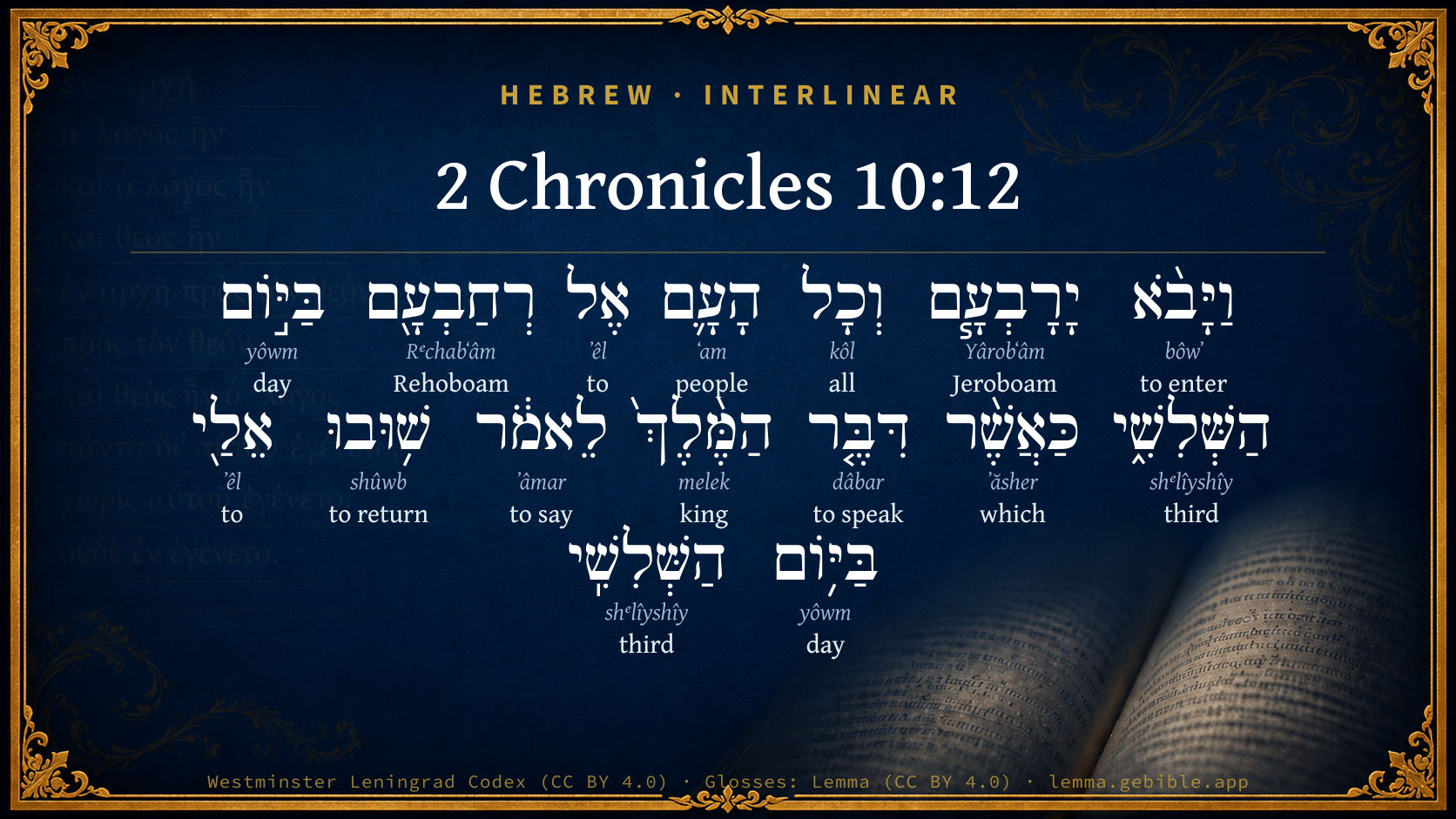
2 Chronicles 10:12

Hebrew (Westminster Leningrad Codex) 2 Chronicles 10:12 appears in the Hebrew Old Testament. The text above is from the Westminster Leningrad Codex. Each word links to its Strong’s number, a concise gloss, and parsing drawn from the Open Scriptures Hebrew Bible morphology. Click any word for its full Brown-Driver-Briggs (BDB) entry.
Download image
Cite this verse

2 Chronicles 10:12 (World English Bible). Public Domain. Lemma interlinear Bible study tool, https://lemma.gebible.app/v/2-chronicles/10/12.

Show BibTeX & RIS
BibTeX
RIS
English Translation
So Jeroboam and all the people came to Rehoboam the third day, as the king bade, saying, Come to me again the third day.
World English Bible · Public Domain
Download a study sheet

One document with this verse’s original text, its word-by-word gloss line, the meaning frame, cross-references with their text, attributed commentary, and full source and license credits — printable, and it pastes into notes with its structure intact.

This verse Autodidact and up

Study sheet (.html) Plain text (.txt)

A passage Seminary Student

Up to 50 verses in one chapter. A passage sheet keeps up to 6 commentary sources and 12 cross-references per verse, in the order this page ranks them, and says so on the sheet whenever that leaves anything out. Ask for a single verse and you get the Autodidact verse sheet above.

Everything on this page stays free to read, with no account — the sheet is a download of what is already on screen, not access to it.

Want to remove ads? Support Godless Engineer
Compare translations 3

The same verse in 3 English versions, stacked beneath the original-language interlinear above. Click any original word for its lexicon entry.

Each is an independent rendering of the whole verse — the interlinear is not word-aligned to these translations.

Highlighted words mark where these versions differ — a whole-verse word diff, not a word-by-word alignment.

  • World English Bible Public Domain
    So Jeroboam and all the people came to Rehoboam the third day, as the king bade, saying, Come to me again the third day.
  • King James Version Public Domain
    So Jeroboam and all the people came to Rehoboam on the third day, as the king bade, saying, Come again to me on the third day.
  • unfoldingWord Literal Text CC BY-SA 4.0
    And Jeroboam came and all the people to Rehoboam on the third day, just as the king spoke saying, “Return to me on the third day.”

unfoldingWord Literal Text — © unfoldingWord, licensed CC BY-SA 4.0. Word-aligned USFM3 via Door43 (git.door43.org/unfoldingWord/en_ult).

Versions to compare (up to 4)

3 of 4 selected

Show all 18 translations

Every available English version of this verse, each an independent rendering of the whole verse.

  • World English Bible Public Domain
    So Jeroboam and all the people came to Rehoboam the third day, as the king bade, saying, Come to me again the third day.
  • Berean Standard Bible Public Domain
    After three days, Jeroboam and all the people returned to Rehoboam, since the king had said, “Come back to me on the third day.”
  • Majority Standard Bible Public Domain
    After three days, Jeroboam and all the people returned to Rehoboam, since the king had said, “Come back to me on the third day.”
  • King James Version Public Domain
    So Jeroboam and all the people came to Rehoboam on the third day, as the king bade, saying, Come again to me on the third day.
  • American Standard Version (1901) Public Domain
    So Jeroboam and all the people came to Rehoboam the third day, as the king bade, saying, Come to me again the third day.
  • Revised Version (1885) Public Domain
    So Jeroboam and all the people came to Rehoboam the third day, as the king bade, saying, Come to me again the third day.
  • Geneva Bible (1599) Public Domain
    Then Ieroboam and all the people came to Rehoboam the third day, as the King had appointed saying, Come againe to me the third day.
  • Douay-Rheims (1899) Public Domain
    So Jeroboam, and all the people came to Roboam the third day, as he commanded them.
  • Young's Literal Translation Public Domain
    And Jeroboam cometh in, and all the people, unto Rehoboam on the third day, as the king spake, saying, `Return unto me on the third day.'
  • Literal Standard Version CC BY-SA 4.0
    And Jeroboam comes in, and all the people, to Rehoboam on the third day, as the king spoke, saying, “Return to me on the third day.”
  • Unlocked Literal Bible CC BY-SA 4.0
    So Jeroboam and all the people came to Rehoboam on the third day, as the king said, “Come back to me on the third day.”
  • unfoldingWord Literal Text CC BY-SA 4.0
    And Jeroboam came and all the people to Rehoboam on the third day, just as the king spoke saying, “Return to me on the third day.”
  • Darby Bible Public Domain
    And Jeroboam and all the people came to Rehoboam the third day, as the king had appointed saying, Come again to me on the third day.
  • World Messianic Bible Public Domain
    So Jeroboam and all the people came to Rehoboam the third day, as the king asked, saying, “Come to me again the third day.”
  • Webster's Bible Public Domain
    So Jeroboam and all the people came to Rehoboam on the third day, as the king directed, saying, Come again to me on the third day.
  • Free Bible Version CC BY-SA 4.0
    Three days later, Jeroboam and all the people returned to Rehoboam, because the king had told them, “Come back in three days time.”
  • Bible in Basic English Public Domain
    So Jeroboam and all the people came to Rehoboam on the third day, as the king had given orders, saying, Come to me again on the third day.
  • JPS Tanakh (1917) Public Domain
    So Jeroboam and all the people came to Rehoboam the third day, as the king bade, saying: 'Come to me again the third day.'

Literal Standard Version (2020), Covenant Press — licensed CC BY-SA 4.0. Text via the HelloAO Bible API (eBible.org). Unlocked Literal Bible (unfoldingWord) — licensed CC BY-SA 4.0. Text via the HelloAO Bible API (eBible.org). unfoldingWord Literal Text — © unfoldingWord, licensed CC BY-SA 4.0. Word-aligned USFM3 via Door43 (git.door43.org/unfoldingWord/en_ult). Free Bible Version, Dr. Jonathan Gallagher — licensed CC BY-SA 4.0. Text via the HelloAO Bible API (eBible.org).

Word by word

More ways to search: Search by grammar → Find every occurrence → Compare this word →

Practice this passage: Drill this verse → Learn its vocabulary →

רְחַבְעָ֖ם
Rᵉchabʻâm
H7346
“Rehoboam”
Noun, Proper
Part of Speech
Noun
Type
Proper
Full BDB Definition

Origin: from H7337 and H5971

TWOT: None

Rehoboam = "a people has enlarged" - son of Solomon and the 1st king of Judah after the split up of the kingdom of Israel
  1. וַיָּבֹ֨א bôwʼ H935 “and · to enter” Conjunction + Verb, Qal, Sequential Imperfect, 3rd Person, Masculine, Singular
  2. יָרָבְעָ֧ם Yârobʻâm H3379 “Jeroboam” Noun, Proper
  3. וְכָל kôl H3605 “and · all of” Conjunction + Noun, Common, Masculine, Singular, Construct
  4. הָעָ֛ם ʻam H5971 “the · people” Particle, Definite Article + Noun, Common, Masculine, Singular, Absolute
  5. אֶל ʼêl H413 “to” Preposition
  6. בַּיּ֣וֹם yôwm H3117 “in/at the · day” Preposition, Determined + Noun, Common, Masculine, Singular, Absolute
  7. הַשְּׁלִשִׁ֑י shᵉlîyshîy H7992 “the · third” Particle, Definite Article + Adjective, Ordinal number, Masculine, Singular, Absolute
  8. כַּאֲשֶׁ֨ר ʼăsher H834 “like/as · which” Preposition + Particle, Relative
  9. דִּבֶּ֤ר dâbar H1696 “to speak” Verb, Piel, Perfect, 3rd Person, Masculine, Singular
  10. הַמֶּ֨לֶךְ֙ melek H4428 “the · king” Particle, Definite Article + Noun, Common, Masculine, Singular, Absolute
  11. לֵאמֹ֔ר ʼâmar H559 “to say” Preposition + Verb, Qal, Infinitive Construct
  12. שׁ֥וּבוּ shûwb H7725 “return” Verb, Qal, Imperative, 2nd Person, Masculine, Plural
  13. אֵלַ֖י ʼêl H413 “to · me” Preposition + Suffix, Personal, 1st Person, Common, Singular
  14. בַּיּ֥וֹם yôwm H3117 “in/at the · day” Preposition, Determined + Noun, Common, Masculine, Singular, Absolute
  15. הַשְּׁלִשִֽׁי shᵉlîyshîy H7992 “the · third” Particle, Definite Article + Adjective, Ordinal number, Masculine, Singular, Absolute

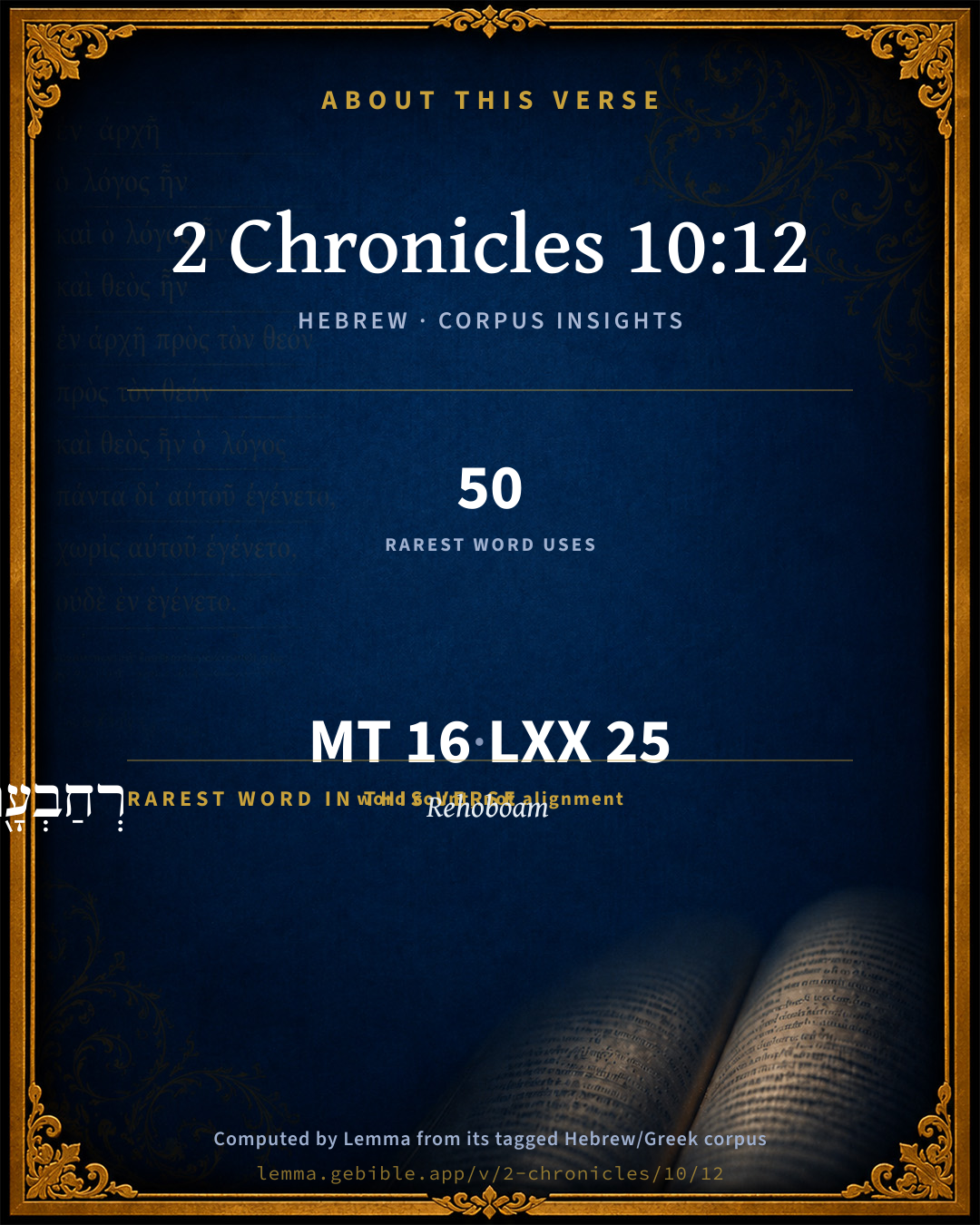
About this verse

These counts appear in no published source. They are computed here, from the morphology-tagged text and Lemma’s own curated glosses. What Lemma adds →

16
words
13
distinct lemmas
Historical
section

Shared distinctive vocabulary

רְחַבְעָ֖ם Rehoboam H7346 occurs in 41 verses of the Hebrew Bible. Also found in:

Grammatical profile

  • 4 verbs
  • 7 nouns
  • 2 adjectives
  • 2 prepositions
  • 1 particle

Verb forms

  • וַיָּבֹ֨א Qal · Sequential Imperfect
  • דִּבֶּ֤ר Piel · Perfect
  • לֵאמֹ֔ר Qal · Infinitive Construct
  • שׁ֥וּבוּ Qal · Imperative

Repetition

Words recur within this verse — often emphatic in Hebrew:

  • בַּיּ֣וֹם day H3117 ×2
  • הַשְּׁלִשִׁ֑י third H7992 ×2
  • אֶל to H413 ×2

Hebrew & Septuagint length

In English translation the verse runs 24 words from the Hebrew and 26 from the Septuagint (LXX English) — closely comparable.

A rough comparison of the two English renderings, which tokenize alike — not a word-level alignment.

Word counts can differ between the Hebrew and the Greek without any difference in meaning — e.g. the Hebrew direct-object marker אֵת has no separate Greek word, and Greek often adds the article ὁ.

In the original languages it is 16 Hebrew tokens and 25 Greek tokens — but the two are counted differently (Hebrew bundles its prefixes and suffixes into one token; the Greek is in lemma form), so that isn’t a like-for-like length.

Cross-references

2

Topical passages linked to 2 Chronicles 10:12 in the Treasury of Scripture Knowledge — connected by theme and wording, ordered by reader-vote popularity; previews shown in the World English Bible.

  • 1 Kings 12:12–15 So Jeroboam and all the people came to Rehoboam the third day, as the king bade, saying, Come to me again the third day.
  • 2 Chronicles 10:5 He said to them, Come again to me after three days. The people departed.

Cross-references courtesy of OpenBible.info (CC BY 4.0).

Hebrew and Greek witnesses Masoretic Hebrew ↔ Greek Septuagint

The same verse in the two great witnesses to the Old Testament, shown verse-for-verse.

These are two independent witnesses, not word-aligned to each other, and the Septuagint is shown in lemma (dictionary) form.

Hebrew 2 Chronicles 10:12 Masoretic · Westminster Leningrad Codex

וַיָּבֹ֨א יָרָבְעָ֧ם וְכָל הָעָ֛ם אֶל רְחַבְעָ֖ם בַּיּ֣וֹם הַשְּׁלִשִׁ֑י כַּאֲשֶׁ֨ר דִּבֶּ֤ר הַמֶּ֨לֶךְ֙ לֵאמֹ֔ר שׁ֥וּבוּ אֵלַ֖י בַּיּ֥וֹם הַשְּׁלִשִֽׁי

So Jeroboam and all the people came to Rehoboam the third day, as the king bade, saying, Come to me again the third day.

World English Bible · Public Domain

Greek LXX 2 Chronicles 10:12 Septuagint · lemma form

καί ἔρχομαι ιεροβοαμ καί πᾶς ὁ λαός πρός ροβοαμ ὁ ἡμέρα ὁ τρίτος ὡς λαλέω ὁ βασιλεύς λέγω ἐπιστρέφω πρός ἐγώ ὁ ἡμέρα ὁ τρίτος

And Jeroboam and all the people came to Roboam on the third day, as the king had spoken, saying, Return to me on the third day.

LXX2012 (modern English Septuagint) · Public Domain

Hebrew: Westminster Leningrad Codex (CC BY 4.0). Greek: Septuagint (public domain); English from LXX2012 (modern English Septuagint) (Public Domain). How the Septuagint differs from the Hebrew →

Commentary

Notes on 2 Chronicles 10:12 from classic Christian and Jewish commentators (each source and its license shown beneath its notes). The classic Christian expositions comment on the surrounding passage and are grouped to its opening verse, so a note may address several verses; the Jewish commentaries on the Tanakh (Rashi and others) are per-verse, so they appear only where the commentator wrote on this verse.

Lemma curates 59 commentaries, every one of them public domain or Creative Commons licensed, each selected and text-cleaned for this edition rather than reprinted as found. About our sources →

Matthew Henry's Commentary

We may learn here, 1. That when public affairs are in a ferment violent proceedings do but make bad worse. Rough answers (such as Rehoboam here gave) do but stir up anger and bring oil to the flames. The pilot has need to steer steadily in a storm. Many have been driven to the mischief they did not intend by being too severely dealt with for what they did intend. 2. That, whatever the devices and designs of men are, God is, by all, doing his own work, and fulfilling the word which he has spoken, no iota or tittle of which shall fall to the ground. The cause of the king's obstinacy and thoughtlessness was of God, that he might perform the word which he spoke by Ahijah, Ch2 10:15. This does not at all excuse Rehoboam's folly, nor lessen the guilt of his haughtiness and passion, that God was pleased to serve his own ends by them. 3. That worldly wealth, honour, and dominion, are very uncertain things. Solomon reigned over all Israel, and, one would think, had done enough to secure the monarchy entire to his family for many ages; and yet he is scarcely cold in his grave before ten of the twelve tribes finally revolt from his son. All the good services he had done for Israel were now forgotten: What portion have we in David? Thus is the government of Christ cast off by many, notwithstanding all he has done to bind the children of men for ever to himself; they say, We will not have this man to reign over us. But this rebellion will certainly be their ruin. 4. That God often visits the iniquities of the fathers upon the children. Solomon forsakes God, and therefore not he, but his son after him, is forsaken by the greatest part of his people. Thus God, by making the penal consequences of sin to last long and visibly to continue after the sinner's death, would give an indication of its malignity, and perhaps some intimation of the perpetuity of its punishment. He that sins against God not only wrongs his soul, but perhaps wrongs his seed more than he thinks of. 5. That, when God is fulfilling his threatenings, he will take care of that, at the same time, promises do not fall to the ground. When Solomon's iniquity is remembered, and for it his son loses ten tribes, David's piety is not forgotten, nor the promise made to him; but for the sake of that his grandson had two tribes preserved to him. The failings of the saints shall not frustrate any promise made to Christ their Head. They shall be chastised, but the covenant not broken, Psa 89:31-34.

Matthew Henry's Commentary on the Whole Bible (1708–1710) — public domain (CC PDM 1.0). Text via the HelloAO Bible API.

Ellicott's Commentary for English Readers

(12) So Jeroboam.—Literatim as Kings.

A Bible Commentary for English Readers, edited by Charles John Ellicott (1878–1897) — public domain. Text from a community e-Sword module.

The Pulpit Commentary

It may be worth observing that the history is silent of what of hope and fear or other thought and feeling transpired with Jeroboam and his party these three critical days of suspense, as also it was so silent as to what transpired with them during the three days, three weeks, three months, before the first interview with Rehoboam at Shechem.

The Pulpit Commentary (1880–1919), ed. H.D.M. Spence-Jones & Joseph S. Exell — public domain. Text from a community e-Sword module.

Kretzmann's Popular Commentary

Paul E. Kretzmann

The Revolt of Israel

v. 12. So Jeroboam and all the people came to Rehoboam on the third day, as the king bade, saying, Come again to me on the third day.

v. 13. And the king answered them roughly, in a violent and haughty manner; and King Rehoboam, headstrong as he was, forsook the counsel of the old men,

v. 14. and answered them after the advice of the young men, saying, My father made your yoke heavy, but I will add thereto; my father chastised you with whips, but I will chastise you with scorpions.

v. 15. So the king hearkened not unto the people; for the cause was of God, He it was that arranged matters in this manner, that the Lord might perform His word which He spake by the hand of Ahijah the Shilonite to Jeroboam, the son of Nebat, 1Ki 11:29. The weakness and inexperience of Rehoboam, his utter want of common sense, and his judicial blindness was made use of by the Lord in bringing upon the house of Solomon the punishment for the latter’s idolatry.

v. 16. And when all Israel saw that the king would not hearken unto them, stubbornly refusing to listen to their appeal, the people answered the king, saying, What portion have we in David, the dynasty of Judah? And we have none inheritance in the son of Jesse. Every man to your tents, O Israel! And now, David, that is, the house of David, the reigning family of Judah, see to thine own house! It was a quiet, but determined declaration of withdrawal, showing the scorn and derision which the people of the northern tribes felt for the foolishness of Rehoboam. So all Israel went to their tents, thus accomplishing the rebellion with all quietness.

v. 17. But as for the children of Israel that dwelt in the cities of Judah, including the Simeonites and the tribe of Benjamin, Rehoboam reigned over them.

v. 18. Then King Rehoboam, apparently unaware of the seriousness of the situation and of the accomplished revolt, sent Hadoram, that was over the tribute, his chief tax-gatherer; and the children of Israel, to show that they were in dead earnest, stoned him with stones that he died. This occurred while Rehoboam was still staying in Shechem. But King Rehoboam made speed, he used all energy, to get him up to his chariot, to flee to Jerusalem, since the seriousness of the situation now finally dawned upon him.

v. 19. And Israel rebelled against the house of David unto this day, to the time that the account was written from which our author took his information. Note: Tyranny is usually followed by disintegration. Mark also: The sins of men are acts of their perverted will, yet God often makes use of the situations due to men’s perversions, in the natural course of events, to carry out His plans.

Paul E. Kretzmann, Popular Commentary of the Bible (1921–1924) — public domain. Text from a community e-Sword module.

unfoldingWord translationNotes

Door43 World Missions Community

on the third day

"after three days" (See: Ordinal Numbers)

made your yoke heavy, but I will add to it

A heavy yoke is a metaphor for very difficult labor and cruel treatment. AT: "treated you cruelly, but I will be more cruel" or "forced you to work very hard, but I will make you work harder" (See: Metaphor)

I will punish you with scorpions

Possible meanings are that 1) "scorpions" is a metaphor for any kind of painful punishment. AT: "I will punish you much more harshly" or 2) "scorpions" is a metaphor for whips with sharp metal barbs at the end. See how you translated this in 2 Chronicles 10:11. AT: "I will punish you with whips that have sharp pieces of metal at the ends" (See: Metaphor)

translationWords

Jeroboam

day

unfoldingWord translationNotes — © Distant Shores Media and the Door43 World Missions Community, licensed CC BY-SA 4.0. Source: git.door43.org/Door43/en_tn.

Lesson kit

Teaching starters — assembled from the data on this page, not authored interpretation. Every prompt links to the verse data it draws on. Edit before teaching.

2 Chronicles, in the Historical, opens this verse with 16 words (13 distinct Hebrew lemmas). Its most distinctive word is Rᵉchabʻâm (“Rehoboam”). A historical commentator’s framing appears above. Read the whole chapter for the surrounding context.

Discussion questions

  1. What does “Rehoboam” (Rᵉchabʻâm) contribute to the verse as a whole?
  2. 1 Kings 11:43 shares the word «Rehoboam» with this verse. How do the two illuminate each other?
  3. “day” occurs 2× in this one verse. What is the effect of the repetition?
  4. These translations render this verse differently; the difference is in the English rendering, not the original. What questions does that raise?
  5. The verb «וַיָּבֹ֨א» is Qal Sequential Imperfect. How does its form color the action?
  6. Reading how Matthew Henry's Commentary and Ellicott's Commentary for English Readers read this verse, where do the two commentators agree and where do they part?

Things to notice

Reading settings

Reading text

Shown beneath each verse's original-language words.

Old Testament
Old Testament edition

Read the OT as the Masoretic Hebrew (MT) or the Greek Septuagint (LXX).

English shown for the Greek Septuagint (in the Hebrew ↔ Greek comparison).

Comparing translations? Open the Compare panel on any verse page to stack up to four side by side.