
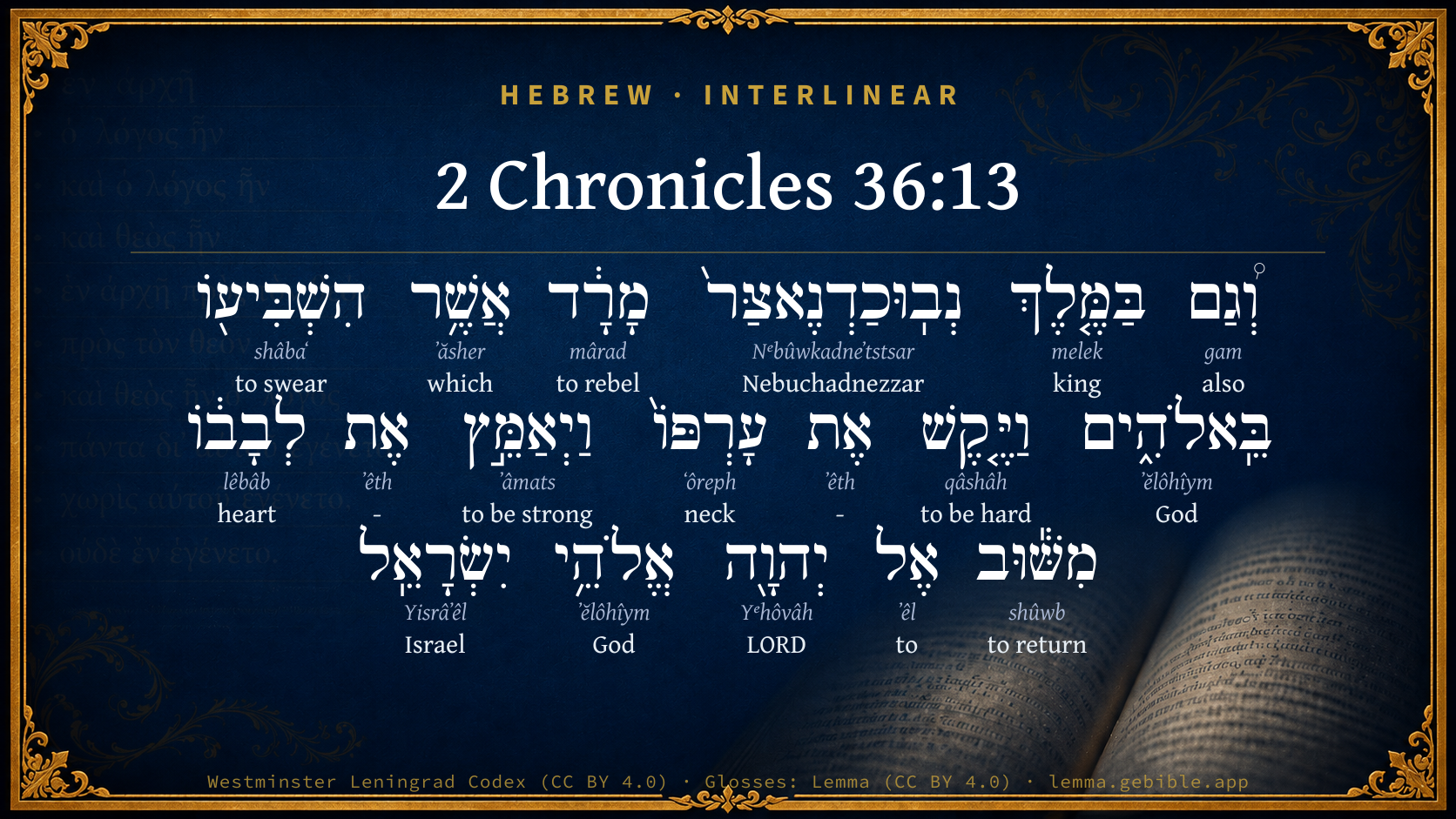
2 Chronicles 36:13

Hebrew (Westminster Leningrad Codex) 2 Chronicles 36:13 appears in the Hebrew Old Testament. The text above is from the Westminster Leningrad Codex. Each word links to its Strong’s number, a concise gloss, and parsing drawn from the Open Scriptures Hebrew Bible morphology. Click any word for its full Brown-Driver-Briggs (BDB) entry.
Download image
Cite this verse

2 Chronicles 36:13 (World English Bible). Public Domain. Lemma interlinear Bible study tool, https://lemma.gebible.app/v/2-chronicles/36/13.

Show BibTeX & RIS
BibTeX
RIS
English Translation
He also rebelled against king Nebuchadnezzar, who had made him swear by God: but he stiffened his neck, and hardened his heart against turning to Yahweh, the God of Israel.
World English Bible · Public Domain
Download a study sheet

One document with this verse’s original text, its word-by-word gloss line, the meaning frame, cross-references with their text, attributed commentary, and full source and license credits — printable, and it pastes into notes with its structure intact.

This verse Autodidact and up

Study sheet (.html) Plain text (.txt)

A passage Seminary Student

Up to 50 verses in one chapter. A passage sheet keeps up to 6 commentary sources and 12 cross-references per verse, in the order this page ranks them, and says so on the sheet whenever that leaves anything out. Ask for a single verse and you get the Autodidact verse sheet above.

Everything on this page stays free to read, with no account — the sheet is a download of what is already on screen, not access to it.

Want to remove ads? Support Godless Engineer
Compare translations 3

The same verse in 3 English versions, stacked beneath the original-language interlinear above. Click any original word for its lexicon entry.

Each is an independent rendering of the whole verse — the interlinear is not word-aligned to these translations.

Highlighted words mark where these versions differ — a whole-verse word diff, not a word-by-word alignment.

  • World English Bible Public Domain
    He also rebelled against king Nebuchadnezzar, who had made him swear by God: but he stiffened his neck, and hardened his heart against turning to Yahweh, the God of Israel.
  • King James Version Public Domain
    And he also rebelled against king Nebuchadnezzar, who had made him swear by God: but he stiffened his neck, and hardened his heart from turning unto the LORD God of Israel.
  • unfoldingWord Literal Text CC BY-SA 4.0
    And also against King Nebuchadnezzar, who had made him swear by God, he rebelled. And he stiffened his neck, and he hardened his heart from turning to Yahweh, the God of Israel.

unfoldingWord Literal Text — © unfoldingWord, licensed CC BY-SA 4.0. Word-aligned USFM3 via Door43 (git.door43.org/unfoldingWord/en_ult).

Versions to compare (up to 4)

3 of 4 selected

Show all 18 translations

Every available English version of this verse, each an independent rendering of the whole verse.

  • World English Bible Public Domain
    He also rebelled against king Nebuchadnezzar, who had made him swear by God: but he stiffened his neck, and hardened his heart against turning to Yahweh, the God of Israel.
  • Berean Standard Bible Public Domain
    He also rebelled against King Nebuchadnezzar, who had made him swear by God. But Zedekiah stiffened his neck and hardened his heart against turning to the LORD, the God of Israel.
  • Majority Standard Bible Public Domain
    He also rebelled against King Nebuchadnezzar, who had made him swear by God. But Zedekiah stiffened his neck and hardened his heart against turning to the LORD, the God of Israel.
  • King James Version Public Domain
    And he also rebelled against king Nebuchadnezzar, who had made him swear by God: but he stiffened his neck, and hardened his heart from turning unto the LORD God of Israel.
  • American Standard Version (1901) Public Domain
    And he also rebelled against king Nebuchadnezzar, who had made him swear by God: but he stiffened his neck, and hardened his heart against turning unto Jehovah, the God of Israel.
  • Revised Version (1885) Public Domain
    And he also rebelled against king Nebuchadnezzar, who had made him swear by God: but he stiffened his neck, and hardened his heart from turning unto the LORD, the God of Israel.
  • Geneva Bible (1599) Public Domain
    But he rebelled moreouer against Nebuchadnezzar, which had caused him to sweare by God: and he hardened his necke and made his heart obstinate that he might not returne to the Lord God of Israel.
  • Douay-Rheims (1899) Public Domain
    Re also revolted from king Nabuchodonosor, who had made him swear by God: and he hardened his neck and his heart, from returning to the Lord the God of Israel.
  • Young's Literal Translation Public Domain
    and also, against king Nebuchadnezzar he hath rebelled, who had caused him to swear by God, and he hardeneth his neck, and strengtheneth his heart, against turning back unto Jehovah, God of Israel.
  • Literal Standard Version CC BY-SA 4.0
    and he has also rebelled against King Nebuchadnezzar who had caused him to swear by God, and he hardens his neck and strengthens his heart against turning back to YHWH, God of Israel.
  • Unlocked Literal Bible CC BY-SA 4.0
    Zedekiah also rebelled against King Nebuchadnezzar, who had made him swear loyalty to him by God. But Zedekiah stiffened his neck and hardened his heart against turning to Yahweh, the God of Israel.
  • unfoldingWord Literal Text CC BY-SA 4.0
    And also against King Nebuchadnezzar, who had made him swear by God, he rebelled. And he stiffened his neck, and he hardened his heart from turning to Yahweh, the God of Israel.
  • Darby Bible Public Domain
    And he also rebelled against king Nebuchadnezzar, who had made him take oath by God; and he stiffened his neck, and hardened his heart from returning to Jehovah the God of Israel.
  • World Messianic Bible Public Domain
    He also rebelled against King Nebuchadnezzar, who had made him swear by God; but he stiffened his neck, and hardened his heart against turning to the LORD, the God of Israel.
  • Webster's Bible Public Domain
    And he also rebelled against king Nebuchadnezzar, who had made him swear by God: but he stiffened his neck, and hardened his heart from turning to the LORD God of Israel.
  • Free Bible Version CC BY-SA 4.0
    He also rebelled against King Nebuchadnezzar, who had made him swear an oath of loyalty by God. Zedekiah was arrogant and hard-hearted, and refused to come back to the Lord, the God of Israel.
  • Bible in Basic English Public Domain
    And he took up arms against King Nebuchadnezzar, though he had made him take an oath by God; but he made his neck stiff and his heart hard, turning away from the Lord, the God of Israel.
  • JPS Tanakh (1917) Public Domain
    And he also rebelled against king Nebuchadnezzar, who had made him swear by God; but he stiffened his neck, and hardened his heart from turning unto the LORD, the God of Israel.

Literal Standard Version (2020), Covenant Press — licensed CC BY-SA 4.0. Text via the HelloAO Bible API (eBible.org). Unlocked Literal Bible (unfoldingWord) — licensed CC BY-SA 4.0. Text via the HelloAO Bible API (eBible.org). unfoldingWord Literal Text — © unfoldingWord, licensed CC BY-SA 4.0. Word-aligned USFM3 via Door43 (git.door43.org/unfoldingWord/en_ult). Free Bible Version, Dr. Jonathan Gallagher — licensed CC BY-SA 4.0. Text via the HelloAO Bible API (eBible.org).

Word by word

More ways to search: Search by grammar → Find every occurrence → Compare this word →

Practice this passage: Drill this verse → Learn its vocabulary →

מָרָ֔ד
mârad
H4775
“to rebel”
Verb, Qal, Perfect, 3rd Person, Masculine, Singular
Part of Speech
Verb
Stem
Qal
Form
Perfect
Person
3rd Person
Gender
Masculine
Number
Singular
Full BDB Definition

Origin: a primitive root

TWOT: 1240

to rebel, revolt, be rebellious - (Qal) to rebel, revolt - against human king - against God - against light (poetic)
  1. וְ֠גַם gam H1571 “and · also” Conjunction + Particle, Accusative
  2. בַּמֶּ֤לֶךְ melek H4428 “in/at the · king” Preposition, Determined + Noun, Common, Masculine, Singular, Absolute
  3. נְבֽוּכַדְנֶאצַּר֙ Nᵉbûwkadneʼtstsar H5019 “Nebuchadnezzar” Noun, Proper
  4. אֲשֶׁ֥ר ʼăsher H834 “which” Particle, Relative
  5. הִשְׁבִּיע֖וֹ shâbaʻ H7650 “to swear · him” Verb, Hiphil, Perfect, 3rd Person, Masculine, Singular + Suffix, Personal, 3rd Person, Masculine, Singular
  6. בֵּֽאלֹהִ֑ים ʼĕlôhîym H430 “in/at · God(s)” Preposition + Noun, Common, Masculine, Plural, Absolute
  7. וַיֶּ֤קֶשׁ qâshâh H7185 “and · to be hard” Conjunction + Verb, Hiphil, Sequential Imperfect, 3rd Person, Masculine, Singular
  8. אֶת ʼêth H853 “-” Particle, Direct Object
  9. עָרְפּוֹ֙ ʻôreph H6203 “neck · his” Noun, Common, Masculine, Singular, Construct + Suffix, Personal, 3rd Person, Masculine, Singular
  10. וַיְאַמֵּ֣ץ ʼâmats H553 “and · to be strong” Conjunction + Verb, Piel, Sequential Imperfect, 3rd Person, Masculine, Singular
  11. אֶת ʼêth H853 “-” Particle, Direct Object
  12. לְבָב֔וֹ lêbâb H3824 “heart · his” Noun, Common, Masculine, Singular, Construct + Suffix, Personal, 3rd Person, Masculine, Singular
  13. מִשּׁ֕וּב shûwb H7725 “from · to return” Preposition + Verb, Qal, Infinitive Construct
  14. אֶל ʼêl H413 “to” Preposition
  15. יְהוָ֖ה Yᵉhôvâh H3068 “LORD” Noun, Proper
  16. אֱלֹהֵ֥י ʼĕlôhîym H430 “God(s) of” Noun, Common, Masculine, Plural, Construct
  17. יִשְׂרָאֵֽל Yisrâʼêl H3478 “Israel” Noun, Proper

About this verse

These counts appear in no published source. They are computed here, from the morphology-tagged text and Lemma’s own curated glosses. What Lemma adds →

18
words
16
distinct lemmas
Historical
section

Notable vocabulary

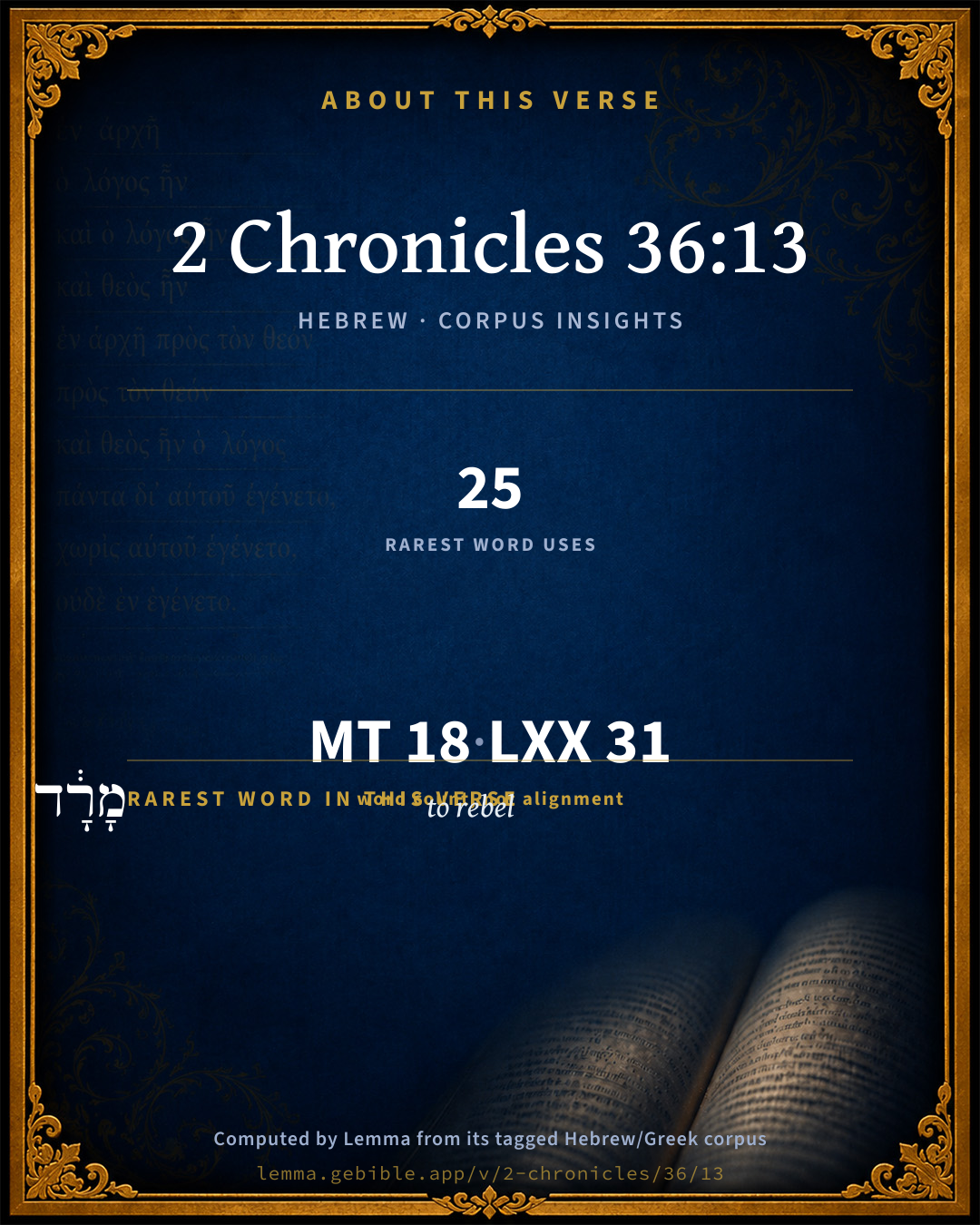
The rarest word here is מָרָ֔ד to rebel H4775 — appearing just 25 times in the whole Hebrew Bible.

Shared distinctive vocabulary

מָרָ֔ד to rebel H4775 occurs in 23 verses of the Hebrew Bible. Also found in:

Grammatical profile

  • 5 verbs
  • 8 nouns
  • 1 preposition
  • 4 particles

Verb forms

  • מָרָ֔ד Qal · Perfect
  • הִשְׁבִּיע֖וֹ Hiphil · Perfect
  • וַיֶּ֤קֶשׁ Hiphil · Sequential Imperfect
  • וַיְאַמֵּ֣ץ Piel · Sequential Imperfect
  • מִשּׁ֕וּב Qal · Infinitive Construct

Repetition

A word recurs within this verse — often emphatic in Hebrew:

  • בֵּֽאלֹהִ֑ים God H430 ×2

Hebrew & Septuagint length

In English translation the verse runs 30 words from the Hebrew and 36 from the Septuagint (LXX English) — closely comparable.

A rough comparison of the two English renderings, which tokenize alike — not a word-level alignment.

Word counts can differ between the Hebrew and the Greek without any difference in meaning — e.g. the Hebrew direct-object marker אֵת has no separate Greek word, and Greek often adds the article ὁ.

In the original languages it is 18 Hebrew tokens and 31 Greek tokens — but the two are counted differently (Hebrew bundles its prefixes and suffixes into one token; the Greek is in lemma form), so that isn’t a like-for-like length.

Cross-references

17

Topical passages linked to 2 Chronicles 36:13 in the Treasury of Scripture Knowledge — connected by theme and wording, ordered by reader-vote popularity; previews shown in the World English Bible.

  • 2 Chronicles 30:8 Now don't you be stiff-necked, as your fathers were; but yield yourselves to Yahweh, and enter into his sanctuary, which he has sanctified forever, and serve Yahweh your God, that his fierce anger may turn away from you.
  • Jeremiah 52:2–3 He did that which was evil in the sight of Yahweh, according to all that Jehoiakim had done.
  • Ezekiel 17:11–20 Moreover the word of Yahweh came to me, saying,
  • Exodus 8:15 But when Pharaoh saw that there was a respite, he hardened his heart, and didn't listen to them, as Yahweh had spoken.
  • Exodus 8:32 Pharaoh hardened his heart this time also, and he didn't let the people go.
  • Exodus 9:17 as you still exalt yourself against my people, that you won't let them go.
  • Joshua 9:15 Joshua made peace with them, and made a covenant with them, to let them live: and the princes of the congregation swore to them.
  • Joshua 9:19–20 But all the princes said to all the congregation, We have sworn to them by Yahweh, the God of Israel: now therefore we may not touch them.
  • 2 Samuel 21:2 The king called the Gibeonites, and said to them (now the Gibeonites were not of the children of Israel, but of the remnant of the Amorites; and the children of Israel had sworn to them: and Saul sought to kill them in his zeal for the children of Israel and Judah);
  • 2 Kings 17:4 The king of Assyria found conspiracy in Hoshea; for he had sent messengers to So king of Egypt, and offered no tribute to the king of Assyria, as he had done year by year: therefore the king of Assyria shut him up, and bound him in prison.
  • 2 Kings 24:20 For through the anger of Yahweh did it happen in Jerusalem and Judah, until he had cast them out from his presence. Zedekiah rebelled against the king of Babylon.
  • Nehemiah 9:16–17 But they and our fathers dealt proudly and hardened their neck, and didn't listen to your commandments,
  • Nehemiah 9:29 and testified against them, that you might bring them again to your law. Yet they dealt proudly, and didn't listen to your commandments, but sinned against your ordinances, (which if a man do, he shall live in them), and withdrew the shoulder, and hardened their neck, and would not hear.
  • Isaiah 48:4 Because I knew that you are obstinate, and your neck is an iron sinew, and your brow brass;
  • Romans 2:4–5 Or do you despise the riches of his goodness, forbearance, and patience, not knowing that the goodness of God leads you to repentance?
  • Hebrews 3:8 Don't harden your hearts, as in the provocation, Like as in the day of the trial in the wilderness,
  • Hebrews 3:13 but exhort one another day by day, so long as it is called "today;" lest any one of you be hardened by the deceitfulness of sin.

Cross-references courtesy of OpenBible.info (CC BY 4.0).

Hebrew and Greek witnesses Masoretic Hebrew ↔ Greek Septuagint

The same verse in the two great witnesses to the Old Testament, shown verse-for-verse.

These are two independent witnesses, not word-aligned to each other, and the Septuagint is shown in lemma (dictionary) form.

Hebrew 2 Chronicles 36:13 Masoretic · Westminster Leningrad Codex

וְ֠גַם בַּמֶּ֤לֶךְ נְבֽוּכַדְנֶאצַּר֙ מָרָ֔ד אֲשֶׁ֥ר הִשְׁבִּיע֖וֹ בֵּֽאלֹהִ֑ים וַיֶּ֤קֶשׁ אֶת עָרְפּוֹ֙ וַיְאַמֵּ֣ץ אֶת לְבָב֔וֹ מִשּׁ֕וּב אֶל יְהוָ֖ה אֱלֹהֵ֥י יִשְׂרָאֵֽל

He also rebelled against king Nebuchadnezzar, who had made him swear by God: but he stiffened his neck, and hardened his heart against turning to Yahweh, the God of Israel.

World English Bible · Public Domain

Greek LXX 2 Chronicles 36:13 Septuagint · lemma form

ἐν ὁ ὁ πρός ὁ βασιλεύς ναβουχοδονοσορ ἀθετέω ὅς ὁρκίζω αὐτός κατά ὁ θεός καί σκληρύνω ὁ τράχηλος αὐτός καί ὁ καρδία αὐτός καταἰσχύω ὁ μή ἐπιστρέφω πρός κύριος θεός ἰσραήλ

in that he rebelled against king Nabuchodonosor, which he adjured him by God not to do: but he stiffened his neck, and hardened his heart, so as not to return to the Lord God of Israel.

LXX2012 (modern English Septuagint) · Public Domain

Hebrew: Westminster Leningrad Codex (CC BY 4.0). Greek: Septuagint (public domain); English from LXX2012 (modern English Septuagint) (Public Domain). How the Septuagint differs from the Hebrew →

Commentary

Notes on 2 Chronicles 36:13 from classic Christian and Jewish commentators (each source and its license shown beneath its notes). The classic Christian expositions comment on the surrounding passage and are grouped to its opening verse, so a note may address several verses; the Jewish commentaries on the Tanakh (Rashi and others) are per-verse, so they appear only where the commentator wrote on this verse.

Lemma curates 59 commentaries, every one of them public domain or Creative Commons licensed, each selected and text-cleaned for this edition rather than reprinted as found. About our sources →

Joseph Benson's Commentary

2Ch 36:13. Who had made him swear by God — Who had required him to swear fealty and constant obedience to him, by the true God, whom he called upon to be a witness against him if he broke his oath. So his rebellion was aggravated with perjury and horrid contempt of God. But he stiffened his neck, and hardened his heart — He added obstinacy and incorrigibleness to his sins.

Joseph Benson's Commentary on the Old and New Testaments (1811–1818) — public domain. Text from a community e-Sword module.

Tyndale Open Study Notes

Tyndale Open Resources

36:13 an oath of loyalty in God’s name: The vassal oath imposed on him was probably similar to those known from Assyrian treaties, sworn in the name of the vassal’s god.

Tyndale Open Study Notes — © Tyndale Open Resources, licensed CC BY-SA 4.0. Text via the HelloAO Bible API.

Jamieson, Fausset & Brown

Robert Jamieson, A. R. Fausset & David Brown

who had made him swear by God--Zedekiah received his crown on the express condition of taking a solemn oath of fealty to the king of Babylon (Eze 17:13); so that his revolt by joining in a league with Pharaoh-hophra, king of Egypt, involved the crime of perjury. His own pride and obdurate impiety, the incurable idolatry of the nation, and their reckless disregard of prophetic warnings, brought down on his already sadly reduced kingdom the long threatened judgments of God. Nebuchadnezzar, the executioner of the divine vengeance, commenced a third siege of Jerusalem, which, after holding out for a year and a half, was taken in the eleventh year of the reign of Zedekiah. It resulted in the burning of the temple, with, most probably, the ark, and in the overthrow of the kingdom of Judah (see on Kg2 25:1-7; Eze 12:13; Eze 17:16).

Jamieson, Fausset & Brown — Commentary Critical and Explanatory on the Whole Bible (1871) — public domain (CC PDM 1.0). Text via the HelloAO Bible API.

Ellicott's Commentary for English Readers

(13) And he also rebelled.—2Ki_24:20.

Who had made him swear by God.—When Nebuchadnezzar appointed Zedekiah vassal-king of Judah, he would naturally make him swear fealty to himself by the God of his fathers. The fact is not specially recorded in Kings; but the prophet Ezekiel makes it the point of a prophecy against the king and his grandees (Eze_17:11-21; comp, especially 2Ch_36:17, “mine oath that he hath despised.”)

But (and) stiffened his neck and hardened his heart.—(Comp. the like expression in Deu_2:30; 2Ki_17:14; Jer_19:15.) Zedekiah was not personally unfavourable to the prophet Jeremiah, and consulted him more than once; but he was too weak and timorous to stand by the prophetic counsel, in defiance of his princes who were intriguing with Egypt.

A Bible Commentary for English Readers, edited by Charles John Ellicott (1878–1897) — public domain. Text from a community e-Sword module.

The Cambridge Bible for Schools and Colleges

gen. ed. J. J. S. Perowne

13. who had made him swear by God] Cp. Eze_17:11-19.

The Cambridge Bible for Schools and Colleges (gen. ed. J. J. S. Perowne; Cambridge University Press, 1878–1918) — public domain. Text from a community e-Sword module.

Albert Barnes' Notes on the Bible

The oath of allegiance was taken when he was first installed in his kingdom. On Zedekiah’s sin in breaking his oath, see Eze 17:18-20; Eze 21:25.

Albert Barnes' Notes on the Bible (1834–1885) — public domain. Text from a community e-Sword/MySword module.

Haydock's Catholic Bible Commentary

By God, to be faithful. T. --- This enhances his crime. C.

George Leo Haydock (1774–1849), Haydock's Catholic Family Bible and Commentary, 1859 edition — public domain. Excludes Psalms (Douay-Rheims chapter numbering differs from Protestant) and Deuterocanonical books (Catholic canon only).

Matthew Poole's English Annotations

Who had made him swear by God; who had required and forced him to swear fealty and constant obedience to him by the true God, whom he had served, and whom he called upon to be a witness against him if he broke his oath. So his rebellion was aggravated with perjury, and horrid contempt of God. Compare Eze 17:18. Hardened his heart, i.e. he added obstinacy and incorrigibleness to his sins.

Matthew Poole's English Annotations on the Holy Bible (1683–1685) — public domain. Text from a community e-Sword/MySword module.

The Pulpit Commentary

He also rebelled against Nebuchadnezzar, who had made him swear by God (Elohim). The criticism of the Prophet Ezekiel upon this oath-violation on the part of Zedekiah is to be found Eze_17:12-20 Eze_21:25. Unto the Lord God of Israel. Note here the resorting on the part of the Jew to the name, Jehovah. It is not this name that is used at the commencement of the verse.

The Pulpit Commentary (1880–1919), ed. H.D.M. Spence-Jones & Joseph S. Exell — public domain. Text from a community e-Sword module.

John Wesley's Explanatory Notes

By God - Who had required him to swear fealty and constant obedience to him by the true God, whom he called upon to be a witness against him if he broke his oath. So his rebellion was aggravated with perjury, and horrid contempt of God.

John Wesley, Explanatory Notes Upon the Whole Bible (1754–1765) — public domain. Text via the GEBible commentary corpus.

unfoldingWord translationNotes

Door43 World Missions Community

Zedekiah stiffened his neck and hardened his heart against turning to Yahweh

The phrases "stiffened his neck" and "hardened his heart" are both metaphors that mean to become stubborn. Zedekiah refusing to worship Yahweh is spoken of as if he refused to turn to Yahweh. AT: "Zedekiah stubbornly refused to worship Yahweh" (See: Doublet and Metaphor)

they followed the disgusting practices of the nations

The idiom "followed the ... practices" means to do those things. AT: "they did the disgusting things that the nations did" (See: Idiom)

disgusting practices

This phrase refers to worshiping other gods.

They polluted the house of Yahweh

A place that is unfit to be used for God's purposes is spoken of as if it were physically dirty. The word "house" represents the temple. AT: "They polluted the temple of Yahweh" (See: Metaphor and Metonymy)

translationWords

rebel

Nebuchadnezzar

oath

God

heart

turn

priest

trespass

people group

consecrate

unfoldingWord translationNotes — © Distant Shores Media and the Door43 World Missions Community, licensed CC BY-SA 4.0. Source: git.door43.org/Door43/en_tn.

Rashi

Rabbi Shlomo Yitzchaki (Rashi)

who adjured him by God as is explained in Ezekiel (17:12): “Say now to the rebellious house, etc.” The entire chapter was written regarding Jehoiachin and Zedekiah: (verse 13f.) “took its king and its princes, and brought them to him to Babylon,” refers to Jehoiachin and his company. “And he took of the royal seed and formed a covenant with him,” refers to Zedekiah.

Rashi on the Tanakh — English translations: “The Judaica Press complete Tanach with Rashi, translated by A. J. Rosenberg” (CC BY 4.0); “Pentateuch with Rashi's commentary by M. Rosenbaum and A.M. Silbermann, 1929-1934” (public domain); “The Metsudah Tanach series, Lakewood, N.J” (CC BY 4.0); and “The Book of Joshua, Metsudah Publications, 1997” (CC BY 4.0). Text via Sefaria.

Lesson kit

Teaching starters — assembled from the data on this page, not authored interpretation. Every prompt links to the verse data it draws on. Edit before teaching.

2 Chronicles, in the Historical, opens this verse with 18 words (16 distinct Hebrew lemmas). Its most distinctive word is mârad (“to rebel”). A historical commentator’s framing appears above. Read the whole chapter for the surrounding context.

Discussion questions

  1. What does “to rebel” (mârad) contribute to the verse as a whole?
  2. How does Genesis 14:4, which shares the word «to rebel», read alongside this verse?
  3. What does the repetition of “God” (2× in this one verse) do in this verse?
  4. These translations render this verse differently; the difference is in the English rendering, not the original. What questions does that raise?
  5. «מָרָ֔ד» is a Qal Perfect verb. How does that grammatical form shape the action described?
  6. Compare how Joseph Benson's Commentary and Tyndale Open Study Notes read this verse. Where do they agree or differ?

Things to notice

Reading settings

Reading text

Shown beneath each verse's original-language words.

Old Testament
Old Testament edition

Read the OT as the Masoretic Hebrew (MT) or the Greek Septuagint (LXX).

English shown for the Greek Septuagint (in the Hebrew ↔ Greek comparison).

Comparing translations? Open the Compare panel on any verse page to stack up to four side by side.