Nehemiah 13:30

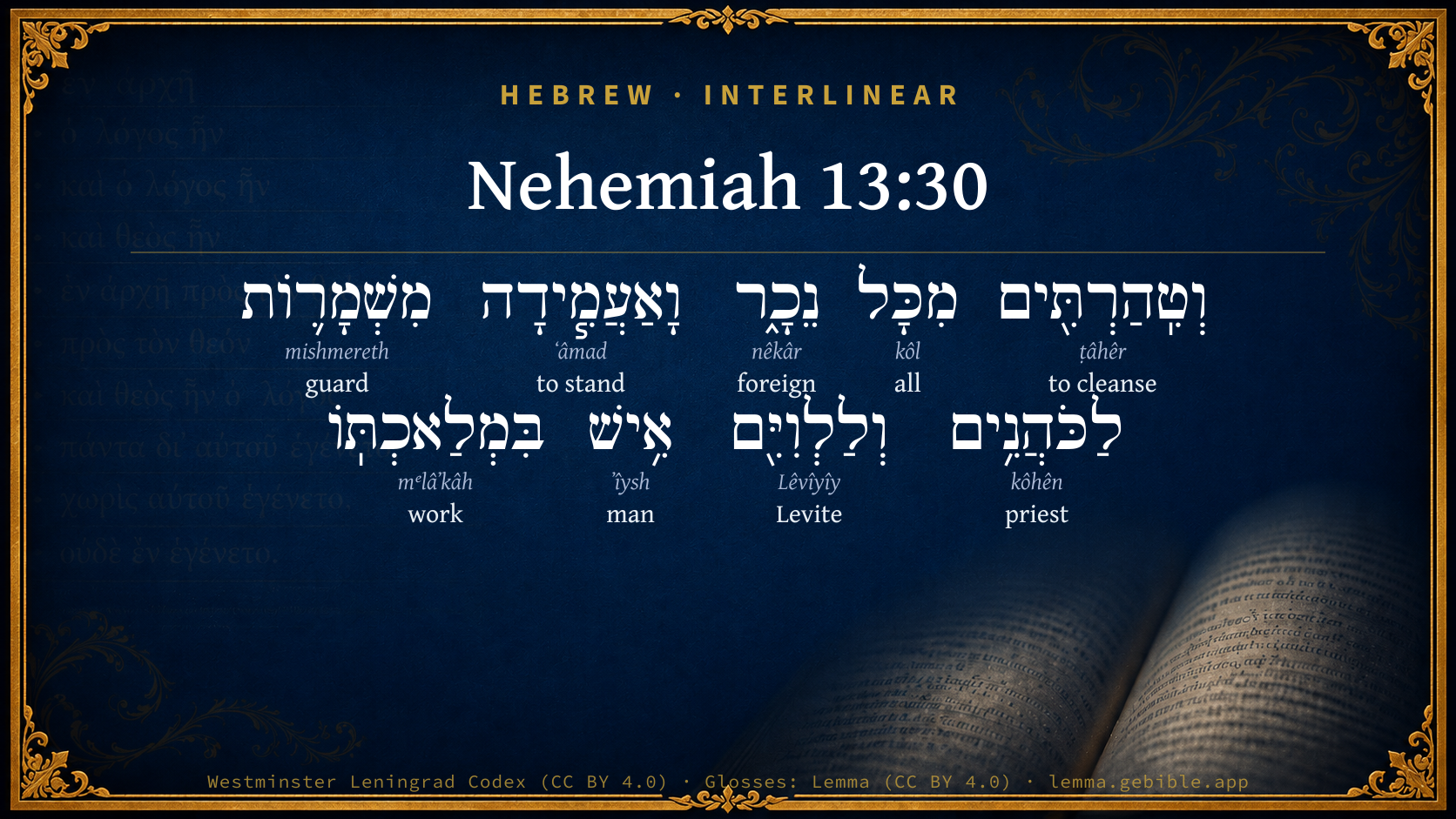
Hebrew (Westminster Leningrad Codex) Nehemiah 13:30 appears in the Hebrew Old Testament. The text above is from the Westminster Leningrad Codex. Each word links to its Strong’s number, a concise gloss, and parsing drawn from the Open Scriptures Hebrew Bible morphology. Click any word for its full Brown-Driver-Briggs (BDB) entry.
Download image
Cite this verse

Nehemiah 13:30 (World English Bible). Public Domain. Lemma interlinear Bible study tool, https://lemma.gebible.app/v/nehemiah/13/30.

Show BibTeX & RIS
BibTeX
RIS
English Translation
Thus cleansed I them from all foreigners, and appointed charges for the priests and for the Levites, everyone in his work;
World English Bible · Public Domain
Download a study sheet

One document with this verse’s original text, its word-by-word gloss line, the meaning frame, cross-references with their text, attributed commentary, and full source and license credits — printable, and it pastes into notes with its structure intact.

This verse Autodidact and up

Study sheet (.html) Plain text (.txt)

A passage Seminary Student

Up to 50 verses in one chapter. A passage sheet keeps up to 6 commentary sources and 12 cross-references per verse, in the order this page ranks them, and says so on the sheet whenever that leaves anything out. Ask for a single verse and you get the Autodidact verse sheet above.

Everything on this page stays free to read, with no account — the sheet is a download of what is already on screen, not access to it.

Want to remove ads? Support Godless Engineer
Compare translations 3

The same verse in 3 English versions, stacked beneath the original-language interlinear above. Click any original word for its lexicon entry.

Each is an independent rendering of the whole verse — the interlinear is not word-aligned to these translations.

Highlighted words mark where these versions differ — a whole-verse word diff, not a word-by-word alignment.

  • World English Bible Public Domain
    Thus cleansed I them from all foreigners, and appointed charges for the priests and for the Levites, everyone in his work;
  • King James Version Public Domain
    Thus cleansed I them from all strangers, and appointed the wards of the priests and the Levites, every one in his business;
  • unfoldingWord Literal Text CC BY-SA 4.0
    And I purified them from everything foreign. And I caused the service watches to stand: for the priests and for the Levites, a man in his work;

unfoldingWord Literal Text — © unfoldingWord, licensed CC BY-SA 4.0. Word-aligned USFM3 via Door43 (git.door43.org/unfoldingWord/en_ult).

Versions to compare (up to 4)

3 of 4 selected

Show all 18 translations

Every available English version of this verse, each an independent rendering of the whole verse.

  • World English Bible Public Domain
    Thus cleansed I them from all foreigners, and appointed charges for the priests and for the Levites, everyone in his work;
  • Berean Standard Bible Public Domain
    Thus I purified the priests and Levites from everything foreign, and I assigned specific duties to each of the priests and Levites.
  • Majority Standard Bible Public Domain
    Thus I purified the priests and Levites from everything foreign, and I assigned specific duties to each of the priests and Levites.
  • King James Version Public Domain
    Thus cleansed I them from all strangers, and appointed the wards of the priests and the Levites, every one in his business;
  • American Standard Version (1901) Public Domain
    Thus cleansed I them from all foreigners, and appointed charges for the priests and for the Levites, every one in his work;
  • Revised Version (1885) Public Domain
    Thus cleansed I them from all strangers, and appointed wards for the priests and for the Levites, every one in his work;
  • Geneva Bible (1599) Public Domain
    Then cleansed I them from all strangers, and appoynted the wardes of the Priestes and of the Leuites, euery one in his office,
  • Douay-Rheims (1899) Public Domain
    So I separated from them all strangers, and I appointed the courses of the priests and the Levites, every man in his ministry:
  • Young's Literal Translation Public Domain
    And I have cleansed them from every stranger, and appoint charges to priests and to Levites, each in his work,
  • Literal Standard Version CC BY-SA 4.0
    And I have cleansed them from every stranger, and appoint charges to priests and to Levites, each in his work,
  • Unlocked Literal Bible CC BY-SA 4.0
    Thus I cleansed them from everything foreign, and established the duties of the priests and the Levites, each to his own task.
  • unfoldingWord Literal Text CC BY-SA 4.0
    And I purified them from everything foreign. And I caused the service watches to stand: for the priests and for the Levites, a man in his work;
  • Darby Bible Public Domain
    And I purified them from all foreigners, and appointed the charges of the priests and the Levites, every one in his service;
  • World Messianic Bible Public Domain
    Thus I cleansed them from all foreigners and appointed duties for the priests and for the Levites, everyone in his work;
  • Webster's Bible Public Domain
    Thus I cleansed them from all strangers, and appointed the wards of the priests and the Levites, every one in his business;
  • Free Bible Version CC BY-SA 4.0
    I purified them from everything foreign, and I made sure the priests and Levites were carrying out their assigned responsibilities.
  • Bible in Basic English Public Domain
    So I made them clean from all strange people, and had regular watches fixed for the priests and for the Levites, everyone in his work;
  • JPS Tanakh (1917) Public Domain
    Thus cleansed I them from everything foreign, and appointed wards for the priests and for the Levites, every one in his work;

Literal Standard Version (2020), Covenant Press — licensed CC BY-SA 4.0. Text via the HelloAO Bible API (eBible.org). Unlocked Literal Bible (unfoldingWord) — licensed CC BY-SA 4.0. Text via the HelloAO Bible API (eBible.org). unfoldingWord Literal Text — © unfoldingWord, licensed CC BY-SA 4.0. Word-aligned USFM3 via Door43 (git.door43.org/unfoldingWord/en_ult). Free Bible Version, Dr. Jonathan Gallagher — licensed CC BY-SA 4.0. Text via the HelloAO Bible API (eBible.org).

Word by word

More ways to search: Search by grammar → Find every occurrence → Compare this word →

Practice this passage: Drill this verse → Learn its vocabulary →

נֵכָ֑ר
nêkâr
H5236
“foreign”
Noun, Common, Masculine, Singular, Absolute
Part of Speech
Noun
Type
Common
Gender
Masculine
Number
Singular
State
Absolute
Full BDB Definition

Origin: from H5234

TWOT: 1368b

foreign, alien, foreignness, that which is foreign - foreignness, foreign gods - alien, foreigner - foreign (vanities)
  1. וְטִֽהַרְתִּ֖ים ṭâhêr H2891 “and · to cleanse · them” Conjunction + Verb, Piel, Perfect, 1st Person, Common, Singular + Suffix, Personal, 3rd Person, Masculine, Plural
  2. מִכָּל kôl H3605 “from · all of” Preposition + Noun, Common, Masculine, Singular, Construct
  3. וָאַעֲמִ֧ידָה ʻâmad H5975 “and · to stand” Conjunction + Verb, Hiphil, Sequential Imperfect, 1st Person, Common, Singular + Suffix, h
  4. מִשְׁמָר֛וֹת mishmereth H4931 “guards” Noun, Common, Feminine, Plural, Absolute
  5. לַכֹּהֲנִ֥ים kôhên H3548 “to/for the · priests” Preposition, Determined + Noun, Common, Masculine, Plural, Absolute
  6. וְלַלְוִיִּ֖ם Lêvîyîy H3881 “and · to/for the · Levites” Conjunction + Preposition, Determined + Noun, Gentilic, Masculine, Plural, Absolute
  7. אִ֥ישׁ ʼîysh H376 “man” Noun, Common, Masculine, Singular, Absolute
  8. בִּמְלַאכְתּֽוֹ mᵉlâʼkâh H4399 “in/at · work · his” Preposition + Noun, Common, Feminine, Singular, Construct + Suffix, Personal, 3rd Person, Masculine, Singular

About this verse

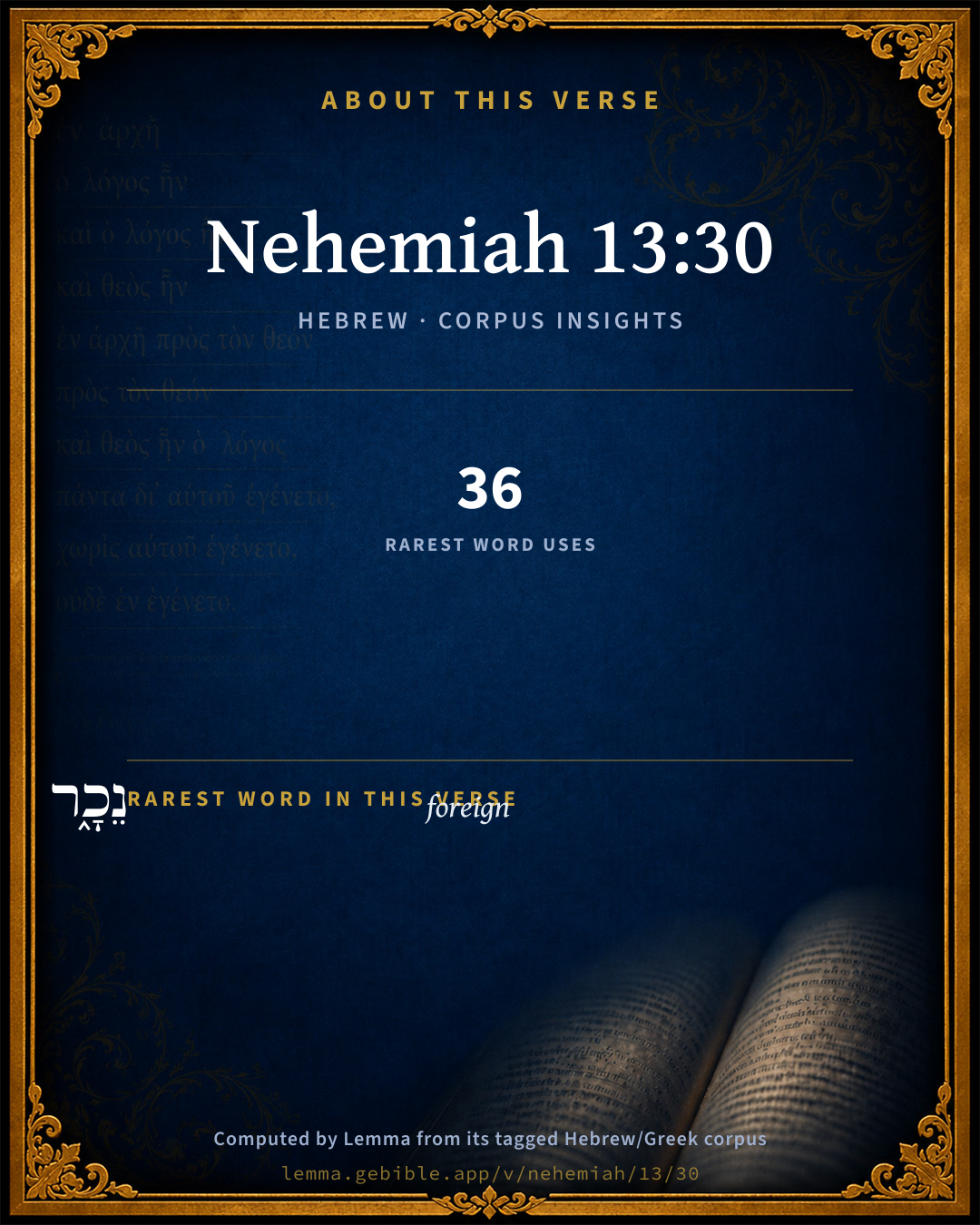
These counts appear in no published source. They are computed here, from the morphology-tagged text and Lemma’s own curated glosses. What Lemma adds →

9
words
9
distinct lemmas
Historical
section

Shared distinctive vocabulary

נֵכָ֑ר foreign H5236 occurs in 35 verses of the Hebrew Bible. Also found in:

Grammatical profile

  • 2 verbs
  • 7 nouns

Verb forms

  • וְטִֽהַרְתִּ֖ים Piel · Perfect
  • וָאַעֲמִ֧ידָה Hiphil · Sequential Imperfect

Cross-references

3

Topical passages linked to Nehemiah 13:30 in the Treasury of Scripture Knowledge — connected by theme and wording, ordered by reader-vote popularity; previews shown in the World English Bible.

  • Nehemiah 10:30 and that we would not give our daughters to the peoples of the land, nor take their daughters for our sons;
  • Nehemiah 12:1–26 Now these are the priests and the Levites who went up with Zerubbabel the son of Shealtiel, and Jeshua: Seraiah, Jeremiah, Ezra,
  • 1 Chronicles 23:1–26 Now David was old and full of days; and he made Solomon his son king over Israel.

Cross-references courtesy of OpenBible.info (CC BY 4.0).

Hebrew and Greek witnesses Masoretic Hebrew ↔ Greek Septuagint

The same verse in the two great witnesses to the Old Testament, shown verse-for-verse.

These are two independent witnesses, not word-aligned to each other, and the Septuagint is shown in lemma (dictionary) form.

Hebrew Nehemiah 13:30 Masoretic · Westminster Leningrad Codex

וְטִֽהַרְתִּ֖ים מִכָּל נֵכָ֑ר וָאַעֲמִ֧ידָה מִשְׁמָר֛וֹת לַכֹּהֲנִ֥ים וְלַלְוִיִּ֖ם אִ֥ישׁ בִּמְלַאכְתּֽוֹ

Thus cleansed I them from all foreigners, and appointed charges for the priests and for the Levites, everyone in his work;

World English Bible · Public Domain

Greek LXX Structure differs

The Septuagint has no separate book of Nehemiah. Its Greek text is the second half of Esdras B (2 Esdras), chapters 11–23; Ezra is the first half (1–10).

A verse-for-verse comparison isn’t shown here because the chapters and verses don’t line up. Switch to the LXX edition with the MT / LXX toggle above to read the Greek directly.

On this verse, The Cambridge Bible for Schools and Colleges discusses the Septuagint’s reading. Read the note in Commentary ↓

Hebrew: Westminster Leningrad Codex (CC BY 4.0). Greek: Septuagint (public domain); English from a public-domain English Septuagint. How the Septuagint differs from the Hebrew →

Commentary

Notes on Nehemiah 13:30 from classic Christian and Jewish commentators (each source and its license shown beneath its notes). The classic Christian expositions comment on the surrounding passage and are grouped to its opening verse, so a note may address several verses; the Jewish commentaries on the Tanakh (Rashi and others) are per-verse, so they appear only where the commentator wrote on this verse.

Lemma curates 59 commentaries, every one of them public domain or Creative Commons licensed, each selected and text-cleaned for this edition rather than reprinted as found. About our sources →

Trapp's Complete Commentary

John Trapp

Neh 13:30 Thus cleansed I them from all strangers, and appointed the wards of the priests and the Levites, every one in his business;

Ver. 30. Thus cleansed I them from all strangers] As from so much filth and rubbish. I made them either put away their strange wives, or quit their places. He did not raise a dust only, but not remove it, as Luther wittily saith of the cardinals and prelates, that met at Rome about reformation of the Church (Sleid. Com.). These he compared to foxes that came to sweep a house full of dust with their tails; and instead of sweeping it out, swept it all about the house, and made a great smoke for the while; but when they were gone, the dust all fell down again. Nehemiah made clean work, and so purged the priesthood, that he made it shine again, as the word here signifieth; the priests were (as Chrysostom saith all ministers should be), puriores coelo, clearer than the azured sky; and as those Nazarites, Lam 4:7, purer than snow, whiter than milk, &c.

John Trapp, A Commentary or Exposition upon All the Books of the Old and New Testament (1647–1656) — public domain. Text from a community e-Sword module.

Joseph Benson's Commentary

Neh 13:30. Thus cleansed I them from all strangers — That is, both priests and Levites were separated from their strange wives: and appointed the wards of the priests, &c. — To observe their courses of attendance at the house of God, and every one to perform there that business which was proper to him.

Joseph Benson's Commentary on the Old and New Testaments (1811–1818) — public domain. Text from a community e-Sword module.

Tyndale Open Study Notes

Tyndale Open Resources

13:30-31 These final verses summarize Nehemiah’s reform. The emphasis on making certain and making sure shows that Nehemiah checked to see that the people did what they agreed to. He held people accountable for their commitments and did not allow for half-hearted reform.

Tyndale Open Study Notes — © Tyndale Open Resources, licensed CC BY-SA 4.0. Text via the HelloAO Bible API.

Ellicott's Commentary for English Readers

(30) This is a brief recapitulation of the special Work of Nehemiah after his return.

Thus cleansed I them.—After the acts of discipline described above, there was doubtless some formal service of expiation.

(30, 31) Conclusion.

A Bible Commentary for English Readers, edited by Charles John Ellicott (1878–1897) — public domain. Text from a community e-Sword module.

The Cambridge Bible for Schools and Colleges

gen. ed. J. J. S. Perowne

30. Nehemiah Summarizes his Work under the heads of purification and organization

cleansed I them] i.e. the people of Israel.

all strangers] R.V. marg. ‘Or, every strange thing’. LXX. ἀπὸ πάσης ἀλλοτριώσεως; the foreign element, which threatened to encroach upon the separateness of Israel and become the renewed source of idolatry. Vulg. ‘ab omnibus alienigenis.’

the wards of] R.V. wards for. Nehemiah did not originate the duties of the priests and Levites; he only set on foot a more systematic distribution of their work. The word ‘wards’ may here indicate the successive relays or ‘watches’ of priests and Levites (LXX. ἐφημερίας. Vulg. ‘ordines’); or, in a more general sense, their ‘duties’ and ‘observances,’ as in Neh_13:13, which seems to agree best with the following clause: ‘each one in his work.’

in his business] R.V. in his work, Neh_13:10, Neh_10:33, Neh_11:12. As generally in these books, except Neh_11:16; Neh_11:22, where ‘business’ is retained. Cf. Pro_22:29, ‘Seest thou a man diligent in his business?’

The Cambridge Bible for Schools and Colleges (gen. ed. J. J. S. Perowne; Cambridge University Press, 1878–1918) — public domain. Text from a community e-Sword module.

Albert Barnes' Notes on the Bible

The wards - Rather, “the offices or observances.” Nehemiah’s arrangement is probably that described in Neh 11:10-22.

Albert Barnes' Notes on the Bible (1834–1885) — public domain. Text from a community e-Sword/MySword module.

Whedon's Commentary on the Bible

Daniel D. Whedon

30. Thus cleansed I them — This verse is a concluding summary of Nehemiah’s reforms.

Appointed the wards — See Neh_12:44-47.

Daniel D. Whedon (gen. ed.), Commentary on the Old and New Testaments (1874–1909) — public domain. Text from a community e-Sword module.

The Pulpit Commentary

Thus cleansed I them. Rather, "And I cleansed them." The process of cleansing touched on in this verse, and also in ver. 3, is not described. It probably resembled the process adopted by Ezra. (Ezr_10:5-17) And appointed the wards. i.e. "assigned their offices to the various priests and Levites". (see Neh_11:11-24 Neh_12:44 Neh_13:13)

Vers. 30, 31. Nehemiah: his character and works.

In these words Nehemiah briefly recalls the services he had recently rendered to the community, concluding with one more prayer that God would remember him. We may suitably conclude with a more general survey of his character and works.

I HIS CHARACTER. His natural abilities were of a superior order: his sagacity, forethought, power of organisation and management, warmth of feeling, power to inspire and rule others, calm consideration in laying his plans, vigour and determination in executing them, etc. But in a homily we think rather of the moral and spiritual. The narrative presents him to us as eminent for

1. Piety. This was at the basis of his character, and guided and animated his whole life. It appears in his

(1) Habitual prayerfulness. From first to last this is conspicuous. (Neh_1:4 Neh_2:4 Neh_4:4, 9 5:19 6:9, 14 13:14, 22, 29, 31) "In everything by prayer and supplication" he made his requests "known unto God". (Php_4:6)

(2) Practical fear of God. (Neh_5:15)

(3) Love for God"s house and its services. (Neh_13:14, and elsewhere)

(4) Reverence for his law, and desire to bring all into harmony with it.

(5) Confidence in God (Neh_2:20 Neh_4:14, Neh_4:20) a confidence, however, which did not produce negligence in counsel or action, but stimulated to both.

(6) Recognition of God"s hand in all his successes. (Neh_2:8, Neh_2:12, 18 4:15 6:16) Appointed the praise of God as the principal part of the dedication of the wall. (Neh_12:27, seq.)

2. Patriotism. An ardent longing for the welfare of Israel, and willingness to do and endure anything for its promotion. (Neh_2:10) In the case of an Israelite, piety and patriotism could unite in a degree difficult to maintain in the case of others; the nation being, as no other, God"s people, owing to him its existence, laws, etc., and set apart by him as his special organ and for his special praise.

3. Disinterestedness. Seeking no personal end, receiving no salary as governor, but gladly devoting his own fortune to the service of the people. (Neh_5:10, Neh_5:14-18)

a. Impartiality. Rebuking wealthy men, rulers and priests, as freely as the common people; enforcing the rights of the latter as zealously as those of the former. (Neh_5:7-13 Neh_13:11)

b. Courage. In facing difficulties and opposition, and correcting offenders in high places. (Neh_4:9 Son_6:11)

c. Perseverance. In prosecuting his work, and beginning again when it was partially undone through his absence.

II THE SERVICES HE RENDERED TO HIS PEOPLE.

1. The strengthening of Jerusalem. He saw this to be the great necessity which must be supplied, if anything else were to be done effectually and permanently for the good of the nation. To this end he

(1) Had the encircling wall thoroughly repaired and its gates restored. Thus turning Jerusalem into a strong fortress, and making it possible for the people to develop into a nation again.

(2) Organised its forces for defence.

(3) Increased its population.

2. Reformation of religion and morals. He sought to reconstitute the nation on the basis of the Divine law. He believed that "righteousness exalteth a nation, but sin is a reproach to any people". (Pro_14:34) He therefore

(1) Suppressed extortion and oppression (ch. 5).

(2) Separated the people from heathen alliances and friendships (ver. 30, and elsewhere).

(3) Promoted the instruction of the people in God"s word (ch. 8, etc.).

(4) Resuscitated the great religious festivals.

(5) Led the people to confession of sin and renewal of their covenant with God (chs. 9, 10).

(6) Reorganised the services of the temple.

(7) Revived the payment of tithes and other offerings for the support of its ministers.

(8) Maintained its sanctity. (Neh_13:8, Neh_13:9)

(9) Enforced the law for the observance of the sabbath (vers. 13-22).

Altogether a remarkable man, raised up by God at a critical period to do a great work for Israel, and, through that nation, for mankind. Let us

(1) Glorify God in him.

(2) Imitate him so far as our abilities and opportunities allow, and so far as is consistent with the more spiritual system under which God has placed us.

(3) Pray God to raise up many such men for his service at home and abroad.

The Pulpit Commentary (1880–1919), ed. H.D.M. Spence-Jones & Joseph S. Exell — public domain. Text from a community e-Sword module.

Keil & Delitzsch

C. F. Keil & F. Delitzsch

Nehemiah concludes his work with a short summary of what he had effected for the community. "I cleansed them from all strangers" (comp. Neh 13:23., Neh 9:2; Neh 13:1.), "and appointed the services for the priests and Levites, each in his business, and for the wood-offering at times appointed (Neh 10:35), and for the first-fruits" (Neh 10:36.). The suffix to וטהרתּים refers to the Jews. נכר, strange, means foreign heathen customs, and chiefly marriages with heathen women, Neh 13:23., Neh 9:2; Neh 13:1. משׁמרות העמיד, properly to set a watch, here used in the more general sense of to appoint posts of service for the priests and Levites, i.e., to arrange for the attendance upon those offices which they had to perform at their posts in the temple, according to the law; comp. Neh 10:37, Neh 10:39; Neh 12:44-46; Neh 13:13. וּלקרבּן and ולבּכּוּרים, Neh 13:31, still depend on משׁמרות ואעמידה: I appointed the attendance for the delivery of the wood for the altar at appointed times (comp. Neh 10:35), and for the first-fruits, i.e., for bringing into the sanctuary the heave-offering for the priests. The בּכּוּרים are named as pars pro toto, instead of all the תרוּמות prescribed by the law. On the arrangements connected with these two subjects, viz., the purification from heathen practices, and the restoration of the regular performance of divine worship, was Nehemiah's whole energy concentrated, after the fortification of Jerusalem by a wall of circumvallation had been completed. He thus earned a lasting claim to the gratitude of the congregation of his fellow-countryman that returned from Babylon, and could conclude his narrative with the prayer that God would remember him for good. On this frequently-repeated supplication (comp. Neh 13:14, Neh 13:22, and Neh 5:19) Rambach justly remarks: magnam Nehemiae pietatem spirat. This piety is, however - as we cannot fail also to perceive - strongly pervaded by the legal spirit of post-Babylonian Judaism.

Keil & Delitzsch — Biblical Commentary on the Old Testament (1861–1891) — public domain (CC PDM 1.0). Text via the HelloAO Bible API. (Old Testament only.)

unfoldingWord translationNotes

Door43 World Missions Community

Thus I cleansed them

"In this way I purified them"

established the duties of the priests and the Levites

"told the priests and Levites what they were to do"

I provided for the wood offering

"I arranged for a supply of wood for the wood offerings"

for the firstfruits

"for the offering of firstfruits at harvest time"

Call me to mind, my God, for good

"Think about all I have done, my God, and bless me because of the good things I have done." See how you translated a similar phrase in Nehemiah 13:14.

translationWords

clean

alien

priest

Levi

sacrifice

appoint

firstfruits

call

mind

God

good

unfoldingWord translationNotes — © Distant Shores Media and the Door43 World Missions Community, licensed CC BY-SA 4.0. Source: git.door43.org/Door43/en_tn.

Lesson kit

Teaching starters — assembled from the data on this page, not authored interpretation. Every prompt links to the verse data it draws on. Edit before teaching.

Nehemiah, in the Historical, opens this verse with 9 words (9 distinct Hebrew lemmas). Its most distinctive word is nêkâr (“foreign”). A historical commentator’s framing appears above. Read the whole chapter for the surrounding context.

Discussion questions

  1. What does “foreign” (nêkâr) contribute to the verse as a whole?
  2. Genesis 17:12 shares the word «foreign» with this verse. How do the two illuminate each other?
  3. The translations on this page render this verse differently — a whole-verse word diff, not a word-by-word alignment. What might account for the different wordings?
  4. The verb «וְטִֽהַרְתִּ֖ים» is Piel Perfect. How does its form color the action?
  5. Reading how Trapp's Complete Commentary and Joseph Benson's Commentary read this verse, where do the two commentators agree and where do they part?

Things to notice

Reading settings

Reading text

Shown beneath each verse's original-language words.

Old Testament
Old Testament edition

Read the OT as the Masoretic Hebrew (MT) or the Greek Septuagint (LXX).

English shown for the Greek Septuagint (in the Hebrew ↔ Greek comparison).

Comparing translations? Open the Compare panel on any verse page to stack up to four side by side.