
Jeremiah 17:24

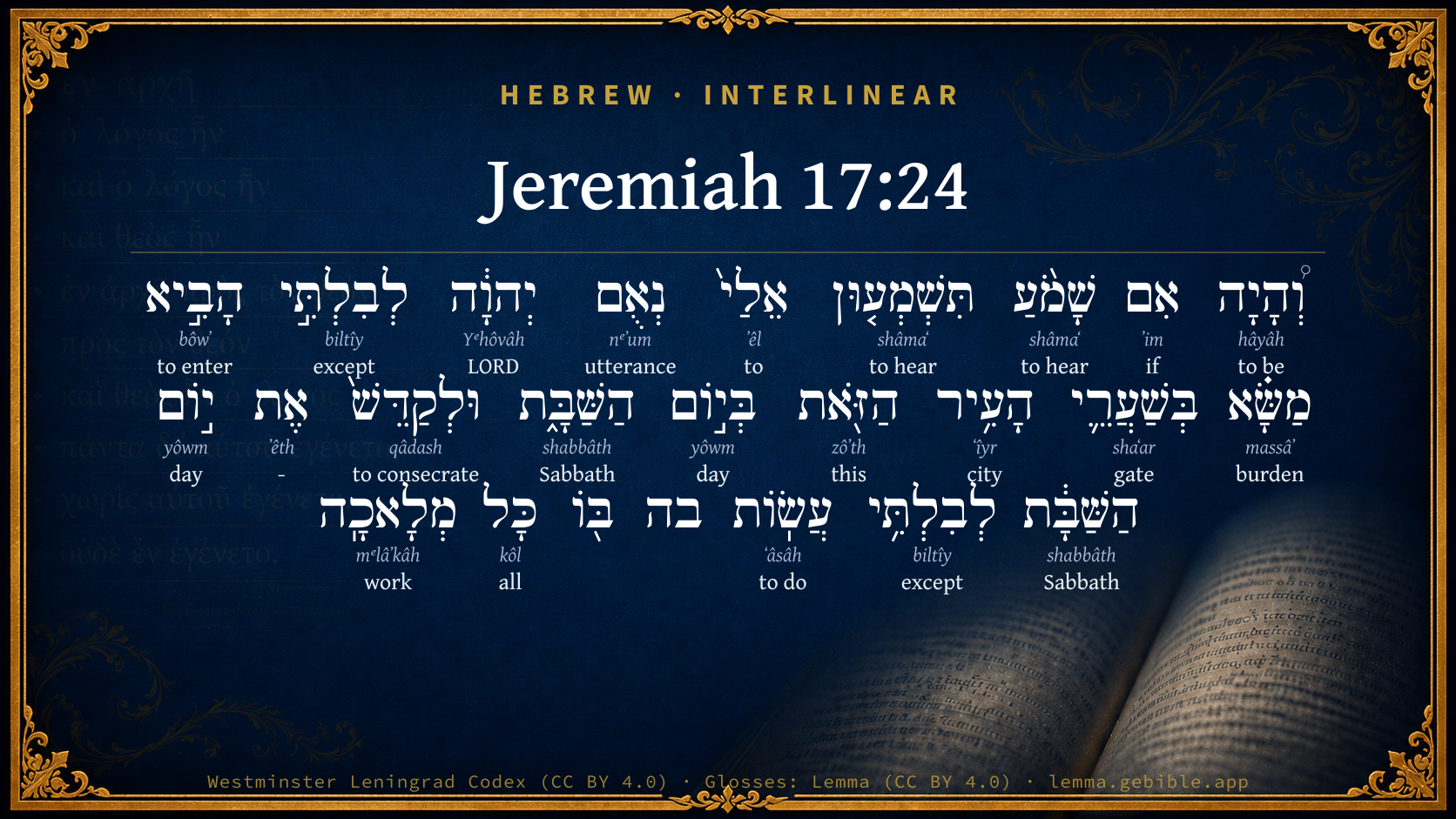
Hebrew (Westminster Leningrad Codex) Jeremiah 17:24 appears in the Hebrew Old Testament. The text above is from the Westminster Leningrad Codex. Each word links to its Strong’s number, a concise gloss, and parsing drawn from the Open Scriptures Hebrew Bible morphology. Click any word for its full Brown-Driver-Briggs (BDB) entry.
Download image
Cite this verse

Jeremiah 17:24 (World English Bible). Public Domain. Lemma interlinear Bible study tool, https://lemma.gebible.app/v/jeremiah/17/24.

Show BibTeX & RIS
BibTeX
RIS
English Translation
It shall happen, if you diligently listen to me, says Yahweh, to bring in no burden through the gates of this city on the Sabbath day, but to make the Sabbath day holy, to do no work therein;
World English Bible · Public Domain
Download a study sheet

One document with this verse’s original text, its word-by-word gloss line, the meaning frame, cross-references with their text, attributed commentary, and full source and license credits — printable, and it pastes into notes with its structure intact.

This verse Autodidact and up

Study sheet (.html) Plain text (.txt)

A passage Seminary Student

Up to 50 verses in one chapter. A passage sheet keeps up to 6 commentary sources and 12 cross-references per verse, in the order this page ranks them, and says so on the sheet whenever that leaves anything out. Ask for a single verse and you get the Autodidact verse sheet above.

Everything on this page stays free to read, with no account — the sheet is a download of what is already on screen, not access to it.

Want to remove ads? Support Godless Engineer
Compare translations 3

The same verse in 3 English versions, stacked beneath the original-language interlinear above. Click any original word for its lexicon entry.

Each is an independent rendering of the whole verse — the interlinear is not word-aligned to these translations.

Highlighted words mark where these versions differ — a whole-verse word diff, not a word-by-word alignment.

  • World English Bible Public Domain
    It shall happen, if you diligently listen to me, says Yahweh, to bring in no burden through the gates of this city on the Sabbath day, but to make the Sabbath day holy, to do no work therein;
  • King James Version Public Domain
    And it shall come to pass, if ye diligently hearken unto me, saith the LORD, to bring in no burden through the gates of this city on the sabbath day, but hallow the sabbath day, to do no work therein;
  • unfoldingWord Literal Text CC BY-SA 4.0
    And it will happen that if listening you listen to me”—the declaration of Yahweh—“to not bring a burden through the gates of this city on the day of the Sabbath, but make holy the day of the Sabbath to not do on it any work,

unfoldingWord Literal Text — © unfoldingWord, licensed CC BY-SA 4.0. Word-aligned USFM3 via Door43 (git.door43.org/unfoldingWord/en_ult).

Versions to compare (up to 4)

3 of 4 selected

Show all 18 translations

Every available English version of this verse, each an independent rendering of the whole verse.

  • World English Bible Public Domain
    It shall happen, if you diligently listen to me, says Yahweh, to bring in no burden through the gates of this city on the Sabbath day, but to make the Sabbath day holy, to do no work therein;
  • Berean Standard Bible Public Domain
    If, however, you listen carefully to Me, says the LORD, and bring no load through the gates of this city on the Sabbath day, and keep the Sabbath day holy, and do no work on it,
  • Majority Standard Bible Public Domain
    If, however, you listen carefully to Me, says the LORD, and bring no load through the gates of this city on the Sabbath day, and keep the Sabbath day holy, and do no work on it,
  • King James Version Public Domain
    And it shall come to pass, if ye diligently hearken unto me, saith the LORD, to bring in no burden through the gates of this city on the sabbath day, but hallow the sabbath day, to do no work therein;
  • American Standard Version (1901) Public Domain
    And it shall come to pass, if ye diligently hearken unto me, saith Jehovah, to bring in no burden through the gates of this city on the sabbath day, but to hallow the sabbath day, to do no work therein;
  • Revised Version (1885) Public Domain
    And it shall come to pass, if ye diligently hearken unto me, saith the LORD, to bring in no burden through the gates of this city on the sabbath day, but to hallow the sabbath day, to do no work therein;
  • Geneva Bible (1599) Public Domain
    Neuerthelesse if ye will heare me, sayth the Lord, and beare no burden through the gates of the citie in the Sabbath day, but sanctifie ye Sabbath day, so that ye do no worke therein,
  • Douay-Rheims (1899) Public Domain
    And it shall come to pass: if you will hearken to me, saith the Lord, to bring in no burdens by the gates of this city on the sabbath day: and if you will sanctify the sabbath day, to do no work therein:
  • Young's Literal Translation Public Domain
    And it hath been, if ye certainly hearken unto Me, An affirmation of Jehovah, So as not to bring in a burden By the gates of this city on the day of rest, And to sanctify the day of rest, So as not to do in it any work --
  • Literal Standard Version CC BY-SA 4.0
    And it has been, if you certainly listen to Me,” || A declaration of YHWH, || “So as not to bring in a burden by the gates of this city on the day of rest, || And to sanctify the day of rest, || So as not to do any work in it—
  • Unlocked Literal Bible CC BY-SA 4.0
    It will happen that if you truly listen to me—this is Yahweh's declaration—and do not bring a load to the gates of this city on the Sabbath day but instead set apart the Sabbath day to Yahweh and not do any work on it,
  • unfoldingWord Literal Text CC BY-SA 4.0
    And it will happen that if listening you listen to me”—the declaration of Yahweh—“to not bring a burden through the gates of this city on the day of the Sabbath, but make holy the day of the Sabbath to not do on it any work,
  • Darby Bible Public Domain
    And it shall come to pass, if ye diligently hearken unto me, saith Jehovah, to bring in no burden through the gates of this city on the sabbath day, and to hallow the sabbath day, to do no work therein;
  • World Messianic Bible Public Domain
    It will happen, if you diligently listen to me,” says the LORD, “to bring in no burden through the gates of this city on the Sabbath day, but to make the Sabbath day holy, to do no work therein;
  • Webster's Bible Public Domain
    And it shall come to pass, if ye diligently hearken to me, saith the LORD, to bring in no burden through the gates of this city on the sabbath day, but hallow the sabbath day, to do no work therein;
  • Free Bible Version CC BY-SA 4.0
    Listen carefully to me, says the Lord, and don't bring any load through the gates of this city on the Sabbath day, and keep the Sabbath day holy, and don't do any work on it.
  • Bible in Basic English Public Domain
    And it will be, that if with all care you give ear to me, says the Lord, and take no weight through the doorways of this town on the Sabbath day, but keep the Sabbath day holy and do no work in it;
  • JPS Tanakh (1917) Public Domain
    And it shall come to pass, if ye diligently hearken unto Me, saith the LORD, to bring in no burden through the gates of this city on the sabbath day, but to hallow the sabbath day, to do no work therein;

Literal Standard Version (2020), Covenant Press — licensed CC BY-SA 4.0. Text via the HelloAO Bible API (eBible.org). Unlocked Literal Bible (unfoldingWord) — licensed CC BY-SA 4.0. Text via the HelloAO Bible API (eBible.org). unfoldingWord Literal Text — © unfoldingWord, licensed CC BY-SA 4.0. Word-aligned USFM3 via Door43 (git.door43.org/unfoldingWord/en_ult). Free Bible Version, Dr. Jonathan Gallagher — licensed CC BY-SA 4.0. Text via the HelloAO Bible API (eBible.org).

Word by word

More ways to search: Search by grammar → Find every occurrence → Compare this word →

Practice this passage: Drill this verse → Learn its vocabulary →

מַשָּׂ֗א
massâʼ
H4853
“burden”
Noun, Common, Masculine, Singular, Absolute
Part of Speech
Noun
Type
Common
Gender
Masculine
Number
Singular
State
Absolute
Full BDB Definition

Origin: from H5375

TWOT: 1421d , 1421e

Massa = "burden" - load, bearing, tribute, burden, lifting (noun masculine) - load, burden - lifting, uplifting, that to which the soul lifts itself up - bearing, carrying - tribute, that which is carried or brought or borne - utterance, oracle, burden (noun masculine) - a son of Ishmael (noun proper masculine)
  1. וְ֠הָיָה hâyâh H1961 “and · to be” Conjunction + Verb, Qal, Sequential Perfect, 3rd Person, Masculine, Singular
  2. אִם ʼim H518 “if” Conjunction
  3. שָׁמֹ֨עַ shâmaʻ H8085 “to hear” Verb, Qal, Infinitive Absolute
  4. תִּשְׁמְע֤וּן shâmaʻ H8085 “to hear” Verb, Qal, Imperfect, 2nd Person, Masculine, Plural + Suffix, n
  5. אֵלַי֙ ʼêl H413 “to · me” Preposition + Suffix, Personal, 1st Person, Common, Singular
  6. נְאֻם nᵉʼum H5002 “utterance of” Noun, Common, Masculine, Singular, Construct
  7. יְהוָ֔ה Yᵉhôvâh H3068 “LORD” Noun, Proper
  8. לְבִלְתִּ֣י biltîy H1115 “to/for · except” Preposition + Conjunction
  9. הָבִ֣יא bôwʼ H935 “to enter” Verb, Hiphil, Infinitive Construct
  10. בְּשַׁעֲרֵ֛י shaʻar H8179 “in/at · gates of” Preposition + Noun, Common, Masculine, Plural, Construct
  11. הָעִ֥יר ʻîyr H5892 “the · city” Particle, Definite Article + Noun, Common, Feminine, Singular, Absolute
  12. הַזֹּ֖את zôʼth H2063 “the · this” Particle, Definite Article + Pronoun, Demonstrative, Feminine, Singular
  13. בְּי֣וֹם yôwm H3117 “in/at · day of” Preposition + Noun, Common, Masculine, Singular, Construct
  14. הַשַּׁבָּ֑ת shabbâth H7676 “the · Sabbath” Particle, Definite Article + Noun, Common, Both, Singular, Absolute
  15. וּלְקַדֵּשׁ֙ qâdash H6942 “and · to consecrate” Conjunction + Preposition + Verb, Piel, Infinitive Construct
  16. אֶת ʼêth H853 “-” Particle, Direct Object
  17. י֣וֹם yôwm H3117 “day of” Noun, Common, Masculine, Singular, Construct
  18. הַשַּׁבָּ֔ת shabbâth H7676 “the · Sabbath” Particle, Definite Article + Noun, Common, Both, Singular, Absolute
  19. לְבִלְתִּ֥י biltîy H1115 “to/for · except” Preposition + Conjunction
  20. עֲשֽׂוֹת ʻâsâh H6213 “to do” Verb, Qal, Infinitive Construct
  21. כָּל kôl H3605 “all of” Noun, Common, Masculine, Singular, Construct
  22. מְלָאכָֽה mᵉlâʼkâh H4399 “work” Noun, Common, Feminine, Singular, Absolute

About this verse

These counts appear in no published source. They are computed here, from the morphology-tagged text and Lemma’s own curated glosses. What Lemma adds →

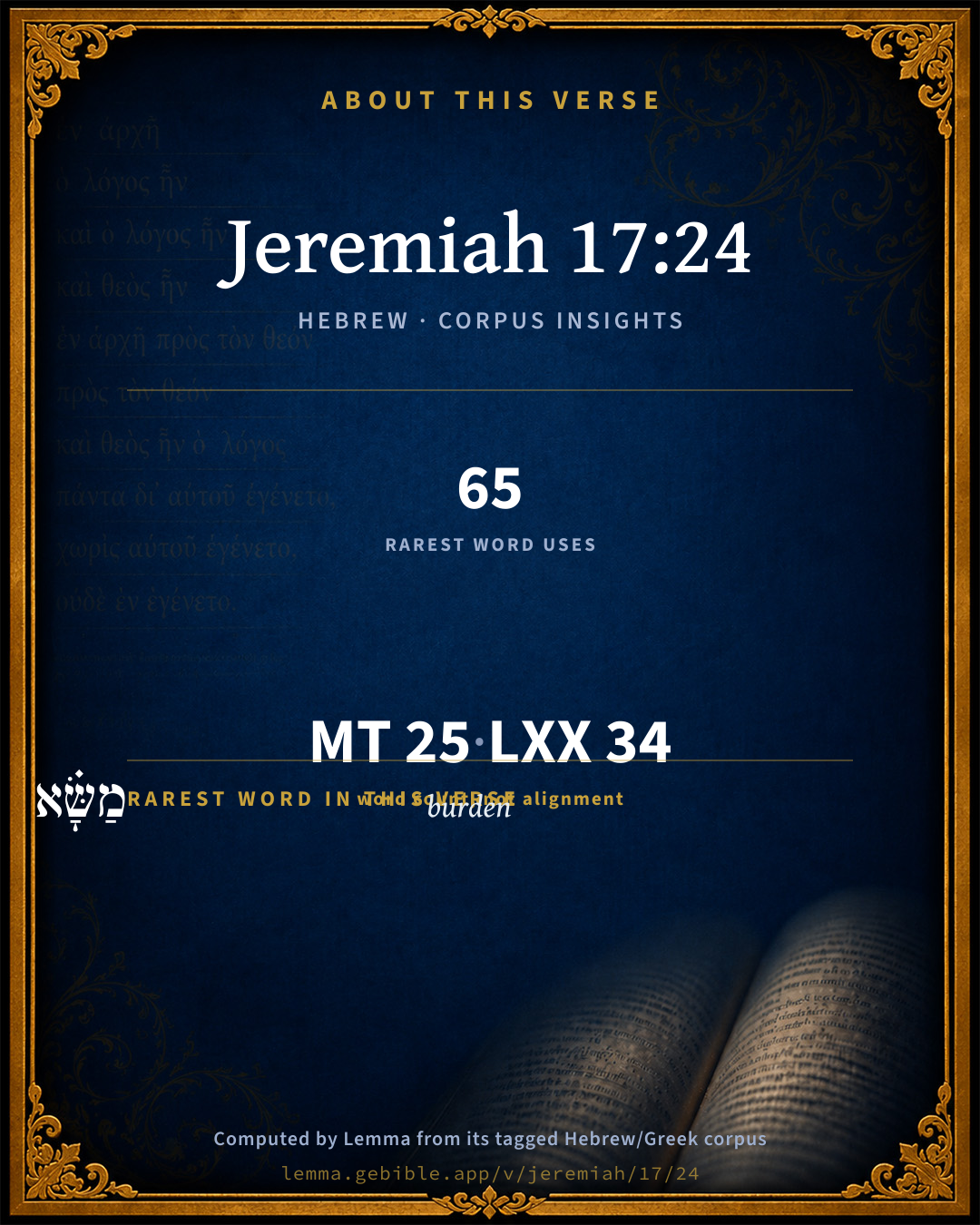
25
words
19
distinct lemmas
Prophets
section

Grammatical profile

  • 6 verbs
  • 11 nouns
  • 1 pronoun
  • 3 prepositions
  • 3 conjunctions
  • 1 particle

Verb forms

  • וְ֠הָיָה Qal · Sequential Perfect
  • שָׁמֹ֨עַ Qal · Infinitive Absolute
  • תִּשְׁמְע֤וּן Qal · Imperfect
  • הָבִ֣יא Hiphil · Infinitive Construct
  • וּלְקַדֵּשׁ֙ Piel · Infinitive Construct
  • עֲשֽׂוֹת Qal · Infinitive Construct

Repetition

Words recur within this verse — often emphatic in Hebrew:

  • שָׁמֹ֨עַ to hear H8085 ×2
  • לְבִלְתִּ֣י except H1115 ×2
  • בְּי֣וֹם day H3117 ×2
  • הַשַּׁבָּ֑ת Sabbath H7676 ×2

Hebrew & Septuagint length

In the original languages it is 25 Hebrew tokens and 34 Greek tokens — but the two are counted differently (Hebrew bundles its prefixes and suffixes into one token; the Greek is in lemma form), so that isn’t a like-for-like length.

Cross-references

9

Topical passages linked to Jeremiah 17:24 in the Treasury of Scripture Knowledge — connected by theme and wording, ordered by reader-vote popularity; previews shown in the World English Bible.

  • Deuteronomy 11:13 It shall happen, if you shall listen diligently to my commandments which I command you this day, to love Yahweh your God, and to serve him with all your heart and with all your soul,
  • Jeremiah 17:21–22 Thus says Yahweh, Take heed to yourselves, and bear no burden on the Sabbath day, nor bring it in by the gates of Jerusalem;
  • 2 Peter 1:5–10 Yes, and for this very cause adding on your part all diligence, in your faith supply moral excellence; and in moral excellence, knowledge;
  • Exodus 15:26 and he said, "If you will diligently listen to the voice of Yahweh your God, and will do that which is right in his eyes, and will pay attention to his commandments, and keep all his statutes, I will put none of the diseases on you, which I have put on the Egyptians; for I am Yahweh who heals you."
  • Deuteronomy 11:22 For if you shall diligently keep all this commandment which I command you, to do it, to love Yahweh your God, to walk in all his ways, and to cleave to him;
  • Isaiah 21:7 and when he sees a troop, horsemen in pairs, a troop of donkeys, a troop of camels, he shall listen diligently with much heed.
  • Isaiah 55:2 Why do you spend money for that which is not bread? and your labor for that which doesn't satisfy? listen diligently to me, and eat you that which is good, and let your soul delight itself in fatness.
  • Isaiah 58:13–14 If you turn away your foot from the Sabbath, from doing your pleasure on my holy day; and call the Sabbath a delight, [and] the holy of Yahweh honorable; and shall honor it, not doing your own ways, nor finding your own pleasure, nor speaking [your own] words:
  • Zechariah 6:15 Those who are far off shall come and build in the temple of Yahweh; and you shall know that Yahweh of hosts has sent me to you. This will happen, if you will diligently obey the voice of Yahweh your God."'"

Cross-references courtesy of OpenBible.info (CC BY 4.0).

Hebrew and Greek witnesses Masoretic Hebrew ↔ Greek Septuagint

The same verse in the two great witnesses to the Old Testament, shown verse-for-verse.

These are two independent witnesses, not word-aligned to each other, and the Septuagint is shown in lemma (dictionary) form.

Hebrew Jeremiah 17:24 Masoretic · Westminster Leningrad Codex

וְ֠הָיָה אִם שָׁמֹ֨עַ תִּשְׁמְע֤וּן אֵלַי֙ נְאֻם יְהוָ֔ה לְבִלְתִּ֣י הָבִ֣יא מַשָּׂ֗א בְּשַׁעֲרֵ֛י הָעִ֥יר הַזֹּ֖את בְּי֣וֹם הַשַּׁבָּ֑ת וּלְקַדֵּשׁ֙ אֶת י֣וֹם הַשַּׁבָּ֔ת לְבִלְתִּ֥י עֲשֽׂוֹת בה בּ֖וֹ כָּל מְלָאכָֽה

It shall happen, if you diligently listen to me, says Yahweh, to bring in no burden through the gates of this city on the Sabbath day, but to make the Sabbath day holy, to do no work therein;

World English Bible · Public Domain

Greek LXX Structure differs

In the Septuagint, Jeremiah is about an eighth shorter than the Hebrew and arranges its material differently — the Oracles Against the Nations (Hebrew chapters 46–51) appear in the middle of the Greek book, after 25:13. Because the chapter and verse boundaries do not line up, a verse-for-verse comparison with the Hebrew is not shown.

A verse-for-verse comparison isn’t shown here because the chapters and verses don’t line up. Switch to the LXX edition with the MT / LXX toggle above to read the Greek directly.

Hebrew: Westminster Leningrad Codex (CC BY 4.0). Greek: Septuagint (public domain); English from a public-domain English Septuagint. How the Septuagint differs from the Hebrew →

Targum (Aramaic paraphrase)

1

The Targum is the ancient Jewish Aramaic paraphrase of the Hebrew Scriptures — an interpretive translation, not the Hebrew text itself. Onkelos (literal) and Pseudo-Jonathan (expansive) render the Torah, and Jonathan the Prophets. Coverage is partial: where no permissively-licensed English translation exists for a verse, only the Aramaic is shown. This is verse-level text, not a word-by-word alignment to the Hebrew.

  1. Targum Jonathan Prophets (Joshua–Malachi)
    וִיהֵי אִם קַבָּלָא תְקַבְּלוּן לְמֵימְרִי אֲמַר יְיָ בְּדִיל דְלָא לְאַעָלָא מְטוּל בְּתַרְעֵי קַרְתָּא הָדָא בְּיוֹמָא דְשַׁבְּתָא וּלְקַדְשָׁא יַת יוֹמָא דְשַׁבָּתָא בְּדִיל דְלָא לְמֶעְבַּד בֵּיהּ כָּל עֲבִידְתָּא:

    (no public-domain English translation for this verse)

    Targum Jonathan — Aramaic: “Mikraot Gedolot” (public domain). English: “Sefaria Community Translation” (CC0 1.0 (public-domain dedication)); “London "Chaldee Paraphrase," 1871” (public domain). Text via Sefaria.

Commentary

Notes on Jeremiah 17:24 from classic Christian and Jewish commentators (each source and its license shown beneath its notes). The classic Christian expositions comment on the surrounding passage and are grouped to its opening verse, so a note may address several verses; the Jewish commentaries on the Tanakh (Rashi and others) are per-verse, so they appear only where the commentator wrote on this verse.

Lemma curates 59 commentaries, every one of them public domain or Creative Commons licensed, each selected and text-cleaned for this edition rather than reprinted as found. About our sources →

Trapp's Complete Commentary

John Trapp

Jer 17:24 And it shall come to pass, if ye diligently hearken unto me, saith the LORD, to bring in no burden through the gates of this city on the sabbath day, but hallow the sabbath day, to do no work therein;

Ver. 24. But hallow the Sabbath day,] sc., By spending the holy time holily, else God may sue us on an action of waste. Idleness is a sin any day, but specially on the Sabbath day; spiritual idleness then, is as bad as corporal labour.

John Trapp, A Commentary or Exposition upon All the Books of the Old and New Testament (1647–1656) — public domain. Text from a community e-Sword module.

Tyndale Open Study Notes

Tyndale Open Resources

17:24-25 The Lord was willing to give the people a chance to change their ways. By choosing to obey God, the people could enjoy unending peace and the continuation of the kingdom and the city of Jerusalem. • The promise of chariots and horses represented the Lord’s blessing.

Tyndale Open Study Notes — © Tyndale Open Resources, licensed CC BY-SA 4.0. Text via the HelloAO Bible API.

Jamieson, Fausset & Brown

Robert Jamieson, A. R. Fausset & David Brown

A part put for the whole, "If ye keep the Sabbath and My other laws."

Jamieson, Fausset & Brown — Commentary Critical and Explanatory on the Whole Bible (1871) — public domain (CC PDM 1.0). Text via the HelloAO Bible API.

Adam Clarke's Commentary

Verse 24. If ye diligently hearken unto me] So we find that though their destruction was positively threatened, yet still there was an unexpressed proviso that, if they did return to the Lord, the calamities should be averted, and a succession of princes would have been continued on the throne of David, Jer 17:25; Jer 17:26.

Adam Clarke's Commentary on the Bible (1810–1826) — public domain. Text from a community e-Sword/MySword module.

John Calvin's Commentaries

Jeremiah introduced, as I have said, a condemnation as to the fathers, that he might make the Jews of his age ashamed of themselves, lest they shouhl imitate the example of those whom they saw to have been disobedient to God. He yet shews, that God would be reconciled to them, provided they from the heart repented; as though he had said, — “Your fathers indeed provoked, for many years, and even for ages, the vengeance of God; but as he is ever inclined to mercy, he is ready to forgive you, if only you cease to follow your fathers and return to him.” In short, he promises them pardon for the time past, if they turned to God.

If by hearing ye will hear, he says, so as to carry no burden through the gates of this city on the sabbath-day, and to sanctify (this is connected with “hear”) the sabbath-day, so that ye do no work on it; then shall enter through the gates of this city kings and princes, etc. He first promises them a perpetuity as to the kingdom; and it was the chief happiness of the people to have a king from the posterity of David; for thus they saw as it were with their eyes the favor of God present, with them, inasmuch as David and his posterity were visible pledges of God’s favor. And we must remember also, that that kingdom was a type of a better kingdom, which had not yet been plainly discovered. Hence in the posterity of David the Jews beheld Christ, until he was manifested. For this reason I said, that they were miserable without a king, and that the perpetuity of the kingdom was a main part, of their happiness. This is the reason why Jeremiah now sets before them, as a singular benefit, the continuance of David’s kingdom among them, provided they observed the sabbath-day: and thus God did not only strictly demand what he had a ritht to do, but also allured them by the sweetness of his promise, according to his usual manner. He may indeed in one word command what he pleases; but when he invites us by promises, he has a regard to our infirmity.

John Calvin's Commentaries (1540-1563) — public domain. Text from the Calvin Translation Society English edition (1840s-50s) via the Christian Classics Ethereal Library (ccel.org). Calvin's coverage is partial (roughly two-thirds of the Bible); uncommented books and verses are honest gaps, never fabricated. The 19th-century editor's footnotes and remarks are omitted so the notes are faithfully Calvin's own voice.

The Cambridge Bible for Schools and Colleges

gen. ed. J. J. S. Perowne

24–27. See introd. summary to section.

The Cambridge Bible for Schools and Colleges (gen. ed. J. J. S. Perowne; Cambridge University Press, 1878–1918) — public domain. Text from a community e-Sword module.

John Gill's Exposition

And it shall come to pass,.... Or, "yet it shall come to pass" (f); so it shall be, notwithstanding all former disobedience and rebellion:

if ye diligently hearken unto me, saith the Lord; or, "in hearing hear" (g); hearken attentively, and readily obey the command given, before mentioned, so as

to bring in no burden through the gates of this city on the sabbath day; to be bought or sold, or to be wrought on or with; and so likewise to carry nothing out of their houses or city, which, though not expressed, is understood as before; and this respects not only the city of Jerusalem, but all other cities and towns in Judea; for the word of the Lord, concerning this matter, was sent to all Judah, the whole land of Judea, Jer 17:20;

but hallow the sabbath day, to do no work therein; one part of the sanctification of the sabbath lay in a cessation from all servile work, though not wholly, but also in the observance of religious worship, and the one was in order to the other; for, unless they abstained from worldly business, they could not be at leisure to attend divine service.

(f) "tamen erit", Gataker; "erit autem", Cocceius. (g) "audiendo audiveritis", Pagninus, Montanus, Schmidt.

John Gill's Exposition of the Whole Bible (1746–1763) — public domain (CC PDM 1.0). Text via the HelloAO Bible API.

unfoldingWord translationNotes

Door43 World Missions Community

this is Yahweh's declaration

Yahweh speaks of himself by name to express the certainty of what he is declaring. See how you translated this in Jeremiah 1:8. AT: "this is what Yahweh has declared" or "this is what I, Yahweh, have declared" (See: First, Second, or Third Person)

those who sit on David's throne

Here the throne that the king of Judah sits on is represented as "David's throne." See how you translated this in Jeremiah 13:13. AT: "those who sit on Judah's throne" or "the kings of the nation of Judah" (See: Metonymy)

this city will be inhabited forever

This can be stated in active form. AT: "people will inhabit this city forever" (See: Active or Passive)

translationWords

prince

David

throne

chariot

horse

eternity

unfoldingWord translationNotes — © Distant Shores Media and the Door43 World Missions Community, licensed CC BY-SA 4.0. Source: git.door43.org/Door43/en_tn.

Lesson kit

Teaching starters — assembled from the data on this page, not authored interpretation. Every prompt links to the verse data it draws on. Edit before teaching.

Jeremiah, in the Prophets, opens this verse with 25 words (19 distinct Hebrew lemmas). Its most distinctive word is massâʼ (“burden”). A historical commentator’s framing appears above. Read the whole chapter for the surrounding context.

Discussion questions

  1. How does “burden” (massâʼ) shape what this verse is saying?
  2. How does Deuteronomy 11:13, which shares this passage’s theme, read alongside this verse?
  3. What does the repetition of “to hear” (2× in this one verse) do in this verse?
  4. These translations render this verse differently; the difference is in the English rendering, not the original. What questions does that raise?
  5. «וְ֠הָיָה» is a Qal Sequential Perfect verb. How does that grammatical form shape the action described?
  6. Compare how Trapp's Complete Commentary and Tyndale Open Study Notes read this verse. Where do they agree or differ?

Things to notice

Reading settings

Reading text

Shown beneath each verse's original-language words.

Old Testament
Old Testament edition

Read the OT as the Masoretic Hebrew (MT) or the Greek Septuagint (LXX).

English shown for the Greek Septuagint (in the Hebrew ↔ Greek comparison).

Comparing translations? Open the Compare panel on any verse page to stack up to four side by side.