
2 Kings 12:11

Hebrew (Westminster Leningrad Codex) 2 Kings 12:11 appears in the Hebrew Old Testament. The text above is from the Westminster Leningrad Codex. Each word links to its Strong’s number, a concise gloss, and parsing drawn from the Open Scriptures Hebrew Bible morphology. Click any word for its full Brown-Driver-Briggs (BDB) entry.
Download image
Cite this verse

2 Kings 12:11 (World English Bible). Public Domain. Lemma interlinear Bible study tool, https://lemma.gebible.app/v/2-kings/12/11.

Show BibTeX & RIS
BibTeX
RIS
English Translation
They gave the money that was weighed out into the hands of those who did the work, who had the oversight of the house of Yahweh: and they paid it out to the carpenters and the builders, who worked on the house of Yahweh,
World English Bible · Public Domain
Download a study sheet

One document with this verse’s original text, its word-by-word gloss line, the meaning frame, cross-references with their text, attributed commentary, and full source and license credits — printable, and it pastes into notes with its structure intact.

This verse Autodidact and up

Study sheet (.html) Plain text (.txt)

A passage Seminary Student

Up to 50 verses in one chapter. A passage sheet keeps up to 6 commentary sources and 12 cross-references per verse, in the order this page ranks them, and says so on the sheet whenever that leaves anything out. Ask for a single verse and you get the Autodidact verse sheet above.

Everything on this page stays free to read, with no account — the sheet is a download of what is already on screen, not access to it.

Want to remove ads? Support Godless Engineer
Compare translations 3

The same verse in 3 English versions, stacked beneath the original-language interlinear above. Click any original word for its lexicon entry.

Each is an independent rendering of the whole verse — the interlinear is not word-aligned to these translations.

Highlighted words mark where these versions differ — a whole-verse word diff, not a word-by-word alignment.

  • World English Bible Public Domain
    They gave the money that was weighed out into the hands of those who did the work, who had the oversight of the house of Yahweh: and they paid it out to the carpenters and the builders, who worked on the house of Yahweh,
  • King James Version Public Domain
    And they gave the money, being told, into the hands of them that did the work, that had the oversight of the house of the LORD: and they laid it out to the carpenters and builders, that wrought upon the house of the LORD,
  • unfoldingWord Literal Text CC BY-SA 4.0
    And they gave the silver that was weighed into the hands of the doers of the work, the ones appointed the house of Yahweh. And they brought it out to the craftsmen of wood and to the builders, the ones making the house of Yahweh,

unfoldingWord Literal Text — © unfoldingWord, licensed CC BY-SA 4.0. Word-aligned USFM3 via Door43 (git.door43.org/unfoldingWord/en_ult).

Versions to compare (up to 4)

3 of 4 selected

Show all 18 translations

Every available English version of this verse, each an independent rendering of the whole verse.

  • World English Bible Public Domain
    They gave the money that was weighed out into the hands of those who did the work, who had the oversight of the house of Yahweh: and they paid it out to the carpenters and the builders, who worked on the house of Yahweh,
  • Berean Standard Bible Public Domain
    Then they would put the counted money into the hands of those who supervised the work on the house of the LORD, who in turn would pay those doing the work—the carpenters, builders,
  • Majority Standard Bible Public Domain
    Then they would put the counted money into the hands of those who supervised the work on the house of the LORD, who in turn would pay those doing the work—the carpenters, builders,
  • King James Version Public Domain
    And they gave the money, being told, into the hands of them that did the work, that had the oversight of the house of the LORD: and they laid it out to the carpenters and builders, that wrought upon the house of the LORD,
  • American Standard Version (1901) Public Domain
    And they gave the money that was weighed out into the hands of them that did the work, that had the oversight of the house of Jehovah: and they paid it out to the carpenters and the builders, that wrought upon the house of Jehovah,
  • Revised Version (1885) Public Domain
    And they gave the money that was weighed out into the hands of them that did the work, that had the oversight of the house of the LORD: and they paid it out to the carpenters and the builders, that wrought upon the house of the LORD,
  • Geneva Bible (1599) Public Domain
    And they gaue the money made readie into the handes of them, that vndertooke the worke, and that had the ouersight of the house of the Lord; and they payed it out to the carpenters and builders that wrought vpon the house of the Lord,
  • Douay-Rheims (1899) Public Domain
    And they gave it out by number and measure into the hands of them that were over the builders of the house of the Lord: and they laid it out to the carpenters, and the masons that wrought in the house of the Lord,
  • Young's Literal Translation Public Domain
    and have given the weighed money into the hands of those doing the work, those inspecting the house of Jehovah, and they bring it out to those working in the wood, and to builders who are working in the house of Jehovah,
  • Literal Standard Version CC BY-SA 4.0
    and have given the weighed money into the hands of those doing the work, those inspecting the house of YHWH, and they bring it out to those working in the wood, and to builders who are working in the house of YHWH,
  • Unlocked Literal Bible CC BY-SA 4.0
    They gave the money that was weighed out into the hands of men who took care of the temple of Yahweh. They paid it out to the carpenters and the builders who worked on the temple of Yahweh,
  • unfoldingWord Literal Text CC BY-SA 4.0
    And they gave the silver that was weighed into the hands of the doers of the work, the ones appointed the house of Yahweh. And they brought it out to the craftsmen of wood and to the builders, the ones making the house of Yahweh,
  • Darby Bible Public Domain
    And they gave the money, weighed out into the hands of them that did the work, who were appointed over the house of Jehovah; and they laid it out to the carpenters and builders that wrought upon the house of Jehovah,
  • World Messianic Bible Public Domain
    They gave the money that was weighed out into the hands of those who did the work, who had the oversight of the LORD’s house; and they paid it out to the carpenters and the builders who worked on the LORD’s house,
  • Webster's Bible Public Domain
    And they gave the money, being counted, into the hands of them that did the work, that had the oversight of the house of the LORD: and they laid it out to the carpenters and builders, that wrought upon the house of the LORD,
  • Free Bible Version CC BY-SA 4.0
    Then they weighed out the money and gave it to the supervisors of the work on the Lord's Temple. They paid the ones doing the work—the carpenters, builders,
  • Bible in Basic English Public Domain
    And the money which was measured out they gave regularly to those who were responsible for overseeing the work, and these gave it in payment to the woodworkers and the builders who were working on the house of the Lord,
  • JPS Tanakh (1917) Public Domain
    (12-12) And they gave the money that was weighed out into the hands of them that did the work, that had the oversight of the house of the LORD; and they paid it out to the carpenters and the builders, that wrought upon the house of the LORD,

Literal Standard Version (2020), Covenant Press — licensed CC BY-SA 4.0. Text via the HelloAO Bible API (eBible.org). Unlocked Literal Bible (unfoldingWord) — licensed CC BY-SA 4.0. Text via the HelloAO Bible API (eBible.org). unfoldingWord Literal Text — © unfoldingWord, licensed CC BY-SA 4.0. Word-aligned USFM3 via Door43 (git.door43.org/unfoldingWord/en_ult). Free Bible Version, Dr. Jonathan Gallagher — licensed CC BY-SA 4.0. Text via the HelloAO Bible API (eBible.org).

Word by word

More ways to search: Search by grammar → Find every occurrence → Compare this word →

Practice this passage: Drill this verse → Learn its vocabulary →

הַֽמְתֻכָּ֔ן
tâkan
H8505
“the · measured”
Particle, Definite Article + Verb, Pual, Participle Passive, Masculine, Singular, Absolute
Part of Speech
Particle + Verb
Stem
Pual
Form
Participle Passive
Gender
Masculine
Number
Singular
State
Absolute
Full BDB Definition

Origin: a primitive root

TWOT: 2511

to regulate, measure, estimate, ponder, balance, make even, level, weigh, be equal, be weighed out, test, prove - (Qal) estimate (participle) - (Niphal) - to be estimated - to be made even or right, be adjusted to the standard - (Piel) to weigh out, mete out - (Pual) - to be weighed out, be measured out - measured out (participle)
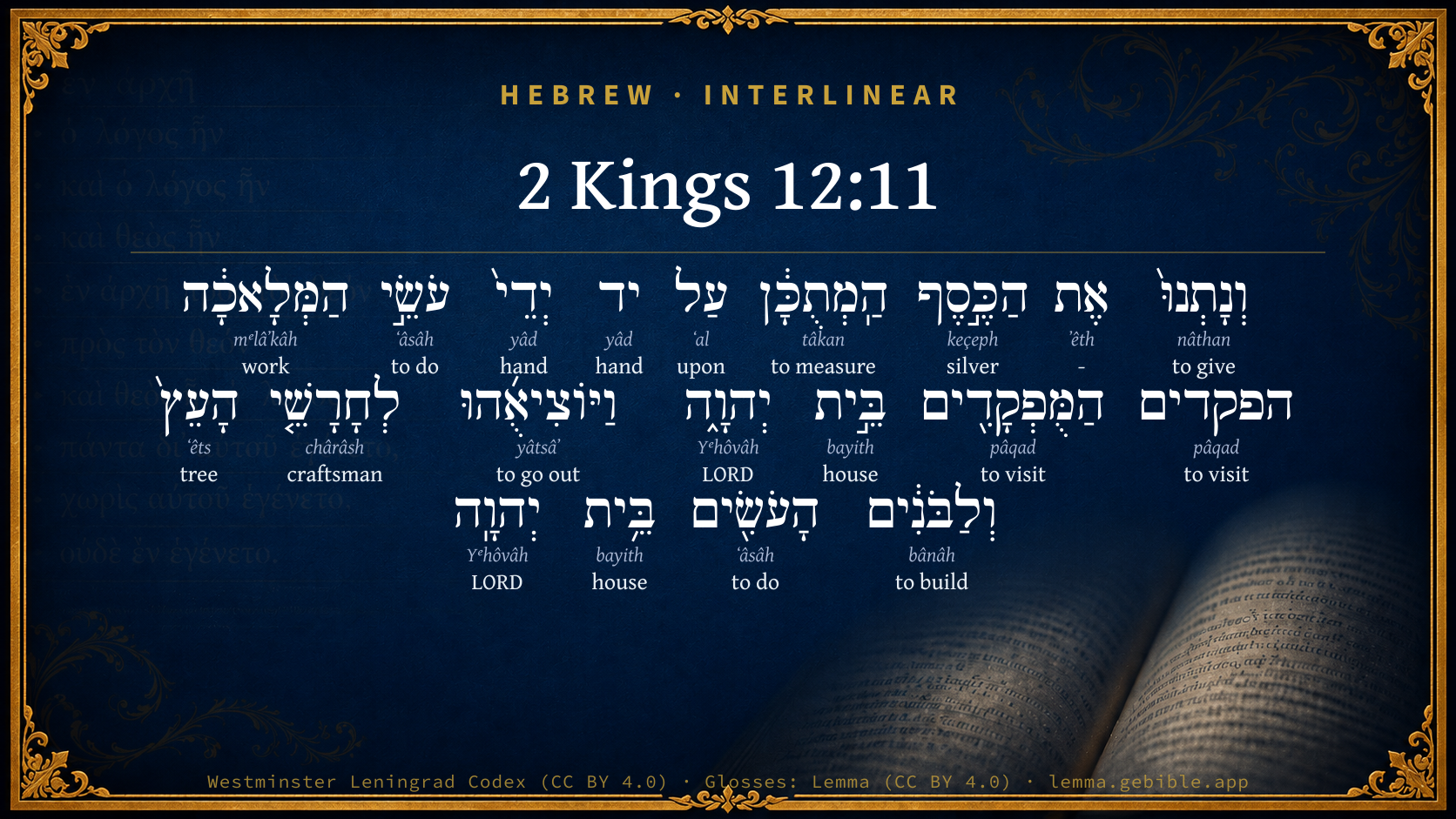
  1. וְנָתְנוּ֙ nâthan H5414 “and · to give” Conjunction + Verb, Qal, Perfect, 3rd Person, Common, Plural
  2. אֶת ʼêth H853 “-” Particle, Direct Object
  3. הַכֶּ֣סֶף keçeph H3701 “the · silver” Particle, Definite Article + Noun, Common, Masculine, Singular, Absolute
  4. עַל ʻal H5921 “upon” Preposition
  5. יד yâd H3027 “hand of” Noun, Common, Both, Singular, Construct
  6. יְדֵי֙ yâd H3027 “hands of” Noun, Common, Both, Dual, Construct
  7. עֹשֵׂ֣י ʻâsâh H6213 “doing” Verb, Qal, Participle Active, Masculine, Plural, Construct
  8. הַמְּלָאכָ֔ה mᵉlâʼkâh H4399 “the · work” Particle, Definite Article + Noun, Common, Feminine, Singular, Absolute
  9. הפקדים pâqad H6485 “the · visited” Particle, Definite Article + Verb, Qal, Participle Passive, Masculine, Plural, Absolute
  10. הַמֻּפְקָדִ֖ים pâqad H6485 “the · visited” Particle, Definite Article + Verb, Hophal, Participle Passive, Masculine, Plural, Absolute
  11. בֵּ֣ית bayith H1004 “house of” Noun, Common, Masculine, Singular, Construct
  12. יְהוָ֑ה Yᵉhôvâh H3068 “LORD” Noun, Proper
  13. וַיּוֹצִיאֻ֜הוּ yâtsâʼ H3318 “and · to go out · him” Conjunction + Verb, Hiphil, Sequential Imperfect, 3rd Person, Masculine, Plural + Suffix, Personal, 3rd Person, Masculine, Singular
  14. לְחָרָשֵׁ֤י chârâsh H2796 “to/for · craftsmen of” Preposition + Noun, Common, Masculine, Plural, Construct
  15. הָעֵץ֙ ʻêts H6086 “the · tree” Particle, Definite Article + Noun, Common, Masculine, Singular, Absolute
  16. וְלַבֹּנִ֔ים bânâh H1129 “and · to/for the · building” Conjunction + Preposition, Determined + Verb, Qal, Participle Active, Masculine, Plural, Absolute
  17. הָעֹשִׂ֖ים ʻâsâh H6213 “the · doing” Particle, Definite Article + Verb, Qal, Participle Active, Masculine, Plural, Absolute
  18. בֵּ֥ית bayith H1004 “house of” Noun, Common, Masculine, Singular, Construct
  19. יְהוָֽה Yᵉhôvâh H3068 “LORD” Noun, Proper

About this verse

These counts appear in no published source. They are computed here, from the morphology-tagged text and Lemma’s own curated glosses. What Lemma adds →

20
words
15
distinct lemmas
Historical
section

Notable vocabulary

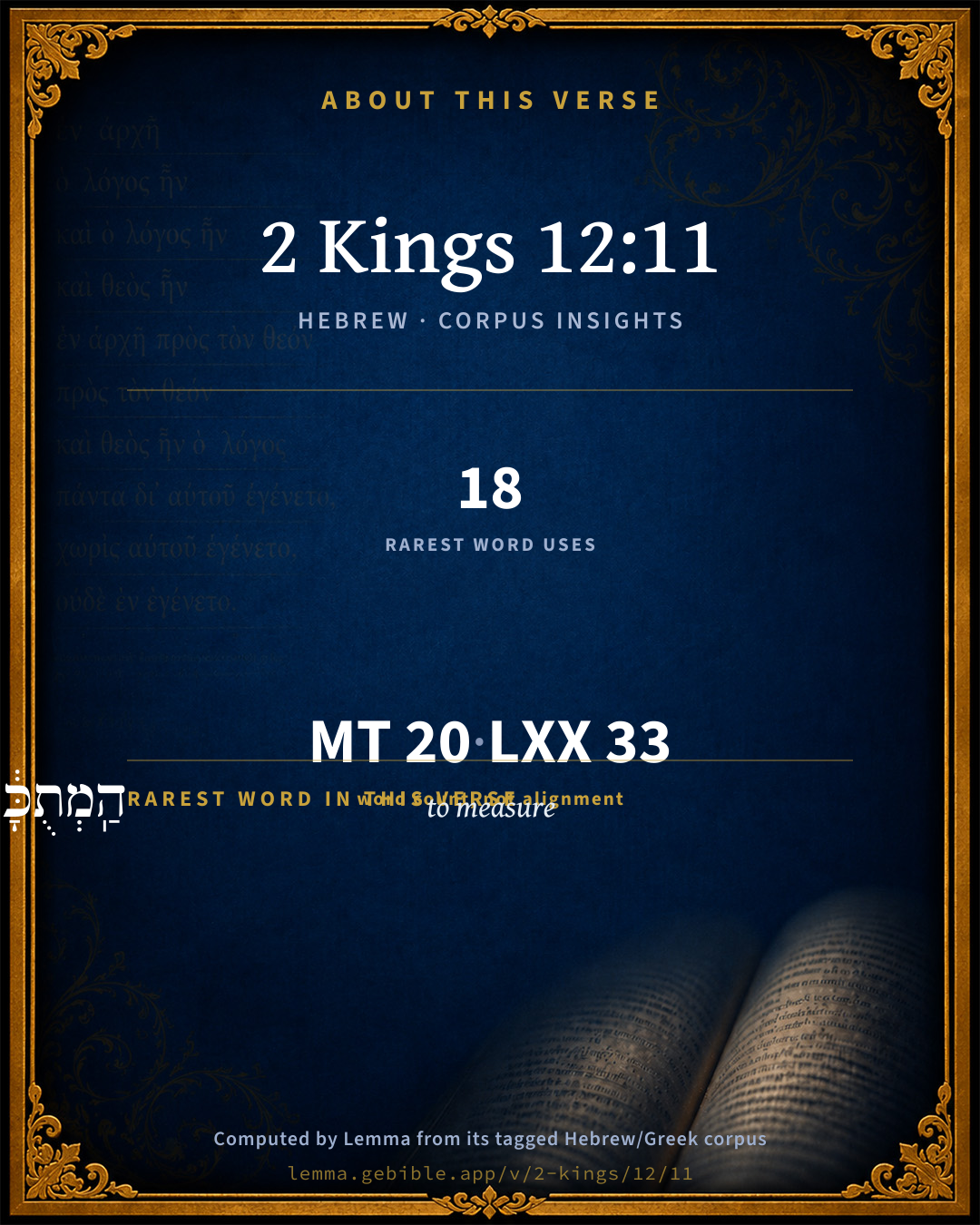
The rarest word here is הַֽמְתֻכָּ֔ן to measure H8505 — appearing just 18 times in the whole Hebrew Bible.

Shared distinctive vocabulary

הַֽמְתֻכָּ֔ן to measure H8505 occurs in 13 verses of the Hebrew Bible. Also found in:

Grammatical profile

  • 8 verbs
  • 10 nouns
  • 1 preposition
  • 1 particle

Verb forms

  • וְנָתְנוּ֙ Qal · Perfect
  • הַֽמְתֻכָּ֔ן Pual · Participle Passive
  • עֹשֵׂ֣י Qal · Participle Active
  • הפקדים Qal · Participle Passive
  • הַמֻּפְקָדִ֖ים Hophal · Participle Passive
  • וַיּוֹצִיאֻ֜הוּ Hiphil · Sequential Imperfect
  • וְלַבֹּנִ֔ים Qal · Participle Active
  • הָעֹשִׂ֖ים Qal · Participle Active

Repetition

Words recur within this verse — often emphatic in Hebrew:

  • יד hand H3027 ×2
  • עֹשֵׂ֣י to do H6213 ×2
  • הפקדים to visit H6485 ×2
  • בֵּ֣ית house H1004 ×2
  • יְהוָ֑ה LORD H3068 ×2

Hebrew & Septuagint length

In English translation the verse runs 44 words from the Hebrew and 46 from the Septuagint (LXX English) — closely comparable.

A rough comparison of the two English renderings, which tokenize alike — not a word-level alignment.

Word counts can differ between the Hebrew and the Greek without any difference in meaning — e.g. the Hebrew direct-object marker אֵת has no separate Greek word, and Greek often adds the article ὁ.

In the original languages it is 20 Hebrew tokens and 33 Greek tokens — but the two are counted differently (Hebrew bundles its prefixes and suffixes into one token; the Greek is in lemma form), so that isn’t a like-for-like length.

Cross-references

3

Topical passages linked to 2 Kings 12:11 in the Treasury of Scripture Knowledge — connected by theme and wording, ordered by reader-vote popularity; previews shown in the World English Bible.

  • 2 Kings 22:5–6 and let them deliver it into the hand of the workmen who have the oversight of the house of Yahweh; and let them give it to the workmen who are in the house of Yahweh, to repair the breaches of the house,
  • 2 Chronicles 24:11–12 It was so, that whenever the chest was brought to the king's officers by the hand of the Levites, and when they saw that there was much money, the king's scribe and the chief priest's officer came and emptied the chest, and took it, and carried it to its place again. Thus they did day by day, and gathered money in abundance.
  • 2 Chronicles 34:9–11 They came to Hilkiah the high priest, and delivered the money that was brought into the house of God, which the Levites, the keepers of the threshold, had gathered of the hand of Manasseh and Ephraim, and of all the remnant of Israel, and of all Judah and Benjamin, and of the inhabitants of Jerusalem.

Cross-references courtesy of OpenBible.info (CC BY 4.0).

Hebrew and Greek witnesses Masoretic Hebrew ↔ Greek Septuagint

The same verse in the two great witnesses to the Old Testament, shown verse-for-verse.

These are two independent witnesses, not word-aligned to each other, and the Septuagint is shown in lemma (dictionary) form.

Hebrew 2 Kings 12:11 Masoretic · Westminster Leningrad Codex

וְנָתְנוּ֙ אֶת הַכֶּ֣סֶף הַֽמְתֻכָּ֔ן עַל יד יְדֵי֙ עֹשֵׂ֣י הַמְּלָאכָ֔ה הפקדים הַמֻּפְקָדִ֖ים בֵּ֣ית יְהוָ֑ה וַיּוֹצִיאֻ֜הוּ לְחָרָשֵׁ֤י הָעֵץ֙ וְלַבֹּנִ֔ים הָעֹשִׂ֖ים בֵּ֥ית יְהוָֽה

They gave the money that was weighed out into the hands of those who did the work, who had the oversight of the house of Yahweh: and they paid it out to the carpenters and the builders, who worked on the house of Yahweh,

World English Bible · Public Domain

Greek LXX 2 Kings 12:11 Septuagint · lemma form

καί γίγνομαι ὡς ὁράω ὅτι πολύς ὁ ἀργύριον ἐν ὁ κιβωτός καί ἀναβαίνω ὁ γραμματεύς ὁ βασιλεύς καί ὁ ἱερεύς ὁ μέγας καί σφίγγω καί ἀριθμέω ὁ ἀργύριον ὁ εὑρίσκω ἐν οἶκος κύριος

And they gave the money that had been collected into the hands of them that wrought the works, the overseers of the house of the Lord; and they gave it out to the carpenters and to the builders that wrought in the house of the Lord.

LXX2012 (modern English Septuagint) · Public Domain

Hebrew: Westminster Leningrad Codex (CC BY 4.0). Greek: Septuagint (public domain); English from LXX2012 (modern English Septuagint) (Public Domain). How the Septuagint differs from the Hebrew →

Targum (Aramaic paraphrase)

1

The Targum is the ancient Jewish Aramaic paraphrase of the Hebrew Scriptures — an interpretive translation, not the Hebrew text itself. Onkelos (literal) and Pseudo-Jonathan (expansive) render the Torah, and Jonathan the Prophets. Coverage is partial: where no permissively-licensed English translation exists for a verse, only the Aramaic is shown. This is verse-level text, not a word-by-word alignment to the Hebrew.

  1. Targum Jonathan Prophets (Joshua–Malachi)
    וַהֲוָה כַּד חֲזוֹ אֲרֵי סַגִי כַסְפָּא בְּאָרוֹנָא וּסְלִיק סַפְרָא דְמַלְכָּא וְכַהֲנָא רַבָּא וְצָרוּ וּמְנוֹ יַת כַּסְפָּא דְאִשְׁתְּכַח בֵּית מַקְדְשָׁא דַיְיָ:

    (no public-domain English translation for this verse)

    Targum Jonathan — Aramaic: “Mikraot Gedolot” (public domain). English: “Sefaria Community Translation” (CC0 1.0 (public-domain dedication)); “London "Chaldee Paraphrase," 1871” (public domain). Text via Sefaria.

Commentary

Notes on 2 Kings 12:11 from classic Christian and Jewish commentators (each source and its license shown beneath its notes). The classic Christian expositions comment on the surrounding passage and are grouped to its opening verse, so a note may address several verses; the Jewish commentaries on the Tanakh (Rashi and others) are per-verse, so they appear only where the commentator wrote on this verse.

Lemma curates 59 commentaries, every one of them public domain or Creative Commons licensed, each selected and text-cleaned for this edition rather than reprinted as found. About our sources →

Trapp's Complete Commentary

John Trapp

2Ki 12:11 And they gave the money, being told, into the hands of them that did the work, that had the oversight of the house of the LORD: and they laid it out to the carpenters and builders, that wrought upon the house of the LORD,

Ver. 11. That did the work.] Though with other men’s hands.

John Trapp, A Commentary or Exposition upon All the Books of the Old and New Testament (1647–1656) — public domain. Text from a community e-Sword module.

Keil & Delitzsch

C. F. Keil & F. Delitzsch

"They gave the money weighed into the hands of those who did the work, who were placed over the house of Jehovah," i.e., the appointed overlookers of the work; "and they paid it (as it was required) to the carpenters and builders, who worked at the house, and to the masons and hewers of stone, and for the purchase of wood and hewn stones, to repair the dilapidations of the house, and for all that might be spent (יצא, i.e., be given out) for the house for repairing it." It is quite clear from this, that the assertion of J. D. Michaelis, De Wette, and others, that the priests had embezzled the money collected, is perfectly imaginary. For if the king had cherished any such suspicion against the priests, he would not have asked for their consent to an alteration of the first arrangement or to the new measure; and still less would he have commanded that the priests who kept the door should put the money into the chest, for this would have been no safeguard against embezzlement. For if the door-keepers wished to embezzle, all that they would need to do would be to put only a part of the money into the chest. The simple reason and occasion for giving up the first arrangement and introducing the new arrangement with the chest, was that the first measure had proved to be insufficient fore the accomplishment of the purpose expected by the king. For inasmuch as the king had not assigned any definite amount for the repairing of the temple, but had left it to the priests to pay for the cost of the repairs out of the money that was to be collected, one portion of which at least came to themselves, according to the law, for their own maintenance and to provide for the expenses of worship, it might easily happen, without the least embezzlement on the part of the priests, that the money collected was paid out again for the immediate necessities of worship and their own maintenance, and that nothing remained to pay for the building expenses. For this reason the king himself now undertook the execution of the requisite repairs. The reason why the chest was provided for the money to be collected was, first of all, that the money to be collected for the building might be separated from the rest of the money that came in and was intended for the priests; and secondly, that the contributions to be gathered for the building might be increased, since it might be expected that the people would give more if the collections were made for the express purpose of restoring the temple, than if only the legal and free-will offerings were simply given to the priests, without any one knowing how much would be applied to the building. - And because the king had taken the building into his own hand, as often as the chest was full he sent his secretary to reckon the money along with the high priest, and hand it over to the superintendents of the building.

If we compare with this the account in the Chronicles, it helps to confirm the view which we have obtained from an unprejudiced examination of the text as to the affair in question. According to Kg2 12:5 of the Chronicles, Joash had commanded the priests and Levites to accelerate the repairs; "but the Levites did not hurry." This may be understood as signifying that they were dilatory both in the collection of the money and in the devotion of a portion of their revenues to the repairing of the temple. But that the king took the matter in hand himself, not so much because of the dilatoriness or negligence of the priests as because his first measure, regarded as an expedient, did not answer the purpose, is evident from the fact that, according to the Chronicles, he did not content himself with placing the chest at the entrance, but had a proclamation made at the same time in Judah and Jerusalem, to offer the tax of Moses for the repair of the temple (Kg2 12:9) - evidently with no other intention than to procure more liberal contributions. For, according to Kg2 12:10, all the chief men and all the people rejoiced thereat, and cast their gifts into the chest, i.e., they offered their gifts with joy for the purpose that had been proclaimed. - The other points of difference between the Chronicles and our text are unimportant. For instance, that they placed the chest "at the gate of the house of Jehovah on the outside." The הוּצה merely defines the expression in our text, יי בּית בּבוא־אישׁ בּימין, "to the right at the entrance into the temple," more minutely, by showing that the ark was not placed on the inner side of the entrance into the court of the priests, but against the outer wall of it. This is not at variance with המּזבּח אצל in Kg2 12:10; for even apart from the account in the Chronicles, and according to our own text, this cannot be understood as signifying that the ark had been placed in the middle of the court, as Thenius explains in opposition to וגו בּבוא־אישׁ, but can only mean at the entrance which was on the right side of the altar, i.e., at the southern entrance into the inner court. Again, the further variation, that according to the Chronicles (Kg2 12:11), when the chest was full, an officer of the high priest came with the scribe (not the high priest himself), furnishes simply a more exact definition of our account, in which the high priest is named; just as, according to Kg2 12:10, the high priest took the chest and bored a hole in the lid, which no intelligent commentator would understand as signifying that the high priest did it with his own hand. But there is a real difference between Kg2 12:14 and Kg2 12:15 of our text and Kg2 12:14 of the Chronicles, though the solution of this suggests itself at once on a closer inspection of the words. According to our account, there were no golden or silver vessels, basons, knives, bowls, etc., made with the money that was brought in, but it was given for the repairing of the house. In the Chronicles, on the contrary, it is stated that "when they had finished the repairs, they brought the remnant of the money to the king and Jehoiada, and he (the king) used it for vessels for the house of the Lord, for vessels of the service," etc. But if we take proper notice of כּכלּותם here, there is no ground for saying that there is any contradiction, since the words of our text affirm nothing more than that none of the money that came in was applied to the making of vessels of worship so long as the repairing of the building went on. What took place afterwards is not stated in our account, which is limited to the main fact; this we learn from the Chronicles.

Keil & Delitzsch — Biblical Commentary on the Old Testament (1861–1891) — public domain (CC PDM 1.0). Text via the HelloAO Bible API. (Old Testament only.)

Geneva Bible (1599)

Geneva Bible translators

For the King had appointed others which were meet for that purpose, 2 Kings 22:5.

Geneva Bible (1599) marginal notes — public domain. Text via Bolls.life.

Jamieson, Fausset & Brown

Robert Jamieson, A. R. Fausset & David Brown

they gave the money, being told, into the hands of them that did the work--The king sent his secretary along with an agent of the high priest to count the money in the chest from time to time (Ch2 24:11), and deliver the amount to the overseers of the building, who paid the workmen and purchased all necessary materials. The custom of putting sums of certain amount in bags, which are labelled and sealed by a proper officer, is a common way of using the currency in Turkey and other Eastern countries.

Jamieson, Fausset & Brown — Commentary Critical and Explanatory on the Whole Bible (1871) — public domain (CC PDM 1.0). Text via the HelloAO Bible API.

Ellicott's Commentary for English Readers

(11) They gave.—Rather, And they used to give, i.e., every time they had emptied the chest.

Being told.—Rather, which was weighed.

Them that did the work.—Not the actual workmen, but, as is immediately explained, “those who had the oversight of the house,” or were charged with the superintendence of the work.

That wrought.—Literally, who were making.

A Bible Commentary for English Readers, edited by Charles John Ellicott (1878–1897) — public domain. Text from a community e-Sword module.

The Cambridge Bible for Schools and Colleges

gen. ed. J. J. S. Perowne

11. they gave the money, being told] R.V. that was weighed out. Here by employing a different word the writer makes plain what was meant by the previous ‘telling’ or ‘counting’. The Chronicler adds that when this was done, the chest was carried back to its place, and that they did this from day to day, i.e. from time to time, and gathered money in abundance.

into the hands of them that did the work] Explained by the following clause as ‘the overseers’, the chief men who had charge of the restoration. The priests and the king’s officer did not pay the workmen, but gave sums in gross over to the contractors.

and they laid [R.V. paid] it out to the carpenters and [R.V. and the] builders] Both nouns are defined, as are also ‘the masons and the hewers of stone’ in the next verse. R.V. inserts the article there also.

The Cambridge Bible for Schools and Colleges (gen. ed. J. J. S. Perowne; Cambridge University Press, 1878–1918) — public domain. Text from a community e-Sword module.

John Gill's Exposition

Howbeit there were not made for the house of the Lord, bowls of silver,.... Either to hold the blood of the sacrifices, or the drink offerings of wine:

snuffers; to trim the lamps; or, as Jarchi and other writers, both Jewish and Christian, musical instruments:

basins; vessels to sprinkle the blood with, as the word signifies:

trumpets; silver ones, to call the assembly, blow over the sacrifices, &c.

any vessels of gold, or vessels of silver; for any other use: these were not made

of the money that was brought into the house of the Lord; yet, in Ch2 24:14, it is said they were, which is to be reconciled thus; they did not make any of those things at first, until the house was repaired, and the charges of it defrayed; and then of what remained they made vessels for the house, which were wanting, that Athaliah had bestowed on Baalim, Ch2 24:7.

John Gill's Exposition of the Whole Bible (1746–1763) — public domain (CC PDM 1.0). Text via the HelloAO Bible API.

Haydock's Catholic Bible Commentary

And they. The king and the high priest conjointly. (Paralipomenon)

George Leo Haydock (1774–1849), Haydock's Catholic Family Bible and Commentary, 1859 edition — public domain. Excludes Psalms (Douay-Rheims chapter numbering differs from Protestant) and Deuterocanonical books (Catholic canon only).

Matthew Poole's English Annotations

Them that did the work, that had the oversight of the house of the Lord; who were chosen out of the people, not without a reflection upon the priests for their neglect or unfaithfulness.

Matthew Poole's English Annotations on the Holy Bible (1683–1685) — public domain. Text from a community e-Sword/MySword module.

The Pulpit Commentary

And they gave the money, being told rather, after weighing itinto the hands of them that did the work, that had the oversight of the house of the Lord. It must be remembered that no coins existed as yet; and the lumps of silver which passed as shekels and half shekels, were of very uncertain weight. To know the value of the money in each bag, it was necessary, not only to count the pieces, but to weigh each bag separately. The bags, when weighed, were handed over by the high priest and the royal secretary to the officers whom Jehoiada had appointed (2Ki_11:18) to have the general superintendence of the "house.

And they laid it out to the carpenters and builders, that wrought upon the house of the Lord. The "paid it out" of our Revisers is better than "laid it out." The overseers of the temple paid over to the carpenters and the builders, from time to time, such money as was needed for the work done or doing.

The Pulpit Commentary (1880–1919), ed. H.D.M. Spence-Jones & Joseph S. Exell — public domain. Text from a community e-Sword module.

unfoldingWord translationNotes

Door43 World Missions Community

weighed out

"counted"

into the hands of men

Here "hands" refers to the men. AT: "to men" (See: Synecdoche)

who took care of the temple

"who repaired the temple"

carpenters

people who build and repair things made of wood

masons

people who build with stone

stonecutters

people who cut stones into the correct size and shape

for buying timber and cutting stone

"to buy wood and to cut stone"

for all that was needed to be paid to repair it

"to pay for all of the needed repairs"

unfoldingWord translationNotes — © Distant Shores Media and the Door43 World Missions Community, licensed CC BY-SA 4.0. Source: git.door43.org/Door43/en_tn.

Rashi

Rabbi Shlomo Yitzchaki (Rashi)

Whenever. A daily occurrence (constantly). They saw that there was much money in the box, and they would go up—the king’s scribe [and the Kohein Gadol] etc.

Rashi on the Tanakh — English translations: “The Judaica Press complete Tanach with Rashi, translated by A. J. Rosenberg” (CC BY 4.0); “Pentateuch with Rashi's commentary by M. Rosenbaum and A.M. Silbermann, 1929-1934” (public domain); “The Metsudah Tanach series, Lakewood, N.J” (CC BY 4.0); and “The Book of Joshua, Metsudah Publications, 1997” (CC BY 4.0). Text via Sefaria.

Lesson kit

Teaching starters — assembled from the data on this page, not authored interpretation. Every prompt links to the verse data it draws on. Edit before teaching.

2 Kings, in the Historical, opens this verse with 20 words (15 distinct Hebrew lemmas). Its most distinctive word is tâkan (“to measure”). A historical commentator’s framing appears above. Read the whole chapter for the surrounding context.

Discussion questions

  1. How does “to measure” (tâkan) shape what this verse is saying?
  2. How does 1 Samuel 2:3, which shares the word «to measure», read alongside this verse?
  3. What does the repetition of “hand” (2× in this one verse) do in this verse?
  4. These translations render this verse differently; the difference is in the English rendering, not the original. What questions does that raise?
  5. «וְנָתְנוּ֙» is a Qal Perfect verb. How does that grammatical form shape the action described?
  6. Compare how Trapp's Complete Commentary and Keil & Delitzsch read this verse. Where do they agree or differ?

Things to notice

Reading settings

Reading text

Shown beneath each verse's original-language words.

Old Testament
Old Testament edition

Read the OT as the Masoretic Hebrew (MT) or the Greek Septuagint (LXX).

English shown for the Greek Septuagint (in the Hebrew ↔ Greek comparison).

Comparing translations? Open the Compare panel on any verse page to stack up to four side by side.