Proverbs 22:29

Hebrew (Westminster Leningrad Codex) Proverbs 22:29 appears in the Hebrew Old Testament. The text above is from the Westminster Leningrad Codex. Each word links to its Strong’s number, a concise gloss, and parsing drawn from the Open Scriptures Hebrew Bible morphology. Click any word for its full Brown-Driver-Briggs (BDB) entry.
Download image
Cite this verse

Proverbs 22:29 (World English Bible). Public Domain. Lemma interlinear Bible study tool, https://lemma.gebible.app/v/proverbs/22/29.

Show BibTeX & RIS
BibTeX
RIS
English Translation
Do you see a man skilled in his work? He will serve kings; He won't serve obscure men.
World English Bible · Public Domain
Highlights
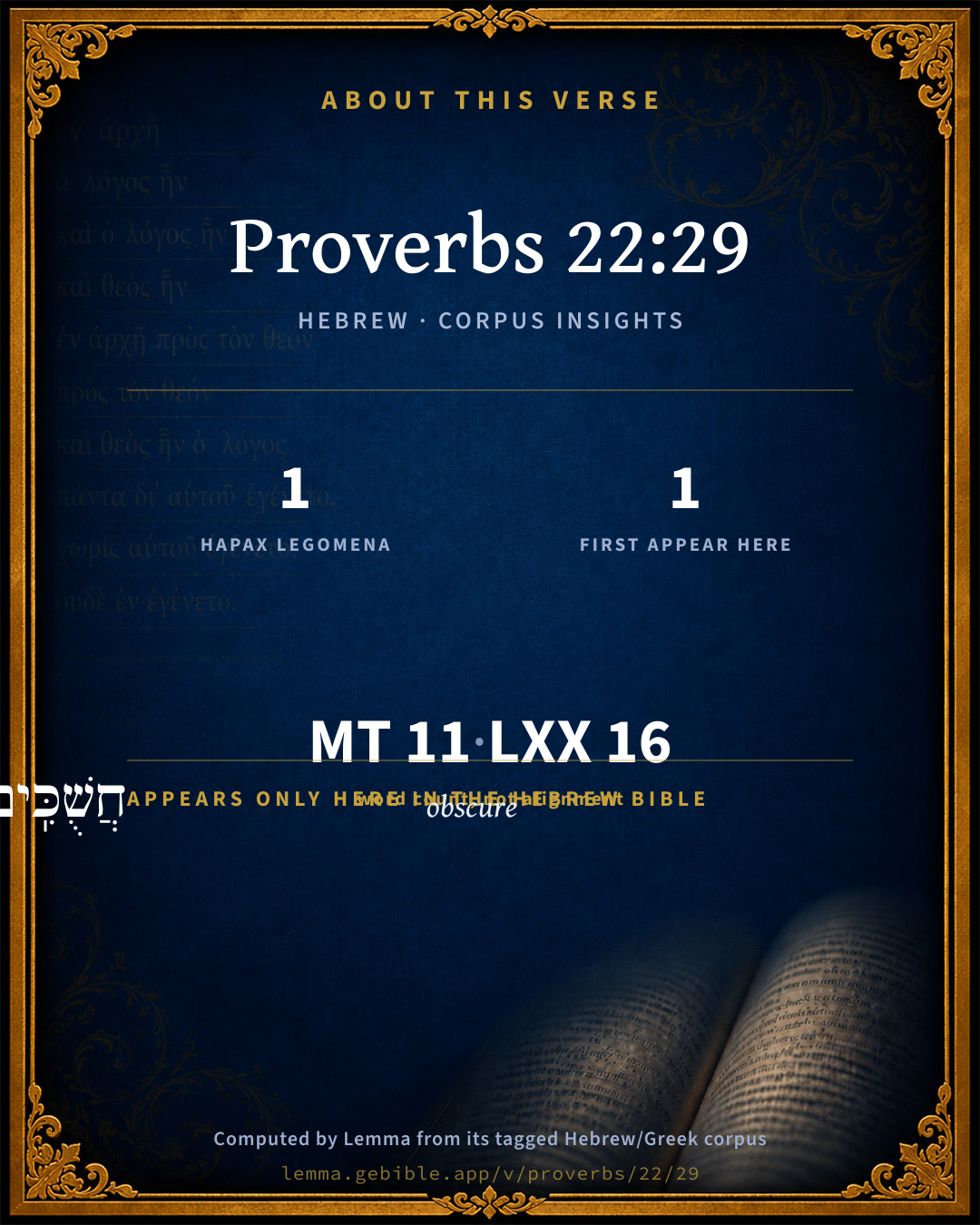
  • 1 hapax legomenon — only here in the Hebrew Bible
  • 1 first appearance in the Hebrew Bible
Full analysis ↓
Download a study sheet

One document with this verse’s original text, its word-by-word gloss line, the meaning frame, cross-references with their text, attributed commentary, and full source and license credits — printable, and it pastes into notes with its structure intact.

This verse Autodidact and up

Study sheet (.html) Plain text (.txt)

A passage Seminary Student

Up to 50 verses in one chapter. A passage sheet keeps up to 6 commentary sources and 12 cross-references per verse, in the order this page ranks them, and says so on the sheet whenever that leaves anything out. Ask for a single verse and you get the Autodidact verse sheet above.

Everything on this page stays free to read, with no account — the sheet is a download of what is already on screen, not access to it.

Want to remove ads? Support Godless Engineer
Compare translations 3

The same verse in 3 English versions, stacked beneath the original-language interlinear above. Click any original word for its lexicon entry.

Each is an independent rendering of the whole verse — the interlinear is not word-aligned to these translations.

Highlighted words mark where these versions differ — a whole-verse word diff, not a word-by-word alignment.

  • World English Bible Public Domain
    Do you see a man skilled in his work? He will serve kings; He won't serve obscure men.
  • King James Version Public Domain
    Seest thou a man diligent in his business? he shall stand before kings; he shall not stand before mean men.
  • unfoldingWord Literal Text CC BY-SA 4.0
    You see a skilled man in his work. He will station himself before the face of kings; he will not station himself before the face of obscure ones.

unfoldingWord Literal Text — © unfoldingWord, licensed CC BY-SA 4.0. Word-aligned USFM3 via Door43 (git.door43.org/unfoldingWord/en_ult).

Versions to compare (up to 4)

3 of 4 selected

Show all 18 translations

Every available English version of this verse, each an independent rendering of the whole verse.

  • World English Bible Public Domain
    Do you see a man skilled in his work? He will serve kings; He won't serve obscure men.
  • Berean Standard Bible Public Domain
    Do you see a man skilled in his work? He will be stationed in the presence of kings; he will not stand before obscure men.
  • Majority Standard Bible Public Domain
    Do you see a man skilled in his work? He will be stationed in the presence of kings; he will not stand before obscure men.
  • King James Version Public Domain
    Seest thou a man diligent in his business? he shall stand before kings; he shall not stand before mean men.
  • American Standard Version (1901) Public Domain
    Seest thou a man diligent in his business? he shall stand before kings; He shall not stand before mean men.
  • Revised Version (1885) Public Domain
    Seest thou a man diligent in his business? he shall stand before kings; he shall not stand before mean men.
  • Geneva Bible (1599) Public Domain
    Thou seest that a diligent man in his businesse standeth before Kings, and standeth not before the base sort.
  • Douay-Rheims (1899) Public Domain
    Hast thou seen a man swift in his work? he shall stand before kings, and shall not be before those that are obscure.
  • Young's Literal Translation Public Domain
    Hast thou seen a man speedy in his business? Before kings he doth station himself, He stations not himself before obscure men!
  • Literal Standard Version CC BY-SA 4.0
    Have you seen a man speedy in his business? He stations himself before kings, || He does not station himself before obscure men!
  • Unlocked Literal Bible CC BY-SA 4.0
    Do you see a man skilled at his work? He will stand before kings; he will not stand before common people.
  • unfoldingWord Literal Text CC BY-SA 4.0
    You see a skilled man in his work. He will station himself before the face of kings; he will not station himself before the face of obscure ones.
  • Darby Bible Public Domain
    Hast thou seen a man diligent in his work? He shall stand before kings; he shall not stand before the mean.
  • World Messianic Bible Public Domain
    Do you see a man skilled in his work? He will serve kings. He won’t serve obscure men.
  • Webster's Bible Public Domain
    Seest thou a man diligent in his business? he shall stand before kings; he shall not stand before mean men.
  • Free Bible Version CC BY-SA 4.0
    If you see someone skilled in what they do, they'll work for kings and not for ordinary people.
  • Bible in Basic English Public Domain
    Have you seen a man who is expert in his business? he will take his place before kings; his place will not be among low persons.
  • JPS Tanakh (1917) Public Domain
    Seest thou a man diligent in his business? he shall stand before kings; he shall not stand before mean men.

Literal Standard Version (2020), Covenant Press — licensed CC BY-SA 4.0. Text via the HelloAO Bible API (eBible.org). Unlocked Literal Bible (unfoldingWord) — licensed CC BY-SA 4.0. Text via the HelloAO Bible API (eBible.org). unfoldingWord Literal Text — © unfoldingWord, licensed CC BY-SA 4.0. Word-aligned USFM3 via Door43 (git.door43.org/unfoldingWord/en_ult). Free Bible Version, Dr. Jonathan Gallagher — licensed CC BY-SA 4.0. Text via the HelloAO Bible API (eBible.org).

Word by word

More ways to search: Search by grammar → Find every occurrence → Compare this word →

Practice this passage: Drill this verse → Learn its vocabulary →

חֲשֻׁכִּֽים
châshôk
H2823
“obscure”
Adjective, Adjective, Masculine, Plural, Absolute
Part of Speech
Adjective
Type
Adjective
Gender
Masculine
Number
Plural
State
Absolute
Full BDB Definition

Origin: from H2821

TWOT: 769b

obscure, insignificant, low
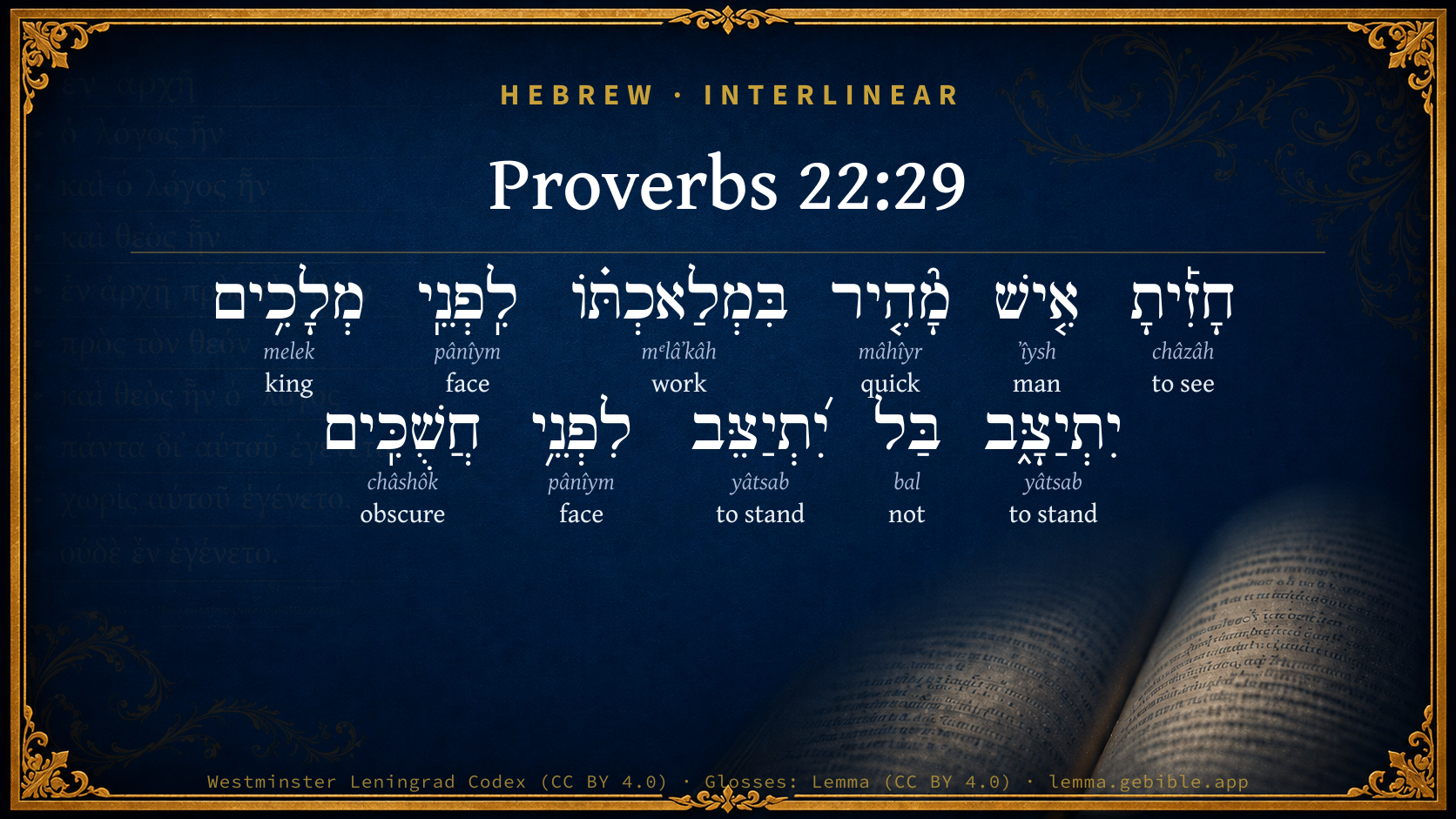
  1. חָזִ֡יתָ châzâh H2372 “to see” Verb, Qal, Perfect, 2nd Person, Masculine, Singular
  2. אִ֤ישׁ ʼîysh H376 “man” Noun, Common, Masculine, Singular, Absolute
  3. מָ֘הִ֤יר mâhîyr H4106 “quick” Adjective, Adjective, Masculine, Singular, Absolute
  4. בִּמְלַאכְתּ֗וֹ mᵉlâʼkâh H4399 “in/at · work · his” Preposition + Noun, Common, Feminine, Singular, Construct + Suffix, Personal, 3rd Person, Masculine, Singular
  5. לִֽפְנֵֽי pânîym H6440 “to/for · face(s) of” Preposition + Noun, Common, Both, Plural, Construct
  6. מְלָכִ֥ים melek H4428 “kings” Noun, Common, Masculine, Plural, Absolute
  7. יִתְיַצָּ֑ב yâtsab H3320 “to stand” Verb, Hithpael, Imperfect, 3rd Person, Masculine, Singular
  8. בַּל bal H1077 “not” Particle, Negative
  9. יִ֝תְיַצֵּב yâtsab H3320 “to stand” Verb, Hithpael, Imperfect, 3rd Person, Masculine, Singular
  10. לִפְנֵ֥י pânîym H6440 “to/for · face(s) of” Preposition + Noun, Common, Both, Plural, Construct

About this verse

These counts appear in no published source. They are computed here, from the morphology-tagged text and Lemma’s own curated glosses. What Lemma adds →

11
words
9
distinct lemmas
Wisdom
section

Notable vocabulary

1 hapax legomenon — a word that appears only here in the entire Hebrew Bible:

  • חֲשֻׁכִּֽים obscure H2823

First appearance in Scripture

This word makes its first canonical appearance in the Hebrew Bible here:

  • חֲשֻׁכִּֽים obscure H2823

Shared distinctive vocabulary

מָ֘הִ֤יר quick H4106 occurs in 4 verses of the Hebrew Bible. Also found in:

Grammatical profile

  • 3 verbs
  • 5 nouns
  • 2 adjectives
  • 1 particle

Verb forms

  • חָזִ֡יתָ Qal · Perfect
  • יִתְיַצָּ֑ב Hithpael · Imperfect
  • יִ֝תְיַצֵּב Hithpael · Imperfect

Repetition

Words recur within this verse — often emphatic in Hebrew:

  • לִֽפְנֵֽי face H6440 ×2
  • יִתְיַצָּ֑ב to stand H3320 ×2

Hebrew & Septuagint length

In English translation the verse runs 18 words from the Hebrew and 23 from the Septuagint (LXX English) — closely comparable.

A rough comparison of the two English renderings, which tokenize alike — not a word-level alignment.

Word counts can differ between the Hebrew and the Greek without any difference in meaning — e.g. the Hebrew direct-object marker אֵת has no separate Greek word, and Greek often adds the article ὁ.

In the original languages it is 11 Hebrew tokens and 16 Greek tokens — but the two are counted differently (Hebrew bundles its prefixes and suffixes into one token; the Greek is in lemma form), so that isn’t a like-for-like length.

Cross-references

10

Topical passages linked to Proverbs 22:29 in the Treasury of Scripture Knowledge — connected by theme and wording, ordered by reader-vote popularity; previews shown in the World English Bible.

  • 1 Kings 11:28 The man Jeroboam was a mighty man of valor; and Solomon saw the young man that he was industrious, and he gave him charge over all the labor of the house of Joseph.
  • Matthew 25:21 "His lord said to him, 'Well done, good and faithful servant. You have been faithful over a few things, I will set you over many things. Enter into the joy of your lord.'
  • Proverbs 12:24 The hands of the diligent ones shall rule, But laziness ends in slave labor.
  • Proverbs 10:4 He becomes poor who works with a lazy hand, But the hand of the diligent brings wealth.
  • Ecclesiastes 9:10 Whatever your hand finds to do, do it with your might; for there is no work, nor device, nor knowledge, nor wisdom, in Sheol, where you are going.
  • Matthew 25:23 "His lord said to him, 'Well done, good and faithful servant. You have been faithful over a few things, I will set you over many things. Enter into the joy of your lord.'
  • Genesis 41:46 Joseph was thirty years old when he stood before Pharaoh king of Egypt. Joseph went out from the presence of Pharaoh, and went throughout all the land of Egypt.
  • Romans 12:11 not lagging in diligence; fervent in spirit; serving the Lord;
  • 1 Kings 10:8 Happy are your men, happy are these your servants, who stand continually before you, [and] who hear your wisdom.
  • 2 Timothy 4:2 preach the word; be urgent in season and out of season; reprove, rebuke, and exhort, with all patience and teaching.

Cross-references courtesy of OpenBible.info (CC BY 4.0).

Hebrew and Greek witnesses Masoretic Hebrew ↔ Greek Septuagint

The same verse in the two great witnesses to the Old Testament, shown verse-for-verse.

These are two independent witnesses, not word-aligned to each other, and the Septuagint is shown in lemma (dictionary) form.

Hebrew Proverbs 22:29 Masoretic · Westminster Leningrad Codex

חָזִ֡יתָ אִ֤ישׁ מָ֘הִ֤יר בִּמְלַאכְתּ֗וֹ לִֽפְנֵֽי מְלָכִ֥ים יִתְיַצָּ֑ב בַּל יִ֝תְיַצֵּב לִפְנֵ֥י חֲשֻׁכִּֽים

Do you see a man skilled in his work? He will serve kings; He won't serve obscure men.

World English Bible · Public Domain

Greek LXX Proverbs 22:29 Septuagint · lemma form

ὁρατικός ἀνήρ καί ὀξύς ἐν ὁ ἔργον αὐτός βασιλεύς δέω παραἵστημι καί μή παραἵστημι ἀνήρ νωθρός

It is fit that an observant man and one diligent in his business should attend on kings, and not attend on slothful men.

LXX2012 (modern English Septuagint) · Public Domain

On this verse, The Pulpit Commentary discusses the Septuagint’s reading. Read the note in Commentary ↓

Hebrew: Westminster Leningrad Codex (CC BY 4.0). Greek: Septuagint (public domain); English from LXX2012 (modern English Septuagint) (Public Domain). How the Septuagint differs from the Hebrew →

Commentary

Notes on Proverbs 22:29 from classic Christian and Jewish commentators (each source and its license shown beneath its notes). The classic Christian expositions comment on the surrounding passage and are grouped to its opening verse, so a note may address several verses; the Jewish commentaries on the Tanakh (Rashi and others) are per-verse, so they appear only where the commentator wrote on this verse.

Lemma curates 59 commentaries, every one of them public domain or Creative Commons licensed, each selected and text-cleaned for this edition rather than reprinted as found. About our sources →

Trapp's Complete Commentary

John Trapp

Pro 22:29 Seest thou a man diligent in his business? he shall stand before kings; he shall not stand before mean [men].

Ver. 29. Seest thou a man diligent.] God loves nimbleness; "what thou doest, do quickly," said Christ to Judas, though it were so ill a business that he was about. Princes love such, and employ them, as Pharaoh did Joseph, and those that were men of activity among his brethren. Solomon also made use of Jeroboam for the same reason, though that was not the wisest act that ever he did. {1Ki 11:28} How dear was Daniel to Darius, because, though sick, yet he despatched the king’s business! What favourites to our Henry VIII were Wolsey, Cromwell, Cranmer, for like reason! A diligent man shall not sit long in a low place. Or if he do all the days of his life, yet if his diligence proceed out of conscience, "he shall stand before the King" of kings when he dies. And surely if Solomon’s servants were held happy for this, and the greatest reward Solomon could promise the diligent is this in the text, what an inconceivable honour must it needs be to look for ever upon the face of God, and, angel-like, stand in his presence!

John Trapp, A Commentary or Exposition upon All the Books of the Old and New Testament (1647–1656) — public domain. Text from a community e-Sword module.

The Biblical Illustrator

Joseph S. Exell

Pro_22:29

Seest thou a man diligent in his business?

he shall stand before kings; he shall not stand before mean men.

The Bible ideal of man

The Bible is a history of human life and a picture of character extending through many ages, and embracing in its scope a vast variety of the family of man. There emerges from this story of life an ideal. There is a moral purpose in all the historical Scriptures.

1. The Bible always recognises a basis of character which is found in the natural endowments of a man.

2. According to the teaching of the Bible there must be a diligent use of these natural powers.

3. The diligence of life must be, according to the Scripture ideal, accompanied by the virtues and purities of a moral self-restraint

4. This ideal man of the Scripture is to be further inspired by a sense of the Divine presence and power. There is one remark necessary to complete the Bible idea of human life. There is a condition which the Scriptures give us as belonging to life, not necessary to perfection, but almost always present, and helpful to its development. The best of men are greatly crossed and exercised by the sorrows and oppositions which are incident to life. Trouble plays an important part as testing and strengthening and sweetening life. (L. D. Bevan, D.D.)

Diligence brings success in life

I believe success in life is within the reach of all who set before them an aim and an ambition that is not beyond the talents and ability which God has bestowed upon them. We should all begin life with a determination to do well whatever we take in hand, and if that determination be adhered to with the pluck for which Englishmen are renowned, success, according to the nature and quality of our brain power, is, I think, a certainty. Had I begun life as a tinker, my earnest endeavour would have been to have made better pots and pans than my neighbours; and I think I may venture to say without any vanity that, with Gods blessing, I should have been fairly successful. The first step on the ladder that leads to success is the firm determination to succeed; the next is the possession of that moral and physical courage which will enable one to mount up, rung after rung, until the top is reached. The best men make a false step now and then, and some even have very bad falls. The weak and puling cry over their misfortunes, and seek for the sympathy of others, and do nothing further after their first or second failure; but the plucky and the courageous pick themselves up without a groan over their broken bones or their first failures, and set to work to mount the ladder again, full of confidence in themselves, and with faith in the results that always attend upon cheerful perseverance. (Lord Wolseley.)

.

The Biblical Illustrator, edited by Joseph S. Exell (c. 1880s–1900s) — public domain. Text from a community e-Sword module.

Joseph Benson's Commentary

Pro 22:29. Seest thou a man diligent in his business — Hebrew, מהיר, expeditious, as the word properly signifies; one of quick despatch, vigorous and speedy in executing what hath been well and wisely contrived. He shall not stand before mean men — He is fit to be employed in the affairs of the greatest princes.

Joseph Benson's Commentary on the Old and New Testaments (1811–1818) — public domain. Text from a community e-Sword module.

The Preacher's Complete Homiletical Commentary

Joseph S. Exell (gen. ed.)

CRITICAL NOTES.—

Pro_22:29. Diligent, rather “expert,” apt.”

MAIN HOMILETICS OF Pro_22:29

THE DESTINY OF THE DILIGENT

I. The diligent man meets with Divine approval. The repeated commendations of diligence and condemnations of slothfulness which we meet with in this book show the estimate which God sets upon rightly-directed industry.

1. The diligent man is in harmony with God. The Divine Father is ever working for the good of His creatures, and no being who ever trod this earth laboured so continuously and earnestly as the Divine Son. With Him during His public ministry the completion of one work was the beginning of another. He was ever about His Father’s business, diligently carrying on and seeking to finish the work which His Father had given Him to do. The man who is diligent in business is in this respect a follower of his Lord and Master.

2. He is in harmony with creatures both above Him and beneath Him. Angels are doing the will of their King with promptitude and despatch—Gabriel “flies swiftly (Dan_9:21) when sent on a message to the earth. Heaven is a world of activity, the cherubim around the throne “rest not day nor night” (Rev_4:8). Many of the creatures below man set him an example of industry. (See on chap. Pro_6:6-11, page 78.) Even inanimate nature seems to rebuke the idle man. (See a comment by Dr. Perry on page 425.)

3. He is in harmony with the needs of humanity. The world calls for diligent workers, and without them all civilisation would soon cease and men sink to the condition of the savage. We have around us many proofs of this. The home of the indolent husband or wife is destitute of all refining influences and is often a nursery of crime. The land where the people are thriftless is a land of degradation and poverty. We can well understand, therefore, that God’s approval rests upon those who make the best use of the time and opportunities which He gives them.

II. The diligent man will reap some reward for his diligence. It is not, of course, possible to take this proverb in an absolutely literal sense, because many diligent men never saw the face of a king. But without diligence it is hardly possible for any man to obtain any position of honour, or if he do he is not likely to retain it. But there is another sense in which diligence may bring a man before kings. Caxton was a diligent man, and by his diligence came literally to stand before the King of England. But he has, by his invention of the printing-press, stood before kings and princes from that hour to this, for they have all learned to honour his name, and to acknowledge their obligations to him. Every time a royal traveller takes his seat in a locomotive James Watt stands before him, for his ability to move with such ease and speed from place to place is the result of that man’s diligence, and his name is held in honour in consequence. And instances might be multiplied indefinitely, in which diligence has caused a man to stand before not only the kings of his own time, but of succeeding generations.

On this subject see also Homiletics on chap. Pro_12:24, page 285.

OUTLINES AND SUGGESTIVE COMMENTS

Of all the qualities which kings especially look to and require in the choice of their servants, that of despatch and energy in the transaction of business is the most acceptable.… There is no other virtue which does not present some shadow of offence to the minds of kings. Expedition in the execution of their commands is the only one which contains nothing that is not acceptable.—Bacon.

God loves nimbleness; “What thou doest, do quickly,” said Christ to Judas, though it were so ill a business that he were about.—Trapp.

The Preacher's Complete Homiletical Commentary (gen. ed. Joseph S. Exell; Funk & Wagnalls, c. 1892) — public domain (pre-1929). A full-Bible homiletical/sermon-outline anthology covering 65 of 66 books (2 John is absent from the source module). Text from a community e-Sword module.

Tyndale Open Study Notes

Tyndale Open Resources

22:29 Saying 5: Those who hone their skills and work hard will have the best jobs and work for the best people.

Tyndale Open Study Notes — © Tyndale Open Resources, licensed CC BY-SA 4.0. Text via the HelloAO Bible API.

Matthew Henry's Commentary

Here is, 1. A plain intimation what a hard thing it is to find a truly ingenious industrious man: "Seest thou a man diligent in his business? Thou wilt not see many such, so epidemical are dulness and slothfulness." He is here commended who lays out himself to get business, though it be but in a very low and narrow sphere, and is not easy when he is out of business, who loves business, is quick and active in it, and goes through it, not only with constancy and resolution, but with dexterity and expedition, a man of despatch, who knows how to bring a deal of business into a little compass. 2. A moral prognostication of the preferment of such a man; though now he stands before mean men, is employed by them and attends upon them, yet he will rise, and is likely enough to stand before kings, as an ambassador to foreign kings or prime-minister of state to his own. Seest thou a man diligent in the business of religion? He is likely to excel in virtue, and shall stand before the King of kings.

Matthew Henry's Commentary on the Whole Bible (1708–1710) — public domain (CC PDM 1.0). Text via the HelloAO Bible API.

Jamieson, Fausset & Brown

Robert Jamieson, A. R. Fausset & David Brown

Success rewards diligence (Pro 10:4; Pro 21:5).

Next: Proverbs Chapter 23

Jamieson, Fausset & Brown — Commentary Critical and Explanatory on the Whole Bible (1871) — public domain (CC PDM 1.0). Text via the HelloAO Bible API.

Adam Clarke's Commentary

Verse 29. He shalt not stand before mean men.] חשכים chashukkim, dark or obscure persons; men of no repute. Na he schal ben before un-noble men. - Old MS. Bible. "Not amonge the symple people." - Coverdale.

The general meaning of the proverb is, "Every diligent, active man, shall be at once independent and respectable."

Adam Clarke's Commentary on the Bible (1810–1826) — public domain. Text from a community e-Sword/MySword module.

Ellicott's Commentary for English Readers

(29) He shall stand before kings.—Shall attend upon them as their minister. (Comp. Gen_41:46.) This verse is a tristich, containing three lines.

A Bible Commentary for English Readers, edited by Charles John Ellicott (1878–1897) — public domain. Text from a community e-Sword module.

The Cambridge Bible for Schools and Colleges

gen. ed. J. J. S. Perowne

29. stand before] Comp. 1Ki_10:8.

mean] “Heb. obscure” R.V. marg.

The Cambridge Bible for Schools and Colleges (gen. ed. J. J. S. Perowne; Cambridge University Press, 1878–1918) — public domain. Text from a community e-Sword module.

John Gill's Exposition

Seest thou a man diligent in his business?.... In the business of his calling, be it what it will, whether for himself or his master; constant in it, swift, ready, and expeditious at it; who industriously pursues it, cheerfully attends it, makes quick dispatch of it; does it off of hand, at once, and is not slothful in it, nor weary of it; when you have observed and taken notice of such a man, which is not very common, you may, without a spirit of prophecy, foresee that such a man will rise in the world;

he shall stand before kings; he shall not stand before mean men, or "obscure persons" (o); he shall not continue in the service of ignoble persons, or keep company with them; but he shall be taken into the service of princes and noble men, and be admitted into their presence, and receive favours from them; as Joseph, who was industrious and diligent in his business in Potiphar's house, was in process of time advanced, and stood before Pharaoh king of Egypt, Gen 39:4. This may be spiritually applied. Every good man has a work or business to do in a religious way; some in a higher sphere, as officers of churches, ministers and deacons; the work of the one lies in reading, study, meditation, and prayer, in the ministration of the word and ordinances, and other duties of their once; and the business of the others in taking care of the poor, and the secular affairs of the churches; others in a lower way, and common to all Christians, which lies in the exercise of grace, and performance of all good works, relative to themselves, their families, and the church of God. Now ministers that are diligent in teaching and ruling; and deacons that do their office well; and private Christians, who are steadfast and immovable, always abounding in the work of the Lord; are ready to every good work, heartily engaged in it, and constantly at it; shall not be company for the sons of darkness, unregenerate men, who are in the dark, and darkness itself; what communion has light with darkness, with works of darkness, they should be not workers of? or have any fellowship with the prince of darkness, from whose power they are delivered; but shall have society with the saints, who are made kings and priests unto God; shall be admitted into the presence of the King of kings now, and have communion with him; and shall stand before him at the great day with confidence, and not be ashamed; shall stand at his right hand, and shall be for ever with him. So the Jews (p) interpret this place, "he shall not stand before dark ones", in hell; "he shall stand before kings", in the garden of Eden, in paradise; that is, in heaven.

(o) "ante obscuros", Mercerus, Junius & Tremellius, Piscator; "coram obscuris", Cocceius, Gejerus, Michaelis; "in conspectu obscurorum", Schultens. (p) Gloss. in T. Bab. Sanhedrin, fol. 104. 2.

Next: Proverbs Chapter 23

John Gill's Exposition of the Whole Bible (1746–1763) — public domain (CC PDM 1.0). Text via the HelloAO Bible API.

Albert Barnes' Notes on the Bible

The gift of a quick and ready intellect is to lead to high office, it is not to be wasted on a work to which the obscure are adequate.

Albert Barnes' Notes on the Bible (1834–1885) — public domain. Text from a community e-Sword/MySword module.

Haydock's Catholic Bible Commentary

Obscure. By industry he shall raise himself to notice. (Haydock) --- Kings employ those who are most active. (Calmet)

George Leo Haydock (1774–1849), Haydock's Catholic Family Bible and Commentary, 1859 edition — public domain. Excludes Psalms (Douay-Rheims chapter numbering differs from Protestant) and Deuterocanonical books (Catholic canon only).

Matthew Poole's English Annotations

Diligent; or, expeditious, as the word properly signifies; one of quick despatch, vigorous and speedy in executing what hath been well and wisely contrived.

He shall stand before kings; he is fit to be employed in the affairs of the greatest princes.

Matthew Poole's English Annotations on the Holy Bible (1683–1685) — public domain. Text from a community e-Sword/MySword module.

Whedon's Commentary on the Bible

Daniel D. Whedon

29. Diligent — Quick, active, prompt, skilled in business. Such a man will attract the attention of those above him — rulers, princes, kings; and he will be called into the public service — he will not remain in the service of mean (common or obscure) men. The form of the verb is forcible: He shall take his stand, or present himself, before kings. It has been said, “Of all the qualities which kings look to and regard in the choice of their servants, that of energy and dispatch in business is the most acceptable. There is no other virtue which does not present some shadow of offence to the minds of kings. Expedition in the execution of their commands is the only one which contains nothing that is not acceptable.”

Daniel D. Whedon (gen. ed.), Commentary on the Old and New Testaments (1874–1909) — public domain. Text from a community e-Sword module.

The Pulpit Commentary

A tristich follows. Seest thou a man diligent in his business! Mere diligence would not commend a man to high notice unless accompanied by dexterity and skill; and though ryhim (mahir) means "quick," it also has the notion of "skilful," and is better here taken in that sense. He shall stand before kings. This phrase means to serve or minister to another. (Gen_41:46 1Sa_16:21, 22 1Ki_10:8 Job_1:6) A man thus export is fitted for any, even the highest situation, may well be employed in affairs of state, and enjoy the confidence of kings. He shall not stand before mean men. "Mean" ( are the men of no importance, ignobiles, obscure. An intellectual, clever, adroit man would never he satisfied with serving such masters; his ambition is higher; he knows that he is capable of better things. Septuagint, "It must needs be that an observant (oratikon ) man, dud one who is keen in his business, should attend on kings, and not attend on slothful men.

See homily on Pro_6:6-11 Pro_27:23. C.

The Pulpit Commentary (1880–1919), ed. H.D.M. Spence-Jones & Joseph S. Exell — public domain. Text from a community e-Sword module.

John Wesley's Explanatory Notes

Before kings - He is fit to be employed in the affairs of princes.

John Wesley, Explanatory Notes Upon the Whole Bible (1754–1765) — public domain. Text via the GEBible commentary corpus.

Keil & Delitzsch

C. F. Keil & F. Delitzsch

After these four proverbs beginning with אל, a new series begins with the following tristich:

29 Seest thou a man who is expert in his calling -

Before kings may he stand;

Not stand before obscure men;

i.e., he can enter into the service of kings, and needs not to enter into the service of mean men = he is entitled to claim the highest official post. חזית, in Pro 26:12 = Pro 29:20, interchanging with ראית, is perf. hypotheticum (cf. Pro 24:10; Pro 25:16): si videris; the conclusion which might begin with דּע כּי expresses further what he who sees will have occasion to observe. Rightly Luther: Sihestu einen Man endelich (vid., at Pro 21:5) in seinem geschefft, u.s.w. = seest thou a man expert in his business, etc.. מהיר denotes in all the three chief dialects one who is skilful in a manner not merely by virtue of external artistic ability, but also by means of intellectual mastery of it. התיצּב לפני, to enter on the situation of a servant before any one; cf. Job 1:6; Job 2:1. עמד לפני, Sa1 16:21; Kg1 10:8. Along with the pausal form יתיצּב, there is also found in Codd. the form יתיצּב (the ground-form to יתיצּב, whence that pausal form is lengthened), which Ben-Bileam defends, for he reckons this word among "the pathachized pausal forms." חשׁכּים, in contrast to מלכים, are the obscuri = ignobiles. The Targ. translate the Heb. דּל and אביון by חשׁיך and חשׁוך. Kimchi compares Jer 39:10, where העם הדּלּים is translated by חשׁיכיּא (cf. Kg2 24:14; Kg2 25:12). חלכּה (חלכּה) is the old Heb. synonym in Ps 10. The poet seems here to transfer the Aram. usus loq. into the Heb.

Keil & Delitzsch — Biblical Commentary on the Old Testament (1861–1891) — public domain (CC PDM 1.0). Text via the HelloAO Bible API. (Old Testament only.)

Bridges on Proverbs

Charles Bridges

Seest thou a man? He is marked out for a special notice.†1 And who is it? A man diligent in his business; quick, ready, actively improving his time, his talents, his opportunity for his work; like Henry Martyn, who was known in his college ’as the man who had not lost an hour.’†2 A mean sphere is too low for such a man. He shall stand, as Joseph,†3 Nehemiah,†4 Daniel†5 — all diligent in their business — did — before kings. If the letter of the promise be not fulfilled, "the diligent man will bear rule" in his own sphere.†6 Such was the honor put upon Eliezer’s care, forethought and activity for his master’s interest. (Gen 24:1-67 .) ’Nobleness of condition is not essential as a school for nobleness of character. It is delightful to think, that humble life may be just as rich in moral grace and moral grandeur as the loftier places in society; that as true a dignity of principle may be earned by him, who in homeliest drudgery plies his conscientious task, as by him who stands entrusted with the fortunes of an empire.’†7

Diligence, even without godliness, is often the way to worldly advancement. Pharaoh chose Joseph’s brethren, as "men of activity," to be rulers of his cattle. (Gen 47:6 .) Jeroboam owed his rise in Solomon’s house to his "industrious" habits. (1Ki 11:28 .) But when a man "serves the Lord in fervency of spirit" (Rom 12:11 ), thriftfully occupying his own talent for the day of reckoning (Luk 19:13 ); not only the mean man, but the mighty man of the world, will be too low for him. He shall stand before the King of Kings with unspeakable honor, with unclouded acceptance — "Well done! good and faithful servant; enter thou into the joy of thy Lord." (Mat 25:21-23 .)

And if "the servants of the wise king were happy, which stood continually before him, and heard his wisdom;" what must be the joy of standing before the great King, seeing his face, and serving him for ever!†8 "This honor have all his saints." (Psa 149:9 .) "If a man serve me," saith our gracious Master, "where I am, there shall also my servant be; if any man serve me, him will my Father honor." (Joh 12:26 .)

Footnotes:

†1 Pro 26:12; Pro 29:20 .

†2 Life, chapter ii.

†3 Gen 39:3-6; Gen 41:42 .

†4 Neh 1:11; Neh 2:1 .

†5 Dan 6:1-3; Dan 6:28 .

†6 Pro 12:24. Compare Sir 10:25 .

†7 Chalmers’ Commercial Discourses, p. 107.

†8 1Ki 10:8, with Rev 7:15 ; Rev 22:3-4 .

Charles Bridges, An Exposition of the Book of Proverbs (1846) — public domain. Text from a community e-Sword module.

Kretzmann's Popular Commentary

Paul E. Kretzmann

v. 29. Seest thou a man diligent in his business? one who is skilful, apt, diligent. He shall stand before kings, being invited to serve them with his counsel and with his ability; he shall not stand before mean men, ordinary, obscure persons, for the services of such a man would be considered too valuable to be of benefit to a small circle only.

Paul E. Kretzmann, Popular Commentary of the Bible (1921–1924) — public domain. Text from a community e-Sword module.

Lesson kit

Teaching starters — assembled from the data on this page, not authored interpretation. Every prompt links to the verse data it draws on. Edit before teaching.

Proverbs, in the Wisdom, opens this verse with 11 words (9 distinct Hebrew lemmas). Its most distinctive word is châshôk (“obscure”). A historical commentator’s framing appears above. Read the whole chapter for the surrounding context.

Discussion questions

  1. How does “obscure” (châshôk) shape what this verse is saying?
  2. This verse holds 1 word here found nowhere else in the Hebrew Bible. What might the rare word draw attention to?
  3. The word “obscure” first appears here in Scripture. What is being introduced at this debut?
  4. Ezra 7:6 shares the word «quick» with this verse. How do the two illuminate each other?
  5. “face” occurs 2× in this one verse. What is the effect of the repetition?
  6. These translations render this verse differently. What is at stake in choosing one wording over another?
  7. The verb «חָזִ֡יתָ» is Qal Perfect. How does its form color the action?
  8. Reading how Trapp's Complete Commentary and The Biblical Illustrator read this verse, where do the two commentators agree and where do they part?

Things to notice

  • 1 word in this verse appears nowhere else in the Hebrew Bible.
  • 1 word makes its first canonical appearance in Scripture here.
  • This verse counts 11 Hebrew ↔ 16 Greek words.
  • These translations choose different wording for 21 words in this verse.
  • “face” occurs 2× in this single verse.

Reading settings

Reading text

Shown beneath each verse's original-language words.

Old Testament
Old Testament edition

Read the OT as the Masoretic Hebrew (MT) or the Greek Septuagint (LXX).

English shown for the Greek Septuagint (in the Hebrew ↔ Greek comparison).

Comparing translations? Open the Compare panel on any verse page to stack up to four side by side.