
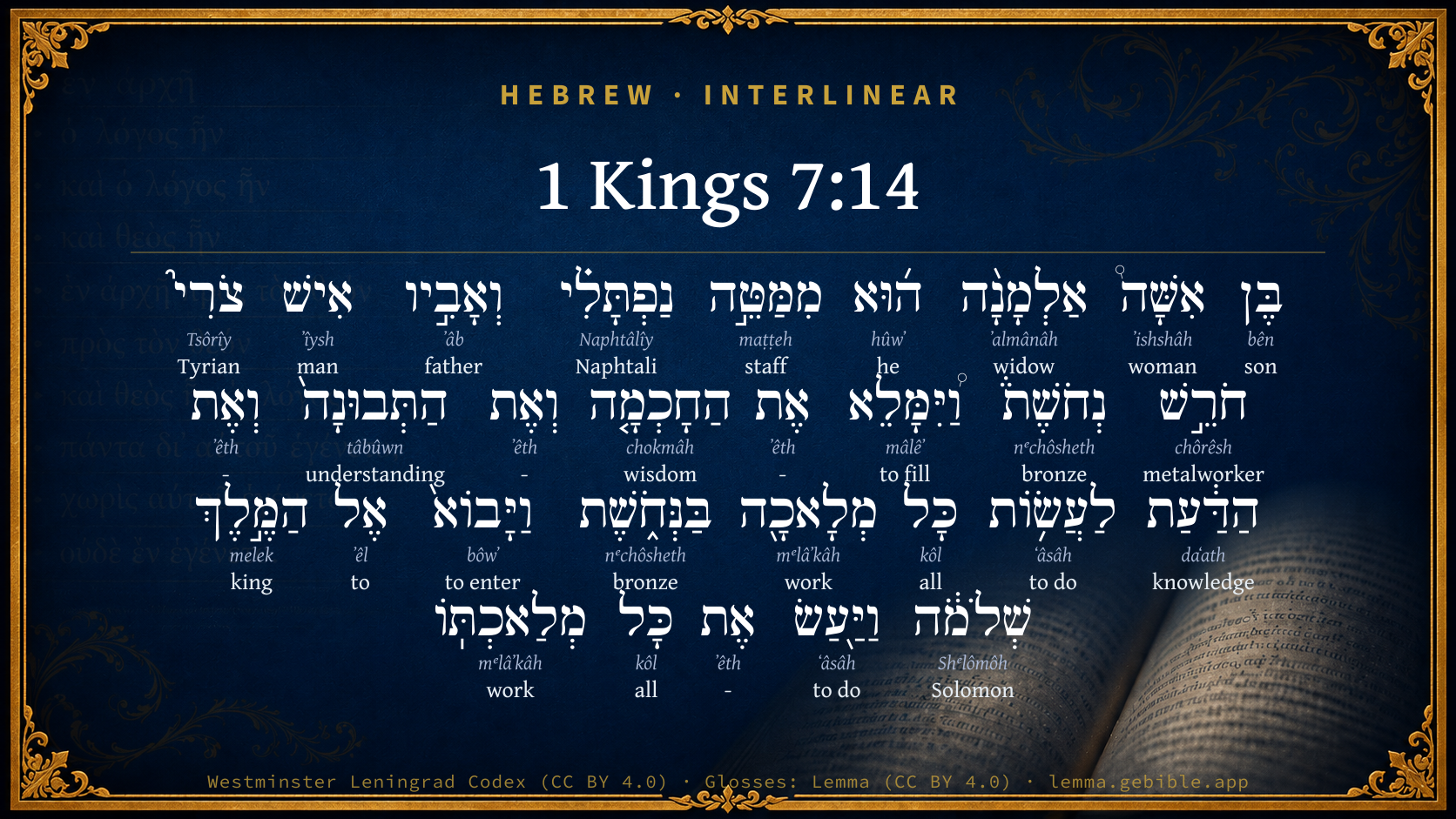
1 Kings 7:14

Hebrew (Westminster Leningrad Codex) 1 Kings 7:14 appears in the Hebrew Old Testament. The text above is from the Westminster Leningrad Codex. Each word links to its Strong’s number, a concise gloss, and parsing drawn from the Open Scriptures Hebrew Bible morphology. Click any word for its full Brown-Driver-Briggs (BDB) entry.
Download image
Cite this verse

1 Kings 7:14 (World English Bible). Public Domain. Lemma interlinear Bible study tool, https://lemma.gebible.app/v/1-kings/7/14.

Show BibTeX & RIS
BibTeX
RIS
English Translation
He was the son of a widow of the tribe of Naphtali, and his father was a man of Tyre, a worker in brass; and he was filled with wisdom and understanding and skill, to work all works in brass. He came to king Solomon, and performed all his work.
World English Bible · Public Domain
Highlights
  • 1 first appearance in the Hebrew Bible
Full analysis ↓
Download a study sheet

One document with this verse’s original text, its word-by-word gloss line, the meaning frame, cross-references with their text, attributed commentary, and full source and license credits — printable, and it pastes into notes with its structure intact.

This verse Autodidact and up

Study sheet (.html) Plain text (.txt)

A passage Seminary Student

Up to 50 verses in one chapter. A passage sheet keeps up to 6 commentary sources and 12 cross-references per verse, in the order this page ranks them, and says so on the sheet whenever that leaves anything out. Ask for a single verse and you get the Autodidact verse sheet above.

Everything on this page stays free to read, with no account — the sheet is a download of what is already on screen, not access to it.

Want to remove ads? Support Godless Engineer
Compare translations 3

The same verse in 3 English versions, stacked beneath the original-language interlinear above. Click any original word for its lexicon entry.

Each is an independent rendering of the whole verse — the interlinear is not word-aligned to these translations.

Highlighted words mark where these versions differ — a whole-verse word diff, not a word-by-word alignment.

  • World English Bible Public Domain
    He was the son of a widow of the tribe of Naphtali, and his father was a man of Tyre, a worker in brass; and he was filled with wisdom and understanding and skill, to work all works in brass. He came to king Solomon, and performed all his work.
  • King James Version Public Domain
    He was a widow's son of the tribe of Naphtali, and his father was a man of Tyre, a worker in brass: and he was filled with wisdom, and understanding, and cunning to work all works in brass. And he came to king Solomon, and wrought all his work.
  • unfoldingWord Literal Text CC BY-SA 4.0
    He the son of a woman, a widow, from the tribe of Naphtali, and his father was a man of Tyre, a crafter of bronze. And he was filled with wisdom and understanding and knowledge to do all work in bronze. And he came to King Solomon, and he did all of his work.

unfoldingWord Literal Text — © unfoldingWord, licensed CC BY-SA 4.0. Word-aligned USFM3 via Door43 (git.door43.org/unfoldingWord/en_ult).

Versions to compare (up to 4)

3 of 4 selected

Show all 18 translations

Every available English version of this verse, each an independent rendering of the whole verse.

  • World English Bible Public Domain
    He was the son of a widow of the tribe of Naphtali, and his father was a man of Tyre, a worker in brass; and he was filled with wisdom and understanding and skill, to work all works in brass. He came to king Solomon, and performed all his work.
  • Berean Standard Bible Public Domain
    He was the son of a widow from the tribe of Naphtali, and his father was a man of Tyre, a craftsman in bronze. Huram had great skill, understanding, and knowledge for every kind of bronze work. So he came to King Solomon and carried out all his work.
  • Majority Standard Bible Public Domain
    He was the son of a widow from the tribe of Naphtali, and his father was a man of Tyre, a craftsman in bronze. Huram had great skill, understanding, and knowledge for every kind of bronze work. So he came to King Solomon and carried out all his work.
  • King James Version Public Domain
    He was a widow's son of the tribe of Naphtali, and his father was a man of Tyre, a worker in brass: and he was filled with wisdom, and understanding, and cunning to work all works in brass. And he came to king Solomon, and wrought all his work.
  • American Standard Version (1901) Public Domain
    He was the son of a widow of the tribe of Naphtali, and his father was a man of Tyre, a worker in brass; and he was filled with wisdom and understanding and skill, to work all works in brass. And he came to king Solomon, and wrought all his work.
  • Revised Version (1885) Public Domain
    He was the son of a widow woman of the tribe of Naphtali, and his father was a man of Tyre, a worker in brass; and he was filled with wisdom and understanding and cunning, to work all works in brass. And he came to king Solomon, and wrought all his work.
  • Geneva Bible (1599) Public Domain
    He was a widowes sonne of the tribe of Naphtali, his father being a man of Tyrus, and wrought in brasse: he was full of wisedome, and vnderstanding, and knowledge to worke all maner of worke in brasse: who came to King Salomon, and wrought all his worke.
  • Douay-Rheims (1899) Public Domain
    The son of a widow woman of the tribe of Nephtali, whose father was a Tyrian, an artificer in brass, and full of wisdom, and understanding, and skill to work all work in brass. And when he was come to king Solomon, he wrought all his work.
  • Young's Literal Translation Public Domain
    he `is' son of a woman, a widow, of the tribe of Naphtali, and his father a man of Tyre, a worker in brass, and he is filled with the wisdom and the understanding, and the knowledge to do all work in brass -- and he cometh unto king Solomon, and doth all his work.
  • Literal Standard Version CC BY-SA 4.0
    he [is the] son of a woman, a widow, of the tribe of Naphtali, and his father [is] a man of Tyre, a worker in bronze, and he is filled with the wisdom and the understanding, and the knowledge to do all work in bronze—and he comes to King Solomon, and does all his work.
  • Unlocked Literal Bible CC BY-SA 4.0
    Huram was the son of a widow of the tribe of Naphtali; his father was a man of Tyre, a craftsman in bronze. Huram was filled with wisdom and understanding and skill to do great work with bronze. He came to King Solomon to work with bronze for the king.
  • unfoldingWord Literal Text CC BY-SA 4.0
    He the son of a woman, a widow, from the tribe of Naphtali, and his father was a man of Tyre, a crafter of bronze. And he was filled with wisdom and understanding and knowledge to do all work in bronze. And he came to King Solomon, and he did all of his work.
  • Darby Bible Public Domain
    He was a widow's son of the tribe of Naphtali, and his father was a man of Tyre, a worker in brass; and he was full of wisdom and understanding and knowledge, to do all kinds of works in brass. And he came to king Solomon, and made all his work.
  • World Messianic Bible Public Domain
    He was the son of a widow of the tribe of Naphtali, and his father was a man of Tyre, a worker in bronze; and he was filled with wisdom and understanding and skill to work all works in bronze. He came to King Solomon and performed all his work.
  • Webster's Bible Public Domain
    He was a widow's son of the tribe of Naphtali, and his father was a man of Tyre, a worker in brass: and he was filled with wisdom, and understanding, and ingenious to work all works in brass. And he came to king Solomon, and wrought all his work.
  • Free Bible Version CC BY-SA 4.0
    He was the son of a widow from the tribe of Naphtali, and his father was from Tyre, a craftsman who worked in bronze. Hiram had great expertise, understanding and being familiar with all kinds of bronze work. He came to King Solomon and carried out all that the king required.
  • Bible in Basic English Public Domain
    He was the son of a widow of the tribe of Naphtali, and his father was a man of Tyre, a worker in brass; he was full of wisdom and knowledge and an expert worker in brass. He came to King Solomon and did all his work for him.
  • JPS Tanakh (1917) Public Domain
    He was the son of a widow of the tribe of Naphtali, and his father was a man of Tyre, a worker in brass; and he was filled with wisdom and understanding and skill, to work all works in brass. And he came to king Solomon, and wrought all his work.

Literal Standard Version (2020), Covenant Press — licensed CC BY-SA 4.0. Text via the HelloAO Bible API (eBible.org). Unlocked Literal Bible (unfoldingWord) — licensed CC BY-SA 4.0. Text via the HelloAO Bible API (eBible.org). unfoldingWord Literal Text — © unfoldingWord, licensed CC BY-SA 4.0. Word-aligned USFM3 via Door43 (git.door43.org/unfoldingWord/en_ult). Free Bible Version, Dr. Jonathan Gallagher — licensed CC BY-SA 4.0. Text via the HelloAO Bible API (eBible.org).

Word by word

More ways to search: Search by grammar → Find every occurrence → Compare this word →

Practice this passage: Drill this verse → Learn its vocabulary →

חֹרֵ֣שׁ
chôrêsh
H2794
“metalworker”
Verb, Qal, Participle Active, Masculine, Singular, Absolute
Part of Speech
Verb
Stem
Qal
Form
Participle Active
Gender
Masculine
Number
Singular
State
Absolute
Full BDB Definition

Origin: act. participle of H2790

TWOT: 763a ?

metal craftsman
  1. בֶּן bên H1121 “son of” Noun, Common, Masculine, Singular, Construct
  2. אִשָּׁה֩ ʼishshâh H802 “woman” Noun, Common, Feminine, Singular, Absolute
  3. אַלְמָנָ֨ה ʼalmânâh H490 “widow” Noun, Common, Feminine, Singular, Absolute
  4. ה֜וּא hûwʼ H1931 “he” Pronoun, Personal, 3rd Person, Masculine, Singular
  5. מִמַּטֵּ֣ה maṭṭeh H4294 “from · staff of” Preposition + Noun, Common, Masculine, Singular, Construct
  6. נַפְתָּלִ֗י Naphtâlîy H5321 “Naphtali” Noun, Proper
  7. וְאָבִ֣יו ʼâb H1 “and · father · his” Conjunction + Noun, Common, Masculine, Singular, Construct + Suffix, Personal, 3rd Person, Masculine, Singular
  8. אִישׁ ʼîysh H376 “man” Noun, Common, Masculine, Singular, Absolute
  9. צֹרִי֮ Tsôrîy H6876 “Tyrian” Noun, Gentilic, Masculine, Singular, Absolute
  10. נְחֹשֶׁת֒ nᵉchôsheth H5178 “bronze” Noun, Common, Feminine, Singular, Absolute
  11. וַ֠יִּמָּלֵא mâlêʼ H4390 “and · to fill” Conjunction + Verb, Niphal, Sequential Imperfect, 3rd Person, Masculine, Singular
  12. אֶת ʼêth H853 “-” Particle, Direct Object
  13. הַחָכְמָ֤ה chokmâh H2451 “the · wisdom” Particle, Definite Article + Noun, Common, Feminine, Singular, Absolute
  14. וְאֶת ʼêth H853 “and · -” Conjunction + Particle, Direct Object
  15. הַתְּבוּנָה֙ tâbûwn H8394 “the · understanding” Particle, Definite Article + Noun, Common, Feminine, Singular, Absolute
  16. וְאֶת ʼêth H853 “and · -” Conjunction + Particle, Direct Object
  17. הַדַּ֔עַת daʻath H1847 “the · knowledge” Particle, Definite Article + Noun, Common, Feminine, Singular, Absolute
  18. לַעֲשׂ֥וֹת ʻâsâh H6213 “to do” Preposition + Verb, Qal, Infinitive Construct
  19. כָּל kôl H3605 “all of” Noun, Common, Masculine, Singular, Construct
  20. מְלָאכָ֖ה mᵉlâʼkâh H4399 “work” Noun, Common, Feminine, Singular, Absolute
  21. בַּנְּחֹ֑שֶׁת nᵉchôsheth H5178 “in/at the · bronze” Preposition, Determined + Noun, Common, Feminine, Singular, Absolute
  22. וַיָּבוֹא֙ bôwʼ H935 “and · to enter” Conjunction + Verb, Qal, Sequential Imperfect, 3rd Person, Masculine, Singular
  23. אֶל ʼêl H413 “to” Preposition
  24. הַמֶּ֣לֶךְ melek H4428 “the · king” Particle, Definite Article + Noun, Common, Masculine, Singular, Absolute
  25. שְׁלֹמֹ֔ה Shᵉlômôh H8010 “Solomon” Noun, Proper
  26. וַיַּ֖עַשׂ ʻâsâh H6213 “and · to do” Conjunction + Verb, Qal, Sequential Imperfect, 3rd Person, Masculine, Singular
  27. אֶת ʼêth H853 “-” Particle, Direct Object
  28. כָּל kôl H3605 “all of” Noun, Common, Masculine, Singular, Construct
  29. מְלַאכְתּֽוֹ mᵉlâʼkâh H4399 “work · his” Noun, Common, Feminine, Singular, Construct + Suffix, Personal, 3rd Person, Masculine, Singular

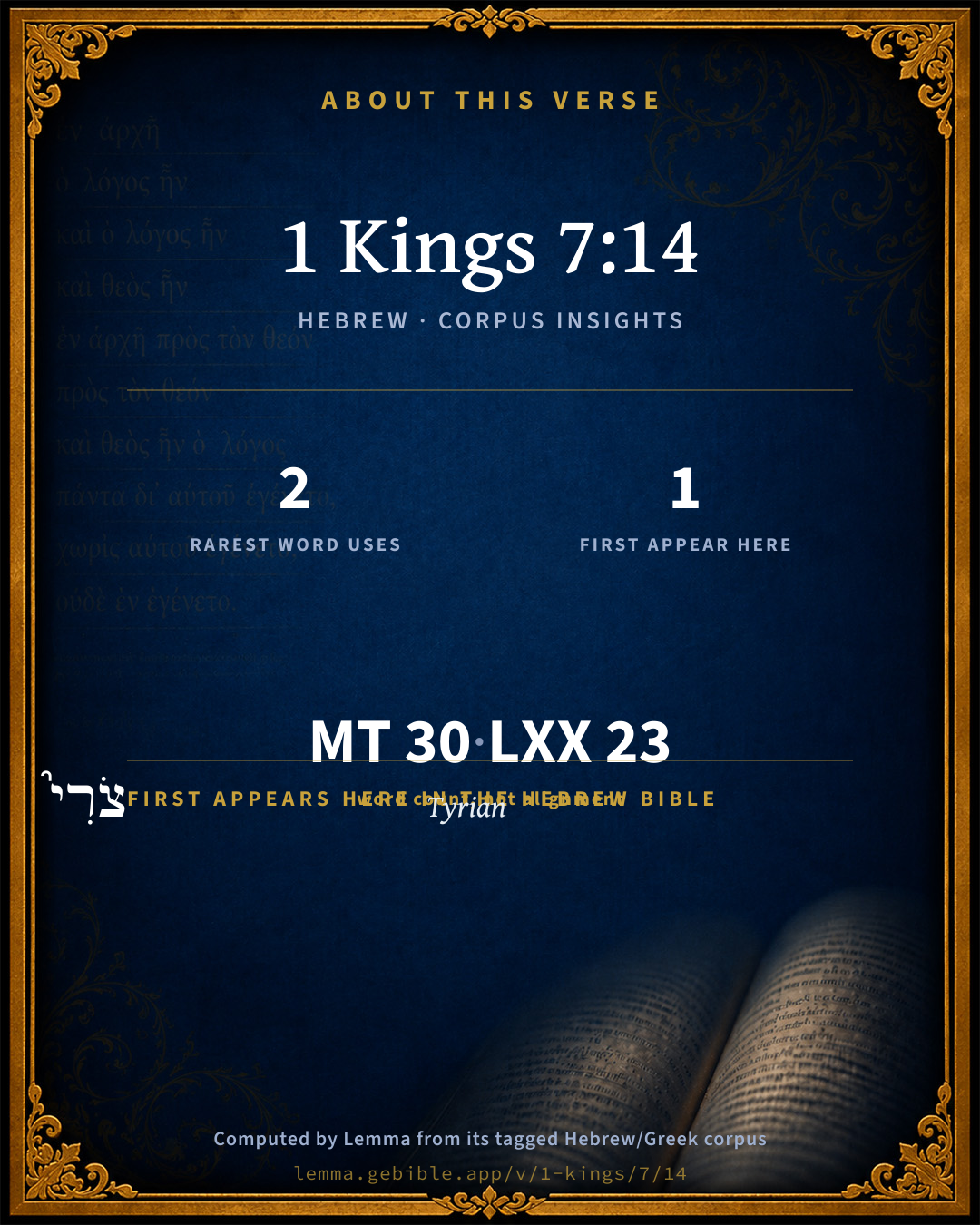
About this verse

These counts appear in no published source. They are computed here, from the morphology-tagged text and Lemma’s own curated glosses. What Lemma adds →

30
words
23
distinct lemmas
Historical
section

Notable vocabulary

The rarest word here is חֹרֵ֣שׁ metalworker H2794 — appearing just 2 times in the whole Hebrew Bible.

First appearance in Scripture

This word makes its first canonical appearance in the Hebrew Bible here:

  • צֹרִי֮ Tyrian H6876

Shared distinctive vocabulary

חֹרֵ֣שׁ metalworker H2794 occurs in 2 verses of the Hebrew Bible. Also found in:

Grammatical profile

  • 5 verbs
  • 19 nouns
  • 1 pronoun
  • 1 preposition
  • 4 particles

Verb forms

  • חֹרֵ֣שׁ Qal · Participle Active
  • וַ֠יִּמָּלֵא Niphal · Sequential Imperfect
  • לַעֲשׂ֥וֹת Qal · Infinitive Construct
  • וַיָּבוֹא֙ Qal · Sequential Imperfect
  • וַיַּ֖עַשׂ Qal · Sequential Imperfect

Repetition

Words recur within this verse — often emphatic in Hebrew:

  • נְחֹשֶׁת֒ bronze H5178 ×2
  • לַעֲשׂ֥וֹת to do H6213 ×2
  • כָּל all H3605 ×2
  • מְלָאכָ֖ה work H4399 ×2

Hebrew & Septuagint length

In English translation the verse runs 50 words from the Hebrew and 52 from the Septuagint (LXX English) — closely comparable.

A rough comparison of the two English renderings, which tokenize alike — not a word-level alignment.

Word counts can differ between the Hebrew and the Greek without any difference in meaning — e.g. the Hebrew direct-object marker אֵת has no separate Greek word, and Greek often adds the article ὁ.

In the original languages it is 30 Hebrew tokens and 23 Greek tokens — but the two are counted differently (Hebrew bundles its prefixes and suffixes into one token; the Greek is in lemma form), so that isn’t a like-for-like length.

Cross-references

7

Topical passages linked to 1 Kings 7:14 in the Treasury of Scripture Knowledge — connected by theme and wording, ordered by reader-vote popularity; previews shown in the World English Bible.

  • 2 Chronicles 2:14 the son of a woman of the daughters of Dan; and his father was a man of Tyre, skillful to work in gold, and in silver, in brass, in iron, in stone, and in timber, in purple, in blue, and in fine linen, and in crimson, also to engrave any manner of engraving, and to devise any device; that there may be [a place] appointed to him with your skillful men, and with the skillful men of my lord David your father.
  • 2 Chronicles 4:16 The pots also, and the shovels, and the flesh-hooks, and all the vessels of it, did Huram his father make for king Solomon for the house of Yahweh of bright brass.
  • Exodus 31:2–6 "Behold, I have called by name Bezalel the son of Uri, the son of Hur, of the tribe of Judah:
  • Exodus 35:30–36:2 Moses said to the children of Israel, "Behold, Yahweh has called by name Bezalel the son of Uri, the son of Hur, of the tribe of Judah.
  • Exodus 36:8 All the wise-hearted men among those who did the work made the tent with ten curtains; of fine twined linen, blue, purple, and scarlet, with cherubim, the work of the skillful workman, they made them.
  • 2 Chronicles 4:11 Huram made the pots, and the shovels, and the basins. So Huram made an end of doing the work that he did for king Solomon in the house of God:
  • Isaiah 28:26 For his God does instruct him aright, [and] does teach him.

Cross-references courtesy of OpenBible.info (CC BY 4.0).

Hebrew and Greek witnesses Masoretic Hebrew ↔ Greek Septuagint

The same verse in the two great witnesses to the Old Testament, shown verse-for-verse.

These are two independent witnesses, not word-aligned to each other, and the Septuagint is shown in lemma (dictionary) form.

Hebrew 1 Kings 7:14 Masoretic · Westminster Leningrad Codex

בֶּן אִשָּׁה֩ אַלְמָנָ֨ה ה֜וּא מִמַּטֵּ֣ה נַפְתָּלִ֗י וְאָבִ֣יו אִישׁ צֹרִי֮ חֹרֵ֣שׁ נְחֹשֶׁת֒ וַ֠יִּמָּלֵא אֶת הַחָכְמָ֤ה וְאֶת הַתְּבוּנָה֙ וְאֶת הַדַּ֔עַת לַעֲשׂ֥וֹת כָּל מְלָאכָ֖ה בַּנְּחֹ֑שֶׁת וַיָּבוֹא֙ אֶל הַמֶּ֣לֶךְ שְׁלֹמֹ֔ה וַיַּ֖עַשׂ אֶת כָּל מְלַאכְתּֽוֹ

He was the son of a widow of the tribe of Naphtali, and his father was a man of Tyre, a worker in brass; and he was filled with wisdom and understanding and skill, to work all works in brass. He came to king Solomon, and performed all his work.

World English Bible · Public Domain

Greek LXX 1 Kings 7:14 Septuagint · lemma form

καί ποιέω δέκα μεχωνωθ χαλκοῦς πέντε πῆχυς μῆκος ὁ μεχωνωθ ὁ εἷς καί τέσσαρες πῆχυς πλάτος αὐτός καί ἕξ ἐν πῆχυς ὕψος αὐτός

the son of a widow woman; and he was of the tribe of Nephthalim, and his father was a Tyrian; a worker in brass, and accomplished in are and skill and knowledge to work every work in brass: and he was brought in to king Solomon, and he wrought all the works.

LXX2012 (modern English Septuagint) · Public Domain

Hebrew: Westminster Leningrad Codex (CC BY 4.0). Greek: Septuagint (public domain); English from LXX2012 (modern English Septuagint) (Public Domain). How the Septuagint differs from the Hebrew →

Targum (Aramaic paraphrase)

1

The Targum is the ancient Jewish Aramaic paraphrase of the Hebrew Scriptures — an interpretive translation, not the Hebrew text itself. Onkelos (literal) and Pseudo-Jonathan (expansive) render the Torah, and Jonathan the Prophets. Coverage is partial: where no permissively-licensed English translation exists for a verse, only the Aramaic is shown. This is verse-level text, not a word-by-word alignment to the Hebrew.

  1. Targum Jonathan Prophets (Joshua–Malachi)
    בַּר אִתְּתָא אַרְמַלְתָּא הוּא מִשִׁבְטָא דְבֵית נַפְתָּלִי וַאֲבוּהִי גְבַר צוֹרִי אוּמַן בְּעוֹבָדָא דִנְחָשָׁא וְאִתְמְלֵי יַת חוּכְמְתָא וְיַת סוּכְלְתָנָא וְיַת דַעְתָּא לְמֶעְבַד כָּל עֲבִידָא בִּנְחָשָׁא וַאֲתָא לְוַת מַלְכָּא שְׁלֹמֹה וַעֲבַד יַת כָּל עֲבִדְתֵּיהּ:

    (no public-domain English translation for this verse)

    Targum Jonathan — Aramaic: “Mikraot Gedolot” (public domain). English: “Sefaria Community Translation” (CC0 1.0 (public-domain dedication)); “London "Chaldee Paraphrase," 1871” (public domain). Text via Sefaria.

Commentary

Notes on 1 Kings 7:14 from classic Christian and Jewish commentators (each source and its license shown beneath its notes). The classic Christian expositions comment on the surrounding passage and are grouped to its opening verse, so a note may address several verses; the Jewish commentaries on the Tanakh (Rashi and others) are per-verse, so they appear only where the commentator wrote on this verse.

Lemma curates 59 commentaries, every one of them public domain or Creative Commons licensed, each selected and text-cleaned for this edition rather than reprinted as found. About our sources →

Trapp's Complete Commentary

John Trapp

1Ki 7:14 He [was] a widow’s son of the tribe of Naphtali, and his father [was] a man of Tyre, a worker in brass: and he was filled with wisdom, and understanding, and cunning to work all works in brass. And he came to king Solomon, and wrought all his work.

Ver. 14. He was a widow’s son of the tribe of Naphtali.] His father was of that tribe, but his mother of the tribe of Dan, {2Ch 2:14} unless the king there mistook the one tribe for the other.

And cunning to work all works.] Not in brass only, but in gold, silver, iron, stone, timber, purple, &c., {2Ch 4:16} so that Solomon, for respect’s sake, called him his father. {2Ch 4:16}

John Trapp, A Commentary or Exposition upon All the Books of the Old and New Testament (1647–1656) — public domain. Text from a community e-Sword module.

Geneva Bible (1599)

Geneva Bible translators

Thus when God will have his glory set forth, he raiseth up men, and giveth them excellent gifts for the accomplishment of the same, Exod. 31:2,3.

Geneva Bible (1599) marginal notes — public domain. Text via Bolls.life.

Jamieson, Fausset & Brown

Robert Jamieson, A. R. Fausset & David Brown

He was a widow's son of the tribe of Naphtali--In Ch2 2:14 his mother is said to have been of the daughters of Dan. The apparent discrepancy may be reconciled thus: Hiram's mother, though belonging to the tribe of Dan, had been married to a Naphtalite, so that when married afterwards to a Tyrian, she might be described as a widow of the tribe of Naphtali. Or, if she was a native of the city Dan (Laish), she might be said to be of the daughters of Dan, as born in that place; and of the tribe of Naphtali, as really belonging to it.

a worker in brass--This refers particularly to the works described in this chapter. But in Ch2 2:13 his artistic skill is represented as extending to a great variety of departments. In fact, he was appointed, from his great natural talents and acquired skill, to superintend the execution of all the works of art in the temple.

Jamieson, Fausset & Brown — Commentary Critical and Explanatory on the Whole Bible (1871) — public domain (CC PDM 1.0). Text via the HelloAO Bible API.

The Cambridge Bible for Schools and Colleges

gen. ed. J. J. S. Perowne

14. He was a widow’s son] The Hebrew says the son of a widow woman and there is no reason why the literal expression should be relegated to the margin, as in A. V.

of the tribe of Naphtali] In 2Ch_2:14 he is called ‘the son of a woman of the daughters of Dan.’ The two may be reconciled if we suppose the woman to have belonged to Dan, and her first husband to have been of the tribe of Naphtali.

a worker in brass] This had been the trade of the father, which his son followed and in which he gained such distinction. There seems to have been a fitness in the circumstance that Hiram, by birth half an Israelite, should be employed on the work of Solomon’s temple.

and he was filled with wisdom] Compare the similar language used (Exo_31:3; Exo_36:1) about Bezaleel and Aholiab. Only in that place there is added to the qualifications ‘the spirit of God.’

The Cambridge Bible for Schools and Colleges (gen. ed. J. J. S. Perowne; Cambridge University Press, 1878–1918) — public domain. Text from a community e-Sword module.

John Gill's Exposition

For he cast two pillars of brass, eighteen cubits high apiece,.... In Ch2 3:15 they are said to be thirty five cubits high, which must be understood of the length or height of them both; and whereas that would allow but seventeen cubits and a half to a pillar, either the round number of eighteen is used, or half a cubit in each may be allowed, either for the base or pedestal into which they were put; or the chapiter at the top of them, into which they might go such a length, and so only what was seen is described:

and a line of twelve cubits did compass either of them about; that was the circumference of them, and therefore their diameter must be four cubits. Eupolemus, an Heathen writer (n) speaks of these pillars, but he makes the circuit of them to be but ten cubits; and says they were equal in height with the temple, and stood on the right and left, and were made of brass, and covered with gold, the thickness of a finger.

(n) Apud Euseb, Praepar. Evangel. l. 9. c. 34. p. 450.

John Gill's Exposition of the Whole Bible (1746–1763) — public domain (CC PDM 1.0). Text via the HelloAO Bible API.

Albert Barnes' Notes on the Bible

Hiram’s mother, while by birth of the tribe of Dan, had had for her first husband a man of the tribe of Naphtali. (Compare this verse and margin reference.)

All his work - The work that he personally did for Solomon seems to have been limited to metal-work, and indeed to works in brass. (See below, 1Ki 7:45, and compare 2Ch 4:16.)

Albert Barnes' Notes on the Bible (1834–1885) — public domain. Text from a community e-Sword/MySword module.

Haydock's Catholic Bible Commentary

Nephthali: 2 Paralipomenon (ii. 14,) we read of Dan. But the king of Tyre might be under a mistake, (Sanctius) or he may only insinuate that she lived at the city of that name, in the tribe of Nephthali. (Menochius) --- One of her husbands might be a Danite, (Grotius) though resident at Tyre. --- Father, may also denote a master or officer; in which sense we read in Paralipomenon, My father, Hiram. (Haydock) (St. Jerome, Trad.) (Menochius) --- If the woman married an idolater, it was contrary to the law: (Calmet) though Grotius maintains the contrary, when the free exercise of religion was granted.

George Leo Haydock (1774–1849), Haydock's Catholic Family Bible and Commentary, 1859 edition — public domain. Excludes Psalms (Douay-Rheims chapter numbering differs from Protestant) and Deuterocanonical books (Catholic canon only).

Matthew Poole's English Annotations

A widow’s son of the tribe of Naphtali.

Object. She was one of the daughters of Dan, 2Ch 2:14.

Answ. So indeed Hiram king of Tyre there affirms; but he might easily mistake or be misinformed, especially being no Israelite, nor a careful observer of the distinction of tribes. Or she might be of Dan by her father, and of Naphtali by her mother, or by her husband, who was of that tribe, and therefore she was truly

a widow of Naphtali. His father was a man of Tyre; either by his descent, being a Tyrian by birth; or by education and habitation, he or his father being given to the study of these arts, and having planted themselves at Tyre for their improvement therein. However that was, it was a singular providence of God, that there was at that time so excellent a workman fit for so great and glorious works.

All works in brass, and of gold, and stone, and purple, and blue, &c., as is affirmed, 2Ch 2:14. But only his skill in brass is here mentioned, because he speaks only of the brazen things which he made.

Matthew Poole's English Annotations on the Holy Bible (1683–1685) — public domain. Text from a community e-Sword/MySword module.

Whedon's Commentary on the Bible

Daniel D. Whedon

14. A widow’s son of the tribe of Naphtali — According to 2Ch_2:14, she was of the daughters of Dan. But this need not be regarded as an error or mistake in either text, for she may have been by birth of the tribe of Dan, and by marriage connected with the tribe of Naphtali. So she would be a widow of Naphtali when Hiram’s father married her. Other explanations are also possible.

A man of Tyre — Probably a native Tyrian, and not, as some have supposed, an Israelite who had become a resident of Tyre.

A worker in brass — This is in apposition with man of Tyre, that is, Hiram’s father. Hiram followed his father’s trade.

He was filled with wisdom — His skill and proficiency in working brass are described in nearly the same words as were used of Bezaleel, the divinely gifted artificer of the tabernacle. Exo_31:3; Exo_36:1.

Cunning to work all works in brass — In 2 Chronicles (2Ch_2:14) it is said that he was “skilful to work in gold, and in silver, in brass, in iron, in stone, and in timber; in purple, in blue, and in fine linen, and in crimson, also to grave any manner of graving, and to find out every device which shall be put to him.”

Wrought all his work — “Of course Hiram was only a foreman or leader of these different branches of art; and he certainly did not come alone, but brought several assistants with him, who carried out the different works under his superintendence.” — Keil.

Daniel D. Whedon (gen. ed.), Commentary on the Old and New Testaments (1874–1909) — public domain. Text from a community e-Sword module.

The Pulpit Commentary

He was a widow"s son of the tribe of Naphtali In 2Ch_2:14 he is described as the "son of a woman of the daughters of Daniel The discrepancy is only apparent. For in the first place it is not absolutely necessary to understand by Dan the tribe of that name. It may well refer to the town, formerly Leshem, (Jos_19:47) or Laish, Jud_1:18:7, 27) colonised by the Danites, and thenceforward bearing their name (ver. 29), which was situated within the borders of Naphtali. If, however, it is preferred to see in the "daughters of Dan" a tribal reference, we may suppose (with Keil, al. ) that the woman was originally a Danite, but became, through her first husband, "of the tribe of Naphtali." But the first explanation is the more simple and obvious, and his father was a man of Tyre i.e. , Hiram was the son (not stepson, or adopted son, as the Rabbins) of a mixed marriage. In earlier times Laish had but little intercourse with the Zidonians. (Jud_1:18:28) It is nowhere stated that the inhabitants were of Phoenician extraction; nor can it be justly inferred from this passage, a worker in brass or copper. Brass is a compound of copper and zinc; but tv,jn) originally and strictly signifies a pure metal (Deu_8:9 Deu_33:25, etc.; Job_28:2) There were copper mines in Palestine, and the art of working this metal was known at a very remote period (Gen_4:22, Hebrews, and see Wilkinson"s "Ancient Egypt," vol. 3. p. 243; and De Rougemont, "Age du Bronze," p. 180). In later times the word sometimes denoted brass (calkov), or copper-bronze Ca mixture of copper and tin). Cf. Jer_6:28. From 2Ch_2:14 we learn that Hiram was "skilful to work in gold and in silver in brass, in iron, in stone, and in timber," etc. From the mention of brass only in this passage, and in ver. 45, it has been somewhat hastily concluded that "the work that he personally did for Solomon" was "limited to works in brass" (Rawlinson). It is, perhaps, safer to say that brass only is mentioned here, because the following section treats exclusively of the brazen ornaments, etc., of the sanctuary (Keil). It would almost seem, however (see note on ver. 48), as if he was not employed to make the vessels of gold. Nor does this supposition really contradict the statement made below, viz., that he wrought all Solomon"s work): and he was filled with wisdom, and understanding, and cunning or knowledge, as the same word is rendered Exo_31:3, where similar language is used of Bezaleel. It is noticeable, however, that the words "filled with the spirit of God," used of the Hebrew, are not applied to the Tyrian workman to work all works in brass. And he came to king Solomon probably with a considerable number of assistants), and wrought all his work.

The Pulpit Commentary (1880–1919), ed. H.D.M. Spence-Jones & Joseph S. Exell — public domain. Text from a community e-Sword module.

John Wesley's Explanatory Notes

In brass - And Of gold, and stone, and purple, and blue, 2 Chron. ii, 14. But only his skill in brass is here mentioned, because he speaks only of the brasen things which he made.

John Wesley, Explanatory Notes Upon the Whole Bible (1754–1765) — public domain. Text via the GEBible commentary corpus.

Rashi

Rabbi Shlomo Yitzchaki (Rashi)

A coppersmith. A craftsman.

He was filled with the wisdom and understanding and the knowledge [skill]. The three tools with which the universe was created, as it is stated, “By wisdom He founded the earth, by understanding He established the heavens, by His knowledge the depths were broken up.” The Beis [Hamikdosh] was built with these three.

Rashi on the Tanakh — English translations: “The Judaica Press complete Tanach with Rashi, translated by A. J. Rosenberg” (CC BY 4.0); “Pentateuch with Rashi's commentary by M. Rosenbaum and A.M. Silbermann, 1929-1934” (public domain); “The Metsudah Tanach series, Lakewood, N.J” (CC BY 4.0); and “The Book of Joshua, Metsudah Publications, 1997” (CC BY 4.0). Text via Sefaria.

Lesson kit

Teaching starters — assembled from the data on this page, not authored interpretation. Every prompt links to the verse data it draws on. Edit before teaching.

1 Kings, in the Historical, opens this verse with 30 words (23 distinct Hebrew lemmas). Its most distinctive word is chôrêsh (“metalworker”). A historical commentator’s framing appears above. Read the whole chapter for the surrounding context.

Discussion questions

  1. The word chôrêsh carries the sense “metalworker.” How does it shape the verse?
  2. This is the first place “Tyrian” appears in Scripture (first appears here). What does its debut here establish?
  3. How does Genesis 4:22, which shares the word «metalworker», read alongside this verse?
  4. What does the repetition of “bronze” (2× in this one verse) do in this verse?
  5. These translations render this verse differently; the difference is in the English rendering, not the original. What questions does that raise?
  6. «חֹרֵ֣שׁ» is a Qal Participle Active verb. How does that grammatical form shape the action described?
  7. Compare how Trapp's Complete Commentary and Geneva Bible (1599) read this verse. Where do they agree or differ?

Things to notice

Reading settings

Reading text

Shown beneath each verse's original-language words.

Old Testament
Old Testament edition

Read the OT as the Masoretic Hebrew (MT) or the Greek Septuagint (LXX).

English shown for the Greek Septuagint (in the Hebrew ↔ Greek comparison).

Comparing translations? Open the Compare panel on any verse page to stack up to four side by side.