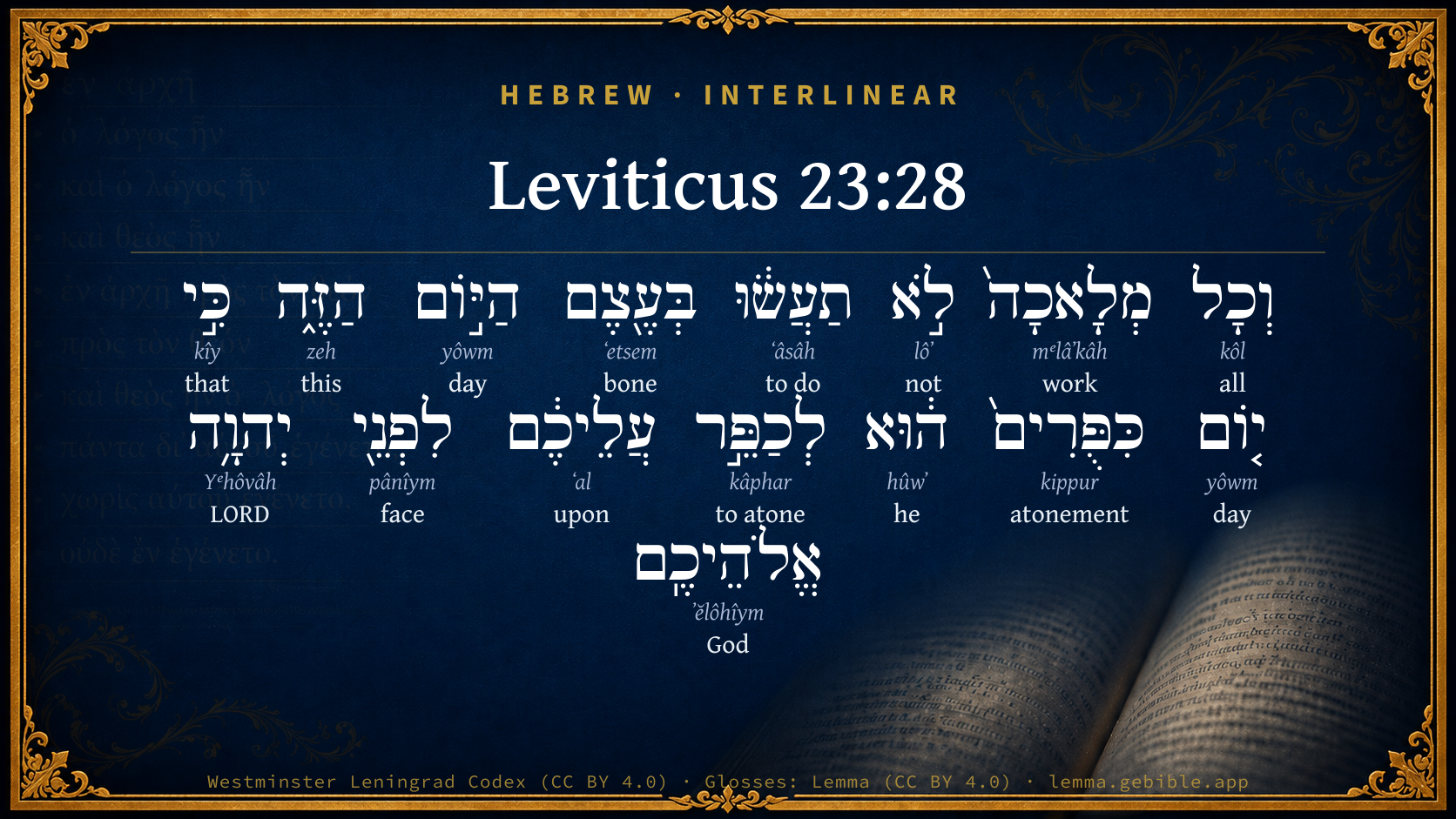
Leviticus 23:28

Hebrew (Westminster Leningrad Codex) Leviticus 23:28 appears in the Hebrew Old Testament. The text above is from the Westminster Leningrad Codex. Each word links to its Strong’s number, a concise gloss, and parsing drawn from the Open Scriptures Hebrew Bible morphology. Click any word for its full Brown-Driver-Briggs (BDB) entry.
Download image
Cite this verse

Leviticus 23:28 (World English Bible). Public Domain. Lemma interlinear Bible study tool, https://lemma.gebible.app/v/leviticus/23/28.

Show BibTeX & RIS
BibTeX
RIS
English Translation
You shall do no manner of work in that same day; for it is a day of atonement, to make atonement for you before Yahweh your God.
World English Bible · Public Domain
Download a study sheet

One document with this verse’s original text, its word-by-word gloss line, the meaning frame, cross-references with their text, attributed commentary, and full source and license credits — printable, and it pastes into notes with its structure intact.

This verse Autodidact and up

Study sheet (.html) Plain text (.txt)

A passage Seminary Student

Up to 50 verses in one chapter. A passage sheet keeps up to 6 commentary sources and 12 cross-references per verse, in the order this page ranks them, and says so on the sheet whenever that leaves anything out. Ask for a single verse and you get the Autodidact verse sheet above.

Everything on this page stays free to read, with no account — the sheet is a download of what is already on screen, not access to it.

Want to remove ads? Support Godless Engineer
Compare translations 3

The same verse in 3 English versions, stacked beneath the original-language interlinear above. Click any original word for its lexicon entry.

Each is an independent rendering of the whole verse — the interlinear is not word-aligned to these translations.

Highlighted words mark where these versions differ — a whole-verse word diff, not a word-by-word alignment.

  • World English Bible Public Domain
    You shall do no manner of work in that same day; for it is a day of atonement, to make atonement for you before Yahweh your God.
  • King James Version Public Domain
    And ye shall do no work in that same day: for it is a day of atonement, to make an atonement for you before the LORD your God.
  • unfoldingWord Literal Text CC BY-SA 4.0
    And you shall not do any work on this same day, for it a Day of Atonement, to make atonement for you to the face of Yahweh your God.

unfoldingWord Literal Text — © unfoldingWord, licensed CC BY-SA 4.0. Word-aligned USFM3 via Door43 (git.door43.org/unfoldingWord/en_ult).

Versions to compare (up to 4)

3 of 4 selected

Show all 18 translations

Every available English version of this verse, each an independent rendering of the whole verse.

  • World English Bible Public Domain
    You shall do no manner of work in that same day; for it is a day of atonement, to make atonement for you before Yahweh your God.
  • Berean Standard Bible Public Domain
    On this day you are not to do any work, for it is the Day of Atonement, when atonement is made for you before the LORD your God.
  • Majority Standard Bible Public Domain
    On this day you are not to do any work, for it is the Day of Atonement, when atonement is made for you before the LORD your God.
  • King James Version Public Domain
    And ye shall do no work in that same day: for it is a day of atonement, to make an atonement for you before the LORD your God.
  • American Standard Version (1901) Public Domain
    And ye shall do no manner of work in that same day; for it is a day of atonement, to make atonement for you before Jehovah your God.
  • Revised Version (1885) Public Domain
    And ye shall do no manner of work in that same day: for it is a day of atonement, to make atonement for you before the LORD your God.
  • Geneva Bible (1599) Public Domain
    And ye shall doe no worke that same day: for it is a day of reconciliation, to make an atonement for you before the Lord your God.
  • Douay-Rheims (1899) Public Domain
    You shall do no servile work in the time of this day: because it is a day of propitiation, that the Lord your God may be merciful unto you.
  • Young's Literal Translation Public Domain
    and ye do no work in this self-same day, for it is a day of atonements, to make atonement for you, before Jehovah your God.
  • Literal Standard Version CC BY-SA 4.0
    and you do no work in this very day, for it is a day of atonements, to make atonement for you, before your God YHWH.
  • Unlocked Literal Bible CC BY-SA 4.0
    You must do no work on that day because it is the Day of Atonement, to make atonement for yourselves before Yahweh your God.
  • unfoldingWord Literal Text CC BY-SA 4.0
    And you shall not do any work on this same day, for it a Day of Atonement, to make atonement for you to the face of Yahweh your God.
  • Darby Bible Public Domain
    And ye shall do no manner of work on that same day; for it is a day of atonement, to make atonement for you before Jehovah your God.
  • World Messianic Bible Public Domain
    You shall do no kind of work in that same day, for it is Yom Kippur, to make atonement for you before the LORD your God.
  • Webster's Bible Public Domain
    And ye shall do no work in that same day; for it is a day of atonement, to make an atonement for you before the LORD your God.
  • Free Bible Version CC BY-SA 4.0
    On this day you must not do any of your usual work because it is the Day of Atonement, when things are made right for you before the Lord your God.
  • Bible in Basic English Public Domain
    And on that day you may do no sort of work, for it is a day of taking away sin, to make you clean before the Lord your God.
  • JPS Tanakh (1917) Public Domain
    And ye shall do no manner of work in that same day; for it is a day of atonement, to make atonement for you before the LORD your God.

Literal Standard Version (2020), Covenant Press — licensed CC BY-SA 4.0. Text via the HelloAO Bible API (eBible.org). Unlocked Literal Bible (unfoldingWord) — licensed CC BY-SA 4.0. Text via the HelloAO Bible API (eBible.org). unfoldingWord Literal Text — © unfoldingWord, licensed CC BY-SA 4.0. Word-aligned USFM3 via Door43 (git.door43.org/unfoldingWord/en_ult). Free Bible Version, Dr. Jonathan Gallagher — licensed CC BY-SA 4.0. Text via the HelloAO Bible API (eBible.org).

Word by word

More ways to search: Search by grammar → Find every occurrence → Compare this word →

Practice this passage: Drill this verse → Learn its vocabulary →

כִּפֻּרִים֙
kippur
H3725
“atonement”
Noun, Common, Masculine, Plural, Absolute
Part of Speech
Noun
Type
Common
Gender
Masculine
Number
Plural
State
Absolute
Full BDB Definition

Origin: from H3722

TWOT: 1023b

atonement
  1. וְכָל kôl H3605 “and · all of” Conjunction + Noun, Common, Masculine, Singular, Construct
  2. מְלָאכָה֙ mᵉlâʼkâh H4399 “work” Noun, Common, Feminine, Singular, Absolute
  3. לֹ֣א lôʼ H3808 “not” Particle, Negative
  4. תַעֲשׂ֔וּ ʻâsâh H6213 “to do” Verb, Qal, Imperfect, 2nd Person, Masculine, Plural
  5. בְּעֶ֖צֶם ʻetsem H6106 “in/at · bone of” Preposition + Noun, Common, Feminine, Singular, Construct
  6. הַיּ֣וֹם yôwm H3117 “the · day” Particle, Definite Article + Noun, Common, Masculine, Singular, Absolute
  7. הַזֶּ֑ה zeh H2088 “the · this” Particle, Definite Article + Pronoun, Demonstrative, Masculine, Singular
  8. כִּ֣י kîy H3588 “that” Conjunction
  9. י֤וֹם yôwm H3117 “day of” Noun, Common, Masculine, Singular, Construct
  10. ה֔וּא hûwʼ H1931 “he” Pronoun, Personal, 3rd Person, Masculine, Singular
  11. לְכַפֵּ֣ר kâphar H3722 “to atone” Preposition + Verb, Piel, Infinitive Construct
  12. עֲלֵיכֶ֔ם ʻal H5921 “upon · you” Preposition + Suffix, Personal, 2nd Person, Masculine, Plural
  13. לִפְנֵ֖י pânîym H6440 “to/for · face(s) of” Preposition + Noun, Common, Both, Plural, Construct
  14. יְהוָ֥ה Yᵉhôvâh H3068 “LORD” Noun, Proper
  15. אֱלֹהֵיכֶֽם ʼĕlôhîym H430 “God(s) · your” Noun, Common, Masculine, Plural, Construct + Suffix, Personal, 2nd Person, Masculine, Plural

About this verse

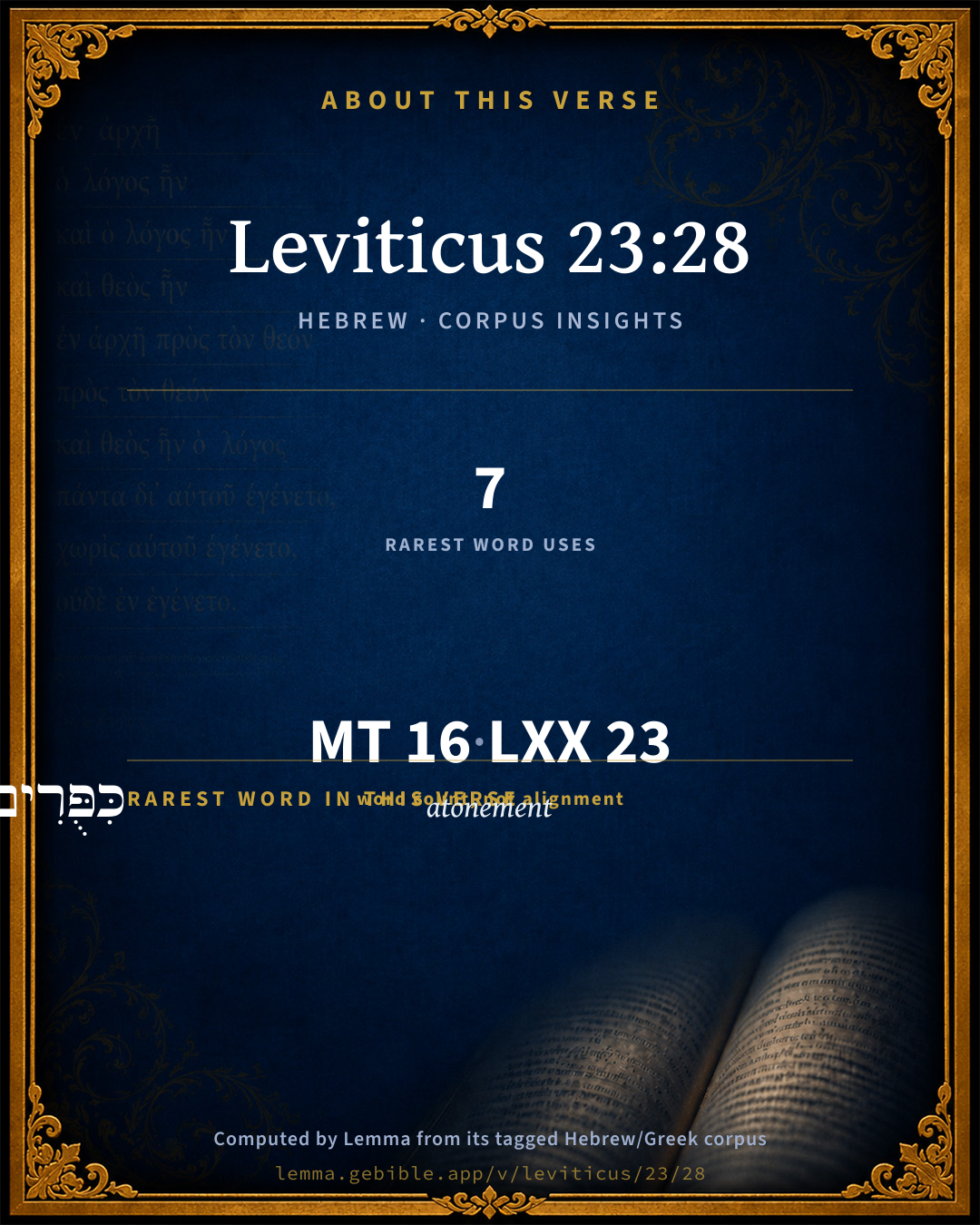
These counts appear in no published source. They are computed here, from the morphology-tagged text and Lemma’s own curated glosses. What Lemma adds →

16
words
15
distinct lemmas
Pentateuch
section

Notable vocabulary

The rarest word here is כִּפֻּרִים֙ atonement H3725 — appearing just 7 times in the whole Hebrew Bible.

Shared distinctive vocabulary

כִּפֻּרִים֙ atonement H3725 occurs in 7 verses of the Hebrew Bible. Also found in:

Grammatical profile

  • 2 verbs
  • 9 nouns
  • 2 pronouns
  • 1 preposition
  • 1 conjunction
  • 1 particle

Verb forms

  • תַעֲשׂ֔וּ Qal · Imperfect
  • לְכַפֵּ֣ר Piel · Infinitive Construct

Repetition

A word recurs within this verse — often emphatic in Hebrew:

  • הַיּ֣וֹם day H3117 ×2

Hebrew & Septuagint length

In English translation the verse runs 27 words from the Hebrew and 28 from the Septuagint (LXX English) — closely comparable.

A rough comparison of the two English renderings, which tokenize alike — not a word-level alignment.

Word counts can differ between the Hebrew and the Greek without any difference in meaning — e.g. the Hebrew direct-object marker אֵת has no separate Greek word, and Greek often adds the article ὁ.

In the original languages it is 16 Hebrew tokens and 23 Greek tokens — but the two are counted differently (Hebrew bundles its prefixes and suffixes into one token; the Greek is in lemma form), so that isn’t a like-for-like length.

Cross-references

12

Topical passages linked to Leviticus 23:28 in the Treasury of Scripture Knowledge — connected by theme and wording, ordered by reader-vote popularity; previews shown in the World English Bible.

  • Leviticus 16:34 "This shall be an everlasting statute for you, to make atonement for the children of Israel once in the year because of all their sins." It was done as Yahweh commanded Moses.
  • Zechariah 3:9 For, behold, the stone that I have set before Joshua; on one stone are seven eyes: behold, I will engrave the engraving of it,' says Yahweh of Hosts, 'and I will remove the iniquity of that land in one day.
  • Isaiah 53:10 Yet it pleased Yahweh to bruise him; he has put him to grief: when you shall make his soul an offering for sin, he shall see [his] seed, he shall prolong his days, and the pleasure of Yahweh shall prosper in his hand.
  • Daniel 9:24 Seventy weeks are decreed on your people and on your holy city, to finish disobedience, and to make an end of sins, and to make reconciliation for iniquity, and to bring in everlasting righteousness, and to seal up vision and prophecy, and to anoint the most holy.
  • Romans 5:10–11 For if, while we were enemies, we were reconciled to God through the death of his Son, much more, being reconciled, we will be saved by his life.
  • Hebrews 9:12 nor yet through the blood of goats and calves, but through his own blood, entered in once for all into the Holy Place, having obtained eternal redemption.
  • Hebrews 9:26 or else he must have suffered often since the foundation of the world. But now once at the end of the ages, he has been revealed to put away sin by the sacrifice of himself.
  • Hebrews 10:10 by which will we have been sanctified through the offering of the body of Jesus Christ once for all.
  • Hebrews 10:14 For by one offering he has perfected forever those who are being sanctified.
  • 1 John 2:2 And he is the atoning sacrifice for our sins, and not for ours only, but also for the whole world.
  • 1 John 4:10 In this is love, not that we loved God, but that he loved us, and sent his Son as the atoning sacrifice for our sins.
  • 1 John 5:6 This is he who came by water and blood, Jesus Christ; not with the water only, but with the water and the blood. It is the Spirit who testifies, because the Spirit is the truth.

Cross-references courtesy of OpenBible.info (CC BY 4.0).

Hebrew and Greek witnesses Masoretic Hebrew ↔ Greek Septuagint

The same verse in the two great witnesses to the Old Testament, shown verse-for-verse.

These are two independent witnesses, not word-aligned to each other, and the Septuagint is shown in lemma (dictionary) form.

Hebrew Leviticus 23:28 Masoretic · Westminster Leningrad Codex

וְכָל מְלָאכָה֙ לֹ֣א תַעֲשׂ֔וּ בְּעֶ֖צֶם הַיּ֣וֹם הַזֶּ֑ה כִּ֣י י֤וֹם כִּפֻּרִים֙ ה֔וּא לְכַפֵּ֣ר עֲלֵיכֶ֔ם לִפְנֵ֖י יְהוָ֥ה אֱלֹהֵיכֶֽם

You shall do no manner of work in that same day; for it is a day of atonement, to make atonement for you before Yahweh your God.

World English Bible · Public Domain

Greek LXX Leviticus 23:28 Septuagint · lemma form

πᾶς ἔργον οὐ ποιέω ἐν αὐτός ὁ ἡμέρα οὗτος εἰμί γάρ ἡμέρα ἐξιλασμός οὗτος σύ ἐκἱλάσκομαι περί σύ ἔναντι κύριος ὁ θεός σύ

You⌃ shall do no work on this self-same day: for this is a day of atonement for you, to make atonement for you before the Lord your God.

LXX2012 (modern English Septuagint) · Public Domain

Hebrew: Westminster Leningrad Codex (CC BY 4.0). Greek: Septuagint (public domain); English from LXX2012 (modern English Septuagint) (Public Domain). How the Septuagint differs from the Hebrew →

Targum (Aramaic paraphrase)

2

The Targum is the ancient Jewish Aramaic paraphrase of the Hebrew Scriptures — an interpretive translation, not the Hebrew text itself. Onkelos (literal) and Pseudo-Jonathan (expansive) render the Torah, and Jonathan the Prophets. Coverage is partial: where no permissively-licensed English translation exists for a verse, only the Aramaic is shown. This is verse-level text, not a word-by-word alignment to the Hebrew.

  1. Targum Onkelos Torah (Genesis–Deuteronomy)
    וְכָל עִבִידָא לָא תַעֲבְּדוּן בִּכְרַן יוֹמָא הָדֵין אֲרֵי יוֹמָא דְכִפּוּרַיָא הוּא לְכַפָּרָא עֲלֵיכוֹן קֳדָם יְיָ אֱלָהֲכוֹן

    (no public-domain English translation for this verse)

    Targum Onkelos — Aramaic: “Onkelos Genesis” (public domain); “Onkelos Exodus” (public domain); “Onkelos Leviticus” (public domain); “Onkelos Numbers” (public domain); “Onkelos Deuteronomy” (public domain). English: “Sefaria Community Translation” (CC0 1.0 (public-domain dedication)); “J.W. Etheridge. The Targums of Onkelos and Jonathan Ben Uzziel on the Pentateuch. London: Longmans, Green, 1862” (public domain). Text via Sefaria.

  2. Targum Pseudo-Jonathan Torah (Genesis–Deuteronomy)
    וְכָל עִיבִידָא לָא תַעַבְּדוּן בִּכְרַן יוֹמָא הָדֵין אֲרוּם יוֹמָא דְכִפּוּרַיָא הוּא לְכַפָּרָא עֲלֵיכוֹן קֳדָם יְיָ אֱלָהָכוֹן

    and do no work on this same day; for it is the Day of Atonement, to make atonement for you before the Lord your God.

    Targum Pseudo-Jonathan — Aramaic: “Targum Jonathan on Genesis” (public domain); “Targum Jonathan on Exodus” (public domain); “Targum Jonathan on Leviticus” (public domain); “Targum Jonathan on Numbers” (public domain); “Targum Jonathan on Deuteronomy” (public domain). English: “The Targum of Jonathan ben Uzziel, trans. J. W. Etheridge, London, 1862” (public domain). Text via Sefaria.

Commentary

Notes on Leviticus 23:28 from classic Christian and Jewish commentators (each source and its license shown beneath its notes). The classic Christian expositions comment on the surrounding passage and are grouped to its opening verse, so a note may address several verses; the Jewish commentaries on the Tanakh (Rashi and others) are per-verse, so they appear only where the commentator wrote on this verse.

Lemma curates 59 commentaries, every one of them public domain or Creative Commons licensed, each selected and text-cleaned for this edition rather than reprinted as found. About our sources →

Adam Clarke's Commentary

Verse 28. A day of atonement] See Clarke on Le 16:2, &c., where this subject is largely explained.

Adam Clarke's Commentary on the Bible (1810–1826) — public domain. Text from a community e-Sword/MySword module.

Ellicott's Commentary for English Readers

(28) And ye shall do no work.—Better, And ye shall do no manner of work, as the Authorised version has it in Lev_23:31 of this very chapter. (See Lev_16:29.) This is the only day which had to be kept like the sabbath, and on which no manner of work was allowed. (See Lev_23:3.)

To make an atonement for you.—See Lev_16:30.

A Bible Commentary for English Readers, edited by Charles John Ellicott (1878–1897) — public domain. Text from a community e-Sword module.

John Gill's Exposition

Ye shall do no work in that same day,.... No more than on the weekly sabbath:

for it is a day of atonement, to make atonement for you before the Lord your God: See Gill on Lev 16:30; Aben Ezra's note is,"for you only,''that is, for the Israelites, and not the Gentiles; but the atonement of Christ, the antitype of this, was not for the sins of the Jews only, but for the sins of the whole world, of all his people in it, Jo1 2:2.

John Gill's Exposition of the Whole Bible (1746–1763) — public domain (CC PDM 1.0). Text via the HelloAO Bible API.

Haydock's Catholic Bible Commentary

Servile is not in the original, or in the other versions, nor in the Vulgate, ver. 30; whence it is inferred, that this day of atonement was to be kept like the sabbath: so that even meat could not be made ready on it lawfully, chap. xvi. 29. (Calmet)

George Leo Haydock (1774–1849), Haydock's Catholic Family Bible and Commentary, 1859 edition — public domain. Excludes Psalms (Douay-Rheims chapter numbering differs from Protestant) and Deuterocanonical books (Catholic canon only).

John Wesley's Explanatory Notes

Whatsoever soul - Either of the Jewish nation, or religion. Hereby God would signify the absolute necessity which every man had of repentance and forgiveness of sin, and the desperate condition of all impenitent persons.

John Wesley, Explanatory Notes Upon the Whole Bible (1754–1765) — public domain. Text via the GEBible commentary corpus.

unfoldingWord translationNotes

Door43 World Missions Community

Connecting Statement:

Yahweh continues telling Moses what the people must do every year.

must be cut off from his people

Being excluded is spoken of as being cut off. See how you translated this idea in Leviticus 7:20. AT: "must be excluded from his people" or "you must separate that person from his people" (See: Metaphor and Active or Passive)

translationWords

works

cut off

unfoldingWord translationNotes — © Distant Shores Media and the Door43 World Missions Community, licensed CC BY-SA 4.0. Source: git.door43.org/Door43/en_tn.

Ramban (Nachmanides)

Rabbi Moshe ben Nachman (Ramban / Nachmanides)

B’ETZEM’ OF THIS DAY. The commentators. have said that the meaning of this phrase is “in this selfsame day.” Similarly, and ye shall eat neither bread, nor parched corn, nor fresh ears until ‘etzem’ this day means “until this selfsame day.” So also, ‘uch’etzem’ the heaven for clearness means “the very” heaven. But we cannot interpret that the word b’etzem here alludes to the essence and power of this day [which is at daytime], just as our Rabbis have said with reference to the verses: ‘b’etzem’ of this day entered Noah … into the ark [which the Rabbis interpreted to mean 332. that because the neighbors threatened to kill him and destroy the ark should they see him entering it, therefore G-d told him to enter it ‘b’etzem’ of this day — in broad daylight]; ‘b’etzem’ of this day the Eternal did bring the children of Israel out of the land of Egypt [which the Rabbis similarly interpreted 332. “in broad daylight,” because of the previous threats of the Egyptians not to let them go — such an interpretation we cannot assume here], for it is written, and ye shall afflict your souls, in the ninth day of the month at even, from even unto even. Similarly, And ye shall make proclamation ‘b’etzem’ of this day a holy assembly [stated with reference to the Festival of Weeks] includes the night as well. Now He did not mention this phrase ‘b’etzem’ of this day with reference to the Sabbath nor the festivals, except for the Festival of Weeks and the Day of Atonement, and so also in the prohibition of chadash (the new produce) at any time on the sixteenth day of Nisan at once rendered chadash (the new crop) permissible food. Since the destruction of the Sanctuary, the prohibition extends to the whole day of the sixteenth of Nisan (Rosh Hashanah 30 a-b; see also “The Commandments,” Vol. II, pp. 186-188). He said until ‘etzem’ of this day. The reason for this appears to be that since He had said of the Festival of Weeks, from the day that ye brought the sheaf of the waving … ye shall number fifty days, Verses 15-16. Thus one might think that the observance of the festival depends on the doing of the acts prescribed for it, whereas the real meaning is: “from the day that you are to bring” etc. irrespective of whether they can be brought or not, as when the Temple is destroyed. and then He stated, and ye shall present a new meal-offering … Ye shall bring out of your dwellings, Verses 16-17. etc., and dealt at length with the commandments of the offerings [in Verses 17-20], therefore it was necessary to state, And ye shall make proclamation ‘b’etzem’ of this day a solemn assembly; meaning that the very day is holy and the doing of work is forbidden on it, and it is not dependent upon the sheaf [of the waving brought on the second day of Passover], nor on the offerings. Similarly in the case of the Day of Atonement, since He had said, and ye shall afflict your souls, and ye shall bring an offering made by fire unto the Eternal, Verse 27. and in the section of Acharei Moth He made the [complete] expiation dependent upon the offerings and on the goat sent [to Azazel], Verse 22. therefore it was necessary to state here, And ye shall do no manner of work on that very day, for it is a day of atonement in itself to make atonement for you, besides the expiation effected by the offerings. Similarly, until ‘etzem’ of this day said in connection with the new produce [means that the prohibition of eating from the new produce continues] up to that very day, which is the day ye have brought the offering of your G-d, thus stating that even if the [meal-] offering [of the new barley] has not been brought, the commandment applies to that very day — so that the new produce at any time on the sixteenth day of Nisan at once rendered chadash (the new crop) permissible food. Since the destruction of the Sanctuary, the prohibition extends to the whole day of the sixteenth of Nisan (Rosh Hashanah 30 a-b; see also “The Commandments,” Vol. II, pp. 186-188). is forbidden before that day and is permissible afterwards. This is the sense of His saying, it is a statute forever throughout your generations in all your dwellings, as I have explained. We further find that Scripture mentions this phrase ‘b’etzem’ of this day in the case of events which have been decreed to come at certain set times. Thus it says of Noah, ‘b’etzem’ of this day entered Noah etc.; [and in case of the exodus it says,] And it came to pass ‘b’etzem’ of this day that all the hosts of the Eternal went out from the land of Egypt; [and when Moses was ordered to ascend Mount Nebo it says,] And the Eternal spoke unto Moses ‘b’etzem’ of that day, saying: ‘Get thee up into this mountain of Abarim, unto Mount Nebo.’ The reason for this expression in these [three] cases is that it is possible to think that Noah had brought into the ark beforehand many of the beasts and fowls [and on the selfsame day that he finished bringing them into the ark, he himself came in]; likewise it is possible [to think] that some Israelites had left Egypt before that time and on that day the exodus was completed, and so also that the command for Moses our teacher’s ascension was given before that day, and on that day he actually went up. Therefore Scripture explained in all these [three] cases that [the particular events referred to in the verses] all took place on these selfsame days, not that they were started before and finished on those days, but they all happened [completely] on these very days. Similarly, ‘b’etzem’ of this day was Abraham circumcised, means that many people were circumcised in one day, the verse thus stating Abraham’s zeal in observing the commandments.It further appears to me that the expression “the etzem” of any thing means “its power and strength,” the term being derived from the verses: my power ‘v’otzem’ (and the might) of my hand; strength ‘v’tha’atzumoth’ (and power). So also, One dieth ‘b’etzem tumo’ means “in the fulness of his strength.” And since the bones form the structure of the body and its strength, they are so called [atzamoth — from the word otzem, strength]. Thus ‘k’etzem’ the heaven for clearness means that the purity of that which they saw [at Mount Sinai] was clear and strong, even as is a pure clear heaven. It is for this reason that He mentions about those specific days [of festivals referred to above] the expression etzem hayom, in order to indicate that these matters specified are of the very essence of the days, not because of other things added to them, namely the offerings brought on those days.And so also did Onkelos translate [the word etzem as] “bikran of that day,” which [literally] means “‘in the horn’ of that day,” [i.e.,] in its essence and in its strength, the word bikran being related to these expressions: and all ‘karnei’ (the horns) of the wicked will I cut off; my shield ‘v’keren’ (and the horn of) my salvation; for since the strength [of the animal] is in its horns, therefore the substance of a thing is called karno [“its horn” — its strength or essence]. In the language of the Sages we find: “He pays the keren (the principal value) but he does not pay the [added] fifth.” And some texts of Onkelos have bichran [with a chaph instead of bikran with a kuph], but it is all one, for in Scripture kova and chova both mean hat, ); 17:5 (chova). See Vol. I, p. 506, where Ramban mentions this princuple briefly, that the kuph and the kaph (or chaph) are often interchangeable. and the Sages always make use of the term akava written with a kaph [meaning “staying”], which is derived from the expression, ‘v’lo y’akveim’ [written with a kuph, and meaning: and He stayeth them not] when His voice is heard. The Rabbis also say mithkasheit [with a kuph] from the word tachshitin [with a chaph, meaning “ornaments”]. They further say: “If ants kors’muha” [with a kuph, meaning “nibbled” the crop], of the root: the boar out of the wood ‘y’chars’menah’ [with a chaph, meaning: doth ravage it]. And those other places where the expression ‘b’etzem’ of this day is mentioned also mean: “in the strength of that day,” for they were matters which in the normal course of events could not happen in one day. Therefore Scripture stated that all the beasts and all the cattle and all the fowl and all creeping things upon the earth were gathered by “the power” of that day, by the decree of G-d upon them, for it was His mouth that commanded and the breath thereof it hath gathered them. Similarly, six hundred thousand men on foot, beside children cannot be gathered together and go out as one man from the land of Egypt [all in one day], only by the strength of the day which was so decreed upon it by word of the Supreme One. And so also in the case of Moses our teacher, this expression [‘b’etzem’ of this day] is intended to teach that on the day he was commanded to write this song, and teach it the children of Israel, put it in their mouths, and he finished speaking all these words, 32:45. it was decreed upon him that he go up by the power of that day in which the Divine decree was given, to Mount Abarim, and then he said the section of ‘V’zoth Habrachah’ (And this is the blessing), Chapter 33. and afterwards he went up to the mountain — all these activities being matters which would usually take many days, but they were all done by the power and strength of the day. Similarly, that three hundred and twenty men should be circumcised in one day in the house of Abraham was a thing that proceeded from G-d. Now the prophet Ezekiel said, they and their fathers have transgressed against Me, to ‘etzem’ this day, in order to include that very day in this group. So also the expression until ‘etzem’ of this day of the prohibition of the new produce, means “until and inclusive of this day” [i.e., on the sixteenth of Nisan it is also forbidden to eat of the new produce, before the bringing of the meal-offering of the new barley], for the essence of a thing is its power and strength.And our Rabbis have interpreted the expression ‘b’etzem’ of this day used in connection with the festivals, to mean 14:7. “on the day itself,” that is to say, from the time the stars appear until they come out on the following night, thus excluding the additional time which the Sages have deduced must be added from profane unto holy [i.e., before the actual beginning of the festival, and after its actual end]. And in the cases of Noah, and the exodus from Egypt, and Moses’ [death], they interpreted that phrase to mean “in the strength of the day,” [that is] mid-day, as is stated in the Sifre, 332. and Rashi wrote it in the section of Ha’azinu.

Ramban (Nachmanides) on the Tanakh — English translation: “Commentary on the Torah by Ramban (Nachmanides). Translated and annotated by Charles B. Chavel. New York, Shilo Pub. House, 1971-1976” (CC BY 4.0). Text via Sefaria.

Lesson kit

Teaching starters — assembled from the data on this page, not authored interpretation. Every prompt links to the verse data it draws on. Edit before teaching.

Leviticus, in the Pentateuch, opens this verse with 16 words (15 distinct Hebrew lemmas). Its most distinctive word is kippur (“atonement”). A historical commentator’s framing appears above. Read the whole chapter for the surrounding context.

Discussion questions

  1. What does “atonement” (kippur) contribute to the verse as a whole?
  2. How does Exodus 29:36, which shares the word «atonement», read alongside this verse?
  3. What does the repetition of “day” (2× in this one verse) do in this verse?
  4. These translations render this verse differently; the difference is in the English rendering, not the original. What questions does that raise?
  5. «תַעֲשׂ֔וּ» is a Qal Imperfect verb. How does that grammatical form shape the action described?
  6. Compare how Adam Clarke's Commentary and Ellicott's Commentary for English Readers read this verse. Where do they agree or differ?

Things to notice

Reading settings

Reading text

Shown beneath each verse's original-language words.

Old Testament
Old Testament edition

Read the OT as the Masoretic Hebrew (MT) or the Greek Septuagint (LXX).

English shown for the Greek Septuagint (in the Hebrew ↔ Greek comparison).

Comparing translations? Open the Compare panel on any verse page to stack up to four side by side.