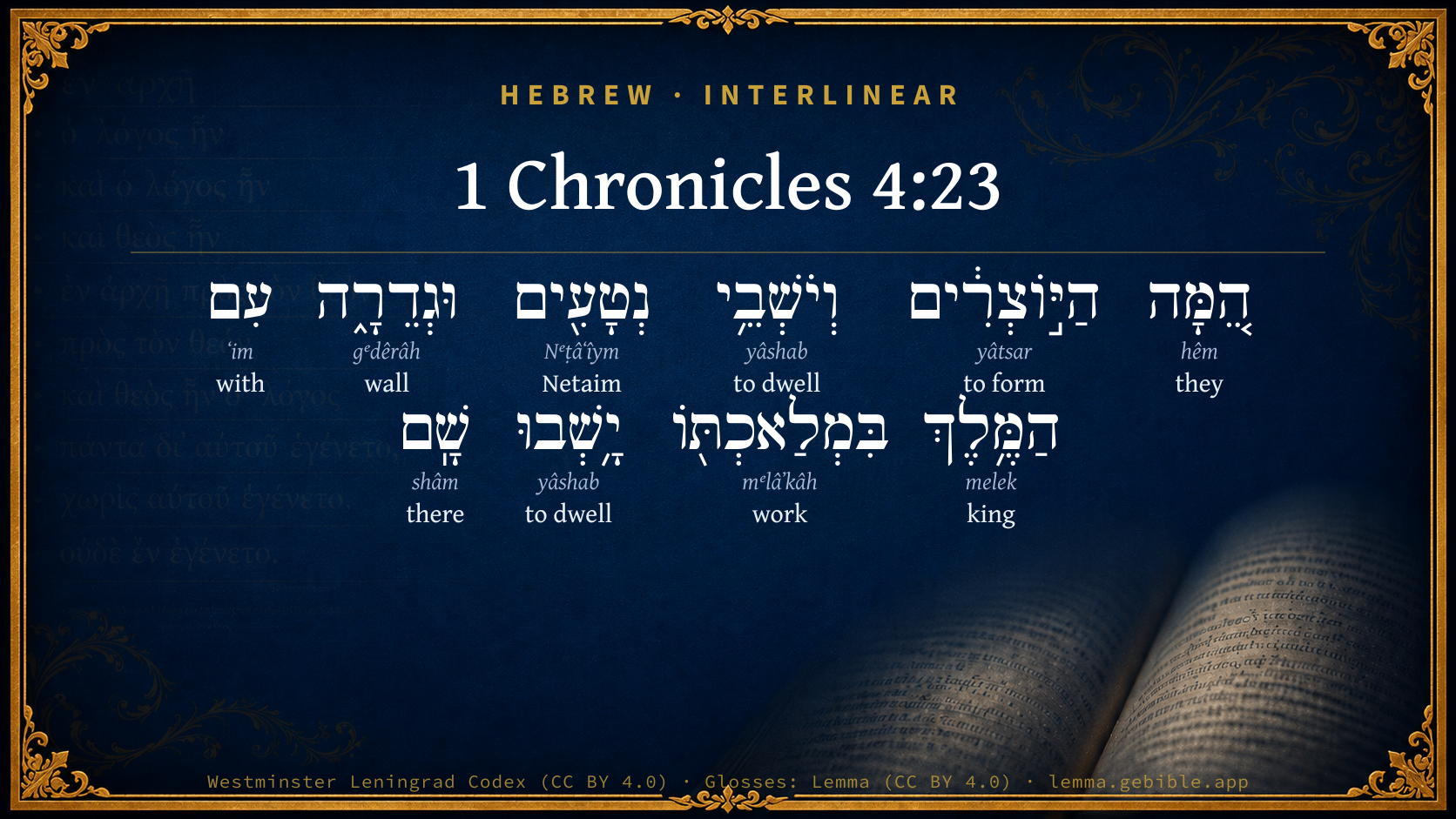
1 Chronicles 4:23

Hebrew (Westminster Leningrad Codex) 1 Chronicles 4:23 appears in the Hebrew Old Testament. The text above is from the Westminster Leningrad Codex. Each word links to its Strong’s number, a concise gloss, and parsing drawn from the Open Scriptures Hebrew Bible morphology. Click any word for its full Brown-Driver-Briggs (BDB) entry.
Download image
Cite this verse

1 Chronicles 4:23 (World English Bible). Public Domain. Lemma interlinear Bible study tool, https://lemma.gebible.app/v/1-chronicles/4/23.

Show BibTeX & RIS
BibTeX
RIS
English Translation
These were the potters, and the inhabitants of Netaim and Gederah: there they lived with the king for his work.
World English Bible · Public Domain
Highlights
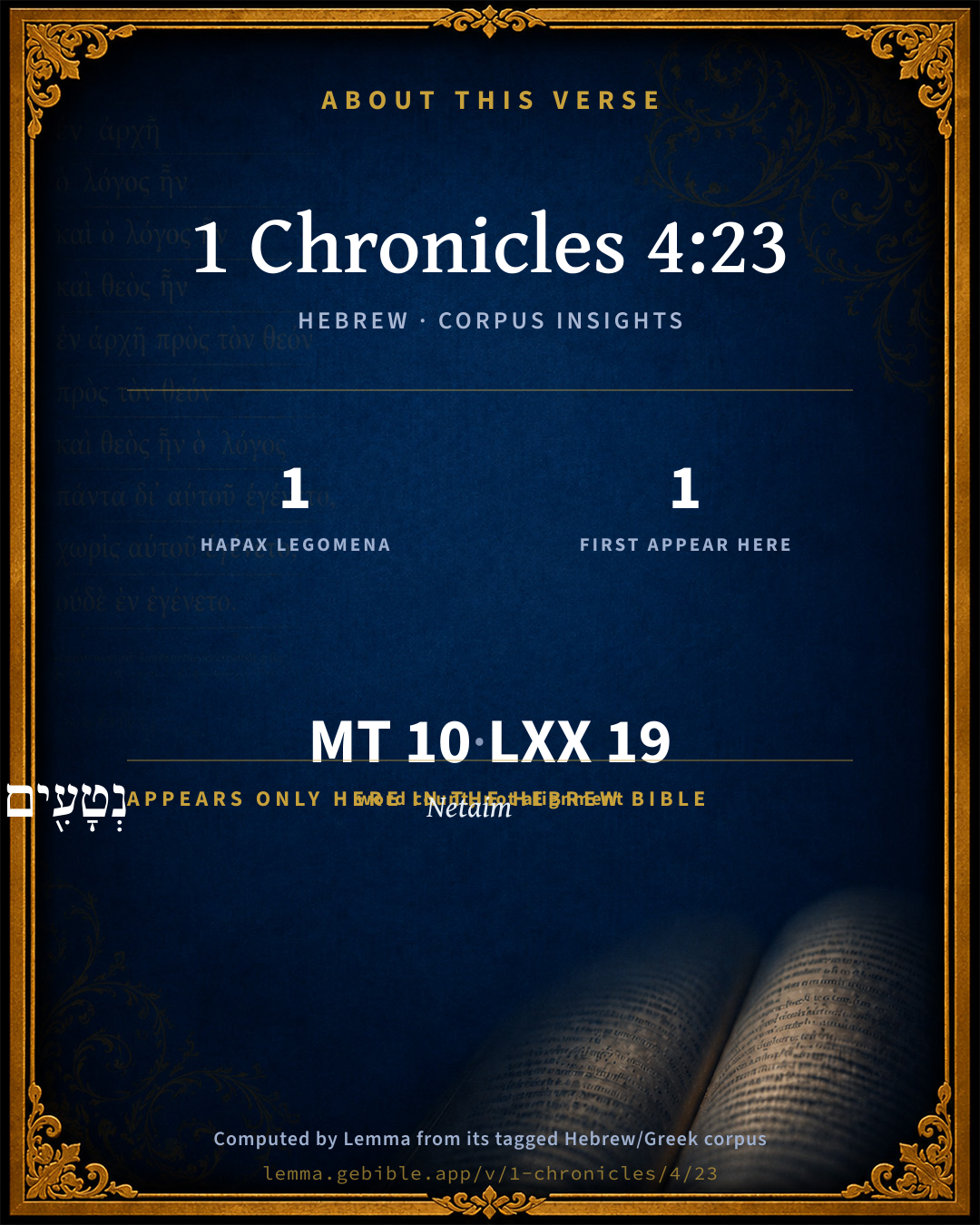
  • 1 hapax legomenon — only here in the Hebrew Bible
  • 1 first appearance in the Hebrew Bible
Full analysis ↓
Download a study sheet

One document with this verse’s original text, its word-by-word gloss line, the meaning frame, cross-references with their text, attributed commentary, and full source and license credits — printable, and it pastes into notes with its structure intact.

This verse Autodidact and up

Study sheet (.html) Plain text (.txt)

A passage Seminary Student

Up to 50 verses in one chapter. A passage sheet keeps up to 6 commentary sources and 12 cross-references per verse, in the order this page ranks them, and says so on the sheet whenever that leaves anything out. Ask for a single verse and you get the Autodidact verse sheet above.

Everything on this page stays free to read, with no account — the sheet is a download of what is already on screen, not access to it.

Want to remove ads? Support Godless Engineer
Compare translations 3

The same verse in 3 English versions, stacked beneath the original-language interlinear above. Click any original word for its lexicon entry.

Each is an independent rendering of the whole verse — the interlinear is not word-aligned to these translations.

Highlighted words mark where these versions differ — a whole-verse word diff, not a word-by-word alignment.

  • World English Bible Public Domain
    These were the potters, and the inhabitants of Netaim and Gederah: there they lived with the king for his work.
  • King James Version Public Domain
    These were the potters, and those that dwelt among plants and hedges: there they dwelt with the king for his work.
  • unfoldingWord Literal Text CC BY-SA 4.0
    These the potters and the dwellers of Netaim and Gederah. They dwelled there with the king in his work.

unfoldingWord Literal Text — © unfoldingWord, licensed CC BY-SA 4.0. Word-aligned USFM3 via Door43 (git.door43.org/unfoldingWord/en_ult).

Versions to compare (up to 4)

3 of 4 selected

Show all 18 translations

Every available English version of this verse, each an independent rendering of the whole verse.

  • World English Bible Public Domain
    These were the potters, and the inhabitants of Netaim and Gederah: there they lived with the king for his work.
  • Berean Standard Bible Public Domain
    These were the potters who lived at Netaim and Gederah. They lived there in the service of the king.
  • Majority Standard Bible Public Domain
    These were the potters who lived at Netaim and Gederah. They lived there in the service of the king.
  • King James Version Public Domain
    These were the potters, and those that dwelt among plants and hedges: there they dwelt with the king for his work.
  • American Standard Version (1901) Public Domain
    These were the potters, and the inhabitants of Netaim and Gederah: there they dwelt with the king for his work.
  • Revised Version (1885) Public Domain
    These were the potters, and the inhabitants of Netaim and Gederah: there they dwelt with the king for his work.
  • Geneva Bible (1599) Public Domain
    These were potters, and dwelt among plants and hedges: there they dwelt with the king for his worke.
  • Douay-Rheims (1899) Public Domain
    These are the potters, and they dwelt in Plantations, and Hedges, with the king for his works, and they abode there.
  • Young's Literal Translation Public Domain
    They `are' the potters and inhabitants of Netaim and Gedera; with the king in his work they dwelt there.
  • Literal Standard Version CC BY-SA 4.0
    They [are] the potters and inhabitants of Netaim and Gedera; they dwelt there with the king in his work.
  • Unlocked Literal Bible CC BY-SA 4.0
    These were the potters who lived in Netaim and Gederah and worked for the king.
  • unfoldingWord Literal Text CC BY-SA 4.0
    These the potters and the dwellers of Netaim and Gederah. They dwelled there with the king in his work.
  • Darby Bible Public Domain
    These were the potters, and those that abode among plantations and enclosures: there they dwelt with the king for his work.
  • World Messianic Bible Public Domain
    These were the potters, and the inhabitants of Netaim and Gederah; they lived there with the king for his work.
  • Webster's Bible Public Domain
    These were the potters, and those that dwelt among plants and hedges: there they dwelt with the king for his work.
  • Free Bible Version CC BY-SA 4.0
    They were potters, inhabitants of Netaim and Gederah, who lived there and worked for the king.
  • Bible in Basic English Public Domain
    These were the potters, and the people living among planted fields with walls round them; they were there to do the king's work.
  • JPS Tanakh (1917) Public Domain
    These were the potters, and those that dwelt among plantations and hedges; there they dwelt occupied in the king's work.

Literal Standard Version (2020), Covenant Press — licensed CC BY-SA 4.0. Text via the HelloAO Bible API (eBible.org). Unlocked Literal Bible (unfoldingWord) — licensed CC BY-SA 4.0. Text via the HelloAO Bible API (eBible.org). unfoldingWord Literal Text — © unfoldingWord, licensed CC BY-SA 4.0. Word-aligned USFM3 via Door43 (git.door43.org/unfoldingWord/en_ult). Free Bible Version, Dr. Jonathan Gallagher — licensed CC BY-SA 4.0. Text via the HelloAO Bible API (eBible.org).

Word by word

More ways to search: Search by grammar → Find every occurrence → Compare this word →

Practice this passage: Drill this verse → Learn its vocabulary →

About this verse

These counts appear in no published source. They are computed here, from the morphology-tagged text and Lemma’s own curated glosses. What Lemma adds →

10
words
9
distinct lemmas
Historical
section

Notable vocabulary

1 hapax legomenon — a word that appears only here in the entire Hebrew Bible:

  • נְטָעִ֖ים Netaim H5196

First appearance in Scripture

This word makes its first canonical appearance in the Hebrew Bible here:

  • נְטָעִ֖ים Netaim H5196

Shared distinctive vocabulary

וּגְדֵרָ֑ה wall H1448 occurs in 11 verses of the Hebrew Bible. Also found in:

Grammatical profile

  • 3 verbs
  • 4 nouns
  • 1 pronoun
  • 1 preposition
  • 1 adverb

Verb forms

  • הַיּ֣וֹצְרִ֔ים Qal · Participle Active
  • וְיֹשְׁבֵ֥י Qal · Participle Active
  • יָ֥שְׁבוּ Qal · Perfect

Repetition

A word recurs within this verse — often emphatic in Hebrew:

  • וְיֹשְׁבֵ֥י to dwell H3427 ×2

Hebrew & Septuagint length

In English translation the verse runs 20 words from the Hebrew and 22 from the Septuagint (LXX English) — closely comparable.

A rough comparison of the two English renderings, which tokenize alike — not a word-level alignment.

Word counts can differ between the Hebrew and the Greek without any difference in meaning — e.g. the Hebrew direct-object marker אֵת has no separate Greek word, and Greek often adds the article ὁ.

In the original languages it is 10 Hebrew tokens and 19 Greek tokens — but the two are counted differently (Hebrew bundles its prefixes and suffixes into one token; the Greek is in lemma form), so that isn’t a like-for-like length.

Cross-references

1

Topical passages linked to 1 Chronicles 4:23 in the Treasury of Scripture Knowledge — connected by theme and wording, ordered by reader-vote popularity; previews shown in the World English Bible.

  • Psalms 81:6 "I removed his shoulder from the burden. His hands were freed from the basket.

Cross-references courtesy of OpenBible.info (CC BY 4.0).

Hebrew and Greek witnesses Masoretic Hebrew ↔ Greek Septuagint

The same verse in the two great witnesses to the Old Testament, shown verse-for-verse.

These are two independent witnesses, not word-aligned to each other, and the Septuagint is shown in lemma (dictionary) form.

Hebrew 1 Chronicles 4:23 Masoretic · Westminster Leningrad Codex

הֵ֚מָּה הַיּ֣וֹצְרִ֔ים וְיֹשְׁבֵ֥י נְטָעִ֖ים וּגְדֵרָ֑ה עִם הַמֶּ֥לֶךְ בִּמְלַאכְתּ֖וֹ יָ֥שְׁבוּ שָֽׁם

These were the potters, and the inhabitants of Netaim and Gederah: there they lived with the king for his work.

World English Bible · Public Domain

Greek LXX 1 Chronicles 4:23 Septuagint · lemma form

οὗτος κεραμεύς ὁ καταοἰκέω ἐν ναταϊμ καί γαδηρα μετά ὁ βασιλεύς ἐν ὁ βασιλεία αὐτός ἐνἰσχύω καί καταοἰκέω ἐκεῖ

These are the potters who lived in Ataim and Gadira with the king: they grew strong in his kingdom, and lived there.

LXX2012 (modern English Septuagint) · Public Domain

On this verse, The Cambridge Bible for Schools and Colleges discusses the Septuagint’s reading. Read the note in Commentary ↓

Hebrew: Westminster Leningrad Codex (CC BY 4.0). Greek: Septuagint (public domain); English from LXX2012 (modern English Septuagint) (Public Domain). How the Septuagint differs from the Hebrew →

Commentary

Notes on 1 Chronicles 4:23 from classic Christian and Jewish commentators (each source and its license shown beneath its notes). The classic Christian expositions comment on the surrounding passage and are grouped to its opening verse, so a note may address several verses; the Jewish commentaries on the Tanakh (Rashi and others) are per-verse, so they appear only where the commentator wrote on this verse.

Lemma curates 59 commentaries, every one of them public domain or Creative Commons licensed, each selected and text-cleaned for this edition rather than reprinted as found. About our sources →

Trapp's Complete Commentary

John Trapp

1Ch 4:23 These [were] the potters, and those that dwelt among plants and hedges: there they dwelt with the king for his work.

Ver. 23. Those that dwelt among plants and hedges.] Hedge rogues, Mr Dyke {a} calleth them: the base brood of their degenerated forefathers, saith another; poor-spirited men; not like that late learned martyr, who in his banishment or flight for conscience, served the mason; nor like Musculus, forced to dig in the town ditch one while for a poor livelihood; but such as choose rather to abide under the hedges of Babylon, and there to plant gardens, make fences and flower pots for the king of Babylon, than to return to their own country, though Cyrus had proclaimed liberty for them so to do.

There they dwelt.] Or, Remained, namely, in Babylon, in the service of the king of that place, being miserable by their own election. These are res obsoletae, things worn out and forgotten; and indeed they deserve to be forgotten. For such the Church prayeth, {Psa 126:4} "Turn again our captivity, O Lord, as the streams in the south." Piscator gathereth from this text, that Ezra wrote this book after the return from Babylon.

{a} Serm. on John v.

John Trapp, A Commentary or Exposition upon All the Books of the Old and New Testament (1647–1656) — public domain. Text from a community e-Sword module.

The Biblical Illustrator

Joseph S. Exell

1Ch_4:23

There they dwelt with the king for his work.

With the King for His work

(A motto for Sunday school teachers.) Work done well, however common, is accounted worthy of its wage, but work done for royalty generally has some special attraction to commend it. Such a man is privileged by appointment to be purveyor of this or that to her Majesty the Queen; and he takes good care to let us know it. It is published in his shop window. It is painted on his sign over the door. He is, By appointment to the Queen. Royalty seems to dignify him. Looking at my text I see three or four observations springing from it.

I. Our King has many kinds of servants.

1. Soldiers. It is their duty to contend earnestly for the faith once delivered to the saints.

2. Watchmen.

3. Heralds.

4. Scribes.

5. Musicians.

6. Potters.

These may supply a very good emblem of Sunday school teachers. The potters take the clay while it is pliable and soft, and put it on the wheel and make the wheel revolve, and then with thumb and finger fashion the clay as it revolves before them. If ever at any time the human mind is plastic it is while the child is young.

7. Gardeners.

This is just what a Sunday school teacher should be. He tries to get the plants out from the wild waste and bring them into the garden walled around. He knows that the Church is the garden of the Lord and he longs to plant many little slips in it.

II. All who live with our King must work. I have thought that some of our Church members imagined that the cause of Christ was a coach, and that they were to ride on it, and that they would prefer the box-seat, or else a very comfortable seat in the middle of the coach. But all who live with our King must work.

1. Because He works.

2. Because His company always inspires us with the desire to do something for Him.

3. Because there is so much to do that you cannot help doing something.

III. Those that work for our King ought to live with Him.

1. That they may gather strength. In the old fable, when Hercules fought with the giant he could not kill him. He flung him down with all his might, but every time the giant got up stronger than before. The old fable said that the earth was the giants mother, and every time that he fell he touched her and got new strength from her. So every time a Christian falls on his knees--draws near to God--he gets new strength.

2. To keep up their enthusiasm.

3. That they may be inspired with courage.

4. If they would cultivate the soft grace of patience.

IV. That which should reconcile us to any work is, that we are working for the King. (C. H. Spurgeon.)

Certain members of the royal household

It is a matter of very common occurrence in this world, in forming our estimates of men and things, to ignore altogether the real and constant contributors to success, and to look only at him or them who represent the success. The commander of an ocean steamer is the person whose name is printed, who meets the public eye, and possesses the public confidence; the men who sweat and pant down deep in the ship before the hot and roaring fires, the men who climb the icy rigging, who with stiffening limbs battle with the frozen sails, and watch hour after hour amid cold and darkness for danger, are never thought of. We see the victorious leader of armies surrounded in the hour of triumph by a brilliant staff, while multitudes shout and cheer. How few ever think at such a time of the thousands of silent graves where men lie who paid the costly price of life for this hour of their leaders triumph! Because the world judges usually in this way the strong contrast of the text strikes us. The royal household is not alone the king with his victorious generals and stately nobles, but the potters and the dwellers or workers among plants and hedges. Our text teaches us--

I. That none are ignored, despised, or forgotten in the royal household of our King because of the apparent insignificance of the position they fill. The work of the Church analagous to that of the potters and hedgers is not in favour. Only a few are willing to do the humble and necessary work of the Church.

II. That the recognition of the value of labour of the humble workers is just as sure, and reward just as certain, as of that which is most prominent. In the service of the King of kings there is no respecting of persons. It is not the position but the work accomplished that obtains consideration from Him. The name of Luther, or even of Paul, is of no account before Him, nor the office of reformer or apostle, only as meaning mighty labour accomplished in and for the Church. The Hudson may be of far more importance to the country because of its deeper channel, broader bosom, than a little brook that meanders through the meadows of some country valley. One is a broad highway, bearing much of the commerce of great States; the other gives grass to the meadows, drink to cattle, and beauty to the landscape; but surely the Hudson is entitled to no more praise for being what it is than the brook for being what it is. No occupation that is right, however mean, can debar us from dwelling with our Lord. We see constantly earthern pots, of very little value in themselves, crowned with the sweetest, the most beautiful, the rarest flowers and plants. Cheap as the red clay is, it is about the only material that could be used. One great value is its cheapness; another is, that plants, with a singular want of taste, would refuse to flourish in pots of silver or gold; their very density and want of porosity render them nearly valueless for this purpose. Just so the very humbleness of work renders some peculiarly fitted to do it. Conclusion:

1. Here we have encouragement for all the Lords workers, in

(1) the satisfaction connected with the doing;

(2) in the present beneficent results of the work;

(3) in the certain future reward.

2. Here we may find reason for warm sympathy with all the workers of our King. (Henry W. F. Jones.)

Working for the King

I. How work links men to kings. There are many wrong ideas in the world about labour. Not a few people try to bring up their children without it, and you will see a man toil early and late to make money, getting no enjoyment out of it himself, and when you get at the reason it is that he may make his son a gentleman, which means, someone who can live without work. This is not according to the Divine idea: My Father worketh hitherto, and I work. It was not for nothing that Christ toiled at the carpenters bench. If you were to take out of the Bible all the stories of men who worked for their living, you would rob it of its greatest beauty. The men and women who work, whether with brain or hand, or both, are the people who save a nation from ruin. What is a mans religion worth if it does not teach him to labour? Are we not to work out our own salvation, and that for the best of reasons, It is God that worketh in us. The sunshine and the rain are useless to the fields that have not been tilled. He who has no plough needs not to trouble to sharpen his scythe. Bibles and sermons to the idle are not, cannot be, appreciated, and Sabbaths are but a weariness to the man who does no kind of Christian work. Do not mistake yourself for a Christian because you like some popular preacher; it is on the same principle that wasps like honey, but they will rather starve than make it. You would not have heard of these men if they had not worked. Their toil has bound up their life with the kings life. Why should you not act so that the story of God cannot be fully told without your name being mentioned?

II. Kings need different kinds of workers. There is a sense in which God needs us and cannot carry out His plans without us. Whatever your talent there is room for you. Not only genius, but dogged drudgery. We want the artist to paint the picture, and the workman to frame it; the author to write the book, and the printer to give it to the world. How true it is that no one man can do all that needs to be done, even with his own gifts. Does the gardener wish to send in a choice rose he has just cut? Does he wish his rose to stand on the kings table? Then he must have the help of the potter. He must have one of his vases. (Thomas Champness.)

The Biblical Illustrator, edited by Joseph S. Exell (c. 1880s–1900s) — public domain. Text from a community e-Sword module.

MacLaren's Expositions of Holy Scripture

Alexander MacLaren

1 Chronicles

THE KING’S POTTERS

1Ch 4:23.

In these dry lists of names which abound in Chronicles, we now and then come across points of interest, oases in the desert, which need but to be pondered sympathetically to yield interesting suggestions. Here for example, buried in a dreary genealogical table, is a little touch which repays meditating on. Among the members of the tribe of Judah were a hereditary caste of potters who lived in ‘Netaim and Gederah,’ if we adhere to the Revised Version’s text, or ‘among plantations and hedges’ if we prefer the margin. But they are also described as dwelling ‘with the king.’ That can only mean on the royal estates, for the king himself resided in Jerusalem. He, however, held large domains in the territory of Judah, on some of which these ceramic artists were settled down and followed their calling. They were kept on the royal estates and kept in comfort, not needing to till, but fed and cared for, that they might be free to mould, out of common clay, forms of beauty and ‘vessels meet for the master’s use.’ Surely we may read into the brief statement of the text a meaning of which the writer of it never dreamt, and see in the description of these forgotten artisans, a symbol of our Christian relations to our Lord and of our life’s work.

I. We, too, dwell with the King.

The Davidic king was in Jerusalem, and the potters were ‘among plantations and hedges,’ yet in a real sense they ‘dwelt with the king,’ though some of them might never have seen his face or trod the streets of the sacred city. Perhaps now and then he came to visit them on his outlying domains, but they were always parts of his household. And have we, Christ’s servants, not His gracious parting word: ‘I am with you always’? True, we are not beside Him in the great city, but He is beside us in His outlying domains, and we may be with Him in His glory, if while we still outwardly live among the ‘plantations and hedges’ of this life, we dwell in spirit, by faith and aspiration, with our risen and ascended Lord. If we so ‘dwell with the King,’ He will dwell with us, and fill our humble abode with the radiance of His presence, ‘making that place of His feet glorious.’ That He should be with us is supreme condescension, that we should be with Him is the perfection of exaltation. How low He stoops, how high we can rise! The vigour of our Christian life largely depends on our keeping vivid the consciousness of our communion with Jesus and the sense of His real presence with us. How life’s burdens would be lightened if we faced them all in the strength of the felt nearness of our Lord! How impossible it would be that we should ever feel the dreary sense of solitude, if we felt that unseen, but most real, Presence wrapping us round! It is only when our faith in it has fallen asleep that any earthly good allures, or any earthly evil frightens us. To be sure, in our thrilling consciousness, that we dwell with Jesus is an impenetrable cuirass that blunts the points of all arrows and keeps the breast that wears it unwounded in the fray. The world has no voices which can make themselves heard above that low sovereign whisper: ‘I am with you always, even to the end of the world’-and after the end has come, then we shall be with Him.

But we find in this notice a hint that leads us in yet another direction. They ‘dwelt with the king’ in the sense that they were housed and cared for on his lands. And in like manner, the true conception of the Christian life is that each of us is ‘a sojourner with Thee,’ set down on Christ’s domains, and looked after by Him in regard to provision for outward wants. We have nothing in property, but all is His and held by His gift and to be used for Him. The slave owns nothing. The patch of ground which he cultivates for his food and what grows on it, are his master’ s. These workmen were not slaves, but they were not owners either. And we hold nothing as our own, if we are true to the terms on which it is given us to hold.

So if we rightly appreciate our position as dwelling on the King’s lands, our delusion of possession will vanish, and we shall feel more keenly the pressure of responsibility while we feel less keenly the grip of anxiety. We are for the time being entrusted with a tiny piece of the royal estates. Let us not strut about as if we were owners, nor be for ever afraid that we shall not have enough for our needs. One sometimes comes on a model village close to the gates of some ducal palace, and notes how the lordly owner’s honour prompts its being kept up to a high standard of comfort and beauty. We may be sure that the potters were well lodged and looked after, and that care for their personal wants was shifted from their shoulders to the king’ s. So should ours be. He will not leave His servants to starve. They should not dishonour Him and disturb themselves by worries and cares that would be reasonable only if they had no Provider. He has said, ‘All things are given to Me of My Father,’ and He gives us all that God has given Him.

II. We dwell with the King for His work.

The king’s potters had not to till the land nor do any work but to mould clay into vessels for use and beauty. For that purpose they had their huts and bits of ground assigned them. So with us, Christ has a purpose in His provision for us. We are set down on His domains, and we enjoy His presence and providing in order that, set free from carking cares and low ends, we may, with free and joyous hearts, yield ourselves to His joyful service. The law of our life should be that we please not ourselves, nor consult our own will in choosing our tasks, nor seek our own profit or gratification in doing them, but ever ask of Him: ‘Lord, what wilt Thou have me to do?’ and when the answer comes, as come it will to all who ask with real desire to learn and with real inclination to do His will, that we ‘make haste and delay not, but make haste to keep His commandments.’ The spirit which should animate our active lives is plainly enough taught us in that little word, they ‘dwelt with the king for his work.’

Nor are we to forget that, in a very profound sense, dwelling with the King must go before doing His work. Unless we are living continually under the operation of the stimulus of communion with Jesus, we shall have neither quickness of ear to know what He wishes us to do, nor any resolute concentration of ourselves on our Christ-appointed tasks. The spring of all noble living is communion with noble ideals, and fellowship with Jesus sets men agoing, as nothing else will, in practical lives of obedience to Jesus. Time given to silent, retired meditation on that sweet, sacred bond that knits the believing soul to the redeeming Lord is not lost with reference to active work for Jesus. The meditative and the practical life are not antagonistic, but complementary, Mary and Martha are sisters, though sometimes they differ, and foolish people try to set them against each other.

But we must beware of a common misconception of what the King’s work is. The royal potters did not make only things of beauty, but very common vessels designed for common and ignoble uses. There were vessels of dishonour dried in their kilns as well as vessels ‘meet for the master’s use.’ There is a usual and lamentable narrowing of the term ‘Christian work,’ to certain conventional forms of service, which has done and is doing an immense amount of harm. The King’s work is far wider in scope than teaching in Sunday-schools, or visiting the sick, or any similar acts that are usually labelled with the name. It covers all the common duties of life. A shallow religion tickets some selected items with the name; a robuster, truer conception extends the designation to everything. It is not only when we are definitely trying to bring others into touch with Jesus that we are doing Him service, but we may be equally serving Him in everything. The difference between the king’s work and the poor potters’ own lay not so much in the nature as in the motive of it, and whatever we do for Christ’s sake and with a view to His will is work that He owns, while a regard to self in our motive or in our end decisively strikes any service tainted by it out of the category.

We are to hallow all our deeds by drawing the motive for them from the King and by laying the fruits of them at His feet. Thus, and only thus, will the most ‘secular’ actions be sanctified and the narrowest life be widened to contain a present Christ.

There are subsidiary motives which may legitimately blend with the supreme one. The potters would be stimulated to work hard and with their utmost skill when they thought of how well they were paid in house and store for their work. We have ample reasons for dedicating our whole selves to Jesus when we think of His gift of Himself to us, of His wages beforehand, of His joyful presence with His eye ever on us, marking our purity of motive and our diligence.

There is a final thought that may well stimulate us to put all our skill and effort into our work. The potters’ work went to Jerusalem. It was for the king. What can be too good for him? He will see it, therefore let us put our best into it. And we shall see it too, when we too enter ‘the city of the great King.’ Jars that perhaps were wrought by these very workmen of whom we have been speaking turn up to-day in the excavations in Palestine. So much has perished and they remain, speaking symbols of the solemn truth that nothing human ever dies. Our ‘works do follow us.’ Let us so live that these may be ‘found unto praise and honour and glory’ at the appearing of ‘the King.’

Alexander MacLaren, Expositions of Holy Scripture (1904–1910) — public domain. Text from a community e-Sword module.

Geneva Bible (1599)

Geneva Bible translators

They were king David’s gardeners, and served him in his works.

Geneva Bible (1599) marginal notes — public domain. Text via Bolls.life.

Adam Clarke's Commentary

Verse 23. These were the potters] "These are the disciples of the law, for whose sake the world was created; who preside in judgment, and establish the world; and they build and perfect the fallen down house of Israel: they dwelt there with the Shechinah of the King of the world, in the study of the law and the intercalation or months, and determining the commencement of years and festivals: and they computed the times from heaven in the days of Ruth, the mother of kingdoms, to the days of Solomon the king." - T. I am afraid this paraphrase gives us as little light as the text itself, which speaks of potters, and those who dwelt among plants and hedges. They were probably brickmakers; perhaps potters also, who had their dwelling in low grounds, and fabricated the clay into pots and bricks that was digged up in forming fences in the king's domains.

Adam Clarke's Commentary on the Bible (1810–1826) — public domain. Text from a community e-Sword/MySword module.

Ellicott's Commentary for English Readers

(23) These were the potters.—Viz., the clans enumerated in 1Ch_4:22.

And those that dwelt among plants and hedges.—Rather, and inhabitants of Net aim and Gederah. Netaim means “plantations” (Isa_17:10). Solomon had pleasure-gardens near Bethlehem. See also the notice of Uzziah’s farms and vineyards (2Ch_26:10). Gederah (Jos_15:36), a town in the Shephelah.

There they dwelt with the king.—Literally, with the king in his work they dwelt there. This seems to say that the potteries of Netaim and Gederah were a royal establishment, as those of Sevres used to be. Perhaps the linen-weaving of Beth-Ashbea (1Ch_4:21) should be included.

A Bible Commentary for English Readers, edited by Charles John Ellicott (1878–1897) — public domain. Text from a community e-Sword module.

The Cambridge Bible for Schools and Colleges

gen. ed. J. J. S. Perowne

23. those that dwelt amongst plants and hedges] R.V. The inhabitants of Netaim and Gederah.

there they dwelt with the king for his work] In the days of the kingdom the inhabitants of these villages were clients of the king and did his work; cp. 1Ki_7:46. The simplicity of this statement seems to have been a stumbling-block to the early translators; LXX. They were strong in his kingdom and dwelt there; Targ., They made their dwelling there with the Shekinah of the King of the World for the practice of the Law.

The Cambridge Bible for Schools and Colleges (gen. ed. J. J. S. Perowne; Cambridge University Press, 1878–1918) — public domain. Text from a community e-Sword module.

John Gill's Exposition

These were the potters,.... Or are the potters; the posterity of those men, who were so famous in their day, are now of mean employments: some of them made earthen pots; and some of them

dwelt among plants and hedges; or were employed in planting gardens and orchards, and making fences for them; or, as others think, "dwelt in Netaim and Gadara", cities in the tribe of Judah:

there they dwelt with the king for his work; to make pots, plant gardens, and set hedges for him; either for the king of Judah, or it may be for the king of Babylon, where they were carried captive, and now chose to remain, doing those servile works for the king, without the city, in the fields.

John Gill's Exposition of the Whole Bible (1746–1763) — public domain (CC PDM 1.0). Text via the HelloAO Bible API.

Albert Barnes' Notes on the Bible

Among plants and hedges - Rather, “in Netaim and Gederah” Jos 15:36.

With the king - Or, probably, “on the king’s property.” Both David and several of the later kings had large territorial possessions in various parts of Judaea 1Ch 27:25, 1Ch 27:31; 2Ch 26:10; 2Ch 27:4; 2Ch 32:28-29.

Albert Barnes' Notes on the Bible (1834–1885) — public domain. Text from a community e-Sword/MySword module.

Haydock's Catholic Bible Commentary

Potters. Hebrew yotserim, may also designate some family, as it seems improbable that the princes, in Moab, should be reduced to so mean a condition. But we have many examples of such a fall; (Haydock) and it is supposed, that these descendants of Sela were employed by the king of Babylon, at Nethaim and Gadera. (Calmet) --- Hedges. These are the proper names of the places where they dwelt. In Hebrew, Netahim and Gedera. (Challoner) --- Septuagint, "Ataim and Gadera." (Haydock) --- The correct Roman edition of the Vulgate prints these words, plantationibus et Sepibus, with large letters, to imply as much. (Menochius) --- King; David. (Sa) (Menochius) --- Many of the tribe of Juda attended David, while he was forced to flee before Saul, and to hide himself in unfrequented places. Some of them might be these Yotserim, or they might follow the profession of potters. (Haydock) --- "With the king they were powerful in his kingdom, and dwelt there." (Septuagint) (Haydock) --- The Vulgate often give the meaning of proper names. (Du Hamel)

George Leo Haydock (1774–1849), Haydock's Catholic Family Bible and Commentary, 1859 edition — public domain. Excludes Psalms (Douay-Rheims chapter numbering differs from Protestant) and Deuterocanonical books (Catholic canon only).

Matthew Poole's English Annotations

These were the potters; or rather, these are; for he seems to oppose their present servitude to their former glory and to show their low and mean spirits, that had rather tarry among the heathen to do their drudgery, than return to Jerusalem to serve God and enjoy their freedom.

There they dwelt, or tarried or now dwell, when their brethren are returned.

With the king of Babylon or Persia; esteeming it a greater honour and happiness to serve that earthly monarch in the meanest employments, than to serve the King of kings in his temple, and in his most noble and heavenly work.

Matthew Poole's English Annotations on the Holy Bible (1683–1685) — public domain. Text from a community e-Sword/MySword module.

Whedon's Commentary on the Bible

Daniel D. Whedon

23. Dwelt among plants and hedges — These words should be rendered as proper names, inhabitants of Netaim and Gederah.

They dwelt with the king for his work — They occupied the royal lands and laboured in manual service for the king. In the excavations made at the southeast angle of the Haram enclosure, remains of ancient pottery were found, bearing in Phenician letters the words, To King Zepha; King Shat. On one piece was a part of the word “Melek,” king. On the other pieces the letters had become obliterated.

Daniel D. Whedon (gen. ed.), Commentary on the Old and New Testaments (1874–1909) — public domain. Text from a community e-Sword module.

John Wesley's Explanatory Notes

There are - He seems to oppose their present servitude to their former glory, and to shew their mean spirits that had rather tarry among the Heathen to do their drudgery, than return to Jerusalem to serve God and enjoy their freedom. The king - Of Babylon: esteeming it a greater honour to serve that earthly monarch in the meanest employments, than to serve the king of kings in his temple.

John Wesley, Explanatory Notes Upon the Whole Bible (1754–1765) — public domain. Text via the GEBible commentary corpus.

Keil & Delitzsch

C. F. Keil & F. Delitzsch

These were the potters,.... Or are the potters; the posterity of those men, who were so famous in their day, are now of mean employments: some of them made earthen pots; and some of them

dwelt among plants and hedges; or were employed in planting gardens and orchards, and making fences for them; or, as others think, "dwelt in Netaim and Gadara", cities in the tribe of Judah:

there they dwelt with the king for his work; to make pots, plant gardens, and set hedges for him; either for the king of Judah, or it may be for the king of Babylon, where they were carried captive, and now chose to remain, doing those servile works for the king, without the city, in the fields.

Keil & Delitzsch — Biblical Commentary on the Old Testament (1861–1891) — public domain (CC PDM 1.0). Text via the HelloAO Bible API. (Old Testament only.)

Rashi

Rabbi Shlomo Yitzchaki (Rashi)

They, the potters They, Jokim, the people of Kozeba and Jashubi Lehem, were manufacturers of clay for the king’s work, and also for pots for the king’s food, and also for the priests.

and the dwellers in plantations who were engaged in the king’s planting.

and hedges craftsmen who made stone fences for the king’s work.

with the king The meaning is that the king stationed them in those towns because they were doing his work. An example (in Mishpatim) concerning a borrower (Exod. 22:14): “But if its owner was with it, he shall not pay,” i.e., with it, in its work.

Rashi on the Tanakh — English translations: “The Judaica Press complete Tanach with Rashi, translated by A. J. Rosenberg” (CC BY 4.0); “Pentateuch with Rashi's commentary by M. Rosenbaum and A.M. Silbermann, 1929-1934” (public domain); “The Metsudah Tanach series, Lakewood, N.J” (CC BY 4.0); and “The Book of Joshua, Metsudah Publications, 1997” (CC BY 4.0). Text via Sefaria.

Lesson kit

Teaching starters — assembled from the data on this page, not authored interpretation. Every prompt links to the verse data it draws on. Edit before teaching.

1 Chronicles, in the Historical, opens this verse with 10 words (9 distinct Hebrew lemmas). Its most distinctive word is Nᵉṭâʻîym (“Netaim”). A historical commentator’s framing appears above. Read the whole chapter for the surrounding context.

Discussion questions

  1. The word Nᵉṭâʻîym carries the sense “Netaim.” How does it shape the verse?
  2. This verse holds 1 word here found nowhere else in the Hebrew Bible. What might the rare word draw attention to?
  3. The word “Netaim” first appears here in Scripture. What is being introduced at this debut?
  4. Numbers 32:16 shares the word «wall» with this verse. How do the two illuminate each other?
  5. “to dwell” occurs 2× in this one verse. What is the effect of the repetition?
  6. These translations render this verse differently; the difference is in the English rendering, not the original. What questions does that raise?
  7. The verb «הַיּ֣וֹצְרִ֔ים» is Qal Participle Active. How does its form color the action?
  8. Reading how Trapp's Complete Commentary and The Biblical Illustrator read this verse, where do the two commentators agree and where do they part?

Things to notice

  • 1 word in this verse appears nowhere else in the Hebrew Bible.
  • 1 word makes its first canonical appearance in Scripture here.
  • This verse counts 10 Hebrew ↔ 19 Greek words.
  • These translations choose different wording for 10 words in this verse.
  • “to dwell” occurs 2× in this single verse.

Reading settings

Reading text

Shown beneath each verse's original-language words.

Old Testament
Old Testament edition

Read the OT as the Masoretic Hebrew (MT) or the Greek Septuagint (LXX).

English shown for the Greek Septuagint (in the Hebrew ↔ Greek comparison).

Comparing translations? Open the Compare panel on any verse page to stack up to four side by side.