Nehemiah 11:16

Hebrew (Westminster Leningrad Codex) Nehemiah 11:16 appears in the Hebrew Old Testament. The text above is from the Westminster Leningrad Codex. Each word links to its Strong’s number, a concise gloss, and parsing drawn from the Open Scriptures Hebrew Bible morphology. Click any word for its full Brown-Driver-Briggs (BDB) entry.
Download image
Cite this verse

Nehemiah 11:16 (World English Bible). Public Domain. Lemma interlinear Bible study tool, https://lemma.gebible.app/v/nehemiah/11/16.

Show BibTeX & RIS
BibTeX
RIS
English Translation
and Shabbethai and Jozabad, of the chiefs of the Levites, who had the oversight of the outward business of the house of God;
World English Bible · Public Domain
Download a study sheet

One document with this verse’s original text, its word-by-word gloss line, the meaning frame, cross-references with their text, attributed commentary, and full source and license credits — printable, and it pastes into notes with its structure intact.

This verse Autodidact and up

Study sheet (.html) Plain text (.txt)

A passage Seminary Student

Up to 50 verses in one chapter. A passage sheet keeps up to 6 commentary sources and 12 cross-references per verse, in the order this page ranks them, and says so on the sheet whenever that leaves anything out. Ask for a single verse and you get the Autodidact verse sheet above.

Everything on this page stays free to read, with no account — the sheet is a download of what is already on screen, not access to it.

Want to remove ads? Support Godless Engineer
Compare translations 3

The same verse in 3 English versions, stacked beneath the original-language interlinear above. Click any original word for its lexicon entry.

Each is an independent rendering of the whole verse — the interlinear is not word-aligned to these translations.

Highlighted words mark where these versions differ — a whole-verse word diff, not a word-by-word alignment.

  • World English Bible Public Domain
    and Shabbethai and Jozabad, of the chiefs of the Levites, who had the oversight of the outward business of the house of God;
  • King James Version Public Domain
    And Shabbethai and Jozabad, of the chief of the Levites, had the oversight of the outward business of the house of God.
  • unfoldingWord Literal Text CC BY-SA 4.0
    and Shabbethai and Jozabad, from the heads of the Levites, were over the work outside of the house of God;

unfoldingWord Literal Text — © unfoldingWord, licensed CC BY-SA 4.0. Word-aligned USFM3 via Door43 (git.door43.org/unfoldingWord/en_ult).

Versions to compare (up to 4)

3 of 4 selected

Show all 18 translations

Every available English version of this verse, each an independent rendering of the whole verse.

  • World English Bible Public Domain
    and Shabbethai and Jozabad, of the chiefs of the Levites, who had the oversight of the outward business of the house of God;
  • Berean Standard Bible Public Domain
    Shabbethai and Jozabad, two leaders of the Levites, who supervised the work outside the house of God;
  • Majority Standard Bible Public Domain
    Shabbethai and Jozabad, two leaders of the Levites, who supervised the work outside the house of God;
  • King James Version Public Domain
    And Shabbethai and Jozabad, of the chief of the Levites, had the oversight of the outward business of the house of God.
  • American Standard Version (1901) Public Domain
    and Shabbethai and Jozabad, of the chiefs of the Levites, who had the oversight of the outward business of the house of God;
  • Revised Version (1885) Public Domain
    and Shabbethai and Jozabad, of the chiefs of the Levites, who had the oversight of the outward business of the house of God;
  • Geneva Bible (1599) Public Domain
    And Shabbethai, and Iozabad of the chiefe of the Leuites were ouer the workes of the house of God without.
  • Douay-Rheims (1899) Public Domain
    And Sabathai and Jozabed, who were over all the outward business of the house of Cod, of the princes of the Levites,
  • Young's Literal Translation Public Domain
    and Shabbethai, and Jozabad, `are' over the outward work of the house of God, of the heads of the Levites,
  • Literal Standard Version CC BY-SA 4.0
    and Shabbethai, and Jozabad, [are] over the outward work of the house of God, of the heads of the Levites,
  • Unlocked Literal Bible CC BY-SA 4.0
    and Shabbethai and Jozabad, who were from the leaders of the Levites and were in charge of the outside work of the house of God.
  • unfoldingWord Literal Text CC BY-SA 4.0
    and Shabbethai and Jozabad, from the heads of the Levites, were over the work outside of the house of God;
  • Darby Bible Public Domain
    and Shabbethai and Jozabad, of the chiefs of the Levites, [who were] over the outward work of the house of God;
  • World Messianic Bible Public Domain
    and Shabbethai and Jozabad, of the chiefs of the Levites, who had the oversight of the outward business of God’s house;
  • Webster's Bible Public Domain
    And Shabbethai and Jozabad, of the chief of the Levites, had the oversight of the outward business of the house of God.
  • Free Bible Version CC BY-SA 4.0
    and Shabbethai and Jozabad, Levite leaders who were in charge of the outside work of God's Temple;
  • Bible in Basic English Public Domain
    And Shabbethai and Jozabad, of the chiefs of the Levites, who were responsible for the outside business of the house of God;
  • JPS Tanakh (1917) Public Domain
    and Shabbethai and Jozabad, of the chiefs of the Levites, who had the oversight of the outward business of the house of God;

Literal Standard Version (2020), Covenant Press — licensed CC BY-SA 4.0. Text via the HelloAO Bible API (eBible.org). Unlocked Literal Bible (unfoldingWord) — licensed CC BY-SA 4.0. Text via the HelloAO Bible API (eBible.org). unfoldingWord Literal Text — © unfoldingWord, licensed CC BY-SA 4.0. Word-aligned USFM3 via Door43 (git.door43.org/unfoldingWord/en_ult). Free Bible Version, Dr. Jonathan Gallagher — licensed CC BY-SA 4.0. Text via the HelloAO Bible API (eBible.org).

Word by word

More ways to search: Search by grammar → Find every occurrence → Compare this word →

Practice this passage: Drill this verse → Learn its vocabulary →

וְשַׁבְּתַ֨י
Shabbᵉthay
H7678
“and · Shabbethai”
Conjunction + Noun, Proper
Part of Speech
Conjunction + Noun
Type
Proper
Full BDB Definition

Origin: from H7676

TWOT: None

Shabbethai = "sabbatical" - a Levite in the time of Ezra and Nehemiah
  1. וְיוֹזָבָ֜ד Yôwzâbâd H3107 “and · Jozabad” Conjunction + Noun, Proper
  2. עַל ʻal H5921 “upon” Preposition
  3. הַמְּלָאכָ֤ה mᵉlâʼkâh H4399 “the · work” Particle, Definite Article + Noun, Common, Feminine, Singular, Absolute
  4. הַחִֽיצֹנָה֙ chîytsôwn H2435 “the · outer” Particle, Definite Article + Adjective, Adjective, Feminine, Singular, Absolute
  5. לְבֵ֣ית bayith H1004 “to/for · house of” Preposition + Noun, Common, Masculine, Singular, Construct
  6. הָאֱלֹהִ֔ים ʼĕlôhîym H430 “the · God(s)” Particle, Definite Article + Noun, Common, Masculine, Plural, Absolute
  7. מֵרָאשֵׁ֖י rôʼsh H7218 “from · heads of” Preposition + Noun, Common, Masculine, Plural, Construct
  8. הַלְוִיִּֽם Lêvîyîy H3881 “the · Levites” Particle, Definite Article + Noun, Gentilic, Masculine, Plural, Absolute

About this verse

These counts appear in no published source. They are computed here, from the morphology-tagged text and Lemma’s own curated glosses. What Lemma adds →

9
words
9
distinct lemmas
Historical
section

Notable vocabulary

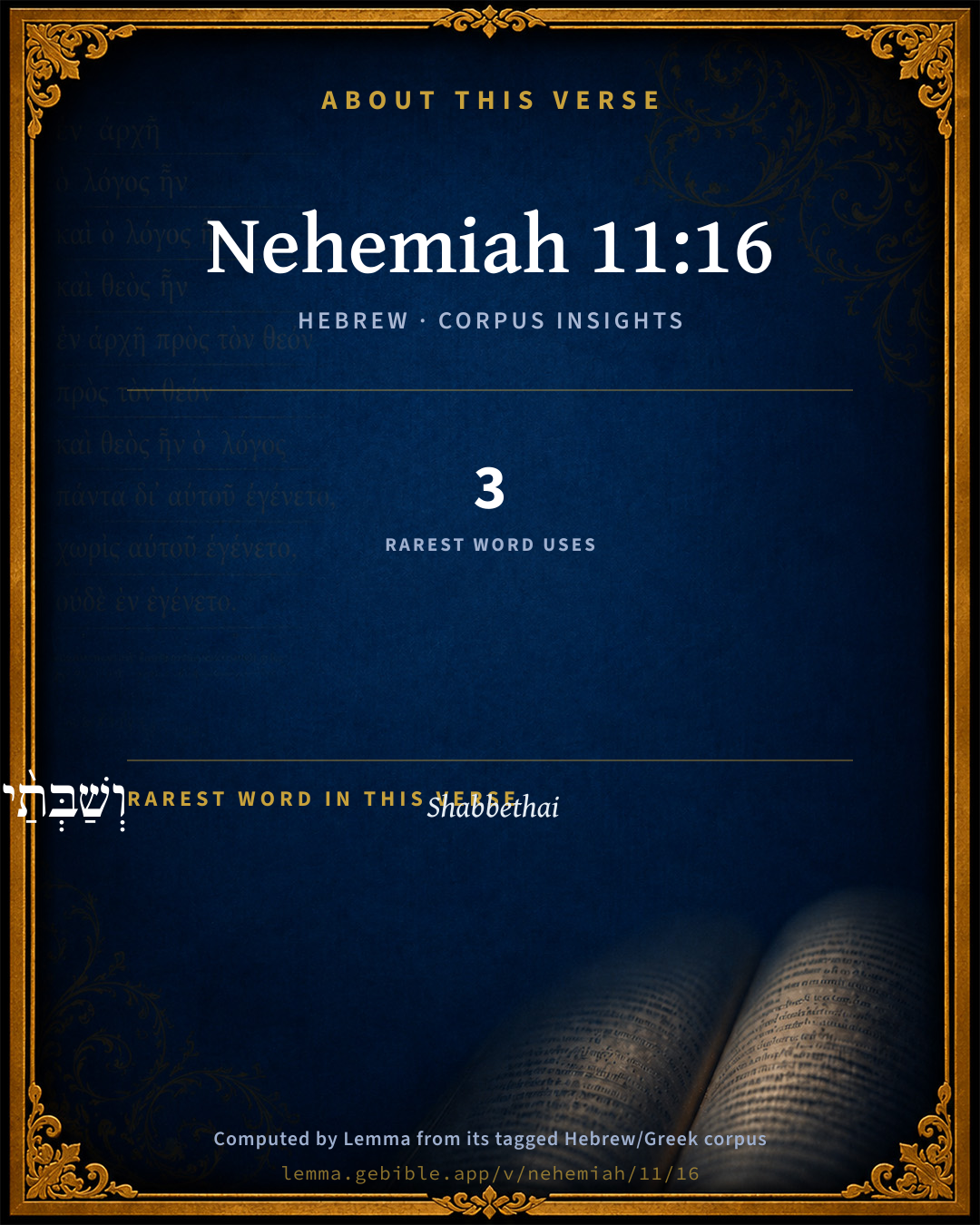
The rarest word here is וְשַׁבְּתַ֨י Shabbethai H7678 — appearing just 3 times in the whole Hebrew Bible.

Shared distinctive vocabulary

וְשַׁבְּתַ֨י Shabbethai H7678 occurs in 3 verses of the Hebrew Bible. Also found in:

Grammatical profile

  • 7 nouns
  • 1 adjective
  • 1 preposition

Cross-references

5

Topical passages linked to Nehemiah 11:16 in the Treasury of Scripture Knowledge — connected by theme and wording, ordered by reader-vote popularity; previews shown in the World English Bible.

  • 1 Chronicles 26:20 Of the Levites, Ahijah was over the treasures of the house of God, and over the treasures of the dedicated things.
  • 1 Chronicles 26:29 Of the Izharites, Chenaniah and his sons were for the outward business over Israel, for officers and judges.
  • Ezra 8:33 On the fourth day the silver and the gold and the vessels were weighed in the house of our God into the hand of Meremoth the son of Uriah the priest; and with him was Eleazar the son of Phinehas; and with them was Jozabad the son of Jeshua, and Noadiah the son of Binnui, the Levite;
  • Nehemiah 8:7 Also Jeshua, and Bani, and Sherebiah, Jamin, Akkub, Shabbethai, Hodiah, Maaseiah, Kelita, Azariah, Jozabad, Hanan, Pelaiah, and the Levites, caused the people to understand the law: and the people [stood] in their place.
  • Acts 6:2–3 The twelve summoned the multitude of the disciples and said, "It is not appropriate for us to forsake the word of God and serve tables.

Cross-references courtesy of OpenBible.info (CC BY 4.0).

Hebrew and Greek witnesses Masoretic Hebrew ↔ Greek Septuagint

The same verse in the two great witnesses to the Old Testament, shown verse-for-verse.

These are two independent witnesses, not word-aligned to each other, and the Septuagint is shown in lemma (dictionary) form.

Hebrew Nehemiah 11:16 Masoretic · Westminster Leningrad Codex

וְשַׁבְּתַ֨י וְיוֹזָבָ֜ד עַל הַמְּלָאכָ֤ה הַחִֽיצֹנָה֙ לְבֵ֣ית הָאֱלֹהִ֔ים מֵרָאשֵׁ֖י הַלְוִיִּֽם

and Shabbethai and Jozabad, of the chiefs of the Levites, who had the oversight of the outward business of the house of God;

World English Bible · Public Domain

Greek LXX Structure differs

The Septuagint has no separate book of Nehemiah. Its Greek text is the second half of Esdras B (2 Esdras), chapters 11–23; Ezra is the first half (1–10).

A verse-for-verse comparison isn’t shown here because the chapters and verses don’t line up. Switch to the LXX edition with the MT / LXX toggle above to read the Greek directly.

On this verse, Adam Clarke's Commentary discusses the Septuagint’s reading. Read the note in Commentary ↓

Hebrew: Westminster Leningrad Codex (CC BY 4.0). Greek: Septuagint (public domain); English from a public-domain English Septuagint. How the Septuagint differs from the Hebrew →

Commentary

Notes on Nehemiah 11:16 from classic Christian and Jewish commentators (each source and its license shown beneath its notes). The classic Christian expositions comment on the surrounding passage and are grouped to its opening verse, so a note may address several verses; the Jewish commentaries on the Tanakh (Rashi and others) are per-verse, so they appear only where the commentator wrote on this verse.

Lemma curates 59 commentaries, every one of them public domain or Creative Commons licensed, each selected and text-cleaned for this edition rather than reprinted as found. About our sources →

The Biblical Illustrator

Joseph S. Exell

Neh_11:16

Had the oversight of the outward business of the house of God.

The secular in sacred service

I. It is possible to secularise the sacred. When sacred service is entered upon from secular motives; when it is performed in a perfunctory manner; when any object less than God is regarded in its performance. An unhallowed hand may not bear up an ark. A cowl does not make a monk. High office cannot elevate a base man.

II. It is neccessary to make the secular sacred. He can who thinks he can. Application:

1. The secret of contentment. Self-humiliation is full of truth and reality.

2. The law of growth. Be thy ambition to become pure in thought and feeling, strong in resolve and deed. Serve. Care not how, mind not where. (Homiletic Commentary.)

Outward business

We have prayed about that house, we have thanked God that the crumbling walls of our little houses lean against the foundations and the walls of Gods dwelling-place. Do we catch the music, do we see the vision of the house of God? Do the words balance well? House is a familiar word, God is the most awful of all words; yet here we find them together in sublime unity and relation. What is the house of God? A church. A chapel, a sanctuary, a tabernacle, a temple. Not necessarily. You may have a cathedral without a house of God, and you may find in some little thatched cottage or chapel on the hillside all the cathedrals out of heaven. Hence it is that we must not look at magnitudes, sizes, revenues, apparatus, but at the ideal. I never go to the house of God. How do you know that? Have you ever been really out of it? Let us go to Jacob for an answer. What said he when he awoke after the delight and yet the torment of the dream? He said, This is none other than the house of God. There are those who only know houses by architecture, by wails, stones, bricks. Well, now, what was Jacobs environment at that time? Churches, chapels, institutions? Not one. Yet he was in a walled place, walled in with light, and ministered to by ascending and descending angels. We must get the house of God and many other things back from little definitions and narrow and petty locelisations, and regard the universe as Gods house. Of course Jacob, having seen all these things, could have said, Nightmare! That is all the answer some men can return to the universe. Let us so live as to make the house, even though a little one, grand, tender in all its ministries, a nest in the heart of God. Let us be careful how we divide things into outward and inward. The time will come when we shell get rid of even Scriptural uses of outward, alien, strange, foreign. All these words are doomed to go. I saw no temple therein, said John. Why did he not see a temple in heaven? Because heaven was all temple. He who lives in light does not even see the sun; he who lives in God has no moon, for he has no night. But men are crafty and expert almost at making little definitions, parties, separations, and the like. Some men divide music into sacred and profane. I never heard any profane music; I do not believe there is any. I have heard sacred music, and I have heard music profaned, perverted, taken away to bad uses, made a seduction on the road to hell. But we must get back to real definitions and proper qualities, and see things as God meant them to be seen. I have also heard of profane history and sacred history. There is no profane history. History truly written, and true to human experience, is an aspect of Providence, an elucidation of that marvellous mystery which penetrates all life, and that whispers to us in many a moment of unexpectedness, The very hairs of your head are all numbered. Who is it that rises up amongst us and splits up history into sacred and profane? What right has such a man to define and separate and classify? I would follow the historian who sees God m everything, in the defeat as well as in the success of the battle. And there are persons who have carried their defining powers, if powers they be, into what are called ecclesiastical matters, so that now we have the temporalities and the spiritualities. What man devised so insane a distinction? There is a sense, but a very poor, narrow sense not worth considering, in which the work of the Church may be divided into the temporal and the spiritual, but, properly regarded, in the spirit of Christ and in the spirit of the Cross, the gift of the poor mans penny may be as true an act of worship as the singing of the anthem. There is nothing secular, or if there is anything that we call secular it is only for momentary convenience. He that made ell things is God; He built the wall of the Church, and He will take care of the roof; it is His place. (J. Parker, D. D.)

.

The Biblical Illustrator, edited by Joseph S. Exell (c. 1880s–1900s) — public domain. Text from a community e-Sword module.

Joseph Benson's Commentary

Neh 11:16. The outward business of the house of God — For those things belonging to the temple and its service, which were to be done without it, or abroad in the country, as the gathering in of the voluntary contributions, or other necessary provisions, out of the several parts of the land.

Joseph Benson's Commentary on the Old and New Testaments (1811–1818) — public domain. Text from a community e-Sword module.

Tyndale Open Study Notes

Tyndale Open Resources

11:16 The work outside the Temple probably included collecting tithes from people and caring for the tithes in storehouses (10:37-39; see also 1 Chr 26:29).

Tyndale Open Study Notes — © Tyndale Open Resources, licensed CC BY-SA 4.0. Text via the HelloAO Bible API.

Jamieson, Fausset & Brown

Robert Jamieson, A. R. Fausset & David Brown

the oversight of the outward business of the house of God--that is, those things which were done outside, or in the country, such as the collecting of the provisions (Ch1 26:29).

Jamieson, Fausset & Brown — Commentary Critical and Explanatory on the Whole Bible (1871) — public domain (CC PDM 1.0). Text via the HelloAO Bible API.

Adam Clarke's Commentary

Verse 16. And Shabbethai] This verse, with verses 20, 21, 28, 29, 32, 33, 34, and 35, are all wanting in the Septuagint and the whole chapter is wanting in the Arabic, the translator not being concerned in Jewish genealogies.

The outward business] Calmet supposes that he provided the victuals for the priests, victims for the sacrifices, the sacerdotal vestments, the sacred vessels, and other necessaries for the service of the temple.

Adam Clarke's Commentary on the Bible (1810–1826) — public domain. Text from a community e-Sword/MySword module.

Ellicott's Commentary for English Readers

(16) Outward business.—This is a remarkable specification of the functions of the Lévites, parallel with the “valour” of the priests just before. The preceding chapter explains the “outward business.”

A Bible Commentary for English Readers, edited by Charles John Ellicott (1878–1897) — public domain. Text from a community e-Sword module.

The Cambridge Bible for Schools and Colleges

gen. ed. J. J. S. Perowne

16. Shabbethai … Jozabad] See these names in Neh_8:7. They do not occur in the parallel list of 1Ch_9:15-16, where however three other names, Heresh, Galal, and Berechiah are inserted.

chief] R.V. chiefs.

had the oversight] R.V. who had the oversight.

the outward business of the house of God] For the use of the adjective ‘outward’ here, cf. 1Ch_26:29, ‘of the Izharites, Chenaniah and his sons were for the outward business over Israel, for officers and judges.’

Whatever ‘the outward business of the house of God’ was, it is clearly meant to be contrasted with ‘the business, or work, of the house of God’ (cf. Neh_11:22 and 1Ch_23:4) consisting in the worship and its ritual. It must not be limited in application to the maintenance of the fabric of the Temple and its courts. The significance of the expression appears from a comparison of the two passages quoted above. The Levites had duties as ‘officers and judges,’ see 1Ch_23:4; 1Ch_26:29; 2Ch_19:8; 2Ch_19:11; and this section formed one-sixth of their whole number (1Ch_23:4).

The Cambridge Bible for Schools and Colleges (gen. ed. J. J. S. Perowne; Cambridge University Press, 1878–1918) — public domain. Text from a community e-Sword module.

John Gill's Exposition

But the Nethinims dwelt in Ophel,.... An high place or tower on the wall of Jerusalem, see Ch2 27:3,

and Ziha, and Gispa, were over the Nethinims; had the oversight of them, and took care that they did their work; they were such themselves, but the principal of them, see Ezr 2:43.

John Gill's Exposition of the Whole Bible (1746–1763) — public domain (CC PDM 1.0). Text via the HelloAO Bible API.

Haydock's Catholic Bible Commentary

Outward. For repairs of the temple, cultivation of the lands given by vow; also to buy provisions, sacred vestments, &c.

George Leo Haydock (1774–1849), Haydock's Catholic Family Bible and Commentary, 1859 edition — public domain. Excludes Psalms (Douay-Rheims chapter numbering differs from Protestant) and Deuterocanonical books (Catholic canon only).

Matthew Poole's English Annotations

i.e. For those things belonging to the temple and its service, which were to be done without it, or abroad in the country, as for the gathering in of the voluntary contributions, or other necessary provisions, out of the several parts of the land. See 1Ch 26:29.

Matthew Poole's English Annotations on the Holy Bible (1683–1685) — public domain. Text from a community e-Sword/MySword module.

Whedon's Commentary on the Bible

Daniel D. Whedon

16. The outward business of the house of God — Not the same as “the outward business over Israel,” which was done in the capacity of “officers and judges.” 1Ch_26:29. It was a business that had special relation to the temple, but its exact nature is at present matter of conjecture. We naturally suppose that it consisted in care for the buildings and furniture, and the collection and arrangement of provisions for the temple service.

Daniel D. Whedon (gen. ed.), Commentary on the Old and New Testaments (1874–1909) — public domain. Text from a community e-Sword module.

The Pulpit Commentary

Church officers.

"The oversight of the outward business of the house of God." What this business was in and about the temple. What it is in Christian Churches: care of the buildings, management of the finances, etc. The "oversight" is now exercised by church-wardens, deacons, treasurers, etc., according to the customs of each Church.

I THE POSITION WHICH THIS "OUTWARD BUSINESS" OCCUPIES.

1. It is subordinate to the spiritual. For the sake of the latter it exists, and in order to its promotion should always be managed.

2. It is" essential to the spiritual. As in this world the body to the action of the soul, or food and raiment to piety and virtue. Preachers must be fed and clothed and housed; congregations cannot meet at stated times without buildings, nor in comfort unless the buildings are bared for and money spent on them. Neglect of the outward will tell unfavourably on spiritual life and growth. Due care for it is promotive of these, as it enables ministers to preach, and congregations to hear and worship, with undisturbed minds. Very useful and honourable, then, is their office who have "the oversight of the outward business of the house of God.

II THE QUALITIES REQUIRED FOR THE DUE DISCHARGE OF ITS DUTIES. Besides the uprightness required in every kind of business.

1. Devoted love for the house of God. Awakening the desire to do all that is possible to secure the due order and the effectiveness of its services, and producing the conviction that it is an honour to be employed even in its humblest ministrations. (see Psa_84:10) Such love will make the officers of a Church examples to others (as they should be) of generosity and activity.

2. Sympathy with, and kindly regard for, those engaged in spiritual ministrations. Arising from a high esteem of their work as well as their character, and impelling to every effort to facilitate their labours, and secure them such honourable and sufficient maintenance as will free them from all anxiety about worldly matters, and enable them to give themselves with undivided heart to their work. Inducing also care to maintain a good understanding between the pastor and the flock, and preserve the former from annoyance and needless interruption.

3. Diligence and fidelity in their work. The contrast between the style in which men holding office in the Church transact their own business, and that in which they transact the business of God"s house, is often very striking and discreditable.

4. The capacity for leading and stimulating their fellow-worshippers. There is often in a congregation much latent ability, and willingness too, to serve the Church by gift or labour, which need only to be called forth. One man with the power to call them forth may totally change for the better the condition of affairs.

5. Withal, indisposition to magnify their office unduly, or go beyond its bounds. (see Rom_12:3 seq. ) Finally, ministers and congregations enjoying the services of such officers have much reason for thankfulness and praise.

The Pulpit Commentary (1880–1919), ed. H.D.M. Spence-Jones & Joseph S. Exell — public domain. Text from a community e-Sword module.

John Wesley's Explanatory Notes

Outward - For those things belonging to the temple and its service, which were to be done without it, or abroad in the country, as the gathering in of the voluntary contributions, or other necessary provision out of the several parts of the land.

John Wesley, Explanatory Notes Upon the Whole Bible (1754–1765) — public domain. Text via the GEBible commentary corpus.

Rashi

Rabbi Shlomo Yitzchaki (Rashi)

over the outside work of the Temple, such as the buildings of the repair of the Temple (sic) and the wood of the arrangement, which they would bring from outside.

Rashi on the Tanakh — English translations: “The Judaica Press complete Tanach with Rashi, translated by A. J. Rosenberg” (CC BY 4.0); “Pentateuch with Rashi's commentary by M. Rosenbaum and A.M. Silbermann, 1929-1934” (public domain); “The Metsudah Tanach series, Lakewood, N.J” (CC BY 4.0); and “The Book of Joshua, Metsudah Publications, 1997” (CC BY 4.0). Text via Sefaria.

Lesson kit

Teaching starters — assembled from the data on this page, not authored interpretation. Every prompt links to the verse data it draws on. Edit before teaching.

Nehemiah, in the Historical, opens this verse with 9 words (9 distinct Hebrew lemmas). Its most distinctive word is Shabbᵉthay (“Shabbethai”). A historical commentator’s framing appears above. Read the whole chapter for the surrounding context.

Discussion questions

  1. The word Shabbᵉthay carries the sense “Shabbethai.” How does it shape the verse?
  2. Ezra 10:15 shares the word «Shabbethai» with this verse. How do the two illuminate each other?
  3. The translations on this page render this verse differently — a whole-verse word diff, not a word-by-word alignment. What might account for the different wordings?
  4. Reading how The Biblical Illustrator and Joseph Benson's Commentary read this verse, where do the two commentators agree and where do they part?

Things to notice

Reading settings

Reading text

Shown beneath each verse's original-language words.

Old Testament
Old Testament edition

Read the OT as the Masoretic Hebrew (MT) or the Greek Septuagint (LXX).

English shown for the Greek Septuagint (in the Hebrew ↔ Greek comparison).

Comparing translations? Open the Compare panel on any verse page to stack up to four side by side.