
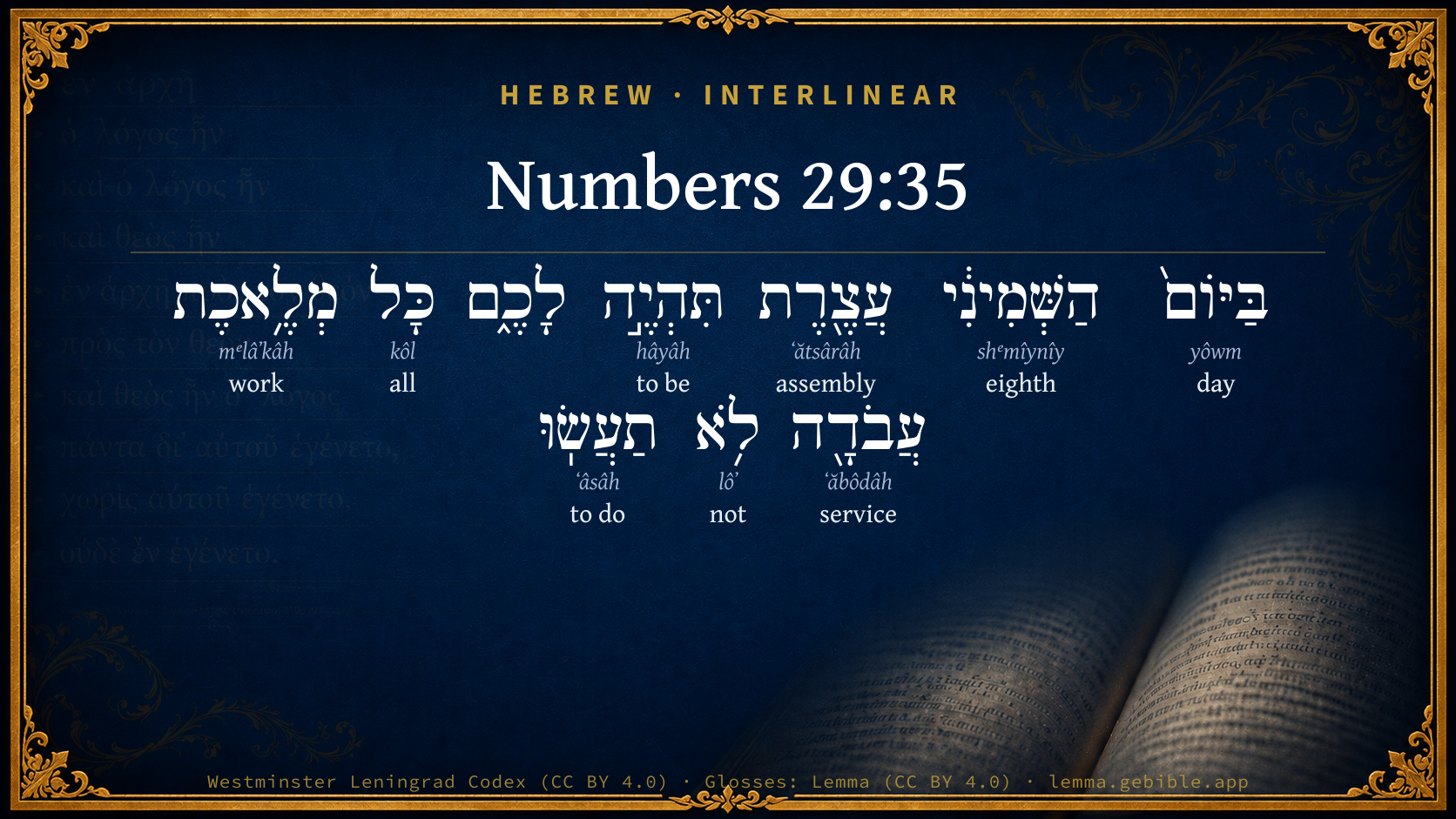
Numbers 29:35

Hebrew (Westminster Leningrad Codex) Numbers 29:35 appears in the Hebrew Old Testament. The text above is from the Westminster Leningrad Codex. Each word links to its Strong’s number, a concise gloss, and parsing drawn from the Open Scriptures Hebrew Bible morphology. Click any word for its full Brown-Driver-Briggs (BDB) entry.
Download image
Cite this verse

Numbers 29:35 (World English Bible). Public Domain. Lemma interlinear Bible study tool, https://lemma.gebible.app/v/numbers/29/35.

Show BibTeX & RIS
BibTeX
RIS
English Translation
On the eighth day you shall have a solemn assembly: you shall do no servile work;
World English Bible · Public Domain
Download a study sheet

One document with this verse’s original text, its word-by-word gloss line, the meaning frame, cross-references with their text, attributed commentary, and full source and license credits — printable, and it pastes into notes with its structure intact.

This verse Autodidact and up

Study sheet (.html) Plain text (.txt)

A passage Seminary Student

Up to 50 verses in one chapter. A passage sheet keeps up to 6 commentary sources and 12 cross-references per verse, in the order this page ranks them, and says so on the sheet whenever that leaves anything out. Ask for a single verse and you get the Autodidact verse sheet above.

Everything on this page stays free to read, with no account — the sheet is a download of what is already on screen, not access to it.

Want to remove ads? Support Godless Engineer
Compare translations 3

The same verse in 3 English versions, stacked beneath the original-language interlinear above. Click any original word for its lexicon entry.

Each is an independent rendering of the whole verse — the interlinear is not word-aligned to these translations.

Highlighted words mark where these versions differ — a whole-verse word diff, not a word-by-word alignment.

  • World English Bible Public Domain
    On the eighth day you shall have a solemn assembly: you shall do no servile work;
  • King James Version Public Domain
    On the eighth day ye shall have a solemn assembly: ye shall do no servile work therein:
  • unfoldingWord Literal Text CC BY-SA 4.0
    On the eighth day an assembly shall be for you. You shall not do any work of labor.

unfoldingWord Literal Text — © unfoldingWord, licensed CC BY-SA 4.0. Word-aligned USFM3 via Door43 (git.door43.org/unfoldingWord/en_ult).

Versions to compare (up to 4)

3 of 4 selected

Show all 18 translations

Every available English version of this verse, each an independent rendering of the whole verse.

  • World English Bible Public Domain
    On the eighth day you shall have a solemn assembly: you shall do no servile work;
  • Berean Standard Bible Public Domain
    On the eighth day you are to hold a solemn assembly; you must not do any regular work.
  • Majority Standard Bible Public Domain
    On the eighth day you are to hold a solemn assembly; you must not do any regular work.
  • King James Version Public Domain
    On the eighth day ye shall have a solemn assembly: ye shall do no servile work therein:
  • American Standard Version (1901) Public Domain
    On the eighth day ye shall have a solemn assembly: ye shall do no servile work;
  • Revised Version (1885) Public Domain
    On the eighth day ye shall have a solemn assembly: ye shall do no servile work:
  • Geneva Bible (1599) Public Domain
    In the eight day, yee shall haue a solemne assemblie: yee shall doe no seruile worke therein,
  • Douay-Rheims (1899) Public Domain
    On the eighth day, which is moat solemn, you shall do no servile work:
  • Young's Literal Translation Public Domain
    `On the eighth day a restraint ye have, ye do no servile work;
  • Literal Standard Version CC BY-SA 4.0
    On the eighth day you have a restraint; you do no servile work;
  • Unlocked Literal Bible CC BY-SA 4.0
    On the eighth day you must have another solemn assembly. You must not do regular work on that day.
  • unfoldingWord Literal Text CC BY-SA 4.0
    On the eighth day an assembly shall be for you. You shall not do any work of labor.
  • Darby Bible Public Domain
    On the eighth day ye shall have a solemn assembly: no manner of servile work shall ye do.
  • World Messianic Bible Public Domain
    “‘On the eighth day you shall have a solemn assembly. You shall do no regular work;
  • Webster's Bible Public Domain
    On the eighth day ye shall have a solemn assembly: in it ye shall do no servile work.
  • Free Bible Version CC BY-SA 4.0
    On the eighth day all of you are to meet together. Don't do any of your normal work.
  • Bible in Basic English Public Domain
    On the eighth day let there be a holy meeting: you may do no field-work;
  • JPS Tanakh (1917) Public Domain
    On the eighth day ye shall have a solemn assembly: ye shall do no manner of servile work;

Literal Standard Version (2020), Covenant Press — licensed CC BY-SA 4.0. Text via the HelloAO Bible API (eBible.org). Unlocked Literal Bible (unfoldingWord) — licensed CC BY-SA 4.0. Text via the HelloAO Bible API (eBible.org). unfoldingWord Literal Text — © unfoldingWord, licensed CC BY-SA 4.0. Word-aligned USFM3 via Door43 (git.door43.org/unfoldingWord/en_ult). Free Bible Version, Dr. Jonathan Gallagher — licensed CC BY-SA 4.0. Text via the HelloAO Bible API (eBible.org).

Word by word

More ways to search: Search by grammar → Find every occurrence → Compare this word →

Practice this passage: Drill this verse → Learn its vocabulary →

עֲצֶ֖רֶת
ʻătsârâh
H6116
“assembly”
Noun, Common, Feminine, Singular, Absolute
Part of Speech
Noun
Type
Common
Gender
Feminine
Number
Singular
State
Absolute
Full BDB Definition

Origin: from H6113

TWOT: 1675c

assembly, solemn assembly - assembly (sacred or festive meeting) - assemblage, company, group
  1. בַּיּוֹם֙ yôwm H3117 “in/at the · day” Preposition, Determined + Noun, Common, Masculine, Singular, Absolute
  2. הַשְּׁמִינִ֔י shᵉmîynîy H8066 “the · eighth” Particle, Definite Article + Adjective, Ordinal number, Masculine, Singular, Absolute
  3. תִּהְיֶ֣ה hâyâh H1961 “to be” Verb, Qal, Imperfect, 3rd Person, Feminine, Singular
  4. כָּל kôl H3605 “all of” Noun, Common, Masculine, Singular, Construct
  5. מְלֶ֥אכֶת mᵉlâʼkâh H4399 “work of” Noun, Common, Feminine, Singular, Construct
  6. עֲבֹדָ֖ה ʻăbôdâh H5656 “service” Noun, Common, Feminine, Singular, Absolute
  7. לֹ֥א lôʼ H3808 “not” Particle, Negative
  8. תַעֲשֽׂוּ ʻâsâh H6213 “to do” Verb, Qal, Imperfect, 2nd Person, Masculine, Plural

About this verse

These counts appear in no published source. They are computed here, from the morphology-tagged text and Lemma’s own curated glosses. What Lemma adds →

10
words
9
distinct lemmas
Pentateuch
section

Notable vocabulary

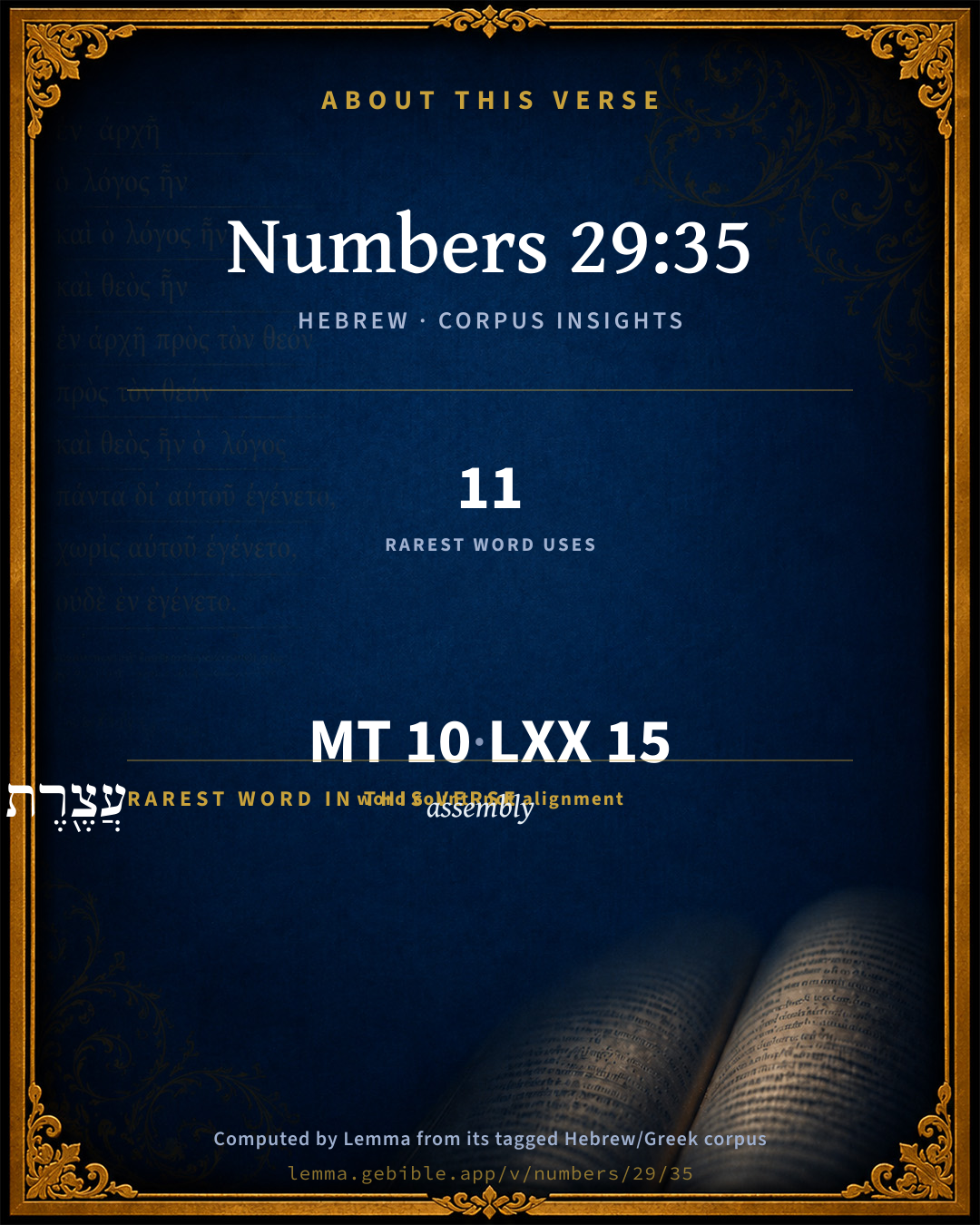
The rarest word here is עֲצֶ֖רֶת assembly H6116 — appearing just 11 times in the whole Hebrew Bible.

Shared distinctive vocabulary

עֲצֶ֖רֶת assembly H6116 occurs in 11 verses of the Hebrew Bible. Also found in:

Grammatical profile

  • 2 verbs
  • 5 nouns
  • 1 adjective
  • 1 preposition
  • 1 particle

Verb forms

  • תִּהְיֶ֣ה Qal · Imperfect
  • תַעֲשֽׂוּ Qal · Imperfect

Hebrew & Septuagint length

In English translation the verse runs 16 words from the Hebrew and 20 from the Septuagint (LXX English) — closely comparable.

A rough comparison of the two English renderings, which tokenize alike — not a word-level alignment.

Word counts can differ between the Hebrew and the Greek without any difference in meaning — e.g. the Hebrew direct-object marker אֵת has no separate Greek word, and Greek often adds the article ὁ.

In the original languages it is 10 Hebrew tokens and 15 Greek tokens — but the two are counted differently (Hebrew bundles its prefixes and suffixes into one token; the Greek is in lemma form), so that isn’t a like-for-like length.

Cross-references

3

Topical passages linked to Numbers 29:35 in the Treasury of Scripture Knowledge — connected by theme and wording, ordered by reader-vote popularity; previews shown in the World English Bible.

  • Leviticus 23:36 Seven days you shall offer an offering made by fire to Yahweh. On the eighth day shall be a holy convocation to you; and you shall offer an offering made by fire to Yahweh. It is a solemn assembly; you shall do no regular work.
  • John 7:37–39 Now on the last and greatest day of the feast, Jesus stood and cried out, "If anyone is thirsty, let him come to me and drink!
  • Revelation 7:9–17 After these things I looked, and behold, a great multitude, which no man could number, out of every nation and of all tribes, peoples, and languages, standing before the throne and before the Lamb, dressed in white robes, with palm branches in their hands.

Cross-references courtesy of OpenBible.info (CC BY 4.0).

Hebrew and Greek witnesses Masoretic Hebrew ↔ Greek Septuagint

The same verse in the two great witnesses to the Old Testament, shown verse-for-verse.

These are two independent witnesses, not word-aligned to each other, and the Septuagint is shown in lemma (dictionary) form.

Hebrew Numbers 29:35 Masoretic · Westminster Leningrad Codex

בַּיּוֹם֙ הַשְּׁמִינִ֔י עֲצֶ֖רֶת תִּהְיֶ֣ה לָכֶ֑ם כָּל מְלֶ֥אכֶת עֲבֹדָ֖ה לֹ֥א תַעֲשֽׂוּ

On the eighth day you shall have a solemn assembly: you shall do no servile work;

World English Bible · Public Domain

Greek LXX Numbers 29:35 Septuagint · lemma form

καί ὁ ἡμέρα ὁ ὄγδοος ἐξόδιον εἰμί σύ πᾶς ἔργον λατρευτός οὐ ποιέω ἐν αὐτός

And on the eighth day there shall be to you a release: you⌃ shall do no servile work in it.

LXX2012 (modern English Septuagint) · Public Domain

Hebrew: Westminster Leningrad Codex (CC BY 4.0). Greek: Septuagint (public domain); English from LXX2012 (modern English Septuagint) (Public Domain). How the Septuagint differs from the Hebrew →

Targum (Aramaic paraphrase)

2

The Targum is the ancient Jewish Aramaic paraphrase of the Hebrew Scriptures — an interpretive translation, not the Hebrew text itself. Onkelos (literal) and Pseudo-Jonathan (expansive) render the Torah, and Jonathan the Prophets. Coverage is partial: where no permissively-licensed English translation exists for a verse, only the Aramaic is shown. This is verse-level text, not a word-by-word alignment to the Hebrew.

  1. Targum Onkelos Torah (Genesis–Deuteronomy)
    בְּיוֹמָא תְּמִינָאָה כְּנִישִׁין תְּהֵא לְכוֹן כָּל עִבִידַת פּוּלְחַן לָא תַעְבְדוּן

    (no public-domain English translation for this verse)

    Targum Onkelos — Aramaic: “Onkelos Genesis” (public domain); “Onkelos Exodus” (public domain); “Onkelos Leviticus” (public domain); “Onkelos Numbers” (public domain); “Onkelos Deuteronomy” (public domain). English: “Sefaria Community Translation” (CC0 1.0 (public-domain dedication)); “J.W. Etheridge. The Targums of Onkelos and Jonathan Ben Uzziel on the Pentateuch. London: Longmans, Green, 1862” (public domain). Text via Sefaria.

  2. Targum Pseudo-Jonathan Torah (Genesis–Deuteronomy)
    בְּיוֹמָא תְמִינָאָה כְּנִישִׁין תֶּהֱווֹן בְּחֶדְוָא מִן מַטִילְכוֹן לְבָתֵּיכוֹן כְּנִישַׁת חֶדְוָא וְיוֹמָא טָבָא וְאִירוּעַ קַדִישׁ תֶּהֱוֵי לְכוֹן כָּל עִיבִידַת פּוּלְחָנָא לָא תַעַבְדוּן

    And on the eighth day you shall gather together joyfully from your tabernacles, in your houses, a gladsome company, a festal day, and a holy convocation shall you have, no servile work shall you do

    Targum Pseudo-Jonathan — Aramaic: “Targum Jonathan on Genesis” (public domain); “Targum Jonathan on Exodus” (public domain); “Targum Jonathan on Leviticus” (public domain); “Targum Jonathan on Numbers” (public domain); “Targum Jonathan on Deuteronomy” (public domain). English: “The Targum of Jonathan ben Uzziel, trans. J. W. Etheridge, London, 1862” (public domain). Text via Sefaria.

Commentary

Notes on Numbers 29:35 from classic Christian and Jewish commentators (each source and its license shown beneath its notes). The classic Christian expositions comment on the surrounding passage and are grouped to its opening verse, so a note may address several verses; the Jewish commentaries on the Tanakh (Rashi and others) are per-verse, so they appear only where the commentator wrote on this verse.

Lemma curates 59 commentaries, every one of them public domain or Creative Commons licensed, each selected and text-cleaned for this edition rather than reprinted as found. About our sources →

Jamieson, Fausset & Brown

Robert Jamieson, A. R. Fausset & David Brown

On the eighth day ye shall have a solemn assembly--The feast of tabernacles was brought to a close on the eighth day, which was the great day (Joh 7:37). Besides the common routine sacrifices, there were special offerings appointed for that day though these were fewer than on any of the preceding days; and there were also, as was natural on that occasion when vast multitudes were convened for a solemn religious purpose, many spontaneous gifts and services, so that there was full scope for the exercise of a devout spirit in the people, both for their obedience to the statutory offerings, and by the presentation of those which were made by free will or in consequence of vows.

Jamieson, Fausset & Brown — Commentary Critical and Explanatory on the Whole Bible (1871) — public domain (CC PDM 1.0). Text via the HelloAO Bible API.

Adam Clarke's Commentary

Verse 35. On the eighth day ye shall have a solemn assembly] This among the Jews was esteemed the chief or high day of the feast, though fewer sacrifices were offered on it than on the others; the people seem to have finished the solemnity with a greater measure of spiritual devotion, and it was on this day of the feast that our blessed Lord called the Jews from the letter to the spirit of the law, proposing himself as the sole fountain whence they could derive the streams of salvation, Joh 7:37. On the subject of this chapter see the notes on Lev. xii., xvi. and xxiii.

Adam Clarke's Commentary on the Bible (1810–1826) — public domain. Text from a community e-Sword/MySword module.

Ellicott's Commentary for English Readers

(35) On the eighth day ye shall have a solemn assembly.—Or, closing feast day. The word azereth, which is here and in the parallel passage in Lev_23:36 (comp. Neh_8:18; 2Ch_7:9) rendered “solemn assembly,” is used in Deu_16:8 of the seventh or closing day of the Feast of the Passover. It is used in Jer_9:2 and Amo_5:2 in a more general manner. In the former of these passages it is used of an assembly or confederacy of false dealers, and in the latter it appears to include solemn festivals generally, without limitation to the last day of their duration. The primary notion appears to be that of restraint—i.e., from the performance of servile work. The sacrifices of the eighth day were the same as those which were appointed for the first day of the seventh month, i.e., the Feast of Trumpets, and also for the tenth day, or Day of Atonement. (See Lev_23:36, and Note.)

A Bible Commentary for English Readers, edited by Charles John Ellicott (1878–1897) — public domain. Text from a community e-Sword module.

The Cambridge Bible for Schools and Colleges

gen. ed. J. J. S. Perowne

35. a solemn assembly] an assembly. The Heb. word ‘aẓereth contains nothing which implies that the assembly was of a specially solemn character. Before the exile an ‘aẓereth was held on the seventh day of the Feast of Unleavened Cakes (Deu_16:8); and see Isa_1:13 (R.V. ‘solemn meeting’), Amo_5:21. After the exile it was used, as here, of an assembly on the additional eighth day of the Feast of Booths (Lev_23:36, Neh_8:18), and on a special fast day (Joe_1:14; Joe_2:15); and the Chronicler relates that such an assembly was held as the climax of rejoicing on the eighth day (contrast 1Ki_8:66) at the dedication of Solomon’s temple (2Ch_7:9).

The Cambridge Bible for Schools and Colleges (gen. ed. J. J. S. Perowne; Cambridge University Press, 1878–1918) — public domain. Text from a community e-Sword module.

John Gill's Exposition

And Moses told the children of Israel,.... All these things; repeated the several laws unto them concerning the above sacrifices, with the additions unto them, and explanations of them:

according to all that the Lord commanded Moses; being a faithful servant to the Lord in all his house, and in all things appertaining to it.

Next: Numbers Chapter 30

John Gill's Exposition of the Whole Bible (1746–1763) — public domain (CC PDM 1.0). Text via the HelloAO Bible API.

Albert Barnes' Notes on the Bible

The offerings prescribed for the closing day of the Feast of tabernacles were the same with those appointed for the Feast of Trumpets and the Day of Atonement. The solemnities of the month thus terminated, as

A whole, with the same sacrifices with which, three weeks before, they had been introduced; and the Day of Atonement, even though succeeded by the rejoicings of the Feast of tabernacles, thus left its impress on the whole month.

Albert Barnes' Notes on the Bible (1834–1885) — public domain. Text from a community e-Sword/MySword module.

Haydock's Catholic Bible Commentary

Eighth day, which was more solemn than the preceding ones, but less so than the first. The victims are every day diminished. (Calmet) --- This day, in the Hebrew calendar, is called the feast of retention, (atsroth) as they staid near the tabernacle. (Du Hamel)

George Leo Haydock (1774–1849), Haydock's Catholic Family Bible and Commentary, 1859 edition — public domain. Excludes Psalms (Douay-Rheims chapter numbering differs from Protestant) and Deuterocanonical books (Catholic canon only).

Whedon's Commentary on the Bible

Daniel D. Whedon

35. The eighth day — This in later times was called the great day of the feast, (Joh_7:37,) but it belonged to it only as the sabbath rest and holy meeting of the seventh day were transferred to it. In point of sacrifice it was like the first and the tenth day of the seventh month. Lev_23:36, note. In Lev_23:36, a Hebrew word of doubtful meaning is added, which in the margin of the Revision is rendered “a closing festival,” inasmuch as it closed not only that particular feast, but the whole series for the year. The joy attending the celebration of this feast is indicated in Psa_42:4, and Isa_30:29. It was the occasion of prophetic addresses also; Hag_2:1, and Isaiah 29 and Isa_32:9, to the end. The most significant of all allusions to this feast is that in Isa_12:3, which points to the typical meaning of the daily ceremony of pouring on the altar water drawn from the pool of Siloam. This custom is enforced by our Lord in Joh_7:37-39. For the great future feast of tabernacles see Rev_7:9.

Daniel D. Whedon (gen. ed.), Commentary on the Old and New Testaments (1874–1909) — public domain. Text from a community e-Sword module.

The Pulpit Commentary

On the eighth day. On the twenty-second day of Ethanim. (see on Lev_23:36) The offering here specified returns to the smaller number ordered for the first/rod tenth days of this month. The feast of tabernacles ended with sundown on this day.

The Pulpit Commentary (1880–1919), ed. H.D.M. Spence-Jones & Joseph S. Exell — public domain. Text from a community e-Sword module.

Keil & Delitzsch

C. F. Keil & F. Delitzsch

The eighth day was to be azereth, a closing feast, and only belonged to the feast of Tabernacles so far as the Sabbath rest and a holy meeting of the seventh feast-day were transferred to it; whilst, so far as its sacrifices were concerned, it resembled the seventh new moon's day and the day of atonement, and was thus shown to be the octave or close of the second festal circle (see at Lev 23:36).

Keil & Delitzsch — Biblical Commentary on the Old Testament (1861–1891) — public domain (CC PDM 1.0). Text via the HelloAO Bible API. (Old Testament only.)

unfoldingWord translationNotes

Door43 World Missions Community

General Information:

Yahweh tells Moses what the people must do after the seven-day festival in the seventh month.

eighth day

This "eighth" is the ordinal number for eight. (See: Ordinal Numbers)

have another solemn assembly

"gather together again to worship Yahweh." This is another assembly similar to the one on the first day of the festival.

an offering made by fire

This can be stated in active form. AT: "you must burn it on the altar" (See: Active or Passive)

translationWords

day

burnt offering

Yahweh

year

unfoldingWord translationNotes — © Distant Shores Media and the Door43 World Missions Community, licensed CC BY-SA 4.0. Source: git.door43.org/Door43/en_tn.

Rashi

Rabbi Shlomo Yitzchaki (Rashi)

עצרת תהיה לכם ON THE EIGHTH DAY THERE SHALL BE A עצרת (RESTRICTION) FOR YOU — you are restricted in the doing of work. Another explanation of עצרת: Restrict yourselves from leaving Jerusalem: this teaches that this (the eighth day) requires that they should remain in Jerusalem overnight (that the pilgrims should not immediately at the termination of the seventh day begin their homeward journey) (Sifrei Bamidbar 151:1). And an explanation of it in the Agada is: because on all the seven days of the Festival they offered sacrifices corresponding in number to the seventy nations of the world, and they propose then to set forth on their way home, the Omnipresent says to them: ‘I beg of you make a small banquet for Me, so that I may have some pleasure from you exclusively” (Sukkah 55b).

Rashi on the Tanakh — English translations: “The Judaica Press complete Tanach with Rashi, translated by A. J. Rosenberg” (CC BY 4.0); “Pentateuch with Rashi's commentary by M. Rosenbaum and A.M. Silbermann, 1929-1934” (public domain); “The Metsudah Tanach series, Lakewood, N.J” (CC BY 4.0); and “The Book of Joshua, Metsudah Publications, 1997” (CC BY 4.0). Text via Sefaria.

Lesson kit

Teaching starters — assembled from the data on this page, not authored interpretation. Every prompt links to the verse data it draws on. Edit before teaching.

Numbers, in the Pentateuch, opens this verse with 10 words (9 distinct Hebrew lemmas). Its most distinctive word is ʻătsârâh (“assembly”). A historical commentator’s framing appears above. Read the whole chapter for the surrounding context.

Discussion questions

  1. What does “assembly” (ʻătsârâh) contribute to the verse as a whole?
  2. How does Leviticus 23:36, which shares the word «assembly», read alongside this verse?
  3. These translations render this verse differently. What is at stake in choosing one wording over another?
  4. «תִּהְיֶ֣ה» is a Qal Imperfect verb. How does that grammatical form shape the action described?
  5. Compare how Jamieson, Fausset & Brown and Adam Clarke's Commentary read this verse. Where do they agree or differ?

Things to notice

Reading settings

Reading text

Shown beneath each verse's original-language words.

Old Testament
Old Testament edition

Read the OT as the Masoretic Hebrew (MT) or the Greek Septuagint (LXX).

English shown for the Greek Septuagint (in the Hebrew ↔ Greek comparison).

Comparing translations? Open the Compare panel on any verse page to stack up to four side by side.