
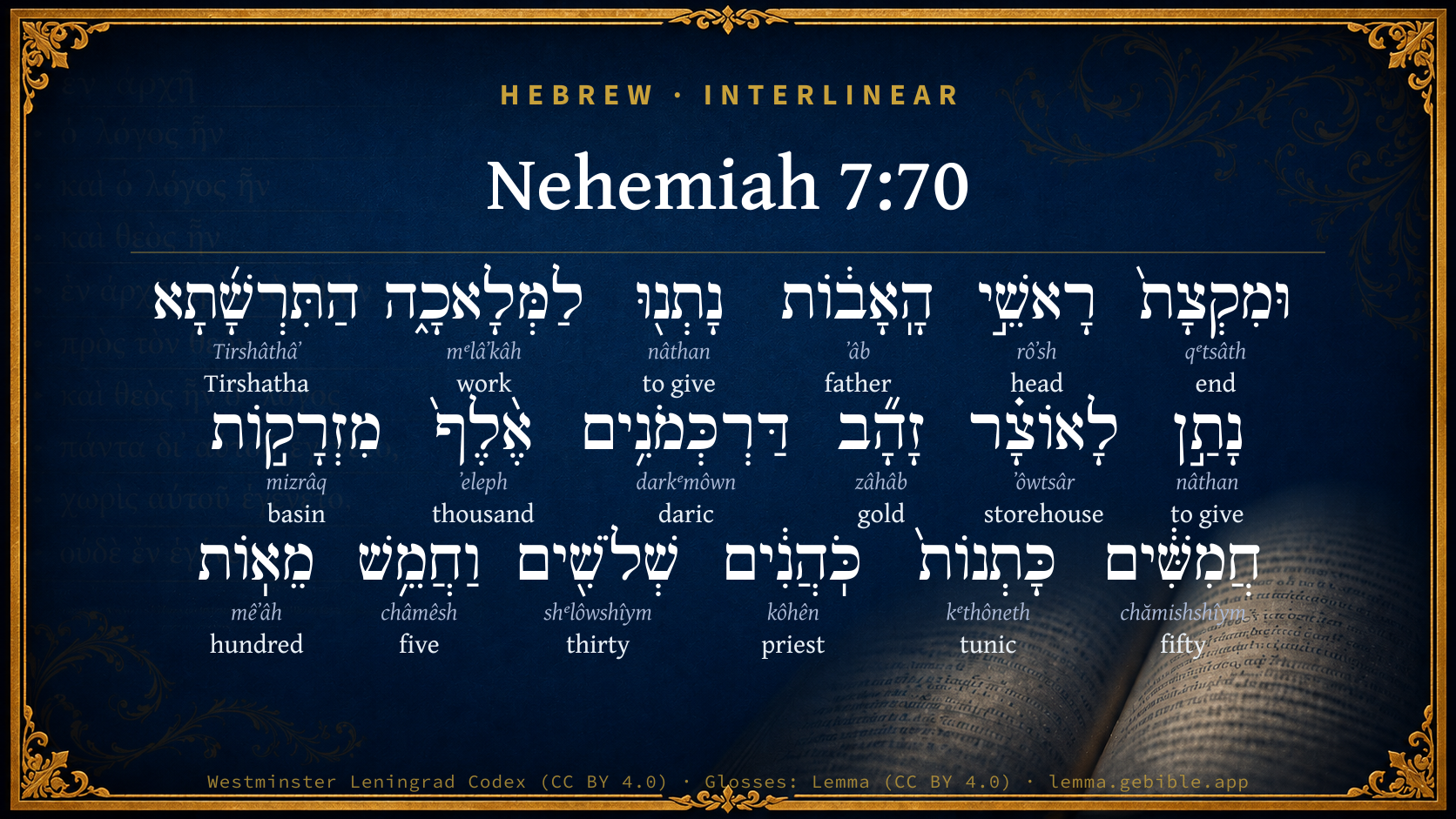
Nehemiah 7:70

Hebrew (Westminster Leningrad Codex) Nehemiah 7:70 appears in the Hebrew Old Testament. The text above is from the Westminster Leningrad Codex. Each word links to its Strong’s number, a concise gloss, and parsing drawn from the Open Scriptures Hebrew Bible morphology. Click any word for its full Brown-Driver-Briggs (BDB) entry.
Download image
Cite this verse

Nehemiah 7:70 (World English Bible). Public Domain. Lemma interlinear Bible study tool, https://lemma.gebible.app/v/nehemiah/7/70.

Show BibTeX & RIS
BibTeX
RIS
English Translation
Some from among the heads of fathers' [houses] gave to the work. The governor gave to the treasury one thousand darics of gold, fifty basins, and five hundred thirty priests' garments.
World English Bible · Public Domain
Download a study sheet

One document with this verse’s original text, its word-by-word gloss line, the meaning frame, cross-references with their text, attributed commentary, and full source and license credits — printable, and it pastes into notes with its structure intact.

This verse Autodidact and up

Study sheet (.html) Plain text (.txt)

A passage Seminary Student

Up to 50 verses in one chapter. A passage sheet keeps up to 6 commentary sources and 12 cross-references per verse, in the order this page ranks them, and says so on the sheet whenever that leaves anything out. Ask for a single verse and you get the Autodidact verse sheet above.

Everything on this page stays free to read, with no account — the sheet is a download of what is already on screen, not access to it.

Want to remove ads? Support Godless Engineer
Compare translations 3

The same verse in 3 English versions, stacked beneath the original-language interlinear above. Click any original word for its lexicon entry.

Each is an independent rendering of the whole verse — the interlinear is not word-aligned to these translations.

Highlighted words mark where these versions differ — a whole-verse word diff, not a word-by-word alignment.

  • World English Bible Public Domain
    Some from among the heads of fathers' [houses] gave to the work. The governor gave to the treasury one thousand darics of gold, fifty basins, and five hundred thirty priests' garments.
  • King James Version Public Domain
    And some of the chief of the fathers gave unto the work. The Tirshatha gave to the treasure a thousand drams of gold, fifty basons, five hundred and thirty priests' garments.
  • unfoldingWord Literal Text CC BY-SA 4.0
    And some from the extremity of the heads of the fathers gave to the work. The Tirshatha gave to the treasury 1,000 gold darics, 50 basins, 530 tunics of priests.

unfoldingWord Literal Text — © unfoldingWord, licensed CC BY-SA 4.0. Word-aligned USFM3 via Door43 (git.door43.org/unfoldingWord/en_ult).

Versions to compare (up to 4)

3 of 4 selected

Show all 18 translations

Every available English version of this verse, each an independent rendering of the whole verse.

  • World English Bible Public Domain
    Some from among the heads of fathers' [houses] gave to the work. The governor gave to the treasury one thousand darics of gold, fifty basins, and five hundred thirty priests' garments.
  • Berean Standard Bible Public Domain
    Some of the heads of the families contributed to the project. The governor gave to the treasury 1,000 darics of gold, 50 bowls, and 530 priestly garments.
  • Majority Standard Bible Public Domain
    Some of the heads of the families contributed to the project. The governor gave to the treasury 1,000 darics of gold, 50 bowls, and 530 priestly garments.
  • King James Version Public Domain
    And some of the chief of the fathers gave unto the work. The Tirshatha gave to the treasure a thousand drams of gold, fifty basons, five hundred and thirty priests' garments.
  • American Standard Version (1901) Public Domain
    And some from among the heads of fathers' `houses' gave unto the work. The governor gave to the treasury a thousand darics of gold, fifty basins, five hundred and thirty priests' garments.
  • Revised Version (1885) Public Domain
    And some from among the heads of fathers’ houses gave unto the work. The Tirshatha gave to the treasury a thousand darics of gold, fifty basons, five hundred and thirty priests’ garments.
  • Geneva Bible (1599) Public Domain
    And certaine of the chiefe fathers gaue vnto the worke. The Tirshatha gaue to the treasure, a thousand drammes of golde, fiftie basins, fiue hundreth and thirtie Priests garments.
  • Douay-Rheims (1899) Public Domain
    And some of the heads of the families gave unto the work. Athersatha gave into the treasure a thousand drama of gold, fifty bowls, and five hundred and thirty garments for priests.
  • Young's Literal Translation Public Domain
    And from the extremity of the heads of the fathers they have given to the work; the Tirshatha hath given to the treasure, of gold, drams a thousand, bowls fifty, priests' coats thirty and five hundred.
  • Literal Standard Version CC BY-SA 4.0
    And from the extremity of the heads of the fathers they have given to the work; the Tirshatha has given to the treasure, one thousand drams of gold, fifty bowls, five hundred and thirty priests’ coats.
  • Unlocked Literal Bible CC BY-SA 4.0
    Some from among the heads of ancestors' families gave gifts for the work. The governor gave to the treasury one thousand darics of gold, 50 basins, and 530 priestly garments.
  • unfoldingWord Literal Text CC BY-SA 4.0
    And some from the extremity of the heads of the fathers gave to the work. The Tirshatha gave to the treasury 1,000 gold darics, 50 basins, 530 tunics of priests.
  • Darby Bible Public Domain
    And some of the chief fathers gave to the work. The Tirshatha gave to the treasure a thousand darics of gold, fifty basons, five hundred and thirty priests' coats.
  • World Messianic Bible Public Domain
    Some from among the heads of fathers’ households gave to the work. The governor gave to the treasury one thousand darics of gold, fifty basins, and five hundred thirty priests’ garments.
  • Webster's Bible Public Domain
    And some of the chief of the fathers gave to the work. The Tirshatha gave to the treasure a thousand drams of gold, fifty basins, five hundred and thirty priests' garments.
  • Free Bible Version CC BY-SA 4.0
    Some of the family leaders made voluntary contributions toward the work. The governor presented to the treasury 1,000 gold darics, 50 bowls and 530 sets of clothes for the priests.
  • Bible in Basic English Public Domain
    And some of the heads of families gave money for the work. The Tirshatha gave into the store a thousand darics of gold, fifty basins, five hundred and thirty priests' robes.
  • JPS Tanakh (1917) Public Domain
    And some from among the heads of fathers' houses gave unto the work. The Tirshatha gave to the treasury a thousand darics of gold, fifty basins, five hundred and thirty priests' tunics.

Literal Standard Version (2020), Covenant Press — licensed CC BY-SA 4.0. Text via the HelloAO Bible API (eBible.org). Unlocked Literal Bible (unfoldingWord) — licensed CC BY-SA 4.0. Text via the HelloAO Bible API (eBible.org). unfoldingWord Literal Text — © unfoldingWord, licensed CC BY-SA 4.0. Word-aligned USFM3 via Door43 (git.door43.org/unfoldingWord/en_ult). Free Bible Version, Dr. Jonathan Gallagher — licensed CC BY-SA 4.0. Text via the HelloAO Bible API (eBible.org).

Word by word

More ways to search: Search by grammar → Find every occurrence → Compare this word →

Practice this passage: Drill this verse → Learn its vocabulary →

דַּרְכְּמֹנִ֥ים
darkᵉmôwn
H1871
“darics”
Noun, Common, Masculine, Plural, Absolute
Part of Speech
Noun
Type
Common
Gender
Masculine
Number
Plural
State
Absolute
Full BDB Definition

Origin: of Persian origin

TWOT: 453c

daric, drachma, dram, unit of measure from Babylon; 128 grains (8.32 grams) of gold worth about $120 dollars and 128 grains of silver worth about $2.40 - a gold coin current in Palestine in the period after the return
  1. וּמִקְצָת֙ qᵉtsâth H7117 “and · from · end of” Conjunction + Preposition + Noun, Common, Feminine, Singular, Construct
  2. רָאשֵׁ֣י rôʼsh H7218 “heads of” Noun, Common, Masculine, Plural, Construct
  3. הָֽאָב֔וֹת ʼâb H1 “the · fathers” Particle, Definite Article + Noun, Common, Masculine, Plural, Absolute
  4. נָתְנ֖וּ nâthan H5414 “to give” Verb, Qal, Perfect, 3rd Person, Common, Plural
  5. לַמְּלָאכָ֑ה mᵉlâʼkâh H4399 “to/for the · work” Preposition, Determined + Noun, Common, Feminine, Singular, Absolute
  6. הַתִּרְשָׁ֜תָא Tirshâthâʼ H8660 “the · Tirshatha” Particle, Definite Article + Noun, Common, Masculine, Singular, Absolute
  7. נָתַ֣ן nâthan H5414 “to give” Verb, Qal, Perfect, 3rd Person, Masculine, Singular
  8. לָאוֹצָ֗ר ʼôwtsâr H214 “to/for the · storehouse” Preposition, Determined + Noun, Common, Masculine, Singular, Absolute
  9. זָהָ֞ב zâhâb H2091 “gold” Noun, Common, Masculine, Singular, Absolute
  10. אֶ֨לֶף֙ ʼeleph H505 “thousand” Adjective, Cardinal number, Both, Singular, Absolute
  11. מִזְרָק֣וֹת mizrâq H4219 “basins” Noun, Common, Masculine, Plural, Absolute
  12. חֲמִשִּׁ֔ים chămishshîym H2572 “fifty” Adjective, Cardinal number, Both, Plural, Absolute
  13. כָּתְנוֹת֙ kᵉthôneth H3801 “tunics of” Noun, Common, Feminine, Plural, Construct
  14. כֹּֽהֲנִ֔ים kôhên H3548 “priests” Noun, Common, Masculine, Plural, Absolute
  15. שְׁלֹשִׁ֖ים shᵉlôwshîym H7970 “thirty” Adjective, Cardinal number, Both, Plural, Absolute
  16. וַחֲמֵ֥שׁ châmêsh H2568 “and · five” Conjunction + Adjective, Cardinal number, Feminine, Singular, Absolute
  17. מֵאֽוֹת mêʼâh H3967 “hundred” Adjective, Cardinal number, Both, Plural, Absolute

About this verse

These counts appear in no published source. They are computed here, from the morphology-tagged text and Lemma’s own curated glosses. What Lemma adds →

18
words
17
distinct lemmas
Historical
section

Notable vocabulary

The rarest word here is דַּרְכְּמֹנִ֥ים daric H1871 — appearing just 4 times in the whole Hebrew Bible.

Shared distinctive vocabulary

דַּרְכְּמֹנִ֥ים daric H1871 occurs in 4 verses of the Hebrew Bible. Also found in:

Grammatical profile

  • 2 verbs
  • 11 nouns
  • 5 adjectives

Verb forms

  • נָתְנ֖וּ Qal · Perfect
  • נָתַ֣ן Qal · Perfect

Repetition

A word recurs within this verse — often emphatic in Hebrew:

  • נָתְנ֖וּ to give H5414 ×2

Cross-references

13

Topical passages linked to Nehemiah 7:70 in the Treasury of Scripture Knowledge — connected by theme and wording, ordered by reader-vote popularity; previews shown in the World English Bible.

  • Nehemiah 8:9 Nehemiah, who was the governor, and Ezra the priest the scribe, and the Levites who taught the people, said to all the people, This day is holy to Yahweh your God; don't mourn, nor weep. For all the people wept, when they heard the words of the law.
  • Exodus 12:22 You shall take a bunch of hyssop, and dip it in the blood that is in the basin, and strike the lintel and the two side-posts with the blood that is in the basin; and none of you shall go out of the door of his house until the morning.
  • Exodus 24:6 Moses took half of the blood and put it in basins, and half of the blood he sprinkled on the altar.
  • Numbers 7:2–86 that the princes of Israel, the heads of their fathers' houses, offered. These were the princes of the tribes. These are they who were over those who were numbered:
  • 1 Kings 7:45 and the pots, and the shovels, and the basins: even all these vessels, which Hiram made for king Solomon, in the house of Yahweh, were of burnished brass.
  • 1 Chronicles 28:17 and the flesh-hooks, and the basins, and the cups, of pure gold; and for the golden bowls by weight for every bowl; and for the silver bowls by weight for every bowl;
  • 1 Chronicles 29:3–9 In addition, because I have set my affection on the house of my God, seeing that I have a treasure of my own of gold and silver, I give it to the house of my God, over and above all that I have prepared for the holy house,
  • 2 Chronicles 4:8 He made also ten tables, and placed them in the temple, five on the right side, and five on the left. He made one hundred basins of gold.
  • 2 Chronicles 4:11 Huram made the pots, and the shovels, and the basins. So Huram made an end of doing the work that he did for king Solomon in the house of God:
  • Ezra 2:68–70 Some of the heads of fathers' [houses], when they came to the house of Yahweh which is in Jerusalem, offered willingly for the house of God to set it up in its place:
  • Nehemiah 7:65 The governor said to them, that they should not eat of the most holy things, until there stood up a priest with Urim and Thummim.
  • Nehemiah 10:1 Now those who sealed were: Nehemiah the governor, the son of Hacaliah, and Zedekiah,
  • Jeremiah 52:19 The cups, and the fire pans, and the basins, and the pots, and the lampstands, and the spoons, and the bowls-that which was of gold, in gold, and that which was of silver, in silver,-the captain of the guard took away.

Cross-references courtesy of OpenBible.info (CC BY 4.0).

Hebrew and Greek witnesses Masoretic Hebrew ↔ Greek Septuagint

The same verse in the two great witnesses to the Old Testament, shown verse-for-verse.

These are two independent witnesses, not word-aligned to each other, and the Septuagint is shown in lemma (dictionary) form.

Hebrew Nehemiah 7:70 Masoretic · Westminster Leningrad Codex

וּמִקְצָת֙ רָאשֵׁ֣י הָֽאָב֔וֹת נָתְנ֖וּ לַמְּלָאכָ֑ה הַתִּרְשָׁ֜תָא נָתַ֣ן לָאוֹצָ֗ר זָהָ֞ב דַּרְכְּמֹנִ֥ים אֶ֨לֶף֙ מִזְרָק֣וֹת חֲמִשִּׁ֔ים כָּתְנוֹת֙ כֹּֽהֲנִ֔ים שְׁלֹשִׁ֖ים וַחֲמֵ֥שׁ מֵאֽוֹת

Some from among the heads of fathers' [houses] gave to the work. The governor gave to the treasury one thousand darics of gold, fifty basins, and five hundred thirty priests' garments.

World English Bible · Public Domain

Greek LXX Structure differs

The Septuagint has no separate book of Nehemiah. Its Greek text is the second half of Esdras B (2 Esdras), chapters 11–23; Ezra is the first half (1–10).

A verse-for-verse comparison isn’t shown here because the chapters and verses don’t line up. Switch to the LXX edition with the MT / LXX toggle above to read the Greek directly.

On this verse, Adam Clarke's Commentary discusses the Septuagint’s reading. Read the note in Commentary ↓

Hebrew: Westminster Leningrad Codex (CC BY 4.0). Greek: Septuagint (public domain); English from a public-domain English Septuagint. How the Septuagint differs from the Hebrew →

Commentary

Notes on Nehemiah 7:70 from classic Christian and Jewish commentators (each source and its license shown beneath its notes). The classic Christian expositions comment on the surrounding passage and are grouped to its opening verse, so a note may address several verses; the Jewish commentaries on the Tanakh (Rashi and others) are per-verse, so they appear only where the commentator wrote on this verse.

Lemma curates 59 commentaries, every one of them public domain or Creative Commons licensed, each selected and text-cleaned for this edition rather than reprinted as found. About our sources →

Joseph Benson's Commentary

Neh 7:70. The Tirshatha — The governor, namely, Nehemiah. So it is no wonder that the number of the moneys, and other things here contributed, differ from that of Ezra, chap. 2., because this was another collection: that was made in Zerubbabel’s time, this in Ezra’s.

Joseph Benson's Commentary on the Old and New Testaments (1811–1818) — public domain. Text from a community e-Sword module.

Tyndale Open Study Notes

Tyndale Open Resources

7:70-72 Some of the family leaders gave gifts as their forefathers had done when sacred buildings were built (Exod 25:2-7; 35:4-9; 2 Kgs 12:1-21). This money supplemented gifts by Israelites who stayed in Babylon (Ezra 1:6) and by the Persian kings (Ezra 6:8).

Tyndale Open Study Notes — © Tyndale Open Resources, licensed CC BY-SA 4.0. Text via the HelloAO Bible API.

Geneva Bible (1599)

Geneva Bible translators

Read Ezra 2:69.

Geneva Bible (1599) marginal notes — public domain. Text via Bolls.life.

Jamieson, Fausset & Brown

Robert Jamieson, A. R. Fausset & David Brown

And some of the chief of the fathers, &c.--With Neh 7:69 the register ends, and the thread of Nehemiah's history is resumed. He was the tirshatha, or governor, and the liberality displayed by him and some of the leading men for the suitable equipment of the ministers of religion, forms the subject of the remaining portion of the chapter. Their donations consisted principally in garments. This would appear a singular description of gifts to be made by any one among us; but, in the East, a present of garments, or of any article of use, is conformable to the prevailing sentiments and customs of society.

drams of gold--that is, darics. A daric was a gold coin of ancient Persia, worth £1 5s.

Jamieson, Fausset & Brown — Commentary Critical and Explanatory on the Whole Bible (1871) — public domain (CC PDM 1.0). Text via the HelloAO Bible API.

Adam Clarke's Commentary

Verse 70. The Tirshatha gave] The Septuagint, particularly the copy in the Codex Alexandrinus, intimates that this sum was given to the Tirshatha, or Nehemiah: Και τῳ Αθερσαθᾳ εδωκαν εις θησαυρον, And to the Athersatha they gave for the treasure, &c.

For the meaning of the word Tirshatha, see on Ezr 2:63.

Adam Clarke's Commentary on the Bible (1810–1826) — public domain. Text from a community e-Sword/MySword module.

The Cambridge Bible for Schools and Colleges

gen. ed. J. J. S. Perowne

70. And some of the chief of the fathers] R.V. And some from among the heads of fathers’ houses. So in Neh_7:71.

The Tirshatha] The contributions are here described in greater detail than in Ezra.

the treasure] R.V. the treasury.

drams] R.V. darics. So in Neh_7:71-72.

five hundred and thirty priests’ garments] See note on Ezr_2:69 for the conjecture ‘five hundred pound of silver and thirty priests’ garments.’

The Cambridge Bible for Schools and Colleges (gen. ed. J. J. S. Perowne; Cambridge University Press, 1878–1918) — public domain. Text from a community e-Sword module.

John Gill's Exposition

And some of the chief of the fathers gave to the treasure of the work,.... To be put into the treasure, out of which the expenses of the temple, and service of it were defrayed:

twenty thousand drachms of gold; which were so many pounds of our money, and somewhat more: for, according to Bishop Cumberland (f), a drachm of gold was of the value of twenty shillings and four pence: and 2200 pounds of silver; "the maneh", or pound, with the Jews, was of the value of sixty shekels, Eze 45:12 and so is reckoned by our Brerewood (g) to be of our money seven pounds and ten shillings; he reckoning a shekel at half a crown, whereas it was little more than two shillings and four pence; and so sixty of them, or a "maneh", came to about seven pounds; wherefore this sum here was seven times so many pounds of silver.

(f) Scripture Weights and Measures, ch. 4. p. 115. (g) De Ponder & Pret. Vet. Num. c. 4.

John Gill's Exposition of the Whole Bible (1746–1763) — public domain (CC PDM 1.0). Text via the HelloAO Bible API.

Albert Barnes' Notes on the Bible

Compared with Ezr 2:69 there is considerable difference between the totals for gold, silver, and garments. The usual explanation is that of corruption in the one or the other of the passages.

Neh 7:73

Dwelt in their cities - Nehemiah’s quotation from Zerubbabel’s register ends here, and the narration of events in Jerusalem in his own day is resumed from Neh 7:3. The narrative Neh. 8; 10 appears from internal evidence to be by a different author (see the introduction of the Book of Nehemiah).

The last two clauses of Neh 7:73 should stand as the beginning of Neh. 8 (as in the Septuagint). The text would then run: “And when the seventh month was come, and the children of Israel were in their cities, the whole people gathered themselves together as one man,” etc. Compare the margin reference.

Albert Barnes' Notes on the Bible (1834–1885) — public domain. Text from a community e-Sword/MySword module.

Haydock's Catholic Bible Commentary

Athersatha; that is, Nehemias, as appears from chap. viii. 9. Either that he was so called at the court of the king of Persia, where he was cup-bearer, or that, as some think, this name signifies governor; and he was at that time governor of Judea. (Challoner) --- Roman Septuagint insinuates that the princes gave these things "to Nehemias." (Calmet) --- Alexandrian Septuagint, "They gave for the work, unto Athersatha." --- Protestants, "The Tirshatha gave," &c. (Haydock) --- Thersa means, "he fed," and satha, "he caused to drink." (Tirinus) --- The A, at the beginning, is only the article. (Haydock)

George Leo Haydock (1774–1849), Haydock's Catholic Family Bible and Commentary, 1859 edition — public domain. Excludes Psalms (Douay-Rheims chapter numbering differs from Protestant) and Deuterocanonical books (Catholic canon only).

Matthew Poole's English Annotations

The Tirshatha, i.e. the governor, to wit, Nehemiah. So it is no wonder that the number of the monies, and other things here contributed, differ from that Ezr 2, because this is another collection; that was made in Zerubbabel’s time, and this in Ezra’s.

Matthew Poole's English Annotations on the Holy Bible (1683–1685) — public domain. Text from a community e-Sword/MySword module.

The Pulpit Commentary

The Tirshatha gave. This is additional to the information contained in Ezra, who does not separate Zerubbabel"s offering from that of the other heads of families. (Neh_2:6-9) The account of the oblations is altogether more exact in Nehemiah than in the earlier historian. For the value of the contributions made, see the comment on Ezra (1.s.c.).

Vers. 70-73. A good collection.

The conclusion of the document found by Nehemiah, being chiefly an account of the gifts of the returned people towards the cost of rebuilding the temple and restoring its services.

I THE OBJECT OF THE COLLECTION. The restoration of the temple and its services lay very near their hearts. It was the chief object of their return to Palestine, (Ezr_1:5) and would be regarded by them, and justly, as the surest foundation, under God, of their unity and prosperity of their welfare at once as individuals, families, and a state. Equally concerned should we be for the erection of churches and the maintenance of public worship, and for like reasons.

II THE LIBERALITY DISPLAYED. Very considerable, if we bear in mind their general poverty, the recentness of their return, and the many demands upon their resources which their re-settlement in the land would make.

III THE UNION OF ALL CLASSES IN CONTRIBUTING TO THE COLLECTION, They were well led by the Tirshatha, Zerubbabel, who was well followed by "some of the chief of the fathers." The rest of the people contributed according to their means. It seems, however, from the words "some," etc., that, as usual, there were some that did not contribute; yet these may have been among the loudest to express their pleasure that so good a collection had been made. With this exception, we have here a model collection.

1. It was well started. Much depends on this. The many take their ideas of what is needful and fitting from their leaders, and are fired by their ardour, or chilled by their coldness.

2. All classes contributed. The rich as well as the poor, the poor as well as the rich. Neither can be spared, neither should be passed over. Not the rich, for a few of them can easily give as much as all the rest, and for their own sake they need to be generous in their gifts. (1Ti_6:17-19) Not the poor, for to give to God"s cause is a privilege which they should delight to share, and the aggregate of their smaller gifts may equal or exceed that of the larger contributions of the wealthy.

3. All contributed voluntarily. (see Ezr_2:68

4. All appear to have contributed liberally.

IV THEIR SUBSEQUENT SETTLEMENT IN THEIR RESPECTIVE CITIES. Which they could effect with a good conscience and cheerful hope of God"s blessing, after having first shown their zealous care for the establishment of his worship.

The Pulpit Commentary (1880–1919), ed. H.D.M. Spence-Jones & Joseph S. Exell — public domain. Text from a community e-Sword module.

Kretzmann's Popular Commentary

Paul E. Kretzmann

The Gifts of the Governor and of the People

v. 70. And some at the chief of the fathers gave unto the work, namely, that of restoring the Temple and of beautifying its worship. The Tirshatha, in this case apparently Nehemiah himself, gave to the treasure a thousand drains of gold, that is, of the Persian dance, which were the legal money of the kingdom, fifty basins, five hundred and thirty priests’ garments.

v. 71. And some of the chief of the fathers gave to the treasure of the work twenty thousand drama of gold and two thousand and two hundred pound of silver (the daric being valued at between five and six dollars, and the pound of silver at $32).

v. 72. And that which the rest of the people gave was twenty thousand drains (darics) of gold, and two thousand pound of silver, and threescore and seven priests’ garments.

v. 73. So the priests and the Levites, and the porters, and the singers, and some of the people, and the Nethinim, and all Israel dwelt in their cities; and when the seventh month came, the children of Israel were in their cities, all of which leads up to the account of the great festival celebrated in that month, with Nehemiah present, as he proceeds to relate. It is well pleasing to the Lord if people are willing to sacrifice of their money and goods for the support of the Church and for the spread of the kingdom.

Paul E. Kretzmann, Popular Commentary of the Bible (1921–1924) — public domain. Text from a community e-Sword module.

unfoldingWord translationNotes

Door43 World Missions Community

the heads of ancestors' families

"the chief patriarchs" or "the leaders of the clans"

gave to the treasury

"put into the treasury"

one thousand darics

"1,000 darics" (See: Numbers)

darics of gold

A daric was a small gold coin that people in the Persian Empire used. (See: Biblical Money)

50 basins

"fifty basins." These are large bowls. (See: Numbers)

530 priestly garments

"five hundred thirty priestly garments." These are items of clothing worn by the priests. (See: Numbers)

twenty thousand darics

"20,000 darics" (See: Numbers)

2,200 minas of silver

"two thousand two hundred minas of silver." A mina is about one half of a kilogram in weight. (See: Numbers and Biblical Weight)

silver

a shiny, gray precious metal used to make coins, jewelry, containers, and ornaments

two thousand minas

"2,000 minas" (See: Numbers)

sixty-seven priestly garments

"67 priestly garments" (See: Numbers)

translationWords

head

family

gift

works

govern

gold

priest

unfoldingWord translationNotes — © Distant Shores Media and the Door43 World Missions Community, licensed CC BY-SA 4.0. Source: git.door43.org/Door43/en_tn.

Lesson kit

Teaching starters — assembled from the data on this page, not authored interpretation. Every prompt links to the verse data it draws on. Edit before teaching.

Nehemiah, in the Historical, opens this verse with 18 words (17 distinct Hebrew lemmas). Its most distinctive word is darkᵉmôwn (“daric”). A historical commentator’s framing appears above. Read the whole chapter for the surrounding context.

Discussion questions

  1. The word darkᵉmôwn carries the sense “daric.” How does it shape the verse?
  2. How does Ezra 2:69, which shares the word «daric», read alongside this verse?
  3. What does the repetition of “to give” (2× in this one verse) do in this verse?
  4. The translations on this page render this verse differently — a whole-verse word diff, not a word-by-word alignment. What might account for the different wordings?
  5. «נָתְנ֖וּ» is a Qal Perfect verb. How does that grammatical form shape the action described?
  6. Compare how Joseph Benson's Commentary and Tyndale Open Study Notes read this verse. Where do they agree or differ?

Things to notice

Reading settings

Reading text

Shown beneath each verse's original-language words.

Old Testament
Old Testament edition

Read the OT as the Masoretic Hebrew (MT) or the Greek Septuagint (LXX).

English shown for the Greek Septuagint (in the Hebrew ↔ Greek comparison).

Comparing translations? Open the Compare panel on any verse page to stack up to four side by side.