
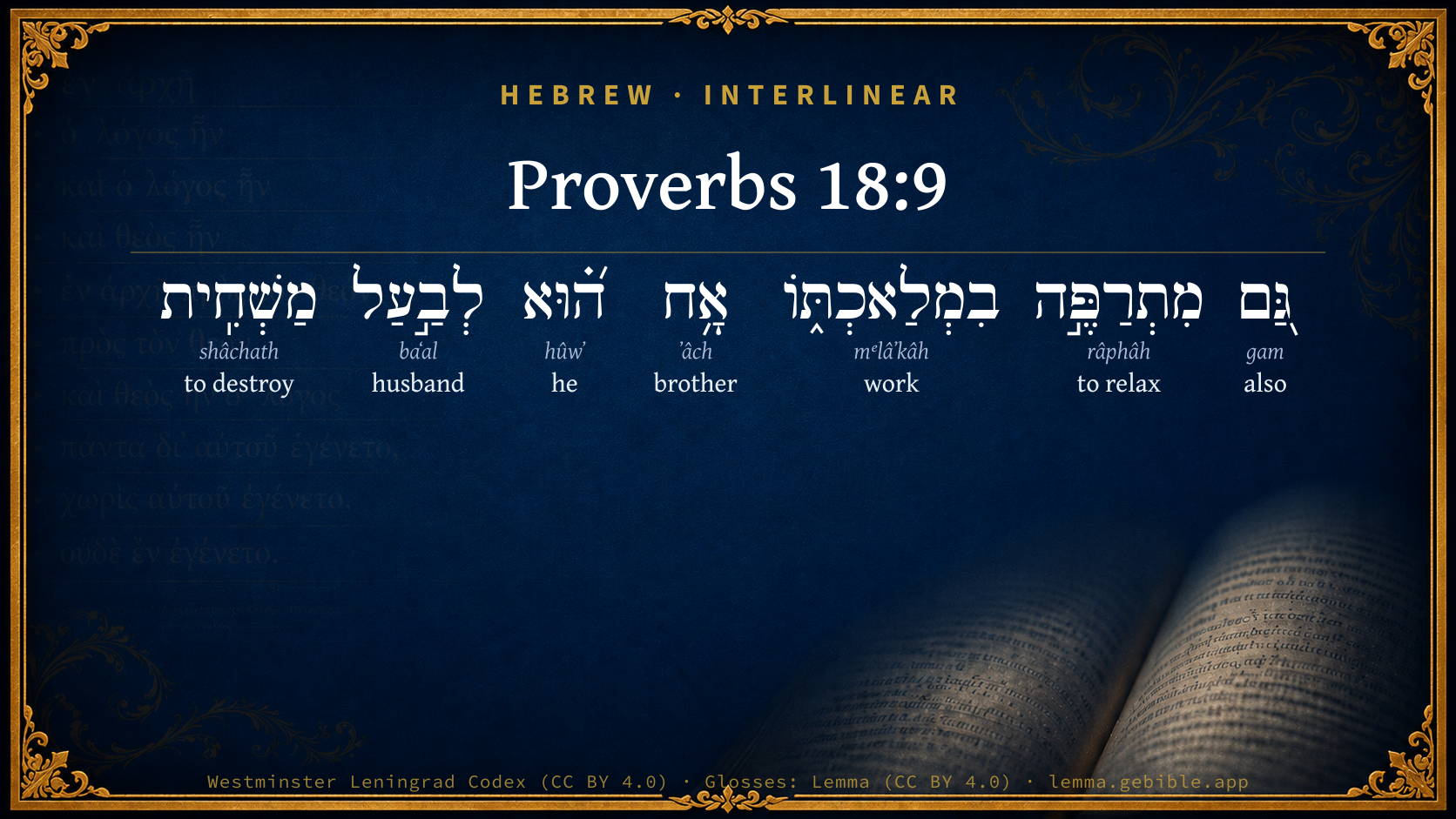
Proverbs 18:9

Hebrew (Westminster Leningrad Codex) Proverbs 18:9 appears in the Hebrew Old Testament. The text above is from the Westminster Leningrad Codex. Each word links to its Strong’s number, a concise gloss, and parsing drawn from the Open Scriptures Hebrew Bible morphology. Click any word for its full Brown-Driver-Briggs (BDB) entry.
Download image
Cite this verse

Proverbs 18:9 (World English Bible). Public Domain. Lemma interlinear Bible study tool, https://lemma.gebible.app/v/proverbs/18/9.

Show BibTeX & RIS
BibTeX
RIS
English Translation
One who is slack in his work Is brother to him who is a master of destruction.
World English Bible · Public Domain
Download a study sheet

One document with this verse’s original text, its word-by-word gloss line, the meaning frame, cross-references with their text, attributed commentary, and full source and license credits — printable, and it pastes into notes with its structure intact.

This verse Autodidact and up

Study sheet (.html) Plain text (.txt)

A passage Seminary Student

Up to 50 verses in one chapter. A passage sheet keeps up to 6 commentary sources and 12 cross-references per verse, in the order this page ranks them, and says so on the sheet whenever that leaves anything out. Ask for a single verse and you get the Autodidact verse sheet above.

Everything on this page stays free to read, with no account — the sheet is a download of what is already on screen, not access to it.

Want to remove ads? Support Godless Engineer
Compare translations 3

The same verse in 3 English versions, stacked beneath the original-language interlinear above. Click any original word for its lexicon entry.

Each is an independent rendering of the whole verse — the interlinear is not word-aligned to these translations.

Highlighted words mark where these versions differ — a whole-verse word diff, not a word-by-word alignment.

  • World English Bible Public Domain
    One who is slack in his work Is brother to him who is a master of destruction.
  • King James Version Public Domain
    He also that is slothful in his work is brother to him that is a great waster.
  • unfoldingWord Literal Text CC BY-SA 4.0
    Also, one who slacks in his work, he a brother to an owner of destruction.

unfoldingWord Literal Text — © unfoldingWord, licensed CC BY-SA 4.0. Word-aligned USFM3 via Door43 (git.door43.org/unfoldingWord/en_ult).

Versions to compare (up to 4)

3 of 4 selected

Show all 18 translations

Every available English version of this verse, each an independent rendering of the whole verse.

  • World English Bible Public Domain
    One who is slack in his work Is brother to him who is a master of destruction.
  • Berean Standard Bible Public Domain
    Whoever is slothful in his work is brother to him who destroys.
  • Majority Standard Bible Public Domain
    Whoever is slothful in his work is brother to him who destroys.
  • King James Version Public Domain
    He also that is slothful in his work is brother to him that is a great waster.
  • American Standard Version (1901) Public Domain
    He also that is slack in his work Is brother to him that is a destroyer.
  • Revised Version (1885) Public Domain
    He also that is slack in his work is brother to him that is a destroyer.
  • Geneva Bible (1599) Public Domain
    He also that is slouthfull in his worke, is euen the brother of him that is a great waster.
  • Douay-Rheims (1899) Public Domain
    He that is loose and slack in his work, is the brother of him that wasteth his own works.
  • Young's Literal Translation Public Domain
    He also that is remiss in his work, A brother he `is' to a destroyer.
  • Literal Standard Version CC BY-SA 4.0
    He also that is remiss in his work, || He [is] a brother to a destroyer.
  • Unlocked Literal Bible CC BY-SA 4.0
    Also, one who is slack in his work is a brother to the one who destroys the most.
  • unfoldingWord Literal Text CC BY-SA 4.0
    Also, one who slacks in his work, he a brother to an owner of destruction.
  • Darby Bible Public Domain
    He also who is indolent in his work is brother of the destroyer.
  • World Messianic Bible Public Domain
    One who is slack in his work is brother to him who is a master of destruction.
  • Webster's Bible Public Domain
    He also that is slothful in his work is brother to him that is a great waster.
  • Free Bible Version CC BY-SA 4.0
    Laziness and destruction are brothers.
  • Bible in Basic English Public Domain
    He who does not give his mind to his work is brother to him who makes destruction.
  • JPS Tanakh (1917) Public Domain
    Even one that is slack in his work is brother to him that is a destroyer.

Literal Standard Version (2020), Covenant Press — licensed CC BY-SA 4.0. Text via the HelloAO Bible API (eBible.org). Unlocked Literal Bible (unfoldingWord) — licensed CC BY-SA 4.0. Text via the HelloAO Bible API (eBible.org). unfoldingWord Literal Text — © unfoldingWord, licensed CC BY-SA 4.0. Word-aligned USFM3 via Door43 (git.door43.org/unfoldingWord/en_ult). Free Bible Version, Dr. Jonathan Gallagher — licensed CC BY-SA 4.0. Text via the HelloAO Bible API (eBible.org).

Word by word

More ways to search: Search by grammar → Find every occurrence → Compare this word →

Practice this passage: Drill this verse → Learn its vocabulary →

מִתְרַפֶּ֣ה
râphâh
H7503
“relaxing”
Verb, Hithpael, Participle Active, Masculine, Singular, Absolute
Part of Speech
Verb
Stem
Hithpael
Form
Participle Active
Gender
Masculine
Number
Singular
State
Absolute
Full BDB Definition

Origin: a primitive root

TWOT: 2198

to sink, relax, sink down, let drop, be disheartened - (Qal) - to sink down - to sink, drop - to sink, relax, abate - to relax, withdraw - (Niphal) idle (participle) - (Piel) to let drop - (Hiphil) - to let drop, abandon, relax, refrain, forsake - to let go - to refrain, let alone - to be quiet - (Hithpael) to show oneself slack
  1. גַּ֭ם gam H1571 “also” Particle, Accusative
  2. בִמְלַאכְתּ֑וֹ mᵉlâʼkâh H4399 “in/at · work · his” Preposition + Noun, Common, Feminine, Singular, Construct + Suffix, Personal, 3rd Person, Masculine, Singular
  3. אָ֥ח ʼâch H251 “brother” Noun, Common, Masculine, Singular, Absolute
  4. ה֝֗וּא hûwʼ H1931 “he” Pronoun, Personal, 3rd Person, Masculine, Singular
  5. לְבַ֣עַל baʻal H1167 “to/for · husband of” Preposition + Noun, Common, Masculine, Singular, Construct
  6. מַשְׁחִֽית shâchath H7843 “destroyer” Noun, Common, Masculine, Singular, Absolute

About this verse

These counts appear in no published source. They are computed here, from the morphology-tagged text and Lemma’s own curated glosses. What Lemma adds →

7
words
7
distinct lemmas
Wisdom
section

Shared distinctive vocabulary

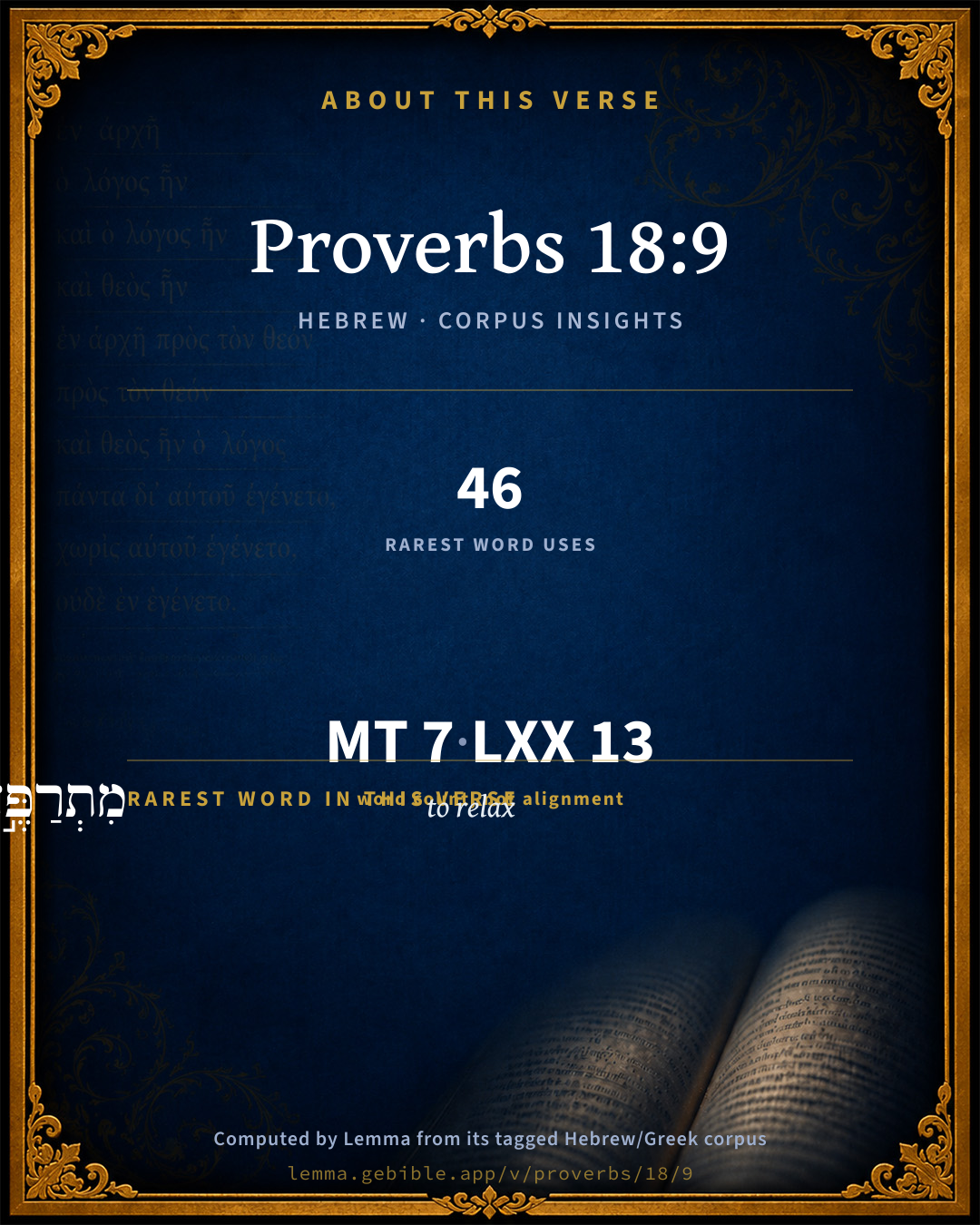
מִתְרַפֶּ֣ה to relax H7503 occurs in 45 verses of the Hebrew Bible. Also found in:

Grammatical profile

  • 1 verb
  • 4 nouns
  • 1 pronoun
  • 1 particle

Verb forms

  • מִתְרַפֶּ֣ה Hithpael · Participle Active

Hebrew & Septuagint length

In English translation the verse runs 17 words from the Hebrew and 16 from the Septuagint (LXX English) — closely comparable.

A rough comparison of the two English renderings, which tokenize alike — not a word-level alignment.

Word counts can differ between the Hebrew and the Greek without any difference in meaning — e.g. the Hebrew direct-object marker אֵת has no separate Greek word, and Greek often adds the article ὁ.

In the original languages it is 7 Hebrew tokens and 13 Greek tokens — but the two are counted differently (Hebrew bundles its prefixes and suffixes into one token; the Greek is in lemma form), so that isn’t a like-for-like length.

Cross-references

10

Topical passages linked to Proverbs 18:9 in the Treasury of Scripture Knowledge — connected by theme and wording, ordered by reader-vote popularity; previews shown in the World English Bible.

  • Proverbs 10:4 He becomes poor who works with a lazy hand, But the hand of the diligent brings wealth.
  • Hebrews 6:12 that you won't be sluggish, but imitators of those who through faith and patience inherited the promises.
  • Proverbs 24:30–34 I went by the field of the sluggard, By the vineyard of the man void of understanding;
  • Proverbs 23:20–21 Don't be among ones drinking too much wine, Or those who gorge themselves on meat:
  • Romans 12:11 not lagging in diligence; fervent in spirit; serving the Lord;
  • Proverbs 28:24 Whoever robs his father or his mother, and says, "It's not wrong." He is a partner with a destroyer.
  • Matthew 25:26 "But his lord answered him, 'You wicked and slothful servant. You knew that I reap where I didn't sow, and gather where I didn't scatter.
  • Luke 15:13–14 Not many days after, the younger son gathered all of this together and traveled into a far country. There he wasted his property with riotous living.
  • Luke 16:1–2 He also said to his disciples, "There was a certain rich man who had a manager. An accusation was made to him that this man was wasting his possessions.
  • Job 30:29 I am a brother to jackals, And a companion to ostriches.

Cross-references courtesy of OpenBible.info (CC BY 4.0).

Hebrew and Greek witnesses Masoretic Hebrew ↔ Greek Septuagint

The same verse in the two great witnesses to the Old Testament, shown verse-for-verse.

These are two independent witnesses, not word-aligned to each other, and the Septuagint is shown in lemma (dictionary) form.

Hebrew Proverbs 18:9 Masoretic · Westminster Leningrad Codex

גַּ֭ם מִתְרַפֶּ֣ה בִמְלַאכְתּ֑וֹ אָ֥ח ה֝֗וּא לְבַ֣עַל מַשְׁחִֽית

One who is slack in his work Is brother to him who is a master of destruction.

World English Bible · Public Domain

Greek LXX Proverbs 18:9 Septuagint · lemma form

ὁ μή ἰάομαι ἑαυτοῦ ἐν ὁ ἔργον αὐτός ἀδελφός εἰμί ὁ λυμαίνω ἑαυτοῦ

A man who helps not himself by his labor is brother of him that ruins himself.

LXX2012 (modern English Septuagint) · Public Domain

On this verse, The Pulpit Commentary discusses the Septuagint’s reading. Read the note in Commentary ↓

Hebrew: Westminster Leningrad Codex (CC BY 4.0). Greek: Septuagint (public domain); English from LXX2012 (modern English Septuagint) (Public Domain). How the Septuagint differs from the Hebrew →

Commentary

Notes on Proverbs 18:9 from classic Christian and Jewish commentators (each source and its license shown beneath its notes). The classic Christian expositions comment on the surrounding passage and are grouped to its opening verse, so a note may address several verses; the Jewish commentaries on the Tanakh (Rashi and others) are per-verse, so they appear only where the commentator wrote on this verse.

Lemma curates 59 commentaries, every one of them public domain or Creative Commons licensed, each selected and text-cleaned for this edition rather than reprinted as found. About our sources →

Trapp's Complete Commentary

John Trapp

Pro 18:9 He also that is slothful in his work is brother to him that is a great waster.

Ver. 9. He also that is slothful in his work.] As he must needs be that goes peddling about with tales, and buzzing evil reports into the ears of those that will hear them. See 1Ti 5:3, with the note there. Lata negligentia dolus est, saith the civilian.

Is brother to him that is a great waster.] Est frater Domini disperditionis, will as certainly come to poverty as the greatest waster of good. A man dies no less surely, though not so suddenly, of a consumption than of an apoplexy.

John Trapp, A Commentary or Exposition upon All the Books of the Old and New Testament (1647–1656) — public domain. Text from a community e-Sword module.

The Biblical Illustrator

Joseph S. Exell

Pro_18:9

He also that is slothful in his work.

Indolence

Indolence is a stream which flows slowly on, but yet undermines the foundation of every virtue. It were as little hazard to be tossed in a storm as to lie thus perpetually becalmed; nor is it to any purpose to have within one the seeds of a thousand good qualities, if we want the vigour and resolution necessary for the exerting them. That the necessity of labour ought to be regarded as a punishment is a mean and sordid notion, invented by the effeminate, the lazy, and the vicious. On the contrary, if God had prohibited labour, such prohibition might justly have been deemed a token of His displeasure, since inaction is a kind of lethargy, equally pernicious to the mind and body. An effeminate Sybarite, we are told, thanked the gods very heartily that he had never seen the sun rise in his life. Can there be a more striking emblem of a narrow and unenlightened mind?--of a wicked and unprofitable servant?

The Biblical Illustrator, edited by Joseph S. Exell (c. 1880s–1900s) — public domain. Text from a community e-Sword module.

The Preacher's Complete Homiletical Commentary

Joseph S. Exell (gen. ed.)

CRITICAL NOTES.—

Pro_18:9. Waster, or destroyer.

MAIN HOMILETICS OF Pro_18:9

TWIN-BROTHERS

I. Slothfulness and prodigality have the same origin. As brothers are the children of a common parent, so sloth and waste have their root in the common sin of ungodliness; men are spendthrifts or they are lazy, because they have no right sense of their obligations to God and to man—because they do not look upon their life as a stewardship for which they must give an account (Rom_14:12), but as a gift which they are at liberty to spend as they please. The acts of the prodigal and the slothful man differ in themselves, but they all spring from that spirit of self-pleasing which is the essence of ungodliness.

II. The slothful man is a waster of God’s most precious gifts. Twin-brothers are often so much alike that it is difficult for onlookers to distinguish one from the other. And there is an aspect in which we may view the slothful man in which we not only note the close resemblance he bears to his prodigal brother, but in which he is transformed into a prodigal himself. For the negative sinner—the man who does nothing—is a waster of his time and of his talents, and is therefore guilty of a positive crime. The man who “hid the Lord’s talent” was visited with a stern sentence as a positive transgressor (Mat_25:25). If we convict a man of prodigality for wasting gold, what shall we say of him who wastes what no gold can buy? “Time,” says J. A. James, “is the most precious thing in the world. When God gives us a moment, He does not promise us another, as if to teach us highly to value and improve it, by the consideration, for aught we know, it may be the last. Time, when gone, never returns. We talk about ‘fetching up’ a lost hour, but the thing is impossible. A moment once lost, is lost for ever. We could as rationally set out to find a sound that had expired in air, as to find a lost moment.” And when we reflect what infinite results depend upon what a man does with his time, we can see the force of the proverb, because the slothful man is a waster of the most precious commodity in this world.

III. The results of both extravagance and sloth are the same. It makes no difference in the end whether a man gets nothing, or spends all that he gets, he can come to poverty by either road. The one has been compared to a man who dies by a rapid and violent disease, and the other by a slow and subtle consumption. But the grave, sooner or later, receives them both.

OUTLINES AND SUGGESTIVE COMMENTS

The practical lesson is, that in personal and domestic interests, diligence and economy should go together, and that the one without the other never can avail for either obtaining or securing even the comforts of life. Of what use is industry if its proceeds are not prudently managed when they come in?—if husband, or wife, or both, be destitute of discretion, improvident and thriftless? if there is the absence of all sober and considerate calculation, and, as a consequence, no due proportioning of outlay to income, but a reckless and wasteful expenditure, leaving an unlooked-for deficiency—a woful amount minus—at the year’s end? The poor inconsiderate fools never think what they are about. They keep no daily reckoning—no accounts; and so their money is gone, they can’t tell how—they had no idea they were living at such a rate!—and even when they have made the discovery there is no improvement. They say, possibly, they must take care; but they only say it, and immediately forget it. Things go on as before; and still (to use rather a colloquial, but sufficiently expressive phrase), what is taken in by the door is thrown out by the window; and still the wonder continues how it goes! They are ever marvelling how other folks do. They can’t understand it. For their parts, all that comes in finds its way off from them as fast as it comes, and many a time faster! Thus, as might be expected, there are the same appearances of bareness, and cheerlessness, and want, in the dwelling of the thriftless as in that of the slothful. Extremes thus meet.… Diligence, let me remind you, is as necessary for the acquisition of spiritual as of temporal good—of the riches of Divine knowledge to the mind, as of the blessings of the Divine life to the heart. And not less is economy of means. How often may it be seen, that with means of a very limited and stinted amount, there is more of spiritual prosperity in one instance, than is discoverable in another, with means the most varied and abundant. Many believers, it is to be feared, are spiritual spendthrifts. They use their privileges on no principle of economy. They read, they hear, they frequent ordinances—and yet their progress in spiritual attainments bears no proportion to the extent of their advantages. Rich in privileges, they are poor in the graces and enjoyments of the life of God in the soul. Why? The answer is plain. They who thrive on slender means, make the most of what they have; whereas they who live in the midst of abundance get into habits of carelessness, and of the prodigal use of what they have.—Wardlaw.

The word also here used may seem to refer this verse to that which goeth before it; and then it is a further description of a talebearer. For he is commonly a fellow slothful in his work, being busy in his words, and he is indeed brother to him that is a great waster, spoiling his own estate by his slothfulness, and by the mischief which his talebearing falleth upon him; and spoiling him to whom he talketh by the ill mind which he putteth into him.—Jermin.

The Preacher's Complete Homiletical Commentary (gen. ed. Joseph S. Exell; Funk & Wagnalls, c. 1892) — public domain (pre-1929). A full-Bible homiletical/sermon-outline anthology covering 65 of 66 books (2 John is absent from the source module). Text from a community e-Sword module.

Matthew Henry's Commentary

Note, 1. Prodigality is very bad husbandry. Those are not only justly branded as fools among men, but will give an uncomfortable account to God of the talents they are entrusted with, who are wasters of their estates, who live above what they have, spend and give more than they can afford, and so, in effect, throw away what they have, and suffer it to run to waste. 2. Idleness is no better. He that is remiss in his work, whose hands hang down (so the word signifies), that stands, as we may, with his thumbs in his mouth, that neglects his business, does it not at all, or as if he did it not, he is own brother to him that is a prodigal, that is, he is as much a fool and in as sure and ready a way to poverty; one scatters what he has, the other lets it run through his fingers. The observation is too true in the affairs of religion; he that is trifling and careless in praying and hearing is brother to him that does not pray or hear at all; and omissions of duty and in duty are as fatal to the soul as commissions of sin.

Matthew Henry's Commentary on the Whole Bible (1708–1710) — public domain (CC PDM 1.0). Text via the HelloAO Bible API.

Jamieson, Fausset & Brown

Robert Jamieson, A. R. Fausset & David Brown

One by failing to get, the other by wasting wealth, grows poor.

waster--literally, "master of washing," a prodigal.

Jamieson, Fausset & Brown — Commentary Critical and Explanatory on the Whole Bible (1871) — public domain (CC PDM 1.0). Text via the HelloAO Bible API.

Adam Clarke's Commentary

Verse 9. He also that is slothful] A slothful man neglects his work, and the materials go to ruin: the waster, he destroys the materials. They are both destroyers.

Adam Clarke's Commentary on the Bible (1810–1826) — public domain. Text from a community e-Sword/MySword module.

Ellicott's Commentary for English Readers

(9) He also that is slothful in his work.—Whatsoever it may be that is committed to his care, is “brother to him that is a great waster,” or “destroyer “; neglect of duty causes almost as much mischief in life as active wickedness.

A Bible Commentary for English Readers, edited by Charles John Ellicott (1878–1897) — public domain. Text from a community e-Sword module.

The Cambridge Bible for Schools and Colleges

gen. ed. J. J. S. Perowne

9. a great waster] Lit. a master of laying waste, or destroying; a destroyer, R.V. Comp. for a similar sentiment, “He that gathereth not with me scattereth abroad,” Mat_12:30.

The Cambridge Bible for Schools and Colleges (gen. ed. J. J. S. Perowne; Cambridge University Press, 1878–1918) — public domain. Text from a community e-Sword module.

John Gill's Exposition

He also that is slothful in his work,.... Remiss in it; hangs down his hands, and does not care to make use of them, but neglects his business:

is brother to him that is a great waster: a prodigal man, who spends his substance in riotous living: the sluggard and the prodigal are brethren in iniquity; for, though they take different courses, they are both sinful, and issue in the same manner; both bring to poverty and want. Or, "brother to a master that wastes" (p); a slothful servant and a wasteful master are near akin, and come into the same class and circumstances. Jarchi interprets it,

"he that separateth from the law, though a disciple of a wise man, is a brother to Satan;''

whose name is Apollyon, the waster and destroyer. A man that is slothful in spiritual things, though a professor of religion, and has a place in the house of God, is brother to him that is a waster and persecutor of it; see Mat 12:30.

(p) "domino devaststionis", Gejerus; "domino dissipanti", Mercerus.

John Gill's Exposition of the Whole Bible (1746–1763) — public domain (CC PDM 1.0). Text via the HelloAO Bible API.

Haydock's Catholic Bible Commentary

Brother. Like him, as both end in poverty, chap. x. 4., and xii. 11.

George Leo Haydock (1774–1849), Haydock's Catholic Family Bible and Commentary, 1859 edition — public domain. Excludes Psalms (Douay-Rheims chapter numbering differs from Protestant) and Deuterocanonical books (Catholic canon only).

Matthew Poole's English Annotations

They are alike; though they take several paths, yet both come to one end, even to extreme want and poverty.

Matthew Poole's English Annotations on the Holy Bible (1683–1685) — public domain. Text from a community e-Sword/MySword module.

Whedon's Commentary on the Bible

Daniel D. Whedon

9. He… is brother — Both courses lead to the same end, poverty; the one does not make what he ought, and the other destroys what is made.

Great waster — Literally, master of destruction; destroyer. Comp. Pro_28:24.

Daniel D. Whedon (gen. ed.), Commentary on the Old and New Testaments (1874–1909) — public domain. Text from a community e-Sword module.

The Pulpit Commentary

He also that is slothful (slack) in his work. A man that does his work in some sort, but not heartily and diligently, as one who knows that labour is not only a duty and necessity, but a means of sanctification, a training for a higher life. Is brother to him that is a great waster; a destroyer. "Brother" is used as "companion" in Pro_28:24, (comp. Job_30:29) for one of like attributes and tendencies; as we say, "next door to;" and the destroyer is, as Nowack says, not merely one who wastes his property by reckless expenditure, but one who delights in such destruction, finds a morbid pleasure in haves and ruin. So the maxim asserts that remissness in duty is as mischievous as actual destructiveness. "An idle brain," say the Italians, "is the devil"s workshop." The word rendered "great" is baal, (Pro_1:19) "owner," patrono (Montanus), domino (Vatablus); and, taking this sense, according to Wordsworth and others, the sentence implies that the servant who is slothful is brother to a master who is a prodigal. But the interpretation given above is best founded. The LXX, reading aprtm instead of, hprtm, renders, "He who healeth not (o mh iwmenov ) himself in his works is brother to him who destroyeth himself." Maxims concerning laziness are found in other places; e.g. Pro_10:4 Pro_12:11, 24 23:21.

Needless destitution.

This strong utterance suggests

I THE PREVALENCE OF DESTITUTION. How much of human life is needlessly low! how many men live low down in the scale who might just as well be living high up it! how sadly do men bereave themselves of good! This applies to:

1. Their circumstances: their daily surroundings; the homes in which they live, their food and raiment, the occupations in which they are engaged; their companionships, etc.

2. Their intelligence: their intellectual activity, their knowledge, their acquaintance with their own complex nature and with the world in which they live, their familiarity with (or their ignorance of) men and things.

3. Their moral and spiritual condition: their capacity or incapacity to control their temper, to govern their spirit, to regulate their life, to form honourable and elevating habits, to worship God, to set their lives in accordance with the will and after the example of Christ.

II THE TWO MAIN SOURCES OF IT. These are those which are indicated in the text.

1. The absence of energy in action; being "slothful or, "slack," Revised Version in work." Men who fail in their department, of whatever kind it may be, are usually those who do not throw any heart, any earnestness, any continuous vigour, into their work. They do what is before them perfunctorily, carelessly, or spasmodically. Hence they make no profits, they earn low wages, they have poor crops, they gain few customers or patients, they win no success; hence they read few instructive books, they make no elevating and informing friendships, they acquire no new ideas, they store up no new facts, they make no mental progress; hence they do not cultivate their moral and spiritual nature, they do not "build themselves up" on the foundation of truth; they are adding no stones to the living temple; they do not grow in wisdom, or in worth, or in grace. The other source is:

2. The presence of prodigality. He that is slothful in work is "brother to him that is a great waster." What sad wastefulness is on every hand! what dissipation of gathered treasure! what expenditure of means and of strength on that which does not profit! For these are the two forms of waste.

(1) Allowing to depart that which it would be wise to hold in hand money, goods, friends, supporters, resources.

(2) Expending power on that which does not profit; letting our time, our strength, our mental forces, our moral energies, be employed upon those things which yield no return, or no adequate and proportionate return. Were men to spend their money on profitable and fruit bearing labour, their brains on enlightening and enlarging study, their spiritual energies on intelligent worship or redeeming work, instead of wasting them as now they do, how would the desert become a fruitful field, in every sphere! But we must not overlook the fact that there is

III A SOLID REMAINDER, NOT THUS ACCOUNTED FOR. Although sloth and waste together explain a very large part indeed of the destitution on the earth, they leave much still to be accounted for. And of this remainder part is due to simple and pure misfortune or incapacity, and part to the guilt of others who are not the sufferers. All this destitution is the proper field for Christian effort. It is the proper object of our genuine compassion, and of our strenuous endeavour toward removal. But to those who are culpably destitute we have to go and say Your way upward is before you; you must exert yourselves if you would rise. No one can really enrich a human soul but himself.

1. Bring a sustained energy to bear on the work in which you are engaged.

2. Guard with a wise watchfulness what you have won.

3. Put out your powers upon that which is worthy of them and that which will repay them. C.

The Pulpit Commentary (1880–1919), ed. H.D.M. Spence-Jones & Joseph S. Exell — public domain. Text from a community e-Sword module.

John Wesley's Explanatory Notes

Is brother - Though they take several paths, yet both come to one end.

John Wesley, Explanatory Notes Upon the Whole Bible (1754–1765) — public domain. Text via the GEBible commentary corpus.

Keil & Delitzsch

C. F. Keil & F. Delitzsch

9 He also who showeth himself slothful in his business,

Is a brother to him who proceedeth to destroy.

The Hithpa. התרפּה signifies here, as at Pro 24:10, to show oneself slack, lazy, negligent. מלאכה is properly a commission for another, as a king has a messenger, ambassador, commissioner to execute it; here, any business, whether an undertaking in commission from another, or a matter one engages in for himself. He who shows himself slack therein, produces in his way, viz., by negligence, destruction, as truly as the בּעל משׁחית, who does it directly by his conduct. Thus one is named, who is called, or who has his own delight in it, to destroy or overthrow. Jerome, incorrectly limiting: sua opera dissipantis. Hitzig well compares Mat 12:30. In the variation, Pro 28:24, the destroyer is called אישׁ משׁחית, the connection of the words being adject.; on the contrary, the connection of בעל משׁחית is genit. (cf. Pro 22:24; Pro 23:2, etc.), for משׁחית as frequently means that which destroys = destruction. Von Hofmann (Schriftbew. ii. 2, 403) understands 'אישׁ מ of the street robber, 'בעל מ of the captain of robbers; but the designation for the latter must be 'שׂר מ, though at Kg1 11:24 he is called by the name שׂר גּדוּד. The form of the word in the proverb here is more original than at 38:24. There חבר [companion] is used, here אח [brother], a general Semitic name of him who, or of that which, is in any way related to another, cf. Job 30:29. Fleischer compares the Arab. proverb: âlshbht âkht alkhṭyât, scepticism is the sister of sin.

Keil & Delitzsch — Biblical Commentary on the Old Testament (1861–1891) — public domain (CC PDM 1.0). Text via the HelloAO Bible API. (Old Testament only.)

Bridges on Proverbs

Charles Bridges

Observe the affinity of the different principles and workings of corruption. The sluggard and the prodigal belong to the same family. The man who "hid the Lord’s talent," was equally unfaithful with him who "wasted his goods." (Mat 25:25 . Luk 16:1 .) The slothful has no heart for his work. Important opportunities slip by. His stock, instead of increasing by trade, gradually dwindles into penury. ’God hath a bountiful "hand, and filleth all things living with plenteousness." (Psa 145:16 . P.T.) But unless we have a diligent hand, wherewith to receive it, we may starve. He that by the sloth of his hand disfurnisheth himself of the means of getting, he is as near of kin to a waster as may be.’†1 He is the brother of a great waster — the lord of a large estate, who, instead of husbanding, improving, and enjoying it, wastes it away in extravagance and folly.

It is the same in religion. The one is content with heartless orthodoxy. His secret prayer brings no after remembrance. His family worship is a routine of formality, not the influential ordinance of the day. "Communing with his heart" is mere barren generality, bringing no accurate and humbling knowledge of himself. And wherein does he differ from the careless waster of his privileges? Where is the important distinction between him who prays, reads, and works formally, and him, who utterly casts these high privileges away? Both take the same course, though by a somewhat different track. The one folds his arms in sloth. The other opens his hands in wastefulness. The one gets nothing. The other spends what he gets. The one rushes into beggary. The other sits still, and waits its arrival. (Pro 6:11 .) The one dies by a rapid and violent disease. The other by a slow, subtle, but sure, consumption. Thus fearful is the guilt, solemn is the account, certain is the ruin, of both. God gives talents, not only to enrich, but to employ. And whether they be selfishly neglected, or carelessly thrown away — "Thou wicked servant" will be the condemnation; "outer darkness" will be the just and eternal doom. (Mat 25:26-30 .) Servant of Christ! let thy Master’s life be thy pattern and thy standard. Not a moment with him was slothfully neglected; not a moment unprofitably wasted. Equally fervent was he in daily work, as in nightly prayer. Follow him in his work, and thou wilt be honoured with His reward. (Joh 12:26 .)

Footnotes:

†1 Bishop Sanderson’s Sermon on 1Co 7:24 .

Charles Bridges, An Exposition of the Book of Proverbs (1846) — public domain. Text from a community e-Sword module.

Kretzmann's Popular Commentary

Paul E. Kretzmann

v. 9. He also that is slothful in his work, who does not apply himself to it with all diligence, is brother to him that is a great waster, a squanderer; the two are closely related, since in either case possessions are lost.

Paul E. Kretzmann, Popular Commentary of the Bible (1921–1924) — public domain. Text from a community e-Sword module.

unfoldingWord translationNotes

Door43 World Missions Community

one who is slack in his work is a brother to the one who destroys

This speaks of the one who is slack being similar to the one who destroys as if they were actually related. AT: "is closely related to" or "is very similar to" (See: Metaphor)

is slack

"is lazy" or "is not interested"

the one who destroys the most

"the one who destroys everything" or "the one who is always destructive"

The name of Yahweh is a strong tower

This speaks of Yahweh protecting his people as if he were a strong tower in which they could take refuge. AT: "Yahweh protects like a strong tower" or "Yahweh protects his people like a strong tower" (See: Metaphor)

The name of Yahweh

Here Yahweh is referred to by his name. AT: "Yahweh" (See: Metonymy)

the righteous

This refers to righteous people. AT: "those who are righteous" or "righteous people" (See: Nominal Adjectives)

runs into it and is safe

This speaks of people seeking safety from Yahweh and Yahweh protecting them as if he were a strong tower that they ran into for safety. AT: "run to him and they are safe" or "seek him and they are safe" (See: Metaphor)

translationWords

name

Yahweh

watchtower

save

unfoldingWord translationNotes — © Distant Shores Media and the Door43 World Missions Community, licensed CC BY-SA 4.0. Source: git.door43.org/Door43/en_tn.

Rashi

Rabbi Shlomo Yitzchaki (Rashi)

Even one who is slack in his work If he is a Torah scholar who separated himself from the Torah.

to the destroyer To Satan.

Rashi on the Tanakh — English translations: “The Judaica Press complete Tanach with Rashi, translated by A. J. Rosenberg” (CC BY 4.0); “Pentateuch with Rashi's commentary by M. Rosenbaum and A.M. Silbermann, 1929-1934” (public domain); “The Metsudah Tanach series, Lakewood, N.J” (CC BY 4.0); and “The Book of Joshua, Metsudah Publications, 1997” (CC BY 4.0). Text via Sefaria.

Lesson kit

Teaching starters — assembled from the data on this page, not authored interpretation. Every prompt links to the verse data it draws on. Edit before teaching.

Proverbs, in the Wisdom, opens this verse with 7 words (7 distinct Hebrew lemmas). Its most distinctive word is râphâh (“to relax”). A historical commentator’s framing appears above. Read the whole chapter for the surrounding context.

Discussion questions

  1. The word râphâh carries the sense “to relax.” How does it shape the verse?
  2. How does Exodus 4:26, which shares the word «to relax», read alongside this verse?
  3. These translations render this verse differently; the difference is in the English rendering, not the original. What questions does that raise?
  4. «מִתְרַפֶּ֣ה» is a Hithpael Participle Active verb. How does that grammatical form shape the action described?
  5. Compare how Trapp's Complete Commentary and The Biblical Illustrator read this verse. Where do they agree or differ?

Things to notice

Reading settings

Reading text

Shown beneath each verse's original-language words.

Old Testament
Old Testament edition

Read the OT as the Masoretic Hebrew (MT) or the Greek Septuagint (LXX).

English shown for the Greek Septuagint (in the Hebrew ↔ Greek comparison).

Comparing translations? Open the Compare panel on any verse page to stack up to four side by side.