
1 Chronicles 9:33

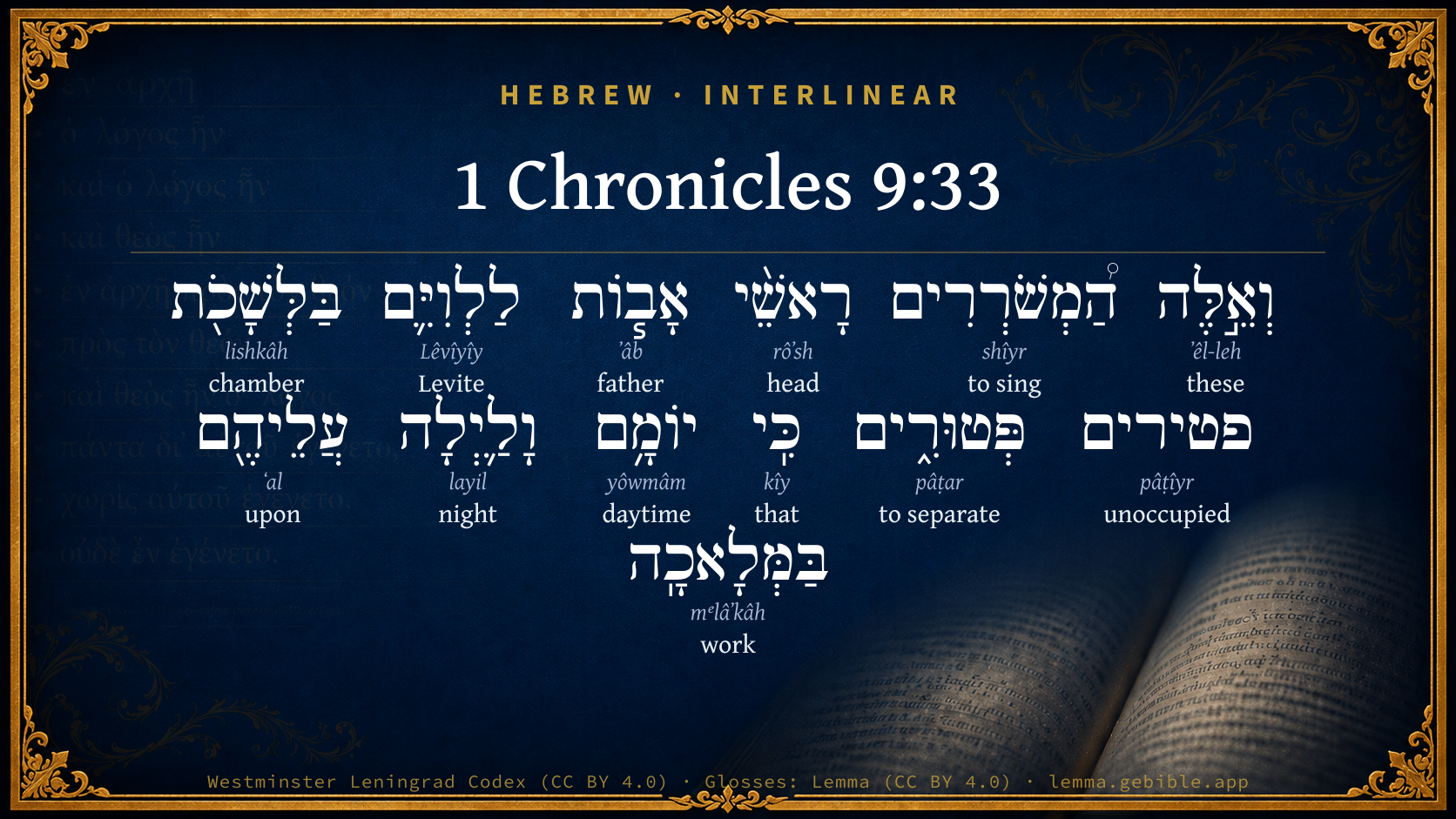
Hebrew (Westminster Leningrad Codex) 1 Chronicles 9:33 appears in the Hebrew Old Testament. The text above is from the Westminster Leningrad Codex. Each word links to its Strong’s number, a concise gloss, and parsing drawn from the Open Scriptures Hebrew Bible morphology. Click any word for its full Brown-Driver-Briggs (BDB) entry.
Download image
Cite this verse

1 Chronicles 9:33 (World English Bible). Public Domain. Lemma interlinear Bible study tool, https://lemma.gebible.app/v/1-chronicles/9/33.

Show BibTeX & RIS
BibTeX
RIS
English Translation
These are the singers, heads of fathers' [houses] of the Levites, [who lived] in the chambers [and were] free [from other service]; for they were employed in their work day and night.
World English Bible · Public Domain
Highlights
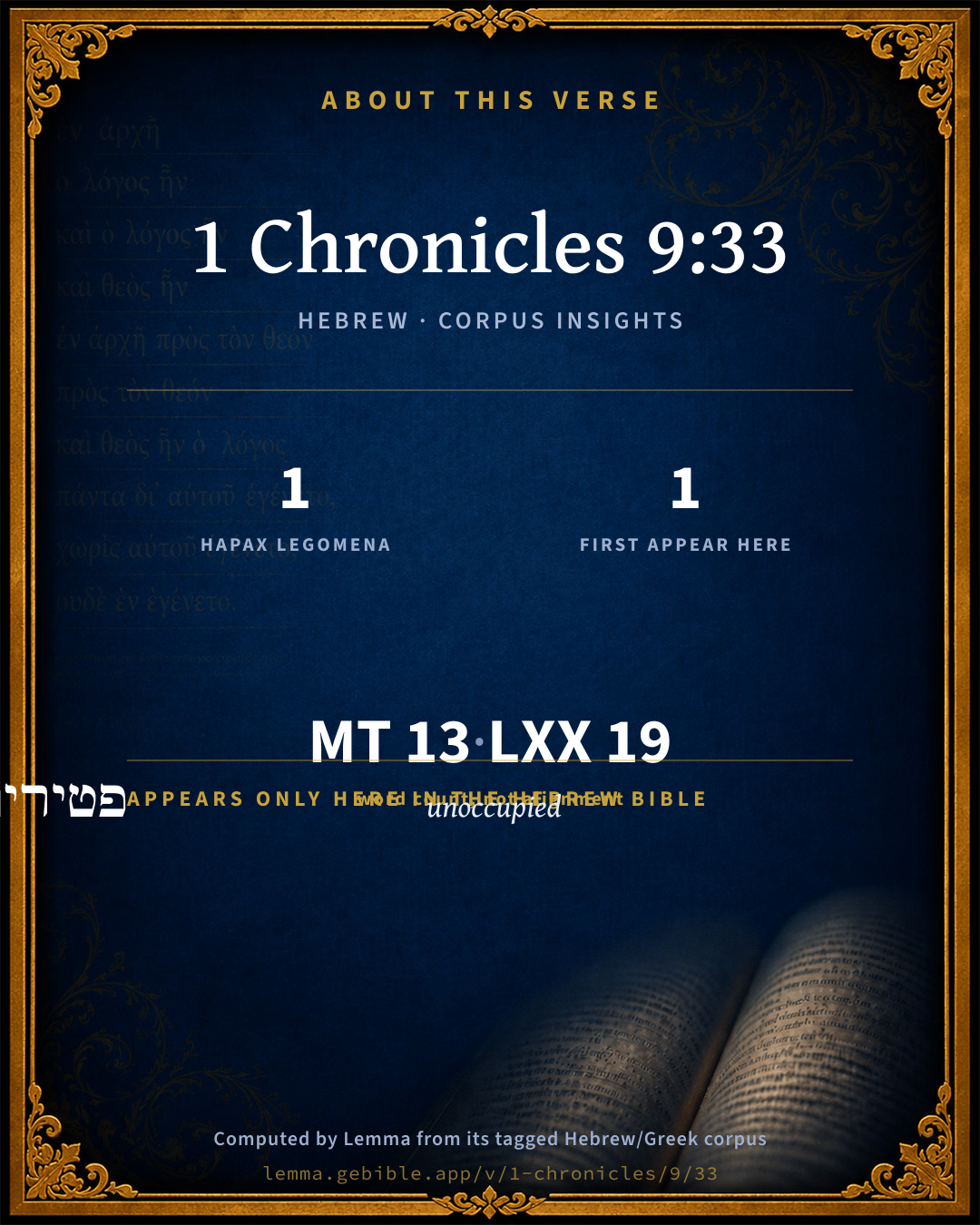
  • 1 hapax legomenon — only here in the Hebrew Bible
  • 1 first appearance in the Hebrew Bible
Full analysis ↓
Download a study sheet

One document with this verse’s original text, its word-by-word gloss line, the meaning frame, cross-references with their text, attributed commentary, and full source and license credits — printable, and it pastes into notes with its structure intact.

This verse Autodidact and up

Study sheet (.html) Plain text (.txt)

A passage Seminary Student

Up to 50 verses in one chapter. A passage sheet keeps up to 6 commentary sources and 12 cross-references per verse, in the order this page ranks them, and says so on the sheet whenever that leaves anything out. Ask for a single verse and you get the Autodidact verse sheet above.

Everything on this page stays free to read, with no account — the sheet is a download of what is already on screen, not access to it.

Want to remove ads? Support Godless Engineer
Compare translations 3

The same verse in 3 English versions, stacked beneath the original-language interlinear above. Click any original word for its lexicon entry.

Each is an independent rendering of the whole verse — the interlinear is not word-aligned to these translations.

Highlighted words mark where these versions differ — a whole-verse word diff, not a word-by-word alignment.

  • World English Bible Public Domain
    These are the singers, heads of fathers' [houses] of the Levites, [who lived] in the chambers [and were] free [from other service]; for they were employed in their work day and night.
  • King James Version Public Domain
    And these are the singers, chief of the fathers of the Levites, who remaining in the chambers were free: for they were employed in that work day and night.
  • unfoldingWord Literal Text CC BY-SA 4.0
    And these, the singers, heads of fathers of the Levites, in the chambers were free, for day and by night over them in the work.

unfoldingWord Literal Text — © unfoldingWord, licensed CC BY-SA 4.0. Word-aligned USFM3 via Door43 (git.door43.org/unfoldingWord/en_ult).

Versions to compare (up to 4)

3 of 4 selected

Show all 18 translations

Every available English version of this verse, each an independent rendering of the whole verse.

  • World English Bible Public Domain
    These are the singers, heads of fathers' [houses] of the Levites, [who lived] in the chambers [and were] free [from other service]; for they were employed in their work day and night.
  • Berean Standard Bible Public Domain
    Those who were musicians, the heads of Levite families, stayed in the temple chambers and were exempt from other duties because they were on duty day and night.
  • Majority Standard Bible Public Domain
    Those who were musicians, the heads of Levite families, stayed in the temple chambers and were exempt from other duties because they were on duty day and night.
  • King James Version Public Domain
    And these are the singers, chief of the fathers of the Levites, who remaining in the chambers were free: for they were employed in that work day and night.
  • American Standard Version (1901) Public Domain
    And these are the singers, heads of fathers' `houses' of the Levites, `who dwelt' in the chambers `and were' free `from other service'; for they were employed in their work day and night.
  • Revised Version (1885) Public Domain
    And these are the singers, heads of fathers’ houses of the Levites, who dwelt in the chambers and were free from other service: for they were employed in their work day and night.
  • Geneva Bible (1599) Public Domain
    And these are the singers, the chiefe fathers of the Leuites, which dwelt in the chambers, and had none other charge: for they had to do in that busines day and night:
  • Douay-Rheims (1899) Public Domain
    These are the chief of the singing men of the families of the Levites, who dwelt in the chambers, by the temple, that they might serve continually day and night in their ministry.
  • Young's Literal Translation Public Domain
    And these who sing, heads of fathers of the Levites, in the chambers, `are' free, for by day and by night `they are' over them in the work.
  • Literal Standard Version CC BY-SA 4.0
    And these who sing, heads of fathers of the Levites, in the chambers, [are] free, for [they are] over them in the work by day and by night.
  • Unlocked Literal Bible CC BY-SA 4.0
    The singers and heads of the Levites' fathers' houses lived in rooms at the sanctuary when they were free from work, because they had to carry out their assigned tasks day and night.
  • unfoldingWord Literal Text CC BY-SA 4.0
    And these, the singers, heads of fathers of the Levites, in the chambers were free, for day and by night over them in the work.
  • Darby Bible Public Domain
    And these were the singers, chief fathers of the Levites, [who were] in the chambers free from service; for they were employed day and night.
  • World Messianic Bible Public Domain
    These are the singers, heads of fathers’ households of the Levites, who lived in the rooms and were free from other service, for they were employed in their work day and night.
  • Webster's Bible Public Domain
    And these are the singers, chief of the fathers of the Levites, who remaining in the chambers were free: for they were employed in that work day and night.
  • Free Bible Version CC BY-SA 4.0
    The musicians, heads of Levite families, lived in the rooms in the Temple and were not required to carry out other duties because they were on duty day and night.
  • Bible in Basic English Public Domain
    And these were those who had the ordering of the music and songs, heads of families of the Levites, who were living in the rooms, and were free from other work, for their work went on day and night.
  • JPS Tanakh (1917) Public Domain
    And these are the singers, heads of fathers' houses of the Levites, who dwelt in the chambers and were free from other service; for they were employed in their work day and night.

Literal Standard Version (2020), Covenant Press — licensed CC BY-SA 4.0. Text via the HelloAO Bible API (eBible.org). Unlocked Literal Bible (unfoldingWord) — licensed CC BY-SA 4.0. Text via the HelloAO Bible API (eBible.org). unfoldingWord Literal Text — © unfoldingWord, licensed CC BY-SA 4.0. Word-aligned USFM3 via Door43 (git.door43.org/unfoldingWord/en_ult). Free Bible Version, Dr. Jonathan Gallagher — licensed CC BY-SA 4.0. Text via the HelloAO Bible API (eBible.org).

Word by word

More ways to search: Search by grammar → Find every occurrence → Compare this word →

Practice this passage: Drill this verse → Learn its vocabulary →

פטירים
pâṭîyr
H6359
“unoccupied”
Noun, Common, Masculine, Plural, Absolute
Part of Speech
Noun
Type
Common
Gender
Masculine
Number
Plural
State
Absolute
Full BDB Definition

Origin: from H6362

TWOT: 1764

unoccupied, free to work
  1. וְאֵ֣לֶּה ʼêl-leh H428 “and · these” Conjunction + Pronoun, Demonstrative, Common, Plural
  2. הַ֠מְשֹׁרְרִים shîyr H7891 “the · singing” Particle, Definite Article + Verb, Polel, Participle Active, Masculine, Plural, Absolute
  3. רָאשֵׁ֨י rôʼsh H7218 “heads of” Noun, Common, Masculine, Plural, Construct
  4. אָב֧וֹת ʼâb H1 “fathers” Noun, Common, Masculine, Plural, Absolute
  5. לַלְוִיִּ֛ם Lêvîyîy H3881 “to/for the · Levites” Preposition, Determined + Noun, Gentilic, Masculine, Plural, Absolute
  6. בַּלְּשָׁכֹ֖ת lishkâh H3957 “in/at the · chambers” Preposition, Determined + Noun, Common, Feminine, Plural, Absolute
  7. פְּטוּרִ֑ים pâṭar H6362 “separated” Verb, Qal, Participle Passive, Masculine, Plural, Absolute
  8. כִּֽי kîy H3588 “that” Conjunction
  9. יוֹמָ֥ם yôwmâm H3119 “daytime” Adverb
  10. וָלַ֛יְלָה layil H3915 “and · night” Conjunction + Noun, Common, Masculine, Singular, Absolute
  11. עֲלֵיהֶ֖ם ʻal H5921 “upon · them” Preposition + Suffix, Personal, 3rd Person, Masculine, Plural
  12. בַּמְּלָאכָֽה mᵉlâʼkâh H4399 “in/at the · work” Preposition, Determined + Noun, Common, Feminine, Singular, Absolute

About this verse

These counts appear in no published source. They are computed here, from the morphology-tagged text and Lemma’s own curated glosses. What Lemma adds →

13
words
13
distinct lemmas
Historical
section

Notable vocabulary

1 hapax legomenon — a word that appears only here in the entire Hebrew Bible:

  • פטירים unoccupied H6359

First appearance in Scripture

This word makes its first canonical appearance in the Hebrew Bible here:

  • פטירים unoccupied H6359

Shared distinctive vocabulary

פְּטוּרִ֑ים to separate H6362 occurs in 5 verses of the Hebrew Bible. Also found in:

Grammatical profile

  • 2 verbs
  • 7 nouns
  • 1 pronoun
  • 1 preposition
  • 1 conjunction
  • 1 adverb

Verb forms

  • הַ֠מְשֹׁרְרִים Polel · Participle Active
  • פְּטוּרִ֑ים Qal · Participle Passive

Hebrew & Septuagint length

In English translation the verse runs 32 words from the Hebrew and 27 from the Septuagint (LXX English) — closely comparable.

A rough comparison of the two English renderings, which tokenize alike — not a word-level alignment.

Word counts can differ between the Hebrew and the Greek without any difference in meaning — e.g. the Hebrew direct-object marker אֵת has no separate Greek word, and Greek often adds the article ὁ.

In the original languages it is 13 Hebrew tokens and 19 Greek tokens — but the two are counted differently (Hebrew bundles its prefixes and suffixes into one token; the Greek is in lemma form), so that isn’t a like-for-like length.

Cross-references

9

Topical passages linked to 1 Chronicles 9:33 in the Treasury of Scripture Knowledge — connected by theme and wording, ordered by reader-vote popularity; previews shown in the World English Bible.

  • 1 Chronicles 6:31–33 These are they whom David set over the service of song in the house of Yahweh, after that the ark had rest.
  • 1 Chronicles 16:4–6 He appointed certain of the Levites to minister before the ark of Yahweh, and to celebrate and to thank and praise Yahweh, the God of Israel:
  • 1 Chronicles 25:1–31 Moreover, David and the captains of the host set apart for the service certain of the sons of Asaph, and of Heman, and of Jeduthun, who should prophesy with harps, with psalteries, and with cymbals: and the number of those who did the work according to their service was:
  • Psalms 134:1–2 Look! Praise Yahweh, all you servants of Yahweh, Who stand by night in Yahweh's house!
  • 1 Chronicles 15:16–22 David spoke to the chief of the Levites to appoint their brothers the singers, with instruments of music, psalteries and harps and cymbals, sounding aloud and lifting up the voice with joy.
  • Ezra 7:24 Also we inform you, that touching any of the priests and Levites, the singers, porters, Nethinim, or servants of this house of God, it shall not be lawful to impose tribute, custom, or toll, on them.
  • Nehemiah 11:17 and Mattaniah the son of Mica, the son of Zabdi, the son of Asaph, who was the chief to begin the thanksgiving in prayer, and Bakbukiah, the second among his brothers; and Abda the son of Shammua, the son of Galal, the son of Jeduthun.
  • Nehemiah 11:22–23 The overseer also of the Levites at Jerusalem was Uzzi the son of Bani, the son of Hashabiah, the son of Mattaniah, the son of Mica, of the sons of Asaph, the singers, over the business of the house of God.
  • Psalms 135:1–3 Praise Yah! Praise the name of Yahweh! Praise him, you servants of Yahweh,

Cross-references courtesy of OpenBible.info (CC BY 4.0).

Hebrew and Greek witnesses Masoretic Hebrew ↔ Greek Septuagint

The same verse in the two great witnesses to the Old Testament, shown verse-for-verse.

These are two independent witnesses, not word-aligned to each other, and the Septuagint is shown in lemma (dictionary) form.

Hebrew 1 Chronicles 9:33 Masoretic · Westminster Leningrad Codex

וְאֵ֣לֶּה הַ֠מְשֹׁרְרִים רָאשֵׁ֨י אָב֧וֹת לַלְוִיִּ֛ם בַּלְּשָׁכֹ֖ת פטירים פְּטוּרִ֑ים כִּֽי יוֹמָ֥ם וָלַ֛יְלָה עֲלֵיהֶ֖ם בַּמְּלָאכָֽה

These are the singers, heads of fathers' [houses] of the Levites, [who lived] in the chambers [and were] free [from other service]; for they were employed in their work day and night.

World English Bible · Public Domain

Greek LXX 1 Chronicles 9:33 Septuagint · lemma form

καί οὗτος ψαλτῳδός ἄρχων ὁ πατριά ὁ λευίτης διατάσσω ἐφημερία ὅτι ἡμέρα καί νύξ ἐπί αὐτός ἐν ὁ ἔργον

And these were the singers, heads of families of the Levites, to whom were established daily courses, for they were employed in the services day and night.

LXX2012 (modern English Septuagint) · Public Domain

On this verse, Haydock's Catholic Bible Commentary discusses the Septuagint’s reading. Read the note in Commentary ↓

Hebrew: Westminster Leningrad Codex (CC BY 4.0). Greek: Septuagint (public domain); English from LXX2012 (modern English Septuagint) (Public Domain). How the Septuagint differs from the Hebrew →

Commentary

Notes on 1 Chronicles 9:33 from classic Christian and Jewish commentators (each source and its license shown beneath its notes). The classic Christian expositions comment on the surrounding passage and are grouped to its opening verse, so a note may address several verses; the Jewish commentaries on the Tanakh (Rashi and others) are per-verse, so they appear only where the commentator wrote on this verse.

Lemma curates 59 commentaries, every one of them public domain or Creative Commons licensed, each selected and text-cleaned for this edition rather than reprinted as found. About our sources →

Trapp's Complete Commentary

John Trapp

1Ch 9:33 And these [are] the singers, chief of the fathers of the Levites, [who remaining] in the chambers [were] free: for they were employed in [that] work day and night.

Ver. 33. Were free,] i.e., Freed from all other employments.

John Trapp, A Commentary or Exposition upon All the Books of the Old and New Testament (1647–1656) — public domain. Text from a community e-Sword module.

Joseph Benson's Commentary

1Ch 9:33. And these — Others of the Levites; of whose several offices he had spoken before. Are — Or rather, were; which is understood all along in the foregoing and following verses. Remaining in the chambers — That they might be ready to come whensoever they were called to the service of God in the tabernacle. Were free — From all trouble and employment, that they might wholly attend upon their proper work; which was either composing or ordering sacred songs, or actually singing, or teaching others to sing them. Day and night — Continually, and particularly in the morning and evening, the two times appointed for solemn service. Thus was God continually praised, as it is fit he should be, who is continually doing us good.

Joseph Benson's Commentary on the Old and New Testaments (1811–1818) — public domain. Text from a community e-Sword module.

Geneva Bible (1599)

Geneva Bible translators

But were continually occupied in singing praises to God.

Geneva Bible (1599) marginal notes — public domain. Text via Bolls.life.

Ellicott's Commentary for English Readers

(33) Refers to the singers treated of in 1Ch_9:14-16 : And these (above mentioned) are the minstrels, heads of Levitical families; in the Temple cells (they lived), exempt from all other charge; for day and night they were over them in the work. The Hebrew is, harsh, and perhaps corrupt, but the meaning seems to be clear. It is hardly meant that the service of song in the Temple was uninterrupted (comp. Rev_4:8), but only that the choristers were under obligation to perpetually recurring service.

They were employed in that work.—Rather, They were over them in the work. They—that is, the leaders for the time being—lived, like the chief warders, in the Temple cells, presiding continually over the guilds of singers.

(33, 34) A general subscription, or concluding statement, with reference to the preceding account of the Levites (1Ch_9:14-32).

A Bible Commentary for English Readers, edited by Charles John Ellicott (1878–1897) — public domain. Text from a community e-Sword module.

The Cambridge Bible for Schools and Colleges

gen. ed. J. J. S. Perowne

33. And these are] This verse may be intended as a colophon to 1Ch_9:15-16, for the names there given are those of singers; cp. Neh_11:17. On the other hand it may have been intended as the heading of such a list as appears in 1Ch_6:33-47 (= 18–32, Heb.), the list itself on second thoughts being omitted.

chief of the fathers of the Levites who remaining in the chambers were free] R.V. heads of fathers’ houses of the Levites, who dwelt in the chambers and were free from other service.

in that work] R.V. in their work.

day and night] Cp. Psa_134:1; Rev_4:8.

The Cambridge Bible for Schools and Colleges (gen. ed. J. J. S. Perowne; Cambridge University Press, 1878–1918) — public domain. Text from a community e-Sword module.

Albert Barnes' Notes on the Bible

The singers - No names follow, and it is thought that they have fallen out.

Were free - “Free,” i. e. from any special duties besides those of supervision, which was so arranged among the overseers that someone exercised it during every part of both day and night.

Albert Barnes' Notes on the Bible (1834–1885) — public domain. Text from a community e-Sword/MySword module.

Haydock's Catholic Bible Commentary

These; probably Sellum, &c., (ver. 17) though it is not certain that the chief porters presided over the singers, chap. xv., and xvi. Hebrew, "And these are the singers, chief of the families (Calmet; or fathers) of the Levites, in the chambers (of the temple) free" from all other avocations, (Haydock) that they may watch over the porters and musicians. Septuagint is clearer: (Calmet) "And these are the masters of music over the bands of Levites, observing their daily courses, because they are day and night over them in the works." (Haydock) --- The sons of Caath seem to be chiefly specified, (ver. 32) though other families sung, chap. vi. 39. --- Chambers, at a distance from their wives, to trim the lamps in the evening, and to see that none were extinguished, (Menochius) as also to teach music, &c. The Synagogues were used afterwards. (Du Hamel)

George Leo Haydock (1774–1849), Haydock's Catholic Family Bible and Commentary, 1859 edition — public domain. Excludes Psalms (Douay-Rheims chapter numbering differs from Protestant) and Deuterocanonical books (Catholic canon only).

Matthew Poole's English Annotations

These, i.e. others of the Levites; of whose several offices he had spoken before.

Are the singers; or rather, were, which is understood, and all along in the foregoing and following verses, and again in this very verse.

In the chambers; where they waited, that they might be ready to come whensoever they were called to the service of God in the tabernacle.

Were free from all trouble and employment, that they might wholly attend upon the proper work.

Employed in that work; either composing or ordering sacred songs; or actually singing; or teaching others to sing them.

Day and night, i.e. continually, and particularly in the morning and evening, the two times appointed for solemn service and offerings.

Matthew Poole's English Annotations on the Holy Bible (1683–1685) — public domain. Text from a community e-Sword/MySword module.

The Pulpit Commentary

Translate, And these singers, chief of the fathers of the Levites, in the chambers were free. The word "free" is surely sufficiently explained by the following sentence, in connection with Ezr_7:24; Neh_11:23. It is more doubtful whether the expression, "these singers," refers to names, which now should have been inserted but are lost, or possibly to ver. 16, ante; the idiom would prefer the former. They were employed in that work day and night; literally, for by day and by night on them, in the work. If we were to suppose the cheth before the "work" an error for he, the translation would be easy and free from all doubt, for by day and by night, the work devolved upon them. Anyway, the substance of the sense is obvious.

The Pulpit Commentary (1880–1919), ed. H.D.M. Spence-Jones & Joseph S. Exell — public domain. Text from a community e-Sword module.

John Wesley's Explanatory Notes

These - Others of the Levites; of whose several offices he had spoken before. Are - Or rather, were; which is understood, all along in the foregoing and following verses. Chambers - That they might be ready to come whensoever they were called to the service of God in the tabernacle. Free - From all trouble and employment, that they might wholly attend upon the proper work. That work - Either composing or ordering sacred songs; or actually singing; or teaching others to sing them. Day and night - Continually, and particularly in the morning and evening, the two times appointed for solemn service. Thus was God continually praised, as it is fit he should be, who is continually doing us good.

John Wesley, Explanatory Notes Upon the Whole Bible (1754–1765) — public domain. Text via the GEBible commentary corpus.

unfoldingWord translationNotes

Door43 World Missions Community

fathers' houses

extended families, people related to each other who usually lived in different houses, what the UDB calls "clans"

they were free from work

"they did not have to do other work"

carry out their assigned tasks

"complete the tasks they needed to do"

day and night

This means "at all times" and can be translated using a phrase or word from your language or culture that gives the same meaning. (See: Merism)

These were leaders of fathers' houses among the Levites, as listed in their genealogical records

"The family history lists included the names of these Levite family leaders"

translationWords

family

sanctuary

free

works

assign

Jerusalem

unfoldingWord translationNotes — © Distant Shores Media and the Door43 World Missions Community, licensed CC BY-SA 4.0. Source: git.door43.org/Door43/en_tn.

Rashi

Rabbi Shlomo Yitzchaki (Rashi)

And these are the singers, etc. who were exempt from any manner of work, except to sing a song

Rashi on the Tanakh — English translations: “The Judaica Press complete Tanach with Rashi, translated by A. J. Rosenberg” (CC BY 4.0); “Pentateuch with Rashi's commentary by M. Rosenbaum and A.M. Silbermann, 1929-1934” (public domain); “The Metsudah Tanach series, Lakewood, N.J” (CC BY 4.0); and “The Book of Joshua, Metsudah Publications, 1997” (CC BY 4.0). Text via Sefaria.

Lesson kit

Teaching starters — assembled from the data on this page, not authored interpretation. Every prompt links to the verse data it draws on. Edit before teaching.

1 Chronicles, in the Historical, opens this verse with 13 words (13 distinct Hebrew lemmas). Its most distinctive word is pâṭîyr (“unoccupied”). A historical commentator’s framing appears above. Read the whole chapter for the surrounding context.

Discussion questions

  1. The word pâṭîyr carries the sense “unoccupied.” How does it shape the verse?
  2. This verse holds 1 word here found nowhere else in the Hebrew Bible. What might the rare word draw attention to?
  3. The word “unoccupied” first appears here in Scripture. What is being introduced at this debut?
  4. 1 Samuel 19:10 shares the word «to separate» with this verse. How do the two illuminate each other?
  5. The translations on this page render this verse differently — a whole-verse word diff, not a word-by-word alignment. What might account for the different wordings?
  6. The verb «הַ֠מְשֹׁרְרִים» is Polel Participle Active. How does its form color the action?
  7. Reading how Trapp's Complete Commentary and Joseph Benson's Commentary read this verse, where do the two commentators agree and where do they part?

Things to notice

Reading settings

Reading text

Shown beneath each verse's original-language words.

Old Testament
Old Testament edition

Read the OT as the Masoretic Hebrew (MT) or the Greek Septuagint (LXX).

English shown for the Greek Septuagint (in the Hebrew ↔ Greek comparison).

Comparing translations? Open the Compare panel on any verse page to stack up to four side by side.