
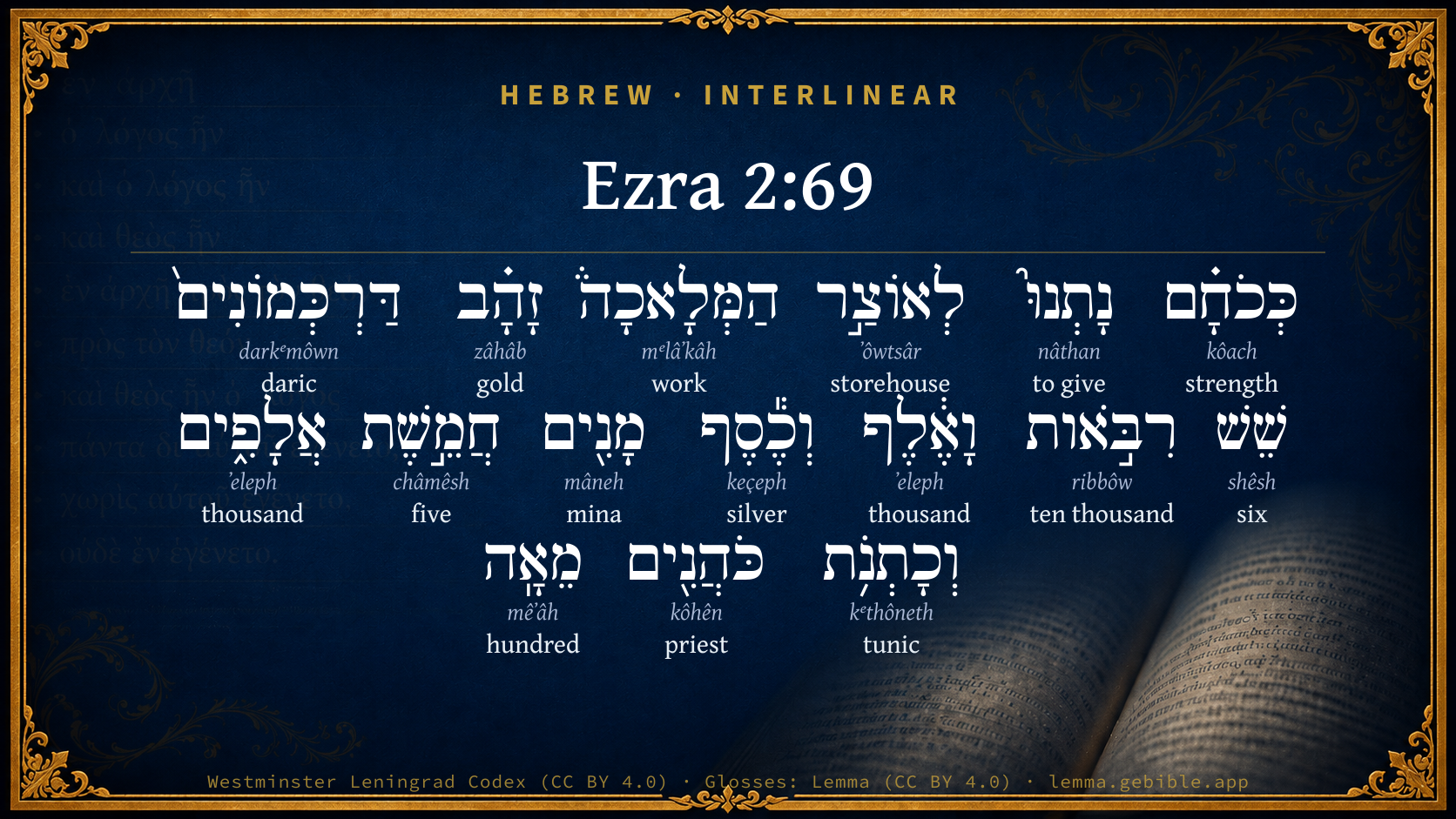
Ezra 2:69

Hebrew (Westminster Leningrad Codex) Ezra 2:69 appears in the Hebrew Old Testament. The text above is from the Westminster Leningrad Codex. Each word links to its Strong’s number, a concise gloss, and parsing drawn from the Open Scriptures Hebrew Bible morphology. Click any word for its full Brown-Driver-Briggs (BDB) entry.
Download image
Cite this verse

Ezra 2:69 (World English Bible). Public Domain. Lemma interlinear Bible study tool, https://lemma.gebible.app/v/ezra/2/69.

Show BibTeX & RIS
BibTeX
RIS
English Translation
they gave after their ability into the treasury of the work sixty-one thousand darics of gold, and five thousand minas of silver, and one hundred priests' garments.
World English Bible · Public Domain
Highlights
  • 1 first appearance in the Hebrew Bible
Full analysis ↓
Download a study sheet

One document with this verse’s original text, its word-by-word gloss line, the meaning frame, cross-references with their text, attributed commentary, and full source and license credits — printable, and it pastes into notes with its structure intact.

This verse Autodidact and up

Study sheet (.html) Plain text (.txt)

A passage Seminary Student

Up to 50 verses in one chapter. A passage sheet keeps up to 6 commentary sources and 12 cross-references per verse, in the order this page ranks them, and says so on the sheet whenever that leaves anything out. Ask for a single verse and you get the Autodidact verse sheet above.

Everything on this page stays free to read, with no account — the sheet is a download of what is already on screen, not access to it.

Want to remove ads? Support Godless Engineer
Compare translations 3

The same verse in 3 English versions, stacked beneath the original-language interlinear above. Click any original word for its lexicon entry.

Each is an independent rendering of the whole verse — the interlinear is not word-aligned to these translations.

Highlighted words mark where these versions differ — a whole-verse word diff, not a word-by-word alignment.

  • World English Bible Public Domain
    they gave after their ability into the treasury of the work sixty-one thousand darics of gold, and five thousand minas of silver, and one hundred priests' garments.
  • King James Version Public Domain
    They gave after their ability unto the treasure of the work threescore and one thousand drams of gold, and five thousand pound of silver, and one hundred priests' garments.
  • unfoldingWord Literal Text CC BY-SA 4.0
    They gave according to their ability to the treasury of the work: 61,000 gold darics, and 5,000 silver minas, and 100 tunics of the priests.

unfoldingWord Literal Text — © unfoldingWord, licensed CC BY-SA 4.0. Word-aligned USFM3 via Door43 (git.door43.org/unfoldingWord/en_ult).

Versions to compare (up to 4)

3 of 4 selected

Show all 18 translations

Every available English version of this verse, each an independent rendering of the whole verse.

  • World English Bible Public Domain
    they gave after their ability into the treasury of the work sixty-one thousand darics of gold, and five thousand minas of silver, and one hundred priests' garments.
  • Berean Standard Bible Public Domain
    According to their ability, they gave to the treasury for this work 61,000 darics of gold, 5,000 minas of silver, and 100 priestly garments.
  • Majority Standard Bible Public Domain
    According to their ability, they gave to the treasury for this work 61,000 darics of gold, 5,000 minas of silver, and 100 priestly garments.
  • King James Version Public Domain
    They gave after their ability unto the treasure of the work threescore and one thousand drams of gold, and five thousand pound of silver, and one hundred priests' garments.
  • American Standard Version (1901) Public Domain
    they gave after their ability into the treasury of the work threescore and one thousand darics of gold, and five thousand pounds of silver, and one hundred priests' garments.
  • Revised Version (1885) Public Domain
    they gave after their ability into the treasury of the work threescore and one thousand darics of gold, and five thousand pounds of silver, and one hundred priests’ garments.
  • Geneva Bible (1599) Public Domain
    They gaue after their abilitie vnto the treasure of the worke, euen one and threescore thousand drammes of golde, and fiue thousand pieces of siluer, and an hundreth Priests garments.
  • Douay-Rheims (1899) Public Domain
    According to their ability, they gave towards the expenses of the work, sixty- one thousand solids of gold, five thousand pounds of silver, and a hundred garments for the priests.
  • Young's Literal Translation Public Domain
    according to their power they have given to the treasure of the work; of gold, drams six myriads and a thousand, and of silver, pounds five thousand, and of priests' coats, a hundred.
  • Literal Standard Version CC BY-SA 4.0
    according to their power they have given to the treasure of the work; of gold, sixty-one thousand drams, and of silver, five thousand pounds, and of priests’ coats, one hundred.
  • Unlocked Literal Bible CC BY-SA 4.0
    They gave according to their ability to the work fund: sixty-one thousand gold darics, five thousand silver minas, and one hundred priestly tunics.
  • unfoldingWord Literal Text CC BY-SA 4.0
    They gave according to their ability to the treasury of the work: 61,000 gold darics, and 5,000 silver minas, and 100 tunics of the priests.
  • Darby Bible Public Domain
    They gave after their ability to the treasure of the work sixty-one thousand darics of gold, and five thousand pounds of silver, and one hundred priests' coats.
  • World Messianic Bible Public Domain
    They gave according to their ability into the treasury of the work sixty-one thousand darics of gold, five thousand minas of silver, and one hundred priests’ garments.
  • Webster's Bible Public Domain
    They gave after their ability to the treasure of the work sixty and one thousand drams of gold, and five thousand pounds of silver, and one hundred priests garments.
  • Free Bible Version CC BY-SA 4.0
    They gave depending on how much they had, putting their gift into the treasury. The total came to 61,000 gold daric coins, 5,000 minas of silver, and 100 robes for the priests.
  • Bible in Basic English Public Domain
    Every one, as he was able, gave for the work sixty-one thousand darics of gold, five thousand pounds of silver and a hundred priests' robes.
  • JPS Tanakh (1917) Public Domain
    they gave after their ability into the treasury of the work threescore and one thousand darics of gold, and five thousand pounds of silver, and one hundred priests' tunics.

Literal Standard Version (2020), Covenant Press — licensed CC BY-SA 4.0. Text via the HelloAO Bible API (eBible.org). Unlocked Literal Bible (unfoldingWord) — licensed CC BY-SA 4.0. Text via the HelloAO Bible API (eBible.org). unfoldingWord Literal Text — © unfoldingWord, licensed CC BY-SA 4.0. Word-aligned USFM3 via Door43 (git.door43.org/unfoldingWord/en_ult). Free Bible Version, Dr. Jonathan Gallagher — licensed CC BY-SA 4.0. Text via the HelloAO Bible API (eBible.org).

Word by word

More ways to search: Search by grammar → Find every occurrence → Compare this word →

Practice this passage: Drill this verse → Learn its vocabulary →

דַּרְכְּמוֹנִים֙
darkᵉmôwn
H1871
“darics”
Noun, Common, Masculine, Plural, Absolute
Part of Speech
Noun
Type
Common
Gender
Masculine
Number
Plural
State
Absolute
Full BDB Definition

Origin: of Persian origin

TWOT: 453c

daric, drachma, dram, unit of measure from Babylon; 128 grains (8.32 grams) of gold worth about $120 dollars and 128 grains of silver worth about $2.40 - a gold coin current in Palestine in the period after the return
  1. כְּכֹחָ֗ם kôach H3581 “like/as · strength · their” Preposition + Noun, Common, Masculine, Singular, Construct + Suffix, Personal, 3rd Person, Masculine, Plural
  2. נָתְנוּ֮ nâthan H5414 “to give” Verb, Qal, Perfect, 3rd Person, Common, Plural
  3. לְאוֹצַ֣ר ʼôwtsâr H214 “to/for · storehouse of” Preposition + Noun, Common, Masculine, Singular, Construct
  4. הַמְּלָאכָה֒ mᵉlâʼkâh H4399 “the · work” Particle, Definite Article + Noun, Common, Feminine, Singular, Absolute
  5. זָהָ֗ב zâhâb H2091 “gold” Noun, Common, Masculine, Singular, Absolute
  6. שֵׁשׁ shêsh H8337 “six” Adjective, Cardinal number, Feminine, Singular, Absolute
  7. רִבֹּ֣אות ribbôw H7239 “ten thousands” Noun, Common, Both, Plural, Absolute
  8. וָאֶ֔לֶף ʼeleph H505 “and · thousand” Conjunction + Adjective, Cardinal number, Both, Singular, Absolute
  9. וְכֶ֕סֶף keçeph H3701 “and · silver” Conjunction + Noun, Common, Masculine, Singular, Absolute
  10. מָנִ֖ים mâneh H4488 “minas” Noun, Common, Masculine, Plural, Absolute
  11. חֲמֵ֣שֶׁת châmêsh H2568 “five” Adjective, Cardinal number, Masculine, Singular, Construct
  12. אֲלָפִ֑ים ʼeleph H505 “thousand” Adjective, Cardinal number, Both, Plural, Absolute
  13. וְכָתְנֹ֥ת kᵉthôneth H3801 “and · tunics of” Conjunction + Noun, Common, Feminine, Plural, Construct
  14. כֹּהֲנִ֖ים kôhên H3548 “priests” Noun, Common, Masculine, Plural, Absolute
  15. מֵאָֽה mêʼâh H3967 “hundred” Adjective, Cardinal number, Both, Singular, Absolute

About this verse

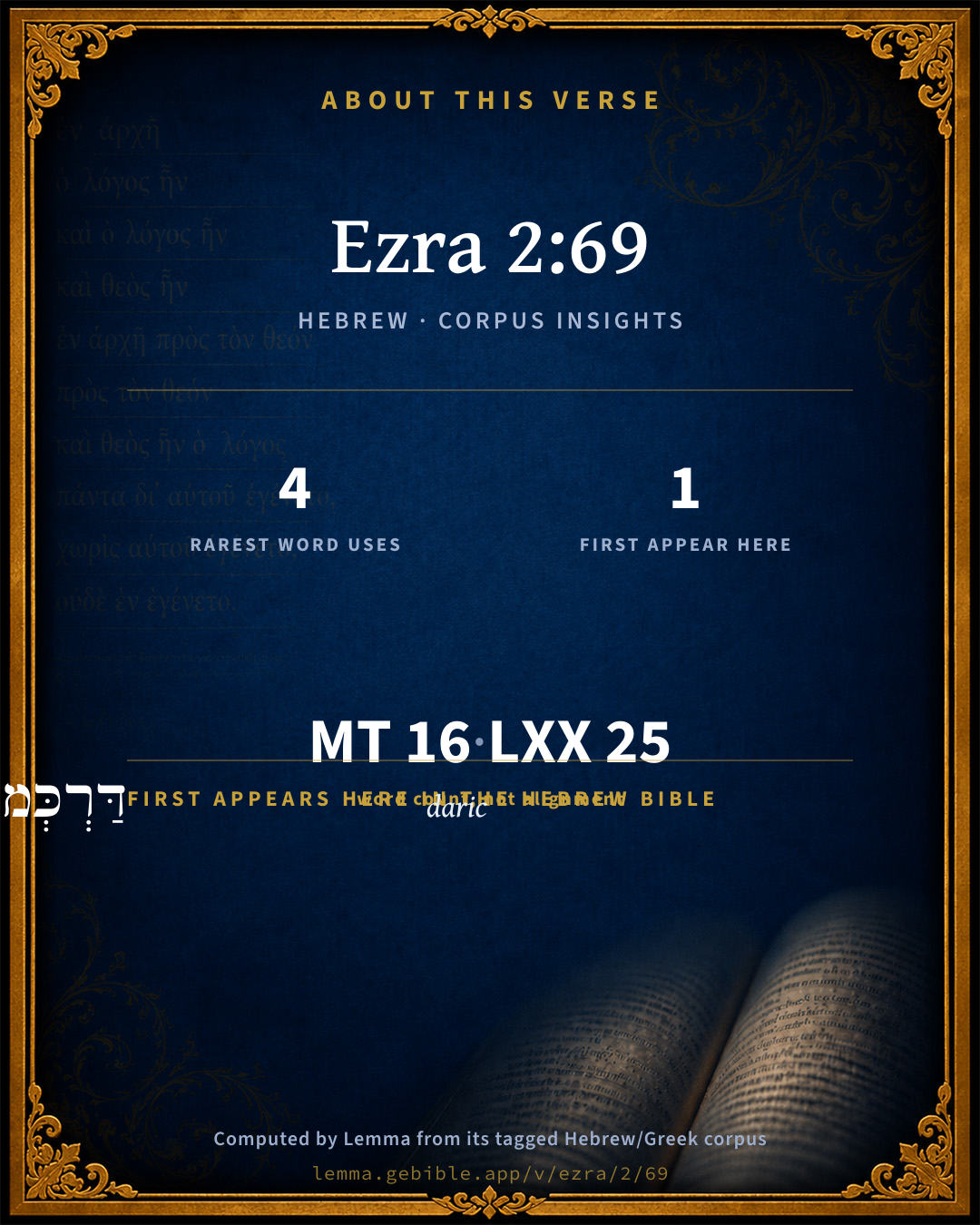
These counts appear in no published source. They are computed here, from the morphology-tagged text and Lemma’s own curated glosses. What Lemma adds →

16
words
15
distinct lemmas
Historical
section

Notable vocabulary

The rarest word here is דַּרְכְּמוֹנִים֙ daric H1871 — appearing just 4 times in the whole Hebrew Bible.

First appearance in Scripture

This word makes its first canonical appearance in the Hebrew Bible here:

  • דַּרְכְּמוֹנִים֙ daric H1871

Shared distinctive vocabulary

דַּרְכְּמוֹנִים֙ daric H1871 occurs in 4 verses of the Hebrew Bible. Also found in:

Grammatical profile

  • 1 verb
  • 10 nouns
  • 5 adjectives

Verb forms

  • נָתְנוּ֮ Qal · Perfect

Repetition

A word recurs within this verse — often emphatic in Hebrew:

  • וָאֶ֔לֶף thousand H505 ×2

Hebrew & Septuagint length

In English translation the verse runs 27 words from the Hebrew and 28 from the Septuagint (LXX English) — closely comparable.

A rough comparison of the two English renderings, which tokenize alike — not a word-level alignment.

Word counts can differ between the Hebrew and the Greek without any difference in meaning — e.g. the Hebrew direct-object marker אֵת has no separate Greek word, and Greek often adds the article ὁ.

In the original languages it is 16 Hebrew tokens and 25 Greek tokens — but the two are counted differently (Hebrew bundles its prefixes and suffixes into one token; the Greek is in lemma form), so that isn’t a like-for-like length.

Cross-references

5

Topical passages linked to Ezra 2:69 in the Treasury of Scripture Knowledge — connected by theme and wording, ordered by reader-vote popularity; previews shown in the World English Bible.

  • Ezra 8:25–34 and weighed to them the silver, and the gold, and the vessels, even the offering for the house of our God, which the king, and his counselors, and his princes, and all Israel there present, had offered:
  • 1 Kings 7:51 Thus all the work that king Solomon worked in the house of Yahweh was finished. Solomon brought in the things which David his father had dedicated, [even] the silver, and the gold, and the vessels, and put them in the treasuries of the house of Yahweh.
  • 1 Chronicles 22:14 Now, behold, in my affliction I have prepared for the house of Yahweh one hundred thousand talents of gold, and one thousand thousand talents of silver, and of brass and iron without weight; for it is in abundance: timber also and stone have I prepared; and you may add to them.
  • 1 Chronicles 26:20–28 Of the Levites, Ahijah was over the treasures of the house of God, and over the treasures of the dedicated things.
  • Nehemiah 7:71–72 Some of the heads of fathers' [houses] gave into the treasury of the work twenty thousand darics of gold, and two thousand two hundred minas of silver.

Cross-references courtesy of OpenBible.info (CC BY 4.0).

Hebrew and Greek witnesses Masoretic Hebrew ↔ Greek Septuagint

The same verse in the two great witnesses to the Old Testament, shown verse-for-verse.

These are two independent witnesses, not word-aligned to each other, and the Septuagint is shown in lemma (dictionary) form.

Hebrew Ezra 2:69 Masoretic · Westminster Leningrad Codex

כְּכֹחָ֗ם נָתְנוּ֮ לְאוֹצַ֣ר הַמְּלָאכָה֒ זָהָ֗ב דַּרְכְּמוֹנִים֙ שֵׁשׁ רִבֹּ֣אות וָאֶ֔לֶף וְכֶ֕סֶף מָנִ֖ים חֲמֵ֣שֶׁת אֲלָפִ֑ים וְכָתְנֹ֥ת כֹּהֲנִ֖ים מֵאָֽה

they gave after their ability into the treasury of the work sixty-one thousand darics of gold, and five thousand minas of silver, and one hundred priests' garments.

World English Bible · Public Domain

Greek LXX Ezra 2:69 Septuagint · lemma form

ὡς ὁ δύναμις αὐτός δίδωμι εἰς θησαυρός ὁ ἔργον χρυσίον καθαρός μνᾶ ἕξ μυριάς καί χίλιοι καί ἀργύριον μνᾶ πεντακισχίλιοι καί κοθωνος ὁ ἱερεύς ἑκατόν

According to their power they gave into the treasury of the work pure gold sixty-one thousand pieces, and five thousand pounds of silver, and one hundred priests' garments.

LXX2012 (modern English Septuagint) · Public Domain

In the Septuagint this is one book — Esdras B (2 Esdras): Ezra is chapters 1–10, Nehemiah 11–23.

Hebrew: Westminster Leningrad Codex (CC BY 4.0). Greek: Septuagint (public domain); English from LXX2012 (modern English Septuagint) (Public Domain). How the Septuagint differs from the Hebrew →

Commentary

Notes on Ezra 2:69 from classic Christian and Jewish commentators (each source and its license shown beneath its notes). The classic Christian expositions comment on the surrounding passage and are grouped to its opening verse, so a note may address several verses; the Jewish commentaries on the Tanakh (Rashi and others) are per-verse, so they appear only where the commentator wrote on this verse.

Lemma curates 59 commentaries, every one of them public domain or Creative Commons licensed, each selected and text-cleaned for this edition rather than reprinted as found. About our sources →

Trapp's Complete Commentary

John Trapp

Ezr 2:69 They gave after their ability unto the treasure of the work threescore and one thousand drams of gold, and five thousand pound of silver, and one hundred priests’ garments.

Ver. 69. They gave after their ability] Men must take heed they stretch not beyond the staple, and so mar all. But few are herein faulty; few Macedonians, that, to their power and beyond, are willing of themselves, &c., 2Co 8:8. Rari quippe boni.

Threescore and one thousand drams of gold] That is, nineteen thousand sixty-two pounds ten shillings.

And five thousand pound of silver] i.e. Fifteen thousand pounds sterling. These sums of money, together with the costly priests’ garments, though they fall far short of what was provided and given in David’s days, 1Ch 22:1-19 1Ch 29:1-30, towards the building of the first temple; yet, considering the mind of this poor people, and their small ability, this gift was as great in God’s account. See Luk 21:1-2. The widow’s mite was beyond the rich man’s magnificence, because it came out of a richer mind.

John Trapp, A Commentary or Exposition upon All the Books of the Old and New Testament (1647–1656) — public domain. Text from a community e-Sword module.

Joseph Benson's Commentary

Ezr 2:69. Threescore and one thousand drachms of gold, &c. — About seventy-five thousand and five hundred pounds of our money; for every drachm of gold is worth ten shillings of our money, and every mina, or pound of silver, nine pounds; for it contains sixty shekels, and every shekel of silver is worth three shillings of our money. And one hundred priests’ garments — Garments, as well as gold and silver, were wont to be laid up in treasuries, Mat 6:20. We may infer then, from these rich offerings, not only, as has been just intimated, that the Jews were not made such poor slaves in Babylon as wrought for their lords and masters, but that there may not be all the truth imaginable in that common saying among them, that they were only the bran, that is, the dregs of the people, who returned to Jerusalem at the end of the captivity, and that all the fine flour stayed behind at Babylon. See Prideaux’s Connect., Ann. 536, and Dodd.

Joseph Benson's Commentary on the Old and New Testaments (1811–1818) — public domain. Text from a community e-Sword module.

Tyndale Open Study Notes

Tyndale Open Resources

2:69 Each of the gold coins (Hebrew darics) was worth a month’s wages for a professional soldier. • 6,250 pounds (Hebrew 5,000 minas): Each mina weighed 20 ounces and was equal to 60 shekels of silver; each shekel was worth an average worker’s monthly wages.

Tyndale Open Study Notes — © Tyndale Open Resources, licensed CC BY-SA 4.0. Text via the HelloAO Bible API.

Geneva Bible (1599)

Geneva Bible translators

Which are called, mina, and contain a piece two marks: so 50,000 minas make 55,000 franks, which mount to of our money 69,666 pounds, 13 shillings 4 pence so that the whole sum was 94,493 pounds, 6 shillings, 8 pence.

Which mount to of our money, 24,826 pounds, 13 shillings and 4 pence, esteeming the French crown at 6 shillings and 4 pence for the dram is the eighth part of an ounce, and the ounce the eighth part of a mark.

Geneva Bible (1599) marginal notes — public domain. Text via Bolls.life.

Jamieson, Fausset & Brown

Robert Jamieson, A. R. Fausset & David Brown

drams of gold--rather, "darics," a Persian coin (see on Ch1 29:7).

priests' garments--(compare Neh 7:70). This--in the circumstances--was a very appropriate gift. In general, it may be remarked that presents of garments, or of any other usable commodities, however singular it may seem to us, is in harmony with the established notions and customs of the East.

Next: Ezra Chapter 3

Jamieson, Fausset & Brown — Commentary Critical and Explanatory on the Whole Bible (1871) — public domain (CC PDM 1.0). Text via the HelloAO Bible API.

Adam Clarke's Commentary

Verse 69. Threescore and one thousand drams of gold] דרכמונים darkemonim, drakmons or darics; a Persian coin, always of gold, and worth about 1£. 5s., not less than £76,250 sterling in gold.

Five thousand pounds of silver] מנים manim, manehs or minas. As a weight, the maneh was 100 shekels; as a coin, 60 shekels in value, or about 9£.; 5000 of these manehs therefore will amount to £45,000, making in the whole a sum of about £120,000; and in this are not included the 100 garments for priests.

Thus we find that God, in the midst of judgment, remembered mercy, and gave them favour in the land of their captivity.

Adam Clarke's Commentary on the Bible (1810–1826) — public domain. Text from a community e-Sword/MySword module.

Ellicott's Commentary for English Readers

(69) The dram being a daric of a little more than our guinea, and the pound, or maneh, a little more than £4. the whole would be nearly £90,000, and not an exorbitant sum for a community far from poor. But Nehemiah c statement is smaller, and probably more correct.

One hundred priests’ garments.—An almost necessary correction or supply in the defective text of Nehemiah (Neh_7:70) makes his “four hundred and thirty priests’ garments,” as contributed by the Tirshatha, “five hundred pounds of silver and thirty priests’ garments.” This being so, the two accounts agree, always allowing that Ezra’s 61,000 is a corruption of 41,000 in the gold, and his 5,000 pounds of silver and 100 priests’ garments round numbers.

A Bible Commentary for English Readers, edited by Charles John Ellicott (1878–1897) — public domain. Text from a community e-Sword module.

The Cambridge Bible for Schools and Colleges

gen. ed. J. J. S. Perowne

69. they gave &c.] There is a slight discrepancy between the sums mentioned in this verse and the sums recorded in greater detail in Nehemiah. The figures stand thus—

Ezra

Heads of fathers’ houses 61,000

darics of gold

5,000

pounds of silver

100

priests’ garments.

Nehemiah

darics of gold

basons

pounds silver

priests’ garments

Tirshatha

1,000

50

500?

30

Heads of fathers’houses

20,000

2,200

Rest of people

20,000

2,000

67

Total

41,000

4,700

97

The contributions as described in Ezra are all placed to the credit of the heads of fathers’ houses; in Nehemiah we find a considerable portion contributed by the Tirshatha and by the rest of the people.

(a) The 61,000 darics of gold appear to consist of the Tirshatha’s 1000+other contributions of which we are able to identify 40,000 (i.e. 20,000 given by heads of fathers’ houses+20,000 given by the rest of the people). Perhaps the value of 50 basons and of the other gifts amounted to a figure which could be described in round numbers as 20,000.

(b) The 5,000 pounds of silver express in round numbers the 2,200 contributed by the heads of fathers’ houses+the 2,000 by the rest of the people+500 pounds silver given by the Tirshatha (the probable reading of Neh_7:70).

(c) The 100 priests’ garments represent the 30 given by the Tirshatha (probable reading of Neh_7:70), and the 67 given by the rest of the people.

after their ability] literally ‘strength’ or ‘power’ as in Dan_1:4 : not elsewhere of ‘wealth’. The word rendered ‘ability’ in Neh_5:8 is different and denotes ‘sufficiency’.

unto the treasure] R.V. into the treasury.

drams] R.V. darics. The A.V. translation ‘dram’ seems to suppose that the coin spoken of was the Greek ‘drachma’. It is in reality the well-known Persian gold coin ‘daric’. The name has commonly been derived from the Darius who was said to have first had the piece coined. But this is far from certain. The word ‘daric’ more probably refers to the emblem on the coin, and is to be derived either from a Persian word meaning ‘a bow’, or from ‘dara’ = ‘a king’, cf. our ‘sovereign’. The obverse side of the coin has the figure of a crowned king, kneeling, holding in his right hand a sceptre or spear and in his left a bow; for the sake possibly of securing a good impression, the reverse of the coin was left rough.

The ‘daric’ is transliterated into Hebrew as ‘Adarcon’ in chap. Ezr_8:27; 1Ch_29:7 : but in this verse and in Neh_7:70-72 it appears as ‘Darcemon’ with a various reading ‘Adarcemon’.

Its value was as nearly as possible equivalent to our sovereign. The coin is by some identified with the gold stater of Crœsus, the last king of Lydia. This is the first mention of coined money in the Old Testament, as the reference to ‘darics’ in David’s reign (1Ch_29:7) is strictly an anachronism.

pound] Hebr. ‘maneh’. We do not find in the Old Testament any mention of Persian silver coinage. Before the Persian period, Hebrew money had for the most part been calculated by weight upon something akin to the Babylonian system, by ‘talent’, ‘maneh’, ‘shekel’.

A ‘talent’ of Hebrew money consisted of ‘50 manim’, one maneh of 60 shekels.

priests’ garments] The priests differed from the Levites in having special garments ‘in which they ministered’ and which they put off as being holy, as soon as they had ceased from their ministrations (Lev_6:10; Eze_42:14; Eze_44:19). The priestly garments are briefly enumerated in Exo_28:40; Exo_39:27. They consisted of (1) a long coat or tunic, (2) a mitre or turban, (3) breeches or nether garments, (4) a girdle. The material was fine linen, and the colour white. These garments the priest appears to have laid aside and deposited in one of the chambers at the entrance of the inner court of the Temple, before passing into the people’s court.

The Cambridge Bible for Schools and Colleges (gen. ed. J. J. S. Perowne; Cambridge University Press, 1878–1918) — public domain. Text from a community e-Sword module.

Albert Barnes' Notes on the Bible

The numbers here and in Nehemiah (see the marginal reference) vary.

Albert Barnes' Notes on the Bible (1834–1885) — public domain. Text from a community e-Sword/MySword module.

Haydock's Catholic Bible Commentary

Solids. Hebrew darcemonim. (Haydock) --- "Darics," worth as much as a golden sicle. (Pelletier) (Calmet) (1 Paralipomenon xxix. 7.) --- Pounds, (mnas) or 60 sicles. (Menochius) --- 3 Esdras has "mnas" in both places.

George Leo Haydock (1774–1849), Haydock's Catholic Family Bible and Commentary, 1859 edition — public domain. Excludes Psalms (Douay-Rheims chapter numbering differs from Protestant) and Deuterocanonical books (Catholic canon only).

Matthew Poole's English Annotations

A dram of gold is supposed to be of the weight of the fourth part of a shekel, and of the value of a French crown.

Matthew Poole's English Annotations on the Holy Bible (1683–1685) — public domain. Text from a community e-Sword/MySword module.

Whedon's Commentary on the Bible

Daniel D. Whedon

69. Threescore and one thousand — Literally, Six myriads and one thousand.

Drams of gold — Rather, gold darics. These were a coin current in the Persian empire from the time of Cyrus onward, probably till the spread of the Macedonian power over the East. Gold darics have been discovered bearing on one side the figure of a king, with a bow in one hand and a lance or javelin in the other, and on the other side a figure of uncertain meaning. The coin weighs 128 grains, and is valued at $5.52. The whole amount of gold, then, contributed by these wealthy fathers was $336,720 — a gift worthy of the occasion.

Five thousand pounds of silver — The Hebrew word here rendered pounds is מנים, manim, that is, mina. The silver mina or maneh is valued at $32, so that the whole amount of silver here named would be $160,000. Nehemiah’s numbers are different. Neh_7:70-72. He says the Tirshatha gave 1,000 gold darics, 50 basins, 530 priests’ garments. Some of the chief fathers gave 20,000 darics, and 2,200 silver mina; and the rest of the people gave 20,000 darics, 2,000 mina, and 67 priests garments; so that the gross sum in Nehemiah is 41,000 darics, 4,200 mina, 597 priests’ garments, and 50 basins. Bertheau thinks Nehemiah’s text is the more accurate and complete; but here again, as in the lists above, one table may supplement the other, so that neither is in itself complete.

Daniel D. Whedon (gen. ed.), Commentary on the Old and New Testaments (1874–1909) — public domain. Text from a community e-Sword module.

The Pulpit Commentary

After their ability. As each was able; the richer more, the poorer less. Threescore and one thousand drams of gold. The word translated "dram" is darkemon, which appears to be the Hebrew representative of the Persian word which the Greeks rendered by dareikos, or "daric." This was a gold coin, stamped with the figure of a Persian king, wearing his crown, and armed with a bow and arrow. According to the most exact computation, each such coin contained somewhat more pure gold than an English guinea, and was worth 1s. 10.5d. of our money. The 61, 000 darics would therefore have been equal to 15s. Five thousand pounds of silver. The word translated "pound" is maneh, an equivalent of the Greek tuna and the Latin mind. In Greece the silver mind was worth a little more than of our money. The value of the Hebrew silver munch is uncertain, but probably was not very different from the Greek. Thus the sum contributed in silver may be estimated at above and the entire contribution at nearly It must be noted, however, that Nehemiah"s estimate (7:71, 72) is less. One hundred priests" garments. Nehemiah says ninety-seven (ibid. vers. 70, 72), whence we may conclude that Ezra uses a round number.

The Pulpit Commentary (1880–1919), ed. H.D.M. Spence-Jones & Joseph S. Exell — public domain. Text from a community e-Sword module.

John Wesley's Explanatory Notes

Sixty one thousand drams - Sixty one thousand drams of gold amount to something more than so many pounds of our money. So bishop Cumberland, who likewise supposes five thousand pounds of silver, to be about thirty seven thousand pounds sterling.

John Wesley, Explanatory Notes Upon the Whole Bible (1754–1765) — public domain. Text via the GEBible commentary corpus.

Rashi

Rabbi Shlomo Yitzchaki (Rashi)

According to their ability according to their ability and their money.

drachmas Heb. דַּרְכְּמוֹנִים, the name of a golden coin.

and priests’ tunics in which to serve.

Rashi on the Tanakh — English translations: “The Judaica Press complete Tanach with Rashi, translated by A. J. Rosenberg” (CC BY 4.0); “Pentateuch with Rashi's commentary by M. Rosenbaum and A.M. Silbermann, 1929-1934” (public domain); “The Metsudah Tanach series, Lakewood, N.J” (CC BY 4.0); and “The Book of Joshua, Metsudah Publications, 1997” (CC BY 4.0). Text via Sefaria.

Lesson kit

Teaching starters — assembled from the data on this page, not authored interpretation. Every prompt links to the verse data it draws on. Edit before teaching.

Ezra, in the Historical, opens this verse with 16 words (15 distinct Hebrew lemmas). Its most distinctive word is darkᵉmôwn (“daric”). A historical commentator’s framing appears above. Read the whole chapter for the surrounding context.

Discussion questions

  1. How does “daric” (darkᵉmôwn) shape what this verse is saying?
  2. This is the first place “daric” appears in Scripture (first appears here). What does its debut here establish?
  3. How does Nehemiah 7:70, which shares the word «daric», read alongside this verse?
  4. What does the repetition of “thousand” (2× in this one verse) do in this verse?
  5. The translations on this page render this verse differently — a whole-verse word diff, not a word-by-word alignment. What might account for the different wordings?
  6. «נָתְנוּ֮» is a Qal Perfect verb. How does that grammatical form shape the action described?
  7. Compare how Trapp's Complete Commentary and Joseph Benson's Commentary read this verse. Where do they agree or differ?

Things to notice

Reading settings

Reading text

Shown beneath each verse's original-language words.

Old Testament
Old Testament edition

Read the OT as the Masoretic Hebrew (MT) or the Greek Septuagint (LXX).

English shown for the Greek Septuagint (in the Hebrew ↔ Greek comparison).

Comparing translations? Open the Compare panel on any verse page to stack up to four side by side.