
Jeremiah 17:22

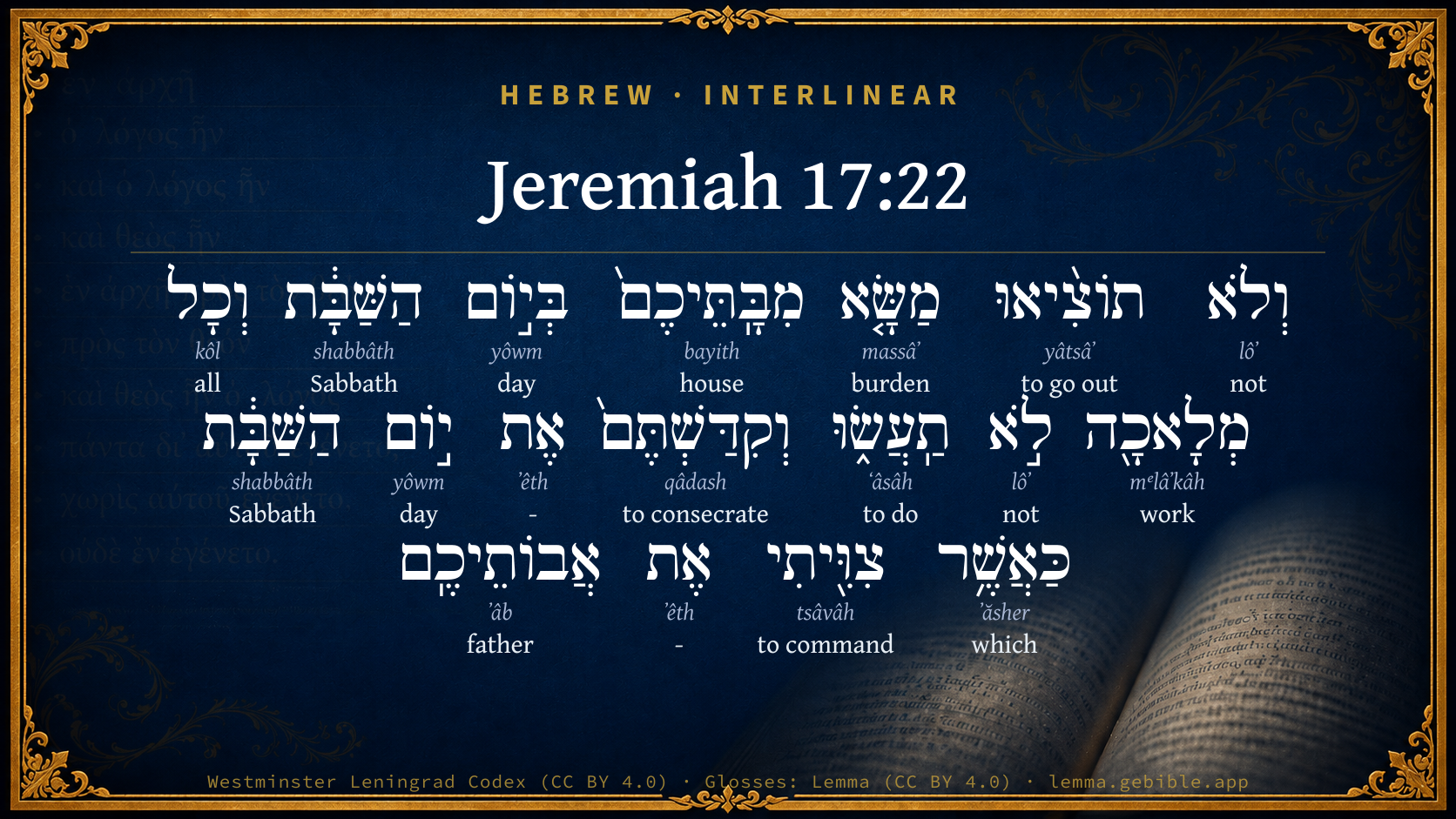
Hebrew (Westminster Leningrad Codex) Jeremiah 17:22 appears in the Hebrew Old Testament. The text above is from the Westminster Leningrad Codex. Each word links to its Strong’s number, a concise gloss, and parsing drawn from the Open Scriptures Hebrew Bible morphology. Click any word for its full Brown-Driver-Briggs (BDB) entry.
Download image
Cite this verse

Jeremiah 17:22 (World English Bible). Public Domain. Lemma interlinear Bible study tool, https://lemma.gebible.app/v/jeremiah/17/22.

Show BibTeX & RIS
BibTeX
RIS
English Translation
neither carry forth a burden out of your houses on the Sabbath day holy, neither do any work: but make the Sabbath day, as I commanded your fathers.
World English Bible · Public Domain
Download a study sheet

One document with this verse’s original text, its word-by-word gloss line, the meaning frame, cross-references with their text, attributed commentary, and full source and license credits — printable, and it pastes into notes with its structure intact.

This verse Autodidact and up

Study sheet (.html) Plain text (.txt)

A passage Seminary Student

Up to 50 verses in one chapter. A passage sheet keeps up to 6 commentary sources and 12 cross-references per verse, in the order this page ranks them, and says so on the sheet whenever that leaves anything out. Ask for a single verse and you get the Autodidact verse sheet above.

Everything on this page stays free to read, with no account — the sheet is a download of what is already on screen, not access to it.

Want to remove ads? Support Godless Engineer
Compare translations 3

The same verse in 3 English versions, stacked beneath the original-language interlinear above. Click any original word for its lexicon entry.

Each is an independent rendering of the whole verse — the interlinear is not word-aligned to these translations.

Highlighted words mark where these versions differ — a whole-verse word diff, not a word-by-word alignment.

  • World English Bible Public Domain
    neither carry forth a burden out of your houses on the Sabbath day holy, neither do any work: but make the Sabbath day, as I commanded your fathers.
  • King James Version Public Domain
    Neither carry forth a burden out of your houses on the sabbath day, neither do ye any work, but hallow ye the sabbath day, as I commanded your fathers.
  • unfoldingWord Literal Text CC BY-SA 4.0
    And do not carry a burden out of your houses on the day of the Sabbath and you are not to do any work, but you shall make holy the day of the Sabbath, as I commanded your fathers.

unfoldingWord Literal Text — © unfoldingWord, licensed CC BY-SA 4.0. Word-aligned USFM3 via Door43 (git.door43.org/unfoldingWord/en_ult).

Versions to compare (up to 4)

3 of 4 selected

Show all 18 translations

Every available English version of this verse, each an independent rendering of the whole verse.

  • World English Bible Public Domain
    neither carry forth a burden out of your houses on the Sabbath day holy, neither do any work: but make the Sabbath day, as I commanded your fathers.
  • Berean Standard Bible Public Domain
    You must not carry a load out of your houses or do any work on the Sabbath day, but you must keep the Sabbath day holy, just as I commanded your forefathers.
  • Majority Standard Bible Public Domain
    You must not carry a load out of your houses or do any work on the Sabbath day, but you must keep the Sabbath day holy, just as I commanded your forefathers.
  • King James Version Public Domain
    Neither carry forth a burden out of your houses on the sabbath day, neither do ye any work, but hallow ye the sabbath day, as I commanded your fathers.
  • American Standard Version (1901) Public Domain
    neither carry forth a burden out of your houses on the sabbath day, neither do ye any work: but hallow ye the sabbath day, as I commanded your fathers.
  • Revised Version (1885) Public Domain
    neither carry forth a burden out of your houses on the sabbath day, neither do ye any work: but hallow ye the sabbath day, as I commanded your fathers;
  • Geneva Bible (1599) Public Domain
    Neither cary foorth burdens out of your houses in the Sabbath day: neither doe yee any worke, but sanctifie the Sabbath, as I commanded your fathers.
  • Douay-Rheims (1899) Public Domain
    And do not bring burdens out of your houses on the sabbath day, neither do ye any work: sanctify the sabbath day, as I commanded your fathers.
  • Young's Literal Translation Public Domain
    Nor do ye take out a burden from your houses on the day of rest, Yea, any work ye do not do, And ye have sanctified the day of rest, As I have commanded your fathers.
  • Literal Standard Version CC BY-SA 4.0
    Nor do you take out a burden from your houses on the day of rest, || Indeed, you do not do any work, || And you have sanctified the day of rest, || As I have commanded your fathers.
  • Unlocked Literal Bible CC BY-SA 4.0
    Do not bring a load out from your house on the Sabbath day. Do not do any work, but set apart the Sabbath day, just as I commanded your ancestors to do.”'
  • unfoldingWord Literal Text CC BY-SA 4.0
    And do not carry a burden out of your houses on the day of the Sabbath and you are not to do any work, but you shall make holy the day of the Sabbath, as I commanded your fathers.
  • Darby Bible Public Domain
    and carry forth no burden out of your houses on the sabbath day, neither do any work; but hallow ye the sabbath day, as I commanded your fathers,
  • World Messianic Bible Public Domain
    Don’t carry a burden out of your houses on the Sabbath day. Don’t do any work, but make the Sabbath day holy, as I commanded your fathers.
  • Webster's Bible Public Domain
    Neither carry forth a burden out of your houses on the sabbath day, neither do ye any work, but hallow ye the sabbath day, as I commanded your fathers.
  • Free Bible Version CC BY-SA 4.0
    Don't carry a load out of your houses, and don't do any work on the Sabbath day. Keep the Sabbath day holy, just as I ordered your forefathers.
  • Bible in Basic English Public Domain
    And take no weight out of your houses on the Sabbath day, or do any work, but keep the Sabbath day holy, as I gave orders to your fathers;
  • JPS Tanakh (1917) Public Domain
    neither carry forth a burden out of your houses on the sabbath day, neither do ye any work; but hallow ye the sabbath day, as I commanded your fathers;

Literal Standard Version (2020), Covenant Press — licensed CC BY-SA 4.0. Text via the HelloAO Bible API (eBible.org). Unlocked Literal Bible (unfoldingWord) — licensed CC BY-SA 4.0. Text via the HelloAO Bible API (eBible.org). unfoldingWord Literal Text — © unfoldingWord, licensed CC BY-SA 4.0. Word-aligned USFM3 via Door43 (git.door43.org/unfoldingWord/en_ult). Free Bible Version, Dr. Jonathan Gallagher — licensed CC BY-SA 4.0. Text via the HelloAO Bible API (eBible.org).

Word by word

More ways to search: Search by grammar → Find every occurrence → Compare this word →

Practice this passage: Drill this verse → Learn its vocabulary →

מַשָּׂ֤א
massâʼ
H4853
“burden”
Noun, Common, Masculine, Singular, Absolute
Part of Speech
Noun
Type
Common
Gender
Masculine
Number
Singular
State
Absolute
Full BDB Definition

Origin: from H5375

TWOT: 1421d , 1421e

Massa = "burden" - load, bearing, tribute, burden, lifting (noun masculine) - load, burden - lifting, uplifting, that to which the soul lifts itself up - bearing, carrying - tribute, that which is carried or brought or borne - utterance, oracle, burden (noun masculine) - a son of Ishmael (noun proper masculine)
  1. וְלֹא lôʼ H3808 “and · not” Conjunction + Particle, Negative
  2. תוֹצִ֨יאוּ yâtsâʼ H3318 “to go out” Verb, Hiphil, Imperfect, 2nd Person, Masculine, Plural
  3. מִבָּֽתֵּיכֶם֙ bayith H1004 “from · houses · your” Preposition + Noun, Common, Masculine, Plural, Construct + Suffix, Personal, 2nd Person, Masculine, Plural
  4. בְּי֣וֹם yôwm H3117 “in/at · day of” Preposition + Noun, Common, Masculine, Singular, Construct
  5. הַשַּׁבָּ֔ת shabbâth H7676 “the · Sabbath” Particle, Definite Article + Noun, Common, Both, Singular, Absolute
  6. וְכָל kôl H3605 “and · all of” Conjunction + Noun, Common, Masculine, Singular, Construct
  7. מְלָאכָ֖ה mᵉlâʼkâh H4399 “work” Noun, Common, Feminine, Singular, Absolute
  8. לֹ֣א lôʼ H3808 “not” Particle, Negative
  9. תַֽעֲשׂ֑וּ ʻâsâh H6213 “to do” Verb, Qal, Imperfect, 2nd Person, Masculine, Plural
  10. וְקִדַּשְׁתֶּם֙ qâdash H6942 “and · to consecrate” Conjunction + Verb, Piel, Sequential Perfect, 2nd Person, Masculine, Plural
  11. אֶת ʼêth H853 “-” Particle, Direct Object
  12. י֣וֹם yôwm H3117 “day of” Noun, Common, Masculine, Singular, Construct
  13. הַשַּׁבָּ֔ת shabbâth H7676 “the · Sabbath” Particle, Definite Article + Noun, Common, Both, Singular, Absolute
  14. כַּאֲשֶׁ֥ר ʼăsher H834 “like/as · which” Preposition + Particle, Relative
  15. צִוִּ֖יתִי tsâvâh H6680 “to command” Verb, Piel, Perfect, 1st Person, Common, Singular
  16. אֶת ʼêth H853 “-” Particle, Direct Object
  17. אֲבוֹתֵיכֶֽם ʼâb H1 “fathers · your” Noun, Common, Masculine, Plural, Construct + Suffix, Personal, 2nd Person, Masculine, Plural

About this verse

These counts appear in no published source. They are computed here, from the morphology-tagged text and Lemma’s own curated glosses. What Lemma adds →

18
words
14
distinct lemmas
Prophets
section

Grammatical profile

  • 4 verbs
  • 9 nouns
  • 5 particles

Verb forms

  • תוֹצִ֨יאוּ Hiphil · Imperfect
  • תַֽעֲשׂ֑וּ Qal · Imperfect
  • וְקִדַּשְׁתֶּם֙ Piel · Sequential Perfect
  • צִוִּ֖יתִי Piel · Perfect

Repetition

Words recur within this verse — often emphatic in Hebrew:

  • בְּי֣וֹם day H3117 ×2
  • הַשַּׁבָּ֔ת Sabbath H7676 ×2
  • וְלֹא not H3808 ×2

Cross-references

16

Topical passages linked to Jeremiah 17:22 in the Treasury of Scripture Knowledge — connected by theme and wording, ordered by reader-vote popularity; previews shown in the World English Bible.

  • Ezekiel 20:12 Moreover also I gave them my Sabbaths, to be a sign between me and them, that they might know that I am Yahweh who sanctifies them.
  • Exodus 20:8–10 "Remember the Sabbath day, to keep it holy.
  • Isaiah 56:2–6 Blessed is the man who does this, and the son of man who holds it fast; who keeps the Sabbath from profaning it, and keeps his hand from doing any evil.
  • Isaiah 58:13 If you turn away your foot from the Sabbath, from doing your pleasure on my holy day; and call the Sabbath a delight, [and] the holy of Yahweh honorable; and shall honor it, not doing your own ways, nor finding your own pleasure, nor speaking [your own] words:
  • Exodus 16:23–29 He said to them, "This is that which Yahweh has spoken, 'Tomorrow is a solemn rest, a holy Sabbath to Yahweh. Bake that which you want to bake, and boil that which you want to boil; and all that remains over lay up for yourselves to be kept until the morning."
  • Exodus 23:12 "Six days you shall do your work, and on the seventh day you shall rest, that your ox and your donkey may have rest, and the son of your handmaid, and the alien may be refreshed.
  • Exodus 31:13–17 "Speak also to the children of Israel, saying, 'Most assuredly you shall keep my Sabbaths: for it is a sign between me and you throughout your generations; that you may know that I am Yahweh who sanctifies you.
  • Deuteronomy 5:12–15 "Observe the Sabbath day, to keep it holy, as Yahweh your God commanded you.
  • Genesis 2:2–3 On the seventh day God finished his work which he had made; and he rested on the seventh day from all his work which he had made.
  • Leviticus 19:3 "'Each one of you shall respect his mother and his father. You shall keep my Sabbaths. I am Yahweh your God.
  • Leviticus 23:3 "'Six days shall work be done: but on the seventh day is a Sabbath of solemn rest, a holy convocation; you shall do no manner of work. It is a Sabbath to Yahweh in all your dwellings.
  • Ezekiel 20:20–21 and make my Sabbaths holy; and they shall be a sign between me and you, that you may know that I am Yahweh your God.
  • Ezekiel 22:8 You have despised my holy things, and have profaned my Sabbaths.
  • Luke 6:5 He said to them, "The Son of Man is lord of the Sabbath."
  • Luke 23:56 They returned, and prepared spices and ointments. On the Sabbath they rested according to the commandment.
  • Revelation 1:10 I was in the Spirit on the Lord's day, and I heard behind me a loud voice, like a trumpet

Cross-references courtesy of OpenBible.info (CC BY 4.0).

Hebrew and Greek witnesses Masoretic Hebrew ↔ Greek Septuagint

The same verse in the two great witnesses to the Old Testament, shown verse-for-verse.

These are two independent witnesses, not word-aligned to each other, and the Septuagint is shown in lemma (dictionary) form.

Hebrew Jeremiah 17:22 Masoretic · Westminster Leningrad Codex

וְלֹא תוֹצִ֨יאוּ מַשָּׂ֤א מִבָּֽתֵּיכֶם֙ בְּי֣וֹם הַשַּׁבָּ֔ת וְכָל מְלָאכָ֖ה לֹ֣א תַֽעֲשׂ֑וּ וְקִדַּשְׁתֶּם֙ אֶת י֣וֹם הַשַּׁבָּ֔ת כַּאֲשֶׁ֥ר צִוִּ֖יתִי אֶת אֲבוֹתֵיכֶֽם

neither carry forth a burden out of your houses on the Sabbath day holy, neither do any work: but make the Sabbath day, as I commanded your fathers.

World English Bible · Public Domain

Greek LXX Structure differs

In the Septuagint, Jeremiah is about an eighth shorter than the Hebrew and arranges its material differently — the Oracles Against the Nations (Hebrew chapters 46–51) appear in the middle of the Greek book, after 25:13. Because the chapter and verse boundaries do not line up, a verse-for-verse comparison with the Hebrew is not shown.

A verse-for-verse comparison isn’t shown here because the chapters and verses don’t line up. Switch to the LXX edition with the MT / LXX toggle above to read the Greek directly.

Hebrew: Westminster Leningrad Codex (CC BY 4.0). Greek: Septuagint (public domain); English from a public-domain English Septuagint. How the Septuagint differs from the Hebrew →

Targum (Aramaic paraphrase)

1

The Targum is the ancient Jewish Aramaic paraphrase of the Hebrew Scriptures — an interpretive translation, not the Hebrew text itself. Onkelos (literal) and Pseudo-Jonathan (expansive) render the Torah, and Jonathan the Prophets. Coverage is partial: where no permissively-licensed English translation exists for a verse, only the Aramaic is shown. This is verse-level text, not a word-by-word alignment to the Hebrew.

  1. Targum Jonathan Prophets (Joshua–Malachi)
    וְלָא תִפְקוּן מַטּוּל מִבָּתֵּיכוֹן בְּיוֹמָא דְשַׁבְּתָא וְכָל עֲבִידְתָּא לָא תַעְבְּדוּן וּתְקַדְשׁוּן יַת יוֹמָא דְשַׁבְּתָא כְּמָא דְפַקְדֵית יַת אֲבָהַתְכוֹן:

    (no public-domain English translation for this verse)

    Targum Jonathan — Aramaic: “Mikraot Gedolot” (public domain). English: “Sefaria Community Translation” (CC0 1.0 (public-domain dedication)); “London "Chaldee Paraphrase," 1871” (public domain). Text via Sefaria.

Commentary

Notes on Jeremiah 17:22 from classic Christian and Jewish commentators (each source and its license shown beneath its notes). The classic Christian expositions comment on the surrounding passage and are grouped to its opening verse, so a note may address several verses; the Jewish commentaries on the Tanakh (Rashi and others) are per-verse, so they appear only where the commentator wrote on this verse.

Lemma curates 59 commentaries, every one of them public domain or Creative Commons licensed, each selected and text-cleaned for this edition rather than reprinted as found. About our sources →

Trapp's Complete Commentary

John Trapp

Jer 17:22 Neither carry forth a burden out of your houses on the sabbath day, neither do ye any work, but hallow ye the sabbath day, as I commanded your fathers.

Ver. 22. Neither carry forth a burden.] Let not the Sabbath of the Lord, that sanctified day of his rest, be so shamefully troubled and disquieted. Make not God’s holy day a voider, as some do, to the week aforegoing.

John Trapp, A Commentary or Exposition upon All the Books of the Old and New Testament (1647–1656) — public domain. Text from a community e-Sword module.

The Biblical Illustrator

Joseph S. Exell

Jer_17:22

But hallow ye the Sabbath day.

Cheating God out of Sunday

An old Christian, living at Salem, was much annoyed by the conduct of some of his neighbours who persisted in working on the Sabbath. One Sabbath, as he was going to Church, his Sabbath breaking neighbours called out to him sneeringly from the hayfield, Well, father, we have cheated the Lord out of two Sundays anyway! I dont know that, replied the old gentleman, I dont know; the account is not yet settled.

The design of the Sabbath

The true spirit of the Sabbath appointment is, not that we should condense the religion of the week into the Sabbath, but that we should carry forth from the Sabbath its hallowed impulses and feelings into the other days of the week, to elevate and sustain us amid its wearisome secularities and depressing cares. The Lord has given us the Sabbath, not to relieve us of out religion, but so to revive our religion on that day as to impel its healthy tide into the remotest nook and corner of everyday duty. (Andrew Thomson.)

.

The Biblical Illustrator, edited by Joseph S. Exell (c. 1880s–1900s) — public domain. Text from a community e-Sword module.

John Calvin's Commentaries

We stated in our last lecture why the Prophet so severely reproved the Jews for neglecting an external rite. It seems indeed a thing in itself of small moment to rest on one day; and God by Isaiah clearly declares, (Isaiah 1:13,) that he cares not for that external worship, for hypocrites think they have done all their duty when they rest on the seventh day; but God denies that he approved of such a service, it being like a childish play. We know what Paul says, that the exercises of the body do not profit much. (1 Timothy 4:8.) This was not written when Jeremiah spoke, but it must have been written in the hearts of the godly. It might then, at the first view, appear a strange thing, that the Prophet insisted so much or a thing of no great moment: but the reason I have briefly explained, and that was, — because the gross impiety of the people was thereby plainly detected, for they despised God in a matter that could easily be done. Men often excuse themselves on the ground of difficulty, — “I could wish to do it, but it is too onerous for me.” They could not have alleged this as to the sanctification of the Sabbath; for what can be easier than to rest for one day? Now, when they carried their burdens and did their work on the Sabbath as on other common days, it was, as it were, designedly to shake off the yoke, and to shew openly that they wholly disregarded the authority of the law.

Another reason must also be noticed, which I have not yet, stated: God did not regard the external rite only, but rather the end, of which he speaks in Exodus 31:13, and in Ezekiel 20:12. In both places he reminds us of the reason why he commanded the Jews to keep holy the seventh day, and that was, that it might be to them a symbol of sanctification.

“I have given my Sabbaths,” he says, “to you, that ye might know that I am your God who sanctifies you.”

If then we consider the end designed by the Sabbath-day, we cannot say that it was an unimportant rite: for what could have been of more importance to that ancient people than to acknowledge that they had been separated by God from other nations, to be a holy and a peculiar people to him, nay, to be his inheritance?

And it appears from other places that this command was typical. We learn especially from Paul that the Sabbath-day was enjoined in order that the people might look to Christ; for well known is the passage in Colossians 2:16, where he says that the Sabbath as well as other rites were types of Christ to come, and that he was the substance of them. And the Apostle also, in the Epistle to the Hebrews 4:9, shews that we are to understand spiritually what God had formerly commanded respecting the seventh day, that is, that men should rest from their works, as God rested from his works after he had finished the creation of the world: and Isaiah, in Isaiah 58, teaches us with sufficient clearness what the design of the Sabbath is, even that the people should cease from their own pleasure; for it was to be a day of rest, in which they were truly to worship God, and to leave off pursuing any of the lusts of their own flesh. And God did not simply forbid them to do some things; but he says,

“Thou shalt rest from all thy work.” (Exodus 20:10; Deuteronomy 5:14)

To come to the Temple, to offer sacrifices, and to circumcise infants, were indeed works; but we cannot say that it was a human work to circumcise infants, for they obeyed God’s command in thus presenting to him their offspring; and it was the same when they came to sing God’s praises and to offer sacrifices.

We now then perceive that the design as to the ancient people was, that they might know that they were to rest from all the works of the flesh; and God, that he might more easily bend them to obedience, set before them his own example; for there is nothing more to be desired than a mutual agreement between us and God. For this reason God says,

“I rested the seventh day from all my works: therefore, rest ye also now from your works.” (Exodus 20:11)

God had no doubt chosen the seventh day, that men might devote themselves wholly to the consideration of his works. However this may be, we see that the principal thing on the seventh day was the worship of God. And even heathen writers, whenever they speak of the Sabbath, mention it as the difference between the Jews and the rest of the world. It was, in short, a general profession of God’s worship, when they rested on the seventh day. When they now regarded it as nothing, by carrying their burdens and violating their sacred rest, it was doubtless nothing less than wantonly to cast away the yoke of God, as though they openly boasted that they despised whatever he had commanded. There was then in the violation of the Sabbath a public defection from the law. As then the Jews had become apostates, Jeremiah with severity justly condemns them; and hence he says that their extreme impiety was sufficiently proved, because they thus disregarded the seventh day.

He says further, Carry not a burden from your houses. Under one thing he includes every worldly business, by which they violated the Sabbath, though he afterwards adds also what is general, And do no work, but sanctify the Sabbath, as I commanded your fathers. To sanctify the Sabbath-day is to make it different from the other days; for sanctification is the same as separation: they ought not then to have done their own concerns on that day as on other days; for it was a day consecrated to God. He then adds, that it was a day which he commanded their fathers to keep holy. He doubtless claims here authority for the law on the ground of time; as though he had said, that he did not introduce the law on that day or on the day before, but that from the time he gathered the people for himself, the precept concerning the observance of the Sabbath had been given, as it was evident; for God at the beginning thus spoke by Moses,

“Remember the seventh day,” etc. (Exodus 20:8.)

As then the whole law of God and the whole of religion fell to the ground through the violation of the Sabbath, the Prophet rightly reminded them here that this day was commanded to be observed by their fathers. We may add further, that they were not ignorant of the memorable punishment by which God had sanctioned the observance of the Sabbath, when by his command he who gathered wood on that day was stoned to death. It now follows —

John Calvin's Commentaries (1540-1563) — public domain. Text from the Calvin Translation Society English edition (1840s-50s) via the Christian Classics Ethereal Library (ccel.org). Calvin's coverage is partial (roughly two-thirds of the Bible); uncommented books and verses are honest gaps, never fabricated. The 19th-century editor's footnotes and remarks are omitted so the notes are faithfully Calvin's own voice.

Ellicott's Commentary for English Readers

(22) Neither carry forth a burden.—Interpreted by the parallel passage in Neh_13:15-22, the burden would be the baskets of fruit, vegetables, or fish which were brought in from the country by the villagers who came to the Temple services, and the wares of the city which were taken to the gates to be sold in turn to them. The Sabbath was observed after a fashion, but, as Sunday has been for many centuries and in many parts of Christendom, it was turned into a market-day, and so, though men abstained probably from manual labour, the quiet sanctity which of right belonged to it was lost. Passages like Isa_56:2-6; Isa_58:13 show that the evil was one of some standing, and the practice of the time of Jehoiakim was not likely to be more rigorous than it had been in the time of Isaiah, or was, at a later period, after the return from the Captivity.

A Bible Commentary for English Readers, edited by Charles John Ellicott (1878–1897) — public domain. Text from a community e-Sword module.

John Gill's Exposition

Neither carry forth a burden out of your houses on the sabbath day,.... Not of dirt and soil only, as some restrain the sense; but of any ware or merchandise, in order to be sold in the city or elsewhere:

neither do ye any work; any servile work, any kind of manufacture, either within doors or without; or exercise any kind of trade, or barter and merchandise, or do any sort of worldly business; nothing but what was of mere necessity, for the preservation of life; see Exo 20:10;

but hallow ye the sabbath day; or, "sanctify it" (b); by separating it from all worldly business, and devoting it to the worship of God in public and private, spending it wholly in acts of religion and piety:

as I commanded your fathers; not Abraham, Isaac, and Jacob; but those that came out of Egypt, to whom, and to their posterity after them, this commandment was enjoined, Exo 20:8; so that this was not a novel injunction, but what was commanded from the beginning of their civil and church state; from the time of their coming out of Egypt, and becoming a separate people and nation, under a theocracy, or the government of God himself; being chosen and set apart to be a special, peculiar, and holy people to himself, of which the sanctification of the sabbath was a sign; and was to be observed unto the Messiah's coming, the sum and substance of it, Col 2:16.

(b) "sanctificate", Cocceius, Schmidt.

John Gill's Exposition of the Whole Bible (1746–1763) — public domain (CC PDM 1.0). Text via the HelloAO Bible API.

Matthew Poole's English Annotations

This command for the sanctification of the sabbath was given Exo 20:8, repeated Exo 23:12; 31:14,15; Le 19:3; 23:3; Deu 5:12,15; Eze 20:12; the bearing of burdens forbidden was such as was for profit; for in some cases it was lawful to carry burdens for the saving the lives of men or beasts, and some learned men justify the poor sick man carrying his bed when he was cured, not only from the command of Christ alone, who could authorize him to it though against the rule of the law, but because he had no further occasion himself to be there, and was not obliged by the law of the sabbath to leave his bed behind him, himself going away; but no unnecessary burdens, no trading burdens, might on the sabbath day be either carried out of the gates of the city, or out of the gates of any of their private houses.

Matthew Poole's English Annotations on the Holy Bible (1683–1685) — public domain. Text from a community e-Sword/MySword module.

The Pulpit Commentary

Neither do ye any work; according to the fourth commandment. (Exo_20:10 Deu_5:14)

The Pulpit Commentary (1880–1919), ed. H.D.M. Spence-Jones & Joseph S. Exell — public domain. Text from a community e-Sword module.

Lesson kit

Teaching starters — assembled from the data on this page, not authored interpretation. Every prompt links to the verse data it draws on. Edit before teaching.

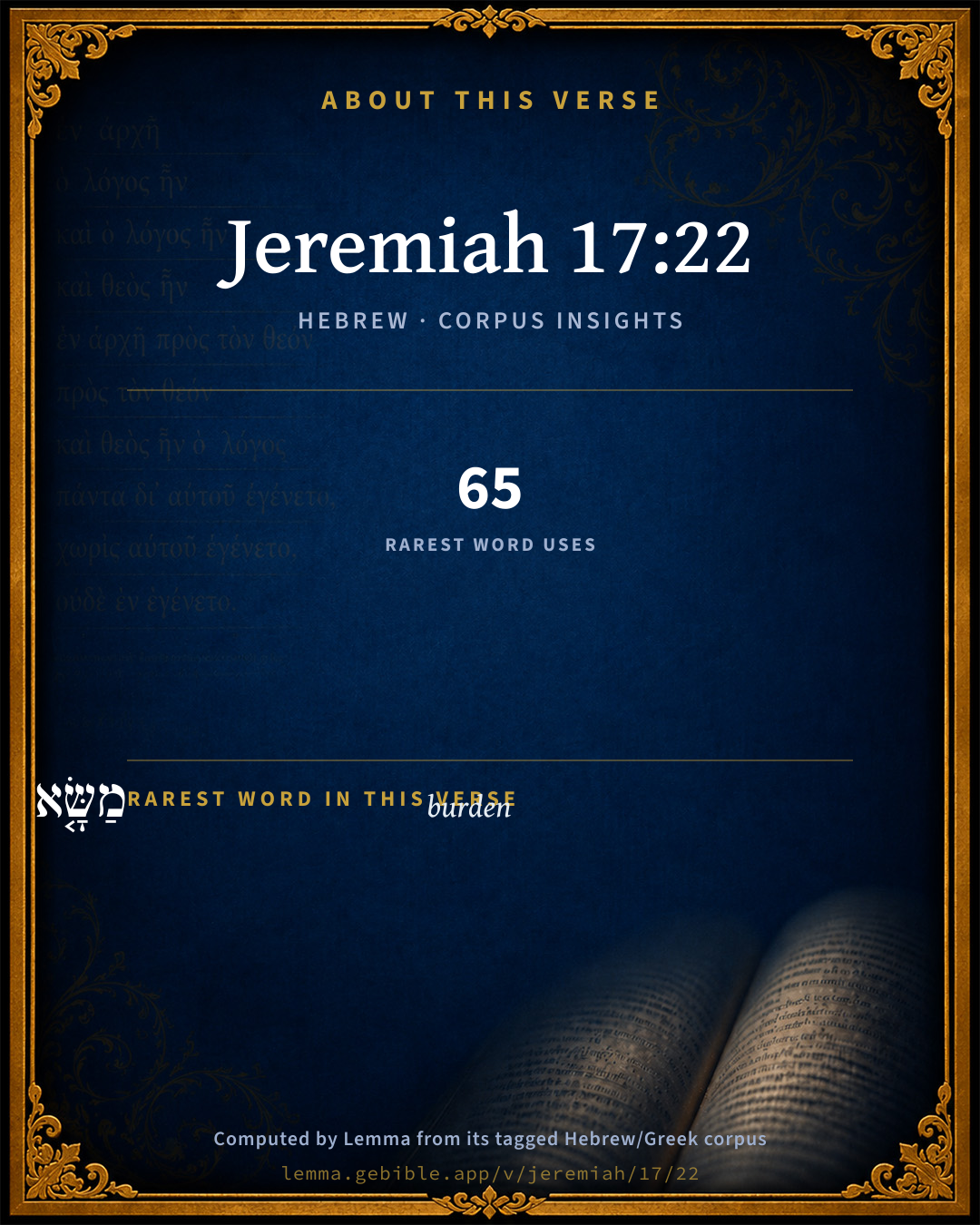
Jeremiah, in the Prophets, opens this verse with 18 words (14 distinct Hebrew lemmas). Its most distinctive word is massâʼ (“burden”). A historical commentator’s framing appears above. Read the whole chapter for the surrounding context.

Discussion questions

  1. The word massâʼ carries the sense “burden.” How does it shape the verse?
  2. How does Ezekiel 20:12, which shares this passage’s theme, read alongside this verse?
  3. What does the repetition of “day” (2× in this one verse) do in this verse?
  4. These translations render this verse differently; the difference is in the English rendering, not the original. What questions does that raise?
  5. «תוֹצִ֨יאוּ» is a Hiphil Imperfect verb. How does that grammatical form shape the action described?
  6. Compare how Trapp's Complete Commentary and The Biblical Illustrator read this verse. Where do they agree or differ?

Things to notice

Reading settings

Reading text

Shown beneath each verse's original-language words.

Old Testament
Old Testament edition

Read the OT as the Masoretic Hebrew (MT) or the Greek Septuagint (LXX).

English shown for the Greek Septuagint (in the Hebrew ↔ Greek comparison).

Comparing translations? Open the Compare panel on any verse page to stack up to four side by side.