

Nehemiah 13:10

Hebrew (Westminster Leningrad Codex) Nehemiah 13:10 appears in the Hebrew Old Testament. The text above is from the Westminster Leningrad Codex. Each word links to its Strong’s number, a concise gloss, and parsing drawn from the Open Scriptures Hebrew Bible morphology. Click any word for its full Brown-Driver-Briggs (BDB) entry.
Download image
Cite this verse

Nehemiah 13:10 (World English Bible). Public Domain. Lemma interlinear Bible study tool, https://lemma.gebible.app/v/nehemiah/13/10.

Show BibTeX & RIS
BibTeX
RIS
English Translation
I perceived that the portions of the Levites had not been given them; so that the Levites and the singers, who did the work, were fled everyone to his field.
World English Bible · Public Domain
Download a study sheet

One document with this verse’s original text, its word-by-word gloss line, the meaning frame, cross-references with their text, attributed commentary, and full source and license credits — printable, and it pastes into notes with its structure intact.

This verse Autodidact and up

Study sheet (.html) Plain text (.txt)

A passage Seminary Student

Up to 50 verses in one chapter. A passage sheet keeps up to 6 commentary sources and 12 cross-references per verse, in the order this page ranks them, and says so on the sheet whenever that leaves anything out. Ask for a single verse and you get the Autodidact verse sheet above.

Everything on this page stays free to read, with no account — the sheet is a download of what is already on screen, not access to it.

Want to remove ads? Support Godless Engineer
Compare translations 3

The same verse in 3 English versions, stacked beneath the original-language interlinear above. Click any original word for its lexicon entry.

Each is an independent rendering of the whole verse — the interlinear is not word-aligned to these translations.

Highlighted words mark where these versions differ — a whole-verse word diff, not a word-by-word alignment.

  • World English Bible Public Domain
    I perceived that the portions of the Levites had not been given them; so that the Levites and the singers, who did the work, were fled everyone to his field.
  • King James Version Public Domain
    And I perceived that the portions of the Levites had not been given them: for the Levites and the singers, that did the work, were fled every one to his field.
  • unfoldingWord Literal Text CC BY-SA 4.0
    And I knew that the portions of the Levites had not been given, and the Levites and the ones who sang, who did the work, had fled, a man to his field.

unfoldingWord Literal Text — © unfoldingWord, licensed CC BY-SA 4.0. Word-aligned USFM3 via Door43 (git.door43.org/unfoldingWord/en_ult).

Versions to compare (up to 4)

3 of 4 selected

Show all 18 translations

Every available English version of this verse, each an independent rendering of the whole verse.

  • World English Bible Public Domain
    I perceived that the portions of the Levites had not been given them; so that the Levites and the singers, who did the work, were fled everyone to his field.
  • Berean Standard Bible Public Domain
    I also learned that because the portions for the Levites had not been given to them, all the Levites and singers responsible for performing the service had gone back to their own fields.
  • Majority Standard Bible Public Domain
    I also learned that because the portions for the Levites had not been given to them, all the Levites and singers responsible for performing the service had gone back to their own fields.
  • King James Version Public Domain
    And I perceived that the portions of the Levites had not been given them: for the Levites and the singers, that did the work, were fled every one to his field.
  • American Standard Version (1901) Public Domain
    And I perceived that the portions of the Levites had not been given them; so that the Levites and the singers, that did the work, were fled every one to his field.
  • Revised Version (1885) Public Domain
    And I perceived that the portions of the Levites had not been given them; so that the Levites and the singers, that did the work, were fled every one to his field.
  • Geneva Bible (1599) Public Domain
    And I perceiued that the portions of the Leuites had not bene giuen, and that euery one was fled to his lande, euen the Leuites and singers that executed the worke.
  • Douay-Rheims (1899) Public Domain
    And I perceived that the portions of the Levites had not been given them: and that the Levites, and the singing men, and they that ministered were fled away every man to his own country:
  • Young's Literal Translation Public Domain
    And I know that the portions of the Levites have not been given, and they flee each to his field -- the Levites and the singers, doing the work.
  • Literal Standard Version CC BY-SA 4.0
    And I know that the portions of the Levites have not been given, and they flee each to his field—the Levites and the singers, doing the work.
  • Unlocked Literal Bible CC BY-SA 4.0
    I learned that the Levites' portions had not been given to them, and they had run away, each to his own field, the Levites and the singers who did the work.
  • unfoldingWord Literal Text CC BY-SA 4.0
    And I knew that the portions of the Levites had not been given, and the Levites and the ones who sang, who did the work, had fled, a man to his field.
  • Darby Bible Public Domain
    And I perceived that the portions of the Levites had not been given, and that the Levites and the singers that did the work had fled every one to his field.
  • World Messianic Bible Public Domain
    I perceived that the portions of the Levites had not been given them, so that the Levites and the singers, who did the work, had each fled to his field.
  • Webster's Bible Public Domain
    And I perceived that the portions of the Levites had not been given them: for the Levites and the singers, that did the work, had fled every one to his field.
  • Free Bible Version CC BY-SA 4.0
    I also found out that the food allowances for the Levites were not being provided, so the Levites had gone back to take care of their fields, along with the singers who led the worship services.
  • Bible in Basic English Public Domain
    And I saw that the Levites had not been given what was needed for their support; so that the Levites and the music-makers, who did the work, had gone away, everyone to his field.
  • JPS Tanakh (1917) Public Domain
    And I perceived that the portions of the Levites had not been given them; so that the Levites and the singers, that did the work, were fled every one to his field.

Literal Standard Version (2020), Covenant Press — licensed CC BY-SA 4.0. Text via the HelloAO Bible API (eBible.org). Unlocked Literal Bible (unfoldingWord) — licensed CC BY-SA 4.0. Text via the HelloAO Bible API (eBible.org). unfoldingWord Literal Text — © unfoldingWord, licensed CC BY-SA 4.0. Word-aligned USFM3 via Door43 (git.door43.org/unfoldingWord/en_ult). Free Bible Version, Dr. Jonathan Gallagher — licensed CC BY-SA 4.0. Text via the HelloAO Bible API (eBible.org).

Word by word

More ways to search: Search by grammar → Find every occurrence → Compare this word →

Practice this passage: Drill this verse → Learn its vocabulary →

מְנָי֥וֹת
mᵉnâth
H4521
“portions of”
Noun, Common, Feminine, Plural, Construct
Part of Speech
Noun
Type
Common
Gender
Feminine
Number
Plural
State
Construct
Full BDB Definition

Origin: from H4487

TWOT: 1213d

portion
  1. וָאֵ֣דְעָ֔ה yâdaʻ H3045 “and · to know” Conjunction + Verb, Qal, Sequential Imperfect, 1st Person, Common, Singular + Suffix, h
  2. כִּֽי kîy H3588 “that” Conjunction
  3. הַלְוִיִּ֖ם Lêvîyîy H3881 “the · Levites” Particle, Definite Article + Noun, Gentilic, Masculine, Plural, Absolute
  4. לֹ֣א lôʼ H3808 “not” Particle, Negative
  5. נִתָּ֑נָה nâthan H5414 “to give” Verb, Niphal, Perfect, 3rd Person, Feminine, Singular
  6. וַיִּבְרְח֧וּ bârach H1272 “and · to flee” Conjunction + Verb, Qal, Sequential Imperfect, 3rd Person, Masculine, Plural
  7. אִישׁ ʼîysh H376 “man” Noun, Common, Masculine, Singular, Absolute
  8. לְשָׂדֵ֛הוּ sâdeh H7704 “to/for · field · his” Preposition + Noun, Common, Masculine, Singular, Construct + Suffix, Personal, 3rd Person, Masculine, Singular
  9. הַלְוִיִּ֥ם Lêvîyîy H3881 “the · Levites” Particle, Definite Article + Noun, Gentilic, Masculine, Plural, Absolute
  10. וְהַמְשֹׁרְרִ֖ים shîyr H7891 “and · the · singing” Conjunction + Particle, Definite Article + Verb, Polel, Participle Active, Masculine, Plural, Absolute
  11. עֹשֵׂ֥י ʻâsâh H6213 “doing” Verb, Qal, Participle Active, Masculine, Plural, Construct
  12. הַמְּלָאכָֽה mᵉlâʼkâh H4399 “the · work” Particle, Definite Article + Noun, Common, Feminine, Singular, Absolute

About this verse

These counts appear in no published source. They are computed here, from the morphology-tagged text and Lemma’s own curated glosses. What Lemma adds →

13
words
12
distinct lemmas
Historical
section

Notable vocabulary

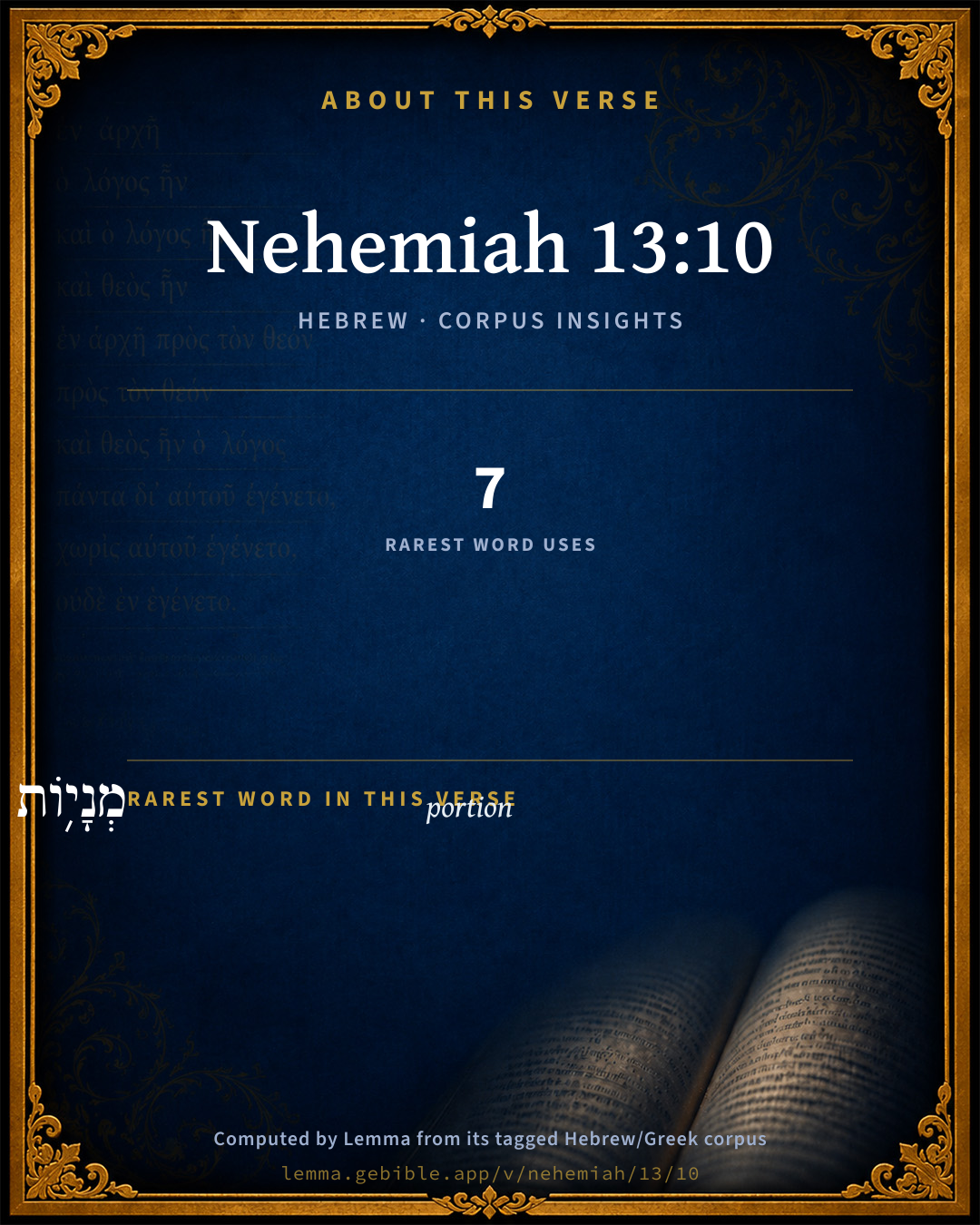
The rarest word here is מְנָי֥וֹת portion H4521 — appearing just 7 times in the whole Hebrew Bible.

Shared distinctive vocabulary

מְנָי֥וֹת portion H4521 occurs in 7 verses of the Hebrew Bible. Also found in:

Grammatical profile

  • 5 verbs
  • 6 nouns
  • 1 conjunction
  • 1 particle

Verb forms

  • וָאֵ֣דְעָ֔ה Qal · Sequential Imperfect
  • נִתָּ֑נָה Niphal · Perfect
  • וַיִּבְרְח֧וּ Qal · Sequential Imperfect
  • וְהַמְשֹׁרְרִ֖ים Polel · Participle Active
  • עֹשֵׂ֥י Qal · Participle Active

Repetition

A word recurs within this verse — often emphatic in Hebrew:

  • הַלְוִיִּ֖ם Levite H3881 ×2

Cross-references

8

Topical passages linked to Nehemiah 13:10 in the Treasury of Scripture Knowledge — connected by theme and wording, ordered by reader-vote popularity; previews shown in the World English Bible.

  • Nehemiah 10:37 and that we should bring the first fruits of our dough, and our heave-offerings, and the fruit of all manner of trees, the new wine and the oil, to the priests, to the chambers of the house of our God; and the tithes of our ground to the Levites; for they, the Levites, take the tithes in all the cities of our tillage.
  • Malachi 3:8 Will a man rob God? Yet you rob me! But you say, 'How have we robbed you?' In tithes and offerings.
  • Numbers 35:2 Command the children of Israel that they give to the Levites of the inheritance of their possession cities to dwell in; and suburbs for the cities round about them shall you give to the Levites.
  • Deuteronomy 12:19 Take heed to yourself that you don't forsake the Levite as long as you live in your land.
  • Nehemiah 12:28–29 The sons of the singers gathered themselves together, both out of the plain round about Jerusalem, and from the villages of the Netophathites;
  • Nehemiah 12:47 All Israel in the days of Zerubbabel, and in the days of Nehemiah, gave the portions of the singers and the porters, as every day required: and they set apart [that which was] for the Levites; and the Levites set apart [that which was] for the sons of Aaron.
  • Malachi 1:6–14 "A son honors his father, and a servant his master. If I am a father, then where is my honor? And if I am a master, where is the respect due me? Says Yahweh of Hosts to you, priests, who despise my name. You say, 'How have we despised your name?'
  • 1 Timothy 5:17–18 Let the elders who rule well be counted worthy of double honor, especially those who labor in the word and in teaching.

Cross-references courtesy of OpenBible.info (CC BY 4.0).

Hebrew and Greek witnesses Masoretic Hebrew ↔ Greek Septuagint

The same verse in the two great witnesses to the Old Testament, shown verse-for-verse.

These are two independent witnesses, not word-aligned to each other, and the Septuagint is shown in lemma (dictionary) form.

Hebrew Nehemiah 13:10 Masoretic · Westminster Leningrad Codex

וָאֵ֣דְעָ֔ה כִּֽי מְנָי֥וֹת הַלְוִיִּ֖ם לֹ֣א נִתָּ֑נָה וַיִּבְרְח֧וּ אִישׁ לְשָׂדֵ֛הוּ הַלְוִיִּ֥ם וְהַמְשֹׁרְרִ֖ים עֹשֵׂ֥י הַמְּלָאכָֽה

I perceived that the portions of the Levites had not been given them; so that the Levites and the singers, who did the work, were fled everyone to his field.

World English Bible · Public Domain

Greek LXX Structure differs

The Septuagint has no separate book of Nehemiah. Its Greek text is the second half of Esdras B (2 Esdras), chapters 11–23; Ezra is the first half (1–10).

A verse-for-verse comparison isn’t shown here because the chapters and verses don’t line up. Switch to the LXX edition with the MT / LXX toggle above to read the Greek directly.

Hebrew: Westminster Leningrad Codex (CC BY 4.0). Greek: Septuagint (public domain); English from a public-domain English Septuagint. How the Septuagint differs from the Hebrew →

Commentary

Notes on Nehemiah 13:10 from classic Christian and Jewish commentators (each source and its license shown beneath its notes). The classic Christian expositions comment on the surrounding passage and are grouped to its opening verse, so a note may address several verses; the Jewish commentaries on the Tanakh (Rashi and others) are per-verse, so they appear only where the commentator wrote on this verse.

Lemma curates 59 commentaries, every one of them public domain or Creative Commons licensed, each selected and text-cleaned for this edition rather than reprinted as found. About our sources →

Matthew Henry's Commentary

Here is another grievance redressed by Nehemiah.

I. The Levites had been wronged. This was the grievance: their portions had not been given them, Neh 13:10. Perhaps Tobiah, when he took possession of the store-chambers, seized the stores too, and, by the connivance of Eliashib, converted them to his own use. The complaint is not that they were not collected from the people, but that they were not given to the Levites, and the Levites were so modest as not to sue for them; for the Levites and singers fled every one to his field. This comes in as a reason either, (1.) Why their payments were withheld. The Levites were non-residents: when they should have been doing their work about the temple, they were at their farms in the country; and therefore the people were little inclined to give them their maintenance. If ministers have not the encouragement they should have, let them consider whether they themselves be not accessory to the contempt they are under, by the neglect of their business. Or rather, (2.) It is the reason why Nehemiah soon perceived that their dues had been denied them, because he missed them from their posts. "Where are the singers" (said Nehemiah); "why do not they attend according to their office, to praise God?" "Why, truly, they have gone every one to his country seat, to get a livelihood for themselves and their families out of their grounds; for their profession would not maintain them." A scandalous maintenance makes a scandalous ministry. The work is neglected because the workmen are. It was not long since the payment of the salaries appointed for the singers was put into a very good method (Neh 12:47); and yet how soon did it fail for want of being looked after!

II. Nehemiah laid the fault upon the rulers, who should have taken care that the Levites minded their business and had all due encouragement therein. This is required from Christian magistrates, that they use their power to oblige ministers to do their duty, and people to do theirs. Nehemiah began with the rulers, and called them to an account: "Why is the house of God forsaken? Neh 13:11. Why are the Levites starved out of it? Why did not you take notice of this and prevent it?" The people forsook the Levites, which was expressly forbidden (Deu 12:19; Deu 14:27); and then the Levites forsook their post in the house of God. Both ministers and people who forsake religion and the services of it, and magistrates too who do not what they can to keep them to it, will have a great deal to answer for.

III. He delayed not to bring the dispersed Levites to their places again, and set them in their stations (as the word is), Neh 13:11. A Levite in his field (clericus in foroa minister keeping the market) is out of his station. God's house is his place, and there let him be found. Many that are careless would do much better than they do if they were but called upon. Say to Archippus, Take heed to thy ministry.

IV. He obliged the people to bring in their tithes, Neh 13:12. His zeal provoked theirs; and, when they saw the Levites at their work, they could not for shame withhold their wages any longer, but honestly and cheerfully brought them in. The better church-work is done the better will church-dues be paid.

V. He provided that just and prompt payment should be made of the Levites' stipends. Commissioners were appointed to see to this (Neh 13:13), and they were such as were accounted faithful, that is, had approved themselves so in other trusts committed to them, and so had purchased to themselves this good degree, Ti1 3:13. Let men be tried first and then trusted, tried in the less and then trusted with more. Their office was to receive and pay, to distribute to their brethren in due season and due proportions.

VI. Having no recompence (it is a question whether he had thanks) from those for whom he did these good services, he looks up to God as his paymaster (Neh 13:14): Remember me, O my God! concerning this. Nehemiah was a man much in pious ejaculations; on every occasion he looked up to God, and committed himself and his affairs to him. 1. He here reflects with comfort and much satisfaction upon what he had done for the house of God and the offices thereof; it pleased him to think that he had been any way instrumental to revive and support religion in his country and to reform what was amiss. What kindness any show to God's ministers, thus shall it be returned into their own bosoms, in the secret joy they shall have there, not only in having done well, but in having done good, good to many, good to souls. 2. He here refers it to God to consider him for it, not in pride, or as boasting of what he had done, much less depending upon it as his righteousness, or as if he thought he had made God a debtor to him, but in a humble appeal to him concerning his integrity and honest intention in what he had done, and a believing expectation that he would not be unrighteous to forget his work and labour of love, Heb 6:10. Observe how modest he is in his requests. He only prays, Remember me, not Reward me - Wipe not out my good deeds, not Publish them, Record them. Yet he was rewarded and his good deeds were recorded; for God does more than we are able to ask. Note, Deeds done for the house of God and the offices of it, for the support of religion and the encouragement of it, are good deeds. There is both righteousness and godliness in them, and God will certainly remember them, and not wipe them out; they shall in no wise lose their reward.

Matthew Henry's Commentary on the Whole Bible (1708–1710) — public domain (CC PDM 1.0). Text via the HelloAO Bible API.

Jamieson, Fausset & Brown

Robert Jamieson, A. R. Fausset & David Brown

NEHEMIAH REFORMS THE OFFICERS IN THE HOUSE OF GOD. (Neh 13:10-14)

And I perceived that the portions of the Levites had not been given them--The people, disgusted with the malversations of Eliashib, or the lax and irregular performance of the sacred rites, withheld the tithes, so that the ministers of religion were compelled for their livelihood to withdraw to their patrimonial possessions in the country. The temple services had ceased; all religious duties had fallen into neglect. The money put into the sacred treasury had been squandered in the entertainment of an Ammonite heathen, an open and contemptuous enemy of God and His people. The return of the governor put an end to these disgraceful and profane proceedings. He administered a sharp rebuke to those priests to whom the management of the temple and its services was committed, for the total neglect of their duties, and the violation of the solemn promises which they had made to him at his departure. He upbraided them with the serious charge of having not only withheld from men their dues, but of having robbed God, by neglecting the care of His house and service. And thus having roused them to a sense of duty and incited them to testify their godly sorrow for their criminal negligence by renewed devotedness to their sacred work, Nehemiah restored the temple services. He recalled the dispersed Levites to the regular discharge of their duties; while the people at large, perceiving that their contributions would be no longer perverted to improper uses, willingly brought in their tithes as formerly. Men of integrity and good report were appointed to act as trustees of the sacred treasures, and thus order, regularity, and active service were re-established in the temple.

Jamieson, Fausset & Brown — Commentary Critical and Explanatory on the Whole Bible (1871) — public domain (CC PDM 1.0). Text via the HelloAO Bible API.

Trapp's Complete Commentary

John Trapp

Neh 13:10 And I perceived that the portions of the Levites had not been given [them]: for the Levites and the singers, that did the work, were fled every one to his field.

Ver. 10. And I perceived] Heb. I took knowledge, and was soon sensible of it, as a great public mischief: for ad tenuitatem beneficiorum necessario sequitur socordia sacerdotum, lean benefits make leaden ministers (Panormit.). This the magistrate must look to, and provide that they may have the double honour that is due to them, of countenance and maintenance, 1Ti 5:17; or else religion will soon go to wreck.

That the portions of the Levites had not been given them] And why? because the high priest was so bad, and the Levites, therefore, thought to be little better. How apt are men to dispute God out of his own! How witty to save their purses! How ready to say, with William Rufus, The Church bread is sweet bread! and with Julian, the apostate, to take away the ministers’ maintenance, pretending conscience; for that too much living would be a burden to them; and who knows how Eliashib and his Levites may misemploy it?

For the Levites and singers, that did the work] And are, therefore, worthy of their wages, must have their honorary stipends, or cannot subsist; are not of the chameleon kind, to live by air; but, as harvest labourers, must have that which is good; as oxen that tread out the corn must have more than straw allowed them.

Were fled every one to his field] For stark need, in the fail of temple maintenance; they were glad to do as they might, and let their charge lie. Though tithes were not paid, yet they had some glebe land {A portion of land assigned to a clergyman as part of his benefice.} to live upon.

John Trapp, A Commentary or Exposition upon All the Books of the Old and New Testament (1647–1656) — public domain. Text from a community e-Sword module.

Joseph Benson's Commentary

Neh 13:10. The portion of the Levites had not been given them — Which might be, either, 1st, Through this corrupt high-priest, Eliashib, who took their portions, as he did the sacred chambers, to his own use, or employed them for the entertainment of Tobiah, and his other great allies: or, 2d, Through the people, who either out of covetousness reserved them to themselves, contrary to their own solemn agreement, or were so offended at Eliashib’s horrid abuse of sacred things, that they abhorred the offering and service of God, and therefore neglected to bring in their tithes, which they knew would be perverted to bad uses. For the Levites, &c., were fled — To their possessions in the country, being forced to do so for a livelihood.

Joseph Benson's Commentary on the Old and New Testaments (1811–1818) — public domain. Text from a community e-Sword module.

Whedon's Commentary on the Bible

Daniel D. Whedon

THE PORTIONS OF THE LEVITES RESTORED, Neh_13:10-14.

10. The portions… had not been given — The arrangements narrated in Neh_12:44-47 had not been carried out, and consequently the ministers of the temple had been obliged to flee every one to his field, in order to procure sustenance for himself. The evil example of the high priest had spread demoralization among all the Levites, and we have the dark picture of this corruption of priests and people vividly presented to us in the prophecy of Malachi.

Daniel D. Whedon (gen. ed.), Commentary on the Old and New Testaments (1874–1909) — public domain. Text from a community e-Sword module.

Keil & Delitzsch

C. F. Keil & F. Delitzsch

The payment of dues to the Levites, and the delivery of the tenths and first-fruits, had also been omitted. - Neh 13:10. "And I perceived that the portions of the Levites had not been given; and the Levites and singers who had to do the work, were fled every one to his field." The Levites, i.e., the assistants of the priests, the singers, and also the porters, who are not expressly mentioned in this passage, were accustomed to receive during the time of their ministry their daily portions of the tenths and first-fruits (Neh 12:47). When then these offerings were discontinued, they were obliged to seek their maintenance from the fields of the towns and villages in which they dwelt (Neh 12:28.), and to forsake the service of the house of God. This is the meaning of the בּרח, to flee to the fields.

Neh 13:11-12

"Then I contended with the rulers, and said, Why is the house of God forsaken?" It was the duty of the סגנים, the heads of the community (comp. Neh 2:16), to see that the tithes, etc., were regularly brought to the house of God. Hence Nehemiah rebukes them by asking: Why is the house of God forsaken? i.e., through the non-delivery of the dues. On נעזב, comp. Neh 10:39. This rebuke made the impression desired. Nehemiah assembled the Levites and set them in their place (comp. Neh 9:3; Ch2 30:16; Ch2 35:10), i.e., he brought them back to the performance of their official duties, and (Neh 13:12) all Judah (the whole community) brought the tithe of the corn, etc., into the store-chambers of the temple; comp. Neh 10:38. Ch2 11:11.

Neh 13:13-14

"And I appointed as managers of the stores (or storehouses, i.e., magazines) Shemaiah the priest," etc. ואוצרה, Hiphil, for אוצירה, is a denominative from אוצר, to set some one over the treasures. Whether Shemaiah and Zadok are the individuals of these names mentioned in Neh 3:30, Neh 3:29, cannot be determined. Zadok is called a סופר, a writer or secretary, not a scribe in the Jewish sense of that word. A Pedaiah occurs Neh 8:4. ידם ועל, and at their hand Hanan, probably as an under-steward. These four were placed in this position because they were esteemed faithful. ועליהם, and it was (incumbent) on them (comp. Ch1 9:27; Ezr 10:12) to distribute to their brethren, i.e., to the priests and Levites, the portions due to them (Neh 13:10). Nehemiah concludes his account of this matter with the wish, that God may remember him concerning it (comp. Neh 5:19), and not wipe out the kindnesses which he has shown to the house of God and its watches. תּמה, abbreviated from the Hiphil תּמחה, to cause to wipe out. חסדים .tuo like Ch2 35:26. משׁמרים (the form occurring only here), properly watches, watch-posts, here the office of attending on the service of the temple.

Keil & Delitzsch — Biblical Commentary on the Old Testament (1861–1891) — public domain (CC PDM 1.0). Text via the HelloAO Bible API. (Old Testament only.)

Tyndale Open Study Notes

Tyndale Open Resources

13:10-12 With Tobiah using the storeroom, there had been no place to store tithes to feed the Levites and Temple singers (Num 18:21-24; see Neh 12:44, 47). They had to farm outside of Jerusalem (12:28-29) to support themselves and could not serve in the Temple.

Tyndale Open Study Notes — © Tyndale Open Resources, licensed CC BY-SA 4.0. Text via the HelloAO Bible API.

Adam Clarke's Commentary

Verse 10. The portions of the Levites had not been given] Hence we find they were obliged to abandon the sacred service, and betake themselves to cultivate the land for their support. This was the fault of the rulers, who permitted all these abuses.

Adam Clarke's Commentary on the Bible (1810–1826) — public domain. Text from a community e-Sword/MySword module.

Ellicott's Commentary for English Readers

(10) Fled every one to his field.—They who performed the work of the Temple were obliged to seek their sustenance by cultivating the fields apportioned to them in the Levitical cities (Num_35:2).

(10-13) The provision for the Levites.

A Bible Commentary for English Readers, edited by Charles John Ellicott (1878–1897) — public domain. Text from a community e-Sword module.

The Cambridge Bible for Schools and Colleges

gen. ed. J. J. S. Perowne

10–14. The failure of the people to furnish the due supplies to the Levites; and Nehemiah’s reform

10. the portions of the Levites] The portion which the people had covenanted to contribute to the Levites (cf. Neh_10:37 ff.) had not been paid. The Levites to escape starvation had dispersed into the country. The Temple services were therefore crippled. Compare the similar rebuke in Mal_3:7-12. ‘The Levites’ here used for the whole class.

for] R.V. so that. Their dispersion was the result, not the occasion of non-payment.

the singers] Under this head, the porters (Neh_13:5) would be included.

every one to his field] For mention of the country villages ‘round about Jerusalem,’ to which ‘the Levites and the singers’ resorted, cf. Neh_12:27-29.

The Cambridge Bible for Schools and Colleges (gen. ed. J. J. S. Perowne; Cambridge University Press, 1878–1918) — public domain. Text from a community e-Sword module.

John Gill's Exposition

Then I contended with the rulers;.... The ecclesiastical rulers, the priests that were appointed over those chambers, Neh 12:44, he expostulated with them warmly, and chode them severely for their conduct:

and said, why is the house of God forsaken? no care being taken of the maintenance of the ministers of it, contrary to the promise made Neh 10:37,

and l gathered them together; the Levites and singers that were dispersed in the countries round about:

and set them in their place; in the temple, and in the course of their ministry there.

John Gill's Exposition of the Whole Bible (1746–1763) — public domain (CC PDM 1.0). Text via the HelloAO Bible API.

Albert Barnes' Notes on the Bible

etc. During Nehemiah’s absence there had been a general falling away, and there was danger of a complete national apostasy.

Albert Barnes' Notes on the Bible (1834–1885) — public domain. Text from a community e-Sword/MySword module.

Haydock's Catholic Bible Commentary

Country. Hebrew, "field," that he might cultivate it, (Haydock) and get food. (Menochius)

George Leo Haydock (1774–1849), Haydock's Catholic Family Bible and Commentary, 1859 edition — public domain. Excludes Psalms (Douay-Rheims chapter numbering differs from Protestant) and Deuterocanonical books (Catholic canon only).

Matthew Poole's English Annotations

The portions of the Levites had not been given them; which might be either,

1. From this corrupt high priest Eliashib, who took their portions, as he did the sacred chambers, to his own use, or employed them for the entertainment of Tobiah, and his other great allies. Or.

2. From the people, who either out of covetousness reserved them to themselves, contrary to their own solemn agreement and covenant, Neh 10:37; or were so offended at Eliashib’s horrid and manifest abuse of sacred things, that they abhorred the offering and service of God, as others did upon a like occasion, 1Sa 2:17, and therefore neglected to bring in their tithes, &c., which they knew would be perverted to bad uses.

Were fled every one to his field; to his possession in the country, being forced to do so for a livelihood.

Matthew Poole's English Annotations on the Holy Bible (1683–1685) — public domain. Text from a community e-Sword/MySword module.

The Pulpit Commentary

I perceived that the portions of the Levites had not been given them: for the Levites ... were fled. What Nehemiah saw was that the Levites were absent, and "the house of God forsaken" (ver. 11). On inquiry, he found that the reason of their absence was the non-payment of the tithes. That did the work. i.e. whose business it was to do the work of the house, or, in other words, conduct Divine service. Every one to his field. Every Levite had a plot of ground, which he cultivated when not engaged in the work of the temple. (see Num 35:2Jo Num_21:3)

Vers. 10-14. Suspended ministrations restored.

Nehemiah, on his return, soon discovers another serious evil which his absence had occasioned; and, with his usual promptness, ability, and energy, corrects it.

I THE SERIOUS IRREGULARITY WHICH HAD ARISEN. The services of the temple, if not discontinued, had been deprived of much of their dignity and impressiveness by the withdrawal of the Levites, including the singers, from their duties. Their appointed daily allowances (Neh_12:47) had been withheld, and they had retired to their fields to obtain a livelihood by other employments.

II ITS CAUSES.

1. Nehemiah"s absence. His presence and authority were as yet necessary to keep all classes to their duty. The reformation he had effected was not sustained by any vital change in the hearts of rulers or people. Their resolutions, so solemnly made under excitement, (Ne 10) were superficial and short-lived.

2. The indifference and negligence of the rulers (ver. 11), who should have taken care that the regulations were observed.

3. The unfitness for his office of the high priest. He ought to have deemed as his own the interests of the inferior ministers of the sanctuary. But his misconduct, as related in vers. 4, 5 whether the lack of offerings gave opportunity for it, or was occasioned by it shows how little likely he was to concern himself about them, so long as his own position and gains were not affected.

4. The covetousness of the people. They are reproved by Malachi about this time for robbing God by withholding the tithes and offerings. (Mal_3:8) Had they furnished the means, the treasurers would hardly have failed to supply the Levites; or if these had proved unfaithful (as seems hinted in ver. 13), the people could surely have secured the substitution of others.

5. Probably the worldliness of the Levites themselves. If their hearts had been in their work it is likely they would have found means of continuing in it. A general declension had evidently taken place, and the various classes would act and react on each other to increase the degeneracy of all.

III ITS CORRECTION. Nehemiah

1. Remonstrated with the rulers.

2. Gathered and reinstated the Levites.

3. Restored the general payment of tithes and offerings.

4. Appointed as treasurers men of good repute, to receive the contributions of the people, and thence "distribute unto their brethren.

IV NEHEMIAH"S PRAYER THEREUPON. Is expressive of

1. Satisfaction with his work. Could think of it before God as an evidence of his love for God"s house.

2. Confident expectation of Divine recognition, acceptance, and recompense of his work. He could expect little of these from the men whose disorders he had corrected. Enough if God approved.

3. Humility. "Wipe not out," etc., as he felt might justly be done. Comp. ver. 22: "Spare me according to the greatness of thy mercy." To interpret these appeals to God as "prayer for posthumous fame" (Stanley, "Jewish Church," 3. p. 135) is surely to miss their meaning.

In conclusion, notice

1. The duty of zealously maintaining the public worship of God. All combining according to their ability. Some ministering, others contributing money or money"s worth; some faithfully using their talent for management, others exercising their authority to correct abuses and reprove negligence. Those who love God"s house will deem such services a privilege and honour. Those who withhold support deserve reproof, and have no right to complain of defective ministrations. "A scandalous maintenance makes a scandalous ministry.

2. The Divine recognition and reward of practical love to the house of God.

3. The worth to a Church of able, devoted, and noble-minded leaders.

Vers. 10-14. Practical Christian wisdom.

Nehemiah must have been shocked indeed to find on his return to Jerusalem (ver. 7) what a sad relapse had taken place during his absence from the city. Most painful of all must it have been to him to find that the service of Jehovah in his own house had been so scandalously neglected. He found not only that chambers of the temple were in the occupation of the enemy of the people of God (ver. 7), but that, the Levites being scattered abroad, because their portion had been withheld (ver. 10), the house of God was forsaken (ver 11). We gather from the whole incident recorded in vers. 10-14

I THAT MATERIAL SUPPLIES AND SPIRITUAL PROSPERITY ARE IMPORTANTLY CONNECTED (ver. 10). "The portions of the Levites had not been given them," and, consequently, they had "fled every one to his field" (ver. 10). It may be open to question whether these Levites singers and other officials had shown as much disinterestedness and devotion as could have been wished. It might be argued that as servants of God they might have stood at their posts and starved rather than desert the field of sacred duty. Perhaps if they had been some degrees more heroic than they were they would have risked and suffered all privations rather than forsake their work. But however this may have been, it is certain that the people had no right whatever to reckon on such heroism; they ought to have acted on the supposition that these were men of average piety, and that men of ordinary goodness will not continue to serve if they are not sustained in their service. The human nature which there is in every good man and which will certainly be shown in every class and order of good men is a factor which must not be disregarded. It is a feature that must be taken into account; a want that must be provided for. If it be left out of account, then, whatever the system or society may be, there will be found, as here, negligence, desertion, duty undone, God"s house forsaken, a fleeing from the temple to the field. Material resources have their place in the prosperity of the best of causes.

II THAT GOOD MEN AS WELL AS GOOD METHODS ARE NECESSARY FOR LASTING SUCCESS. Judging from the four concluding verses of the preceding chapter, (Neh_12:44-47) we gather that a very satisfactory system for receiving and storing the offerings, and also for distributing them, had been devised and brought into action. Yet, in Nehemiah"s absence, it failed to effect its purpose. When he returned and witnessed the failure, he immediately

(1) set to work to reorganise: he "set in their place" (ver. 11) the Levites, who, at his instance, returned to Jerusalem, and he "made treasurers over the treasuries "(ver. 12); but besides this, he

(2) appointed "faithful men" (ver. 12), on whom reliance could be placed, to do the work they undertook, infusing his own spirit into all the officers. He impressed on them all his own fervent and faithful genius. How long things went well we know not, but Nehemiah did the best he could do to provide for permanent prosperity: he associated good men with a good method. We should trust neither to one nor to the other. Again and again organisations have broken clown in the Church (whether tithe-taking, money-getting institutions, or others) because, though the machinery was excellent, there was no steam to work the wheels; again and again there has been an excellent spirit, but all has failed for want of a wise method. We must

(a) use our best judgment to perfect our system, and

(b) pray for, and look out for, the wise and earnest-minded men to work it.

III THAT INDIVIDUAL FIDELITY WILL SURELY MEET WITH ITS APPROPRIATE RECOMPENSE (vers. 13, 14).

1. Usually from man. "I made treasurers... Shelemiah," etc. ... "for they were counted faithful." Integrity, diligence, conscientiousness will generally be seen of man and receive its reward. It may indeed pass unnoticed, but as a rule it is recognised and rewarded. Be faithful, and you will be "counted faithful.

2. Certainly from God. "Remember me, O my God, concerning this, and wipe not out my good deeds," etc. (ver. 14). There are many motives, all good, but some higher than others, which should prompt us to diligent and faithful labour for our Lord and our race. We may work in the vineyard of the Great Husbandman because

(1) be calls us, and it is our bounden duty to respond; or because

(2) our zeal is called forth by the apparent and urgent necessity for our help; or because

(3) we delight in holy activity, and are never so happy as when the weapon of usefulness is in our hand; or we may do so because

(4) we have "respect unto the recompense of the our God for good;" we would that he should "not wipe out our good deeds" (ver. 14), but record them in his "book of remembrance;" and, not being "unrighteous to forget our work and labor of love", (Heb_6:10) reward every one according to his work. The truest humility (Luk_17:10) may characterise the same disciple that has the most earnest aspiration to receive his Master"s commendation, and to have rule given him over many things." We may turn this prayer into a prediction. God will remember us, and will suffer nothing to blot out our pure endeavours from his book. We shall surely meet them again. Our "works follow us," and will find us in his presence. C.

The Pulpit Commentary (1880–1919), ed. H.D.M. Spence-Jones & Joseph S. Exell — public domain. Text from a community e-Sword module.

John Wesley's Explanatory Notes

Not given - Which might be either,

1. from this corrupt high-priest Eliashib, who took their portions, as he did the sacred chambers, to his own use, or employed them for the entertainment of Tobiah, and his other great allies. Or,

2. from the people, who either out of covetousness reserved them to themselves, contrary to their own solemn agreement, or were so offended at Eliashib's horrid abuse of sacred things, that they abhorred the offering and service of God, and therefore neglected to bring in their tithes, which they knew would be perverted to bad uses. Fled - To his possession in the country, being forced to do so for a livelihood.

John Wesley, Explanatory Notes Upon the Whole Bible (1754–1765) — public domain. Text via the GEBible commentary corpus.

unfoldingWord translationNotes

Door43 World Missions Community

the Levites' portions had not been given to them

The full meaning of this statement can be made clear. This can also be translated in active form. AT: "the people had not been bringing into the storerooms their tithes and offerings of food for the temple priests" (See: Assumed Knowledge and Implicit Information and Active or Passive)

they had run away, each to his own field, the Levites and the singers who did the work

"the Levites and the singers who did the work had left the temple, each one going to his own field"

Why is the house of God neglected?

Nehemiah uses a rhetorical question to challenge or even ridicule the officials who had not done their work. This question can be translated as a statement. AT: "You have neglected the house of God!" (See: Rhetorical Question)

translationWords

Levi

works

house of God

unfoldingWord translationNotes — © Distant Shores Media and the Door43 World Missions Community, licensed CC BY-SA 4.0. Source: git.door43.org/Door43/en_tn.

Rashi

Rabbi Shlomo Yitzchaki (Rashi)

portions Heb. מְנָיוֹת, [like] מָנוֹת.

had not been given that the Israelites had not placed the gifts there, and because of that they fled and wandered here and there to ask for their gifts, and were not occupied as much with their service.

Rashi on the Tanakh — English translations: “The Judaica Press complete Tanach with Rashi, translated by A. J. Rosenberg” (CC BY 4.0); “Pentateuch with Rashi's commentary by M. Rosenbaum and A.M. Silbermann, 1929-1934” (public domain); “The Metsudah Tanach series, Lakewood, N.J” (CC BY 4.0); and “The Book of Joshua, Metsudah Publications, 1997” (CC BY 4.0). Text via Sefaria.

Lesson kit

Teaching starters — assembled from the data on this page, not authored interpretation. Every prompt links to the verse data it draws on. Edit before teaching.

Nehemiah, in the Historical, opens this verse with 13 words (12 distinct Hebrew lemmas). Its most distinctive word is mᵉnâth (“portion”). A historical commentator’s framing appears above. Read the whole chapter for the surrounding context.

Discussion questions

  1. How does “portion” (mᵉnâth) shape what this verse is saying?
  2. 2 Chronicles 31:3 shares the word «portion» with this verse. How do the two illuminate each other?
  3. “Levite” occurs 2× in this one verse. What is the effect of the repetition?
  4. The translations on this page render this verse differently — a whole-verse word diff, not a word-by-word alignment. What might account for the different wordings?
  5. The verb «וָאֵ֣דְעָ֔ה» is Qal Sequential Imperfect. How does its form color the action?
  6. Reading how Matthew Henry's Commentary and Jamieson, Fausset & Brown read this verse, where do the two commentators agree and where do they part?

Things to notice

Reading settings

Reading text

Shown beneath each verse's original-language words.

Old Testament
Old Testament edition

Read the OT as the Masoretic Hebrew (MT) or the Greek Septuagint (LXX).

English shown for the Greek Septuagint (in the Hebrew ↔ Greek comparison).

Comparing translations? Open the Compare panel on any verse page to stack up to four side by side.