
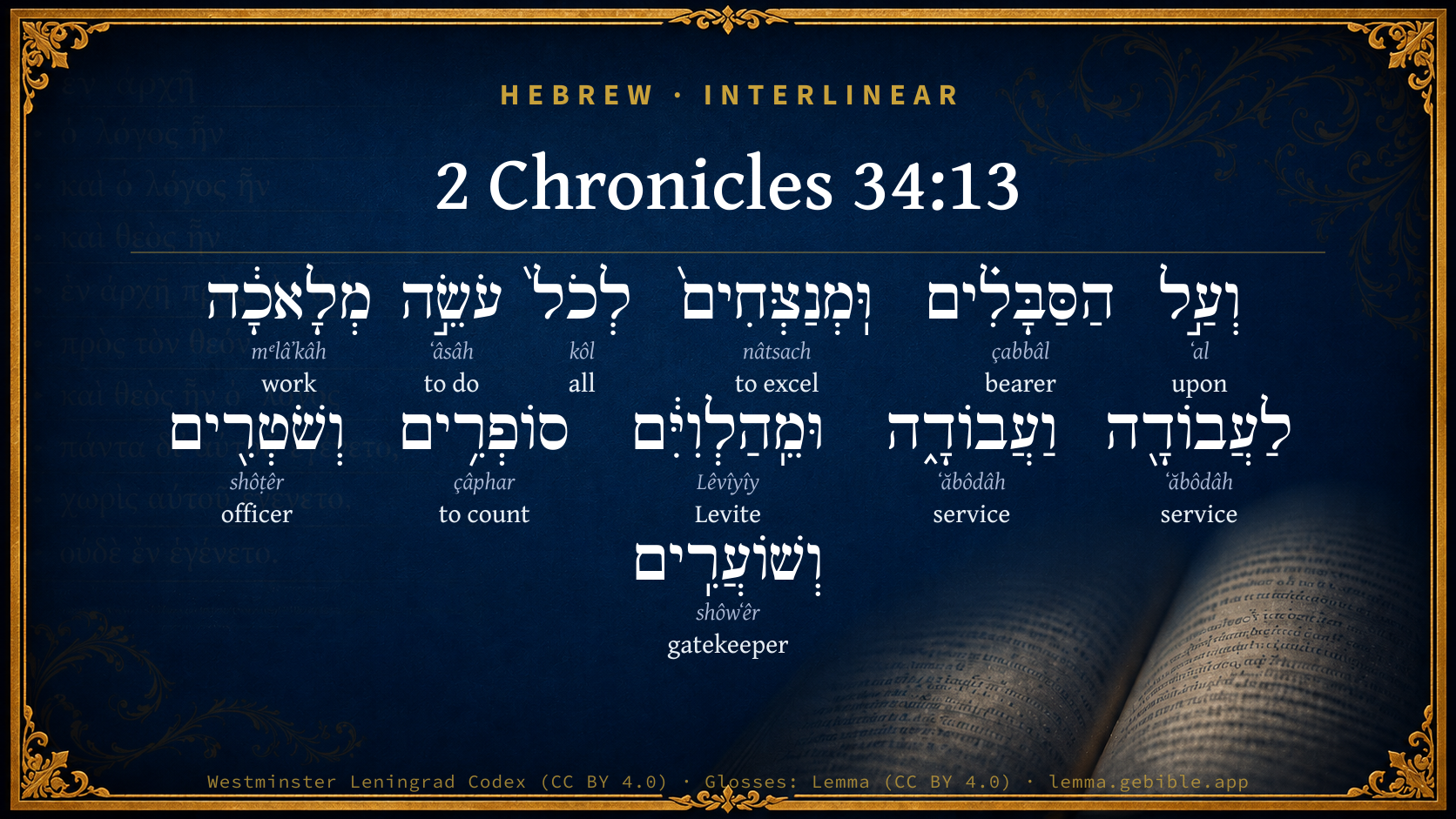
2 Chronicles 34:13

Hebrew (Westminster Leningrad Codex) 2 Chronicles 34:13 appears in the Hebrew Old Testament. The text above is from the Westminster Leningrad Codex. Each word links to its Strong’s number, a concise gloss, and parsing drawn from the Open Scriptures Hebrew Bible morphology. Click any word for its full Brown-Driver-Briggs (BDB) entry.
Download image
Cite this verse

2 Chronicles 34:13 (World English Bible). Public Domain. Lemma interlinear Bible study tool, https://lemma.gebible.app/v/2-chronicles/34/13.

Show BibTeX & RIS
BibTeX
RIS
English Translation
Also they were over the bearers of burdens, and set forward all who did the work in every manner of service: and of the Levites there were scribes, and officers, and porters.
World English Bible · Public Domain
Download a study sheet

One document with this verse’s original text, its word-by-word gloss line, the meaning frame, cross-references with their text, attributed commentary, and full source and license credits — printable, and it pastes into notes with its structure intact.

This verse Autodidact and up

Study sheet (.html) Plain text (.txt)

A passage Seminary Student

Up to 50 verses in one chapter. A passage sheet keeps up to 6 commentary sources and 12 cross-references per verse, in the order this page ranks them, and says so on the sheet whenever that leaves anything out. Ask for a single verse and you get the Autodidact verse sheet above.

Everything on this page stays free to read, with no account — the sheet is a download of what is already on screen, not access to it.

Want to remove ads? Support Godless Engineer
Compare translations 3

The same verse in 3 English versions, stacked beneath the original-language interlinear above. Click any original word for its lexicon entry.

Each is an independent rendering of the whole verse — the interlinear is not word-aligned to these translations.

Highlighted words mark where these versions differ — a whole-verse word diff, not a word-by-word alignment.

  • World English Bible Public Domain
    Also they were over the bearers of burdens, and set forward all who did the work in every manner of service: and of the Levites there were scribes, and officers, and porters.
  • King James Version Public Domain
    Also they were over the bearers of burdens, and were overseers of all that wrought the work in any manner of service: and of the Levites there were scribes, and officers, and porters.
  • unfoldingWord Literal Text CC BY-SA 4.0
    And over the burden bearers and directors for every doer of the work for service and service, and from the Levites, were scribes and officials and gatekeepers.

unfoldingWord Literal Text — © unfoldingWord, licensed CC BY-SA 4.0. Word-aligned USFM3 via Door43 (git.door43.org/unfoldingWord/en_ult).

Versions to compare (up to 4)

3 of 4 selected

Show all 18 translations

Every available English version of this verse, each an independent rendering of the whole verse.

  • World English Bible Public Domain
    Also they were over the bearers of burdens, and set forward all who did the work in every manner of service: and of the Levites there were scribes, and officers, and porters.
  • Berean Standard Bible Public Domain
    were over the laborers and supervised all who did the work, task by task. Some of the Levites were secretaries, officers, and gatekeepers.
  • Majority Standard Bible Public Domain
    were over the laborers and supervised all who did the work, task by task. Some of the Levites were secretaries, officers, and gatekeepers.
  • King James Version Public Domain
    Also they were over the bearers of burdens, and were overseers of all that wrought the work in any manner of service: and of the Levites there were scribes, and officers, and porters.
  • American Standard Version (1901) Public Domain
    Also they were over the bearers of burdens, and set forward all that did the work in every manner of service: and of the Levites there were scribes, and officers, and porters.
  • Revised Version (1885) Public Domain
    Also they were over the bearers of burdens, and set forward all that did the work in every manner of service: and of the Levites there were scribes, and officers, and porters.
  • Geneva Bible (1599) Public Domain
    And they were ouer the bearers of burdens, and them that set forwarde all the workemen in euery worke: and of the Leuites were scribes, and officers and porters.
  • Douay-Rheims (1899) Public Domain
    But over them that carried burdens for divers uses, were scribes, and masters of the number of the Levites, and porters.
  • Young's Literal Translation Public Domain
    and over the burden-bearers, and overseers of every one doing work for service and service; and of the Levites `are' scribes, and officers, and gatekeepers.
  • Literal Standard Version CC BY-SA 4.0
    and over the burden-bearers, and overseers of everyone doing work for every service; and of the Levites [are] scribes, and officers, and gatekeepers.
  • Unlocked Literal Bible CC BY-SA 4.0
    These Levites were in charge of those who carried building material and all other men who worked in any way. There were also Levites who were secretaries, administrators, and gate guards.
  • unfoldingWord Literal Text CC BY-SA 4.0
    And over the burden bearers and directors for every doer of the work for service and service, and from the Levites, were scribes and officials and gatekeepers.
  • Darby Bible Public Domain
    They were also over the bearers of burdens, and were overseers of all that worked in any manner of service. And of the Levites were the scribes, and officers, and doorkeepers.
  • World Messianic Bible Public Domain
    Also they were over the bearers of burdens, and directed all who did the work in every kind of service. Of the Levites, there were scribes, officials, and gatekeepers.
  • Webster's Bible Public Domain
    Also they were over the bearers of burdens, and were overseers of all that wrought the work in any manner of service: and of the Levites there were scribes, and officers, and porters.
  • Free Bible Version CC BY-SA 4.0
    were in charge of the workmen and directed everyone involved, depending on what was required. Some of the Levites were scribes, some officers, and some gatekeepers.
  • Bible in Basic English Public Domain
    Had authority over the transport workers, giving directions to all who were doing any sort of work; and among the Levites there were scribes and overseers and door-keepers.
  • JPS Tanakh (1917) Public Domain
    Also they were over the bearers of burdens, and presided over all that did the work in every manner of service; and of the Levites there were scribes, and officers, and porters.

Literal Standard Version (2020), Covenant Press — licensed CC BY-SA 4.0. Text via the HelloAO Bible API (eBible.org). Unlocked Literal Bible (unfoldingWord) — licensed CC BY-SA 4.0. Text via the HelloAO Bible API (eBible.org). unfoldingWord Literal Text — © unfoldingWord, licensed CC BY-SA 4.0. Word-aligned USFM3 via Door43 (git.door43.org/unfoldingWord/en_ult). Free Bible Version, Dr. Jonathan Gallagher — licensed CC BY-SA 4.0. Text via the HelloAO Bible API (eBible.org).

Word by word

More ways to search: Search by grammar → Find every occurrence → Compare this word →

Practice this passage: Drill this verse → Learn its vocabulary →

הַסַּבָּלִ֗ים
çabbâl
H5449
“the · bearers”
Particle, Definite Article + Noun, Common, Masculine, Plural, Absolute
Part of Speech
Particle + Noun
Type
Common
Gender
Masculine
Number
Plural
State
Absolute
Full BDB Definition

Origin: from H5445

TWOT: 1458b

burden-bearer
  1. וְעַ֣ל ʻal H5921 “and · upon” Conjunction + Preposition
  2. וּֽמְנַצְּחִים֙ nâtsach H5329 “and · excelling” Conjunction + Verb, Piel, Participle Active, Masculine, Plural, Absolute
  3. לְכֹל֙ kôl H3605 “to/for · all of” Preposition + Noun, Common, Masculine, Singular, Construct
  4. עֹשֵׂ֣ה ʻâsâh H6213 “doing” Verb, Qal, Participle Active, Masculine, Singular, Construct
  5. מְלָאכָ֔ה mᵉlâʼkâh H4399 “work” Noun, Common, Feminine, Singular, Absolute
  6. לַעֲבוֹדָ֖ה ʻăbôdâh H5656 “to/for · service” Preposition + Noun, Common, Feminine, Singular, Absolute
  7. וַעֲבוֹדָ֑ה ʻăbôdâh H5656 “and · service” Conjunction + Noun, Common, Feminine, Singular, Absolute
  8. וּמֵֽהַלְוִיִּ֔ם Lêvîyîy H3881 “and · from · the · Levites” Conjunction + Preposition + Particle, Definite Article + Noun, Gentilic, Masculine, Plural, Absolute
  9. סוֹפְרִ֥ים çâphar H5608 “scribes” Noun, Common, Masculine, Plural, Absolute
  10. וְשֹׁטְרִ֖ים shôṭêr H7860 “and · officers” Conjunction + Noun, Common, Masculine, Plural, Absolute
  11. וְשׁוֹעֲרִֽים shôwʻêr H7778 “and · gatekeepers” Conjunction + Noun, Common, Masculine, Plural, Absolute

About this verse

These counts appear in no published source. They are computed here, from the morphology-tagged text and Lemma’s own curated glosses. What Lemma adds →

12
words
11
distinct lemmas
Historical
section

Notable vocabulary

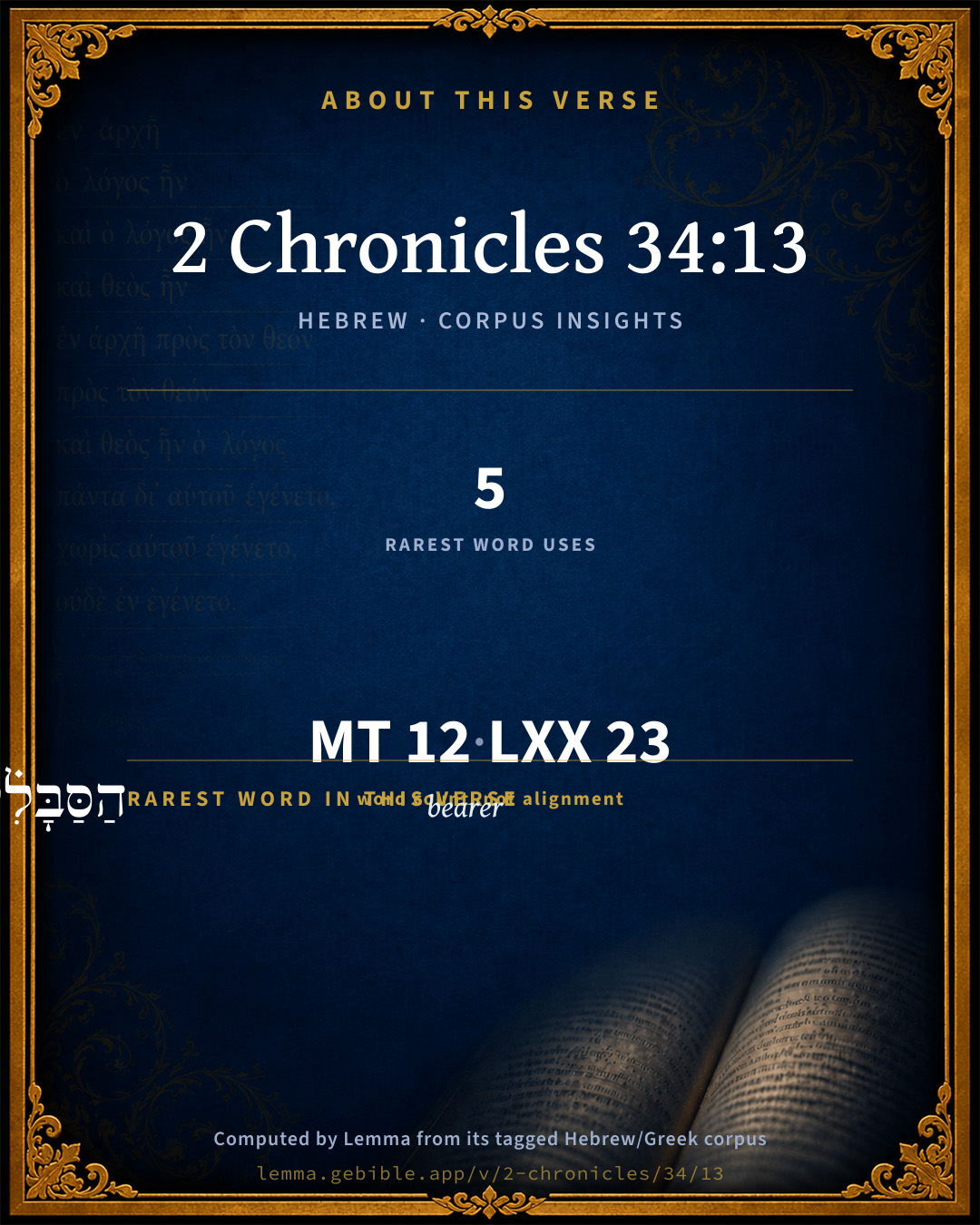
The rarest word here is הַסַּבָּלִ֗ים bearer H5449 — appearing just 5 times in the whole Hebrew Bible.

Shared distinctive vocabulary

הַסַּבָּלִ֗ים bearer H5449 occurs in 5 verses of the Hebrew Bible. Also found in:

Grammatical profile

  • 2 verbs
  • 9 nouns
  • 1 preposition

Verb forms

  • וּֽמְנַצְּחִים֙ Piel · Participle Active
  • עֹשֵׂ֣ה Qal · Participle Active

Repetition

A word recurs within this verse — often emphatic in Hebrew:

  • לַעֲבוֹדָ֖ה service H5656 ×2

Hebrew & Septuagint length

In English translation the verse runs 32 words from the Hebrew and 26 from the Septuagint (LXX English) — closely comparable.

A rough comparison of the two English renderings, which tokenize alike — not a word-level alignment.

Word counts can differ between the Hebrew and the Greek without any difference in meaning — e.g. the Hebrew direct-object marker אֵת has no separate Greek word, and Greek often adds the article ὁ.

In the original languages it is 12 Hebrew tokens and 23 Greek tokens — but the two are counted differently (Hebrew bundles its prefixes and suffixes into one token; the Greek is in lemma form), so that isn’t a like-for-like length.

Cross-references

16

Topical passages linked to 2 Chronicles 34:13 in the Treasury of Scripture Knowledge — connected by theme and wording, ordered by reader-vote popularity; previews shown in the World English Bible.

  • Nehemiah 4:10 Judah said, The strength of the bearers of burdens is decayed, and there is much rubbish; so that we are not able to build the wall.
  • 2 Chronicles 2:18 He set seventy thousand of them to bear burdens, and eighty thousand who were stone cutters in the mountains, and three thousand six hundred overseers to set the people at work.
  • 1 Chronicles 9:17 The porters: Shallum, and Akkub, and Talmon, and Ahiman, and their brothers (Shallum was the chief),
  • 1 Chronicles 15:18 and with them their brothers of the second degree, Zechariah, Ben, and Jaaziel, and Shemiramoth, and Jehiel, and Unni, Eliab, and Benaiah, and Maaseiah, and Mattithiah, and Eliphelehu, and Mikneiah, and Obed-edom, and Jeiel, the doorkeepers.
  • 1 Chronicles 16:38 and Obed-edom with their brothers, sixty-eight; Obed-edom also the son of Jeduthun and Hosah to be doorkeepers;
  • 1 Chronicles 16:42 and with them Heman and Jeduthun [with] trumpets and cymbals for those that should sound aloud, and [with] instruments for the songs of God; and the sons of Jeduthun to be at the gate.
  • 1 Chronicles 23:4–5 Of these, twenty-four thousand were to oversee the work of the house of Yahweh; and six thousand were officers and judges;
  • 1 Chronicles 26:1–19 For the divisions of the doorkeepers: of the Korahites, Meshelemiah the son of Kore, of the sons of Asaph.
  • 1 Chronicles 26:29–30 Of the Izharites, Chenaniah and his sons were for the outward business over Israel, for officers and judges.
  • 2 Chronicles 2:10 Behold, I will give to your servants, the cutters who cut timber, twenty thousand measures of beaten wheat, and twenty thousand measures of barley, and twenty thousand baths of wine, and twenty thousand baths of oil.
  • 2 Chronicles 8:10 These were the chief officers of king Solomon, even two hundred fifty, who ruled over the people.
  • 2 Chronicles 8:14 He appointed, according to the ordinance of David his father, the divisions of the priests to their service, and the Levites to their offices, to praise, and to minister before the priests, as the duty of every day required; the doorkeepers also by their divisions at every gate: for so had David the man of God commanded.
  • 2 Chronicles 19:11 Behold, Amariah the chief priest is over you in all matters of Yahweh; and Zebadiah the son of Ishmael, the ruler of the house of Judah, in all the king's matters: also the Levites shall be officers before you. Deal courageously, and Yahweh be with the good.
  • Ezra 7:6–7 this Ezra went up from Babylon: and he was a ready scribe in the law of Moses, which Yahweh, the God of Israel, had given; and the king granted him all his request, according to the hand of Yahweh his God on him.
  • Jeremiah 8:8 How do you say, We are wise, and the law of Yahweh is with us? But, behold, the false pen of the scribes has worked falsely.
  • Matthew 26:3 Then the chief priests, the scribes, and the elders of the people were gathered together in the court of the high priest, who was called Caiaphas.

Cross-references courtesy of OpenBible.info (CC BY 4.0).

Hebrew and Greek witnesses Masoretic Hebrew ↔ Greek Septuagint

The same verse in the two great witnesses to the Old Testament, shown verse-for-verse.

These are two independent witnesses, not word-aligned to each other, and the Septuagint is shown in lemma (dictionary) form.

Hebrew 2 Chronicles 34:13 Masoretic · Westminster Leningrad Codex

וְעַ֣ל הַסַּבָּלִ֗ים וּֽמְנַצְּחִים֙ לְכֹל֙ עֹשֵׂ֣ה מְלָאכָ֔ה לַעֲבוֹדָ֖ה וַעֲבוֹדָ֑ה וּמֵֽהַלְוִיִּ֔ם סוֹפְרִ֥ים וְשֹׁטְרִ֖ים וְשׁוֹעֲרִֽים

Also they were over the bearers of burdens, and set forward all who did the work in every manner of service: and of the Levites there were scribes, and officers, and porters.

World English Bible · Public Domain

Greek LXX 2 Chronicles 34:13 Septuagint · lemma form

καί ἐπί ὁ νωτοφόρος καί ἐπί πᾶς ὁ ποιέω ὁ ἔργον ἐργασία καί ἐργασία καί ἀπό ὁ λευείτης γραμματεύς καί κριτής καί πυλωρός

And overseers were over the burden-bearers, and over all the workmen in the respective works; and of the Levites were appointed scribes, and judges, and porters.

LXX2012 (modern English Septuagint) · Public Domain

Hebrew: Westminster Leningrad Codex (CC BY 4.0). Greek: Septuagint (public domain); English from LXX2012 (modern English Septuagint) (Public Domain). How the Septuagint differs from the Hebrew →

Commentary

Notes on 2 Chronicles 34:13 from classic Christian and Jewish commentators (each source and its license shown beneath its notes). The classic Christian expositions comment on the surrounding passage and are grouped to its opening verse, so a note may address several verses; the Jewish commentaries on the Tanakh (Rashi and others) are per-verse, so they appear only where the commentator wrote on this verse.

Lemma curates 59 commentaries, every one of them public domain or Creative Commons licensed, each selected and text-cleaned for this edition rather than reprinted as found. About our sources →

Trapp's Complete Commentary

John Trapp

2Ch 34:13 Also [they were] over the bearers of burdens, and [were] overseers of all that wrought the work in any manner of service: and of the Levites [there were] scribes, and officers, and porters.

Ver. 13. Also they were over the bearers of burdens.] To see they did their work carefully; and to make them do it cheerfully. See on 2Ch 34:12.

John Trapp, A Commentary or Exposition upon All the Books of the Old and New Testament (1647–1656) — public domain. Text from a community e-Sword module.

Ellicott's Commentary for English Readers

(13) Also.—And.

They.—The Levitical musicians-

Were over the bearers of burdens.—They probably cheered their labours with song and music; as was the practice in ancient Egypt.

And were overseers.—Leaders, conductors; see Note on 2Ch_34:12. Notice the honourable position here assigned to the musical guilds of Levites.

And of the Levites . . . porters.—In connection, that is, with the work of restoration. But comp. 1Ch_23:4-5. The writer may only intend to say that there were Levitical guilds of “scribes, officers, and porters,” as well as of musicians.

Scribes.—1Ch_2:55.

A Bible Commentary for English Readers, edited by Charles John Ellicott (1878–1897) — public domain. Text from a community e-Sword module.

The Cambridge Bible for Schools and Colleges

gen. ed. J. J. S. Perowne

13. were overseers of all that wrought the work] R.V. set forward all that did the work.

in any manner] R.V. in every manner.

scribes] Transcribers of the Law; Ezr_7:6; Ezr_7:11.

officers] Cp. 2Ch_19:11.

porters] Cp. 1Ch_26:1 ff.

The Cambridge Bible for Schools and Colleges (gen. ed. J. J. S. Perowne; Cambridge University Press, 1878–1918) — public domain. Text from a community e-Sword module.

John Gill's Exposition

And when they brought out the money that was brought into the house of the Lord,.... The Levites, who brought it out of the country into the temple, and from thence brought it to the high priest, who delivering it to the king's ministers, and they to the overseers, the repairs were begun:

and then Hilkiah the high priest found a book of the law of the Lord given by Moses house of the Lord,.... The Levites, who brought it out of the country into the temple, and from thence brought it to the high priest, who delivering it to the king's ministers, and they to the overseers, the repairs were begun: See Gill on Kg2 22:8. From hence, to the end of Ch2 34:28, is the same as Kg2 22:8.

John Gill's Exposition of the Whole Bible (1746–1763) — public domain (CC PDM 1.0). Text via the HelloAO Bible API.

Albert Barnes' Notes on the Bible

Of the Levites there were scribes - Hereto the word “scribe” has never been used to designate a class (compare 1Ki 4:3). But here an order of scribes, forming a distinct division of the Levitical body, has been instituted. The class itself probably originated in the reign of Hezekiah (compare Pro 25:1); and it is probably to the rise of this class that we are indebted for the preservation of so many prophecies belonging to Hezekiah’s time, while the works of almost all previous prophets - Ahijah, Iddo, Shemaiah, Jehu, the son of Hanani, and probably many others - have perished.

Albert Barnes' Notes on the Bible (1834–1885) — public domain. Text from a community e-Sword/MySword module.

Haydock's Catholic Bible Commentary

Masters: literally, "master porters." Prot. "officers and porters;" all Levites. H. --- Jahath, &c. directed them that carried burdens, (C.) as the Hebrew intimates; and in general, all the officers were chosen from the same tribe. H.

George Leo Haydock (1774–1849), Haydock's Catholic Family Bible and Commentary, 1859 edition — public domain. Excludes Psalms (Douay-Rheims chapter numbering differs from Protestant) and Deuterocanonical books (Catholic canon only).

Whedon's Commentary on the Bible

Daniel D. Whedon

13. Of the Levites… scribes — On the ancient office of the scribe, see note on 2Sa_8:17. “Here,” says Rawlinson, “we have come to a new state of things — an order of scribes, forming a distinct division of the Levitical body, has been instituted. It has been well observed, that though the class-term is first found in this passage, the class itself probably originated in the reign of Hezekiah. When that monarch employed men to copy out the uncollected proverbs of Solomon, (Pro_25:1,) a class of scribes must have been instituted. It is probably to the rise of this class that we are indebted for the preservation of so many prophecies belonging to Hezekiah’s time, while the works of almost all previous prophets — Ahijah, Iddo, Shemaiah, Jehu the son of Hanani, and probably many others — have perished.”

Daniel D. Whedon (gen. ed.), Commentary on the Old and New Testaments (1874–1909) — public domain. Text from a community e-Sword module.

The Pulpit Commentary

Scribes. Considering the mention of "scribes" in the plural in 1Ki_4:3, although it stands alone, till, at all events, the time of Hezekiah, (as testified by Pro_25:1) it is at any rate not improbable that an order of scribes was instituted by Solomon; that it fell into desuetude immediately under the divided kingdom, and, coming into vogue again under Hezekiah, is now mentioned in the natural way we here find it. The mention of the "scribe" in the singular number is of frequent occurrence in the historic books, and in Isaiah. (Isa_33:18 Isa_36:22) The officers. This word reproduces, in the Hebrew, the familiar shoterim. (Exo_5:10 see also 1Ch_23:3-6)

The Pulpit Commentary (1880–1919), ed. H.D.M. Spence-Jones & Joseph S. Exell — public domain. Text from a community e-Sword module.

Rashi

Rabbi Shlomo Yitzchaki (Rashi)

and of the Levites, scribes to write down the [amount of] silver brought to the House of the Lord and how they had collected it.

and officers over the work.

Rashi on the Tanakh — English translations: “The Judaica Press complete Tanach with Rashi, translated by A. J. Rosenberg” (CC BY 4.0); “Pentateuch with Rashi's commentary by M. Rosenbaum and A.M. Silbermann, 1929-1934” (public domain); “The Metsudah Tanach series, Lakewood, N.J” (CC BY 4.0); and “The Book of Joshua, Metsudah Publications, 1997” (CC BY 4.0). Text via Sefaria.

Lesson kit

Teaching starters — assembled from the data on this page, not authored interpretation. Every prompt links to the verse data it draws on. Edit before teaching.

2 Chronicles, in the Historical, opens this verse with 12 words (11 distinct Hebrew lemmas). Its most distinctive word is çabbâl (“bearer”). A historical commentator’s framing appears above. Read the whole chapter for the surrounding context.

Discussion questions

  1. The word çabbâl carries the sense “bearer.” How does it shape the verse?
  2. How does 1 Kings 5:15, which shares the word «bearer», read alongside this verse?
  3. What does the repetition of “service” (2× in this one verse) do in this verse?
  4. These translations render this verse differently; the difference is in the English rendering, not the original. What questions does that raise?
  5. «וּֽמְנַצְּחִים֙» is a Piel Participle Active verb. How does that grammatical form shape the action described?
  6. Compare how Trapp's Complete Commentary and Ellicott's Commentary for English Readers read this verse. Where do they agree or differ?

Things to notice

Reading settings

Reading text

Shown beneath each verse's original-language words.

Old Testament
Old Testament edition

Read the OT as the Masoretic Hebrew (MT) or the Greek Septuagint (LXX).

English shown for the Greek Septuagint (in the Hebrew ↔ Greek comparison).

Comparing translations? Open the Compare panel on any verse page to stack up to four side by side.