1 Chronicles 28:19

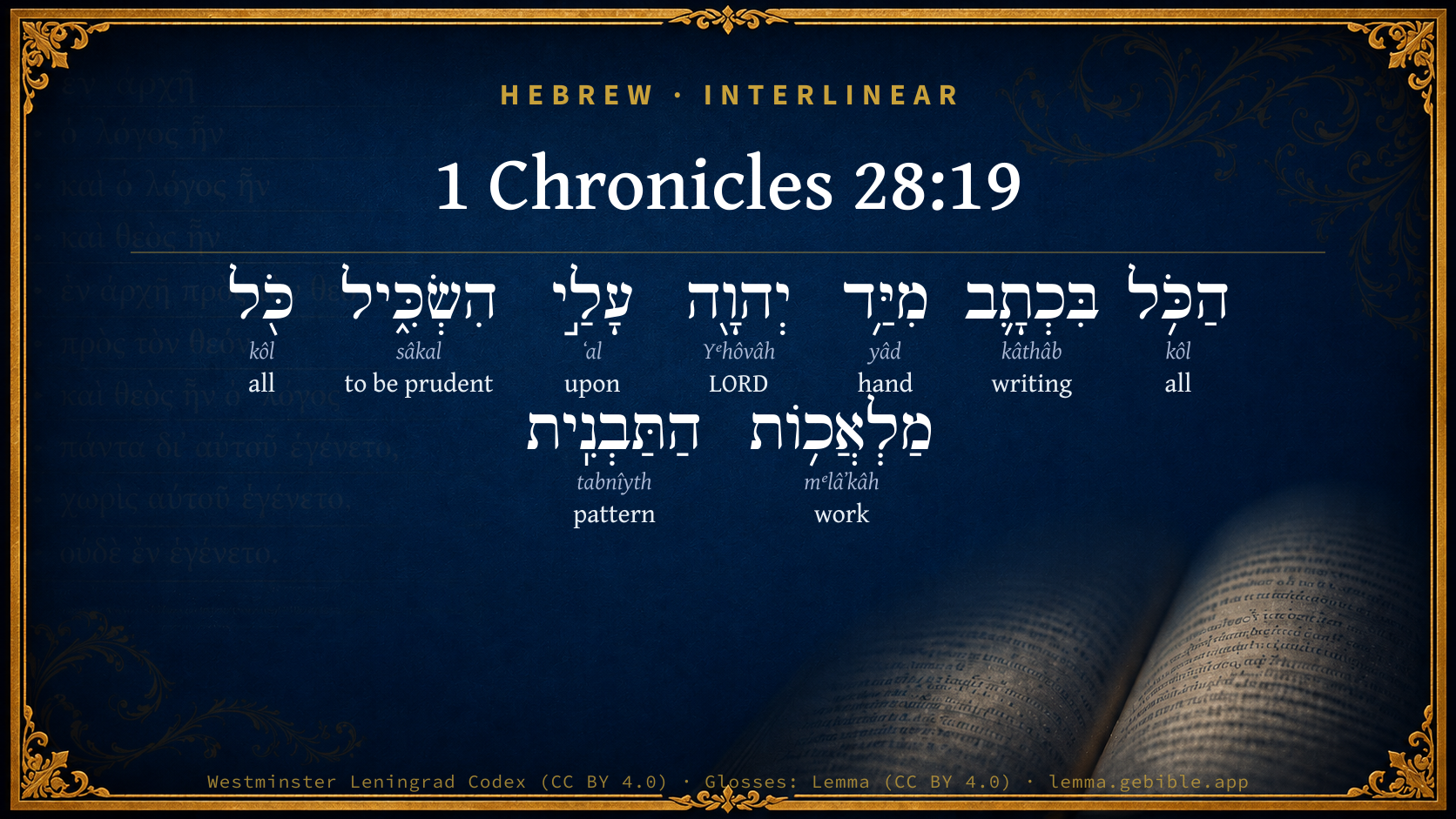
Hebrew (Westminster Leningrad Codex) 1 Chronicles 28:19 appears in the Hebrew Old Testament. The text above is from the Westminster Leningrad Codex. Each word links to its Strong’s number, a concise gloss, and parsing drawn from the Open Scriptures Hebrew Bible morphology. Click any word for its full Brown-Driver-Briggs (BDB) entry.
Download image
Cite this verse

1 Chronicles 28:19 (World English Bible). Public Domain. Lemma interlinear Bible study tool, https://lemma.gebible.app/v/1-chronicles/28/19.

Show BibTeX & RIS
BibTeX
RIS
English Translation
All this, [said David], have I been made to understand in writing from the hand of Yahweh, even all the works of this pattern.
World English Bible · Public Domain
Highlights
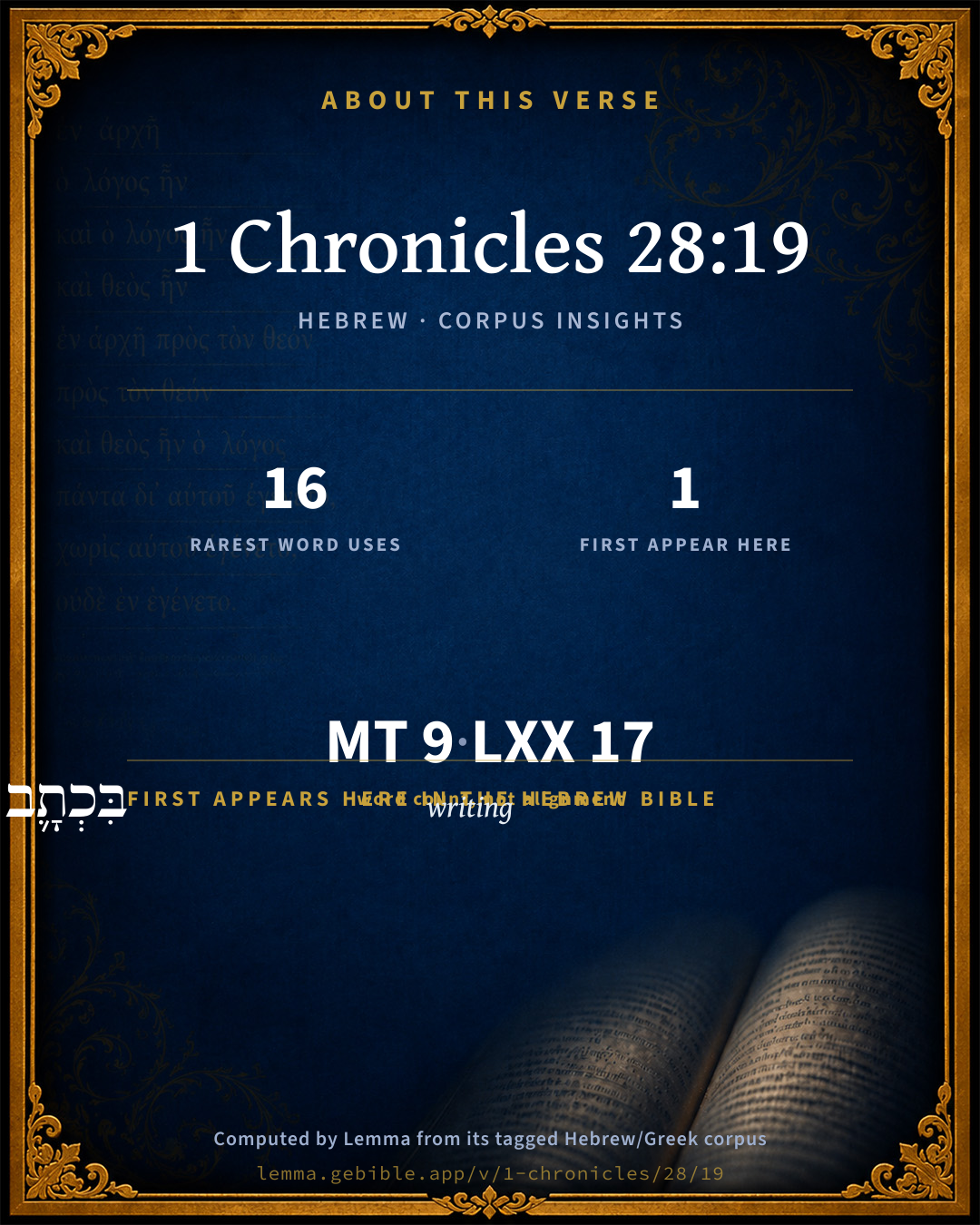
  • 1 first appearance in the Hebrew Bible
Full analysis ↓
Download a study sheet

One document with this verse’s original text, its word-by-word gloss line, the meaning frame, cross-references with their text, attributed commentary, and full source and license credits — printable, and it pastes into notes with its structure intact.

This verse Autodidact and up

Study sheet (.html) Plain text (.txt)

A passage Seminary Student

Up to 50 verses in one chapter. A passage sheet keeps up to 6 commentary sources and 12 cross-references per verse, in the order this page ranks them, and says so on the sheet whenever that leaves anything out. Ask for a single verse and you get the Autodidact verse sheet above.

Everything on this page stays free to read, with no account — the sheet is a download of what is already on screen, not access to it.

Want to remove ads? Support Godless Engineer
Compare translations 3

The same verse in 3 English versions, stacked beneath the original-language interlinear above. Click any original word for its lexicon entry.

Each is an independent rendering of the whole verse — the interlinear is not word-aligned to these translations.

Highlighted words mark where these versions differ — a whole-verse word diff, not a word-by-word alignment.

  • World English Bible Public Domain
    All this, [said David], have I been made to understand in writing from the hand of Yahweh, even all the works of this pattern.
  • King James Version Public Domain
    All this, said David, the LORD made me understand in writing by his hand upon me, even all the works of this pattern.
  • unfoldingWord Literal Text CC BY-SA 4.0
    “Everything in writing from the hand of Yahweh upon me. He made understand all of the works of the plan.”

unfoldingWord Literal Text — © unfoldingWord, licensed CC BY-SA 4.0. Word-aligned USFM3 via Door43 (git.door43.org/unfoldingWord/en_ult).

Versions to compare (up to 4)

3 of 4 selected

Show all 18 translations

Every available English version of this verse, each an independent rendering of the whole verse.

  • World English Bible Public Domain
    All this, [said David], have I been made to understand in writing from the hand of Yahweh, even all the works of this pattern.
  • Berean Standard Bible Public Domain
    “All this,” said David, “all the details of this plan, the LORD has made clear to me in writing by His hand upon me.”
  • Majority Standard Bible Public Domain
    “All this,” said David, “all the details of this plan, the LORD has made clear to me in writing by His hand upon me.”
  • King James Version Public Domain
    All this, said David, the LORD made me understand in writing by his hand upon me, even all the works of this pattern.
  • American Standard Version (1901) Public Domain
    All this, `said David', have I been made to understand in writing from the hand of Jehovah, even all the works of this pattern.
  • Revised Version (1885) Public Domain
    All this, said David, have I been made to understand in writing from the hand of the LORD, even all the works of this pattern.
  • Geneva Bible (1599) Public Domain
    All, said he, by writing sent to me by the hand of the Lord, which made me vnderstand all the workemanship of the paterne.
  • Douay-Rheims (1899) Public Domain
    All these things, said he, came to me written by the hand of the Lord that I might understand all the works of the pattern.
  • Young's Literal Translation Public Domain
    The whole `is' in writing from the hand of Jehovah, `He caused me to understand all the work of the pattern,' `said David.'
  • Literal Standard Version CC BY-SA 4.0
    The whole [is] in writing from the hand of YHWH, “He caused me to understand all the work of the pattern,” [said David.]
  • Unlocked Literal Bible CC BY-SA 4.0
    David said, “I have put all this in writing as Yahweh directed me and gave me to understand regarding the design.”
  • unfoldingWord Literal Text CC BY-SA 4.0
    “Everything in writing from the hand of Yahweh upon me. He made understand all of the works of the plan.”
  • Darby Bible Public Domain
    All this [said David,] in writing, by Jehovah's hand upon me, instructing as to all the works of the pattern.
  • World Messianic Bible Public Domain
    “All this”, David said, “I have been made to understand in writing from the LORD’s hand, even all the works of this pattern.”
  • Webster's Bible Public Domain
    All this, said David, the LORD made me understand in writing by his hand upon me, even all the works of this pattern.
  • Free Bible Version CC BY-SA 4.0
    “All this is in writing from the hand of the Lord, given to me as instructions—every detail of this plan,” said David.
  • Bible in Basic English Public Domain
    All this, said David, the design for all these things, has been made dear to me in writing by the hand of the Lord.
  • JPS Tanakh (1917) Public Domain
    'All this do I give thee in writing, as the LORD hath made me wise by His hand upon me, even all the works of this pattern.'

Literal Standard Version (2020), Covenant Press — licensed CC BY-SA 4.0. Text via the HelloAO Bible API (eBible.org). Unlocked Literal Bible (unfoldingWord) — licensed CC BY-SA 4.0. Text via the HelloAO Bible API (eBible.org). unfoldingWord Literal Text — © unfoldingWord, licensed CC BY-SA 4.0. Word-aligned USFM3 via Door43 (git.door43.org/unfoldingWord/en_ult). Free Bible Version, Dr. Jonathan Gallagher — licensed CC BY-SA 4.0. Text via the HelloAO Bible API (eBible.org).

Word by word

More ways to search: Search by grammar → Find every occurrence → Compare this word →

Practice this passage: Drill this verse → Learn its vocabulary →

בִּכְתָ֛ב
kâthâb
H3791
“in/at · writing”
Preposition + Noun, Common, Masculine, Singular, Absolute
Part of Speech
Preposition + Noun
Type
Common
Gender
Masculine
Number
Singular
State
Absolute
Full BDB Definition

Origin: from H3789

TWOT: 1053a

a writing, document, edict - register, enrolment, roll - mode of writing, character, letter - letter, document, a writing - a written edict - of royal enactment - of divine authority
  1. הַכֹּ֥ל kôl H3605 “the · all” Particle, Definite Article + Noun, Common, Masculine, Singular, Absolute
  2. מִיַּ֥ד yâd H3027 “from · hand of” Preposition + Noun, Common, Both, Singular, Construct
  3. יְהוָ֖ה Yᵉhôvâh H3068 “LORD” Noun, Proper
  4. עָלַ֣י ʻal H5921 “upon · me” Preposition + Suffix, Personal, 1st Person, Common, Singular
  5. הִשְׂכִּ֑יל sâkal H7919 “to be prudent” Verb, Hiphil, Perfect, 3rd Person, Masculine, Singular
  6. כֹּ֖ל kôl H3605 “all of” Noun, Common, Masculine, Singular, Construct
  7. מַלְאֲכ֥וֹת mᵉlâʼkâh H4399 “works of” Noun, Common, Feminine, Plural, Construct
  8. הַתַּבְנִֽית tabnîyth H8403 “the · pattern” Particle, Definite Article + Noun, Common, Feminine, Singular, Absolute

About this verse

These counts appear in no published source. They are computed here, from the morphology-tagged text and Lemma’s own curated glosses. What Lemma adds →

9
words
8
distinct lemmas
Historical
section

Notable vocabulary

The rarest word here is בִּכְתָ֛ב writing H3791 — appearing just 16 times in the whole Hebrew Bible.

First appearance in Scripture

This word makes its first canonical appearance in the Hebrew Bible here:

  • בִּכְתָ֛ב writing H3791

Shared distinctive vocabulary

בִּכְתָ֛ב writing H3791 occurs in 16 verses of the Hebrew Bible. Also found in:

Grammatical profile

  • 1 verb
  • 7 nouns
  • 1 preposition

Verb forms

  • הִשְׂכִּ֑יל Hiphil · Perfect

Repetition

A word recurs within this verse — often emphatic in Hebrew:

  • הַכֹּ֥ל all H3605 ×2

Hebrew & Septuagint length

In English translation the verse runs 24 words from the Hebrew and 21 from the Septuagint (LXX English) — closely comparable.

A rough comparison of the two English renderings, which tokenize alike — not a word-level alignment.

Word counts can differ between the Hebrew and the Greek without any difference in meaning — e.g. the Hebrew direct-object marker אֵת has no separate Greek word, and Greek often adds the article ὁ.

In the original languages it is 9 Hebrew tokens and 17 Greek tokens — but the two are counted differently (Hebrew bundles its prefixes and suffixes into one token; the Greek is in lemma form), so that isn’t a like-for-like length.

Cross-references

6

Topical passages linked to 1 Chronicles 28:19 in the Treasury of Scripture Knowledge — connected by theme and wording, ordered by reader-vote popularity; previews shown in the World English Bible.

  • 1 Chronicles 28:11–12 Then David gave to Solomon his son the pattern of the porch [of the temple], and of the houses of it, and of the treasuries of it, and of the upper rooms of it, and of the inner chambers of it, and of the place of the mercy seat;
  • Exodus 25:40 See that you make them after their pattern, which has been shown to you on the mountain.
  • Exodus 26:30 You shall set up the tent according to the way that it was shown to you on the mountain.
  • Ezekiel 1:3 the word of Yahweh came expressly to Ezekiel the priest, the son of Buzi, in the land of the Chaldeans by the river Chebar; and the hand of Yahweh was there on him.
  • Ezekiel 3:14 So the Spirit lifted me up, and took me away; and I went in bitterness, in the heat of my spirit; and the hand of Yahweh was strong on me.
  • Ezekiel 3:22 The hand of Yahweh was there on me; and he said to me, Arise, go forth into the plain, and I will there talk with you.

Cross-references courtesy of OpenBible.info (CC BY 4.0).

Hebrew and Greek witnesses Masoretic Hebrew ↔ Greek Septuagint

The same verse in the two great witnesses to the Old Testament, shown verse-for-verse.

These are two independent witnesses, not word-aligned to each other, and the Septuagint is shown in lemma (dictionary) form.

Hebrew 1 Chronicles 28:19 Masoretic · Westminster Leningrad Codex

הַכֹּ֥ל בִּכְתָ֛ב מִיַּ֥ד יְהוָ֖ה עָלַ֣י הִשְׂכִּ֑יל כֹּ֖ל מַלְאֲכ֥וֹת הַתַּבְנִֽית

All this, [said David], have I been made to understand in writing from the hand of Yahweh, even all the works of this pattern.

World English Bible · Public Domain

Greek LXX 1 Chronicles 28:19 Septuagint · lemma form

πᾶς ἐν γραφή χείρ κύριος δίδωμι δαυίδ σαλωμών κατά ὁ περιγίγνομαι αὐτός σύνεσις ὁ κατεργασία ὁ παράδειγμα

David gave all to Solomon in the Lord's handwriting, according to the knowledge given him of the work of the pattern.

LXX2012 (modern English Septuagint) · Public Domain

On this verse, Haydock's Catholic Bible Commentary discusses the Septuagint’s reading. Read the note in Commentary ↓

Hebrew: Westminster Leningrad Codex (CC BY 4.0). Greek: Septuagint (public domain); English from LXX2012 (modern English Septuagint) (Public Domain). How the Septuagint differs from the Hebrew →

Commentary

Notes on 1 Chronicles 28:19 from classic Christian and Jewish commentators (each source and its license shown beneath its notes). The classic Christian expositions comment on the surrounding passage and are grouped to its opening verse, so a note may address several verses; the Jewish commentaries on the Tanakh (Rashi and others) are per-verse, so they appear only where the commentator wrote on this verse.

Lemma curates 59 commentaries, every one of them public domain or Creative Commons licensed, each selected and text-cleaned for this edition rather than reprinted as found. About our sources →

Trapp's Complete Commentary

John Trapp

1Ch 28:19 All [this, said David], the LORD made me understand in writing by [his] hand upon me, [even] all the works of this pattern.

Ver. 19. To understand in writing.] Either of his own setting down, by divine direction; or else of God’s setting down, and sent him by an angel, or by some prophet.

By his hand upon me.] As of old upon Moses. {Exo 25:40}

John Trapp, A Commentary or Exposition upon All the Books of the Old and New Testament (1647–1656) — public domain. Text from a community e-Sword module.

The Biblical Illustrator

Joseph S. Exell

1Ch_28:19

The Lord made me understand in writing by His hand upon me.

The liberty of prophesying

David not only made preparation for the building of the temple by collecting material, but he gave to Solomon definite directions for completing the erection and constructing the sacred vessels, and in doing this he is careful to say that he did not follow his own ideas or adopt arbitrary plans, but that he was guided by Divine revelation. Is not this the essential thing with us in this ministry--that we should be authorised, led, energised by the self-same Spirit? Does not the Church demand that the preacher shall be an inspired man?

I. The nature of this inspiration. All this the Lord made me to understand by His hand upon me. Now, I am sure you will not at this moment expect from me any exact definition of the term inspiration. There are some words you cannot define. You cannot define such words as love, or life, or beauty. Neither will you expect me to distinguish between the inspiration of Isaiah and that of Shakespeare, or between the inspiration of David building the temple and that of Michael Angelo building St. Peters; the singularity of the prophet and preacher is that they have to do not with the intellectual and material worlds, but with the spiritual universe, with the relation of man to the living God, and to that eternal universe of which He is the centre.

1. The true preacher is a man of faith. God revealed to David the patterns of the temple building and furniture. In vision he beheld the forms that he was to body forth in silver and gold and cedar. He did not follow his own vagrant fancy, but he made all the sacred things according to the patterns seen in his exalted mood. There is a faculty of sight which is more profound and penetrating than any power of sense. This is manifest in the intellectual world. The poet, the painter, and the musician possess a faculty that beggars sense; they look upon a world that is unseen by the natural eye. Now, just as these rare spirits of the intellectual realm possess an imaginative faculty that transcends the tangible and technical world, a faculty that beggars sense, so the true preacher has a faculty that beggars imagination, a faculty of faith that penetrates depths beyond space and worlds beyond reason. The true preacher possesses spiritual imagination by which he discerns everywhere the spiritual fact. In man he finds the image of God; behind this world he discerns the eternal world; within history he traces the working of a Divine plan and purpose; in the Church he is conscious of Gods presence and love; and he feels the power of that immortal life of which this life iii the germ, and for which this life is the preparation. This is the grand gift of the true preacher: in an eminent degree he possesses that faith which is the substance of things hoped for, the evidence of things not seen.

2. Again, the true preacher is a man of experience. David did not proceed by simply reduplicating the forms and arrangements of the tabernacle. God granted him an inward revelation, he had a vision that was inwrought into his very soul. The Lord made me understand by His hand upon me, even all the works of this pattern. This means something more than a superficial knowledge, than a mere spectacle; it implies a vivid, profound, personal acquaintance with the things he was called upon to fashion and arrange. It means something more than a passing dream; the objective became the subjective; David realised Gods purpose as an inward and joyful experience. His soul entered into the vision, the vision entered into his soul. And if the preacher is to be effective, the subjects of his preaching must be living facts to his own mind and heart. There is a whole world of difference between the mere intellectual perception of a doctrine and the realisation of that doctrine in our own conscience and feeling. Just think of the dweller in a city who knows the seasons only as they appear in the almanac! Spring quarter begins; bits of information and hints about summer gardening; stray allusions to harvest; and then the record closes with prognostications of winters storms and snows. The almanac gives much information--varied, exact, useful information; you seem, indeed, to know all about the thing. Do you? Ah! it is a very different matter to know the seasons as they actually unfold in nature. And so it is one thing to know religion formally in a theological treatise, and another thing to know its power and sweetness and hope in your own soul. Notice--

II. The limits of this inspiration. The Lord made me understand in writing. The question arises as to what is precisely to be understood by this writing. Some think it teaches that David simply followed the law of Moses. Moses, as we learn in the book of Exodus, received the measures and plans of the tabernacle from God Himself, and all that David did, these commentators think, was to follow severely these ancient specifications in the instructions which he gave to Solomon. David follows the writing from Jehovahs hand given to Moses. Other students think that this explanation of the passage is wholly mistaken. They hold that David affirms that he received an altogether special revelation. Just as the Lord had formerly shown to Moses the pattern of the tabernacle, so did the Lord also make known by revelation to David the pattern of the temple and its furniture. It seems to me that neither interpretation expresses the real situation--a middle view seems the juster. The description given in Exodus of the sacred utensils evidently furnished the groundwork for the workmanship of David, but what he teaches here is that it was under the guidance of the Divine Spirit that he varied the sacred architecture and furniture to suit the changed conditions of the new temple. He did not work either independently or arbitrarily, but modified the structure and the vessels by the authority of the Spirit who first instituted them. The grand teaching of the whole situation being this, that in the entire work of the temple we must be governed by Divine revelation, but that at the same time we must be sensitive to the action of the Spirit of God, so that we may interpret the Scriptures and modify ecclesiastical organisations according to the changing needs of successive generations. Does not the preacher of to-day need to learn the lesson taught here? One of our great dangers is a literalism which denies all further revelation or inspiration. We must beware lest we doom ourselves to a barren literalism. But, on the other hand, there are others who assume entire independence of revelation. They affirm that men are still as fully inspired as Moses was, or Isaiah, or John, or Paul, and that it is an injustice to ourselves to yield exclusive reverence to the sacred oracles. What, then, is the true path here? We answer, the path followed by the King of Israel in our text. We must reverentially accept the fully-accredited revelation that God has secured to us, and under the influence of the Holy Spirit give that revelation new and fuller expression as the evolution of the race may require. We must be true to the Scriptures, and true also to the Spirit that gives to the written word concurrent adaptation. Only as we follow this delicate line shall we be truly orthodox and yet remain full of reality, power, and effectiveness. A great artist does not attempt to get rid of nature; if he were to yield to such licentiousness his images would become bizarre, his poetry unintelligible, and his music degenerate into a monstrous melody; the sincere artist is therefore profoundly true to the forms, the colours, and the sequences of nature, he gives place to no arbitrary ideas. But, at the same time, he is not literal, topographical, prosaic; he seizes the essential truth of the physical universe, and gives it free rendering and bold representation. It is much the same with the preacher. He is profoundly loyal to Gods Word, but in the light and liberty of the Spirit he freely handles the eternal truth, and makes it speak to the heart of the congregation. It is Gods message to this generation that is expected from you. Be able to say, The Lord made me understand this by His hand upon me, and your word shall be in power and blessing.

III. The conditions of this inspiration.

1. We must watch against the temper of unbelief. We discern a thing only when we are in the mood to see it, to hear it, to know it. And it is entirely true that we apprehend the things of the higher world and the higher life just as we have a certain affinity with them. I deny altogether that the mood of doubt is the becoming mood of a theologian. The mood of the artist is the receptive mood. We are sometimes told how some grand melody, picture, or poem originated in a most trivial incident, but this only shows how exceedingly delicate was the susceptibility of the artist; he must have possessed a peculiar alertness and responsiveness of soul. A cold, critical temper would mean a poor artist. Did not Columbus expect to see America? Is America, therefore, a baseless fabric? Columbus saw America because he was prepared to see it, and the true attitude to unknown worlds is the expectant attitude of the astronomer looking for a star mathematically inferred, but not hitherto seen, of the chemist searching for an element indicated, but not yet demonstrated. We lose much by cherishing the spirit of doubt. Preachers are men who ought to live in the mood of meditation and susceptibility--waiting, listening, looking, hoping; and so does God whisper into their wakened ear great and gracious truths.

2. We must be on our guard against the spirit of worldliness. It has been noticed that the greatest naturalists, poets, and philosophers are singularly unworldly men. It seems as if they can see the rarer beauty of the world, hear the music of the spheres, catch the subtler suggestions of phenomena only as they are free from all secularity of spirit. The best and the highest of the things that are seen are discerned and appreciated only by men cleansed from the spirit of greed, and pride, and self. And this in a very high degree is true of the preacher. It is only when the eye is single that the whole body is full of light.

3. We must watch against sensuality. Sensual, not having the Spirit, writes the apostle. Now sensual indulgence clouds the genius of the artist and the scholar. Hugh Miller tells us that when he was a young man he one day drank some liquor, and on turning to read Milton found himself incapable of appreciating the great master. So any form of sensuality renders the spiritual man incapable of influentially realising the great discoveries of revelation. Sensual thought makes the higher perceptions impossible, the gross film blinds the eye of the soul. Purity of thought and feeling are essential to a really great preacher. Blessed are the pure in heart, for they see the best of everything, and they possess a wonderful faculty for making other people feel the power and charm of truth and goodness. We have spoken this morning of the patterns God showed to Moses and to David, but we must remember that He has shown to us another order of patterns, sublimer far than archetypes of architecture and upholstery. God who in times past spake unto the fathers by the prophets hath in these latter days spoken unto us by His Son. Our Lord Jesus Christ has taken us into the Mount and shown us patterns of things in the heavens. Study the New Testament and you will find set forth with clearness the ultimate moral ideals after which the ages have blindly striven. At Nazareth and Bethany you see the ideal home. You have seen the ideal Church when you have seen Christ dwelling with His disciples. And, more than all, comprehending all, you behold the supreme ideal of character, We see Jesus. All the great ideals are in this writing by His hand, not the shadow of heavenly things, but the very substance of the things. (W. L. Watkinson.)

Gods handwriting upon David

The temple was to be a type, an eminent type of Christ, and also a type of His Church. No man knew what God meant to teach by that temple; and consequently if it had been left to human judgment, it would not have been a true type; for who can make a type if he knows not what it is to typify? God alone knew what He intended to teach by this building, and so that it might convey Divine teaching, it must be arranged according to Divine command. I call your attention--

I. To the singular instructions given to David.

1. David did not receive them by consultation with others.

2. David did not slavishly follow the former model.

3. God gave David instructions about the details of the work.

4. The directions given were extremely minute.

5. The innermost things were laid bare to David.

6. David not only knew the details; but he understood them.

7. The writing was written on Davids own mind by God Himself.

II. The spiritual tuition of the saints in the truth of God.

1. God still writes upon the hearts of men.

2. Let me show you a little in detail how God writes the great truths of His Word on our hearts.

III. The duty of the transmission to others of anything that god writes on your hearts.

1. David told Solomon about it.

2. We ought to talk about Christ to chosen companions.

3. David gathered all the people together and told them about the temple. (C. H. Spurgeon.)

The Biblical Illustrator, edited by Joseph S. Exell (c. 1880s–1900s) — public domain. Text from a community e-Sword module.

Joseph Benson's Commentary

1Ch 28:19. The Lord made me understated in writing — The meaning is, either, 1st, That God revealed this to Samuel, or Gad, or Nathan or some other man of God, to be by them put in writing, and communicated to David: or, 2d, That God did, as it were, by his own hand and finger, (wherewith he wrote the ten commandments,) write these things upon the table of his mind.

Joseph Benson's Commentary on the Old and New Testaments (1811–1818) — public domain. Text from a community e-Sword module.

Geneva Bible (1599)

Geneva Bible translators

For all this was left in writing in the book of the Law, Exod. 25:40, which book the king was bound to put in execution, Deut. 17:19.

Geneva Bible (1599) marginal notes — public domain. Text via Bolls.life.

Adam Clarke's Commentary

Verse 19. Understand in writing] In some vision of ecstasy he had seen a regularly sketched out plan, which had made so deep an impression on his mind that he could readily describe it to his son.

"That the architecture of the temple," says Dr. Delaney, "was of Divine origin, I, for my part, am fully satisfied from this passage, and am confirmed in this opinion by finding from Vilalpandas that the Roman, at least the Greek, architecture is derived from this, as from its fountain; and in my humble opinion even an infidel may easily believe these to be of Divine original, inasmuch as they are, at least the latter is, found perfect in the earliest models; nor hath the utmost reach of human wisdom, invention, and industry, been ever able to improve it, or alter it but to disadvantage, through the course of so many ages."

Adam Clarke's Commentary on the Bible (1810–1826) — public domain. Text from a community e-Sword/MySword module.

Ellicott's Commentary for English Readers

(19) All this said David.—The words with which David delivered the plans of the building and the schedule of its vessels to Solomon. The omission of any introductory formula, such as “And David said,” is dramatic. (Comp. 1Ch_16:8; 1Ch_23:4-5.) Literally rendered, after the Hebrew punctuation, the verse runs:—“The whole in a writing from the hand of Jehovah, to me he made clear; all the works of the model.” With the expression “a writing from the hand of Jehovah” (comp. Exo_31:18; Exo_25:40), David affirms his “pattern” of the sanctuary and its vessels to have been conceived, and described in writing, under that Divine guidance which he sought and followed in all the great enterprises of his life. Whether “the writing” was a communication “by the hand of” one of David’s seers, or merely the description of the Mosaic sanctuary (Exodus 25 seq.), is not clear. The verb “he taught” (hiskîl) requires an object, such as is supplied in the Authorised version: “made me understand.” It takes a dative (Pro_21:11), and probably the word rendered “upon me” is really a later equivalent of the same construction. Else we might compare Neh_2:8, Eze_1:3, and render: “The whole, in a writing from the hand of Jehovah upon me, he taught,” implying that David himself sketched out the whole design under Divine inspiration. Perhaps the text is corrupt.

A Bible Commentary for English Readers, edited by Charles John Ellicott (1878–1897) — public domain. Text from a community e-Sword module.

The Cambridge Bible for Schools and Colleges

gen. ed. J. J. S. Perowne

19. All this, said David, the Lord made me understand in writing by his hand upon me, even all the works of this pattern] The “writing” here mentioned probably means not a book, but a plan or series of patterns shewn to him in a vision. Cp. Exo_25:9.

The Cambridge Bible for Schools and Colleges (gen. ed. J. J. S. Perowne; Cambridge University Press, 1878–1918) — public domain. Text from a community e-Sword module.

John Gill's Exposition

All this, said David, the Lord made me understand in writing by his hand upon me,.... Either by an impulse of his Spirit on him, whereby it was as it were written on his mind, and as clearly represented to him, as if he had it in writing before him; though the Jews think that all was first made known to Samuel, or some other prophet, who delivered it to David in writing, as from the Lord: but I see not why it may not be understood that David had the pattern of the temple, and all things relative to it, by an handwriting from the Lord himself, through the ministry of angels, as Moses received the two tables, the handwriting of the Lord, from himself; for the words, as they lie in order in the Hebrew text, are, the whole of this "in writing from the hand of the Lord, unto me, he made me to understand: even all the works of this pattern"; the particulars of which are given before.

All this, said David, the Lord made me understand in writing by his hand upon me,.... Either by an impulse of his Spirit on him, whereby it was as it were written on his mind, and as clearly represented to him, as if he had it in writing before him; though the Jews think that all was first made known to Samuel, or some other prophet, who delivered it to David in writing, as from the Lord: but I see not why it may not be understood that David had the pattern of the temple, and all things relative to it, by an handwriting from the Lord himself, through the ministry of angels, as Moses received the two tables, the handwriting of the Lord, from himself; for the words, as they lie in order in the Hebrew text, are, the whole of this "in writing from the hand of the Lord, unto me, he made me to understand: even all the works of this pattern"; the particulars of which are given before.

1 Chronicles 28:20

ch1 28:20

ch1 28:20

ch1 28:20And David said to Solomon his son, be strong, and of good courage, and do it,.... See Gill on Ch1 28:10.

fear not, nor be dismayed; that thou shalt meet with any opposition in the work, or not be able to finish it for want of materials and workmen, or money to pay them:

for the Lord God, even my God, will be with thee; to guide and direct, prosper and succeed; the Targum is,"the Word of the Lord God, my God, will be thy help:"

he will not fail thee, nor forsake thee; a promise made to Joshua, and is applicable to every good man in whatsoever good work he is concerned, Jos 1:5,

until thou hast finished all the work for the service of the house of the Lord; built the temple, and all the apartments of it, and courts belonging to it, and made and provided all the utensils and vessels necessary for the service and worship of God.

John Gill's Exposition of the Whole Bible (1746–1763) — public domain (CC PDM 1.0). Text via the HelloAO Bible API.

Haydock's Catholic Bible Commentary

These things, said he, is not in Hebrew. Septuagint, "All in the handwriting of the Lord, did David give to Solomon, according to the knowledge given to him from above, respecting the workmanship of the pattern." (Haydock) --- David saw the pattern in a kind of ecstasy; (Salien; Estius) or some prophet delivered it unto him, (Calmet) marked out by the hand of an angel, (Tirinus) like the tabernacle given to Moses. (Du Hamel)

George Leo Haydock (1774–1849), Haydock's Catholic Family Bible and Commentary, 1859 edition — public domain. Excludes Psalms (Douay-Rheims chapter numbering differs from Protestant) and Deuterocanonical books (Catholic canon only).

Matthew Poole's English Annotations

The meaning is either,

1. That God revealed this to Samuel, (see 1Ch 9:22) or Gad, or Nathan, or some other man of God, who put it into writing, and by them to David. Or,

2. That God did, as it were, by his own hand and finger, (wherewith he wrote the ten commandments, Exo 31:18) write these things upon the table of my mind, which now I deliver to thee.

Matthew Poole's English Annotations on the Holy Bible (1683–1685) — public domain. Text from a community e-Sword/MySword module.

Whedon's Commentary on the Bible

Daniel D. Whedon

19. The Lord made me understand in writing by his hand upon me — Literally, the whole in a writing from the hand of Jehovah upon me he taught, all the works of the pattern. The meaning of this passage seems to be, that David had committed his plans for the temple to writing, and having modelled them largely after the pattern of the tabernacle, and conscious of the Divine inspiration and approval with which he wrote, he presented his patterns to Solomon as no devices or plans of his own invention, but as truly God-given as that received by Moses in the mount. Exo_25:40. It need not be assumed, however, that David received the revelation of his plans in the same way that Moses did those of the tabernacle.

Daniel D. Whedon (gen. ed.), Commentary on the Old and New Testaments (1874–1909) — public domain. Text from a community e-Sword module.

The Pulpit Commentary

This abrupt bringing in of David as the speaker himself has already had one illustration in 1Ch_23:5. (See on the matter of this verse, note on per. 11; and comp. 2Ki_3:15 for the parallel of an expression which evidently intends to assert an inspiring hand of the Lord.)

The Pulpit Commentary (1880–1919), ed. H.D.M. Spence-Jones & Joseph S. Exell — public domain. Text from a community e-Sword module.

John Wesley's Explanatory Notes

In writing - God revealed this to some man of God, who put it into writing, and by him to David. Or, God did, as it were, by his own hand, (where-with he wrote the Ten Commandments) write these things upon the table of his mind.

John Wesley, Explanatory Notes Upon the Whole Bible (1754–1765) — public domain. Text via the GEBible commentary corpus.

Keil & Delitzsch

C. F. Keil & F. Delitzsch

All this, said David, the Lord made me understand in writing by his hand upon me,.... Either by an impulse of his Spirit on him, whereby it was as it were written on his mind, and as clearly represented to him, as if he had it in writing before him; though the Jews think that all was first made known to Samuel, or some other prophet, who delivered it to David in writing, as from the Lord: but I see not why it may not be understood that David had the pattern of the temple, and all things relative to it, by an handwriting from the Lord himself, through the ministry of angels, as Moses received the two tables, the handwriting of the Lord, from himself; for the words, as they lie in order in the Hebrew text, are, the whole of this "in writing from the hand of the Lord, unto me, he made me to understand: even all the works of this pattern"; the particulars of which are given before.

All this, said David, the Lord made me understand in writing by his hand upon me,.... Either by an impulse of his Spirit on him, whereby it was as it were written on his mind, and as clearly represented to him, as if he had it in writing before him; though the Jews think that all was first made known to Samuel, or some other prophet, who delivered it to David in writing, as from the Lord: but I see not why it may not be understood that David had the pattern of the temple, and all things relative to it, by an handwriting from the Lord himself, through the ministry of angels, as Moses received the two tables, the handwriting of the Lord, from himself; for the words, as they lie in order in the Hebrew text, are, the whole of this "in writing from the hand of the Lord, unto me, he made me to understand: even all the works of this pattern"; the particulars of which are given before.

1 Chronicles 28:20

ch1 28:20

ch1 28:20

ch1 28:20And David said to Solomon his son, be strong, and of good courage, and do it,.... See Gill on Ch1 28:10.

fear not, nor be dismayed; that thou shalt meet with any opposition in the work, or not be able to finish it for want of materials and workmen, or money to pay them:

for the Lord God, even my God, will be with thee; to guide and direct, prosper and succeed; the Targum is,"the Word of the Lord God, my God, will be thy help:"

he will not fail thee, nor forsake thee; a promise made to Joshua, and is applicable to every good man in whatsoever good work he is concerned, Jos 1:5,

until thou hast finished all the work for the service of the house of the Lord; built the temple, and all the apartments of it, and courts belonging to it, and made and provided all the utensils and vessels necessary for the service and worship of God.

Keil & Delitzsch — Biblical Commentary on the Old Testament (1861–1891) — public domain (CC PDM 1.0). Text via the HelloAO Bible API. (Old Testament only.)

Rashi

Rabbi Shlomo Yitzchaki (Rashi)

All was in writing The meaning is: He arranged everything in writing for him: the sum of every weight of every vessel, from Samuel the Seer.

all the works of the pattern He endowed me with the wisdom and the understanding of the pattern of the House, e.g., the pattern of the length, the width, and the height, and Samuel derived everything from the Torah with the holy spirit, as we learned (Middoth 2:1): “The Temple Mount was five hundred cubits by five hundred cubits.” He expounded (Ex. 27:18): “The length of the forecourt was one hundred cubits; the free width: fifty by fifty.” Fifty times fifty are twentyfive hundred cubits. It appears to me that he cut them into five strips to be five hundred by five hundred cubits. This was set down in the final liturgical poem for the Sabbath of Hanukkah, which commences: “Manasseh, etc.” Samuel derived all this with the holy spirit and taught it to David.

Rashi on the Tanakh — English translations: “The Judaica Press complete Tanach with Rashi, translated by A. J. Rosenberg” (CC BY 4.0); “Pentateuch with Rashi's commentary by M. Rosenbaum and A.M. Silbermann, 1929-1934” (public domain); “The Metsudah Tanach series, Lakewood, N.J” (CC BY 4.0); and “The Book of Joshua, Metsudah Publications, 1997” (CC BY 4.0). Text via Sefaria.

Lesson kit

Teaching starters — assembled from the data on this page, not authored interpretation. Every prompt links to the verse data it draws on. Edit before teaching.

1 Chronicles, in the Historical, opens this verse with 9 words (8 distinct Hebrew lemmas). Its most distinctive word is kâthâb (“writing”). A historical commentator’s framing appears above. Read the whole chapter for the surrounding context.

Discussion questions

  1. How does “writing” (kâthâb) shape what this verse is saying?
  2. This is the first place “writing” appears in Scripture (first appears here). What does its debut here establish?
  3. How does 2 Chronicles 2:11, which shares the word «writing», read alongside this verse?
  4. What does the repetition of “all” (2× in this one verse) do in this verse?
  5. The translations on this page render this verse differently — a whole-verse word diff, not a word-by-word alignment. What might account for the different wordings?
  6. «הִשְׂכִּ֑יל» is a Hiphil Perfect verb. How does that grammatical form shape the action described?
  7. Compare how Trapp's Complete Commentary and The Biblical Illustrator read this verse. Where do they agree or differ?

Things to notice

Reading settings

Reading text

Shown beneath each verse's original-language words.

Old Testament
Old Testament edition

Read the OT as the Masoretic Hebrew (MT) or the Greek Septuagint (LXX).

English shown for the Greek Septuagint (in the Hebrew ↔ Greek comparison).

Comparing translations? Open the Compare panel on any verse page to stack up to four side by side.