1 Kings 9:23

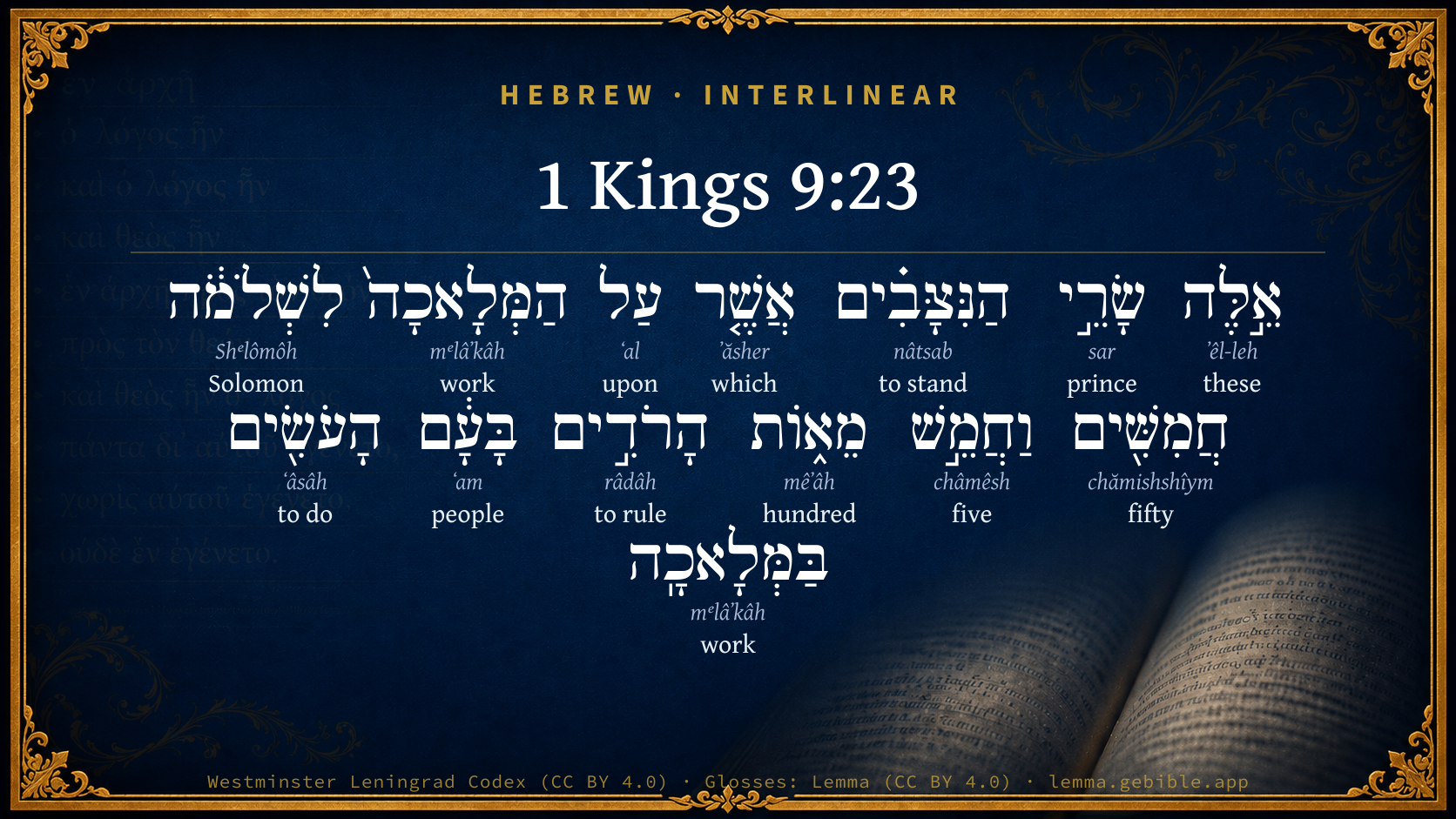
Hebrew (Westminster Leningrad Codex) 1 Kings 9:23 appears in the Hebrew Old Testament. The text above is from the Westminster Leningrad Codex. Each word links to its Strong’s number, a concise gloss, and parsing drawn from the Open Scriptures Hebrew Bible morphology. Click any word for its full Brown-Driver-Briggs (BDB) entry.
Download image
Cite this verse

1 Kings 9:23 (World English Bible). Public Domain. Lemma interlinear Bible study tool, https://lemma.gebible.app/v/1-kings/9/23.

Show BibTeX & RIS
BibTeX
RIS
English Translation
These were the chief officers who were over Solomon's work, five hundred fifty, who bore rule over the people who labored in the work.
World English Bible · Public Domain
Download a study sheet

One document with this verse’s original text, its word-by-word gloss line, the meaning frame, cross-references with their text, attributed commentary, and full source and license credits — printable, and it pastes into notes with its structure intact.

This verse Autodidact and up

Study sheet (.html) Plain text (.txt)

A passage Seminary Student

Up to 50 verses in one chapter. A passage sheet keeps up to 6 commentary sources and 12 cross-references per verse, in the order this page ranks them, and says so on the sheet whenever that leaves anything out. Ask for a single verse and you get the Autodidact verse sheet above.

Everything on this page stays free to read, with no account — the sheet is a download of what is already on screen, not access to it.

Want to remove ads? Support Godless Engineer
Compare translations 3

The same verse in 3 English versions, stacked beneath the original-language interlinear above. Click any original word for its lexicon entry.

Each is an independent rendering of the whole verse — the interlinear is not word-aligned to these translations.

Highlighted words mark where these versions differ — a whole-verse word diff, not a word-by-word alignment.

  • World English Bible Public Domain
    These were the chief officers who were over Solomon's work, five hundred fifty, who bore rule over the people who labored in the work.
  • King James Version Public Domain
    These were the chief of the officers that were over Solomon's work, five hundred and fifty, which bare rule over the people that wrought in the work.
  • unfoldingWord Literal Text CC BY-SA 4.0
    These the commanders of the deputies who over the work for Solomon, 550, the ones ruling over the people doing the work.

unfoldingWord Literal Text — © unfoldingWord, licensed CC BY-SA 4.0. Word-aligned USFM3 via Door43 (git.door43.org/unfoldingWord/en_ult).

Versions to compare (up to 4)

3 of 4 selected

Show all 18 translations

Every available English version of this verse, each an independent rendering of the whole verse.

  • World English Bible Public Domain
    These were the chief officers who were over Solomon's work, five hundred fifty, who bore rule over the people who labored in the work.
  • Berean Standard Bible Public Domain
    They were also the chief officers over Solomon’s projects: 550 supervisors over the people who did the work.
  • Majority Standard Bible Public Domain
    They were also the chief officers over Solomon’s projects: 550 supervisors over the people who did the work.
  • King James Version Public Domain
    These were the chief of the officers that were over Solomon's work, five hundred and fifty, which bare rule over the people that wrought in the work.
  • American Standard Version (1901) Public Domain
    These were the chief officers that were over Solomon's work, five hundred and fifty, who bare rule over the people that wrought in the work.
  • Revised Version (1885) Public Domain
    These were the chief officers that were over Solomon’s work, five hundred and fifty, which bare rule over the people that wrought in the work.
  • Geneva Bible (1599) Public Domain
    These were the princes of the officers, that were ouer Salomons worke: euen fiue hundreth and fiftie, and they ruled the people that wrought in the worke.
  • Douay-Rheims (1899) Public Domain
    And there were five hundred and fifty chief officers set over all the works of Solomon, and they had people under them, and had charge over the appointed works.
  • Young's Literal Translation Public Domain
    These `are' the heads of the officers who `are' over the work of Solomon, fifty and five hundred, those ruling among the people who are labouring in the work.
  • Literal Standard Version CC BY-SA 4.0
    These [are] the five hundred and fifty heads of the officers who [are] over the work of Solomon, those ruling among the people who are laboring in the work.
  • Unlocked Literal Bible CC BY-SA 4.0
    These were also the chief officers managing the supervisors who were over Solomon's works, 550 of them, who supervised the people who did the work.
  • unfoldingWord Literal Text CC BY-SA 4.0
    These the commanders of the deputies who over the work for Solomon, 550, the ones ruling over the people doing the work.
  • Darby Bible Public Domain
    These were the chief superintendents that were over Solomon's work, five hundred and fifty, that ruled over the people that wrought in the work.
  • World Messianic Bible Public Domain
    These were the five hundred fifty chief officers who were over Solomon’s work, who ruled over the people who labored in the work.
  • Webster's Bible Public Domain
    These were the chief of the officers that were over Solomon's work, five hundred and fifty, who bore rule over the people that wrought in the work.
  • Free Bible Version CC BY-SA 4.0
    They were also the chief officers in charge of Solomon's programs: 550 in command of the people who carried out the work.
  • Bible in Basic English Public Domain
    These were the chiefs of the overseers of Solomon's work, five hundred and fifty, in authority over the people who did the work.
  • JPS Tanakh (1917) Public Domain
    These were the chief officers that were over Solomon's work, five hundred and fifty, who bore rule over the people that wrought in the work.

Literal Standard Version (2020), Covenant Press — licensed CC BY-SA 4.0. Text via the HelloAO Bible API (eBible.org). Unlocked Literal Bible (unfoldingWord) — licensed CC BY-SA 4.0. Text via the HelloAO Bible API (eBible.org). unfoldingWord Literal Text — © unfoldingWord, licensed CC BY-SA 4.0. Word-aligned USFM3 via Door43 (git.door43.org/unfoldingWord/en_ult). Free Bible Version, Dr. Jonathan Gallagher — licensed CC BY-SA 4.0. Text via the HelloAO Bible API (eBible.org).

Word by word

More ways to search: Search by grammar → Find every occurrence → Compare this word →

Practice this passage: Drill this verse → Learn its vocabulary →

הָרֹדִ֣ים
râdâh
H7287
“the · ruling”
Particle, Definite Article + Verb, Qal, Participle Active, Masculine, Plural, Absolute
Part of Speech
Particle + Verb
Stem
Qal
Form
Participle Active
Gender
Masculine
Number
Plural
State
Absolute
Full BDB Definition

Origin: a primitive root

TWOT: 2121 , 2122

to rule, have dominion, dominate, tread down - (Qal) to have dominion, rule, subjugate - (Hiphil) to cause to dominate - to scrape out - (Qal) to scrape, scrape out
  1. אֵ֣לֶּה ʼêl-leh H428 “these” Pronoun, Demonstrative, Common, Plural
  2. שָׂרֵ֣י sar H8269 “princes of” Noun, Common, Masculine, Plural, Construct
  3. הַנִּצָּבִ֗ים nâtsab H5324 “the · standing” Particle, Definite Article + Verb, Niphal, Participle Active, Masculine, Plural, Absolute
  4. אֲשֶׁ֤ר ʼăsher H834 “which” Particle, Relative
  5. עַל ʻal H5921 “upon” Preposition
  6. הַמְּלָאכָה֙ mᵉlâʼkâh H4399 “the · work” Particle, Definite Article + Noun, Common, Feminine, Singular, Absolute
  7. לִשְׁלֹמֹ֔ה Shᵉlômôh H8010 “to/for · Solomon” Preposition + Noun, Proper
  8. חֲמִשִּׁ֖ים chămishshîym H2572 “fifty” Adjective, Cardinal number, Both, Plural, Absolute
  9. וַחֲמֵ֣שׁ châmêsh H2568 “and · five” Conjunction + Adjective, Cardinal number, Feminine, Singular, Absolute
  10. מֵא֑וֹת mêʼâh H3967 “hundred” Adjective, Cardinal number, Both, Plural, Absolute
  11. בָּעָ֔ם ʻam H5971 “in/at the · people” Preposition, Determined + Noun, Common, Masculine, Singular, Absolute
  12. הָעֹשִׂ֖ים ʻâsâh H6213 “the · doing” Particle, Definite Article + Verb, Qal, Participle Active, Masculine, Plural, Absolute
  13. בַּמְּלָאכָֽה mᵉlâʼkâh H4399 “in/at the · work” Preposition, Determined + Noun, Common, Feminine, Singular, Absolute

About this verse

These counts appear in no published source. They are computed here, from the morphology-tagged text and Lemma’s own curated glosses. What Lemma adds →

14
words
13
distinct lemmas
Historical
section

Shared distinctive vocabulary

הָרֹדִ֣ים to rule H7287 occurs in 25 verses of the Hebrew Bible. Also found in:

Grammatical profile

  • 3 verbs
  • 5 nouns
  • 3 adjectives
  • 1 pronoun
  • 1 preposition
  • 1 particle

Verb forms

  • הַנִּצָּבִ֗ים Niphal · Participle Active
  • הָרֹדִ֣ים Qal · Participle Active
  • הָעֹשִׂ֖ים Qal · Participle Active

Repetition

A word recurs within this verse — often emphatic in Hebrew:

  • הַמְּלָאכָה֙ work H4399 ×2

Cross-references

3

Topical passages linked to 1 Kings 9:23 in the Treasury of Scripture Knowledge — connected by theme and wording, ordered by reader-vote popularity; previews shown in the World English Bible.

  • 1 Kings 5:16 besides Solomon's chief officers who were over the work, three thousand and three hundred, who bore rule over the people who labored in the work.
  • 2 Chronicles 8:10 These were the chief officers of king Solomon, even two hundred fifty, who ruled over the people.
  • 2 Chronicles 2:18 He set seventy thousand of them to bear burdens, and eighty thousand who were stone cutters in the mountains, and three thousand six hundred overseers to set the people at work.

Cross-references courtesy of OpenBible.info (CC BY 4.0).

Hebrew and Greek witnesses Masoretic Hebrew ↔ Greek Septuagint

The same verse in the two great witnesses to the Old Testament, shown verse-for-verse.

These are two independent witnesses, not word-aligned to each other, and the Septuagint is shown in lemma (dictionary) form.

Hebrew 1 Kings 9:23 Masoretic · Westminster Leningrad Codex

אֵ֣לֶּה שָׂרֵ֣י הַנִּצָּבִ֗ים אֲשֶׁ֤ר עַל הַמְּלָאכָה֙ לִשְׁלֹמֹ֔ה חֲמִשִּׁ֖ים וַחֲמֵ֣שׁ מֵא֑וֹת הָרֹדִ֣ים בָּעָ֔ם הָעֹשִׂ֖ים בַּמְּלָאכָֽה

These were the chief officers who were over Solomon's work, five hundred fifty, who bore rule over the people who labored in the work.

World English Bible · Public Domain

Hebrew: Westminster Leningrad Codex (CC BY 4.0). Greek: Septuagint (public domain); English from a public-domain English Septuagint. How the Septuagint differs from the Hebrew →

Targum (Aramaic paraphrase)

1

The Targum is the ancient Jewish Aramaic paraphrase of the Hebrew Scriptures — an interpretive translation, not the Hebrew text itself. Onkelos (literal) and Pseudo-Jonathan (expansive) render the Torah, and Jonathan the Prophets. Coverage is partial: where no permissively-licensed English translation exists for a verse, only the Aramaic is shown. This is verse-level text, not a word-by-word alignment to the Hebrew.

  1. Targum Jonathan Prophets (Joshua–Malachi)
    אִילֵין רַבָּנֵי אִסְטַרְטִיגַיָא דִי מְמַנָן עַל עֲבִדְתָּא דִשְׁלֹמֹה חֲמֵשׁ מְאָה וְחַמְשִׁין דִי מְפַלְחִין בְּעַמָא דְעָבְדִין בְּעִבִדְתָּא:

    (no public-domain English translation for this verse)

    Targum Jonathan — Aramaic: “Mikraot Gedolot” (public domain). English: “Sefaria Community Translation” (CC0 1.0 (public-domain dedication)); “London "Chaldee Paraphrase," 1871” (public domain). Text via Sefaria.

Commentary

Notes on 1 Kings 9:23 from classic Christian and Jewish commentators (each source and its license shown beneath its notes). The classic Christian expositions comment on the surrounding passage and are grouped to its opening verse, so a note may address several verses; the Jewish commentaries on the Tanakh (Rashi and others) are per-verse, so they appear only where the commentator wrote on this verse.

Lemma curates 59 commentaries, every one of them public domain or Creative Commons licensed, each selected and text-cleaned for this edition rather than reprinted as found. About our sources →

Trapp's Complete Commentary

John Trapp

1Ki 9:23 These [were] the chief of the officers that [were] over Solomon’s work, five hundred and fifty, which bare rule over the people that wrought in the work.

Ver. 23. Five hundred and fifty.] Nothing so many as he had about his temple work. {1Ki 5:16} These also took their turns, two hundred and fifty at a time, and fifty to be over them also. {2Ch 8:10}

John Trapp, A Commentary or Exposition upon All the Books of the Old and New Testament (1647–1656) — public domain. Text from a community e-Sword module.

Geneva Bible (1599)

Geneva Bible translators

The overseers of Solomon’s works, were divided into three parts: the first contained 3300, the second 300, and the third 250, which were Israelites: so here are contained the two last parts, which make 550, see 2 Chron. 8:10.

Geneva Bible (1599) marginal notes — public domain. Text via Bolls.life.

Jamieson, Fausset & Brown

Robert Jamieson, A. R. Fausset & David Brown

These were the chief of the officers--(See on Ch2 8:10).

Jamieson, Fausset & Brown — Commentary Critical and Explanatory on the Whole Bible (1871) — public domain (CC PDM 1.0). Text via the HelloAO Bible API.

Ellicott's Commentary for English Readers

(23) Five hundred and fifty.—In 1Ki_5:16 we read of just six times as many officers as those here mentioned over the workers for the Temple. But in that passage there would seem to be reference to the special levy then raised; here the description is apparently of a regularly established system.

A Bible Commentary for English Readers, edited by Charles John Ellicott (1878–1897) — public domain. Text from a community e-Sword module.

The Cambridge Bible for Schools and Colleges

gen. ed. J. J. S. Perowne

23. These were the chief of the officers] Better, with R.V. the chief officers. This is a select class out of the whole number of such officers. A greater number, 3300, is spoken of in chap. 1Ki_5:16, and it may be that while the works in Lebanon, and at the Temple and the king’s house, were in progress, the larger number of chief officers was engaged in the supervision; but afterwards, for the ordinary fortification and pleasaunce-building, the smaller number was found sufficient. In 2Ch_8:11, two hundred and fifty is given as the number of these officials. Kennicott explains this variation by the reading of one letter for another in the Hebrew system of indicating numbers by the letters of the alphabet.

The Cambridge Bible for Schools and Colleges (gen. ed. J. J. S. Perowne; Cambridge University Press, 1878–1918) — public domain. Text from a community e-Sword module.

John Gill's Exposition

And three times in a year did Solomon offer burnt offerings and peace offerings upon the altar which he built unto the Lord,.... The brasen altar, the altar of burnt offering, which stood in the court of the priests, and by whom he offered. The three times were the feasts of passover, pentecost, and tabernacles, as explained in Ch2 8:13, not that these were the only offerings, or these the only times he offered; for he offered all other sacrifices, and at all other times commanded in the law of Moses, as on sabbaths and new moons, as expressed in the above place:

and he burnt incense upon the altar that was before the Lord; the altar of incense, which stood in the holy place, right beside the most holy, in which was the ark, the symbol of the divine Presence; not that Solomon burnt incense in person, but by the priests, whom he furnished with incense; for no king might offer incense, as the case of Uzziah shows:

so he finished the house; which respects not the building of it, that had been observed before, but the service of it; as he had provided all vessels and utensils for the furniture of it, and all things to be used in them; as sacrifices for the altar of burnt offering, incense for the altar of incense, bread for the shewbread table, and oil for the lamps; so he appointed the courses of the priests, Levites, and porters, to do their duty, who went through every part of service assigned them, and completed the whole; see Ch2 8:14.

John Gill's Exposition of the Whole Bible (1746–1763) — public domain (CC PDM 1.0). Text via the HelloAO Bible API.

Albert Barnes' Notes on the Bible

Five hundred and fifty - See 1Ki 5:16 note.

Albert Barnes' Notes on the Bible (1834–1885) — public domain. Text from a community e-Sword/MySword module.

Haydock's Catholic Bible Commentary

Officers of the crown. There were 250 over the army, (Paralipomenon) or 3,300, (3,600, Paralipomenon) including those who presided over the proselytes, chap. v. 16. (Calmet) --- These are employed while the temple was building. (Menochius)

George Leo Haydock (1774–1849), Haydock's Catholic Family Bible and Commentary, 1859 edition — public domain. Excludes Psalms (Douay-Rheims chapter numbering differs from Protestant) and Deuterocanonical books (Catholic canon only).

Matthew Poole's English Annotations

Object. They were only two hundred and fifty in 2Ch 8:10.

Answ. First, Those might be officers of another sort; for they are not said to be over the work, as these are, but only over the people. Secondly, The two hundred and fifty were Israelites, who are therefore distinctly mentioned in that book, where many things are more exactly noted than in the former; and the other three hundred were strangers, who therefore are neglected in that more accurate account. Or, thirdly, There was but two hundred and fifty at one time, which is noted there, and two hundred and fifty at another time, (for it is apparent they did their work by turns,) and the other fifty either were superior to all the rest, or rather were a reserve to supply the place of any of the five hundred when there was occasion, which might frequently happen. And so this was an act not unbecoming Solomon’s wisdom, to make provision for emergencies.

Matthew Poole's English Annotations on the Holy Bible (1683–1685) — public domain. Text from a community e-Sword/MySword module.

Whedon's Commentary on the Bible

Daniel D. Whedon

23. Five hundred and fifty — See note on 1Ki_5:16.

Daniel D. Whedon (gen. ed.), Commentary on the Old and New Testaments (1874–1909) — public domain. Text from a community e-Sword module.

The Pulpit Commentary

These were the chief of the Officers that were over Solomon"s work; five hundred and fifty, which bare rule over the people that wrought in the work. (see on 1Ki_5:16)

The Pulpit Commentary (1880–1919), ed. H.D.M. Spence-Jones & Joseph S. Exell — public domain. Text from a community e-Sword module.

unfoldingWord translationNotes

Door43 World Missions Community

550 of them

"five hundred and fifty of them" (See: Numbers)

translationWords

chief

works

unfoldingWord translationNotes — © Distant Shores Media and the Door43 World Missions Community, licensed CC BY-SA 4.0. Source: git.door43.org/Door43/en_tn.

Rashi

Rabbi Shlomo Yitzchaki (Rashi)

Supervising officers. Commanders over the officers.

Five hundred fifty. Three hundred of them were proselytes in charge of 70,000 who bore burdens, 80,000 hewers in the mountains, and 3,300 who controlled the people who did the work, as stated above, “These were in addition to Shlomo’s chief officers, etc., three thousand three hundred [officers].” But in Divrei Hayomim it states, “six hundred.” These three hundred that are missing here, he counted there, for they were appointed over all of them. The two hundred fifty remaining were Bnei Yisroel appointed over the other laborers. In Divrei Hayomim they were counted separately, [as it states,] “and these were Shlomo’s supervising officers, two hundred fifty, who controlled “the people who did the work,” the laborers.

Rashi on the Tanakh — English translations: “The Judaica Press complete Tanach with Rashi, translated by A. J. Rosenberg” (CC BY 4.0); “Pentateuch with Rashi's commentary by M. Rosenbaum and A.M. Silbermann, 1929-1934” (public domain); “The Metsudah Tanach series, Lakewood, N.J” (CC BY 4.0); and “The Book of Joshua, Metsudah Publications, 1997” (CC BY 4.0). Text via Sefaria.

Lesson kit

Teaching starters — assembled from the data on this page, not authored interpretation. Every prompt links to the verse data it draws on. Edit before teaching.

1 Kings, in the Historical, opens this verse with 14 words (13 distinct Hebrew lemmas). Its most distinctive word is râdâh (“to rule”). A historical commentator’s framing appears above. Read the whole chapter for the surrounding context.

Discussion questions

  1. How does “to rule” (râdâh) shape what this verse is saying?
  2. How does Genesis 1:26, which shares the word «to rule», read alongside this verse?
  3. What does the repetition of “work” (2× in this one verse) do in this verse?
  4. These translations render this verse differently; the difference is in the English rendering, not the original. What questions does that raise?
  5. «הַנִּצָּבִ֗ים» is a Niphal Participle Active verb. How does that grammatical form shape the action described?
  6. Compare how Trapp's Complete Commentary and Geneva Bible (1599) read this verse. Where do they agree or differ?

Things to notice

Reading settings

Reading text

Shown beneath each verse's original-language words.

Old Testament
Old Testament edition

Read the OT as the Masoretic Hebrew (MT) or the Greek Septuagint (LXX).

English shown for the Greek Septuagint (in the Hebrew ↔ Greek comparison).

Comparing translations? Open the Compare panel on any verse page to stack up to four side by side.