Leviticus 13:48

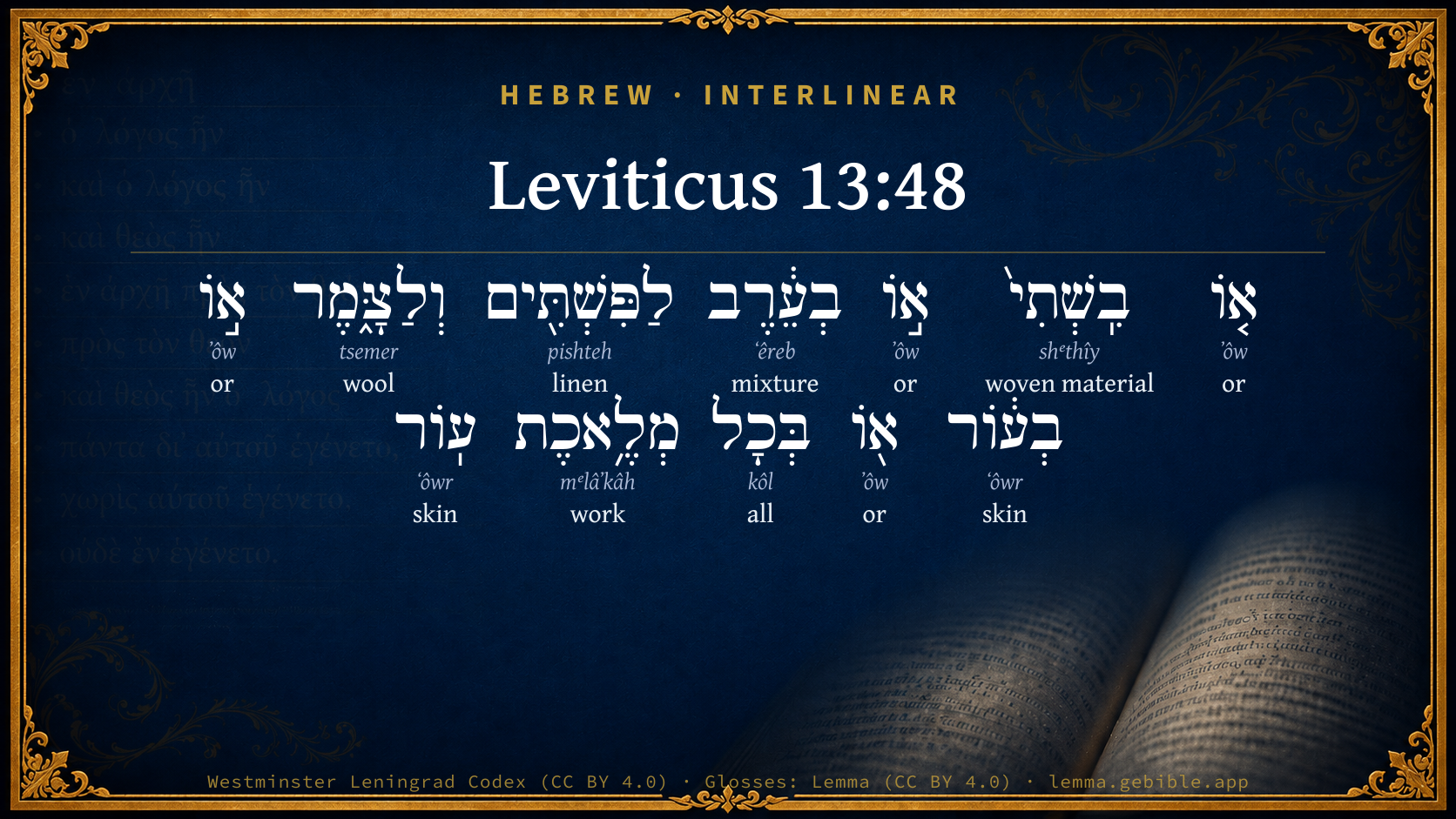
Hebrew (Westminster Leningrad Codex) Leviticus 13:48 appears in the Hebrew Old Testament. The text above is from the Westminster Leningrad Codex. Each word links to its Strong’s number, a concise gloss, and parsing drawn from the Open Scriptures Hebrew Bible morphology. Click any word for its full Brown-Driver-Briggs (BDB) entry.
Download image
Cite this verse

Leviticus 13:48 (World English Bible). Public Domain. Lemma interlinear Bible study tool, https://lemma.gebible.app/v/leviticus/13/48.

Show BibTeX & RIS
BibTeX
RIS
English Translation
whether it is in warp, or woof; of linen, or of wool; whether in a skin, or in anything made of skin;
World English Bible · Public Domain
Highlights
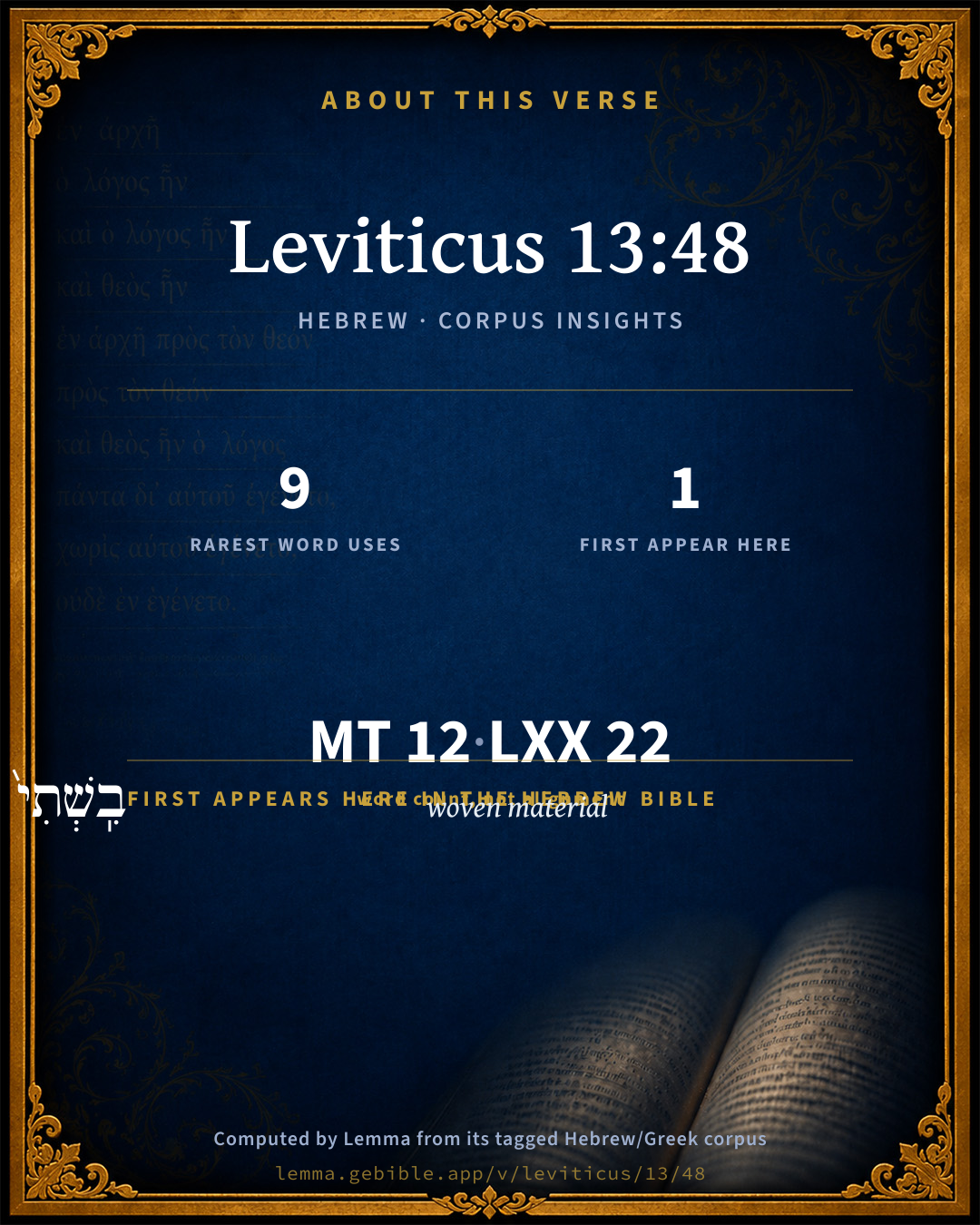
  • 1 first appearance in the Hebrew Bible
Full analysis ↓
Download a study sheet

One document with this verse’s original text, its word-by-word gloss line, the meaning frame, cross-references with their text, attributed commentary, and full source and license credits — printable, and it pastes into notes with its structure intact.

This verse Autodidact and up

Study sheet (.html) Plain text (.txt)

A passage Seminary Student

Up to 50 verses in one chapter. A passage sheet keeps up to 6 commentary sources and 12 cross-references per verse, in the order this page ranks them, and says so on the sheet whenever that leaves anything out. Ask for a single verse and you get the Autodidact verse sheet above.

Everything on this page stays free to read, with no account — the sheet is a download of what is already on screen, not access to it.

Want to remove ads? Support Godless Engineer
Compare translations 3

The same verse in 3 English versions, stacked beneath the original-language interlinear above. Click any original word for its lexicon entry.

Each is an independent rendering of the whole verse — the interlinear is not word-aligned to these translations.

Highlighted words mark where these versions differ — a whole-verse word diff, not a word-by-word alignment.

  • World English Bible Public Domain
    whether it is in warp, or woof; of linen, or of wool; whether in a skin, or in anything made of skin;
  • King James Version Public Domain
    Whether it be in the warp, or woof; of linen, or of woolen; whether in a skin, or in any thing made of skin;
  • unfoldingWord Literal Text CC BY-SA 4.0
    or in the warp or in the woof of the linen or of the wool, or on leather, or on any work of leather,

unfoldingWord Literal Text — © unfoldingWord, licensed CC BY-SA 4.0. Word-aligned USFM3 via Door43 (git.door43.org/unfoldingWord/en_ult).

Versions to compare (up to 4)

3 of 4 selected

Show all 18 translations

Every available English version of this verse, each an independent rendering of the whole verse.

  • World English Bible Public Domain
    whether it is in warp, or woof; of linen, or of wool; whether in a skin, or in anything made of skin;
  • Berean Standard Bible Public Domain
    any weave or knit of linen or wool, or any article of leather—
  • Majority Standard Bible Public Domain
    any weave or knit of linen or wool, or any article of leather—
  • King James Version Public Domain
    Whether it be in the warp, or woof; of linen, or of woolen; whether in a skin, or in any thing made of skin;
  • American Standard Version (1901) Public Domain
    whether it be in warp, or woof; of linen, or of woollen; whether in a skin, or in anything made of skin;
  • Revised Version (1885) Public Domain
    whether it be in warp, or woof; of linen, or of woollen; whether in a skin, or in any thing made of skin;
  • Geneva Bible (1599) Public Domain
    Whether it bee in the warpe or in ye woofe of linen or of wollen, either in a skin, or in any thing made of skin,
  • Douay-Rheims (1899) Public Domain
    In the warp, and the woof, or a skin. or whatsoever is made of a skin,
  • Young's Literal Translation Public Domain
    or in the warp, or in the woof, of linen or of wool, or in a skin, or in any work of skin,
  • Literal Standard Version CC BY-SA 4.0
    or in the warp, or in the woof, of linen or of wool, or in a skin, or in any work of skin—
  • Unlocked Literal Bible CC BY-SA 4.0
    or anything woven or knitted from wool or linen, or leather or anything made with leather—
  • unfoldingWord Literal Text CC BY-SA 4.0
    or in the warp or in the woof of the linen or of the wool, or on leather, or on any work of leather,
  • Darby Bible Public Domain
    either in the warp or in the woof of linen or of wool, or in a skin, or in anything made of skin,
  • World Messianic Bible Public Domain
    whether it is in warp or woof; of linen or of wool; whether in leather, or in anything made of leather;
  • Webster's Bible Public Domain
    Whether in the warp, or woof, of linen, or of woolen: whether in a skin, or in any thing made of skin:
  • Free Bible Version CC BY-SA 4.0
    anything woven or knitted made from linen or wool, or anything made of leather:
  • Bible in Basic English Public Domain
    If it is in the threads of the linen or of the wool, or in leather, or in anything made of skin;
  • JPS Tanakh (1917) Public Domain
    or in the warp, or in the woof, whether they be of linen, or of wool; or in a skin, or in any thing made of skin.

Literal Standard Version (2020), Covenant Press — licensed CC BY-SA 4.0. Text via the HelloAO Bible API (eBible.org). Unlocked Literal Bible (unfoldingWord) — licensed CC BY-SA 4.0. Text via the HelloAO Bible API (eBible.org). unfoldingWord Literal Text — © unfoldingWord, licensed CC BY-SA 4.0. Word-aligned USFM3 via Door43 (git.door43.org/unfoldingWord/en_ult). Free Bible Version, Dr. Jonathan Gallagher — licensed CC BY-SA 4.0. Text via the HelloAO Bible API (eBible.org).

Word by word

More ways to search: Search by grammar → Find every occurrence → Compare this word →

Practice this passage: Drill this verse → Learn its vocabulary →

בִֽשְׁתִי֙
shᵉthîy
H8359
“in/at · woven material”
Preposition + Noun, Common, Masculine, Singular, Absolute
Part of Speech
Preposition + Noun
Type
Common
Gender
Masculine
Number
Singular
State
Absolute
Full BDB Definition

Origin: from H7896

TWOT: 2479a

warp, woven material
  1. א֤וֹ ʼôw H176 “or” Conjunction
  2. א֣וֹ ʼôw H176 “or” Conjunction
  3. בְעֵ֔רֶב ʻêreb H6154 “in/at · mixture” Preposition + Noun, Common, Masculine, Singular, Absolute
  4. לַפִּשְׁתִּ֖ים pishteh H6593 “to/for the · linen” Preposition, Determined + Noun, Common, Masculine, Plural, Absolute
  5. וְלַצָּ֑מֶר tsemer H6785 “and · to/for the · wool” Conjunction + Preposition, Determined + Noun, Common, Masculine, Singular, Absolute
  6. א֣וֹ ʼôw H176 “or” Conjunction
  7. בְע֔וֹר ʻôwr H5785 “in/at · skin” Preposition + Noun, Common, Masculine, Singular, Absolute
  8. א֖וֹ ʼôw H176 “or” Conjunction
  9. בְּכָל kôl H3605 “in/at · all of” Preposition + Noun, Common, Masculine, Singular, Construct
  10. מְלֶ֥אכֶת mᵉlâʼkâh H4399 “work of” Noun, Common, Feminine, Singular, Construct
  11. עֽוֹר ʻôwr H5785 “skin” Noun, Common, Masculine, Singular, Absolute

About this verse

These counts appear in no published source. They are computed here, from the morphology-tagged text and Lemma’s own curated glosses. What Lemma adds →

12
words
8
distinct lemmas
Pentateuch
section

Notable vocabulary

The rarest word here is בִֽשְׁתִי֙ woven material H8359 — appearing just 9 times in the whole Hebrew Bible.

First appearance in Scripture

This word makes its first canonical appearance in the Hebrew Bible here:

  • בִֽשְׁתִי֙ woven material H8359

Shared distinctive vocabulary

בִֽשְׁתִי֙ woven material H8359 occurs in 9 verses of the Hebrew Bible. Also found in:

Grammatical profile

  • 8 nouns
  • 4 conjunctions

Repetition

Words recur within this verse — often emphatic in Hebrew:

  • בְע֔וֹר skin H5785 ×2
  • א֤וֹ or H176 ×4

Hebrew & Septuagint length

In English translation the verse runs 22 words from the Hebrew and 27 from the Septuagint (LXX English) — closely comparable.

A rough comparison of the two English renderings, which tokenize alike — not a word-level alignment.

Word counts can differ between the Hebrew and the Greek without any difference in meaning — e.g. the Hebrew direct-object marker אֵת has no separate Greek word, and Greek often adds the article ὁ.

In the original languages it is 12 Hebrew tokens and 22 Greek tokens — but the two are counted differently (Hebrew bundles its prefixes and suffixes into one token; the Greek is in lemma form), so that isn’t a like-for-like length.

Cross-references

4

Topical passages linked to Leviticus 13:48 in the Treasury of Scripture Knowledge — connected by theme and wording, ordered by reader-vote popularity; previews shown in the World English Bible.

  • Leviticus 13:51 He shall examine the plague on the seventh day. If the plague has spread in the garment, either in the warp, or in the woof, or in the skin, whatever use the skin is used for, the plague is a destructive mildew. It is unclean.
  • Deuteronomy 8:11 Beware lest you forget Yahweh your God, in not keeping his commandments, and his ordinances, and his statutes, which I command you this day:
  • Jude 1:23 and some save, snatching them out of the fire with fear, hating even the clothing stained by the flesh.
  • Revelation 3:4 Nevertheless you have a few names in Sardis that did not defile their garments. They will walk with me in white, for they are worthy.

Cross-references courtesy of OpenBible.info (CC BY 4.0).

Hebrew and Greek witnesses Masoretic Hebrew ↔ Greek Septuagint

The same verse in the two great witnesses to the Old Testament, shown verse-for-verse.

These are two independent witnesses, not word-aligned to each other, and the Septuagint is shown in lemma (dictionary) form.

Hebrew Leviticus 13:48 Masoretic · Westminster Leningrad Codex

א֤וֹ בִֽשְׁתִי֙ א֣וֹ בְעֵ֔רֶב לַפִּשְׁתִּ֖ים וְלַצָּ֑מֶר א֣וֹ בְע֔וֹר א֖וֹ בְּכָל מְלֶ֥אכֶת עֽוֹר

whether it is in warp, or woof; of linen, or of wool; whether in a skin, or in anything made of skin;

World English Bible · Public Domain

Greek LXX Leviticus 13:48 Septuagint · lemma form

ἤ ἐν στήμων ἤ ἐν κρόκη ἤ ἐν ὁ λινοῦς ἤ ἐν ὁ ἐρεοῦς ἤ ἐν δέρμα ἤ ἐν πᾶς ἐργάσιμος δέρμα

either in the warp or in the woof, or in the linen, or in the woollen threads, or in a skin, or in any workmanship of skin,

LXX2012 (modern English Septuagint) · Public Domain

On this verse, The Cambridge Bible for Schools and Colleges discusses the Septuagint’s reading. Read the note in Commentary ↓

Hebrew: Westminster Leningrad Codex (CC BY 4.0). Greek: Septuagint (public domain); English from LXX2012 (modern English Septuagint) (Public Domain). How the Septuagint differs from the Hebrew →

Targum (Aramaic paraphrase)

2

The Targum is the ancient Jewish Aramaic paraphrase of the Hebrew Scriptures — an interpretive translation, not the Hebrew text itself. Onkelos (literal) and Pseudo-Jonathan (expansive) render the Torah, and Jonathan the Prophets. Coverage is partial: where no permissively-licensed English translation exists for a verse, only the Aramaic is shown. This is verse-level text, not a word-by-word alignment to the Hebrew.

  1. Targum Onkelos Torah (Genesis–Deuteronomy)
    אוֹ בְשִׁתְיָא אוֹ בְעַרְבָא לְכִתָּנָא וּלְעַמְרָא אוֹ בְמַשְׁכָּא אוֹ בְּכָל עֲבִידַת מְשָׁךְ

    (no public-domain English translation for this verse)

    Targum Onkelos — Aramaic: “Onkelos Genesis” (public domain); “Onkelos Exodus” (public domain); “Onkelos Leviticus” (public domain); “Onkelos Numbers” (public domain); “Onkelos Deuteronomy” (public domain). English: “Sefaria Community Translation” (CC0 1.0 (public-domain dedication)); “J.W. Etheridge. The Targums of Onkelos and Jonathan Ben Uzziel on the Pentateuch. London: Longmans, Green, 1862” (public domain). Text via Sefaria.

  2. Targum Pseudo-Jonathan Torah (Genesis–Deuteronomy)
    אוֹ בְשִׁתְיָא אוֹ בְעַרְבָא לְכִיתְּנָא וּלְעַמְרָא אוֹ בִּצְלָא אוֹ בְּכָל עִיבִידַת צְלָא

    whether in the warp or in the woof, in linen or in woollen, or in a skin, or in anything made of skin:

    Targum Pseudo-Jonathan — Aramaic: “Targum Jonathan on Genesis” (public domain); “Targum Jonathan on Exodus” (public domain); “Targum Jonathan on Leviticus” (public domain); “Targum Jonathan on Numbers” (public domain); “Targum Jonathan on Deuteronomy” (public domain). English: “The Targum of Jonathan ben Uzziel, trans. J. W. Etheridge, London, 1862” (public domain). Text via Sefaria.

Commentary

Notes on Leviticus 13:48 from classic Christian and Jewish commentators (each source and its license shown beneath its notes). The classic Christian expositions comment on the surrounding passage and are grouped to its opening verse, so a note may address several verses; the Jewish commentaries on the Tanakh (Rashi and others) are per-verse, so they appear only where the commentator wrote on this verse.

Lemma curates 59 commentaries, every one of them public domain or Creative Commons licensed, each selected and text-cleaned for this edition rather than reprinted as found. About our sources →

Joseph Benson's Commentary

Lev 13:48. In the warp or woof — A learned man renders it, in the outside, or in the inside of it. If the signification of these words be doubtful now, as some of those concerning the living creatures and precious stones are confessed to be, it is not material to us, this law being abolished; it sufficeth that the Jews understood these things by frequent experience.

Joseph Benson's Commentary on the Old and New Testaments (1811–1818) — public domain. Text from a community e-Sword module.

The Cambridge Bible for Schools and Colleges

gen. ed. J. J. S. Perowne

48. whether it be in warp, or woof] The LXX. and other versions translate thus; another suggestion is that different ways of working up the material are meant (so R.V. mg.).

The Cambridge Bible for Schools and Colleges (gen. ed. J. J. S. Perowne; Cambridge University Press, 1878–1918) — public domain. Text from a community e-Sword module.

John Gill's Exposition

And the priest shall look upon the plague,.... The green or red spot in the garment, &c.

and shut up it that hath the plague seven days; the woollen or linen garment, the warp or the woof, or skins, and those things that were made of them.

John Gill's Exposition of the Whole Bible (1746–1763) — public domain (CC PDM 1.0). Text via the HelloAO Bible API.

Albert Barnes' Notes on the Bible

Rather, “And the clothing in which there is a stroke of leprosy, whether the stroke is in clothing of wool or in clothing of linen; or in yarn for warp or in yarn for woof, either for linen clothing or for woolen clothing; or in a skin of leather or in any article made of leather.”

Albert Barnes' Notes on the Bible (1834–1885) — public domain. Text from a community e-Sword/MySword module.

Matthew Poole's English Annotations

In the warp, or woof; a learned man renders it, in the outside, or in the inside of it. If the signification of these words be doubtful or unknown now, as some of those of the living creatures and precious stones are confessed to be, it is not material to us, this law being abolished; it sufficeth that the Jews understood these things by frequent experience.

Matthew Poole's English Annotations on the Holy Bible (1683–1685) — public domain. Text from a community e-Sword/MySword module.

The Pulpit Commentary

Whether it be in the warp, or woof. It is hardly possible that such a fault as leprosy or mildew could appear in one set of the threads without affecting the others, provided that both were equally good when they were made up into the cloth; but it is quite possible that a heap of yarn, used either for the warp or for the woof, might have been injuriously affected before it was woven, and then the fault would naturally make its appearance where the mischief had been originally done. Whether in a skin, or in anything made of skin. An example of the first would be a sheepskin cloak; the second would designate anything made of leather.

The Pulpit Commentary (1880–1919), ed. H.D.M. Spence-Jones & Joseph S. Exell — public domain. Text from a community e-Sword module.

John Wesley's Explanatory Notes

In the warp or woof - A learned man renders it in the outside, or in the inside of it. If the signification of these words be doubtful now, as some of those of the living creatures and precious stones are confessed to be, it is not material to us, this law being abolished; it sufficeth that the Jews understood these things by frequent experience.

John Wesley, Explanatory Notes Upon the Whole Bible (1754–1765) — public domain. Text via the GEBible commentary corpus.

Rashi

Rabbi Shlomo Yitzchaki (Rashi)

לפשתים ולצמר‎ means OF FLAX OR OF WOOL.

או בעור WHETHER IN A SKIN — this is a skin which has not been manufactured (of which no article has been made).

או במלאכת עור OR IN ANYTHING MADE OF SKIN — this is a skin which has been manufactured.

Rashi on the Tanakh — English translations: “The Judaica Press complete Tanach with Rashi, translated by A. J. Rosenberg” (CC BY 4.0); “Pentateuch with Rashi's commentary by M. Rosenbaum and A.M. Silbermann, 1929-1934” (public domain); “The Metsudah Tanach series, Lakewood, N.J” (CC BY 4.0); and “The Book of Joshua, Metsudah Publications, 1997” (CC BY 4.0). Text via Sefaria.

Lesson kit

Teaching starters — assembled from the data on this page, not authored interpretation. Every prompt links to the verse data it draws on. Edit before teaching.

Leviticus, in the Pentateuch, opens this verse with 12 words (8 distinct Hebrew lemmas). Its most distinctive word is shᵉthîy (“woven material”). A historical commentator’s framing appears above. Read the whole chapter for the surrounding context.

Discussion questions

  1. How does “woven material” (shᵉthîy) shape what this verse is saying?
  2. The word “woven material” first appears here in Scripture. What is being introduced at this debut?
  3. Leviticus 13:49 shares the word «woven material» with this verse. How do the two illuminate each other?
  4. “skin” occurs 2× in this one verse. What is the effect of the repetition?
  5. The translations on this page render this verse differently — a whole-verse word diff, not a word-by-word alignment. What might account for the different wordings?
  6. Reading how Joseph Benson's Commentary and The Cambridge Bible for Schools and Colleges read this verse, where do the two commentators agree and where do they part?

Things to notice

Reading settings

Reading text

Shown beneath each verse's original-language words.

Old Testament
Old Testament edition

Read the OT as the Masoretic Hebrew (MT) or the Greek Septuagint (LXX).

English shown for the Greek Septuagint (in the Hebrew ↔ Greek comparison).

Comparing translations? Open the Compare panel on any verse page to stack up to four side by side.