Deuteronomy 16:8

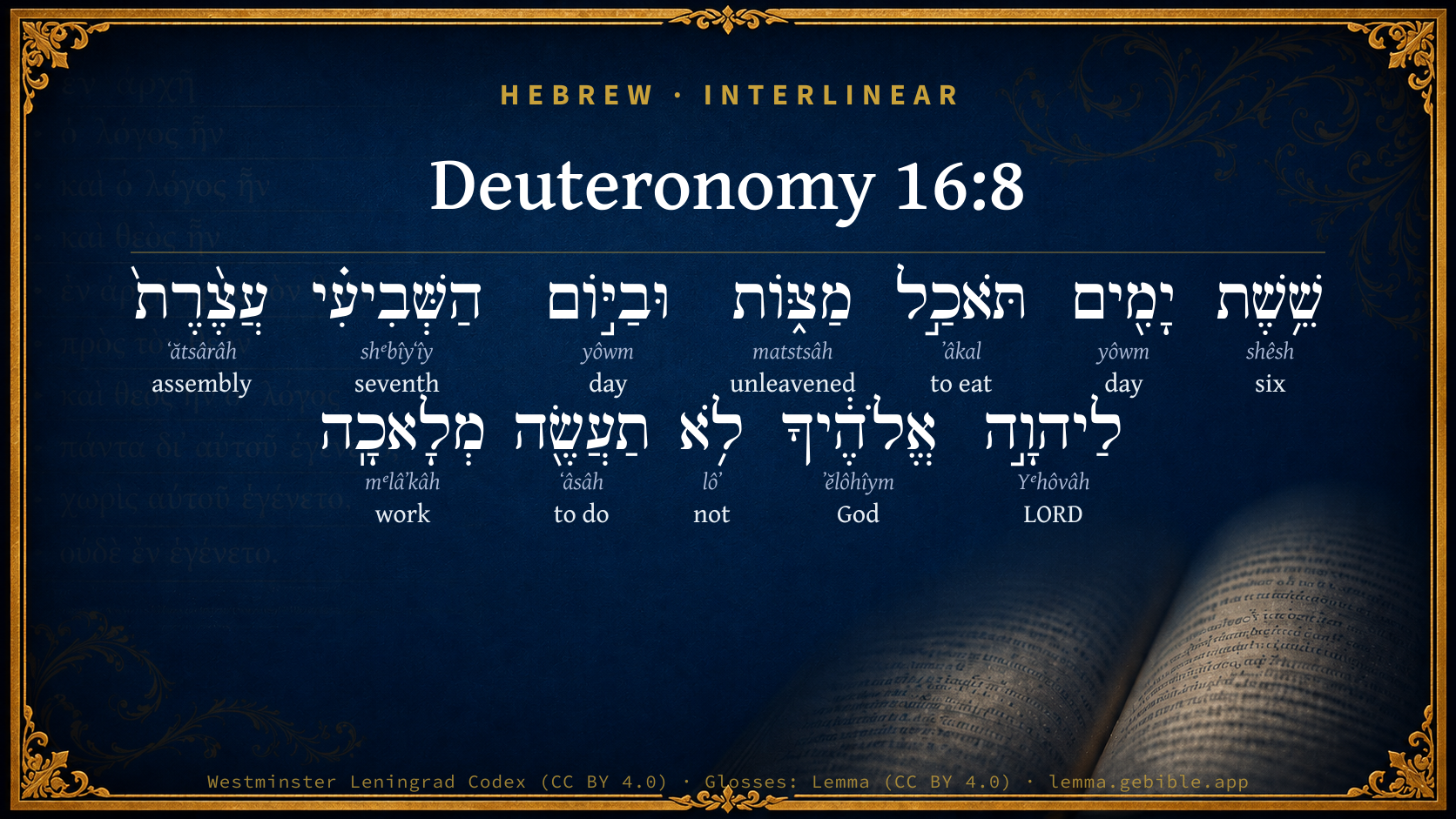
Hebrew (Westminster Leningrad Codex) Deuteronomy 16:8 appears in the Hebrew Old Testament. The text above is from the Westminster Leningrad Codex. Each word links to its Strong’s number, a concise gloss, and parsing drawn from the Open Scriptures Hebrew Bible morphology. Click any word for its full Brown-Driver-Briggs (BDB) entry.
Download image
Cite this verse

Deuteronomy 16:8 (World English Bible). Public Domain. Lemma interlinear Bible study tool, https://lemma.gebible.app/v/deuteronomy/16/8.

Show BibTeX & RIS
BibTeX
RIS
English Translation
Six days you shall eat unleavened bread; and on the seventh day shall be a solemn assembly to Yahweh your God; you shall do no work [therein].
World English Bible · Public Domain
Download a study sheet

One document with this verse’s original text, its word-by-word gloss line, the meaning frame, cross-references with their text, attributed commentary, and full source and license credits — printable, and it pastes into notes with its structure intact.

This verse Autodidact and up

Study sheet (.html) Plain text (.txt)

A passage Seminary Student

Up to 50 verses in one chapter. A passage sheet keeps up to 6 commentary sources and 12 cross-references per verse, in the order this page ranks them, and says so on the sheet whenever that leaves anything out. Ask for a single verse and you get the Autodidact verse sheet above.

Everything on this page stays free to read, with no account — the sheet is a download of what is already on screen, not access to it.

Want to remove ads? Support Godless Engineer
Compare translations 3

The same verse in 3 English versions, stacked beneath the original-language interlinear above. Click any original word for its lexicon entry.

Each is an independent rendering of the whole verse — the interlinear is not word-aligned to these translations.

Highlighted words mark where these versions differ — a whole-verse word diff, not a word-by-word alignment.

  • World English Bible Public Domain
    Six days you shall eat unleavened bread; and on the seventh day shall be a solemn assembly to Yahweh your God; you shall do no work [therein].
  • King James Version Public Domain
    Six days thou shalt eat unleavened bread: and on the seventh day shall be a solemn assembly to the LORD thy God: thou shalt do no work therein.
  • unfoldingWord Literal Text CC BY-SA 4.0
    Six days you shall eat unleavened bread, and on the seventh day a festive assembly for Yahweh your God, do not do work.

unfoldingWord Literal Text — © unfoldingWord, licensed CC BY-SA 4.0. Word-aligned USFM3 via Door43 (git.door43.org/unfoldingWord/en_ult).

Versions to compare (up to 4)

3 of 4 selected

Show all 18 translations

Every available English version of this verse, each an independent rendering of the whole verse.

  • World English Bible Public Domain
    Six days you shall eat unleavened bread; and on the seventh day shall be a solemn assembly to Yahweh your God; you shall do no work [therein].
  • Berean Standard Bible Public Domain
    For six days you must eat unleavened bread, and on the seventh day you shall hold a solemn assembly to the LORD your God, and you must not do any work.
  • Majority Standard Bible Public Domain
    For six days you must eat unleavened bread, and on the seventh day you shall hold a solemn assembly to the LORD your God, and you must not do any work.
  • King James Version Public Domain
    Six days thou shalt eat unleavened bread: and on the seventh day shall be a solemn assembly to the LORD thy God: thou shalt do no work therein.
  • American Standard Version (1901) Public Domain
    Six days thou shalt eat unleavened bread; and on the seventh day shall be a solemn assembly to Jehovah thy God; thou shalt do no work `therein'.
  • Revised Version (1885) Public Domain
    Six days thou shalt eat unleavened bread: and on the seventh day shall be a solemn assembly to the LORD thy God; thou shalt do no work therein.
  • Geneva Bible (1599) Public Domain
    Six daies shalt thou eate vnleauened bread, and ye seuenth day shall be a solemne assemblie to ye Lord thy God thou shalt do no worke therein.
  • Douay-Rheims (1899) Public Domain
    Six days shalt thou eat unleavened bread: and on the seventh day, because it is the assembly of the Lord thy God, thou shalt do no work.
  • Young's Literal Translation Public Domain
    six days thou dost eat unleavened things, and on the seventh day `is' a restraint to Jehovah thy God; thou dost do no work.
  • Literal Standard Version CC BY-SA 4.0
    [for] six days you eat unleavened things, and on the seventh day [is] a restraint to your God YHWH; you do no work.
  • Unlocked Literal Bible CC BY-SA 4.0
    For six days you will eat unleavened bread; on the seventh day there will be a solemn assembly for Yahweh your God; on that day you must do no work.
  • unfoldingWord Literal Text CC BY-SA 4.0
    Six days you shall eat unleavened bread, and on the seventh day a festive assembly for Yahweh your God, do not do work.
  • Darby Bible Public Domain
    Six days thou shalt eat unleavened bread, and on the seventh day is a solemn assembly to Jehovah thy God; thou shalt do no work.
  • World Messianic Bible Public Domain
    Six days you shall eat unleavened bread. On the seventh day shall be a solemn assembly to the LORD your God. You shall do no work.
  • Webster's Bible Public Domain
    Six days thou shalt eat unleavened bread: and on the seventh day shall be a solemn assembly to the LORD thy God: in it thou shalt do no work.
  • Free Bible Version CC BY-SA 4.0
    Eat bread without yeast for six days, and then on the seventh day you are to have a holy meeting to honor the Lord your God. You are not to do any work.
  • Bible in Basic English Public Domain
    For six days let your food be unleavened bread; and on the seventh day there is to be a holy meeting to the Lord your God; no work is to be done.
  • JPS Tanakh (1917) Public Domain
    Six days thou shalt eat unleavened bread; and on the seventh day shall be a solemn assembly to the LORD thy God; thou shalt do no work therein.

Literal Standard Version (2020), Covenant Press — licensed CC BY-SA 4.0. Text via the HelloAO Bible API (eBible.org). Unlocked Literal Bible (unfoldingWord) — licensed CC BY-SA 4.0. Text via the HelloAO Bible API (eBible.org). unfoldingWord Literal Text — © unfoldingWord, licensed CC BY-SA 4.0. Word-aligned USFM3 via Door43 (git.door43.org/unfoldingWord/en_ult). Free Bible Version, Dr. Jonathan Gallagher — licensed CC BY-SA 4.0. Text via the HelloAO Bible API (eBible.org).

Word by word

More ways to search: Search by grammar → Find every occurrence → Compare this word →

Practice this passage: Drill this verse → Learn its vocabulary →

עֲצֶ֨רֶת֙
ʻătsârâh
H6116
“assembly”
Noun, Common, Feminine, Singular, Absolute
Part of Speech
Noun
Type
Common
Gender
Feminine
Number
Singular
State
Absolute
Full BDB Definition

Origin: from H6113

TWOT: 1675c

assembly, solemn assembly - assembly (sacred or festive meeting) - assemblage, company, group
  1. שֵׁ֥שֶׁת shêsh H8337 “six” Adjective, Cardinal number, Masculine, Singular, Construct
  2. יָמִ֖ים yôwm H3117 “days” Noun, Common, Masculine, Plural, Absolute
  3. תֹּאכַ֣ל ʼâkal H398 “to eat” Verb, Qal, Imperfect, 2nd Person, Masculine, Singular
  4. מַצּ֑וֹת matstsâh H4682 “unleavened bread” Noun, Common, Feminine, Plural, Absolute
  5. וּבַיּ֣וֹם yôwm H3117 “and · in/at the · day” Conjunction + Preposition, Determined + Noun, Common, Masculine, Singular, Absolute
  6. הַשְּׁבִיעִ֗י shᵉbîyʻîy H7637 “the · seventh” Particle, Definite Article + Adjective, Ordinal number, Masculine, Singular, Absolute
  7. לַיהוָ֣ה Yᵉhôvâh H3068 “to/for · LORD” Preposition + Noun, Proper
  8. אֱלֹהֶ֔יךָ ʼĕlôhîym H430 “God(s) · your” Noun, Common, Masculine, Plural, Construct + Suffix, Personal, 2nd Person, Masculine, Singular
  9. לֹ֥א lôʼ H3808 “not” Particle, Negative
  10. תַעֲשֶׂ֖ה ʻâsâh H6213 “to do” Verb, Qal, Imperfect, 2nd Person, Masculine, Singular
  11. מְלָאכָֽה mᵉlâʼkâh H4399 “work” Noun, Common, Feminine, Singular, Absolute

About this verse

These counts appear in no published source. They are computed here, from the morphology-tagged text and Lemma’s own curated glosses. What Lemma adds →

12
words
11
distinct lemmas
Pentateuch
section

Notable vocabulary

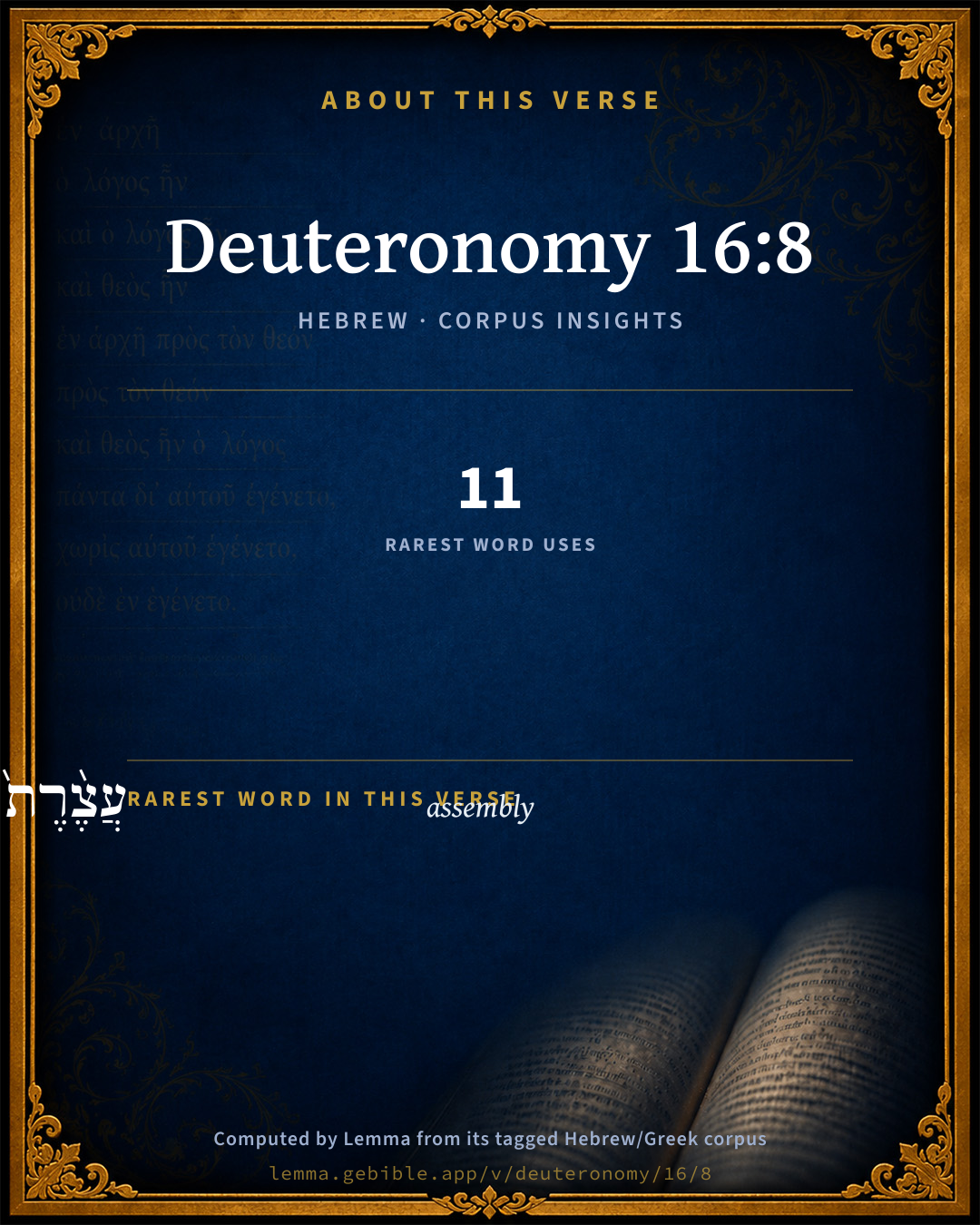
The rarest word here is עֲצֶ֨רֶת֙ assembly H6116 — appearing just 11 times in the whole Hebrew Bible.

Shared distinctive vocabulary

עֲצֶ֨רֶת֙ assembly H6116 occurs in 11 verses of the Hebrew Bible. Also found in:

Grammatical profile

  • 2 verbs
  • 7 nouns
  • 2 adjectives
  • 1 particle

Verb forms

  • תֹּאכַ֣ל Qal · Imperfect
  • תַעֲשֶׂ֖ה Qal · Imperfect

Repetition

A word recurs within this verse — often emphatic in Hebrew:

  • יָמִ֖ים day H3117 ×2

Hebrew & Septuagint length

In English translation the verse runs 27 words from the Hebrew and 38 from the Septuagint (LXX English) — the Septuagint runs noticeably longer here. See the side-by-side →

A rough comparison of the two English renderings, which tokenize alike — not a word-level alignment.

Word counts can differ between the Hebrew and the Greek without any difference in meaning — e.g. the Hebrew direct-object marker אֵת has no separate Greek word, and Greek often adds the article ὁ.

Cross-references

5

Topical passages linked to Deuteronomy 16:8 in the Treasury of Scripture Knowledge — connected by theme and wording, ordered by reader-vote popularity; previews shown in the World English Bible.

  • Exodus 12:15–16 Seven days shall you eat unleavened bread; even the first day you shall put away yeast out of your houses, for whoever eats leavened bread from the first day until the seventh day, that soul shall be cut off from Israel.
  • Exodus 13:6–8 Seven days you shall eat unleavened bread, and in the seventh day shall be a feast to Yahweh.
  • Leviticus 23:6–8 On the fifteenth day of the same month is the feast of unleavened bread to Yahweh. Seven days you shall eat unleavened bread.
  • Leviticus 23:36 Seven days you shall offer an offering made by fire to Yahweh. On the eighth day shall be a holy convocation to you; and you shall offer an offering made by fire to Yahweh. It is a solemn assembly; you shall do no regular work.
  • Numbers 28:17–19 On the fifteenth day of this month shall be a feast: seven days shall unleavened bread be eaten.

Cross-references courtesy of OpenBible.info (CC BY 4.0).

Hebrew and Greek witnesses Masoretic Hebrew ↔ Greek Septuagint

The same verse in the two great witnesses to the Old Testament, shown verse-for-verse.

Here the Septuagint runs noticeably longer than the Hebrew — LXX2012 (modern English Septuagint) 38 words vs World English Bible 27. A rough length comparison of the two English translations, not a word-level alignment — read both below.

These are two independent witnesses, not word-aligned to each other, and the Septuagint is shown in lemma (dictionary) form.

Hebrew Deuteronomy 16:8 Masoretic · Westminster Leningrad Codex

שֵׁ֥שֶׁת יָמִ֖ים תֹּאכַ֣ל מַצּ֑וֹת וּבַיּ֣וֹם הַשְּׁבִיעִ֗י עֲצֶ֨רֶת֙ לַיהוָ֣ה אֱלֹהֶ֔יךָ לֹ֥א תַעֲשֶׂ֖ה מְלָאכָֽה

Six days you shall eat unleavened bread; and on the seventh day shall be a solemn assembly to Yahweh your God; you shall do no work [therein].

World English Bible · Public Domain

Greek LXX Deuteronomy 16:8 Septuagint · lemma form

ἕξ ἡμέρα ἐσθίω ἄζυμος καί ὁ ἡμέρα ὁ ἕβδομος ἐξόδιον ἑορτή κύριος ὁ θεός σύ οὐ ποιέω ἐν αὐτός πᾶς ἔργον πλήν ὅσος ποιέω ψυχή

Six days shall you eat unleavened bread, and on the seventh day is a holiday, a feast to the Lord your God: you shall not do in it any work, save what must be done by any one.

LXX2012 (modern English Septuagint) · Public Domain

On this verse, Haydock's Catholic Bible Commentary discusses the Septuagint’s reading. Read the note in Commentary ↓

Hebrew: Westminster Leningrad Codex (CC BY 4.0). Greek: Septuagint (public domain); English from LXX2012 (modern English Septuagint) (Public Domain). How the Septuagint differs from the Hebrew →

Targum (Aramaic paraphrase)

2

The Targum is the ancient Jewish Aramaic paraphrase of the Hebrew Scriptures — an interpretive translation, not the Hebrew text itself. Onkelos (literal) and Pseudo-Jonathan (expansive) render the Torah, and Jonathan the Prophets. Coverage is partial: where no permissively-licensed English translation exists for a verse, only the Aramaic is shown. This is verse-level text, not a word-by-word alignment to the Hebrew.

  1. Targum Onkelos Torah (Genesis–Deuteronomy)
    שִׁתָּא יוֹמִין תֵּיכוּל פַּטִירָא וּבְיוֹמָא שְׁבִיעָאָה כְּנֵשׁ קֳדָם יְיָ אֱלָהָךְ לָא תַעְבֵּד עִבִידָא

    (no public-domain English translation for this verse)

    Targum Onkelos — Aramaic: “Onkelos Genesis” (public domain); “Onkelos Exodus” (public domain); “Onkelos Leviticus” (public domain); “Onkelos Numbers” (public domain); “Onkelos Deuteronomy” (public domain). English: “Sefaria Community Translation” (CC0 1.0 (public-domain dedication)); “J.W. Etheridge. The Targums of Onkelos and Jonathan Ben Uzziel on the Pentateuch. London: Longmans, Green, 1862” (public domain). Text via Sefaria.

  2. Targum Pseudo-Jonathan Torah (Genesis–Deuteronomy)
    בְּיוֹמָא קַמָּא תְקַרְבוּן יַת עוֹמְרָא וְתֵיכְלוּן פַּטִּירֵי מַעֲלַלְתָּא עַתִּיקָא וְשִׁתָּא יוֹמִין דְּאִשְׁתְּיָירוּ תְּהוֹן מַרְשַׁן לְמֵיכוֹל פַּטוּרֵי מַעֲלַלְתָּא חֲדַתָּא וּבְיוֹמָא שְׁבִיעָאָה הַהוּא תְּהוֹן כְּנִישִׁין בְּתוּשְׁבְּחָא קֳדָם יְיָ אֱלָהָכוֹן לָא תַעַבְדוּן עִיבִידְתָּא

    On the first day thou shalt offer the omer, and eat unleavened cakes of the old corn; but in the six remaining days you may begin to eat unleavened cakes of the new corn, and on the seventh day you shall assemble with thanksgiving before the Lord your God; no work shall you perform.

    Targum Pseudo-Jonathan — Aramaic: “Targum Jonathan on Genesis” (public domain); “Targum Jonathan on Exodus” (public domain); “Targum Jonathan on Leviticus” (public domain); “Targum Jonathan on Numbers” (public domain); “Targum Jonathan on Deuteronomy” (public domain). English: “The Targum of Jonathan ben Uzziel, trans. J. W. Etheridge, London, 1862” (public domain). Text via Sefaria.

Commentary

Notes on Deuteronomy 16:8 from classic Christian and Jewish commentators (each source and its license shown beneath its notes). The classic Christian expositions comment on the surrounding passage and are grouped to its opening verse, so a note may address several verses; the Jewish commentaries on the Tanakh (Rashi and others) are per-verse, so they appear only where the commentator wrote on this verse.

Lemma curates 59 commentaries, every one of them public domain or Creative Commons licensed, each selected and text-cleaned for this edition rather than reprinted as found. About our sources →

The Cambridge Bible for Schools and Colleges

gen. ed. J. J. S. Perowne

8. See introd. note. The incompatibility of this v. with the preceding is obvious unless we are to explain tents as the shelters which pilgrims to the central sanctuary pitched during the feast. But (as we have seen) tents means the people’s homes. The numbering of the days is not clear. If the Passover day itself is included there is no contradiction of Deu_16:3, for that was the first day of unleavened bread, and this v. may be interpreted as also fixing seven days for the eating of such bread; but distinguishing them as six plus a seventh on which in addition the solemn assembly was to be held. But if the Passover day was meant to be included it is strange that it is not mentioned. On the whole, and particularly because of the two expressions characteristic of P, a solemn assembly and thou shalt do no work (the latter however also in Deu_5:13), it is probable that Deu_16:8 is an addition by the compiler of the two once separate laws on the Passover and the Maṣṣôth.

The Cambridge Bible for Schools and Colleges (gen. ed. J. J. S. Perowne; Cambridge University Press, 1878–1918) — public domain. Text from a community e-Sword module.

Joseph Benson's Commentary

Deu 16:8. Six days — That is, besides the first day on which the passover was killed. So that, in all, unleavened bread was eaten seven days.

Joseph Benson's Commentary on the Old and New Testaments (1811–1818) — public domain. Text from a community e-Sword module.

John Gill's Exposition

Six days shalt thou eat unleavened bread,.... In other places it is ordered to be eaten seven days, Exo 12:15 and here it is not said six only; it was to be eaten on the seventh as on the other, though that is here distinguished from the six, because of special and peculiar service assigned to it, but not because of an exemption from eating unleavened bread on it. The Jews seem to understand this of different corn of which the bread was made, and not of different sort of bread; the Targum of Jonathan is, on the first day ye shall offer the sheaf (the firstfruits of the barley harvest), and on the six days which remain ye shall begin to eat the unleavened bread of the new fruits, and so Jarchi:

and on the seventh day shall be a solemn assembly to the Lord thy God; a holy convocation, devoted to religious exercises, and the people were restrained, according to the sense of the word, from all servile work, as follows:

thou shalt do no work therein; that is, the business of their callings, their trades and manufactories; they were obliged to abstain from all kind of work excepting what was necessary for the dressing of food, and in this it differed from a sabbath; see Exo 12:16.

John Gill's Exposition of the Whole Bible (1746–1763) — public domain (CC PDM 1.0). Text via the HelloAO Bible API.

Haydock's Catholic Bible Commentary

Six days after the solemn day is ended, or in all seven (Exodus xiii. 7.; Calmet); or the seventh day is here remarkable for some particular distinction. (Menochius) --- Assembly. Hebrew, " the feast of prohibition, or of withholding," or rather the festival day, in which all must make their appearance, to do homage to their Lord, Leviticus xxiii. 36. (Calmet) --- Septuagint, "on the 7th is the dismission, (or termination) a feast to the Lord." (Haydock)

George Leo Haydock (1774–1849), Haydock's Catholic Family Bible and Commentary, 1859 edition — public domain. Excludes Psalms (Douay-Rheims chapter numbering differs from Protestant) and Deuterocanonical books (Catholic canon only).

Matthew Poole's English Annotations

Six days, to wit, besides the first day, on which the passover was killed; or rather besides the seventh and the last day, which is here mentioned apart, not as if leavened bread might be eaten then, for the contrary was evident from many places, but because there was something more to be done, to wit, a solemn assembly to be kept. So in all there were seven days, as it is said, Exo 12:15; Lev 23:6; Num 28:17.

Matthew Poole's English Annotations on the Holy Bible (1683–1685) — public domain. Text from a community e-Sword/MySword module.

The Pulpit Commentary

On the seventh day shall be a solemn assembly. This is not placed in antithesis to the injunction, six days thou shalt eat unleavened bread, as if the Feast of Unleavened Bread (mazzoth) lasted only for six days and the seventh was to be devoted to a service of a different kind; it simply prescribes that the seventh day of the festival was to be celebrated by an assembling of the whole of those who had come to the feast; the festival was to be wound up with a day of holy convocation, in which no work was to be done. (Lev_23:36) On all the days unleavened bread was to be eaten, and on the seventh there was besides to be a solemn assembly to the Lord (jwOjyl trx called inmi). (Lev_23:36, "a holy convocation (vdqo arq)

The Pulpit Commentary (1880–1919), ed. H.D.M. Spence-Jones & Joseph S. Exell — public domain. Text from a community e-Sword module.

John Wesley's Explanatory Notes

Six days - Namely, besides the first day, on which the passover was killed.

John Wesley, Explanatory Notes Upon the Whole Bible (1754–1765) — public domain. Text via the GEBible commentary corpus.

Rashi

Rabbi Shlomo Yitzchaki (Rashi)

ששת ימים תאכל מצות SIX DAYS THOU SHALT EAT UNLEAVENED BREAD — But in another passage it states, (Exodus 12:15): “seven days [ye shall eat unleavened bread]’’! But the explanation is: seven days ye may eat Mazzoth prepared from the old produce and six days (out of the seven. i.e. the last six days, after the Omer has been offered and the new crop has become permitted as food) ye may eat Mazzoth prepared from the new crop (Sifrei Devarim 134:5). Another explanation is: It teaches regarding the eating of unleavened bread on the seventh day of Passover that it is not obligatory; and from here (from this law concerning the seventh day) you may derive the law for the other six days. For the seventh day was included in the general statement (“seven days, thou shalt eat unleavened bread’’), and in the text: “six days thou shall eat unleavened bread” it has left the general statement, to teach... eating unleavened bread on it is not obligatory but optional. Now, according to the well-known rule, it did not leave the general statement in order to teach this regarding itself alone but regarding everything that is included in the general statement. Now how is it with the seventh day? It is optional as regards the eating of unleavened bread (as explained in the earlier portion of this comment)! This, too, according to the rule, applies also to everything that was included in the general statement, and therefore all the other days are also optional in this respect, with the exception, however, of the first night of Passover, for which Scripture has fixed it (the eating of unleavened bread) as an obligation, as it is said, (Exodus 22:18) “at evening ye shall eat unleavened bread” (Pesachim 120a; cf. also Rashi on Exodus 12:15).

עצרת לה' אלהיך [AND ON THE SEVENTH DAY SHALL BE] A RESTRICTION IN HONOR OF THE LORD — i.e., restrict yourself from work (Chagigh 18a). — Another explanation is that עצרת denotes a gathering for eating and drinking (a banquet), like the expression used (Judges 13:15) “Let us detain (נעצרה) thee [that we may make ready a kid for thee]”.

Rashi on the Tanakh — English translations: “The Judaica Press complete Tanach with Rashi, translated by A. J. Rosenberg” (CC BY 4.0); “Pentateuch with Rashi's commentary by M. Rosenbaum and A.M. Silbermann, 1929-1934” (public domain); “The Metsudah Tanach series, Lakewood, N.J” (CC BY 4.0); and “The Book of Joshua, Metsudah Publications, 1997” (CC BY 4.0). Text via Sefaria.

Ramban (Nachmanides)

Rabbi Moshe ben Nachman (Ramban / Nachmanides)

Now he said, And on the seventh day [of Passover] shall be a solemn assembly to the Eternal thy G-d; thou shalt do no work therein. But he did not mention the prohibition of work on the first day [of Passover]; he likewise did not state such a prohibition for the Festival of Weeks, nor for Tabernacles, nor did he mention the commandment of the palm-branch [on the Festival of Tabernacles] and he likewise did not mention here the Day of Remembrance [i.e., the New Year] and the tenth of that month [i.e., the Day of Atonement] — the reason, as I have explained, is that now he came to mention only the [commandment to make an] appearance [in the Sanctuary] and the [commandment of] festivity, for all Israelites are obligated to make a pilgrimage on these three festivals to the place which G-d shall choose and celebrate there every man as he is able, according to the blessing of G-d which He hath given him, to rejoice before Him, to thank for all the good which He hath bestowed on us according to his compassions, and according to the multitude of His mercies. He [Moses] added, and on the seventh day shall be a solemn assembly meaning: Six days thou shalt eat unleavened bread and in addition to them is a solemn assembly on the seventh day, the purport being that they be further detained before Him to eat the unleavened bread. And because he said that [the seventh day] is Atzereth it might possibly mean that they be “restrained” only for the eating of the unleavened bread as on the [six] preceding days, therefore it was necessary to admonish [also in the same verse] that you are not to do work therein. Similarly He said with reference to the eighth day of the Festival of Tabernacles in the section on the festivals in the Book of Leviticus, Seven days ye shall bring an offering made by fire unto the Eternal; on the eighth day shall be a holy convocation unto you; and ye shall bring an offering made by fire unto the Eternal; it is a solemn assembly; ye shall do no manner of servile work, meaning that [the eighth day] is restrained in addition to the first [seven] days with respect to the bringing of a fire-offering, and it has a further prohibition against [doing therein any manner of] servile work, [a prohibition shared only by the first day of Tabernacles, but not by any of the intermediate days].And by way of the Truth, [the mystic teachings of the Cabala, the verse stating that the seventh day of Passover] Atzereth is “the congregation of Israel,” and the verse comes to teach us the secret of the day. But it is not like Atzereth of the eighth day of Tabernacles, for the eighth day is a separate festival and the offering brought then, is for the congregation of Israel, but it is unlike the offerings brought on the seven days [of the Tabernacles]. The seventh day of Passover, however, is part of the Festival [of Passover] and it is Atzereth, for, sometimes it is counted as the eighth (crown). See L’vush Ha’orah to Ricanti here. and sometimes it is included [as part of the seven]. Thus it is like the Sabbath in which there is the [commandment to] remember and [the commandment to] observe, the honor for the day and honor for the night. [Thus the offering on the seventh day of Passover is part of the festival], and therefore he said here, a solemn assembly to the Eternal thy G-d, while there [with reference to the eighth day of Tabernacles] it is said, and ye shall bring an offering made by fire unto the Eternal; it is a solemn assembly, meaning that the offering is the Atzereth and therefore “the meal” is small. The student learned in the mystic teachings of Cabala will understand.He [Moses] did not mention here the eighth day of the Festival of Tabernacles, because it has already been mentioned, and [because] there is no obligation that we go up in pilgrimage to the Sanctuary another time [in honor of the eighth day].

Ramban (Nachmanides) on the Tanakh — English translation: “Commentary on the Torah by Ramban (Nachmanides). Translated and annotated by Charles B. Chavel. New York, Shilo Pub. House, 1971-1976” (CC BY 4.0). Text via Sefaria.

Lesson kit

Teaching starters — assembled from the data on this page, not authored interpretation. Every prompt links to the verse data it draws on. Edit before teaching.

Deuteronomy, in the Pentateuch, opens this verse with 12 words (11 distinct Hebrew lemmas). Its most distinctive word is ʻătsârâh (“assembly”). The Greek Septuagint runs longer here. A historical commentator’s framing appears above. Read the whole chapter for the surrounding context.

Discussion questions

  1. The word ʻătsârâh carries the sense “assembly.” How does it shape the verse?
  2. Leviticus 23:36 shares the word «assembly» with this verse. How do the two illuminate each other?
  3. “day” occurs 2× in this one verse. What is the effect of the repetition?
  4. Compared with the Hebrew, the Septuagint runs longer here. What questions does that raise?
  5. These translations render this verse differently. What is at stake in choosing one wording over another?
  6. The verb «תֹּאכַ֣ל» is Qal Imperfect. How does its form color the action?
  7. Reading how The Cambridge Bible for Schools and Colleges and Joseph Benson's Commentary read this verse, where do the two commentators agree and where do they part?

Things to notice

Reading settings

Reading text

Shown beneath each verse's original-language words.

Old Testament
Old Testament edition

Read the OT as the Masoretic Hebrew (MT) or the Greek Septuagint (LXX).

English shown for the Greek Septuagint (in the Hebrew ↔ Greek comparison).

Comparing translations? Open the Compare panel on any verse page to stack up to four side by side.