
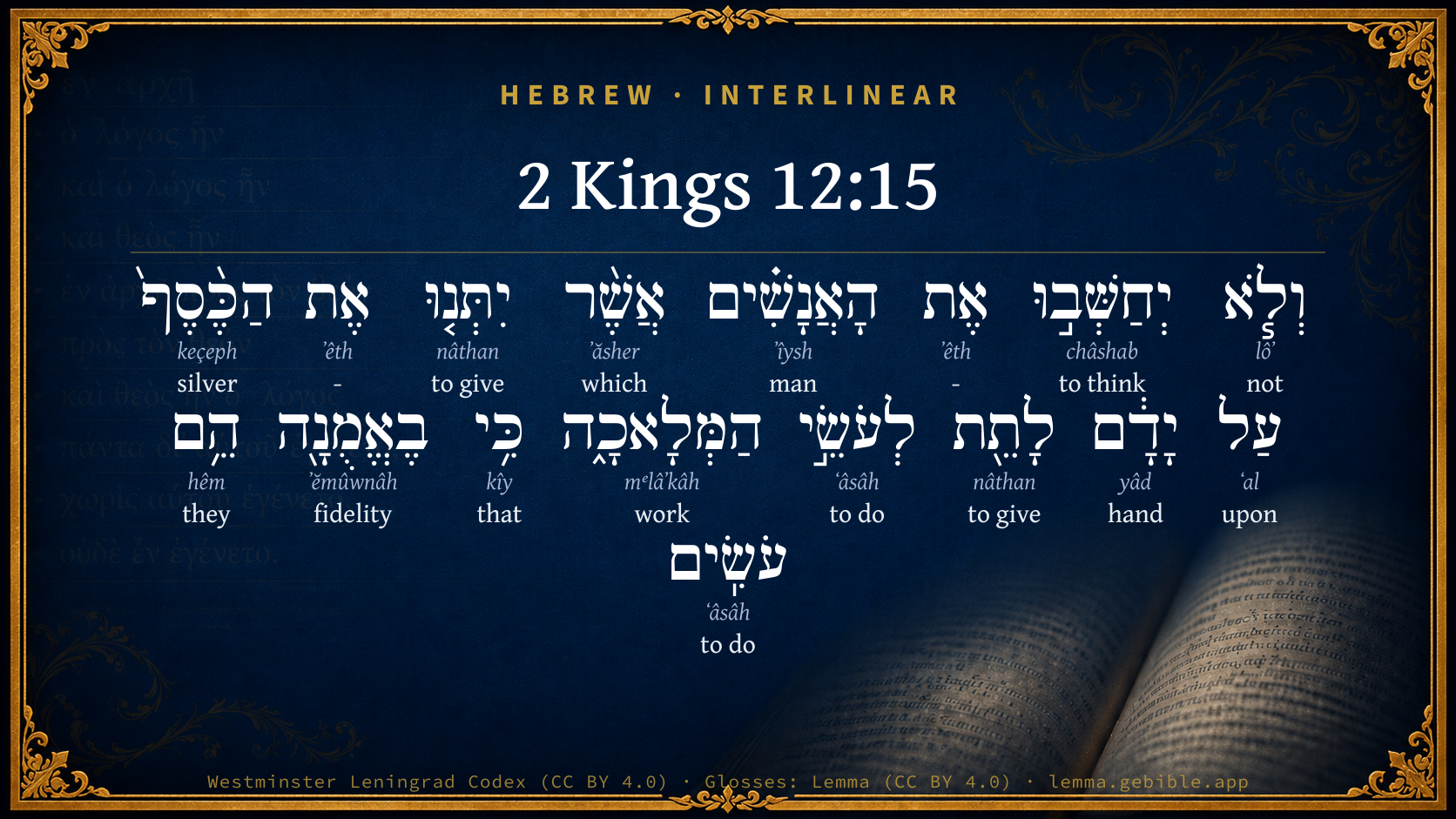
2 Kings 12:15

Hebrew (Westminster Leningrad Codex) 2 Kings 12:15 appears in the Hebrew Old Testament. The text above is from the Westminster Leningrad Codex. Each word links to its Strong’s number, a concise gloss, and parsing drawn from the Open Scriptures Hebrew Bible morphology. Click any word for its full Brown-Driver-Briggs (BDB) entry.
Download image
Cite this verse

2 Kings 12:15 (World English Bible). Public Domain. Lemma interlinear Bible study tool, https://lemma.gebible.app/v/2-kings/12/15.

Show BibTeX & RIS
BibTeX
RIS
English Translation
Moreover they didn't demand an accounting from the men into whose hand they delivered the money to give to those who did the work; for they dealt faithfully.
World English Bible · Public Domain
Download a study sheet

One document with this verse’s original text, its word-by-word gloss line, the meaning frame, cross-references with their text, attributed commentary, and full source and license credits — printable, and it pastes into notes with its structure intact.

This verse Autodidact and up

Study sheet (.html) Plain text (.txt)

A passage Seminary Student

Up to 50 verses in one chapter. A passage sheet keeps up to 6 commentary sources and 12 cross-references per verse, in the order this page ranks them, and says so on the sheet whenever that leaves anything out. Ask for a single verse and you get the Autodidact verse sheet above.

Everything on this page stays free to read, with no account — the sheet is a download of what is already on screen, not access to it.

Want to remove ads? Support Godless Engineer
Compare translations 3

The same verse in 3 English versions, stacked beneath the original-language interlinear above. Click any original word for its lexicon entry.

Each is an independent rendering of the whole verse — the interlinear is not word-aligned to these translations.

Highlighted words mark where these versions differ — a whole-verse word diff, not a word-by-word alignment.

  • World English Bible Public Domain
    Moreover they didn't demand an accounting from the men into whose hand they delivered the money to give to those who did the work; for they dealt faithfully.
  • King James Version Public Domain
    Moreover they reckoned not with the men, into whose hand they delivered the money to be bestowed on workmen: for they dealt faithfully.
  • unfoldingWord Literal Text CC BY-SA 4.0
    And they did not reckon with the men into whose hand they gave the silver to give to the doers of the work, for they were acting in faithfulness.

unfoldingWord Literal Text — © unfoldingWord, licensed CC BY-SA 4.0. Word-aligned USFM3 via Door43 (git.door43.org/unfoldingWord/en_ult).

Versions to compare (up to 4)

3 of 4 selected

Show all 18 translations

Every available English version of this verse, each an independent rendering of the whole verse.

  • World English Bible Public Domain
    Moreover they didn't demand an accounting from the men into whose hand they delivered the money to give to those who did the work; for they dealt faithfully.
  • Berean Standard Bible Public Domain
    No accounting was required from the men who received the money to pay the workmen, because they acted with integrity.
  • Majority Standard Bible Public Domain
    No accounting was required from the men who received the money to pay the workmen, because they acted with integrity.
  • King James Version Public Domain
    Moreover they reckoned not with the men, into whose hand they delivered the money to be bestowed on workmen: for they dealt faithfully.
  • American Standard Version (1901) Public Domain
    Moreover they reckoned not with the men, into whose hand they delivered the money to give to them that did the work; for they dealt faithfully.
  • Revised Version (1885) Public Domain
    Moreover they reckoned not with the men, into whose hand they delivered the money to give to them that did the work: for they dealt faithfully.
  • Geneva Bible (1599) Public Domain
    Moreouer, they reckoned not with the men, into whose handes they deliuered that money to be bestowed on workemen: for they dealt faithfully.
  • Douay-Rheims (1899) Public Domain
    And they reckoned not with the men that received the money to distribute it to the workmen, but they bestowed it faithfully.
  • Young's Literal Translation Public Domain
    and they do not reckon with the men into whose hand they give the money to give to those doing the work, for in faithfulness they are dealing.
  • Literal Standard Version CC BY-SA 4.0
    and they do not reckon with the men into whose hand they give the money to give to those doing the work, for they are dealing in faithfulness.
  • Unlocked Literal Bible CC BY-SA 4.0
    In addition, they did not require the money paid for repairs to be accounted for by the men who received it and paid it to the workmen, because these men were honest.
  • unfoldingWord Literal Text CC BY-SA 4.0
    And they did not reckon with the men into whose hand they gave the silver to give to the doers of the work, for they were acting in faithfulness.
  • Darby Bible Public Domain
    And they did not reckon with the men into whose hand they gave the money to be bestowed on workmen; for they dealt faithfully.
  • World Messianic Bible Public Domain
    Moreover they didn’t demand an accounting from the men into whose hand they delivered the money to give to those who did the work; for they dealt faithfully.
  • Webster's Bible Public Domain
    Moreover, they reckoned not with the men, into whose hand they delivered the money to be bestowed on workmen: for they dealt faithfully.
  • Free Bible Version CC BY-SA 4.0
    No accounts were demanded from the men who received the money to pay the workers because they did everything honestly.
  • Bible in Basic English Public Domain
    And they did not get any statement of accounts from the men to whom the money was given for the workmen, for they made use of it with good faith.
  • JPS Tanakh (1917) Public Domain
    (12-16) Moreover they reckoned not with the men, into whose hand they delivered the money to give to them that did the work; for they dealt faithfully.

Literal Standard Version (2020), Covenant Press — licensed CC BY-SA 4.0. Text via the HelloAO Bible API (eBible.org). Unlocked Literal Bible (unfoldingWord) — licensed CC BY-SA 4.0. Text via the HelloAO Bible API (eBible.org). unfoldingWord Literal Text — © unfoldingWord, licensed CC BY-SA 4.0. Word-aligned USFM3 via Door43 (git.door43.org/unfoldingWord/en_ult). Free Bible Version, Dr. Jonathan Gallagher — licensed CC BY-SA 4.0. Text via the HelloAO Bible API (eBible.org).

Word by word

More ways to search: Search by grammar → Find every occurrence → Compare this word →

Practice this passage: Drill this verse → Learn its vocabulary →

בֶאֱמֻנָ֖ה
ʼĕmûwnâh
H530
“in/at · fidelity”
Preposition + Noun, Common, Feminine, Singular, Absolute
Part of Speech
Preposition + Noun
Type
Common
Gender
Feminine
Number
Singular
State
Absolute
Full BDB Definition

Origin: from H529

TWOT: 116e

firmness, fidelity, steadfastness, steadiness
  1. וְלֹ֧א lôʼ H3808 “and · not” Conjunction + Particle, Negative
  2. יְחַשְּׁב֣וּ châshab H2803 “to think” Verb, Piel, Imperfect, 3rd Person, Masculine, Plural
  3. אֶת ʼêth H853 “-” Particle, Direct Object
  4. הָאֲנָשִׁ֗ים ʼîysh H376 “the · men” Particle, Definite Article + Noun, Common, Masculine, Plural, Absolute
  5. אֲשֶׁ֨ר ʼăsher H834 “which” Particle, Relative
  6. יִתְּנ֤וּ nâthan H5414 “to give” Verb, Qal, Imperfect, 3rd Person, Masculine, Plural
  7. אֶת ʼêth H853 “-” Particle, Direct Object
  8. הַכֶּ֨סֶף֙ keçeph H3701 “the · silver” Particle, Definite Article + Noun, Common, Masculine, Singular, Absolute
  9. עַל ʻal H5921 “upon” Preposition
  10. יָדָ֔ם yâd H3027 “hand · their” Noun, Common, Both, Singular, Construct + Suffix, Personal, 3rd Person, Masculine, Plural
  11. לָתֵ֖ת nâthan H5414 “to give” Preposition + Verb, Qal, Infinitive Construct
  12. לְעֹשֵׂ֣י ʻâsâh H6213 “to/for · doing” Preposition + Verb, Qal, Participle Active, Masculine, Plural, Construct
  13. הַמְּלָאכָ֑ה mᵉlâʼkâh H4399 “the · work” Particle, Definite Article + Noun, Common, Feminine, Singular, Absolute
  14. כִּ֥י kîy H3588 “that” Conjunction
  15. הֵ֥ם hêm H1992 “they” Pronoun, Personal, 3rd Person, Masculine, Plural
  16. עֹשִֽׂים ʻâsâh H6213 “doing” Verb, Qal, Participle Active, Masculine, Plural, Absolute

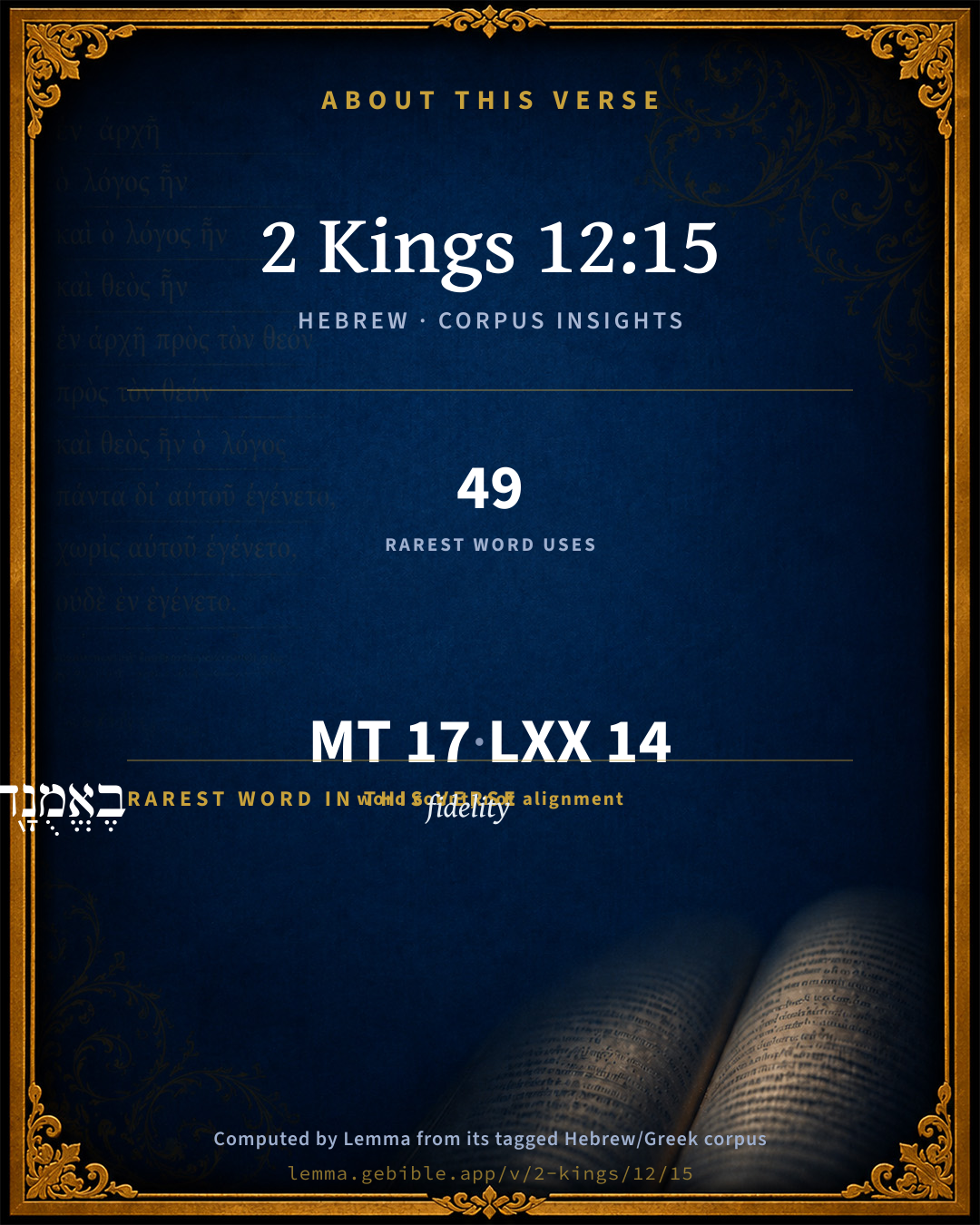
About this verse

These counts appear in no published source. They are computed here, from the morphology-tagged text and Lemma’s own curated glosses. What Lemma adds →

17
words
14
distinct lemmas
Historical
section

Shared distinctive vocabulary

בֶאֱמֻנָ֖ה fidelity H530 occurs in 49 verses of the Hebrew Bible. Also found in:

Grammatical profile

  • 5 verbs
  • 5 nouns
  • 1 pronoun
  • 1 preposition
  • 1 conjunction
  • 4 particles

Verb forms

  • יְחַשְּׁב֣וּ Piel · Imperfect
  • יִתְּנ֤וּ Qal · Imperfect
  • לָתֵ֖ת Qal · Infinitive Construct
  • לְעֹשֵׂ֣י Qal · Participle Active
  • עֹשִֽׂים Qal · Participle Active

Repetition

Words recur within this verse — often emphatic in Hebrew:

  • יִתְּנ֤וּ to give H5414 ×2
  • לְעֹשֵׂ֣י to do H6213 ×2

Hebrew & Septuagint length

In English translation the verse runs 28 words from the Hebrew and 24 from the Septuagint (LXX English) — closely comparable.

A rough comparison of the two English renderings, which tokenize alike — not a word-level alignment.

Word counts can differ between the Hebrew and the Greek without any difference in meaning — e.g. the Hebrew direct-object marker אֵת has no separate Greek word, and Greek often adds the article ὁ.

In the original languages it is 17 Hebrew tokens and 14 Greek tokens — but the two are counted differently (Hebrew bundles its prefixes and suffixes into one token; the Greek is in lemma form), so that isn’t a like-for-like length.

Cross-references

8

Topical passages linked to 2 Kings 12:15 in the Treasury of Scripture Knowledge — connected by theme and wording, ordered by reader-vote popularity; previews shown in the World English Bible.

  • 2 Kings 22:7 However there was no reckoning made with them of the money that was delivered into their hand; for they dealt faithfully.
  • 2 Chronicles 34:12 The men did the work faithfully: and the overseers of them were Jahath and Obadiah, the Levites, of the sons of Merari; and Zechariah and Meshullam, of the sons of the Kohathites, to set it forward; and [others of] the Levites, all who were skillful with instruments of music.
  • Nehemiah 7:2 that I gave my brother Hanani, and Hananiah the governor of the castle, charge over Jerusalem; for he was a faithful man, and feared God above many.
  • Matthew 24:45 "Who then is the faithful and wise servant, whom his lord has set over his household, to give them their food in due season?
  • Luke 16:1 He also said to his disciples, "There was a certain rich man who had a manager. An accusation was made to him that this man was wasting his possessions.
  • Luke 16:10–11 He who is faithful in a very little is faithful also in much. He who is dishonest in a very little is also dishonest in much.
  • 1 Corinthians 4:2–3 Here, moreover, it is required of stewards, that they be found faithful.
  • 3 John 1:5 Beloved, you do a faithful work in whatever you accomplish for those who are brothers and strangers.

Cross-references courtesy of OpenBible.info (CC BY 4.0).

Hebrew and Greek witnesses Masoretic Hebrew ↔ Greek Septuagint

The same verse in the two great witnesses to the Old Testament, shown verse-for-verse.

These are two independent witnesses, not word-aligned to each other, and the Septuagint is shown in lemma (dictionary) form.

Hebrew 2 Kings 12:15 Masoretic · Westminster Leningrad Codex

וְלֹ֧א יְחַשְּׁב֣וּ אֶת הָאֲנָשִׁ֗ים אֲשֶׁ֨ר יִתְּנ֤וּ אֶת הַכֶּ֨סֶף֙ עַל יָדָ֔ם לָתֵ֖ת לְעֹשֵׂ֣י הַמְּלָאכָ֑ה כִּ֥י בֶאֱמֻנָ֖ה הֵ֥ם עֹשִֽׂים

Moreover they didn't demand an accounting from the men into whose hand they delivered the money to give to those who did the work; for they dealt faithfully.

World English Bible · Public Domain

Greek LXX 2 Kings 12:15 Septuagint · lemma form

ὅτι ὁ ποιέω ὁ ἔργον δίδωμι αὐτός καί κραταιόω ἐν αὐτός ὁ οἶκος κύριος

Also they took no account of the men into whose hands they gave the money to give to the workmen, for they acted faithfully.

LXX2012 (modern English Septuagint) · Public Domain

Hebrew: Westminster Leningrad Codex (CC BY 4.0). Greek: Septuagint (public domain); English from LXX2012 (modern English Septuagint) (Public Domain). How the Septuagint differs from the Hebrew →

Targum (Aramaic paraphrase)

1

The Targum is the ancient Jewish Aramaic paraphrase of the Hebrew Scriptures — an interpretive translation, not the Hebrew text itself. Onkelos (literal) and Pseudo-Jonathan (expansive) render the Torah, and Jonathan the Prophets. Coverage is partial: where no permissively-licensed English translation exists for a verse, only the Aramaic is shown. This is verse-level text, not a word-by-word alignment to the Hebrew.

  1. Targum Jonathan Prophets (Joshua–Malachi)
    אֲרֵי לְעָבְדֵי עֲבִידְתָּא יַהֲבִין לֵיהּ וּמְתַקְפִין בֵּיהּ יַת בֵּית מַקְדְשָׁא דַיָי:

    (no public-domain English translation for this verse)

    Targum Jonathan — Aramaic: “Mikraot Gedolot” (public domain). English: “Sefaria Community Translation” (CC0 1.0 (public-domain dedication)); “London "Chaldee Paraphrase," 1871” (public domain). Text via Sefaria.

Commentary

Notes on 2 Kings 12:15 from classic Christian and Jewish commentators (each source and its license shown beneath its notes). The classic Christian expositions comment on the surrounding passage and are grouped to its opening verse, so a note may address several verses; the Jewish commentaries on the Tanakh (Rashi and others) are per-verse, so they appear only where the commentator wrote on this verse.

Lemma curates 59 commentaries, every one of them public domain or Creative Commons licensed, each selected and text-cleaned for this edition rather than reprinted as found. About our sources →

Trapp's Complete Commentary

John Trapp

2Ki 12:15 Moreover they reckoned not with the men, into whose hand they delivered the money to be bestowed on workmen: for they dealt faithfully.

Ver. 15. For they dealt faithfully.] This was much to their commendation. See on Neh 7:2.

John Trapp, A Commentary or Exposition upon All the Books of the Old and New Testament (1647–1656) — public domain. Text from a community e-Sword module.

Adam Clarke's Commentary

Verse 15. They reckoned not with the men] They placed great confidence in them, and were not disappointed, for they dealt faithfully.

Adam Clarke's Commentary on the Bible (1810–1826) — public domain. Text from a community e-Sword/MySword module.

Ellicott's Commentary for English Readers

(15) Moreover they reckoned not.—Rather, and they were not wont to reckon.

To be bestowed on workmen.—Literally, to give to the doers of the work. Here the phrase “doers of the work” obviously means the artisans, not the superintendents, as in 2Ki_12:11.

They dealt faithfully.—This is not a covert thrust at the priests, as Thenius imagines. The statement of the verse is repeated in 2Ki_22:7, in connection with the restoration of the Temple under Josiah, where the priests are not concerned in the matter at all. All that is meant is, that the officials entrusted with the oversight of the work were above suspicion, and did not belie their reputation.

A Bible Commentary for English Readers, edited by Charles John Ellicott (1878–1897) — public domain. Text from a community e-Sword module.

The Cambridge Bible for Schools and Colleges

gen. ed. J. J. S. Perowne

15. the men into whose hand they delivered] This must refer to certain treasurers into whose care each new chest full of offerings was entrusted. These were selected at first as being men who were sure to deal uprightly, and to them, without demanding any account, all was given over, and through their hands it was passed on to the overseers and contractors, and thus distributed to the workmen.

to be bestowed on workmen] R.V. to give to them that did the work. The same expression and with the same signification as in verses 11 and 14.

The Cambridge Bible for Schools and Colleges (gen. ed. J. J. S. Perowne; Cambridge University Press, 1878–1918) — public domain. Text from a community e-Sword module.

John Gill's Exposition

And Jehoash king of Judah took all the hallowed things that Jehoshaphat, and Jehoram, and Ahaziah, his fathers, kings of Judah, had dedicated,.... To sacred uses, and had laid up in the temple:

and his own hallowed things: which he had devoted to the same uses:

and all the gold that was found in the treasures of the house of the Lord: which were gifts and presents from divers persons for sacred services:

and sent it to Hazael king of Syria, and he went away from Jerusalem; to bribe him, that he might desist from his purpose; which showed a meanness of spirit, and was the effect of his idolatry and apostasy, having forsaken the Lord, and being forsaken by him; in whom should have been his trust and confidence, and then he need not have been afraid to meet the king of Syria.

John Gill's Exposition of the Whole Bible (1746–1763) — public domain (CC PDM 1.0). Text via the HelloAO Bible API.

Haydock's Catholic Bible Commentary

Faithfully, and corresponded with the trust reposed in them. (Haydock)

George Leo Haydock (1774–1849), Haydock's Catholic Family Bible and Commentary, 1859 edition — public domain. Excludes Psalms (Douay-Rheims chapter numbering differs from Protestant) and Deuterocanonical books (Catholic canon only).

Matthew Poole's English Annotations

For they perceived by many experiments that they were faithful.

Matthew Poole's English Annotations on the Holy Bible (1683–1685) — public domain. Text from a community e-Sword/MySword module.

Whedon's Commentary on the Bible

Daniel D. Whedon

15. Reckoned not with the men — The men who had charge of the disbursement of the funds were men of such high standing and integrity, and gave such general evidence of having done their work faithfully, that no one desired any special reckoning with them.

Daniel D. Whedon (gen. ed.), Commentary on the Old and New Testaments (1874–1909) — public domain. Text from a community e-Sword module.

The Pulpit Commentary

Moreover they reckoned not with the men, into whose hand they delivered the money to be bestowed on workmen. Society rests upon faith and trust. In all business transactions confidence must be reposed in some one, whose character is the guarantee of his honesty. In the case before us, the overseers of the temple were the persons trusted to expend the money aright (see ver. 11). The overseers (2Ki_11:18) had been appointed by the high priest. For they dealt faithfully; i.e. honestly.

The Pulpit Commentary (1880–1919), ed. H.D.M. Spence-Jones & Joseph S. Exell — public domain. Text from a community e-Sword module.

John Wesley's Explanatory Notes

Faithfully - For they perceived by many experiments that they were faithful.

John Wesley, Explanatory Notes Upon the Whole Bible (1754–1765) — public domain. Text via the GEBible commentary corpus.

Keil & Delitzsch

C. F. Keil & F. Delitzsch

No return was required of the inspectors as to the money handed over to them, because they were convinced of their honesty.

Keil & Delitzsch — Biblical Commentary on the Old Testament (1861–1891) — public domain (CC PDM 1.0). Text via the HelloAO Bible API. (Old Testament only.)

unfoldingWord translationNotes

Door43 World Missions Community

they did not require the money paid for repairs to be accounted for by the men who received it and paid it to the workmen

This can be stated in active form. AT: "they did not require the men who received the money and paid the workmen for the repairs to account for the money" (See: Active or Passive)

to be accounted for

to keep a record of how much money was received and spent

the money for the guilt offerings and the money for the sin offerings was not brought into the temple of Yahweh

It is implied that this money was not used for the repairs. This can be stated in active form. AT: "they did not use the money from the guilt offerings and the sin offerings to pay for the repairs to the temple of Yahweh" (See: Assumed Knowledge and Implicit Information and Active or Passive)

translationWords

guilt offering

sin offering

priest

unfoldingWord translationNotes — © Distant Shores Media and the Door43 World Missions Community, licensed CC BY-SA 4.0. Source: git.door43.org/Door43/en_tn.

Lesson kit

Teaching starters — assembled from the data on this page, not authored interpretation. Every prompt links to the verse data it draws on. Edit before teaching.

2 Kings, in the Historical, opens this verse with 17 words (14 distinct Hebrew lemmas). Its most distinctive word is ʼĕmûwnâh (“fidelity”). A historical commentator’s framing appears above. Read the whole chapter for the surrounding context.

Discussion questions

  1. What does “fidelity” (ʼĕmûwnâh) contribute to the verse as a whole?
  2. How does Exodus 17:12, which shares the word «fidelity», read alongside this verse?
  3. What does the repetition of “to give” (2× in this one verse) do in this verse?
  4. The translations on this page render this verse differently — a whole-verse word diff, not a word-by-word alignment. What might account for the different wordings?
  5. «יְחַשְּׁב֣וּ» is a Piel Imperfect verb. How does that grammatical form shape the action described?
  6. Compare how Trapp's Complete Commentary and Adam Clarke's Commentary read this verse. Where do they agree or differ?

Things to notice

Reading settings

Reading text

Shown beneath each verse's original-language words.

Old Testament
Old Testament edition

Read the OT as the Masoretic Hebrew (MT) or the Greek Septuagint (LXX).

English shown for the Greek Septuagint (in the Hebrew ↔ Greek comparison).

Comparing translations? Open the Compare panel on any verse page to stack up to four side by side.