
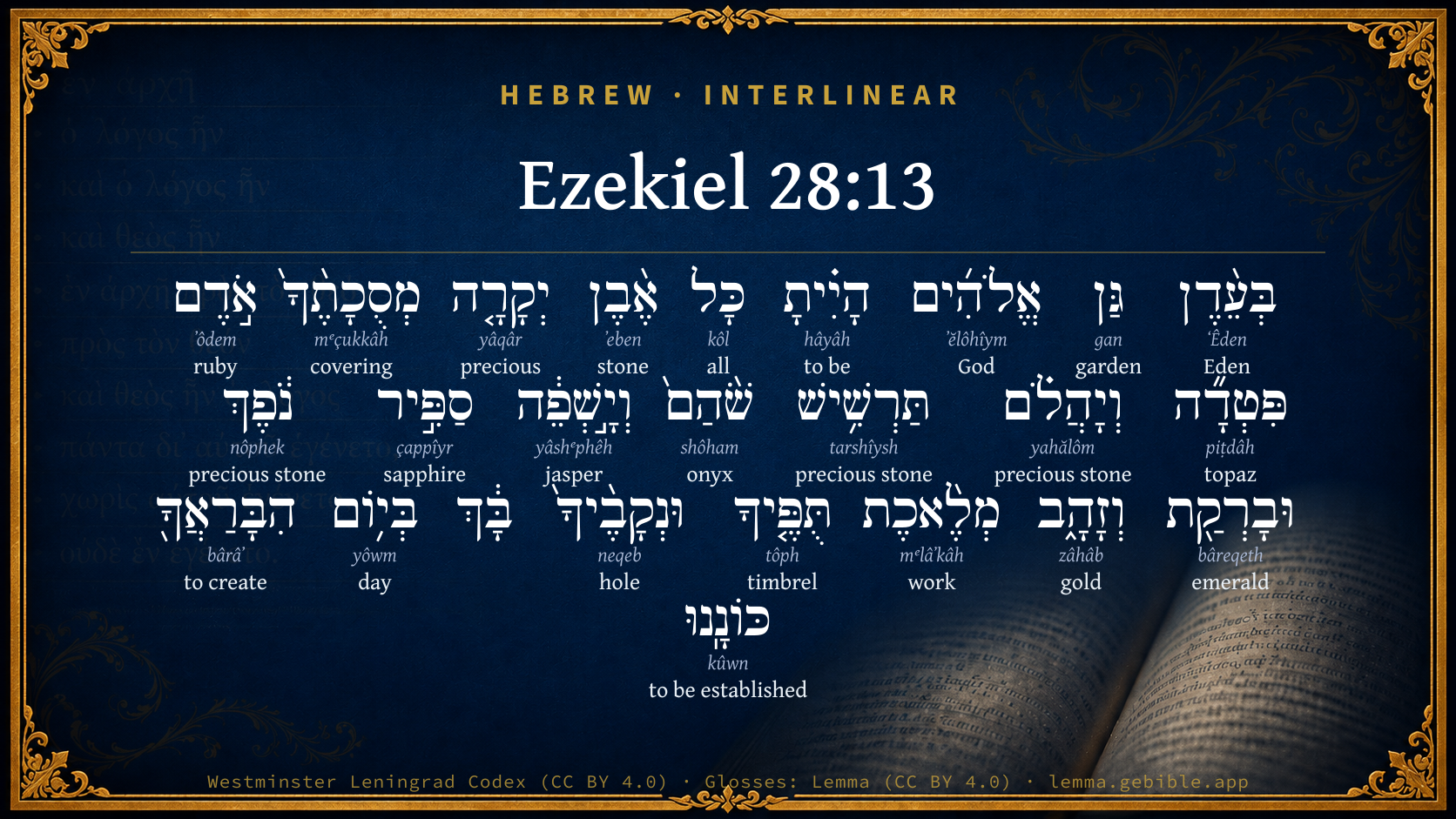
Ezekiel 28:13

Hebrew (Westminster Leningrad Codex) Ezekiel 28:13 appears in the Hebrew Old Testament. The text above is from the Westminster Leningrad Codex. Each word links to its Strong’s number, a concise gloss, and parsing drawn from the Open Scriptures Hebrew Bible morphology. Click any word for its full Brown-Driver-Briggs (BDB) entry.
Download image
Cite this verse

Ezekiel 28:13 (World English Bible). Public Domain. Lemma interlinear Bible study tool, https://lemma.gebible.app/v/ezekiel/28/13.

Show BibTeX & RIS
BibTeX
RIS
English Translation
You were in Eden, the garden of God; every precious stone adorned you: ruby, topaz, emerald, chrysolite, onx, jasper, sapphire, turquoise, and beryl. Gold work of tambourines and of pipes was in you. In the day that you were created they were prepared.
World English Bible · Public Domain
Highlights
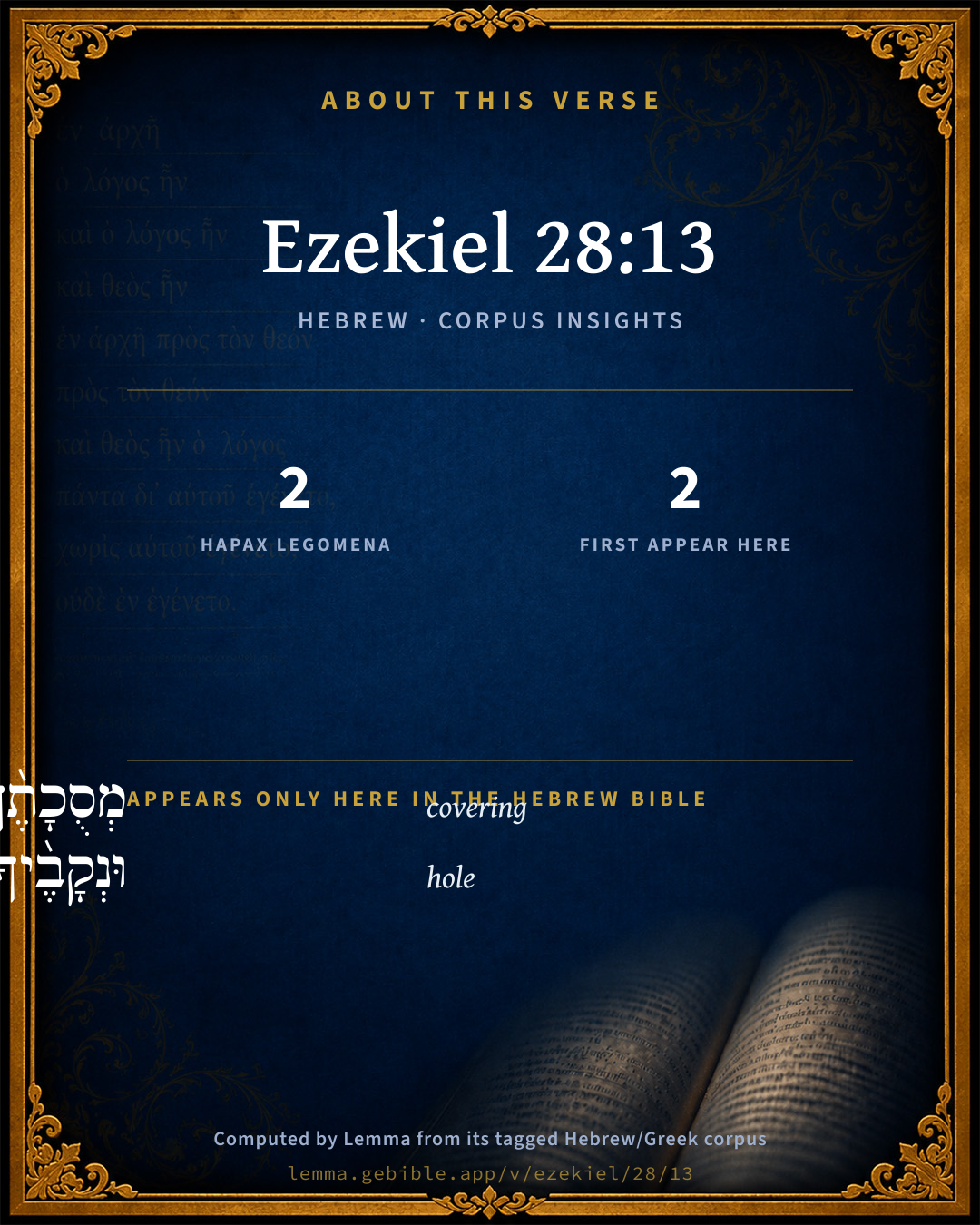
  • 2 hapax legomena — only here in the Hebrew Bible
  • 2 first appearances in the Hebrew Bible
Full analysis ↓
Download a study sheet

One document with this verse’s original text, its word-by-word gloss line, the meaning frame, cross-references with their text, attributed commentary, and full source and license credits — printable, and it pastes into notes with its structure intact.

This verse Autodidact and up

Study sheet (.html) Plain text (.txt)

A passage Seminary Student

Up to 50 verses in one chapter. A passage sheet keeps up to 6 commentary sources and 12 cross-references per verse, in the order this page ranks them, and says so on the sheet whenever that leaves anything out. Ask for a single verse and you get the Autodidact verse sheet above.

Everything on this page stays free to read, with no account — the sheet is a download of what is already on screen, not access to it.

Want to remove ads? Support Godless Engineer
Compare translations 3

The same verse in 3 English versions, stacked beneath the original-language interlinear above. Click any original word for its lexicon entry.

Each is an independent rendering of the whole verse — the interlinear is not word-aligned to these translations.

Highlighted words mark where these versions differ — a whole-verse word diff, not a word-by-word alignment.

  • World English Bible Public Domain
    You were in Eden, the garden of God; every precious stone adorned you: ruby, topaz, emerald, chrysolite, onx, jasper, sapphire, turquoise, and beryl. Gold work of tambourines and of pipes was in you. In the day that you were created they were prepared.
  • King James Version Public Domain
    Thou hast been in Eden the garden of God; every precious stone was thy covering, the sardius, topaz, and the diamond, the beryl, the onyx, and the jasper, the sapphire, the emerald, and the carbuncle, and gold: the workmanship of thy tabrets and of thy pipes was prepared in thee in the day that thou wast created.
  • unfoldingWord Literal Text CC BY-SA 4.0
    You were in Eden, the garden of God. Every precious stone covered you: ruby, topaz, emerald, chrysolite, onyx, jasper, sapphire, turquoise, and beryl. Your settings and mountings were made from gold. It was on the day you were created that they were prepared.

unfoldingWord Literal Text — © unfoldingWord, licensed CC BY-SA 4.0. Word-aligned USFM3 via Door43 (git.door43.org/unfoldingWord/en_ult).

Versions to compare (up to 4)

3 of 4 selected

Show all 18 translations

Every available English version of this verse, each an independent rendering of the whole verse.

  • World English Bible Public Domain
    You were in Eden, the garden of God; every precious stone adorned you: ruby, topaz, emerald, chrysolite, onx, jasper, sapphire, turquoise, and beryl. Gold work of tambourines and of pipes was in you. In the day that you were created they were prepared.
  • Berean Standard Bible Public Domain
    You were in Eden, the garden of God. Every kind of precious stone adorned you: ruby, topaz, and diamond, beryl, onyx, and jasper, sapphire, turquoise, and emerald. Your mountings and settings were crafted in gold, prepared on the day of your creation.
  • Majority Standard Bible Public Domain
    You were in Eden, the garden of God. Every kind of precious stone adorned you: ruby, topaz, and diamond, beryl, onyx, and jasper, sapphire, turquoise, and emerald. Your mountings and settings were crafted in gold, prepared on the day of your creation.
  • King James Version Public Domain
    Thou hast been in Eden the garden of God; every precious stone was thy covering, the sardius, topaz, and the diamond, the beryl, the onyx, and the jasper, the sapphire, the emerald, and the carbuncle, and gold: the workmanship of thy tabrets and of thy pipes was prepared in thee in the day that thou wast created.
  • American Standard Version (1901) Public Domain
    Thou wast in Eden, the garden of God; every precious stone was thy covering, the sardius, the topaz, and the diamond, the beryl, the onyx, and the jasper, the sapphire, the emerald, and the carbuncle, and gold: the workmanship of thy tabrets and of thy pipes was in thee; in the day that thou wast created they were prepared.
  • Revised Version (1885) Public Domain
    Thou wast in Eden the garden of God; every precious stone was thy covering, the sardius, the topaz, and the diamond, the beryl, the onyx, and the jasper, the sapphire, the emerald, and the carbuncle, and gold: the workmanship of thy tabrets and of thy pipes was in thee; in the day that thou wast created they were prepared.
  • Geneva Bible (1599) Public Domain
    Thou hast ben in Eden the garden of God: euery precious stone was in thy garment, the rubie, the topaze and the diamonde, the chrysolite, the onix, and the iasper, the saphir, emeraude, and the carbuncle and golde: the woorkemanship of thy timbrels, and of thy pipes was prepared in thee in the day that thou wast created.
  • Douay-Rheims (1899) Public Domain
    Thou wast in the pleasures of the paradise of God: every precious stone teas thy covering: the sardius, the topaz, and the jasper, the chrysolite, and the onyx, and the beryl, the sapphire, and the carbuncle, and the emerald: gold the work of thy beauty: and thy pipes were prepared in the day that thou wast created.
  • Young's Literal Translation Public Domain
    In Eden, the garden of God, thou hast been, Every precious stone thy covering, Ruby, topaz, and diamond, beryl, onyx, and jasper, Sapphire, emerald, and carbuncle, and gold, The workmanship of thy tabrets, and of thy pipes, In thee in the day of thy being produced, have been prepared.
  • Literal Standard Version CC BY-SA 4.0
    You have been in Eden, the garden of God, || Every precious stone [was] your covering, || Ruby, topaz, and diamond, beryl, onyx, and jasper, || Sapphire, emerald, and carbuncle, and gold, || The workmanship of your tambourines and of your pipes, || In you in the day of your being produced, have been created;
  • Unlocked Literal Bible CC BY-SA 4.0
    You were in Eden, the garden of God. Every precious stone covered you: ruby, topaz, emerald, chrysolite, onyx, jasper, sapphire, turquoise, and beryl. Your settings and mountings were made from gold. It was on the day you were created that they were prepared.
  • unfoldingWord Literal Text CC BY-SA 4.0
    You were in Eden, the garden of God. Every precious stone covered you: ruby, topaz, emerald, chrysolite, onyx, jasper, sapphire, turquoise, and beryl. Your settings and mountings were made from gold. It was on the day you were created that they were prepared.
  • Darby Bible Public Domain
    thou wast in Eden, the garden of God. Every precious stone was thy covering: the sardius, the topaz, and the diamond, the chrysolite, the onyx, and the jasper, the sapphire, the carbuncle, and the emerald, and gold. The workmanship of thy tambours and of thy pipes was in thee: in the day that thou wast created were they prepared.
  • World Messianic Bible Public Domain
    You were in Eden, the garden of God. Every precious stone adorned you: ruby, topaz, emerald, chrysolite, onyx, jasper, sapphire, turquoise, and beryl. Gold work of tambourines and of pipes was in you. They were prepared in the day that you were created.
  • Webster's Bible Public Domain
    Thou hast been in Eden the garden of God; every precious stone was thy covering, the sardius, topaz, and the diamond, the beryl, the onyx, and the jasper, the sapphire, the emerald, and the carbuncle, and gold: the workmanship of thy tabrets and of thy pipes was prepared in thee in the day that thou wast created.
  • Free Bible Version CC BY-SA 4.0
    You were there in Eden, God's garden. You wore all kinds of precious stones: carnelian, topaz, and amethyst; beryl, onyx, and jasper; lapis lazuli, turquoise, and emerald. They were placed in gold mountings and settings using skilled craftsmanship, and were made on the day when you were created.
  • Bible in Basic English Public Domain
    You were in Eden, the garden of God; every stone of great price was your clothing, the sardius, the topaz, and the diamond, the beryl, the onyx, and the jasper, the emerald and the carbuncle: your store-houses were full of gold, and things of great price were in you; in the day when you were made they were got ready.
  • JPS Tanakh (1917) Public Domain
    thou wast in Eden the garden of God; every precious stone was thy covering, the carnelian, the topaz, and the emerald, the beryl, the onyx, and the jasper, the sapphire, the carbuncle, and the smaragd, and gold; the workmanship of thy settings and of thy sockets was in thee, in the day that thou wast created they were prepared.

Literal Standard Version (2020), Covenant Press — licensed CC BY-SA 4.0. Text via the HelloAO Bible API (eBible.org). Unlocked Literal Bible (unfoldingWord) — licensed CC BY-SA 4.0. Text via the HelloAO Bible API (eBible.org). unfoldingWord Literal Text — © unfoldingWord, licensed CC BY-SA 4.0. Word-aligned USFM3 via Door43 (git.door43.org/unfoldingWord/en_ult). Free Bible Version, Dr. Jonathan Gallagher — licensed CC BY-SA 4.0. Text via the HelloAO Bible API (eBible.org).

Word by word

More ways to search: Search by grammar → Find every occurrence → Compare this word →

Practice this passage: Drill this verse → Learn its vocabulary →

מְסֻכָתֶ֨ךָ֙
mᵉçukkâh
H4540
“covering · your”
Noun, Common, Feminine, Singular, Construct + Suffix, Personal, 2nd Person, Masculine, Singular
Part of Speech
Noun
Type
Common
Gender
Feminine
Number
Singular
State
Construct
Full BDB Definition

Origin: a covering, i.e. garniture

TWOT: 1492a

covering
  1. בְּעֵ֨דֶן ʻÊden H5731 “in/at · Eden” Preposition + Noun, Proper
  2. גַּן gan H1588 “garden of” Noun, Common, Both, Singular, Construct
  3. אֱלֹהִ֜ים ʼĕlôhîym H430 “God(s)” Noun, Common, Masculine, Plural, Absolute
  4. הָיִ֗יתָ hâyâh H1961 “to be” Verb, Qal, Perfect, 2nd Person, Masculine, Singular
  5. כָּל kôl H3605 “all of” Noun, Common, Masculine, Singular, Construct
  6. אֶ֨בֶן ʼeben H68 “stone” Noun, Common, Feminine, Singular, Absolute
  7. יְקָרָ֤ה yâqâr H3368 “precious” Adjective, Adjective, Feminine, Singular, Absolute
  8. אֹ֣דֶם ʼôdem H124 “ruby” Noun, Common, Masculine, Singular, Absolute
  9. פִּטְדָ֞ה piṭdâh H6357 “topaz” Noun, Common, Feminine, Singular, Absolute
  10. וְיָהֲלֹ֗ם yahălôm H3095 “and · precious stone” Conjunction + Noun, Common, Masculine, Singular, Absolute
  11. תַּרְשִׁ֥ישׁ tarshîysh H8658 “precious stone” Noun, Common, Masculine, Singular, Absolute
  12. שֹׁ֨הַם֙ shôham H7718 “onyx” Noun, Common, Masculine, Singular, Absolute
  13. וְיָ֣שְׁפֵ֔ה yâshᵉphêh H3471 “and · jasper” Conjunction + Noun, Common, Masculine, Singular, Absolute
  14. סַפִּ֣יר çappîyr H5601 “sapphire” Noun, Common, Masculine, Singular, Absolute
  15. נֹ֔פֶךְ nôphek H5306 “precious stone” Noun, Common, Masculine, Singular, Absolute
  16. וּבָרְקַ֖ת bâreqeth H1304 “and · emerald” Conjunction + Noun, Common, Feminine, Singular, Absolute
  17. וְזָהָ֑ב zâhâb H2091 “and · gold” Conjunction + Noun, Common, Masculine, Singular, Absolute
  18. מְלֶ֨אכֶת mᵉlâʼkâh H4399 “work of” Noun, Common, Feminine, Singular, Construct
  19. תֻּפֶּ֤יךָ tôph H8596 “timbrels · your” Noun, Common, Masculine, Plural, Construct + Suffix, Personal, 2nd Person, Masculine, Singular
  20. וּנְקָבֶ֨יךָ֙ neqeb H5345 “and · holes · your” Conjunction + Noun, Common, Masculine, Plural, Construct + Suffix, Personal, 2nd Person, Masculine, Singular
  21. בְּי֥וֹם yôwm H3117 “in/at · day of” Preposition + Noun, Common, Masculine, Singular, Construct
  22. הִבָּרַאֲךָ֖ bârâʼ H1254 “to create · you” Verb, Niphal, Infinitive Construct + Suffix, Personal, 2nd Person, Masculine, Singular
  23. כּוֹנָֽנוּ kûwn H3559 “to be established” Verb, Polal, Perfect, 3rd Person, Common, Plural

About this verse

These counts appear in no published source. They are computed here, from the morphology-tagged text and Lemma’s own curated glosses. What Lemma adds →

25
words
24
distinct lemmas
Prophets
section

Notable vocabulary

2 hapax legomena — words that appear only here in the entire Hebrew Bible:

  • מְסֻכָתֶ֨ךָ֙ covering H4540
  • וּנְקָבֶ֨יךָ֙ hole H5345

First appearance in Scripture

These words make their first canonical appearance in the Hebrew Bible here:

  • מְסֻכָתֶ֨ךָ֙ covering H4540
  • וּנְקָבֶ֨יךָ֙ hole H5345

Shared distinctive vocabulary

אֹ֣דֶם ruby H124 occurs in 3 verses of the Hebrew Bible. Also found in:

Grammatical profile

  • 3 verbs
  • 20 nouns
  • 1 adjective
  • 1 preposition

Verb forms

  • הָיִ֗יתָ Qal · Perfect
  • הִבָּרַאֲךָ֖ Niphal · Infinitive Construct
  • כּוֹנָֽנוּ Polal · Perfect

Hebrew & Septuagint length

In English translation the verse runs 43 words from the Hebrew and 59 from the Septuagint (LXX English) — closely comparable.

A rough comparison of the two English renderings, which tokenize alike — not a word-level alignment.

Word counts can differ between the Hebrew and the Greek without any difference in meaning — e.g. the Hebrew direct-object marker אֵת has no separate Greek word, and Greek often adds the article ὁ.

Cross-references

21

Topical passages linked to Ezekiel 28:13 in the Treasury of Scripture Knowledge — connected by theme and wording, ordered by reader-vote popularity; previews shown in the World English Bible.

  • Ezekiel 28:15 You were perfect in your ways from the day that you were created, until unrighteousness was found in you.
  • Genesis 2:8 Yahweh God planted a garden eastward, in Eden, and there he put the man whom he had formed.
  • Ezekiel 27:16 Syria was your merchant by reason of the multitude of your handiworks: they traded for your wares with emeralds, purple, and embroidered work, and fine linen, and coral, and rubies.
  • Isaiah 54:11–12 you afflicted, tossed with tempest, and not comforted, behold, I will set your stones in beautiful colors, and lay your foundations with sapphires.
  • Isaiah 51:3 For Yahweh has comforted Zion; he has comforted all her waste places, and has made her wilderness like Eden, and her desert like the garden of Yahweh; joy and gladness shall be found therein, thanksgiving, and the voice of melody.
  • Genesis 2:11–12 The name of the first is Pishon: this is the one which flows through the whole land of Havilah, where there is gold;
  • Genesis 3:23–24 Therefore Yahweh God sent him forth from the garden of Eden, to till the ground from whence he was taken.
  • Exodus 28:17–20 You shall set in it settings of stones, four rows of stones: a row of ruby, topaz, and beryl shall be the first row;
  • Exodus 39:10–21 They set in it four rows of stones. A row of ruby, topaz, and beryl was the first row;
  • Isaiah 14:11 Your pomp is brought down to Sheol, [and] the noise of your viols: the worm is spread under you, and worms cover you.
  • Isaiah 23:16 Take a harp, go about the city, you prostitute that has been forgotten; make sweet melody, sing many songs, that you may be remembered.
  • Isaiah 30:32 Every stroke of the appointed staff, which Yahweh shall lay on him, shall be with [the sound of] tambourines and harps; and in battles with the brandishing [of his arm] will he fight with them.
  • Ezekiel 31:8–9 The cedars in the garden of God could not hide it; the fir trees were not like its boughs, and the plane trees were not as its branches; nor was any tree in the garden of God like it in its beauty.
  • Ezekiel 36:35 They shall say, This land that was desolate is become like the garden of Eden; and the waste and desolate and ruined cities are fortified and inhabited.
  • Revelation 21:19–20 The foundations of the city's wall were adorned with all kinds of precious stones. The first foundation was jasper; the second, sapphire; the third, chalcedony; the fourth, emerald;
  • Genesis 13:10 Lot lifted up his eyes, and saw all the plain of the Jordan, that it was well watered every where, before Yahweh destroyed Sodom and Gomorrah, like the garden of Yahweh, like the land of Egypt, as you go to Zoar.
  • Ezekiel 21:30 Cause it to return into its sheath. In the place where you were created, in the land of your birth, will I judge you.
  • Ezekiel 26:13 I will cause the noise of your songs to cease; and the sound of your harps shall be no more heard.
  • Ezekiel 27:22 The traffickers of Sheba and Raamah, they were your traffickers; they traded for your wares with the chief of all spices, and with all precious stones, and gold.
  • Revelation 2:7 He who has an ear, let him hear what the Spirit says to the assemblies. To him who overcomes I will give to eat of the tree of life, which is in the Paradise of my God.
  • Revelation 17:4 The woman was dressed in purple and scarlet, and decked with gold and precious stones and pearls, having in her hand a golden cup full of abominations and the impurities of the sexual immorality of the earth.

Cross-references courtesy of OpenBible.info (CC BY 4.0).

Hebrew and Greek witnesses Masoretic Hebrew ↔ Greek Septuagint

The same verse in the two great witnesses to the Old Testament, shown verse-for-verse.

These are two independent witnesses, not word-aligned to each other, and the Septuagint is shown in lemma (dictionary) form.

Hebrew Ezekiel 28:13 Masoretic · Westminster Leningrad Codex

בְּעֵ֨דֶן גַּן אֱלֹהִ֜ים הָיִ֗יתָ כָּל אֶ֨בֶן יְקָרָ֤ה מְסֻכָתֶ֨ךָ֙ אֹ֣דֶם פִּטְדָ֞ה וְיָהֲלֹ֗ם תַּרְשִׁ֥ישׁ שֹׁ֨הַם֙ וְיָ֣שְׁפֵ֔ה סַפִּ֣יר נֹ֔פֶךְ וּבָרְקַ֖ת וְזָהָ֑ב מְלֶ֨אכֶת תֻּפֶּ֤יךָ וּנְקָבֶ֨יךָ֙ בָּ֔ךְ בְּי֥וֹם הִבָּרַאֲךָ֖ כּוֹנָֽנוּ

You were in Eden, the garden of God; every precious stone adorned you: ruby, topaz, emerald, chrysolite, onx, jasper, sapphire, turquoise, and beryl. Gold work of tambourines and of pipes was in you. In the day that you were created they were prepared.

World English Bible · Public Domain

Greek LXX Ezekiel 28:13 Septuagint · lemma form

ἐν ὁ τρυφή ὁ παράδεισος ὁ θεός γίγνομαι πᾶς λίθος χρηστός ἐνδέω σάρδιον καί τοπάζιον καί σμάραγδος καί ἄνθραξ καί σάπφειρος καί ἴασπις καί ἀργύριον καί χρυσίον καί λιγύριον καί ἀχάτης καί ἀμέθυστος καί χρυσόλιθος καί βηρύλλιον καί ὀνύχιον καί χρυσίον ἐνπίμπλημι ὁ θησαυρός σύ καί ὁ ἀποθήκη σύ ἐν σύ ἀπό ὅς ἡμέρα κτίζω σύ

You were in the delight of the paradise of God; you have bound upon you every precious stone, the sardius, and topaz, and emerald, and carbuncle, and sapphire, and jasper, and silver, and gold, and ligure, and agate, and amethyst, and chrysolite, and beryl, and onyx: and you have filled your treasures and your stores in you with gold.

LXX2012 (modern English Septuagint) · Public Domain

On this verse, Jamieson, Fausset & Brown discusses the Septuagint’s reading. Read the note in Commentary ↓

Hebrew: Westminster Leningrad Codex (CC BY 4.0). Greek: Septuagint (public domain); English from LXX2012 (modern English Septuagint) (Public Domain). How the Septuagint differs from the Hebrew →

Targum (Aramaic paraphrase)

1

The Targum is the ancient Jewish Aramaic paraphrase of the Hebrew Scriptures — an interpretive translation, not the Hebrew text itself. Onkelos (literal) and Pseudo-Jonathan (expansive) render the Torah, and Jonathan the Prophets. Coverage is partial: where no permissively-licensed English translation exists for a verse, only the Aramaic is shown. This is verse-level text, not a word-by-word alignment to the Hebrew.

  1. Targum Jonathan Prophets (Joshua–Malachi)
    בִּסְגִי טָבְוָן וְתַפְנוּקִין אַתְּ מִתְפְּנַק כְּאִילוּ בְּעֵדֶן גִנְתָא דַייָ אַתְּ שָׁרַי כָּל עֻתְרָא גֵיוְתָא וִיקָרָא מִתְיַהַב לָךְ כָּל אַבְנִין טָבִין מְסַרְדָן עַל לְבוּשָׁךְ סַמְקָן יַרְקָן וְסִבְהֲלוֹם כְּרוּם יַמָא וּבוּרְלָא וּפַנְתֵּירִין שִׁבְזֵיז אִזְמַררְגְדִין וּבַרְקָן מְשַׁקְעִן בִּדְהַב כָּל אִלֵין עֲבִידַת תִּקוּנְךְ בְּכֵן רָאֵים לִבָּךְ בְּרַם לָא אִסְתַּכַּלְתְּ בְּפִגְרָךְ דְאִתְעֲבִיד חֲלָלִין וּנְקָבִין דְאִינוּן צוֹרְכָן דְלָא אֶפְשַׁר לָךְ דְתִתְקַיֵים בְּלָא בְּהוֹן מִיוֹמָא דְאִתְבְּרֵיתָא עִמָךְ מְתַקְנִין:

    (no public-domain English translation for this verse)

    Targum Jonathan — Aramaic: “Mikraot Gedolot” (public domain). English: “Sefaria Community Translation” (CC0 1.0 (public-domain dedication)); “London "Chaldee Paraphrase," 1871” (public domain). Text via Sefaria.

Commentary

Notes on Ezekiel 28:13 from classic Christian and Jewish commentators (each source and its license shown beneath its notes). The classic Christian expositions comment on the surrounding passage and are grouped to its opening verse, so a note may address several verses; the Jewish commentaries on the Tanakh (Rashi and others) are per-verse, so they appear only where the commentator wrote on this verse.

Lemma curates 59 commentaries, every one of them public domain or Creative Commons licensed, each selected and text-cleaned for this edition rather than reprinted as found. About our sources →

Trapp's Complete Commentary

John Trapp

Eze 28:13 Thou hast been in Eden the garden of God; every precious stone [was] thy covering, the sardius, topaz, and the diamond, the beryl, the onyx, and the jasper, the sapphire, the emerald, and the carbuncle, and gold: the workmanship of thy tabrets and of thy pipes was prepared in thee in the day that thou wast created.

Ver. 13. Thou hast been in Eden.] As a bird of paradise, or as a tree growing there - {a}

“γαγενημενον εκ Dιος ερνος.” - Hom.

Thou art equal to Adam in the state of innocence; and thy Tyre is no whit inferior to the garden of God.

“ Flores in pratis fragrant, et purpura campis:

Gemma coloratis fulget speciosa lapillis. ”

Every precious stone was thy covering.] Not thy diadem only was decked with them, as the Pope’s triple crown is at this day with gems of greatest value, but thy royal robe - not inferior, haply, to that of Demetrius, king of Macedonia, which none of his successors would wear propter invidiosam impendii magnificentiam, it was so extreme stately and costly - yea, thy pantofies possibly, as Dioclesian’s the emperor holding forth his feet to be kissed, as doth also the Pope at this day, who hath the cross in precious stones set upon his pantofle, to the great reproach of Christianity.

The sardius, topaz, and the diamond.] Nine of those rich stones that were set in the high priest’s rationale or breastplate. See on Eze 28:2.

The workmanship of thy tabrets.] At thy birth, and at thine inauguration, there was great mirth made, concrepantibus tympanis, tibiis et tubis. What a deal of joy and jollity was there lately expressed in many places for the birth of the prince of Spain.

{a} φυτον ουρανιον. - Plato.

John Trapp, A Commentary or Exposition upon All the Books of the Old and New Testament (1647–1656) — public domain. Text from a community e-Sword module.

The Biblical Illustrator

Joseph S. Exell

Eze_28:13-14

Thou hast been in Eden, the garden of God.

In the garden of God

1. History, it is clear, may be written as poetry; and that, too, without any evaporation of its facts. Ezekiels figure gives us the essential spirit of a great age. We see its successes; we feel its pride; we thrill with its joys. Thou hast exploited life--thou hast had days of heaven upon the earth--thou hast been in the garden of God. What testimony this is to Gods long-suffering! Tyre did not want Him, though He wanted Tyre. There was no reciprocity; Tyre sang and revelled along its wealthy way, and would not so much as lift its eyes to Heaven, where God sorrowed. She revolted from the pure deep heavens, and vilely dug her gods out of, the hillsides. To have clipped her wings, to have pruned her glories down to lifes bare necessities would have seemed the kindliest discipline. Instead, God gives ages of blandishments for ages of contempt. Till the hour of doom comes.

2. It is not impossible to write much modern history in the same brilliant, revelatory style. The Englishman is as the Tyrian. Life in the cities of our empire is full, splendid with colour, seething with joys. We have been, and are, in Eden. We have had our griefs, but he is a bold man who denies our delights. We have been born amid roses, reared amid songs, and there are hours when we are drunken with the rapture of living.

Life is a golden cup; God filled it.

3. He who saunters up through the leafy ways of the Sydenham Palace will come at length to a commanding terrace where, upon its lofty pedestal, rises the bold head of Sir Joseph Paxton. The fruit of Paxtons genius stretches around him. His ideal was captivating--a palace of light in a paradise of flowers. And now from his high place he looks out upon his gift to his fellows. He looks upon the rosaries, with their crimson and pink buds; upon lawns and bowers; upon fountains and statuary; upon spreading cedars and majestic oaks; upon sunny glades and shady ways, where the white petals of the syringa drop gently to the grass and the mavis sings from the thorn. With garlanded brow the worker stands in the midst of his work, the creator at the heart of his creation. God, the Bountiful One, has given us Eden; have we found a place for Him in the garden? What, then, is Gods place in mans Eden? Beware lest thine heart be lifted up, and thou catch the trick of the Tyrians, and imagine thyself in the seat of God, It is true, thou art the anointed cherub. In the eyes of inert thou shinest like a visitant from heaven. Thou dwellest amid stones of fire, amid stones that flame with rainbow lights. Thou hast made a robe for thyself of diamonds and gold. Burma and Brazil and Kimberley are upon thy gleaming arms and throat. Thou hast mastered the art of amazing by display. The highways of the earth are full of the stir and noise of those who travel to see thy splendours. There is dazzling of eyes and aching of heart when they behold thee. In good sooth, thou art the anointed cherub. Well for thee if thou art content in thy cherubic beauty to lay thy heart low before the Giver of every good and perfect gift, for He hath set thee so.

Him that glorieth, let him glory in the Lord.

4. Let us live up to our Eden. He who lives in the garden of God should have the paradise spirit. Hear St. Paul: Walk worthy of God, who hath called you to His Kingdom and glory. A keen observer has told us of the splendid landscape gardening that encircles many a country mansion; he tells us how the lobelia and the verbena and the peony blow, how the thrushes whistle in the trees and feed upon the lawns, and how, from under a covert of blue and scarlet blossoms, the stoat will spring upon the birds. Savage beast and lovely flowers in one bed! This is a parable of human life. The goodness of God makes a paradise about us. Broad spaces are rich with bloom and beauty. And there, amid the flowers His love has planted, crouch human passions. How few are touched by the shocking antithesis. Rodway says that in Guiana he has often scared centipedes and tarantulas that were hiding in the thick of rare and gorgeous orchids. It is to be feared that the underworld in the garden of God is often far from attractive. God gives grace; we supply sin. The one thing needed to perfect our Eden is that Christ should cleanse our hearts and fill them with the light of His love. And if we would live up to our Eden, let us note and live by the true purpose of the paradise. God giveth us all things richly to enjoy. The worlds honest laughter does not bore nor offend Him. He reckons it among His pleasures; it goes with the ripple of the tide, the music of the spheres, and the angels song. He who makes Eden about us can hardly object to our delighting in it. Yet let us remember what we are Let us not discard our intelligence. Who does not know that joy is not for enjoyments sake only? Enjoyment is for refreshing, and refreshing is for service. The hour you elect to live only for the pleasures of Eden, that hour the light of your paradise begins to fade. Lastly, let none but Christ enlarge your fair garden. The devil is forever seeking to draw you out to new ground. He is forever saying he will extend your Eden. Be careful that you annex nothing at his suggestion. Pick no flower he praises. He is a liar from the beginning. He covers his foul meaning with fair advertisements. His object is not delectation, but death. Scorn satanic paradises. Grant Allen says there are some flowers that smell like raw meat, that they may attract blue-bottles. The devils garden is prepared for flesh flies. Keep a critical eye on your gratifications. (James Dunk.)

The Biblical Illustrator, edited by Joseph S. Exell (c. 1880s–1900s) — public domain. Text from a community e-Sword module.

Tyndale Open Study Notes

Tyndale Open Resources

28:13-14 Mocking Tyre’s claim to antiquity and preeminence, Ezekiel describes its king as being present in Eden at the beginning of the world, as the mighty angelic guardian—that is, as one of the heavenly beings that carried the Lord’s throne in ch 1 and guarded the garden in Gen 3. There in Eden, he had access to the holy mountain of God (mountains are often associated with God’s presence in the Bible). • The stones of fire may be an obscure reference to a hedge of sparkling gemstones around the Garden of Eden. The list of jewels that the prince of Tyre supposedly wore in his original glory adds to this image of his divine election since it includes nine of the twelve jewels found on the high priest’s breastplate in Exod 28. This description satirizes the prince of Tyre’s claim to an even higher place than Adam’s—a place among the divine beings themselves.

Tyndale Open Study Notes — © Tyndale Open Resources, licensed CC BY-SA 4.0. Text via the HelloAO Bible API.

Geneva Bible (1599)

Geneva Bible translators

Or, carbuncle.

Or, jasper.

Geneva Bible (1599) marginal notes — public domain. Text via Bolls.life.

Jamieson, Fausset & Brown

Robert Jamieson, A. R. Fausset & David Brown

in Eden--The king of Tyre is represented in his former high state (contrasted with his subsequent downfall), under images drawn from the primeval man in Eden, the type of humanity in its most Godlike form.

garden of God--the model of ideal loveliness (Eze 31:8-9; Eze 36:35). In the person of the king of Tyre a new trial was made of humanity with the greatest earthly advantages. But as in the case of Adam, the good gifts of God were only turned into ministers to pride and self.

every precious stone--so in Eden (Gen 2:12), "gold, bdellium, and the onyx stone." So the king of Tyre was arrayed in jewel-bespangled robes after the fashion of Oriental monarchs. The nine precious stones here mentioned answer to nine of the twelve (representing the twelve tribes) in the high priest's breastplate (Exo 39:10-13; Rev 21:14, Rev 21:19-21). Of the four rows of three in each, the third is omitted in the Hebrew, but is supplied in the Septuagint. In this, too, there is an ulterior reference to Antichrist, who is blasphemously to arrogate the office of our divine High Priest (Zac 6:13).

tabrets--tambourines.

pipes--literally, "holes" in musical pipes or flutes.

created--that is, in the day of thine accession to the throne. Tambourines and all the marks of joy were ready prepared for thee ("in thee," that is, "with and for thee"). Thou hadst not, like others, to work thy way to the throne through arduous struggles. No sooner created than, like Adam, thou wast surrounded with the gratifications of Eden. FAIRBAIRN, for "pipes," translates, "females" (having reference to Gen 1:27), that is, musician-women. MAURER explains the Hebrew not as to music, but as to the setting and mounting of the gems previously mentioned.

Jamieson, Fausset & Brown — Commentary Critical and Explanatory on the Whole Bible (1871) — public domain (CC PDM 1.0). Text via the HelloAO Bible API.

Adam Clarke's Commentary

Verse 13. Thou hast been in Eden] This also is a strong irony. Thou art like Adam, when in his innocence and excellence he was in the garden of Eden!

Every precious stone was thy covering] For a description of these stones See Clarke on Ex 28:17.

Adam Clarke's Commentary on the Bible (1810–1826) — public domain. Text from a community e-Sword/MySword module.

Ellicott's Commentary for English Readers

(13) Every precious stone.—There is some uncertainty in regard to the names of some of these stones (as sardius may be carnelian, and beryl chrysolite), but the general fact is an allusion to the profuse use of precious stones as ornaments of their royal apparel by Oriental monarchs. The stones mentioned are the same with those in the breastplate of the high priest (Exo_39:10), the third row being omitted; this is supplied in the Greek.

Thy pipes.—The word occurs only here, and its most probable sense is females, those who played upon the tambourines. All these things did not need to be collected by the king of Tyre, but were ready prepared to his hand at the moment of his accession to the throne, just as everything was made ready for Adam in Eden.

A Bible Commentary for English Readers, edited by Charles John Ellicott (1878–1897) — public domain. Text from a community e-Sword module.

The Cambridge Bible for Schools and Colleges

gen. ed. J. J. S. Perowne

13. Thou host been] thou wast in Eden. The term rendered “covering” does not occur again. Possibly “emerald” and “carbuncle” should be transposed. These precious stones are mentioned in sets of three, being nine in number, to which LXX. adds three more, the ligure, the agate and the amethyst, as in the high-priest’s breastplate (Exo_28:19), while Syr. reduces the number to eight. Possibly the original number may have been very much smaller.

thy tabrets and of thy pipes] It is obvious that timbrels and pipes are out of place here. It is also probable that the preceding words and gold should be disjoined from the list of precious stones. Render: and of gold was the workmanship of thy sockets and grooves. Reference is unmistakeably to the setting of precious stones, and while possibly a person might be supposed to be covered or clothed with the jewels mentioned, the phrase “thy sockets” seems to recall the figure of the ring. The phrase “was prepared” is wanting in LXX. and the last words “in the day that thou wast created” should probably go to the next verse.

The Cambridge Bible for Schools and Colleges (gen. ed. J. J. S. Perowne; Cambridge University Press, 1878–1918) — public domain. Text from a community e-Sword module.

John Gill's Exposition

Thou hast been in Eden the garden of God,.... Not only in Eden, but in the garden which was in Eden, and was of the Lord's immediate planting; and therefore called the garden of God, as well as because of its excellency, fragrancy, and delight; not that the king of Tyre was literally there, or ever dwelt in it; but his situation in Tyre was as safe, and as pleasant and delightful, as Adam's was in the garden of Eden, at least in his own imagination. So the Targum,

"thou delightest thyself with plenty of all good things and delectable ones, as if thou dwellest in the garden of God;''

in the mystical sense, this designs the church of God, which is an Eden, a garden, a paradise; see Sol 4:12 and where antichrist first appeared, and took his seat, and seated himself as if he was God, Th2 2:4,

every precious stone was thy covering; not only the covering of his head, his crown, was decked with jewels and precious stones of all sorts; but his clothes, the covering of his body, were adorned with them. So the Targum,

"all precious stones were set in order upon thy garments.''

Kimchi renders it "thine hedge", or "fence" (o); and takes it to be an hyperbole, as if his house, or garden, or vineyard, were fenced with precious stones. This fitly describes the whore of Rome arrayed in purple and scarlet colour, and decked with gold and precious stones, Rev 17:4. The pope's triple crown is stuck with them, and a cross of precious stones is upon his slipper, when he holds out his toe to be kissed:

the sardius, topaz, and the diamond, the beryl, the onyx, and the jasper, the sapphire, the emerald, and the carbuncle, and gold. Writers differ very much about these stones; and it is difficult to say what answer to the Hebrew words here used. The stone "sardius", or the sardine stone, is of a blood colour, commonly called a cornelian, and is found in Sardis and Sardinia, from whence some say it has its name. The "topaz" is a hard transparent stone, said to be of a beautiful yellow or gold colour by those who confound it with the chrysolite; otherwise the true topaz is of a fine green colour, as Pliny (p) and Isidore (q); the best is what is found in Ethopia, Job 28:19. The "diamond" is a precious stone, the first in rank, value, hardness and lustre; the most perfect colour is the white. The "beryl" is a stone of a pale green colour, thought to be the diamond of the ancients: the word is "tarshish", and thought by some the "chrysolite". The "onyx" resembles a man's nail, from whence it has its name: the word "shoham" here used is supposed to mean the "sardonyx", a compound of the "sardian" and "onyx" stones. The "jasper" is a stone of various colours and spots, variegated like a panther; hence the Targum here renders it "pantherin"; the most valuable is the green spotted with red or purple. The "sapphire" is a stone of an azure colour or sky blue, exceeding hard and transparent. The "emerald" is of an exceeding fine green colour, very bright, and clear, and delightful to the eye; but is rather intended by the next word, as the "carbuncle" by this, which is a stone of the ruby kind, and very rare; see Isa 54:12. "Gold" is mentioned along with them, and last of all, as being less valuable; but chiefly because these stones were set in gold, as the Targum paraphrases it; these are nine of the stones which were in the breastplate of the Jewish high priest (r), whom the king of Tyre might have knowledge of and imitate, as it is certain the pope of Rome does in some things:

the workmanship of thy tabrets and of thy pipes was prepared in thee in the day that thou wast created; either born into the world; or made a crowned king; against which time, drums, and pipes, and such like instruments of music, were prepared in Tyre, and at them made use of by way of rejoicing: and as this was literally true of the king of Tyre at his coronation, so of the bishop of Rome at his creation and inauguration, which is attended with bells ringing, drums beating, trumpets sounding; and so in mystical Babylon is heard, though the time is coming when it will not be heard, the voice of harpers, musicians, pipers, and trumpeters, Rev 18:22.

(o) So R. Sol. Urbin. Ohel Moed, fol. 14. 2. (p) Nat. Hist. l. 38. c. 8. (q) Origin. l. 16. c. 7. (r) Vid. Braunium de Vestitu Sacerdot. Heb. l. 2. c. 12-19.

John Gill's Exposition of the Whole Bible (1746–1763) — public domain (CC PDM 1.0). Text via the HelloAO Bible API.

Haydock's Catholic Bible Commentary

Paradise. Thou hadst every thing delightful at Tyre. (Calmet) --- Covering. Hebrew, "bandage;" diadem, (Haydock) or belt. Septuagint specify twelve stones. See Exodus xxviii. 17. --- Pipes; music used at the coronation, which was celebrated as a birth-day. (Calmet) --- God give and withdraws power from all kings. As long as they act well, they are a sort of sanctuary. (Haydock)

George Leo Haydock (1774–1849), Haydock's Catholic Family Bible and Commentary, 1859 edition — public domain. Excludes Psalms (Douay-Rheims chapter numbering differs from Protestant) and Deuterocanonical books (Catholic canon only).

Matthew Poole's English Annotations

Thou hast been; thou hast dwelt and reigned.

In Eden; in the midst of all delights; and though nature made thy lot a very barren rock, thy art and industry, added to that of thy progenitors, have made it as pleasant, rich, and beautiful as Eden, that place of all desirable enjoyments.

The garden of God: this is explicative of the former; a garden is a place of delight, and men have made some delightful to a wonder, but none ever like that God planted: this of Tyre came as near as any, and yet ungrateful and atheistical Tyre dreams of Divine power and stability, forgetting human frailty and uncertainty.

Every precious stone; every sort of rich stones.

Thy covering, bought to adorn thy crown, thy robes, thy bed, &c.

The sardius; of a red, and by some said to be the ruby.

Topaz; of a yellowish green.

The diamond; of clear, waterish, sparkling colour.

The beryl; of a sea-green colour, the best.

The onyx resembles the whiteness of the nail of a man’s hand.

The jasper; of divers colours, but the best green.

The sapphire; of sky colour, or blue.

The emerald; green interspersed with golden spots.

The carbuncle; of flame colour.

Gold; beside the abundance of which in their public treasures, much was used about the clothes and robes of this proud prince; it is like these precious stones were set in gold, that they might the safer be put upon his garments. This was the accoutrement of solemnities, especially of the coronation, as appears in the close of the verse.

The workmanship of thy tabrets, & c: now the prophet notes their joys, music and songs; both to wind or loud music, and to softer music, as the lute and tabret, in the day of their king’s coronation, and all this music on instruments of most exquisite make, and of their own artists’ work too; in this they exceeded as in the other.

Wast created; either born, for the birth of princes hath been celebrated with great joys; or rather in the day of this king’s coronation, or investiture in the kingdom and royal dignity.

Matthew Poole's English Annotations on the Holy Bible (1683–1685) — public domain. Text from a community e-Sword/MySword module.

Whedon's Commentary on the Bible

Daniel D. Whedon

13. The king of Tyre seems to dwell in a paradise equal to that in which Adam was placed, and to wear jewels equal to those upon the breast of the high priest (Exodus 28). Toy makes the list of precious stones as follows: “ruby, topaz, and jasper, tarshish stone, onyx, and beryl, sapphire, carbuncle, and emerald.”

Tabrets… pipes — Possibly, settings, ouches, referring to the good workmanship of the jewels mentioned above. Perrot and Chipiez think the word translated “tabrets” and “pipes” to be technical terms for the wheels (drums) on which the lapidaries polished their stones and the drills with which they pierced them. Many jewels finely cut have been discovered in Phoenicia, among these a sardonyx seal ring of Abibal, the father of Hiram, king of Tyre (Phoenicia and Cyprus, 1:231, 241). If the A. V. and R.V. are correct these are the jeweled musical instruments used at the king’s coronation in the day when he was created king (Eze_26:13; Isa_5:12; Dan_3:5).

Daniel D. Whedon (gen. ed.), Commentary on the Old and New Testaments (1874–1909) — public domain. Text from a community e-Sword module.

The Pulpit Commentary

Thou hast been in Eden, etc. The words are suggestive, as showing that Ezekiel was familiar with the history of Ge 2 and Ge 3. (compare the mention of Noah, in Eze_15:1-4) To him the King of Tyre seemed to claim a position like that of Adam before his fall, perfect in beauty and in wisdom, the lord of the creation. And in that fancied Eden he stood, so he thought, not like Adam, "naked and ashamed," but like one of the cherubim that guarded the gates of the primeval Paradise, (Gen_3:24) covered with all imaginable splendor. Ezekiel returns to the phrase Eze_31:8, Eze_31:16, 18 and Eze_36:35. Other instances meet us in Joe_2:3 and Isa_51:3. Every precious stone. All the stones named are found in the list of the gems on the high priest"s breastplate. (Exo_28:17-20 Exo_39:8-14) Three, however, of those gems are wanting those in the third row of the breastplate which are not named elsewhere; and the order is not the same. The LXX makes the two lists identical, apparently correcting Ezekiel by Exodus. St. John (Rev_21:19) reproduces his imagery in his vision of the foundation stones of the New Jerusalem, but naturally returns to the fullness of the symbolic number twelve. Possibly the description of gold and bdellium and onyx (or beryl), as in Gen_2:11, Gen_2:12, may have suggested the thought that Eden was a land of jewels. The workmanship of thy tabret and pipes; better, the service. The Authorized Version and Revised Version follow Luther. Keil agrees as to "tabret" (so Gen_31:27; Isa_5:12; elsewhere, as in Exo_15:20 and, Job_21:12, the Authorized Version gives "timbrels but takes the latter word (not found elsewhere) as identical with its feminine form, and meaning "female." He sees in the clause, accordingly, a picture of the pomp of the Tyrian king, surrounded by the odalisques of the harem, who, with their timbrels, danced to his honor as their lord and king (comp. Isa_23:16; Exo_15:20; 1Sa_18:6) Havernick, who agrees with Keil, calls attention to a passage in Athenaeus (12:8. p. 531), in which Strafe, a Sidonian king, is said to have prepared for a great festival by bringing girls who played on the flute and harp from all parts of Greece. Others, however (Smend), find in both the words articles of jewelry, pearls perforated or set in gold (as in Exo_28:20) and so see in them the conclusion of the description of the gorgeous apparel of the king. Furst takes the words as meaning musical instruments that were of gold set with jewels. Ewald, following out the Urim and Thummim idea, takes the gems as the subject of the sentence, and translates, "they were for the work of thine oracles and divining." On the whole, the interpretation given above seems preferable. In the day that thou wast created. The words point to the time of the king"s enthronement or coronation. It was then that he appeared in all his supreme magnificence. Had Ezekiel been a witness of that ceremony?

The Pulpit Commentary (1880–1919), ed. H.D.M. Spence-Jones & Joseph S. Exell — public domain. Text from a community e-Sword module.

John Wesley's Explanatory Notes

In Eden - In the midst of all delights. The workmanship - Now the prophet notes their joys, musick, and songs, both to loud, and to softer musick, as the lute, and tabret in the day of their kings coronation, and all this on instruments of most exquisite make, and of their own artists work; in this they exceeded as in the other. Created - King: in the day of thy coronation.

John Wesley, Explanatory Notes Upon the Whole Bible (1754–1765) — public domain. Text via the GEBible commentary corpus.

Rashi

Rabbi Shlomo Yitzchaki (Rashi)

In Eden, the garden of God With much goodness and pleasure. You enjoy yourself as if you were dwelling in Eden, the garden of God. All wealth, pride, and honor are given to you: all precious stones are set on your raiment.

your covering Your canopy. Another explanation: Your raiment.

the work of your drums and your orifices Although I gave you all this honor, I knew that you would become haughty, and I made in you the work of the perforated drums that let out wind with an instrumental sound like a drum, and these are what you should have contemplated about.

Rashi on the Tanakh — English translations: “The Judaica Press complete Tanach with Rashi, translated by A. J. Rosenberg” (CC BY 4.0); “Pentateuch with Rashi's commentary by M. Rosenbaum and A.M. Silbermann, 1929-1934” (public domain); “The Metsudah Tanach series, Lakewood, N.J” (CC BY 4.0); and “The Book of Joshua, Metsudah Publications, 1997” (CC BY 4.0). Text via Sefaria.

Lesson kit

Teaching starters — assembled from the data on this page, not authored interpretation. Every prompt links to the verse data it draws on. Edit before teaching.

Ezekiel, in the Prophets, opens this verse with 25 words (24 distinct Hebrew lemmas). Its most distinctive word is mᵉçukkâh (“covering”). A historical commentator’s framing appears above. Read the whole chapter for the surrounding context.

Discussion questions

  1. What does “covering” (mᵉçukkâh) contribute to the verse as a whole?
  2. 2 words here appear nowhere else in the Hebrew Bible. Why might the author reach for such rare wording?
  3. 2 words make their first appearance in Scripture here. What does this debut establish?
  4. How does Exodus 28:17, which shares the word «ruby», read alongside this verse?
  5. The translations on this page render this verse differently — a whole-verse word diff, not a word-by-word alignment. What might account for the different wordings?
  6. «הָיִ֗יתָ» is a Qal Perfect verb. How does that grammatical form shape the action described?
  7. Compare how Trapp's Complete Commentary and The Biblical Illustrator read this verse. Where do they agree or differ?

Things to notice

  • 2 words in this verse appear nowhere else in the Hebrew Bible.
  • 2 words make their first canonical appearance in Scripture here.
  • These translations choose different wording for 21 words in this verse.
  • 24 distinct Hebrew lemmas span 25 words in this verse.

Reading settings

Reading text

Shown beneath each verse's original-language words.

Old Testament
Old Testament edition

Read the OT as the Masoretic Hebrew (MT) or the Greek Septuagint (LXX).

English shown for the Greek Septuagint (in the Hebrew ↔ Greek comparison).

Comparing translations? Open the Compare panel on any verse page to stack up to four side by side.