
2 Chronicles 8:9

Hebrew (Westminster Leningrad Codex) 2 Chronicles 8:9 appears in the Hebrew Old Testament. The text above is from the Westminster Leningrad Codex. Each word links to its Strong’s number, a concise gloss, and parsing drawn from the Open Scriptures Hebrew Bible morphology. Click any word for its full Brown-Driver-Briggs (BDB) entry.
Download image
Cite this verse

2 Chronicles 8:9 (World English Bible). Public Domain. Lemma interlinear Bible study tool, https://lemma.gebible.app/v/2-chronicles/8/9.

Show BibTeX & RIS
BibTeX
RIS
English Translation
But of the children of Israel did Solomon make no servants for his work; but they were men of war, and chief of his captains, and rulers of his chariots and of his horsemen.
World English Bible · Public Domain
Download a study sheet

One document with this verse’s original text, its word-by-word gloss line, the meaning frame, cross-references with their text, attributed commentary, and full source and license credits — printable, and it pastes into notes with its structure intact.

This verse Autodidact and up

Study sheet (.html) Plain text (.txt)

A passage Seminary Student

Up to 50 verses in one chapter. A passage sheet keeps up to 6 commentary sources and 12 cross-references per verse, in the order this page ranks them, and says so on the sheet whenever that leaves anything out. Ask for a single verse and you get the Autodidact verse sheet above.

Everything on this page stays free to read, with no account — the sheet is a download of what is already on screen, not access to it.

Want to remove ads? Support Godless Engineer
Compare translations 3

The same verse in 3 English versions, stacked beneath the original-language interlinear above. Click any original word for its lexicon entry.

Each is an independent rendering of the whole verse — the interlinear is not word-aligned to these translations.

Highlighted words mark where these versions differ — a whole-verse word diff, not a word-by-word alignment.

  • World English Bible Public Domain
    But of the children of Israel did Solomon make no servants for his work; but they were men of war, and chief of his captains, and rulers of his chariots and of his horsemen.
  • King James Version Public Domain
    But of the children of Israel did Solomon make no servants for his work; but they were men of war, and chief of his captains, and captains of his chariots and horsemen.
  • unfoldingWord Literal Text CC BY-SA 4.0
    But, from the sons of Israel which Solomon did not make to be laborers for his work, rather, they were men of battle, and chiefs of his officers, and chiefs of his chariots and his horsemen.

unfoldingWord Literal Text — © unfoldingWord, licensed CC BY-SA 4.0. Word-aligned USFM3 via Door43 (git.door43.org/unfoldingWord/en_ult).

Versions to compare (up to 4)

3 of 4 selected

Show all 18 translations

Every available English version of this verse, each an independent rendering of the whole verse.

  • World English Bible Public Domain
    But of the children of Israel did Solomon make no servants for his work; but they were men of war, and chief of his captains, and rulers of his chariots and of his horsemen.
  • Berean Standard Bible Public Domain
    But Solomon did not consign any of the Israelites to slave labor, because they were his men of war, his officers and captains, and the commanders of his chariots and cavalry.
  • Majority Standard Bible Public Domain
    But Solomon did not consign any of the Israelites to slave labor, because they were his men of war, the leaders of his captains, and the commanders of his chariots and cavalry.
  • King James Version Public Domain
    But of the children of Israel did Solomon make no servants for his work; but they were men of war, and chief of his captains, and captains of his chariots and horsemen.
  • American Standard Version (1901) Public Domain
    But of the children of Israel did Solomon make no servants for his work; but they were men of war, and chief of his captains, and rulers of his chariots and of his horsemen.
  • Revised Version (1885) Public Domain
    But of the children of Israel did Solomon make no servants for his work; but they were men of war, and chief of his captains, and rulers of his chariots and of his horsemen.
  • Geneva Bible (1599) Public Domain
    But of the children of Israel did Salomon make no seruantes for his worke: for they were men of warre, and his chiefe princes, and the captaines of his charets and of his horsemen.
  • Douay-Rheims (1899) Public Domain
    But of the children of Israel he set none to serve in the king's works: for they were men of war, and chief captains, and rulers of his chariots and horsemen.
  • Young's Literal Translation Public Domain
    And none of the sons of Israel hath Solomon made servants for his work, but they `are' men of war, and heads of his captains, and heads of his charioteers, and of his horsemen;
  • Literal Standard Version CC BY-SA 4.0
    And Solomon has made none of the sons of Israel servants for his work, but they [are] men of war, and heads of his captains, and heads of his charioteers, and of his horsemen;
  • Unlocked Literal Bible CC BY-SA 4.0
    However, Solomon made no forced laborers of the people of Israel. Instead, they became his soldiers, his commanders, his officers, and commanders of his chariot forces and his horsemen.
  • unfoldingWord Literal Text CC BY-SA 4.0
    But, from the sons of Israel which Solomon did not make to be laborers for his work, rather, they were men of battle, and chiefs of his officers, and chiefs of his chariots and his horsemen.
  • Darby Bible Public Domain
    But of the children of Israel, of them did Solomon make no bondmen for his work; but they were men of war, and chief of his captains, and captains of his chariots and his horsemen.
  • World Messianic Bible Public Domain
    But of the children of Israel, Solomon made no servants for his work, but they were men of war, chief of his captains, and rulers of his chariots and of his horsemen.
  • Webster's Bible Public Domain
    But of the children of Israel did Solomon make no servants for his work; but they were men of war, and chief of his captains, and captains of his chariots and horsemen.
  • Free Bible Version CC BY-SA 4.0
    But Solomon did not make any of the Israelites work as slaves. Instead, they were his military men, his officers, and commanders of his chariots and horsemen.
  • Bible in Basic English Public Domain
    But Solomon did not make use of the children of Israel as servants for his work; they were men of war, his chiefs and his captains, and captains of his war-carriages and his horsemen.
  • JPS Tanakh (1917) Public Domain
    But of the children of Israel did Solomon make no servants for his work; but they were men of war, and chief of his captains, and rulers of his chariots and of his horsemen.

Literal Standard Version (2020), Covenant Press — licensed CC BY-SA 4.0. Text via the HelloAO Bible API (eBible.org). Unlocked Literal Bible (unfoldingWord) — licensed CC BY-SA 4.0. Text via the HelloAO Bible API (eBible.org). unfoldingWord Literal Text — © unfoldingWord, licensed CC BY-SA 4.0. Word-aligned USFM3 via Door43 (git.door43.org/unfoldingWord/en_ult). Free Bible Version, Dr. Jonathan Gallagher — licensed CC BY-SA 4.0. Text via the HelloAO Bible API (eBible.org).

Word by word

More ways to search: Search by grammar → Find every occurrence → Compare this word →

Practice this passage: Drill this verse → Learn its vocabulary →

שָׁלִישָׁ֔יו
shâlîysh
H7991
“officers · his”
Noun, Common, Masculine, Plural, Construct + Suffix, Personal, 3rd Person, Masculine, Singular
Part of Speech
Noun
Type
Common
Gender
Masculine
Number
Plural
State
Construct
Full BDB Definition

Origin: from H7969

TWOT: 2403e , 2403f , 2403g

third part - name of a measure - a musical instrument - maybe three-stringed, triangular shape, or three-barred - perhaps a sistrum or triangle - shield carrier, adjutant, officer, captain
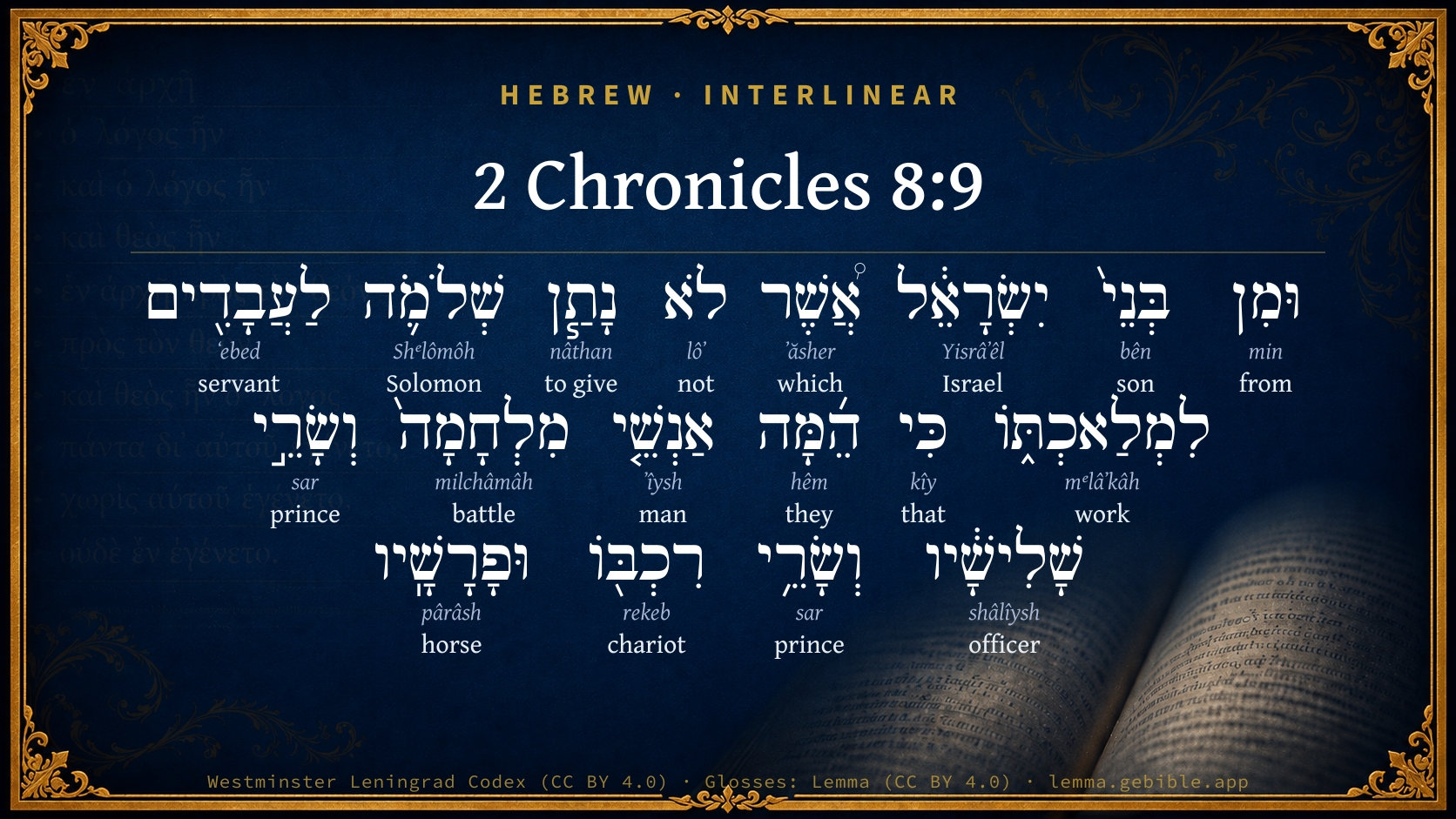
  1. וּמִן min H4480 “and · from” Conjunction + Preposition
  2. בְּנֵי֙ bên H1121 “sons of” Noun, Common, Masculine, Plural, Construct
  3. יִשְׂרָאֵ֔ל Yisrâʼêl H3478 “Israel” Noun, Proper
  4. אֲ֠שֶׁר ʼăsher H834 “which” Particle, Relative
  5. לֹא lôʼ H3808 “not” Particle, Negative
  6. נָתַ֧ן nâthan H5414 “to give” Verb, Qal, Perfect, 3rd Person, Masculine, Singular
  7. שְׁלֹמֹ֛ה Shᵉlômôh H8010 “Solomon” Noun, Proper
  8. לַעֲבָדִ֖ים ʻebed H5650 “to/for · servants” Preposition + Noun, Common, Masculine, Plural, Absolute
  9. לִמְלַאכְתּ֑וֹ mᵉlâʼkâh H4399 “to/for · work · his” Preposition + Noun, Common, Feminine, Singular, Construct + Suffix, Personal, 3rd Person, Masculine, Singular
  10. כִּי kîy H3588 “that” Conjunction
  11. הֵ֜מָּה hêm H1992 “they” Pronoun, Personal, 3rd Person, Masculine, Plural
  12. אַנְשֵׁ֤י ʼîysh H376 “men of” Noun, Common, Masculine, Plural, Construct
  13. מִלְחָמָה֙ milchâmâh H4421 “battle” Noun, Common, Feminine, Singular, Absolute
  14. וְשָׂרֵ֣י sar H8269 “and · princes of” Conjunction + Noun, Common, Masculine, Plural, Construct
  15. וְשָׂרֵ֥י sar H8269 “and · princes of” Conjunction + Noun, Common, Masculine, Plural, Construct
  16. רִכְבּ֖וֹ rekeb H7393 “chariot · his” Noun, Common, Masculine, Singular, Construct + Suffix, Personal, 3rd Person, Masculine, Singular
  17. וּפָרָשָֽׁיו pârâsh H6571 “and · horses · his” Conjunction + Noun, Common, Masculine, Plural, Construct + Suffix, Personal, 3rd Person, Masculine, Singular

About this verse

These counts appear in no published source. They are computed here, from the morphology-tagged text and Lemma’s own curated glosses. What Lemma adds →

18
words
17
distinct lemmas
Historical
section

Notable vocabulary

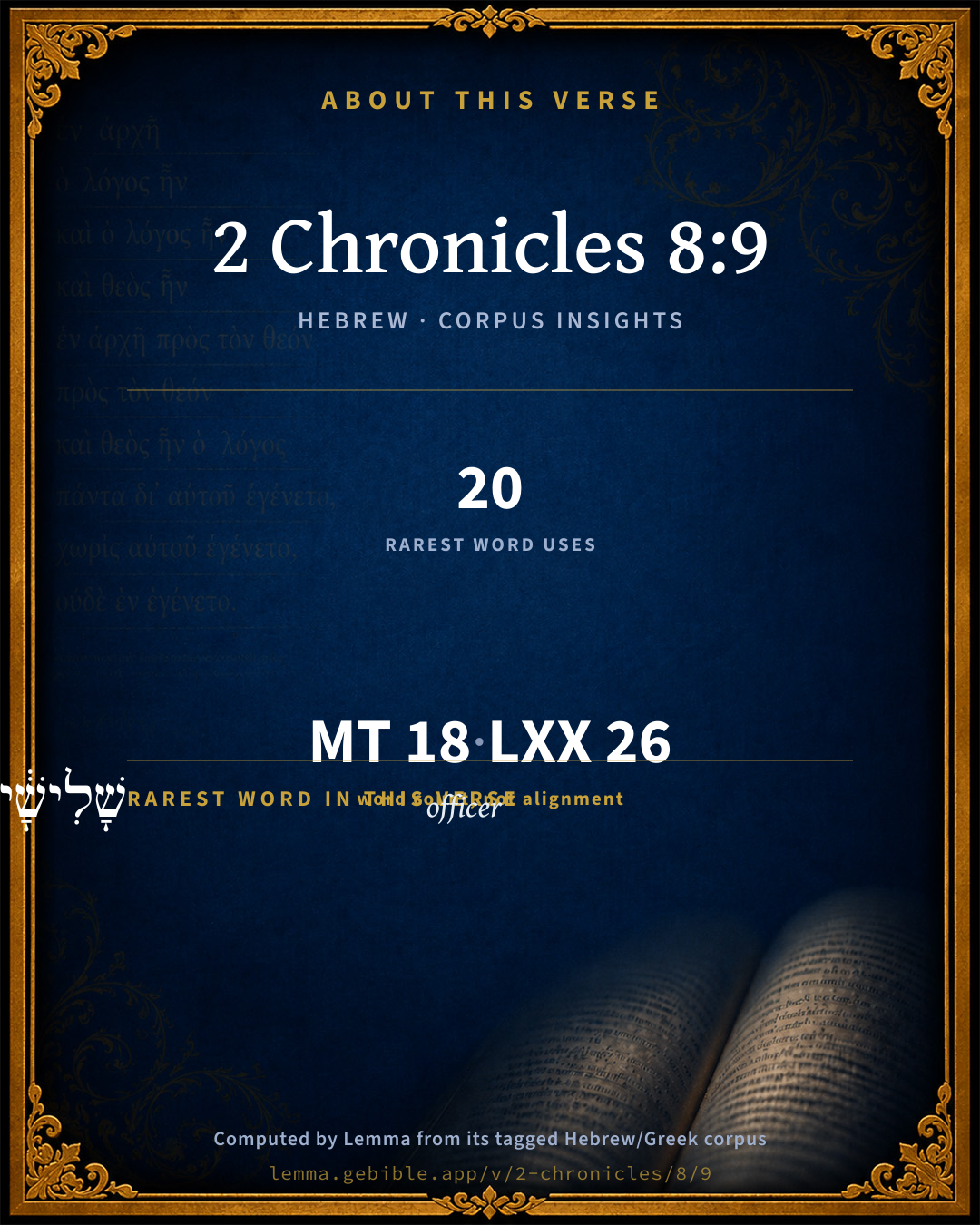
The rarest word here is שָׁלִישָׁ֔יו officer H7991 — appearing just 20 times in the whole Hebrew Bible.

Shared distinctive vocabulary

שָׁלִישָׁ֔יו officer H7991 occurs in 18 verses of the Hebrew Bible. Also found in:

Grammatical profile

  • 1 verb
  • 12 nouns
  • 1 pronoun
  • 1 preposition
  • 1 conjunction
  • 2 particles

Verb forms

  • נָתַ֧ן Qal · Perfect

Repetition

A word recurs within this verse — often emphatic in Hebrew:

  • וְשָׂרֵ֣י prince H8269 ×2

Hebrew & Septuagint length

In English translation the verse runs 34 words from the Hebrew and 31 from the Septuagint (LXX English) — closely comparable.

A rough comparison of the two English renderings, which tokenize alike — not a word-level alignment.

Word counts can differ between the Hebrew and the Greek without any difference in meaning — e.g. the Hebrew direct-object marker אֵת has no separate Greek word, and Greek often adds the article ὁ.

In the original languages it is 18 Hebrew tokens and 26 Greek tokens — but the two are counted differently (Hebrew bundles its prefixes and suffixes into one token; the Greek is in lemma form), so that isn’t a like-for-like length.

Cross-references

5

Topical passages linked to 2 Chronicles 8:9 in the Treasury of Scripture Knowledge — connected by theme and wording, ordered by reader-vote popularity; previews shown in the World English Bible.

  • Exodus 19:5–6 Now therefore, if you will indeed obey my voice, and keep my covenant, then you shall be my own possession from among all peoples; for all the earth is mine;
  • Leviticus 25:39–46 "'If your brother has grown poor among you, and sells himself to you; you shall not make him to serve as a slave.
  • 1 Samuel 8:11–12 He said, This will be the manner of the king who shall reign over you: he will take your sons, and appoint them to him, for his chariots, and to be his horsemen; and they shall run before his chariots;
  • Galatians 4:26 But the Jerusalem that is above is free, which is the mother of us all.
  • Galatians 4:31 So then, brothers, we are not children of a handmaid, but of the free woman.

Cross-references courtesy of OpenBible.info (CC BY 4.0).

Hebrew and Greek witnesses Masoretic Hebrew ↔ Greek Septuagint

The same verse in the two great witnesses to the Old Testament, shown verse-for-verse.

These are two independent witnesses, not word-aligned to each other, and the Septuagint is shown in lemma (dictionary) form.

Hebrew 2 Chronicles 8:9 Masoretic · Westminster Leningrad Codex

וּמִן בְּנֵי֙ יִשְׂרָאֵ֔ל אֲ֠שֶׁר לֹא נָתַ֧ן שְׁלֹמֹ֛ה לַעֲבָדִ֖ים לִמְלַאכְתּ֑וֹ כִּי הֵ֜מָּה אַנְשֵׁ֤י מִלְחָמָה֙ וְשָׂרֵ֣י שָׁלִישָׁ֔יו וְשָׂרֵ֥י רִכְבּ֖וֹ וּפָרָשָֽׁיו

But of the children of Israel did Solomon make no servants for his work; but they were men of war, and chief of his captains, and rulers of his chariots and of his horsemen.

World English Bible · Public Domain

Greek LXX 2 Chronicles 8:9 Septuagint · lemma form

καί ἐκ ὁ υἱός ἰσραήλ οὐ δίδωμι σαλωμών εἰς παῖς ὁ βασιλεία αὐτός ὅτι αὐτός ἀνήρ πολεμιστής καί ἄρχων καί δυνατός καί ἄρχων ἅρμα καί ἱππεύς

But Solomon did not make any of the children of Israel servants in his kingdom; for, behold, they were warriors and rulers, and mighty men, and captains of chariots and horsemen.

LXX2012 (modern English Septuagint) · Public Domain

Hebrew: Westminster Leningrad Codex (CC BY 4.0). Greek: Septuagint (public domain); English from LXX2012 (modern English Septuagint) (Public Domain). How the Septuagint differs from the Hebrew →

Commentary

Notes on 2 Chronicles 8:9 from classic Christian and Jewish commentators (each source and its license shown beneath its notes). The classic Christian expositions comment on the surrounding passage and are grouped to its opening verse, so a note may address several verses; the Jewish commentaries on the Tanakh (Rashi and others) are per-verse, so they appear only where the commentator wrote on this verse.

Lemma curates 59 commentaries, every one of them public domain or Creative Commons licensed, each selected and text-cleaned for this edition rather than reprinted as found. About our sources →

Trapp's Complete Commentary

John Trapp

2Ch 8:9 But of the children of Israel did Solomon make no servants for his work; but they [were] men of war, and chief of his captains, and captains of his chariots and horsemen.

Ver. 9. But of the children of Israel.] See 1Ki 9:22.

John Trapp, A Commentary or Exposition upon All the Books of the Old and New Testament (1647–1656) — public domain. Text from a community e-Sword module.

Adam Clarke's Commentary

Verse 9. But of the children of Israel] 1Kg 9:21.

Adam Clarke's Commentary on the Bible (1810–1826) — public domain. Text from a community e-Sword/MySword module.

The Cambridge Bible for Schools and Colleges

gen. ed. J. J. S. Perowne

9. and chief of his captains] Read (with 1Ki_9:22) and his princes and his captains. The statements of this verse must be read in connexion with 1Ki_5:13 ff; 1Ki_12:4 ff., whence it appears that though Solomon did not actually reduce any Israelite to permanent slavery, yet he imposed upon his own people a corvée which was felt to be very burdensome.

The Cambridge Bible for Schools and Colleges (gen. ed. J. J. S. Perowne; Cambridge University Press, 1878–1918) — public domain. Text from a community e-Sword module.

Keil & Delitzsch

C. F. Keil & F. Delitzsch

שׁלישׁיו ושׁרי should be altered into ושׁלישׁיו שׂריו as in Kg1 9:22, for שׁלישׁים are not chariot combatants, but royal adjutants; see on Exo 14:7 and Sa2 23:8. Over the statute labourers 250 upper overseers were placed. נציבים שׂרי, chief of the superiors, i.e., chief overseer. The Keth. נציבים, praefecti, is the true reading; cf. Ch1 18:13; Ch2 17:2. The Keri has arisen out of Kg1 9:23. These overseers were Israelites, while in the number 550 (Kg1 9:23) the Israelite and Canaanite upper overseers are both included; see on Ch2 2:17. בּעם refers to כּל־העם, Ch2 8:7, and denotes the Canaanite people who remained.

Keil & Delitzsch — Biblical Commentary on the Old Testament (1861–1891) — public domain (CC PDM 1.0). Text via the HelloAO Bible API. (Old Testament only.)

unfoldingWord translationNotes

Door43 World Missions Community

Solomon made no forced laborers of the people of Israel

"Solomon did not make any of the people of Israel become slaves"

translationWords

Solomon

commander

chariot

horseman

king

unfoldingWord translationNotes — © Distant Shores Media and the Door43 World Missions Community, licensed CC BY-SA 4.0. Source: git.door43.org/Door43/en_tn.

Rashi

Rabbi Shlomo Yitzchaki (Rashi)

for his work [i.e.] for the work of his building. Why? All the proselytes were [employed] to do his work, but not the men of Israel, because the Israelites served as soldiers and men of war and the officers of his chariots and his horsemen.

Rashi on the Tanakh — English translations: “The Judaica Press complete Tanach with Rashi, translated by A. J. Rosenberg” (CC BY 4.0); “Pentateuch with Rashi's commentary by M. Rosenbaum and A.M. Silbermann, 1929-1934” (public domain); “The Metsudah Tanach series, Lakewood, N.J” (CC BY 4.0); and “The Book of Joshua, Metsudah Publications, 1997” (CC BY 4.0). Text via Sefaria.

Lesson kit

Teaching starters — assembled from the data on this page, not authored interpretation. Every prompt links to the verse data it draws on. Edit before teaching.

2 Chronicles, in the Historical, opens this verse with 18 words (17 distinct Hebrew lemmas). Its most distinctive word is shâlîysh (“officer”). A historical commentator’s framing appears above. Read the whole chapter for the surrounding context.

Discussion questions

  1. What does “officer” (shâlîysh) contribute to the verse as a whole?
  2. How does Exodus 14:7, which shares the word «officer», read alongside this verse?
  3. What does the repetition of “prince” (2× in this one verse) do in this verse?
  4. These translations render this verse differently. What is at stake in choosing one wording over another?
  5. «נָתַ֧ן» is a Qal Perfect verb. How does that grammatical form shape the action described?
  6. Compare how Trapp's Complete Commentary and Adam Clarke's Commentary read this verse. Where do they agree or differ?

Things to notice

Reading settings

Reading text

Shown beneath each verse's original-language words.

Old Testament
Old Testament edition

Read the OT as the Masoretic Hebrew (MT) or the Greek Septuagint (LXX).

English shown for the Greek Septuagint (in the Hebrew ↔ Greek comparison).

Comparing translations? Open the Compare panel on any verse page to stack up to four side by side.