
2 Kings 22:9

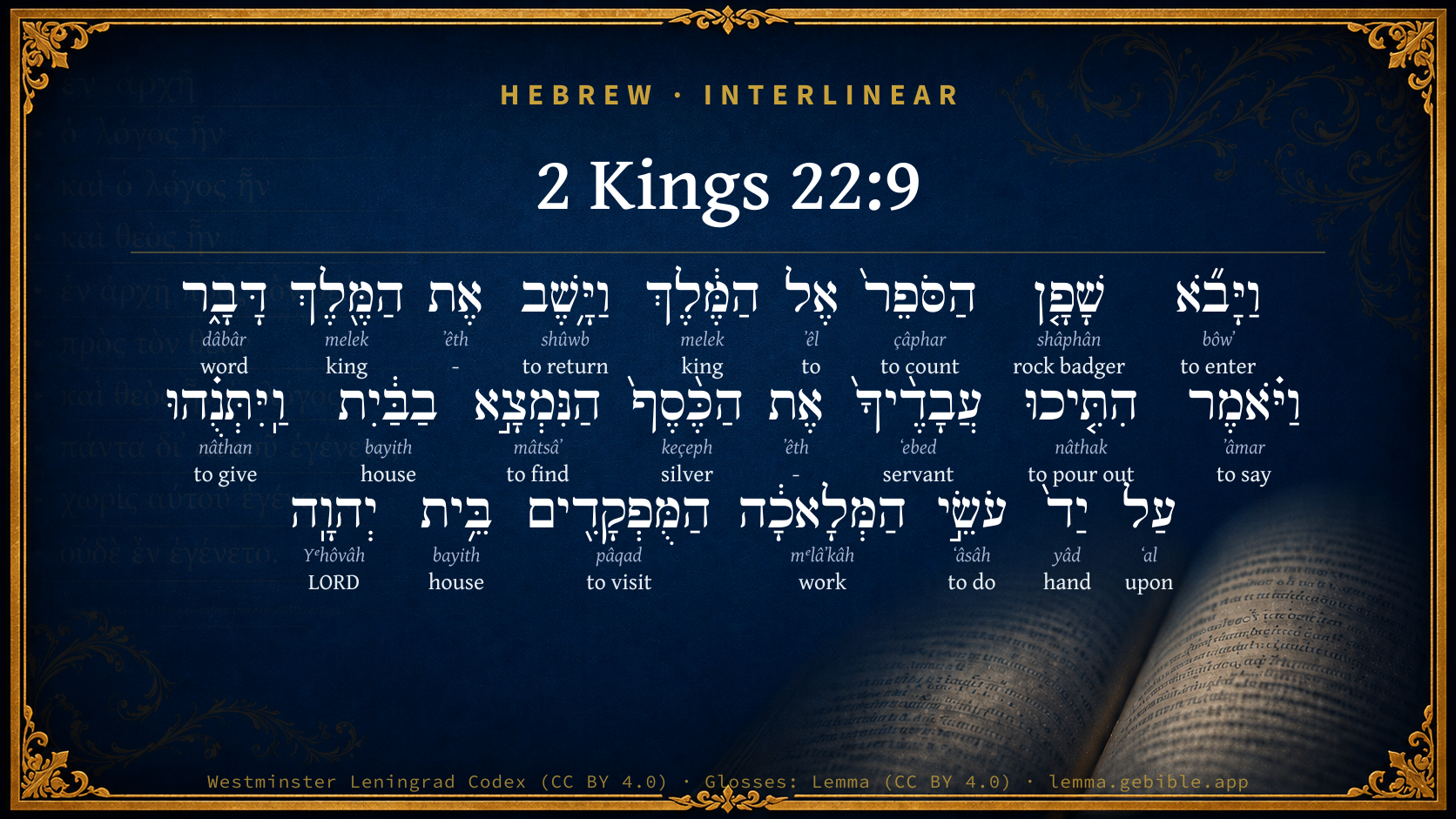
Hebrew (Westminster Leningrad Codex) 2 Kings 22:9 appears in the Hebrew Old Testament. The text above is from the Westminster Leningrad Codex. Each word links to its Strong’s number, a concise gloss, and parsing drawn from the Open Scriptures Hebrew Bible morphology. Click any word for its full Brown-Driver-Briggs (BDB) entry.
Download image
Cite this verse

2 Kings 22:9 (World English Bible). Public Domain. Lemma interlinear Bible study tool, https://lemma.gebible.app/v/2-kings/22/9.

Show BibTeX & RIS
BibTeX
RIS
English Translation
Shaphan the scribe came to the king, and brought the king word again, and said, Your servants have emptied out the money that was found in the house, and have delivered it into the hand of the workmen who have the oversight of the house of Yahweh.
World English Bible · Public Domain
Download a study sheet

One document with this verse’s original text, its word-by-word gloss line, the meaning frame, cross-references with their text, attributed commentary, and full source and license credits — printable, and it pastes into notes with its structure intact.

This verse Autodidact and up

Study sheet (.html) Plain text (.txt)

A passage Seminary Student

Up to 50 verses in one chapter. A passage sheet keeps up to 6 commentary sources and 12 cross-references per verse, in the order this page ranks them, and says so on the sheet whenever that leaves anything out. Ask for a single verse and you get the Autodidact verse sheet above.

Everything on this page stays free to read, with no account — the sheet is a download of what is already on screen, not access to it.

Want to remove ads? Support Godless Engineer
Compare translations 3

The same verse in 3 English versions, stacked beneath the original-language interlinear above. Click any original word for its lexicon entry.

Each is an independent rendering of the whole verse — the interlinear is not word-aligned to these translations.

Highlighted words mark where these versions differ — a whole-verse word diff, not a word-by-word alignment.

  • World English Bible Public Domain
    Shaphan the scribe came to the king, and brought the king word again, and said, Your servants have emptied out the money that was found in the house, and have delivered it into the hand of the workmen who have the oversight of the house of Yahweh.
  • King James Version Public Domain
    And Shaphan the scribe came to the king, and brought the king word again, and said, Thy servants have gathered the money that was found in the house, and have delivered it into the hand of them that do the work, that have the oversight of the house of the LORD.
  • unfoldingWord Literal Text CC BY-SA 4.0
    And Shaphan the scribe went to the king, and he brought a word back the king and said, “Your servants have poured out the silver found in the house, and they have given it into the hand of the doers of the work, the ones appointed the house of Yahweh.”

unfoldingWord Literal Text — © unfoldingWord, licensed CC BY-SA 4.0. Word-aligned USFM3 via Door43 (git.door43.org/unfoldingWord/en_ult).

Versions to compare (up to 4)

3 of 4 selected

Show all 18 translations

Every available English version of this verse, each an independent rendering of the whole verse.

  • World English Bible Public Domain
    Shaphan the scribe came to the king, and brought the king word again, and said, Your servants have emptied out the money that was found in the house, and have delivered it into the hand of the workmen who have the oversight of the house of Yahweh.
  • Berean Standard Bible Public Domain
    And Shaphan the scribe went to the king and reported, “Your servants have paid out the money that was found in the temple and have put it into the hands of the workers and supervisors of the house of the LORD.”
  • Majority Standard Bible Public Domain
    And Shaphan the scribe went to the king and reported, “Your servants have paid out the money that was found in the temple and have put it into the hands of the workers and supervisors of the house of the LORD.”
  • King James Version Public Domain
    And Shaphan the scribe came to the king, and brought the king word again, and said, Thy servants have gathered the money that was found in the house, and have delivered it into the hand of them that do the work, that have the oversight of the house of the LORD.
  • American Standard Version (1901) Public Domain
    And Shaphan the scribe came to the king, and brought the king word again, and said, Thy servants have emptied out the money that was found in the house, and have delivered it into the hand of the workmen that have the oversight of the house of Jehovah.
  • Revised Version (1885) Public Domain
    And Shaphan the scribe came to the king, and brought the king word again, and said, Thy servants have emptied out the money that was found in the house, and have delivered it into the hand of the workmen that have the oversight of the house of the LORD.
  • Geneva Bible (1599) Public Domain
    So Shaphan the chanceller came to ye King, and brought him word againe, and saide, Thy seruants haue gathered the money, that was found in the house, and haue deliuered it vnto the hands of them that doe the worke, and haue the ouersight of the house of the Lord.
  • Douay-Rheims (1899) Public Domain
    And Saphan the scribe came to the king, and brought him word again concerning that which he had commanded, and said: Thy servants have gathered together the money that was found in the house of the Lord, and they have given it to be distributed to the workmen, by the overseers of the works of the temple of the Lord.
  • Young's Literal Translation Public Domain
    And Shaphan the scribe cometh in unto the king, and bringeth the king back word, and saith, `Thy servants have poured out the silver that hath been found in the house, and give it into the hand of the doers of the work, the inspectors, in the house of Jehovah.'
  • Literal Standard Version CC BY-SA 4.0
    And Shaphan the scribe comes to the king, and brings the king back word, and says, “Your servants have poured out the silver that has been found in the house, and give it into the hand of those doing the work, the inspectors, in the house of YHWH.”
  • Unlocked Literal Bible CC BY-SA 4.0
    Shaphan went and took the book to the king, and also reported to him, saying, “Your servants have spent the money that was found in the temple and they have given it into the hand of the workmen who supervise the care for the house of Yahweh.”
  • unfoldingWord Literal Text CC BY-SA 4.0
    And Shaphan the scribe went to the king, and he brought a word back the king and said, “Your servants have poured out the silver found in the house, and they have given it into the hand of the doers of the work, the ones appointed the house of Yahweh.”
  • Darby Bible Public Domain
    And Shaphan the scribe came to the king, and brought the king word again and said, Thy servants have emptied out the money that was found in the house, and have delivered it into the hand of them that do the work, that have the oversight of the house of Jehovah.
  • World Messianic Bible Public Domain
    Shaphan the scribe came to the king, and brought the king word again, and said, “Your servants have emptied out the money that was found in the house, and have delivered it into the hands of the workmen who have the oversight of the LORD’s house.”
  • Webster's Bible Public Domain
    And Shaphan the scribe came to the king, and brought the king word again, and said, Thy servants have gathered the money that was found in the house, and have delivered it into the hand of them that do the work, that have the oversight of the house of the LORD.
  • Free Bible Version CC BY-SA 4.0
    Shaphan the scribe went to the king to give him a report, saying, “Your officials have paid out the money that was in the Lord's Temple and have handed it over to those appointed to supervise the work at the Lord's Temple.”
  • Bible in Basic English Public Domain
    Then, after reading it, Shaphan the scribe went in to the king and gave him an account of what had been done, saying, Your servants have given out the money which was in the house, and have given it to the overseers of the work of the house of the Lord.
  • JPS Tanakh (1917) Public Domain
    And Shaphan the scribe came to the king, and brought back word unto the king, and said: 'Thy servants have poured out the money that was found in the house, and have delivered it into the hand of the workmen that have the oversight of the house of the LORD.'

Literal Standard Version (2020), Covenant Press — licensed CC BY-SA 4.0. Text via the HelloAO Bible API (eBible.org). Unlocked Literal Bible (unfoldingWord) — licensed CC BY-SA 4.0. Text via the HelloAO Bible API (eBible.org). unfoldingWord Literal Text — © unfoldingWord, licensed CC BY-SA 4.0. Word-aligned USFM3 via Door43 (git.door43.org/unfoldingWord/en_ult). Free Bible Version, Dr. Jonathan Gallagher — licensed CC BY-SA 4.0. Text via the HelloAO Bible API (eBible.org).

Word by word

More ways to search: Search by grammar → Find every occurrence → Compare this word →

Practice this passage: Drill this verse → Learn its vocabulary →

הִתִּ֤יכוּ
nâthak
H5413
“to pour out”
Verb, Hiphil, Perfect, 3rd Person, Common, Plural
Part of Speech
Verb
Stem
Hiphil
Form
Perfect
Person
3rd Person
Gender
Common
Number
Plural
Full BDB Definition

Origin: a primitive root

TWOT: 1442

to pour out or forth, drop (or rain), be poured, be poured out, be melted, be molten - (Qal) to pour forth - (Niphal) to be poured, be poured out - (Hiphil) to pour out, melt - (Hophal) to be melted
  1. וַיָּבֹ֞א bôwʼ H935 “and · to enter” Conjunction + Verb, Qal, Sequential Imperfect, 3rd Person, Masculine, Singular
  2. שָׁפָ֤ן shâphân H8227 “rock badger” Noun, Proper
  3. הַסֹּפֵר֙ çâphar H5608 “the · scribe” Particle, Definite Article + Noun, Common, Masculine, Singular, Absolute
  4. אֶל ʼêl H413 “to” Preposition
  5. הַמֶּ֔לֶךְ melek H4428 “the · king” Particle, Definite Article + Noun, Common, Masculine, Singular, Absolute
  6. וַיָּ֥שֶׁב shûwb H7725 “and · to return” Conjunction + Verb, Hiphil, Sequential Imperfect, 3rd Person, Masculine, Singular
  7. אֶת ʼêth H853 “-” Particle, Direct Object
  8. הַמֶּ֖לֶךְ melek H4428 “the · king” Particle, Definite Article + Noun, Common, Masculine, Singular, Absolute
  9. דָּבָ֑ר dâbâr H1697 “word” Noun, Common, Masculine, Singular, Absolute
  10. וַיֹּ֗אמֶר ʼâmar H559 “and · to say” Conjunction + Verb, Qal, Sequential Imperfect, 3rd Person, Masculine, Singular
  11. עֲבָדֶ֨יךָ֙ ʻebed H5650 “servants · your” Noun, Common, Masculine, Plural, Construct + Suffix, Personal, 2nd Person, Masculine, Singular
  12. אֶת ʼêth H853 “-” Particle, Direct Object
  13. הַכֶּ֨סֶף֙ keçeph H3701 “the · silver” Particle, Definite Article + Noun, Common, Masculine, Singular, Absolute
  14. הַנִּמְצָ֣א mâtsâʼ H4672 “the · finding” Particle, Definite Article + Verb, Niphal, Participle Active, Masculine, Singular, Absolute
  15. בַבַּ֔יִת bayith H1004 “in/at the · house” Preposition, Determined + Noun, Common, Masculine, Singular, Absolute
  16. וַֽיִּתְּנֻ֗הוּ nâthan H5414 “and · to give · him” Conjunction + Verb, Qal, Sequential Imperfect, 3rd Person, Masculine, Plural + Suffix, Personal, 3rd Person, Masculine, Singular
  17. עַל ʻal H5921 “upon” Preposition
  18. יַד֙ yâd H3027 “hand of” Noun, Common, Both, Singular, Construct
  19. עֹשֵׂ֣י ʻâsâh H6213 “doing” Verb, Qal, Participle Active, Masculine, Plural, Construct
  20. הַמְּלָאכָ֔ה mᵉlâʼkâh H4399 “the · work” Particle, Definite Article + Noun, Common, Feminine, Singular, Absolute
  21. הַמֻּפְקָדִ֖ים pâqad H6485 “the · visited” Particle, Definite Article + Verb, Hophal, Participle Passive, Masculine, Plural, Absolute
  22. בֵּ֥ית bayith H1004 “house of” Noun, Common, Masculine, Singular, Construct
  23. יְהוָֽה Yᵉhôvâh H3068 “LORD” Noun, Proper

About this verse

These counts appear in no published source. They are computed here, from the morphology-tagged text and Lemma’s own curated glosses. What Lemma adds →

24
words
21
distinct lemmas
Historical
section

Notable vocabulary

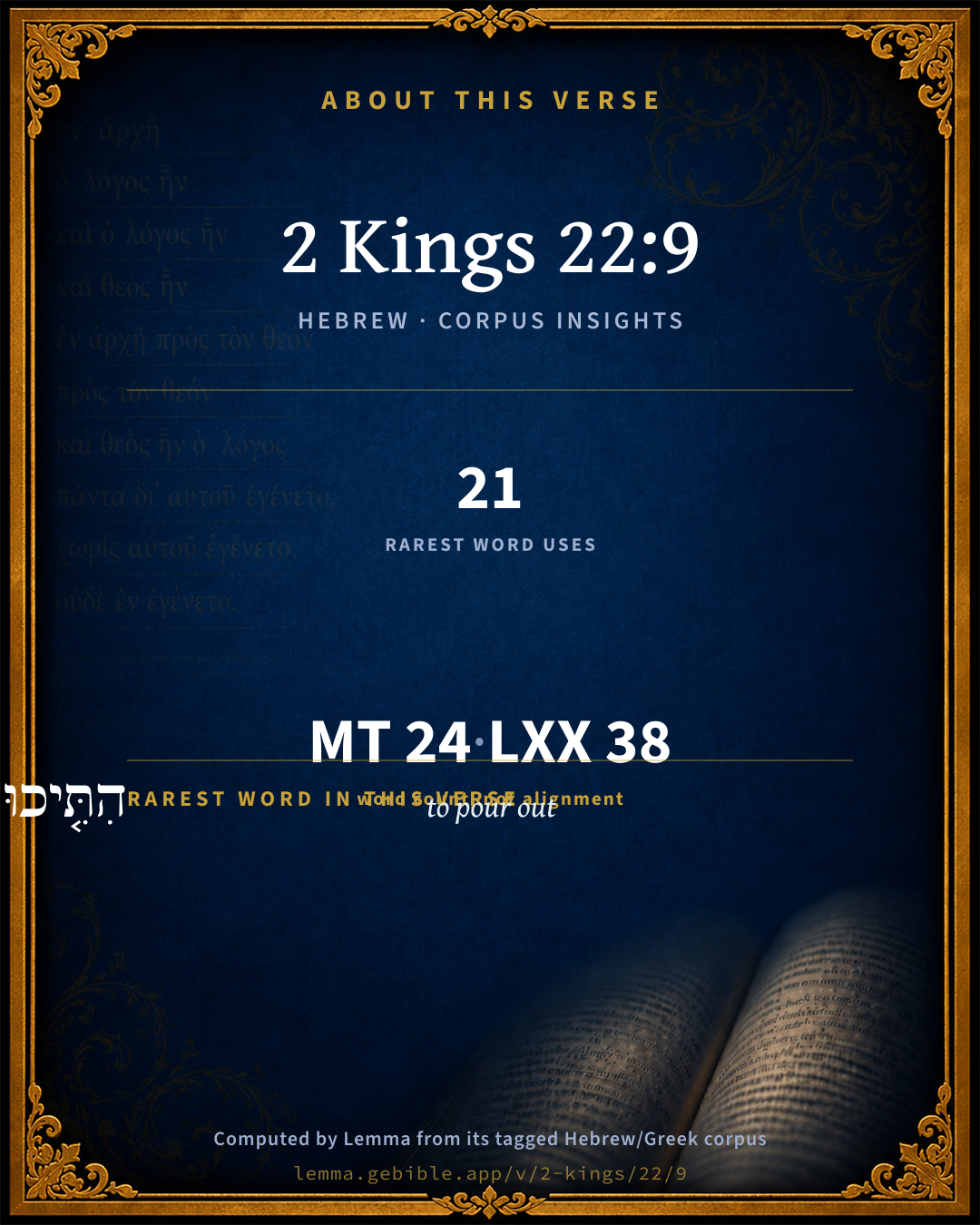
The rarest word here is הִתִּ֤יכוּ to pour out H5413 — appearing just 21 times in the whole Hebrew Bible.

Shared distinctive vocabulary

הִתִּ֤יכוּ to pour out H5413 occurs in 19 verses of the Hebrew Bible. Also found in:

Grammatical profile

  • 8 verbs
  • 12 nouns
  • 2 prepositions
  • 2 particles

Verb forms

  • וַיָּבֹ֞א Qal · Sequential Imperfect
  • וַיָּ֥שֶׁב Hiphil · Sequential Imperfect
  • וַיֹּ֗אמֶר Qal · Sequential Imperfect
  • הִתִּ֤יכוּ Hiphil · Perfect
  • הַנִּמְצָ֣א Niphal · Participle Active
  • וַֽיִּתְּנֻ֗הוּ Qal · Sequential Imperfect
  • עֹשֵׂ֣י Qal · Participle Active
  • הַמֻּפְקָדִ֖ים Hophal · Participle Passive

Repetition

Words recur within this verse — often emphatic in Hebrew:

  • הַמֶּ֔לֶךְ king H4428 ×2
  • בַבַּ֔יִת house H1004 ×2

Hebrew & Septuagint length

In English translation the verse runs 47 words from the Hebrew and 55 from the Septuagint (LXX English) — closely comparable.

A rough comparison of the two English renderings, which tokenize alike — not a word-level alignment.

Word counts can differ between the Hebrew and the Greek without any difference in meaning — e.g. the Hebrew direct-object marker אֵת has no separate Greek word, and Greek often adds the article ὁ.

In the original languages it is 24 Hebrew tokens and 38 Greek tokens — but the two are counted differently (Hebrew bundles its prefixes and suffixes into one token; the Greek is in lemma form), so that isn’t a like-for-like length.

Cross-references

11

Topical passages linked to 2 Kings 22:9 in the Treasury of Scripture Knowledge — connected by theme and wording, ordered by reader-vote popularity; previews shown in the World English Bible.

  • 2 Kings 18:18 When they had called to the king, there came out to them Eliakim the son of Hilkiah, who was over the household, and Shebnah the scribe, and Joah the son of Asaph the recorder.
  • 2 Kings 22:3 It happened in the eighteenth year of king Josiah, that the king sent Shaphan, the son of Azaliah the son of Meshullam, the scribe, to the house of Yahweh, saying,
  • 2 Kings 22:12 The king commanded Hilkiah the priest, and Ahikam the son of Shaphan, and Achbor the son of Micaiah, and Shaphan the scribe, and Asaiah the king's servant, saying,
  • 2 Kings 25:22 As for the people who were left in the land of Judah, whom Nebuchadnezzar king of Babylon had left, even over them he made Gedaliah the son of Ahikam, the son of Shaphan, governor.
  • Jeremiah 26:24 But the hand of Ahikam the son of Shaphan was with Jeremiah, that they should not give him into the hand of the people to put him to death.
  • Jeremiah 29:3 by the hand of Elasah the son of Shaphan, and Gemariah the son of Hilkiah, (whom Zedekiah king of Judah sent to Babylon to Nebuchadnezzar king of Babylon), saying,
  • Jeremiah 36:10–12 Then read Baruch in the book the words of Jeremiah in the house of Yahweh, in the chamber of Gemariah the son of Shaphan, the scribe, in the upper court, at the entry of the new gate of Yahweh's house, in the ears of all the people.
  • Jeremiah 39:14 they sent, and took Jeremiah out of the court of the guard, and committed him to Gedaliah the son of Ahikam, the son of Shaphan, that he should carry him home: so he lived among the people.
  • Jeremiah 40:11 Likewise when all the Jews who were in Moab, and among the children of Ammon, and in Edom, and who were in all the countries, heard that the king of Babylon had left a remnant of Judah, and that he had set over them Gedaliah the son of Ahikam, the son of Shaphan;
  • Jeremiah 41:2 Then arose Ishmael the son of Nethaniah, and the ten men who were with him, and struck Gedaliah the son of Ahikam the son of Shaphan with the sword, and killed him, whom the king of Babylon had made governor over the land.
  • Ezekiel 8:11 There stood before them seventy men of the elders of the house of Israel; and in the midst of them stood Jaazaniah the son of Shaphan, every man with his censer in his hand; and the odor of the cloud of incense went up.

Cross-references courtesy of OpenBible.info (CC BY 4.0).

Hebrew and Greek witnesses Masoretic Hebrew ↔ Greek Septuagint

The same verse in the two great witnesses to the Old Testament, shown verse-for-verse.

These are two independent witnesses, not word-aligned to each other, and the Septuagint is shown in lemma (dictionary) form.

Hebrew 2 Kings 22:9 Masoretic · Westminster Leningrad Codex

וַיָּבֹ֞א שָׁפָ֤ן הַסֹּפֵר֙ אֶל הַמֶּ֔לֶךְ וַיָּ֥שֶׁב אֶת הַמֶּ֖לֶךְ דָּבָ֑ר וַיֹּ֗אמֶר הִתִּ֤יכוּ עֲבָדֶ֨יךָ֙ אֶת הַכֶּ֨סֶף֙ הַנִּמְצָ֣א בַבַּ֔יִת וַֽיִּתְּנֻ֗הוּ עַל יַד֙ עֹשֵׂ֣י הַמְּלָאכָ֔ה הַמֻּפְקָדִ֖ים בֵּ֥ית יְהוָֽה

Shaphan the scribe came to the king, and brought the king word again, and said, Your servants have emptied out the money that was found in the house, and have delivered it into the hand of the workmen who have the oversight of the house of Yahweh.

World English Bible · Public Domain

Greek LXX 2 Kings 22:9 Septuagint · lemma form

καί εἰςφέρω πρός ὁ βασιλεύς ιωσιας καί ἐπιστρέφω ὁ βασιλεύς ῥῆμα καί εἶπον χωνεύω ὁ δοῦλος σύ ὁ ἀργύριον ὁ εὑρίσκω ἐν ὁ οἶκος κύριος καί δίδωμι αὐτός ἐπί χείρ ποιέω ὁ ἔργον ὁ καταἵστημι ἐν οἶκος κύριος

And he went into the house of the Lord to the king, and reported the matter to the king, and said, Your servants have collected the money that was found in the house of the Lord, and have given it into the hand of the workmen that are appointed in the house of the Lord.

LXX2012 (modern English Septuagint) · Public Domain

On this verse, Ellicott's Commentary for English Readers discusses the Septuagint’s reading. Read the note in Commentary ↓

Hebrew: Westminster Leningrad Codex (CC BY 4.0). Greek: Septuagint (public domain); English from LXX2012 (modern English Septuagint) (Public Domain). How the Septuagint differs from the Hebrew →

Targum (Aramaic paraphrase)

1

The Targum is the ancient Jewish Aramaic paraphrase of the Hebrew Scriptures — an interpretive translation, not the Hebrew text itself. Onkelos (literal) and Pseudo-Jonathan (expansive) render the Torah, and Jonathan the Prophets. Coverage is partial: where no permissively-licensed English translation exists for a verse, only the Aramaic is shown. This is verse-level text, not a word-by-word alignment to the Hebrew.

  1. Targum Jonathan Prophets (Joshua–Malachi)
    וַאֲתָא שָׁפָן סַפְרָא לְמַלְכָּא וַאֲתֵיב יַת מַלְכָּא פִתְגָמָא וַאֲמַר טְקִיסוּ עַבְדָךְ יַת כַּסְפָּא דְאִשְׁתְּכַח בְּבֵיתָא וְיַהֲבוּהִי עַל יְדֵי עָבְדֵי עֲבִידְתָּא דִמְמַנָן בְּבֵית מַקְדְשָׁא דַיָי:

    (no public-domain English translation for this verse)

    Targum Jonathan — Aramaic: “Mikraot Gedolot” (public domain). English: “Sefaria Community Translation” (CC0 1.0 (public-domain dedication)); “London "Chaldee Paraphrase," 1871” (public domain). Text via Sefaria.

Commentary

Notes on 2 Kings 22:9 from classic Christian and Jewish commentators (each source and its license shown beneath its notes). The classic Christian expositions comment on the surrounding passage and are grouped to its opening verse, so a note may address several verses; the Jewish commentaries on the Tanakh (Rashi and others) are per-verse, so they appear only where the commentator wrote on this verse.

Lemma curates 59 commentaries, every one of them public domain or Creative Commons licensed, each selected and text-cleaned for this edition rather than reprinted as found. About our sources →

Trapp's Complete Commentary

John Trapp

2Ki 22:9 And Shaphan the scribe came to the king, and brought the king word again, and said, Thy servants have gathered the money that was found in the house, and have delivered it into the hand of them that do the work, that have the oversight of the house of the LORD.

Ver. 9. Thy servants have gathered.] Heb., Melted. {a} Hence Vatablus inferreth, that much of the silver gathered was yet uncoined. See 2Ki 22:4.

{a} Conflaverunt.

John Trapp, A Commentary or Exposition upon All the Books of the Old and New Testament (1647–1656) — public domain. Text from a community e-Sword module.

Keil & Delitzsch

C. F. Keil & F. Delitzsch

The reading of the book of the law to the king, and the inquiry made of the prophetess Huldah concerning it. - Kg2 22:9, Kg2 22:10. When Shaphan informed the king of the execution of his command, he also told him that Hilkiah had given him a book, and read it to the king. דּבר השׁיב, to bring an answer, to give a report as to a commission that has been received. התּיכוּ, they poured out the money, i.e., out of the chest in which it was collected, into bags. ויּקראהוּ, "he read it to the king," is simplified in the Chronicles (Kg2 22:18) by בו יקרא, "he read therein." That יקראהו does not signify that the whole was read, is evident from a comparison of Kg2 23:2, where the reading of the whole is expressed by כּל־דּברי ס. Which passages or sections Shaphan read by himself (Kg2 22:8), and which he read to the king, it is impossible to determine exactly. To the king he most likely read, among other things, the threats and curses of the law against those who transgressed it (Deut 28), and possibly also Lev 26, because the reading made such an impression upon him, that in his anguish of soul he rent his clothes. Nor is it possible to decide anything with certainty, as to whether the king had hitherto been altogether unacquainted with the book of the law, and had merely a traditional knowledge of the law itself, or whether he had already had a copy of the law, but had not yet read it through, or had not read it with proper attention, which accounted for the passages that were read to him now making so deep and alarming an impression upon him. It is a well-known experience, that even books which have been read may, under peculiar circumstances, produce an impression such as has not been made before. But in all probability Josiah had not had in his possession any copy of the law, or even read it till now; although the thorough acquaintance with the law, which all the prophets display, places the existence of the Pentateuch in prophetical circles beyond the reach of doubt.

Keil & Delitzsch — Biblical Commentary on the Old Testament (1861–1891) — public domain (CC PDM 1.0). Text via the HelloAO Bible API. (Old Testament only.)

Geneva Bible (1599)

Geneva Bible translators

Hebrew, melted.

Geneva Bible (1599) marginal notes — public domain. Text via Bolls.life.

Ellicott's Commentary for English Readers

(9) Thy servants.—Hilkiah and I.

Have gathered.—Rather, have poured out—i.e., from the alms-chest into the bags.

In the house.—In the wider sense of the word, as including the outer court (2Ki_12:9). Chronicles reads “in the house of the Lord,” which is probably right. So LXX., Vulg., Arabic here.

A Bible Commentary for English Readers, edited by Charles John Ellicott (1878–1897) — public domain. Text from a community e-Sword module.

The Cambridge Bible for Schools and Colleges

gen. ed. J. J. S. Perowne

9. And Shaphan the scribe came to the king] The LXX. has for these words ‘And he went in unto the king in the house of the Lord’, but with no apparent warrant. Shaphan, bearing the book with him (2Ch_34:16), comes and gives a calm account of the business on which he had been sent at first, viz. the enquiry and arrangement about the money which had been gathered. When that part of the business is despatched, he tells the king concerning the book that has been discovered. On this ‘Book of the Law’ see Introduction, pp. xlvi–xlviii.

Thy servants have gathered [R.V. emptied out] the money] The verb, in most of its forms is used of ‘pouring out’, and now and then (see A.V. margin) of ‘melting’ metals. Here what seems to be intended is that Hilkiah and Shaphan had removed the offerings from the chest at the temple, and had found out what sum was in hand for the work of restoration.

them that do the work [R.V. the workmen], that have the oversight] As above in verse 5. The scribe and the priest pass on the money to the contractors.

The Cambridge Bible for Schools and Colleges (gen. ed. J. J. S. Perowne; Cambridge University Press, 1878–1918) — public domain. Text from a community e-Sword module.

John Gill's Exposition

And Shaphan the scribe came to the king, and brought the king word again,.... Of the delivery of his message to the high priest, and of what had been done upon it:

and said, thy servants have gathered the money that was found in the house; meaning Hilkiah and himself, who had examined the chest in the temple, into which the money was put for the repairs of it, and had taken it out, and told it:

and have delivered it into the hand of them that do the work, that have the oversight of the house of the Lord; according to the king's orders.

John Gill's Exposition of the Whole Bible (1746–1763) — public domain (CC PDM 1.0). Text via the HelloAO Bible API.

Albert Barnes' Notes on the Bible

Have gathered - Rather, “have poured out” or “emptied out.” The allusion probably is to the emptying of the chest in which all the money collected had been placed 2Ki 12:9.

Albert Barnes' Notes on the Bible (1834–1885) — public domain. Text from a community e-Sword/MySword module.

The Pulpit Commentary

And Shaphan the scribe came to the king, and brought the king word again, and said, Thy servants have gathered the money that was in the house (see above, vers. 4-6), and have delivered it into the hand of them that do the work, that have the oversight of the house of the Lord; i.e. "We have carried out the king"s orders exactly, in every particular."

The Pulpit Commentary (1880–1919), ed. H.D.M. Spence-Jones & Joseph S. Exell — public domain. Text from a community e-Sword module.

Lesson kit

Teaching starters — assembled from the data on this page, not authored interpretation. Every prompt links to the verse data it draws on. Edit before teaching.

2 Kings, in the Historical, opens this verse with 24 words (21 distinct Hebrew lemmas). Its most distinctive word is nâthak (“to pour out”). A historical commentator’s framing appears above. Read the whole chapter for the surrounding context.

Discussion questions

  1. What does “to pour out” (nâthak) contribute to the verse as a whole?
  2. How does Exodus 9:33, which shares the word «to pour out», read alongside this verse?
  3. What does the repetition of “king” (2× in this one verse) do in this verse?
  4. The translations on this page render this verse differently — a whole-verse word diff, not a word-by-word alignment. What might account for the different wordings?
  5. «וַיָּבֹ֞א» is a Qal Sequential Imperfect verb. How does that grammatical form shape the action described?
  6. Compare how Trapp's Complete Commentary and Keil & Delitzsch read this verse. Where do they agree or differ?

Things to notice

Reading settings

Reading text

Shown beneath each verse's original-language words.

Old Testament
Old Testament edition

Read the OT as the Masoretic Hebrew (MT) or the Greek Septuagint (LXX).

English shown for the Greek Septuagint (in the Hebrew ↔ Greek comparison).

Comparing translations? Open the Compare panel on any verse page to stack up to four side by side.