
Ezra 3:9

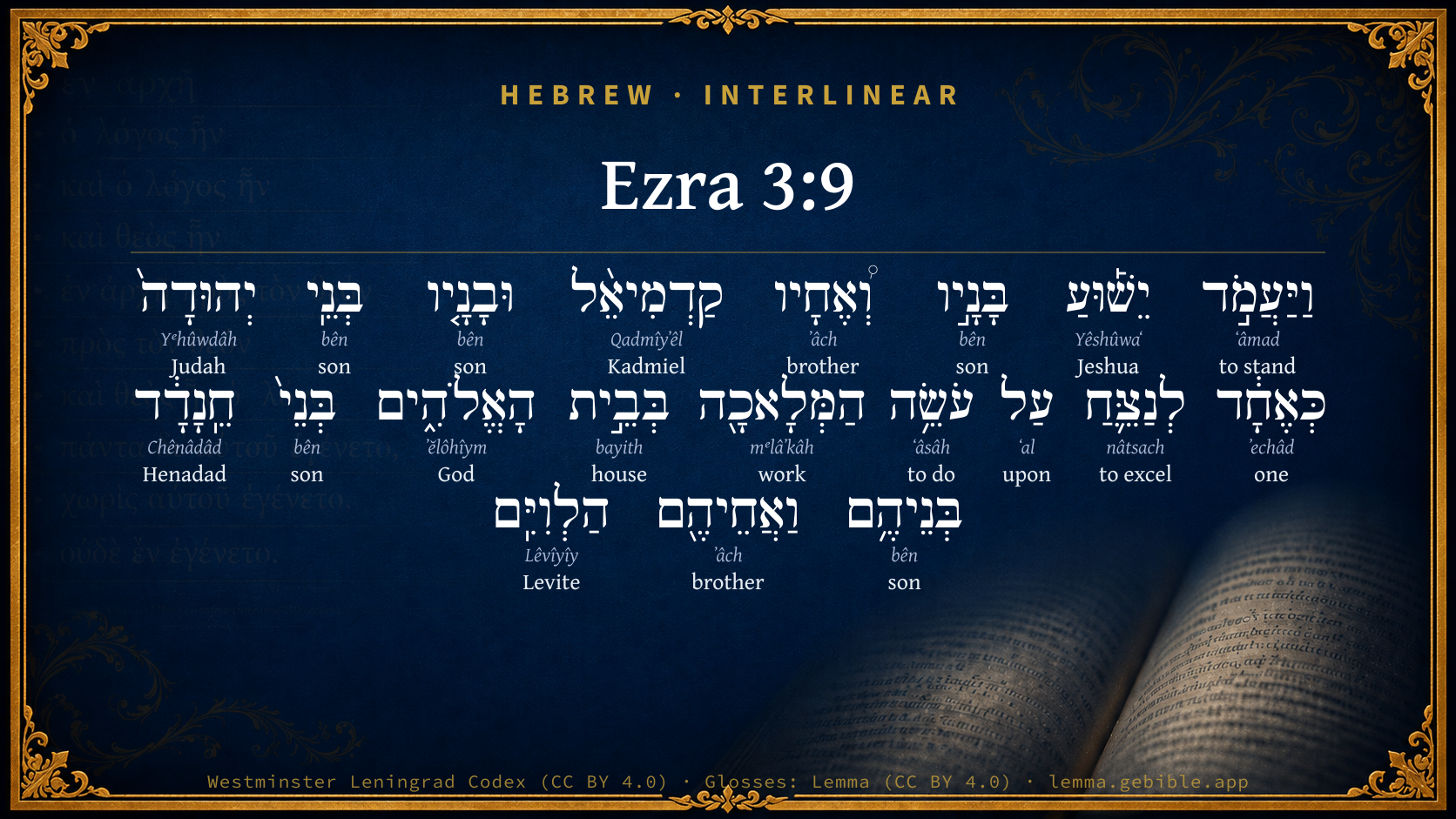
Hebrew (Westminster Leningrad Codex) Ezra 3:9 appears in the Hebrew Old Testament. The text above is from the Westminster Leningrad Codex. Each word links to its Strong’s number, a concise gloss, and parsing drawn from the Open Scriptures Hebrew Bible morphology. Click any word for its full Brown-Driver-Briggs (BDB) entry.
Download image
Cite this verse

Ezra 3:9 (World English Bible). Public Domain. Lemma interlinear Bible study tool, https://lemma.gebible.app/v/ezra/3/9.

Show BibTeX & RIS
BibTeX
RIS
English Translation
Then stood Jeshua with his sons and his brothers, Kadmiel and his sons, the sons of Judah, together, to have the oversight of the workmen in the house of God: the sons of Henadad, with their sons and their brothers the Levites.
World English Bible · Public Domain
Highlights
  • 1 first appearance in the Hebrew Bible
Full analysis ↓
Download a study sheet

One document with this verse’s original text, its word-by-word gloss line, the meaning frame, cross-references with their text, attributed commentary, and full source and license credits — printable, and it pastes into notes with its structure intact.

This verse Autodidact and up

Study sheet (.html) Plain text (.txt)

A passage Seminary Student

Up to 50 verses in one chapter. A passage sheet keeps up to 6 commentary sources and 12 cross-references per verse, in the order this page ranks them, and says so on the sheet whenever that leaves anything out. Ask for a single verse and you get the Autodidact verse sheet above.

Everything on this page stays free to read, with no account — the sheet is a download of what is already on screen, not access to it.

Want to remove ads? Support Godless Engineer
Compare translations 3

The same verse in 3 English versions, stacked beneath the original-language interlinear above. Click any original word for its lexicon entry.

Each is an independent rendering of the whole verse — the interlinear is not word-aligned to these translations.

Highlighted words mark where these versions differ — a whole-verse word diff, not a word-by-word alignment.

  • World English Bible Public Domain
    Then stood Jeshua with his sons and his brothers, Kadmiel and his sons, the sons of Judah, together, to have the oversight of the workmen in the house of God: the sons of Henadad, with their sons and their brothers the Levites.
  • King James Version Public Domain
    Then stood Jeshua with his sons and his brethren, Kadmiel and his sons, the sons of Judah, together, to set forward the workmen in the house of God: the sons of Henadad, with their sons and their brethren the Levites.
  • unfoldingWord Literal Text CC BY-SA 4.0
    And Jeshua, his sons and his brothers, Kadmiel and his sons, the sons of Judah, stood as one to act as overseers for the ones doing the work at the house of God, the sons of Henadad, their sons, and their brothers the Levites.

unfoldingWord Literal Text — © unfoldingWord, licensed CC BY-SA 4.0. Word-aligned USFM3 via Door43 (git.door43.org/unfoldingWord/en_ult).

Versions to compare (up to 4)

3 of 4 selected

Show all 18 translations

Every available English version of this verse, each an independent rendering of the whole verse.

  • World English Bible Public Domain
    Then stood Jeshua with his sons and his brothers, Kadmiel and his sons, the sons of Judah, together, to have the oversight of the workmen in the house of God: the sons of Henadad, with their sons and their brothers the Levites.
  • Berean Standard Bible Public Domain
    So Jeshua and his sons and brothers, Kadmiel and his sons (descendants of Yehudah), and the sons of Henadad and their sons and brothers—all Levites—joined together to supervise those working on the house of God.
  • Majority Standard Bible Public Domain
    So Jeshua and his sons and brothers, Kadmiel and his sons (descendants of Yehudah), and the sons of Henadad and their sons and brothers—all Levites—joined together to supervise those working on the house of God.
  • King James Version Public Domain
    Then stood Jeshua with his sons and his brethren, Kadmiel and his sons, the sons of Judah, together, to set forward the workmen in the house of God: the sons of Henadad, with their sons and their brethren the Levites.
  • American Standard Version (1901) Public Domain
    Then stood Jeshua with his sons and his brethren, Kadmiel and his sons, the sons of Judah, together, to have the oversight of the workmen in the house of God: the sons of Henadad, with their sons and their brethren the Levites.
  • Revised Version (1885) Public Domain
    Then stood Jeshua with his sons and his brethren, Kadmiel and his sons, the sons of Judah, together, to have the oversight of the workmen in the house of God: the sons of Henadad, with their sons and their brethren the Levites.
  • Geneva Bible (1599) Public Domain
    And Ieshua stood with his sonnes, and his brethren, and Kadmiel with his sonnes, and the sonnes of Iudah together to set forward ye workemen in the house of God, and the sonnes of Henadad with their sonnes, and their brethren the Leuites.
  • Douay-Rheims (1899) Public Domain
    Then Josue and his sons and his brethren, Cedmihel, and his sons, and the children of Juda, as one man, stood to hasten them that did the work in the temple of God: the sons of Henadad, and their sons, and their brethren the Levites.
  • Young's Literal Translation Public Domain
    And Jeshua standeth, `and' his sons, and his brethren, Kadmiel and his sons, sons of Judah together, to overlook those doing the work in the house of God; the sons of Henadad, `and' their sons and their brethren the Levites.
  • Literal Standard Version CC BY-SA 4.0
    And Jeshua stands, [and] his sons, and his brothers, Kadmiel and his sons, sons of Judah together, to overlook those doing the work in the house of God; the sons of Henadad, [and] their sons and their brothers the Levites.
  • Unlocked Literal Bible CC BY-SA 4.0
    Jeshua and his sons and brothers, and Kadmiel and his sons, who were descendants of Hodaviah), and the sons of Henadad and their sons and brothers-all of them were Levites-joined together in supervising those working on the house of God.
  • unfoldingWord Literal Text CC BY-SA 4.0
    And Jeshua, his sons and his brothers, Kadmiel and his sons, the sons of Judah, stood as one to act as overseers for the ones doing the work at the house of God, the sons of Henadad, their sons, and their brothers the Levites.
  • Darby Bible Public Domain
    And Jeshua stood up, his sons and his brethren, Kadmiel and his sons, the sons of Judah, as one [man], to superintend the workmen in the house of God; [also] the sons of Henadad, their sons and their brethren, the Levites.
  • World Messianic Bible Public Domain
    Then Yeshua stood with his sons and his brothers, Kadmiel and his sons, the sons of Judah, together to have the oversight of the workmen in God’s house: the sons of Henadad, with their sons and their brothers the Levites.
  • Webster's Bible Public Domain
    Then stood Jeshua with his sons and his brethren, Kadmiel and his sons, the sons of Judah, together, to set forward the workmen in the house of God: the sons of Henadad, with their sons and their brethren the Levites.
  • Free Bible Version CC BY-SA 4.0
    Jeshua and his sons and relatives, Kadmiel and his sons, the descendants of Yehudah, the sons of Henadad and their sons and relatives, all of them Levites, supervised those working on God's Temple.
  • Bible in Basic English Public Domain
    Then Jeshua with his sons and his brothers, Kadmiel with his sons, the sons of Hodaviah, together took up the work of overseeing the workmen in the house of God: the sons of Henadad with their sons and their brothers, the Levites.
  • JPS Tanakh (1917) Public Domain
    Then stood Jeshua with his sons and his brethren, and Kadmiel and his sons, the sons of Judah, together, to have the oversight of the workmen in the house of God; the sons of Henadad also, with their sons and their brethren the Levites.

Literal Standard Version (2020), Covenant Press — licensed CC BY-SA 4.0. Text via the HelloAO Bible API (eBible.org). Unlocked Literal Bible (unfoldingWord) — licensed CC BY-SA 4.0. Text via the HelloAO Bible API (eBible.org). unfoldingWord Literal Text — © unfoldingWord, licensed CC BY-SA 4.0. Word-aligned USFM3 via Door43 (git.door43.org/unfoldingWord/en_ult). Free Bible Version, Dr. Jonathan Gallagher — licensed CC BY-SA 4.0. Text via the HelloAO Bible API (eBible.org).

Word by word

More ways to search: Search by grammar → Find every occurrence → Compare this word →

Practice this passage: Drill this verse → Learn its vocabulary →

חֵֽנָדָ֔ד
Chênâdâd
H2582
“Henadad”
Noun, Proper
Part of Speech
Noun
Type
Proper
Full BDB Definition

Origin: probably from H0 ">02580) and 0l H908

TWOT: None

Henadad = "favour of Hadad" - head of a family of Levites who took part in the rebuilding of the temple
  1. וַיַּעֲמֹ֣ד ʻâmad H5975 “and · to stand” Conjunction + Verb, Qal, Sequential Imperfect, 3rd Person, Masculine, Singular
  2. יֵשׁ֡וּעַ Yêshûwaʻ H3442 “Jeshua” Noun, Proper
  3. בָּנָ֣יו bên H1121 “sons · his” Noun, Common, Masculine, Plural, Construct + Suffix, Personal, 3rd Person, Masculine, Singular
  4. וְ֠אֶחָיו ʼâch H251 “and · brothers · his” Conjunction + Noun, Common, Masculine, Plural, Construct + Suffix, Personal, 3rd Person, Masculine, Singular
  5. קַדְמִיאֵ֨ל Qadmîyʼêl H6934 “Kadmiel” Noun, Proper
  6. וּבָנָ֤יו bên H1121 “and · sons · his” Conjunction + Noun, Common, Masculine, Plural, Construct + Suffix, Personal, 3rd Person, Masculine, Singular
  7. בְּנֵֽי bên H1121 “sons of” Noun, Common, Masculine, Plural, Construct
  8. יְהוּדָה֙ Yᵉhûwdâh H3063 “Judah” Noun, Proper
  9. כְּאֶחָ֔ד ʼechâd H259 “like/as · one” Preposition + Adjective, Cardinal number, Masculine, Singular, Absolute
  10. לְנַצֵּ֛חַ nâtsach H5329 “to excel” Preposition + Verb, Piel, Infinitive Construct
  11. עַל ʻal H5921 “upon” Preposition
  12. עֹשֵׂ֥ה ʻâsâh H6213 “doing” Verb, Qal, Participle Active, Masculine, Singular, Construct
  13. הַמְּלָאכָ֖ה mᵉlâʼkâh H4399 “the · work” Particle, Definite Article + Noun, Common, Feminine, Singular, Absolute
  14. בְּבֵ֣ית bayith H1004 “in/at · house of” Preposition + Noun, Common, Masculine, Singular, Construct
  15. הָאֱלֹהִ֑ים ʼĕlôhîym H430 “the · God(s)” Particle, Definite Article + Noun, Common, Masculine, Plural, Absolute
  16. בְּנֵי֙ bên H1121 “sons of” Noun, Common, Masculine, Plural, Construct
  17. בְּנֵיהֶ֥ם bên H1121 “sons · their” Noun, Common, Masculine, Plural, Construct + Suffix, Personal, 3rd Person, Masculine, Plural
  18. וַאֲחֵיהֶ֖ם ʼâch H251 “and · brothers · their” Conjunction + Noun, Common, Masculine, Plural, Construct + Suffix, Personal, 3rd Person, Masculine, Plural
  19. הַלְוִיִּֽם Lêvîyîy H3881 “the · Levites” Particle, Definite Article + Noun, Gentilic, Masculine, Plural, Absolute

About this verse

These counts appear in no published source. They are computed here, from the morphology-tagged text and Lemma’s own curated glosses. What Lemma adds →

20
words
15
distinct lemmas
Historical
section

Notable vocabulary

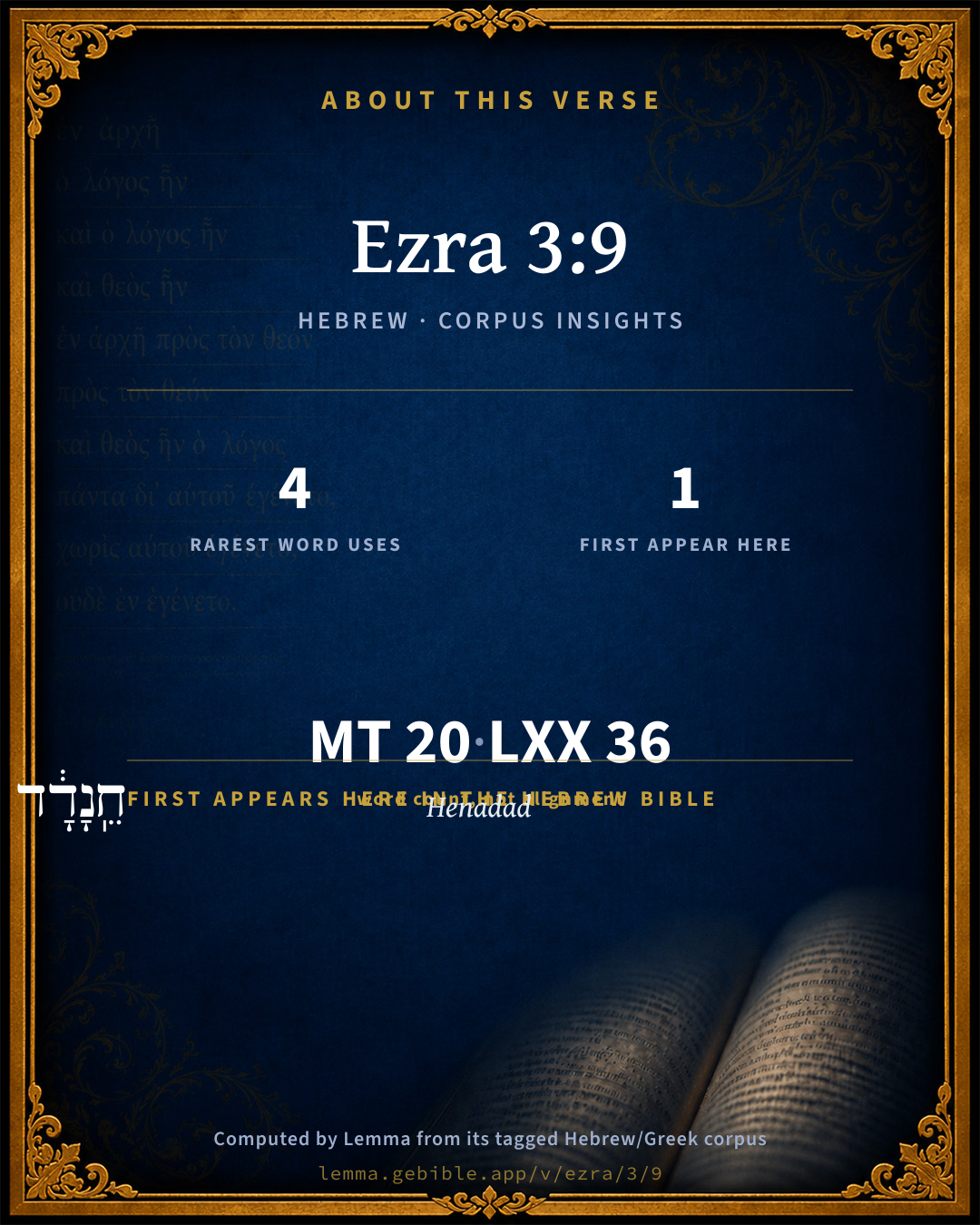
The rarest word here is חֵֽנָדָ֔ד Henadad H2582 — appearing just 4 times in the whole Hebrew Bible.

First appearance in Scripture

This word makes its first canonical appearance in the Hebrew Bible here:

  • חֵֽנָדָ֔ד Henadad H2582

Shared distinctive vocabulary

חֵֽנָדָ֔ד Henadad H2582 occurs in 4 verses of the Hebrew Bible. Also found in:

Grammatical profile

  • 3 verbs
  • 15 nouns
  • 1 adjective
  • 1 preposition

Verb forms

  • וַיַּעֲמֹ֣ד Qal · Sequential Imperfect
  • לְנַצֵּ֛חַ Piel · Infinitive Construct
  • עֹשֵׂ֥ה Qal · Participle Active

Repetition

Words recur within this verse — often emphatic in Hebrew:

  • בָּנָ֣יו son H1121 ×5
  • וְ֠אֶחָיו brother H251 ×2

Hebrew & Septuagint length

In English translation the verse runs 42 words from the Hebrew and 39 from the Septuagint (LXX English) — closely comparable.

A rough comparison of the two English renderings, which tokenize alike — not a word-level alignment.

Word counts can differ between the Hebrew and the Greek without any difference in meaning — e.g. the Hebrew direct-object marker אֵת has no separate Greek word, and Greek often adds the article ὁ.

In the original languages it is 20 Hebrew tokens and 36 Greek tokens — but the two are counted differently (Hebrew bundles its prefixes and suffixes into one token; the Greek is in lemma form), so that isn’t a like-for-like length.

Cross-references

3

Topical passages linked to Ezra 3:9 in the Treasury of Scripture Knowledge — connected by theme and wording, ordered by reader-vote popularity; previews shown in the World English Bible.

  • Ezra 2:40 The Levites: the children of Jeshua and Kadmiel, of the children of Hodaviah, seventy-four.
  • Ezra 3:8 Now in the second year of their coming to the house of God at Jerusalem, in the second month, began Zerubbabel the son of Shealtiel, and Jeshua the son of Jozadak, and the rest of their brothers the priests and the Levites, and all those who were come out of the captivity to Jerusalem, and appointed the Levites, from twenty years old and upward, to have the oversight of the work of the house of Yahweh.
  • Nehemiah 7:43 The Levites: the children of Jeshua, of Kadmiel, of the children of Hodevah, seventy-four.

Cross-references courtesy of OpenBible.info (CC BY 4.0).

Hebrew and Greek witnesses Masoretic Hebrew ↔ Greek Septuagint

The same verse in the two great witnesses to the Old Testament, shown verse-for-verse.

These are two independent witnesses, not word-aligned to each other, and the Septuagint is shown in lemma (dictionary) form.

Hebrew Ezra 3:9 Masoretic · Westminster Leningrad Codex

וַיַּעֲמֹ֣ד יֵשׁ֡וּעַ בָּנָ֣יו וְ֠אֶחָיו קַדְמִיאֵ֨ל וּבָנָ֤יו בְּנֵֽי יְהוּדָה֙ כְּאֶחָ֔ד לְנַצֵּ֛חַ עַל עֹשֵׂ֥ה הַמְּלָאכָ֖ה בְּבֵ֣ית הָאֱלֹהִ֑ים בְּנֵי֙ חֵֽנָדָ֔ד בְּנֵיהֶ֥ם וַאֲחֵיהֶ֖ם הַלְוִיִּֽם

Then stood Jeshua with his sons and his brothers, Kadmiel and his sons, the sons of Judah, together, to have the oversight of the workmen in the house of God: the sons of Henadad, with their sons and their brothers the Levites.

World English Bible · Public Domain

Greek LXX Ezra 3:9 Septuagint · lemma form

καί ἵστημι ἰησοῦς καί ὁ υἱός αὐτός καί ὁ ἀδελφός αὐτός καδμιηλ καί ὁ υἱός αὐτός υἱός ἰουδά ἐπί ὁ ποιέω ὁ ἔργον ἐν οἶκος ὁ θεός υἱός ηναδαδ υἱός αὐτός καί ἀδελφός αὐτός ὁ λευείτης

And Jesus and his sons and his brethren stood, Cadmiel and his sons the sons of Juda, over them that wrought the works in the house of God: the sons of Enadad, their sons and their brethren the Levites.

LXX2012 (modern English Septuagint) · Public Domain

In the Septuagint this is one book — Esdras B (2 Esdras): Ezra is chapters 1–10, Nehemiah 11–23.

On this verse, The Cambridge Bible for Schools and Colleges discusses the Septuagint’s reading. Read the note in Commentary ↓

Hebrew: Westminster Leningrad Codex (CC BY 4.0). Greek: Septuagint (public domain); English from LXX2012 (modern English Septuagint) (Public Domain). How the Septuagint differs from the Hebrew →

Commentary

Notes on Ezra 3:9 from classic Christian and Jewish commentators (each source and its license shown beneath its notes). The classic Christian expositions comment on the surrounding passage and are grouped to its opening verse, so a note may address several verses; the Jewish commentaries on the Tanakh (Rashi and others) are per-verse, so they appear only where the commentator wrote on this verse.

Lemma curates 59 commentaries, every one of them public domain or Creative Commons licensed, each selected and text-cleaned for this edition rather than reprinted as found. About our sources →

Trapp's Complete Commentary

John Trapp

Ezr 3:9 Then stood Jeshua [with] his sons and his brethren, Kadmiel and his sons, the sons of Judah, together, to set forward the workmen in the house of God: the sons of Henadad, [with] their sons and their brethren the Levites.

Ver. 9. Then stood Jeshua] Not the high priest, but another, a Levite.

The sons of Henadad, with their sons] A generation of godly and active men in the things of God, see Neh 3:18; Neh 3:24; Neh 10:9. Grace is not hereditary, the white halcyons hatch black young ones, Heroum filii noxae. Nevertheless, nurture helpeth nature; and good men strive to mend that by education which they have marred by propagation. They cocker not, but correct their children; they pray for them, and drop good principles into them; they smooth them as arrows, Psa 128:3-4, getting off the knottiness of their nature; and leave not till they see them the work of God’s hands, so as to sanctify the Holy One of Jacob, and to fear the God of Israel, Isa 29:23. These sons of Henadad, as they attended upon the temple work, so themselves were as the polished corners of the temple, Psa 144:12.

John Trapp, A Commentary or Exposition upon All the Books of the Old and New Testament (1647–1656) — public domain. Text from a community e-Sword module.

Joseph Benson's Commentary

Ezr 3:9. Then stood Jeshua with his sons — This person was not the high- priest, so called, but a Levite, of whom see Ezr 2:40. To set forward the workmen — To encourage them to a cheerful and vigorous prosecution of the work.

Joseph Benson's Commentary on the Old and New Testaments (1811–1818) — public domain. Text from a community e-Sword module.

Geneva Bible (1599)

Geneva Bible translators

They gave them exhortations, and encouraged every man forward in the work.

Geneva Bible (1599) marginal notes — public domain. Text via Bolls.life.

Jamieson, Fausset & Brown

Robert Jamieson, A. R. Fausset & David Brown

Jeshua with his sons--not the high priest, but a Levite (Ezr 2:40). To these, as probably distinguished for their mechanical skill and taste, the duty of acting as overseers was particularly committed.

Jamieson, Fausset & Brown — Commentary Critical and Explanatory on the Whole Bible (1871) — public domain (CC PDM 1.0). Text via the HelloAO Bible API.

Ellicott's Commentary for English Readers

(9) Together—As one man. Jeshua and Kadmiel, both of the stock of Judah, or Hodaviah (Ezr_2:40), or Hodevah (Neh_7:43), were the two heads of Levitical families; and their fewness is compensated by their unanimity and vigour. Henadad is not mentioned in Ezr_2:40, though it is a Levitical name in Nehemiah. Why omitted there, or why inserted here, it is not possible to determine.

A Bible Commentary for English Readers, edited by Charles John Ellicott (1878–1897) — public domain. Text from a community e-Sword module.

The Cambridge Bible for Schools and Colleges

gen. ed. J. J. S. Perowne

9. This verse presents considerable difficulty: (a) The English reader cannot fail to be struck with the awkwardness of the final clause, ‘the sons of Henadad … the Levites’. (b) The names here mentioned have been understood by different commentators to represent four, two and three families.

(a) The manifest dislocation of the verse has caused some to conjecture that it is a gloss, which has found its way into the text, having been originally introduced to supplement the previous verse by the names of those who had been appointed to the work and by emphasizing the fact that they undertook the duty. This conjecture, which is not without probability, would assign a very early date to the gloss, since the verse appears in the LXX. and, though in a corrupt form, in 1Es_5:58, ‘Then stood up Jesus, and his sons and brethren, and Cadmiel his brother and the sons of Madiabun, with the sons of Joda the son of Eliadun, with their sons and brethren, all Levites, with one accord, betters forward of the business, labouring to advance the works in the house of God’ (A.V.).

If we dismiss this conjecture on the ground of its lack of external evidence, we must be prepared to treat the verse as having come down to us in some way corrupted or mutilated.

The key to the verse lies in the last words, ‘the Levites’. The verse describes who the Levites were that received the commission (described in Ezr_3:8), and how they discharged it. The student therefore will take care not to confound the Jeshua here mentioned with the Jeshua (the high-priest) mentioned in the previous verse. This Jeshua is the Levite whose name occurs in chap. Ezr_2:40.

The natural arrangement of the words (illustrated by 1Es_5:58 quoted above) would be, ‘Then stood Jeshua with his sons and his brethren, Kadmiel and his sons, the sons of Judah, (and) the sons of Henadad with their sons and their brethren (i.e. all) the Levites together, to have the oversight of the workmen in the house of God.’ The verse thus specifies the Levites who undertook the oversight of the workmen.

(b) The names of the Levitical families who returned appear in chap. Ezr_2:40, where there is some uncertainty whether the expression ‘of the children of Hodaviah’ refers to Kadmiel alone or to ‘the children of Jeshua and Kadmiel’ taken together.

The ‘Judah’ of our verse is probably a misreading for Hodaviah, not, as some prefer, an alternative name of the same person.

(1) Some see in the verse a mention of four Levitical families, i.e. those of Jeshua, Kadmiel, Judah, and Henadad.

(2) Others think that only two are intended, i.e. those of Jeshua and Kadmiel, who are further defined as sons of Hodaviah (=Judah), and as sons of Henadad.

(3) It seems better to suppose that there are three families referred to: (i) ‘Jeshua with his sons and his brethren,’ apparently a complete family, (ii) ‘Kadmiel and his sons, the sons of Hodaviah’, apparently a special branch of the family of Kadmiel, (iii) ‘And the sons of Henadad, with their sons and their brethren’, who, though not mentioned in Ezr_2:40, are represented in Nehemiah’s time (Neh_3:18; Neh_3:24; Neh_10:9).

The absence of Henadad’s name from the list in chap. Ezr_2:40 is strange. But we must account for it by supposing either that the Henadad family never left Palestine, or that they came to Jerusalem between the arrival of Zerubbabel and the beginning of the second year, or that they belonged to the class more numerous than scholars have hitherto taken account of, i.e. those who returned to Jerusalem from exile in other countries. Perhaps the family of Henadad (‘the grace or favour of Hadad’, cf. Hadad, Benhadad, Hadadrimmon) had Syrian connexions or had found refuge in Syria during the disasters of Israel and Judah. Compare Ezr_6:21, ‘all such as had separated themselves from the filthiness of the heathen of the land’.

The Cambridge Bible for Schools and Colleges (gen. ed. J. J. S. Perowne; Cambridge University Press, 1878–1918) — public domain. Text from a community e-Sword module.

John Gill's Exposition

Then stood Jeshua, with his sons,.... Not Jeshua the high priest before mentioned, but Jeshua the Levite, Ezr 2:40,

and his brethren, Kadmiel and his sons, the sons of Judah, together; the same with Hodaviah, Ezr 2:40

to set forward the workmen in the house of God; to give them orders to begin and lay the foundation, and hasten and animate them to it:

the sons of Henadad, with their sons and their brethren the Levites: two of this man's sons are mentioned in Neh 3:18.

John Gill's Exposition of the Whole Bible (1746–1763) — public domain (CC PDM 1.0). Text via the HelloAO Bible API.

Albert Barnes' Notes on the Bible

Jeshua - See the marginal reference. Not the high priest, but the head of one of the two Levitical houses which had returned.

Together - The Hebrew phrase is very emphatic - “they stood up as one man.”

Albert Barnes' Notes on the Bible (1834–1885) — public domain. Text from a community e-Sword/MySword module.

Matthew Poole's English Annotations

Jeshua; not the high priest so called, but a Levite, of whom see Ezr 2:40.

To set forward the workmen; by their presence and favour to encourage them to a cheerful and vigorous prosecution of the work.

Matthew Poole's English Annotations on the Holy Bible (1683–1685) — public domain. Text from a community e-Sword/MySword module.

Whedon's Commentary on the Bible

Daniel D. Whedon

9. Jeshua… Kadmiel — Levites mentioned in the list of the returned, Ezr_2:40. This Jeshua is not to be confounded with the high priest, the son of Jozadak, of the same name.

Sons of Judah — Instead of Judah, we should probably read Hodevah (Neh_7:43) or Hodaviah, who is also mentioned in Ezr_2:40.

Daniel D. Whedon (gen. ed.), Commentary on the Old and New Testaments (1874–1909) — public domain. Text from a community e-Sword module.

The Pulpit Commentary

Jeshua here is the head of the Levitical family mentioned in Ezr_2:40 as "the children of Jeshua," and Kadmiel is the head of the other family. Judah represents the "Hodaviah" of that place, and is probably a corrupt reading, as Nehemiah (Neh_7:43) has "Hodevah." The sons of Henadad, who are here united with the Jeshuites and Kadmielites, constitute a third Levitical family, which (as the text stands) was also engaged in superintending the work. But there is some reason to suspect that the passage is an unauthorized addition to the true text.

The Pulpit Commentary (1880–1919), ed. H.D.M. Spence-Jones & Joseph S. Exell — public domain. Text from a community e-Sword module.

John Wesley's Explanatory Notes

Joshua - Not the high-priest so called, but a Levite, of whom see chap. ii, 40. To set forward - To encourage them to a vigourous prosecution of the work.

John Wesley, Explanatory Notes Upon the Whole Bible (1754–1765) — public domain. Text via the GEBible commentary corpus.

Rashi

Rabbi Shlomo Yitzchaki (Rashi)

And Jeshua...stood They stood and recited the song together around the ones who did the work of the foundation of the Temple.

Rashi on the Tanakh — English translations: “The Judaica Press complete Tanach with Rashi, translated by A. J. Rosenberg” (CC BY 4.0); “Pentateuch with Rashi's commentary by M. Rosenbaum and A.M. Silbermann, 1929-1934” (public domain); “The Metsudah Tanach series, Lakewood, N.J” (CC BY 4.0); and “The Book of Joshua, Metsudah Publications, 1997” (CC BY 4.0). Text via Sefaria.

Lesson kit

Teaching starters — assembled from the data on this page, not authored interpretation. Every prompt links to the verse data it draws on. Edit before teaching.

Ezra, in the Historical, opens this verse with 20 words (15 distinct Hebrew lemmas). Its most distinctive word is Chênâdâd (“Henadad”). A historical commentator’s framing appears above. Read the whole chapter for the surrounding context.

Discussion questions

  1. What does “Henadad” (Chênâdâd) contribute to the verse as a whole?
  2. The word “Henadad” first appears here in Scripture. What is being introduced at this debut?
  3. Nehemiah 3:18 shares the word «Henadad» with this verse. How do the two illuminate each other?
  4. “son” occurs 5× in this one verse. What is the effect of the repetition?
  5. The translations on this page render this verse differently — a whole-verse word diff, not a word-by-word alignment. What might account for the different wordings?
  6. The verb «וַיַּעֲמֹ֣ד» is Qal Sequential Imperfect. How does its form color the action?
  7. Reading how Trapp's Complete Commentary and Joseph Benson's Commentary read this verse, where do the two commentators agree and where do they part?

Things to notice

Reading settings

Reading text

Shown beneath each verse's original-language words.

Old Testament
Old Testament edition

Read the OT as the Masoretic Hebrew (MT) or the Greek Septuagint (LXX).

English shown for the Greek Septuagint (in the Hebrew ↔ Greek comparison).

Comparing translations? Open the Compare panel on any verse page to stack up to four side by side.