
1 Chronicles 29:5

Hebrew (Westminster Leningrad Codex) 1 Chronicles 29:5 appears in the Hebrew Old Testament. The text above is from the Westminster Leningrad Codex. Each word links to its Strong’s number, a concise gloss, and parsing drawn from the Open Scriptures Hebrew Bible morphology. Click any word for its full Brown-Driver-Briggs (BDB) entry.
Download image
Cite this verse

1 Chronicles 29:5 (World English Bible). Public Domain. Lemma interlinear Bible study tool, https://lemma.gebible.app/v/1-chronicles/29/5.

Show BibTeX & RIS
BibTeX
RIS
English Translation
of gold for the [things of] gold, and of silver for the [things of] silver, and for all manner of work [to be made] by the hands of artificers. Who then offers willingly to consecrate himself this day to Yahweh?
World English Bible · Public Domain
Download a study sheet

One document with this verse’s original text, its word-by-word gloss line, the meaning frame, cross-references with their text, attributed commentary, and full source and license credits — printable, and it pastes into notes with its structure intact.

This verse Autodidact and up

Study sheet (.html) Plain text (.txt)

A passage Seminary Student

Up to 50 verses in one chapter. A passage sheet keeps up to 6 commentary sources and 12 cross-references per verse, in the order this page ranks them, and says so on the sheet whenever that leaves anything out. Ask for a single verse and you get the Autodidact verse sheet above.

Everything on this page stays free to read, with no account — the sheet is a download of what is already on screen, not access to it.

Want to remove ads? Support Godless Engineer
Compare translations 3

The same verse in 3 English versions, stacked beneath the original-language interlinear above. Click any original word for its lexicon entry.

Each is an independent rendering of the whole verse — the interlinear is not word-aligned to these translations.

Highlighted words mark where these versions differ — a whole-verse word diff, not a word-by-word alignment.

  • World English Bible Public Domain
    of gold for the [things of] gold, and of silver for the [things of] silver, and for all manner of work [to be made] by the hands of artificers. Who then offers willingly to consecrate himself this day to Yahweh?
  • King James Version Public Domain
    The gold for things of gold, and the silver for things of silver, and for all manner of work to be made by the hands of artificers. And who then is willing to consecrate his service this day unto the LORD?
  • unfoldingWord Literal Text CC BY-SA 4.0
    gold for the gold and silver for the silver and for all of the work by the hand of the craftsmen. And who is willing to fill his hand today to Yahweh?”

unfoldingWord Literal Text — © unfoldingWord, licensed CC BY-SA 4.0. Word-aligned USFM3 via Door43 (git.door43.org/unfoldingWord/en_ult).

Versions to compare (up to 4)

3 of 4 selected

Show all 18 translations

Every available English version of this verse, each an independent rendering of the whole verse.

  • World English Bible Public Domain
    of gold for the [things of] gold, and of silver for the [things of] silver, and for all manner of work [to be made] by the hands of artificers. Who then offers willingly to consecrate himself this day to Yahweh?
  • Berean Standard Bible Public Domain
    for the gold work and the silver work, and for all the work to be done by the craftsmen. Now who will volunteer to consecrate himself to the LORD today?”
  • Majority Standard Bible Public Domain
    for the gold work and the silver work, and for all the work to be done by the craftsmen. Now who is willing to consecrate himself to the LORD today?”
  • King James Version Public Domain
    The gold for things of gold, and the silver for things of silver, and for all manner of work to be made by the hands of artificers. And who then is willing to consecrate his service this day unto the LORD?
  • American Standard Version (1901) Public Domain
    of gold for the `things of' gold, and of silver for the `things of' silver, and for all manner of work `to be made' by the hands of artificers. Who then offereth willingly to consecrate himself this day unto Jehovah?
  • Revised Version (1885) Public Domain
    of gold for the things of gold, and of silver for the things of silver, and for all manner of work to be made by the hands of artificers. Who then offereth willingly to consecrate himself this day unto the LORD?
  • Geneva Bible (1599) Public Domain
    The golde for the things of golde, and the siluer for things of siluer, and for all the worke by the handes of artificers: and who is willing to fill his hand to day vnto the Lord?
  • Douay-Rheims (1899) Public Domain
    And gold for wheresoever there is need of gold: and silver for wheresoever there is need of silver, for the works to be made by the hands of the artificers: now if any man is willing to offer, let him fill his hand to day, and offer what he pleaseth to the Lord.
  • Young's Literal Translation Public Domain
    even gold for `things of' gold, and silver for `those of' silver, and for all the work by the hand of artificers; and who `is' he that is offering willingly to consecrate his hand to-day to Jehovah?'
  • Literal Standard Version CC BY-SA 4.0
    even gold for [things of] gold, and silver for [things of] silver, and for all the work by the hand of craftsmen; and who [is] he that is offering to willingly consecrate his hand to YHWH today?”
  • Unlocked Literal Bible CC BY-SA 4.0
    I am donating gold for the things to be made of gold, and silver for the things to be made of silver, and things for all kinds of work to be done by craftsmen. Who else wants to make a contribution to Yahweh today and give himself to him?”
  • unfoldingWord Literal Text CC BY-SA 4.0
    gold for the gold and silver for the silver and for all of the work by the hand of the craftsmen. And who is willing to fill his hand today to Yahweh?”
  • Darby Bible Public Domain
    gold for [things of] gold, and silver for [things of] silver, and for all manner of work by the hands of artificers. And who is willing to offer to Jehovah this day?
  • World Messianic Bible Public Domain
    of gold for the things of gold, and of silver for the things of silver, and for all kinds of work to be made by the hands of artisans. Who then offers willingly to consecrate himself today to the LORD?”
  • Webster's Bible Public Domain
    The gold for things of gold, and the silver for things of silver, and for all manner of work to be made by the hands of artificers. And who then is willing to consecrate his service this day to the LORD?
  • Free Bible Version CC BY-SA 4.0
    gold for the gold work, and silver for the silver work, and for all the work done by the craftsmen. Now who willingly wants to commit themselves to giving to the Lord today?”
  • Bible in Basic English Public Domain
    Gold for the gold things, and silver for the silver things, and for every sort of work to be done by the expert workmen. Who then will come forward, offering himself this day for the Lord's work?
  • JPS Tanakh (1917) Public Domain
    of gold for the things of gold, and of silver for the things of silver, and for all manner of work to be made by the hands of artificers. Who then offereth willingly to consecrate himself this day unto the LORD?'

Literal Standard Version (2020), Covenant Press — licensed CC BY-SA 4.0. Text via the HelloAO Bible API (eBible.org). Unlocked Literal Bible (unfoldingWord) — licensed CC BY-SA 4.0. Text via the HelloAO Bible API (eBible.org). unfoldingWord Literal Text — © unfoldingWord, licensed CC BY-SA 4.0. Word-aligned USFM3 via Door43 (git.door43.org/unfoldingWord/en_ult). Free Bible Version, Dr. Jonathan Gallagher — licensed CC BY-SA 4.0. Text via the HelloAO Bible API (eBible.org).

Word by word

More ways to search: Search by grammar → Find every occurrence → Compare this word →

Practice this passage: Drill this verse → Learn its vocabulary →

מִתְנַדֵּ֔ב
nâdab
H5068
“inciting”
Verb, Hithpael, Participle Active, Masculine, Singular, Absolute
Part of Speech
Verb
Stem
Hithpael
Form
Participle Active
Gender
Masculine
Number
Singular
State
Absolute
Full BDB Definition

Origin: a primitive root

TWOT: 1299

to incite, impel, make willing - (Qal) to incite, impel - (Hithpael) - to volunteer - to offer free-will offerings
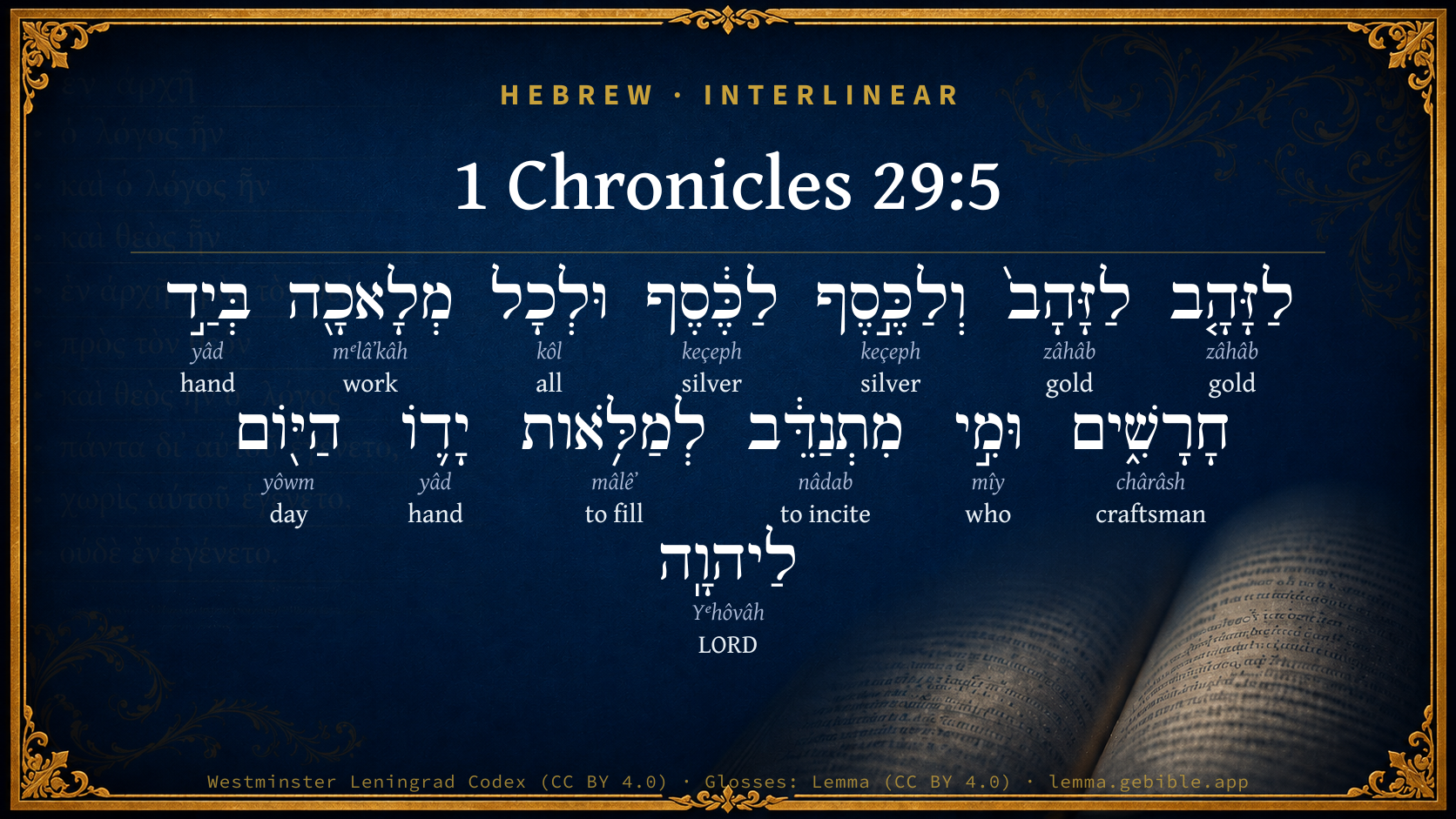
  1. לַזָּהָ֤ב zâhâb H2091 “to/for the · gold” Preposition, Determined + Noun, Common, Masculine, Singular, Absolute
  2. לַזָּהָב֙ zâhâb H2091 “to/for the · gold” Preposition, Determined + Noun, Common, Masculine, Singular, Absolute
  3. וְלַכֶּ֣סֶף keçeph H3701 “and · to/for the · silver” Conjunction + Preposition, Determined + Noun, Common, Masculine, Singular, Absolute
  4. לַכֶּ֔סֶף keçeph H3701 “to/for the · silver” Preposition, Determined + Noun, Common, Masculine, Singular, Absolute
  5. וּלְכָל kôl H3605 “and · to/for · all of” Conjunction + Preposition + Noun, Common, Masculine, Singular, Construct
  6. מְלָאכָ֖ה mᵉlâʼkâh H4399 “work” Noun, Common, Feminine, Singular, Absolute
  7. בְּיַ֣ד yâd H3027 “in/at · hand of” Preposition + Noun, Common, Both, Singular, Construct
  8. חָרָשִׁ֑ים chârâsh H2796 “craftsmen” Noun, Common, Masculine, Plural, Absolute
  9. וּמִ֣י mîy H4310 “and · who” Conjunction + Particle, Interrogative
  10. לְמַלֹּ֥אות mâlêʼ H4390 “to fill” Preposition + Verb, Piel, Infinitive Construct
  11. יָד֛וֹ yâd H3027 “hand · his” Noun, Common, Both, Singular, Construct + Suffix, Personal, 3rd Person, Masculine, Singular
  12. הַיּ֖וֹם yôwm H3117 “the · day” Particle, Definite Article + Noun, Common, Masculine, Singular, Absolute
  13. לַיהוָֽה Yᵉhôvâh H3068 “to/for · LORD” Preposition + Noun, Proper

About this verse

These counts appear in no published source. They are computed here, from the morphology-tagged text and Lemma’s own curated glosses. What Lemma adds →

14
words
11
distinct lemmas
Historical
section

Notable vocabulary

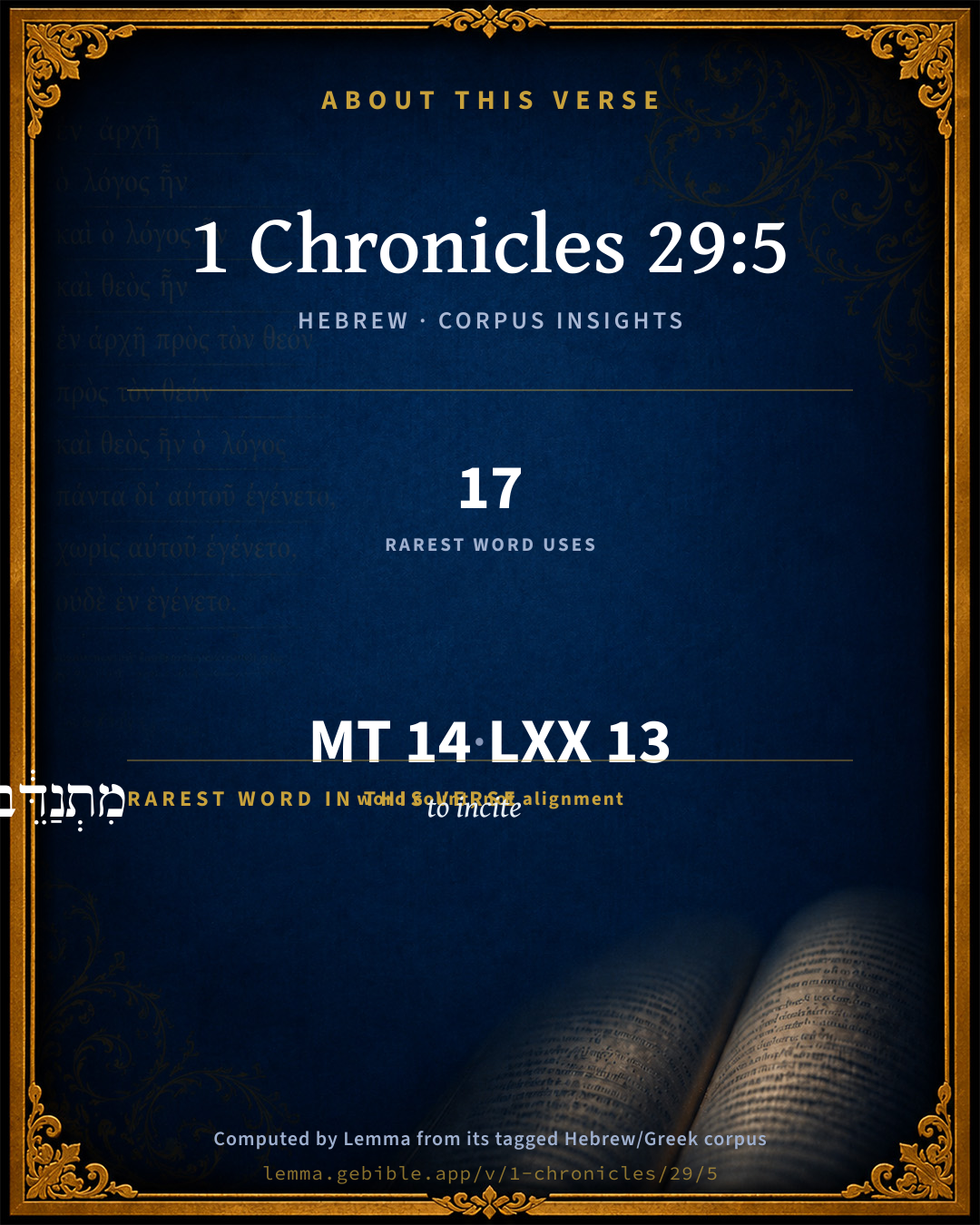
The rarest word here is מִתְנַדֵּ֔ב to incite H5068 — appearing just 17 times in the whole Hebrew Bible.

Shared distinctive vocabulary

מִתְנַדֵּ֔ב to incite H5068 occurs in 15 verses of the Hebrew Bible. Also found in:

Grammatical profile

  • 2 verbs
  • 11 nouns
  • 1 particle

Verb forms

  • מִתְנַדֵּ֔ב Hithpael · Participle Active
  • לְמַלֹּ֥אות Piel · Infinitive Construct

Repetition

Words recur within this verse — often emphatic in Hebrew:

  • לַזָּהָ֤ב gold H2091 ×2
  • וְלַכֶּ֣סֶף silver H3701 ×2
  • בְּיַ֣ד hand H3027 ×2

Hebrew & Septuagint length

In English translation the verse runs 40 words from the Hebrew and 41 from the Septuagint (LXX English) — closely comparable.

A rough comparison of the two English renderings, which tokenize alike — not a word-level alignment.

Word counts can differ between the Hebrew and the Greek without any difference in meaning — e.g. the Hebrew direct-object marker אֵת has no separate Greek word, and Greek often adds the article ὁ.

In the original languages it is 14 Hebrew tokens and 13 Greek tokens — but the two are counted differently (Hebrew bundles its prefixes and suffixes into one token; the Greek is in lemma form), so that isn’t a like-for-like length.

Cross-references

7

Topical passages linked to 1 Chronicles 29:5 in the Treasury of Scripture Knowledge — connected by theme and wording, ordered by reader-vote popularity; previews shown in the World English Bible.

  • Exodus 35:5–9 'Take from among you an offering to Yahweh. Whoever is of a willing heart, let him bring it, Yahweh's offering: gold, silver, brass,
  • Numbers 7:2–3 that the princes of Israel, the heads of their fathers' houses, offered. These were the princes of the tribes. These are they who were over those who were numbered:
  • Ezra 1:4–6 Whoever is left, in any place where he sojourns, let the men of his place help him with silver, and with gold, and with goods, and with animals, besides the freewill-offering for the house of God which is in Jerusalem.
  • Ezra 2:68–69 Some of the heads of fathers' [houses], when they came to the house of Yahweh which is in Jerusalem, offered willingly for the house of God to set it up in its place:
  • Ezra 7:15–16 and to carry the silver and gold, which the king and his counselors have freely offered to the God of Israel, whose habitation is in Jerusalem,
  • Exodus 25:2–9 "Speak to the children of Israel, that they take an offering for me. From everyone whose heart makes him willing you shall take my offering.
  • Numbers 7:10–89 The princes gave offerings for the dedication of the altar in the day that it was anointed, even the princes gave their offerings before the altar.

Cross-references courtesy of OpenBible.info (CC BY 4.0).

Hebrew and Greek witnesses Masoretic Hebrew ↔ Greek Septuagint

The same verse in the two great witnesses to the Old Testament, shown verse-for-verse.

These are two independent witnesses, not word-aligned to each other, and the Septuagint is shown in lemma (dictionary) form.

Hebrew 1 Chronicles 29:5 Masoretic · Westminster Leningrad Codex

לַזָּהָ֤ב לַזָּהָב֙ וְלַכֶּ֣סֶף לַכֶּ֔סֶף וּלְכָל מְלָאכָ֖ה בְּיַ֣ד חָרָשִׁ֑ים וּמִ֣י מִתְנַדֵּ֔ב לְמַלֹּ֥אות יָד֛וֹ הַיּ֖וֹם לַיהוָֽה

of gold for the [things of] gold, and of silver for the [things of] silver, and for all manner of work [to be made] by the hands of artificers. Who then offers willingly to consecrate himself this day to Yahweh?

World English Bible · Public Domain

Greek LXX 1 Chronicles 29:5 Septuagint · lemma form

διά χείρ τεχνίτης καί τίς ὁ προθυμόω πληρόω ὁ χείρ αὐτός σήμερον κύριος

for you to use the gold for things of gold, and the silver for things of silver, and for every work by the hand of the artificers. And who is willing to dedicate himself in work this day for the Lord?

LXX2012 (modern English Septuagint) · Public Domain

Hebrew: Westminster Leningrad Codex (CC BY 4.0). Greek: Septuagint (public domain); English from LXX2012 (modern English Septuagint) (Public Domain). How the Septuagint differs from the Hebrew →

Commentary

Notes on 1 Chronicles 29:5 from classic Christian and Jewish commentators (each source and its license shown beneath its notes). The classic Christian expositions comment on the surrounding passage and are grouped to its opening verse, so a note may address several verses; the Jewish commentaries on the Tanakh (Rashi and others) are per-verse, so they appear only where the commentator wrote on this verse.

Lemma curates 59 commentaries, every one of them public domain or Creative Commons licensed, each selected and text-cleaned for this edition rather than reprinted as found. About our sources →

Trapp's Complete Commentary

John Trapp

1Ch 29:5 The gold for [things] of gold, and the silver for [things] of silver, and for all manner of work [to be made] by the hands of artificers. And who [then] is willing to consecrate his service this day unto the LORD?

Ver. 5. And who then is willing?] For Virtus nolentium nulla est. See Exo 35:5. God careth not for that which is given with grudging. {2Co 9:7}

To consecrate his service.] Heb., To fill his hand, viz., with gold and other gifts.

John Trapp, A Commentary or Exposition upon All the Books of the Old and New Testament (1647–1656) — public domain. Text from a community e-Sword module.

The Biblical Illustrator

Joseph S. Exell

1Ch_29:5

And who then is willing to consecrate his service this day unto the Lord.

Consecration

I. Service. This demands--

1. A settled purpose.

2. An active resolve.

II. A welling service.

1. A willing service is the only efficient service.

2. The willingness of our service is the only part that is absolutely required.

III. An immediate service.

1. Seasons for service are never absent.

2. Efficiency and pleasure ensue when service is performed in its own time.

IV. The highest service. The service of the Lord implies--

1. That the mind is perpetually under the influence of Divine truth.

2. That holy thoughts are actuated by the presence of the Spirit in them.

3. Entire consecration. (Thos. Davies, D. D.)

Self-dedication

It does the heart good to read over those closing chapters of this book and to note the spirit which animated the generation for which the first temple was built. As regards the cost and beauty of our churches there is this to be borne in mind, that whatever our present shortcomings may be, there is one great difference between ourselves and the ancient people of God--that whereas all their gifts were offered for a single building, we have to maintain all the churches in the kingdom, which in number must be fast approaching twenty thousand. But large as are the sums which have been spent, and are daily being spent on church building and church restoration, there is one offering which God values more than any other gift, and which each of us, from highest to lowest, may offer if we will--a perfect heart. (F. E. Paget.)

Consecration to Gods service

I. The nature of the service required. The service of God is a phrase which amounts to much the same thing as the worship of God.

1. Servitude sometimes arises from--

(1) Subjugation or conquest.

(2) Hereditary succession. Some men are born servants or slaves. The servitude which God requires is a servitude which makes the servant free.

2. The service which God requires involves--

(1) Divine illumination.

(2) Pure and ardent love.

(3) Continued and unceasing obedience.

II. What are the obligations under which we are all placed to render such service to the Almighty?

1. It is the duty of man to obey and serve Him.

2. Such service is very profitable and beneficial to man.

3. It is a refuge to its subject in the day of trouble.

4. It is an antidote to the fear of death.

III. That the service of God is indispensable.

1. Because it is the commandment of God.

2. The grand design of human life is the service of God.

3. The service of God is the only means of salvation.

IV. I come now to propose the inquiry, Who then is willing? etc.

1. The service of God is a willing service.

2. I address myself

(1) To the aged.

(2) To those in the prime and activity of life.

(3) More especially to the young. Lock--

(a) At the magnitude of the work.

(b) The difficulty with which it may afterwards be accomplished.

(c) The shortness and uncertainty of life.

(d) The consequences that will follow from this early devotement of yourselves unto God. Objections:

1. Time enough yet.

2. I shall lose my friends if I embrace in my youth the religion of Jesus Christ. It was once said by an ancient philosopher, Caesar is my friend--I have nothing to fear; and a greater than Caesar is here. Jesus is a friend that sticketh closer than a brother.

3. To embrace religion in youth will expose to obloquy and shame. Was it not said by one of the ancients that where God is there can be no exile--no banishment from His presence?

4. God is merciful, and we may get religion when we please. You may reckon on mercy until you are taken out of the world without it; and there is no mercy beyond the gates of death. (W. Tease.)

Who is willing to serve God

I. The nature of the service which God demands.

1. It is spiritual. It is the homage and devotion of the heart. All the intellectual powers, the understanding, will, affections, conscience, memory are to be dedicated to the worship of God. Without this no service can be acceptable to God (Isa_1:11; Isa_1:13; Mat_15:8-9).

2. It is to be constant and unremitting (1Co_10:31).

3. It must be affectionate. It is impossible for us to offer any acceptable service to God which does not spring from this love in our heart (1Jn_5:3). How is this to be obtained? The answer is Very plain (Eph_4:22-24). Thus God will create a clean heart, and renew a right spirit within you.

4. It must be practical (Mat_5:16; 1Co_9:27; 2Co_10:5).

II. The service which God requires of us should be performed without delay.

1. It is enjoined upon us by the Scriptures (Heb_3:15; Jos_24:15; 2Co_6:2). You have no certainty that any further opportunities will be afforded in which you may serve God (Pro_27:1; Luk_13:25-27).

3. The longer you defer entering into the service of God the more difficulties and obstacles will be thrown in your way. How absurd the notion that futurity will present more favourable opportunities for serving God than any with which we have yet been blessed. Suppose a sick man were to say, As long as this disorder remains upon me, and the more deeply my constitution is affected by it, the more certainly shall I receive a speedy cure. Would you consider this person to be perfectly sane? Or should one of your debtors assure you that by your increasing his obligations to you some three or four fold he would be immediately able to cancel the whole, would you believe him? The longer you live in sin the more grievously do you provoke God. You crucify to yourselves the Son of God afresh. It is awfully possible for men to outlive the day of grace (Psa_95:11).

4. Our services will be more acceptable now than they can possibly be at any future period.

III. Let us now consider the import of the question, Who then is willing? etc.

1. It carries with it the assumption that God is waiting to accept your service.

2. It implies also that every one possesses the ability to consecrate his service unto God.

3. We are taught by the text that there is a disinclination in the heart of man to submit himself to the will of God.

Conclusion:

1. This is the most honourable service in which you can engage

2. It is pleasant (Pro_3:17; Isa_32:17; Psa_16:3; Isa_2:5).

3. It is reasonable (Act_17:28).

4. It is the only service which secures a vast reward (1Co_2:9). (R. Treffry.)

Consecration

The New Version reads, Who then offereth willingly to consecrate himself this day unto the Lord. This preferable reading suggests the theme of self consecration to God.

I. What this consecration involves. A man may consecrate many things to God and yet not consecrate himself. God does not value s mans money, time, talents, if he withholds himself. Consecration of self involves--

1. The heart. This is the seat of our affections, the love of our nature, end the fountain from which flows everything that constitutes the character. Give me thine heart.

2. The body. The body as well as the soul is the temple of God (1Co_6:15; 1Co_6:19; Eph_5:30). Self-consecration covers our whole being--body, soul, and spirit. It will also embrace our time, talents, wealth.

II. The claim which God has to this self-consecration. His claim results--

1. From His love. God loves us. The love of a father constitutes a claim to the love of a dutiful son, how much more to the love of a prodigal son.

2. From the way in which God has consecrated or sanctified Himself for us. He gave Himself for me.

3. He asks our self-consecration to His service because it is the best thing we can do for ourselves.

III. This self-consecration is immediate duty.

1. It is a great mistake for any to withhold self-consecration because they are too young. It is easier to be pure, and truthful, and loving, and diligent in the service of God when young than it will be to practise those virtues when old, if you have neglected them when young. The habits formed by a life of sin and neglect of God are like iron chains that you cannot easily break. Many who once said they were too young are now saying they are too old.

2. The sooner you commence to serve God the more you will be able to accomplish.

3. The present may be your only opportunity. We have been speaking specially to the young; but this is also a word for the aged. It is a delightful thing to see the young decide for Christ, but it is a sad thing to see the parents left behind. I was deeply impressed with this one day. I was on a visit close to the east coast where so many wrecks had recently taken place; among them was a vessel at the mouth of the Tyne. It was Christmas day, and on the pier among the crowd of spectators stood the son of the captain, watching and waiting for his father; for he was expected to be at home on that festive day. Probably as they gazed at each other a violent sea struck the vessel, and it sunk with all hands--wrecked within sight of port and within sight of friends. Parents, are there none of your children who have decided for Christ, and are standing on the Rock and looking out and expecting you home? Shall they see you wrecked within sight of port? (Absalom Clarke.)

Service for God

Men make a great deal of to-morrow. God always and everywhere lays stress on to-day. Day by day God supplies, and day by day He asks us to serve. In reference to this service we want to try and answer three questions.

I. Who is it asks for it?

II. Why does he want it? God wishes to use men, because by this means He can bestow richer blessing upon them than He could in any other way.

III. How may we render it?

1. By yielding your heart to Him.

2. By living an upright, consistent, unselfish life.

3. By earnest loving effort.

4. By helping and encouraging His people. (J. D. Kilburn.)

Christian consecration

I. Christian consecration is a personal thing: Who?

II. Christian consecration is a voluntary thing: Who is willing?

III. Christian consecration is an active thing: His service.

IV. Christian consecration is a reasonable thing: Unto the Lord.

V. Christian consecration is a prompt thing: This day.

VI. Christian consecration is a sympathetic thing: it prompts the consecrated to commend the grace of God to others and press the question, Who is willing? etc. (Thos. Kelly, D. D.)

Consecration

A great disappointment in life is often a terrible experience. A picturesque writer compares the setting of a secret hope to the setting of the sun. The brightness of life seems gone. And such might well to some extent have been the experience of David. He had set his heart on erecting the temple on Mount Zion. We may judge, then, what a collapse fell on his intensest interest and expectation when the decree issued that the work was not to be done by him. Instead of sinking into sullen apathy, or the inertness of despair, he devoted himself with renewed and consecrated energy to gather the materials necessary for the work, and in the text he appeals to and seeks to stimulate the people. The consecration here required--

I. Must have in it the element of spontaneity. We must know what love to God really is, and we must feel the spell of its sweet strength. As to the form in which our love is to manifest itself, that is a question of inferior importance. We know that our love to our fellow creatures is not conformed to any common or uniform law; it is sometimes radiant in a smile, flippant on the tongue; its speech bewrayeth itself; it asserts itself irrepressibly in a thousand ways. In other cases it is reticent, it is reserved, it is like the image of moon or star in a mountain tam, it abideth alone; few ever see it; and yet in both cases it is deep and sincere, strong even as death. The great question is not as to how our love is to express itself, but as to whether it really exists at all, the supreme power of the soul, a living and present reality within us. One of our poets represents a wretched slave, in reply to the query of her master in respect to her affection for himself, as replying with a gladness-glamoured, Yes, with her lips, when her heart, burned to say, No. The sad, pathetic picture of the poet is the precise converse of what we are now insisting upon, namely, that the professed devotion of ourselves to God must be the gift of love, or can He do else than spurn the sacrifice altogether?

II. Must be a whole-hearted, undivided thing--body as well as soul. The later representatives of the Gnostics held that the body was so wholly bad as to be beyond redemption; that it did not matter what became of it; that it might be plunged into the blackest depths of vicious excess and that the spirit within would contract no defilement and suffer no detriment. Accordingly the primitive Christians were in imminent peril of being seduced into the immoralities which abounded around them. Hence the warnings which abound in apostolic Epistles against lasciviousness, revelling, banquetings, and such like. Why should we not feel respecting the body that it is as truly consecrated to God in the case of a Christian as the soul can be?

III. This consecration is no cheap or easy thing. We must not offer unto God that which costs us nothing.

1. There is the cost of self-discipline.

2. The diligent and laborious use of the means of grace. (Dean Forrest.)

Consecration

I do not know a question in the sacred volume more full of import, or more adapted to press upon the heart.

I. We shall explain what we regard as the consecration of service to God.

1. There must be correct views of the Divine character and claims, as they are revealed in the record of His word. You must receive Him as He there appears.

(1) The God of creation.

(2) The God of providence.

(3) The God of redemption.

2. A practical obedience to the will of God, whether expressly declared, or whether to be inferred from His revealed attributes.

3. The use of active exertion to promote the Divine glory in the world. Religion does not only direct our attention to duties which pertain exclusively to our own personal characters and interests; it also prompts a concern for the improvement and welfare of our fellow-men. It is not equivocal testimony that your own hearts are given to God in faith and true holiness when you desire to be instrumental in restoring the authority of His law over the minds and lives of others.

II. We shall present the considerations which ought to urge to as engagement in the service of God.

1. We are placed under universal and imperative obligation to do so.

2. The influence His service has in preventing the degradation and promoting the dignity of our nature. The habits of men must always according to their moral nature tend to degrade or dignify. He who is truly devoted to God, whatever be his deficiencies and disadvantages in other respects, is placed on a far higher eminence than can ever be attained by the most arduous aspirations of the carnal mind. Must not that bestow transcendent dignity which writes the law of Jehovah on the heart, renders the body a living temple and an habitation of God, places the thoughts and employments of men in a sphere where they become associated with prophets and apostles and martyrs of the Redeemer and the Redeemer Himself, and where they are blended with the sublime realities of the invisible and eternal world? The service of God ennobles all that it comprehends; it is as the rose which gave its fragrance to the very clay; it is as the sunbeam which tints with a fresh hue of beauty and splendour the forms of earth, and causes them to reflect its own glory.

3. The true and solid pleasure His service communicates to the soul. Here is--

(1) Peace with God.

(2) Freedom from the dominion of sin.

(3) Redemption from the terror of the curse.

(4) The confidence of rectitude and pardon.

(5) The inspiration which springs from a participation in the triumphs of pure benevolence and love.

(6) The possession of privileges which, from the consolations of time, shall rise to the happiness of eternity.

4. The glorious recompence by which the engagements of His service are consummated.

III. We shall impress the question by which, to an engagement in the service of God, you are emphatically challenged. Who is willing? What excuses can you propose to justify a negative. You are too young. Suffer little children to come unto Me. You are too poor. The Saviour came to preach the gospel to the poor. You are too guilty. The Son of Man came to seek and to save that which was lost. You are prevented by worldly attachments. He that loveth father or mother more than Me is not worthy of Me, etc. You are deterred by threatening of persecution. Whosoever will save his life shall lose it, etc. (James Parsons.)

The true idea of the Christian life

I. This is Gods appeal for service.

II. Service is the true idea of the Christian life. For religion is not a mere viaticum to carry the soul to glory;but a power and support required during life, and not in death only.

III. Service implies obedience, self-denial, and activity. Such a work requires generosity and earnestness, resembling the zeal of the Jews in building their temple.

IV. The service of God requires a voluntary and distinct consecration.

V. The service of God is of the most pressing urgency. It should be this day. (L. H. Byrnes, B. A.)

The act of the will

In making our choice there is a determined act of our own will. To be willing is one thing; to will is another thing. We may be entirely willing, for instance, to go to some other country--say America--and such willingness may continue for years; but unless you will to go, you will never reach there. Our choice involves a definite act of the will; we may think about religion; we may talk about religion; we may be kindly affected towards religion; but we are called to do more. We are called to make a determined act of our will and to make our choice. You have seen a grand vessel about to be launched. Everything was ready for her departure from dry land. Every impediment had been removed but one, and that was the one which prevented her from entering the element on which she was to sail. One single block hound her to earth. It was in itself a mere trifle. A blow of the hammer wielded by a vigorous arm would set her free; but let that block remain untouched, and no onward movement would be made by the gallant ship. The hammer swings in the air; the blow is struck; she rushes into the great deep, where she floats with ease and grace as one born to it as her own possession. That stroke of the hammer corresponds to the act of the will--the deliberate resolution taken and made to consecrate oneself to Christ and to God. It must be taken, or the journey will never be traversed. (Cameron Lees, D. D.)

Complete consecration

I give Thee all--I keep back nothing for myself. Such was the motto engraved upon the ring and seals of the great Reformer Calvin. The words were deeply cut in what was solid, whether of metal or stone. They were ever carried about him, ever present with him. He meant them to be unchangeable by engraving them where he did. Offered willingly:--Rich mens presents are gold and silver, or other costly things. Mine must be recommended by the affectionate pleasure with which I give them. (The Ven. Bede when dying.)

The Biblical Illustrator, edited by Joseph S. Exell (c. 1880s–1900s) — public domain. Text from a community e-Sword module.

Joseph Benson's Commentary

1Ch 29:5. Who then is willing to consecrate to this service? — To offer an offering, as I have done. Hebrew, to fill his hand unto the Lord. They that engage themselves in the service of God will have their hands full: there is work enough for the whole man in that service.

Joseph Benson's Commentary on the Old and New Testaments (1811–1818) — public domain. Text from a community e-Sword module.

Geneva Bible (1599)

Geneva Bible translators

He was not only liberal himself, but provoked others to set forth the works of God.

Or, to offer.

Geneva Bible (1599) marginal notes — public domain. Text via Bolls.life.

Jamieson, Fausset & Brown

Robert Jamieson, A. R. Fausset & David Brown

who then is willing to consecrate his service--Hebrew, "fill his hand"; that is, make an offering (Exo 32:29; Lev 8:33; Kg1 13:33). The meaning is, that whoever would contribute voluntarily, as he had done, would be offering a freewill offering to the Lord. It was a sacrifice which every one of them could make, and in presenting which the offerer himself would be the priest. David, in asking freewill offerings for the temple, imitated the conduct of Moses in reference to the tabernacle (Exo 25:1-8).

Jamieson, Fausset & Brown — Commentary Critical and Explanatory on the Whole Bible (1871) — public domain (CC PDM 1.0). Text via the HelloAO Bible API.

Adam Clarke's Commentary

Verse 5. To consecrate his service] למלאות ידו lemalloth yado, to fill his hand; to bring an offering to the Lord.

Adam Clarke's Commentary on the Bible (1810–1826) — public domain. Text from a community e-Sword/MySword module.

Ellicott's Commentary for English Readers

(5) The gold for things of gold.—Literally. as for the gold, for the gold, and as for the silver for the silver—Scil., “I give it” (1Ch_29:3)—and for every work by hand of craftsmen.

And who then is willing to consecrate his service?—Literally, And who volunteers (Jdg_5:1) to fill his hand to-day for Jehovah? To fill his hand: that is, with a liberal offering (Exo_32:29).

A Bible Commentary for English Readers, edited by Charles John Ellicott (1878–1897) — public domain. Text from a community e-Sword module.

The Cambridge Bible for Schools and Colleges

gen. ed. J. J. S. Perowne

5. the gold for things of gold, and the silver for things of silver] R.V. of gold for the thing of gold, and of silver for the things of silver.

And who then is willing to consecrate his service] R.V. Who then offereth willingly to consecrate himself. The phrase to consecrate himself (Hebrew, to fill his hand) means properly to make himself a priest. The offering of gifts is regarded as a priestly act, in the performance of which the layman “makes himself a priest.” Cp. 2Ch_13:9, note.

The Cambridge Bible for Schools and Colleges (gen. ed. J. J. S. Perowne; Cambridge University Press, 1878–1918) — public domain. Text from a community e-Sword module.

John Gill's Exposition

The gold for things of gold, the silver for things of silver,.... The one for what was to be overlaid with gold, the other for what was to be overlaid with silver:

and for all manner of work to be made by the hands of artificers; what remained was to be made use of in employing artificers in making vessels for the temple that were needful:

and who then is willing to consecrate his service this day unto the Lord; or fill his hand? (k) and give largely and liberally towards building an house for the service and worship, honour and glory, of God; and David, having set so good an example, could with the better grace recommend the good work to his nobles and people, and which had its desired effect, as follows.

(k) "impleat manum suam", V. L. "ut impleat manum suam", Vatablus, Piscator.

John Gill's Exposition of the Whole Bible (1746–1763) — public domain (CC PDM 1.0). Text via the HelloAO Bible API.

Albert Barnes' Notes on the Bible

To consecrate his service - literally, as in the margin, “to fill his hand,” i. e., “to come with full hands to Yahweh.” The words contain an appeal to the assembly for voluntary offerings.

Albert Barnes' Notes on the Bible (1834–1885) — public domain. Text from a community e-Sword/MySword module.

Haydock's Catholic Bible Commentary

Fill his hand, is an expression applied to priests, by which David imitates, that any one may now offer a species of sacrifice to the Lord, Judges vii. 5., and Exodus xxxii. 29. (Calmet) (Menochius) --- He wishes them to act with generosity. (Haydock)

George Leo Haydock (1774–1849), Haydock's Catholic Family Bible and Commentary, 1859 edition — public domain. Excludes Psalms (Douay-Rheims chapter numbering differs from Protestant) and Deuterocanonical books (Catholic canon only).

Matthew Poole's English Annotations

To consecrate his service, Heb. to fill his hand, i.e. to offer an offering, as Exo 32:29; Lev 8:33, as I have done.

Matthew Poole's English Annotations on the Holy Bible (1683–1685) — public domain. Text from a community e-Sword/MySword module.

Whedon's Commentary on the Bible

Daniel D. Whedon

5. To consecrate his service — Rather, as the margin, to fill his hand to-day for Jehovah; that is, to draw near with his hands full of gifts to Jehovah.

Daniel D. Whedon (gen. ed.), Commentary on the Old and New Testaments (1874–1909) — public domain. Text from a community e-Sword module.

The Pulpit Commentary

The Authorized Version, to consecrate his service, might in this instance seem to be not merely an inaccurate but an incorrect translation. For David"s evident meaning was, after rehearsing his own example, to base on it the appeal, Who is willing to bring all ungrudging handful this day to the Lord? and 2Ch_13:9 might perhaps be cited as a confirmatory instance. But on the other hand, the idiom was evidently, by the witness of many passages, a general one, and the meaning of it is not incorrectly conveyed in the Authorized Version, where service means in every ease active and practical help (Exo_28:41 Exo_29:9 Exo_32:29; Num_3:3, etc.) The question now is not one of consecrating heart and affection, but rather of giving the practical proof of them.

Consecrated service.

These words are an appeal of David to the nobles, and" to the people generally, to contribute towards the building of the temple of Jehovah at Jerusalem. Ha himself set the example of liberality; and his subjects generally followed the example he gave. "Who then," asked he, "is willing to fill his hand this day unto the Lord?" As these gifts were really an expression of the devotion that animated the hearts of the Israelites, the English Version may be said to offer rather an enlargement than a perversion of the language. And the question is one which may be addressed to all hearers of the gospel. For all are called upon to give themselves and all they have and are unto the God who made them, and the Redeemer who bought them. We have here

I A CLAIM AFFIRMED. Religion not only offers a blessing, it requires a service. Salvation is the substance of what God gives; consecration is what God demands. Salvation is from past sin; consecration is for future life and service. God has a right to the surrender of our will, the devotion of our powers, the offering of our possessions, the service of our hands. The heart is his first demand; our labours, our influence, our liberality, will all follow. This is a just claim. It is founded on Divine right and authority; for he is our Creator and King, He has a powerful claim upon our gratitude; for he has treated us with bounty, and he has given us his Son to redeem us from iniquity and from destruction. We are for ever dependent upon him, who is our Lord and Judge; and, in giving unto him, we do but give him his own.

II THE RESPONSE EXPECTED.

1. A willing response. In fact, there can be no unwilling response. God does not use constraint, and a grudged offering would not be acceptable to him; for it is our affection and devotion that he desires.

2. An immediate response. "Who is willing this day?" To-day is not too early; to-morrow may be too late. The old have no time to lose. The middle-aged and busy should not leave decision until old age comes, if come it should. But it is chiefly from the young that an immediate acceptance of the invitation of the gospel is desired, that so they may spend a whole life in his delightful service. "To-day if ye will hear his voice, harden not your heart.

III AN APPEAL URGED. "Who is willing?" All who are capable of understanding the entreaty and the ground upon which it is based; all who enjoy religious privileges, who hear God"s Word, Christ"s gospel, are under a sacred obligation to yield themselves a living sacrifice unto God. Motives, inducements, persuasions, all are brought to bear upon the soul. A most honourable and happy service, the most desirable recompense, the profoundest satisfaction, all are proffered to you upon the terms of unconditional surrender, complete consecration. "Who then is willing to consecrate his service this day unto the Lord? T.

The Pulpit Commentary (1880–1919), ed. H.D.M. Spence-Jones & Joseph S. Exell — public domain. Text from a community e-Sword module.

John Wesley's Explanatory Notes

To consecrate - To offer an offering, as I have done. Hebrew. To fill his hand unto the Lord. They that engage themselves in the service of God, will have their hands full: there is work enough for the whole man in that service.

John Wesley, Explanatory Notes Upon the Whole Bible (1754–1765) — public domain. Text via the GEBible commentary corpus.

Keil & Delitzsch

C. F. Keil & F. Delitzsch

The gold for things of gold, the silver for things of silver,.... The one for what was to be overlaid with gold, the other for what was to be overlaid with silver:

and for all manner of work to be made by the hands of artificers; what remained was to be made use of in employing artificers in making vessels for the temple that were needful:

and who then is willing to consecrate his service this day unto the Lord; or fill his hand? (k) and give largely and liberally towards building an house for the service and worship, honour and glory, of God; and David, having set so good an example, could with the better grace recommend the good work to his nobles and people, and which had its desired effect, as follows.

(k) "impleat manum suam", V. L. "ut impleat manum suam", Vatablus, Piscator.

Keil & Delitzsch — Biblical Commentary on the Old Testament (1861–1891) — public domain (CC PDM 1.0). Text via the HelloAO Bible API. (Old Testament only.)

Rashi

Rabbi Shlomo Yitzchaki (Rashi)

The gold for the gold and the silver for the silver and for all the work (and I gave it) into the hands of the craftsmen the artisans, and this is what I prepared for the Temple, and although I amassed all this... and whoever of you... volunteers to consecrate himself today for the Lord to bring gold, silver, or anything for the building, on the model of (Ex. 35:22): “... all moved by their hearts: they brought brooches and nose-rings.”

to consecrate lit., to fill his hand; on the model of (ibid. 29:9): “... and you shall fill the hand... of Aaron and the hand of his sons,” which the Targum renders: “and you shall offer up the sacrifice of Aaron.”

Rashi on the Tanakh — English translations: “The Judaica Press complete Tanach with Rashi, translated by A. J. Rosenberg” (CC BY 4.0); “Pentateuch with Rashi's commentary by M. Rosenbaum and A.M. Silbermann, 1929-1934” (public domain); “The Metsudah Tanach series, Lakewood, N.J” (CC BY 4.0); and “The Book of Joshua, Metsudah Publications, 1997” (CC BY 4.0). Text via Sefaria.

Lesson kit

Teaching starters — assembled from the data on this page, not authored interpretation. Every prompt links to the verse data it draws on. Edit before teaching.

1 Chronicles, in the Historical, opens this verse with 14 words (11 distinct Hebrew lemmas). Its most distinctive word is nâdab (“to incite”). A historical commentator’s framing appears above. Read the whole chapter for the surrounding context.

Discussion questions

  1. How does “to incite” (nâdab) shape what this verse is saying?
  2. How does Exodus 25:2, which shares the word «to incite», read alongside this verse?
  3. What does the repetition of “gold” (2× in this one verse) do in this verse?
  4. The translations on this page render this verse differently — a whole-verse word diff, not a word-by-word alignment. What might account for the different wordings?
  5. «מִתְנַדֵּ֔ב» is a Hithpael Participle Active verb. How does that grammatical form shape the action described?
  6. Compare how Trapp's Complete Commentary and The Biblical Illustrator read this verse. Where do they agree or differ?

Things to notice

Reading settings

Reading text

Shown beneath each verse's original-language words.

Old Testament
Old Testament edition

Read the OT as the Masoretic Hebrew (MT) or the Greek Septuagint (LXX).

English shown for the Greek Septuagint (in the Hebrew ↔ Greek comparison).

Comparing translations? Open the Compare panel on any verse page to stack up to four side by side.