

1 Chronicles 23:24

Hebrew (Westminster Leningrad Codex) 1 Chronicles 23:24 appears in the Hebrew Old Testament. The text above is from the Westminster Leningrad Codex. Each word links to its Strong’s number, a concise gloss, and parsing drawn from the Open Scriptures Hebrew Bible morphology. Click any word for its full Brown-Driver-Briggs (BDB) entry.
Download image
Cite this verse

1 Chronicles 23:24 (World English Bible). Public Domain. Lemma interlinear Bible study tool, https://lemma.gebible.app/v/1-chronicles/23/24.

Show BibTeX & RIS
BibTeX
RIS
English Translation
These were the sons of Levi after their fathers' houses, even the heads of the fathers' [houses] of those of those who were counted, in the number of names by their polls, who did the work for the service of the house of Yahweh, from twenty years old and upward.
World English Bible · Public Domain
Download a study sheet

One document with this verse’s original text, its word-by-word gloss line, the meaning frame, cross-references with their text, attributed commentary, and full source and license credits — printable, and it pastes into notes with its structure intact.

This verse Autodidact and up

Study sheet (.html) Plain text (.txt)

A passage Seminary Student

Up to 50 verses in one chapter. A passage sheet keeps up to 6 commentary sources and 12 cross-references per verse, in the order this page ranks them, and says so on the sheet whenever that leaves anything out. Ask for a single verse and you get the Autodidact verse sheet above.

Everything on this page stays free to read, with no account — the sheet is a download of what is already on screen, not access to it.

Want to remove ads? Support Godless Engineer
Compare translations 3

The same verse in 3 English versions, stacked beneath the original-language interlinear above. Click any original word for its lexicon entry.

Each is an independent rendering of the whole verse — the interlinear is not word-aligned to these translations.

Highlighted words mark where these versions differ — a whole-verse word diff, not a word-by-word alignment.

  • World English Bible Public Domain
    These were the sons of Levi after their fathers' houses, even the heads of the fathers' [houses] of those of those who were counted, in the number of names by their polls, who did the work for the service of the house of Yahweh, from twenty years old and upward.
  • King James Version Public Domain
    These were the sons of Levi after the house of their fathers; even the chief of the fathers, as they were counted by number of names by their polls, that did the work for the service of the house of the LORD, from the age of twenty years and upward.
  • unfoldingWord Literal Text CC BY-SA 4.0
    These the sons of Levi according to the house of their fathers, heads of fathers, by their appointments, in the numbering of names by their skulls, the doer of the work of the service of the house of Yahweh, from sons of 20 years and above.

unfoldingWord Literal Text — © unfoldingWord, licensed CC BY-SA 4.0. Word-aligned USFM3 via Door43 (git.door43.org/unfoldingWord/en_ult).

Versions to compare (up to 4)

3 of 4 selected

Show all 18 translations

Every available English version of this verse, each an independent rendering of the whole verse.

  • World English Bible Public Domain
    These were the sons of Levi after their fathers' houses, even the heads of the fathers' [houses] of those of those who were counted, in the number of names by their polls, who did the work for the service of the house of Yahweh, from twenty years old and upward.
  • Berean Standard Bible Public Domain
    These were the descendants of Levi by their families—the heads of families, registered individually by name—those twenty years of age or older who worked in the service of the house of the LORD.
  • Majority Standard Bible Public Domain
    These were the descendants of Levi by their families—the heads of families, registered individually by name—those twenty years of age or older who worked in the service of the house of the LORD.
  • King James Version Public Domain
    These were the sons of Levi after the house of their fathers; even the chief of the fathers, as they were counted by number of names by their polls, that did the work for the service of the house of the LORD, from the age of twenty years and upward.
  • American Standard Version (1901) Public Domain
    These were the sons of Levi after their fathers' houses, even the heads of the fathers' `houses' of those of them that were counted, in the number of names by their polls, who did the work for the service of the house of Jehovah, from twenty years old and upward.
  • Revised Version (1885) Public Domain
    These were the sons of Levi after their fathers’ houses, even the heads of the fathers’ houses of those of them that were counted, in the number of names by their polls, who did the work for the service of the house of the LORD, from twenty years old and upward.
  • Geneva Bible (1599) Public Domain
    These were the sonnes of Leui according to the house of their fathers, euen the chiefe fathers according to their offices, according to the nomber of names and their summe that did the worke for the seruice of the house of the Lord from the age of twentie yeeres and aboue.
  • Douay-Rheims (1899) Public Domain
    These are the sons of Levi in their kindreds and families, princes by their courses, and the number of every head that did the works of the ministry of the house of the Lord from twenty years old and upward.
  • Young's Literal Translation Public Domain
    These `are' sons of Levi, by the house of their fathers, heads of the fathers, by their appointments, in the number of names, by their polls, doing the work for the service of the house of Jehovah, from a son of twenty years and upward,
  • Literal Standard Version CC BY-SA 4.0
    These [are] sons of Levi, by the house of their fathers, heads of the fathers, by their appointments, in the number of names, by their counted heads, doing the work for the service of the house of YHWH, from a son of twenty years and upward,
  • Unlocked Literal Bible CC BY-SA 4.0
    These were Levi's descendants corresponding to their clans. They were the leaders, counted and listed by name, of the clans that did the work in the service of Yahweh's house, from twenty years old and upward.
  • unfoldingWord Literal Text CC BY-SA 4.0
    These the sons of Levi according to the house of their fathers, heads of fathers, by their appointments, in the numbering of names by their skulls, the doer of the work of the service of the house of Yahweh, from sons of 20 years and above.
  • Darby Bible Public Domain
    These were the sons of Levi according to their fathers' houses, the chief fathers, as they were reckoned, by number of names by their polls, who did the work of the service of the house of Jehovah, from twenty years old and upward.
  • World Messianic Bible Public Domain
    These were the sons of Levi after their fathers’ houses, even the heads of the fathers’ houses of those who were counted individually, in the number of names by their polls, who did the work for the service of the LORD’s house, from twenty years old and upward.
  • Webster's Bible Public Domain
    These were the sons of Levi after the house of their fathers; even the chief of the fathers, as they were counted by number of names by their polls, that did the work for the service of the house of the LORD, from the age of twenty years and upward.
  • Free Bible Version CC BY-SA 4.0
    These were the descendants of Levi by family, the heads of families chiefs listed individually by name—those twenty years of age or more who served in the house of the Lord.
  • Bible in Basic English Public Domain
    These were the sons of Levi, grouped by families, the heads of the families of those who were numbered by name, by heads, all those of twenty years old and over who did the work of the house of the Lord.
  • JPS Tanakh (1917) Public Domain
    These were the sons of Levi after their fathers' houses, even the heads of the fathers' houses, according to their muster, in the number of names by their polls, who did the work for the service of the house of the LORD, from twenty years old and upward.

Literal Standard Version (2020), Covenant Press — licensed CC BY-SA 4.0. Text via the HelloAO Bible API (eBible.org). Unlocked Literal Bible (unfoldingWord) — licensed CC BY-SA 4.0. Text via the HelloAO Bible API (eBible.org). unfoldingWord Literal Text — © unfoldingWord, licensed CC BY-SA 4.0. Word-aligned USFM3 via Door43 (git.door43.org/unfoldingWord/en_ult). Free Bible Version, Dr. Jonathan Gallagher — licensed CC BY-SA 4.0. Text via the HelloAO Bible API (eBible.org).

Word by word

More ways to search: Search by grammar → Find every occurrence → Compare this word →

Practice this passage: Drill this verse → Learn its vocabulary →

לְגֻלְגְּלֹתָ֔ם
gulgôleth
H1538
“to/for · skulls · their”
Preposition + Noun, Common, Feminine, Plural, Construct + Suffix, Personal, 3rd Person, Masculine, Plural
Part of Speech
Preposition + Noun
Type
Common
Gender
Feminine
Number
Plural
State
Construct
Full BDB Definition

Origin: by reduplication from H1556

TWOT: 353l

head, poll, skull - skull - head, poll (of census)
  1. אֵ֣לֶּה ʼêl-leh H428 “these” Pronoun, Demonstrative, Common, Plural
  2. בְנֵֽי bên H1121 “sons of” Noun, Common, Masculine, Plural, Construct
  3. לֵוִי֩ Lêvîy H3878 “Levi” Noun, Proper
  4. לְבֵ֨ית bayith H1004 “to/for · house of” Preposition + Noun, Common, Masculine, Singular, Construct
  5. אֲבֹתֵיהֶ֜ם ʼâb H1 “fathers · their” Noun, Common, Masculine, Plural, Construct + Suffix, Personal, 3rd Person, Masculine, Plural
  6. רָאשֵׁ֧י rôʼsh H7218 “heads of” Noun, Common, Masculine, Plural, Construct
  7. הָאָב֣וֹת ʼâb H1 “the · fathers” Particle, Definite Article + Noun, Common, Masculine, Plural, Absolute
  8. לִפְקוּדֵיהֶ֗ם pâqad H6485 “to/for · visited · them” Preposition + Verb, Qal, Participle Passive, Masculine, Plural, Construct + Suffix, Personal, 3rd Person, Masculine, Plural
  9. בְּמִסְפַּ֤ר miçpâr H4557 “in/at · number of” Preposition + Noun, Common, Masculine, Singular, Construct
  10. שֵׁמוֹת֙ shêm H8034 “names” Noun, Common, Masculine, Plural, Absolute
  11. עֹשֵׂה֙ ʻâsâh H6213 “doing” Verb, Qal, Participle Active, Masculine, Singular, Construct
  12. הַמְּלָאכָ֔ה mᵉlâʼkâh H4399 “the · work” Particle, Definite Article + Noun, Common, Feminine, Singular, Absolute
  13. לַעֲבֹדַ֖ת ʻăbôdâh H5656 “to/for · service of” Preposition + Noun, Common, Feminine, Singular, Construct
  14. בֵּ֣ית bayith H1004 “house of” Noun, Common, Masculine, Singular, Construct
  15. יְהוָ֑ה Yᵉhôvâh H3068 “LORD” Noun, Proper
  16. מִבֶּ֛ן bên H1121 “from · son of” Preposition + Noun, Common, Masculine, Singular, Construct
  17. עֶשְׂרִ֥ים ʻesrîym H6242 “twenty” Adjective, Cardinal number, Both, Plural, Absolute
  18. שָׁנָ֖ה shâneh H8141 “year” Noun, Common, Feminine, Singular, Absolute
  19. וָמָֽעְלָה maʻal H4605 “and · above · toward” Conjunction + Adverb + Suffix, Demonstrative

About this verse

These counts appear in no published source. They are computed here, from the morphology-tagged text and Lemma’s own curated glosses. What Lemma adds →

20
words
17
distinct lemmas
Historical
section

Notable vocabulary

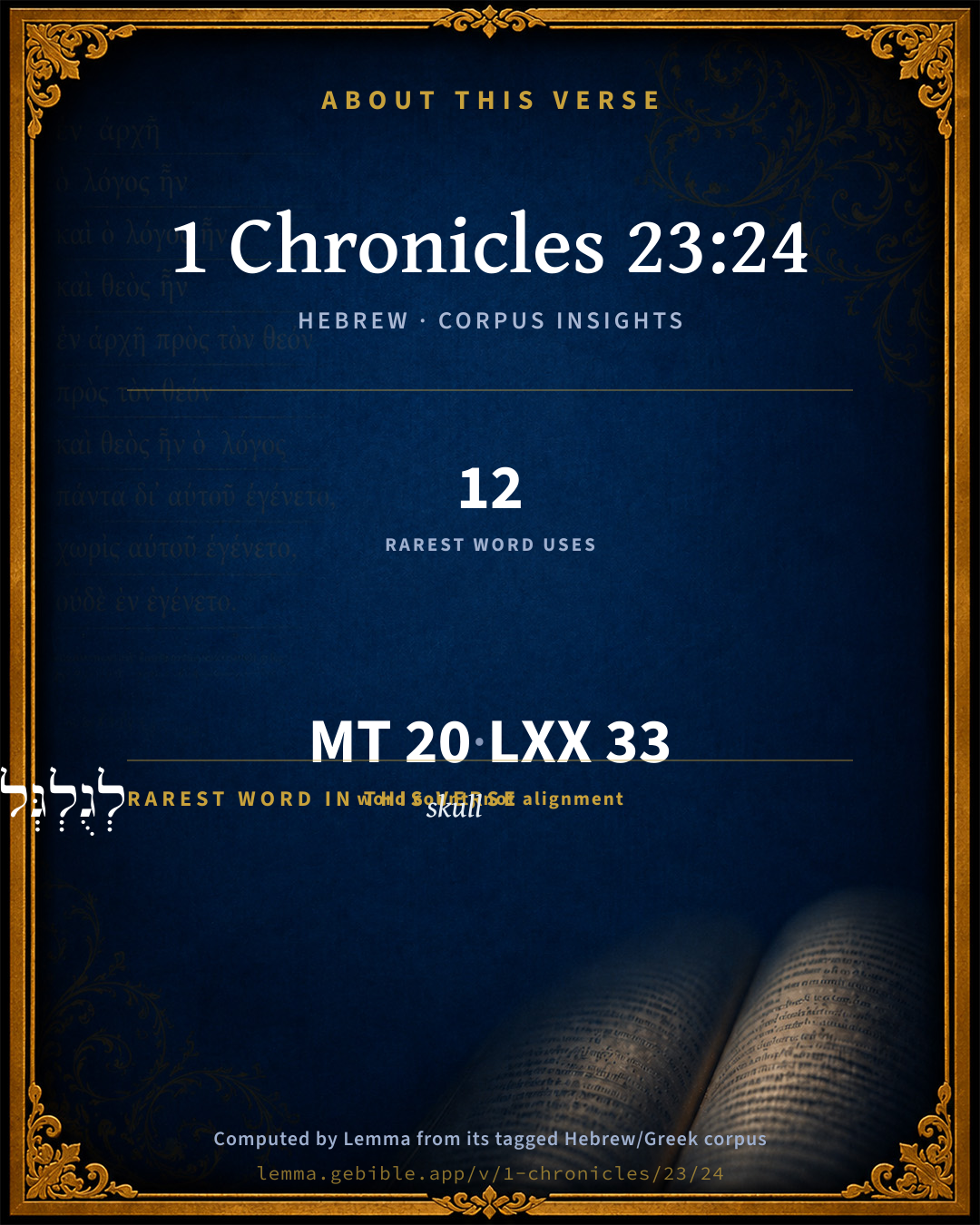
The rarest word here is לְגֻלְגְּלֹתָ֔ם skull H1538 — appearing just 12 times in the whole Hebrew Bible.

Shared distinctive vocabulary

לְגֻלְגְּלֹתָ֔ם skull H1538 occurs in 12 verses of the Hebrew Bible. Also found in:

Grammatical profile

  • 2 verbs
  • 15 nouns
  • 1 adjective
  • 1 pronoun
  • 1 adverb

Verb forms

  • לִפְקוּדֵיהֶ֗ם Qal · Participle Passive
  • עֹשֵׂה֙ Qal · Participle Active

Repetition

Words recur within this verse — often emphatic in Hebrew:

  • בְנֵֽי son H1121 ×2
  • לְבֵ֨ית house H1004 ×2
  • אֲבֹתֵיהֶ֜ם father H1 ×2

Hebrew & Septuagint length

In English translation the verse runs 50 words from the Hebrew and 49 from the Septuagint (LXX English) — closely comparable.

A rough comparison of the two English renderings, which tokenize alike — not a word-level alignment.

Word counts can differ between the Hebrew and the Greek without any difference in meaning — e.g. the Hebrew direct-object marker אֵת has no separate Greek word, and Greek often adds the article ὁ.

In the original languages it is 20 Hebrew tokens and 33 Greek tokens — but the two are counted differently (Hebrew bundles its prefixes and suffixes into one token; the Greek is in lemma form), so that isn’t a like-for-like length.

Cross-references

15

Topical passages linked to 1 Chronicles 23:24 in the Treasury of Scripture Knowledge — connected by theme and wording, ordered by reader-vote popularity; previews shown in the World English Bible.

  • Numbers 10:17 The tent was taken down; and the sons of Gershon and the sons of Merari, who bore the tent, set forward.
  • Numbers 10:21 The Kohathites set forward, bearing the sanctuary: and [the others] did set up the tent against their coming.
  • 1 Chronicles 23:3 The Levites were numbered from thirty years old and upward: and their number by their polls, man by man, was thirty-eight thousand.
  • Numbers 4:3 from thirty years old and upward even until fifty years old, all who enter into the service, to do the work in the Tent of Meeting.
  • Numbers 8:24 "This is that which belongs to the Levites: from twenty-five years old and upward they shall go in to wait on the service in the work of the Tent of Meeting;
  • Ezra 3:8 Now in the second year of their coming to the house of God at Jerusalem, in the second month, began Zerubbabel the son of Shealtiel, and Jeshua the son of Jozadak, and the rest of their brothers the priests and the Levites, and all those who were come out of the captivity to Jerusalem, and appointed the Levites, from twenty years old and upward, to have the oversight of the work of the house of Yahweh.
  • Numbers 1:2–4 "Take a census of all the congregation of the children of Israel, by their families, by their fathers' houses, according to the number of the names, every male, one by one;
  • Numbers 1:18 They assembled all the congregation together on the first day of the second month; and they declared their ancestry by their families, by their fathers' houses, according to the number of the names, from twenty years old and upward, one by one.
  • Numbers 1:22 Of the children of Simeon, their generations, by their families, by their fathers' houses, those who were numbered of it, according to the number of the names, one by one, every male from twenty years old and upward, all who were able to go out to war;
  • Numbers 2:32 These are those who were numbered of the children of Israel by their fathers' houses. All who were numbered of the camps according to their hosts were six hundred three thousand five hundred fifty.
  • Numbers 3:15 "Number the children of Levi by their fathers' houses, by their families: every male from a month old and upward shall you number."
  • Numbers 3:20 The sons of Merari by their families: Mahli and Mushi. These are the families of the Levites according to their fathers' houses.
  • Numbers 3:47 you shall take five shekels apiece for each one; after the shekel of the sanctuary you shall take them (the shekel is twenty gerahs):
  • Numbers 4:34–49 Moses and Aaron and the princes of the congregation numbered the sons of the Kohathites by their families, and by their fathers' houses,
  • 1 Chronicles 23:27 For by the last words of David the sons of Levi were numbered, from twenty years old and upward.

Cross-references courtesy of OpenBible.info (CC BY 4.0).

Hebrew and Greek witnesses Masoretic Hebrew ↔ Greek Septuagint

The same verse in the two great witnesses to the Old Testament, shown verse-for-verse.

These are two independent witnesses, not word-aligned to each other, and the Septuagint is shown in lemma (dictionary) form.

Hebrew 1 Chronicles 23:24 Masoretic · Westminster Leningrad Codex

אֵ֣לֶּה בְנֵֽי לֵוִי֩ לְבֵ֨ית אֲבֹתֵיהֶ֜ם רָאשֵׁ֧י הָאָב֣וֹת לִפְקוּדֵיהֶ֗ם בְּמִסְפַּ֤ר שֵׁמוֹת֙ לְגֻלְגְּלֹתָ֔ם עֹשֵׂה֙ הַמְּלָאכָ֔ה לַעֲבֹדַ֖ת בֵּ֣ית יְהוָ֑ה מִבֶּ֛ן עֶשְׂרִ֥ים שָׁנָ֖ה וָמָֽעְלָה

These were the sons of Levi after their fathers' houses, even the heads of the fathers' [houses] of those of those who were counted, in the number of names by their polls, who did the work for the service of the house of Yahweh, from twenty years old and upward.

World English Bible · Public Domain

Greek LXX 1 Chronicles 23:24 Septuagint · lemma form

οὗτος υἱός λευί κατά οἶκος πατριά αὐτός ἄρχων ὁ πατριά αὐτός κατά ὁ ἐπίσκεψις αὐτός κατά ὁ ἀριθμός ὄνομα αὐτός κατά κεφαλή αὐτός ποιέω ὁ ἔργον λειτουργία οἶκος κύριος ἀπό εἰκοσαετής καί ἀπάνω

These are the sons of Levi according to the houses of their fathers; chiefs of their families according to their numbering, according to the number of their names, according to their polls, doing the works of service of the house of the Lord, from twenty years old and upward.

LXX2012 (modern English Septuagint) · Public Domain

Hebrew: Westminster Leningrad Codex (CC BY 4.0). Greek: Septuagint (public domain); English from LXX2012 (modern English Septuagint) (Public Domain). How the Septuagint differs from the Hebrew →

Commentary

Notes on 1 Chronicles 23:24 from classic Christian and Jewish commentators (each source and its license shown beneath its notes). The classic Christian expositions comment on the surrounding passage and are grouped to its opening verse, so a note may address several verses; the Jewish commentaries on the Tanakh (Rashi and others) are per-verse, so they appear only where the commentator wrote on this verse.

Lemma curates 59 commentaries, every one of them public domain or Creative Commons licensed, each selected and text-cleaned for this edition rather than reprinted as found. About our sources →

Matthew Henry's Commentary

Here is, I. An alteration made in the computation of the effective men of the Levites - that whereas, in Moses's time, they were not enlisted, or taken into service, till they were thirty-years old, nor admitted as probationers till twenty-five (Num 8:24), David ordered, by direction from God, that they should be numbered for the service of the house of the Lord, from the age of twenty years and upwards, Ch1 23:24. This order he confirmed by his last words, Ch1 23:27. When he put his last hand to the draught of this establishment he expressly appointed this to be done for ever after; yet not he; but the Lord. 1. Perhaps the young Levites, having no work appointed them till twenty-five years old, had many of them got a habit of idleness, or grew addicted to their pleasures, which proved both a blemish to their reputation and a hindrance to their usefulness afterwards, to prevent which inconvenience they are set to work, and brought under discipline, at twenty-years old. Those that will be eminent must learn to take care and take care betimes. 2. When the work of the Levites was to carry burdens, heavy burdens, the tabernacle and the furniture of it, God would not call any to it till they had come to their full strength; for he considers our frame, and, in service as well as sufferings, will lay no more upon us than we are able to bear. But now God had given rest to his people, and made Jerusalem his dwelling-place for ever, so that there was no more occasion to carry the tabernacle and the vessels thereof, the service was much easier, and what would not over-work them nor over-load them if they entered upon it at twenty-years old. 3. Now the people of Israel were multiplied, and there was a more general resort to Jerusalem, and would be when the temple was built, than had ever been at Shiloh, or Nob, or Gibeon; it was therefore requisite there should be more hands employed in the temple-service, that every Israelite who brought an offering might find a Levite ready to assist him. When more work is to be done it is a pity but there should be more workmen fetched in for the doing of it. When the harvest is plenteous why should the labourers be few?

II. A further account of the Levites' work. What the work of the priests was we are told (Ch1 23:13): To sanctify the most holy things, to burn incense before the Lord, and to bless in his name; that work the Levites were not to meddle with, and yet they had work enough, and good work, according to that to which they were appointed, Ch1 23:4, Ch1 23:5. 1. Those of them that were to set forward the work of the house of God (Ch1 23:4) were therein to wait on the sons of Aaron (Ch1 23:28), were to do the drudgery-work (if any work for God is to be called drudgery) of the house of God, to keep the courts and chambers clean, set things in their places, and have them ready when there was occasion to use them. They were to prepare the show-bread which the priests were to set on the table, to provide the flour and cakes for the meat-offerings, that the priests might have every thing ready to their hands. 2. Those of them that were judges and officers had an eye particularly upon all measure and size, Ch1 23:29. The standards of all weights and measures were kept in the sanctuary; and the Levites had the care of them, to see that they were exact, and to try other weights and measures by them when they were appealed to. 3. The work of the singers was to thank and praise the Lord (Ch1 23:30), at the offering of the morning and evening sacrifices, and other oblations on the sabbaths, new moons, etc., Ch1 23:31. Moses appointed that they should blow with trumpets over their burnt offerings and other sacrifices, and on their solemn days, Num 10:10. The sound of the trumpet was awful, and might be affecting to the worshippers, but was not articulate, nor such a reasonable service as this which David appointed, of singing psalms on those occasions. As the Jewish church grew up from its infancy, it grew more and more intelligent in its devotions, till it came at length, in the gospel, to put away childish things, Co1 13:11; Gal 4:3, Gal 4:9. 4. The work of the porters (Ch1 23:5) was to keep the charge of the tabernacle and of the holy place, that none might come nigh but such as were allowed, and those no nearer than was allowed them, Ch1 23:32. They were likewise to keep the charge of the sons of Aaron, to be at their beck and go on their errands, who are yet called their brethren, to be a memorandum to the priests that, though they were advanced to a high station, yet they were hewn out of the same rock with common Levites, and therefore must not lord it over them, but in all instances treat them as brethren.

Matthew Henry's Commentary on the Whole Bible (1708–1710) — public domain (CC PDM 1.0). Text via the HelloAO Bible API.

Jamieson, Fausset & Brown

Robert Jamieson, A. R. Fausset & David Brown

OFFICE OF THE LEVITES. (Ch1 23:24-32)

These were the sons of Levi . . . that did the work . . . from the age of twenty years and upward--The enumeration of the Levites was made by David (Ch1 23:3) on the same rule as that followed by Moses (Num 4:3), namely, from thirty years. But he saw afterwards that this rule might be beneficially relaxed, and that the enrolment of Levites for their proper duties might be made from twenty years of age. The ark and tabernacle being now stationary at Jerusalem, the labor of the Levites was greatly diminished, as they were no longer obliged to transport its heavy furniture from place to place. The number of thirty-eight thousand Levites, exclusive of priests, was doubtless more than sufficient for the ordinary service of the tabernacle. But this pious king thought that it would contribute to the glory of the Lord to employ as many officers in his divine service as possible. These first rules, however, which David instituted, were temporary, as very different arrangements were made after the ark had been deposited in the tabernacle of Zion.

Next: 1 Chronicles Chapter 24

Jamieson, Fausset & Brown — Commentary Critical and Explanatory on the Whole Bible (1871) — public domain (CC PDM 1.0). Text via the HelloAO Bible API.

Trapp's Complete Commentary

John Trapp

1Ch 23:24 These [were] the sons of Levi after the house of their fathers; [even] the chief of the fathers, as they were counted by number of names by their polls, that did the work for the service of the house of the LORD, from the age of twenty years and upward.

Ver. 24. From the age of twenty years and upward.] The reason whereof followeth: {1Ch 23:25} the people were increased and in peace; and consequently God’s service much increased in the labour of it.

John Trapp, A Commentary or Exposition upon All the Books of the Old and New Testament (1647–1656) — public domain. Text from a community e-Sword module.

Joseph Benson's Commentary

1Ch 23:24. From the age of twenty years and upward — As the Levites were anciently numbered from two several times, from the twenty-fifth year of their age, and from the thirtieth, (Num 4:3; Num 8:24,) in like manner they are here numbered, both from their twentieth year, when they were solemnly prepared for, and instructed, and by degrees exercised, in some parts of their work; and from their thirtieth year, when they were admitted to the full exercise of their office. And the reason why they were now sooner admitted to service than they had been formerly, is given in the next verses, because now their work was more easy, being wholly discharged from that burdensome work of carrying the tabernacle. Besides, the people of Israel were multiplied, therefore more hands were necessary; that every Israelite who brought an offering, might find a Levite ready to assist him.

Joseph Benson's Commentary on the Old and New Testaments (1811–1818) — public domain. Text from a community e-Sword module.

Tyndale Open Study Notes

Tyndale Open Resources

23:24-27 In the census of 23:3, individuals were counted at age thirty, but the actual registration of the divisions included those twenty years old or older (cp. Num 1:3). The age of entry into Levitical service apparently varied over time according to need.

Tyndale Open Study Notes — © Tyndale Open Resources, licensed CC BY-SA 4.0. Text via the HelloAO Bible API.

Geneva Bible (1599)

Geneva Bible translators

David did choose the Levites twice, first at the age of thirty, as verse 3 and again afterward at 20, as the necessity of the office did require: at the beginning they had no charge in the Temple, before they were five and twenty years old, and had none after fifty, Num. 4:3.

Geneva Bible (1599) marginal notes — public domain. Text via Bolls.life.

Adam Clarke's Commentary

Verse 24. Twenty years and upward.] It appears that this was a different ordinance from that mentioned 1Ch 23:3. At first he appointed the Levites to serve from thirty years and upward; now from twenty years. These were David's last orders; see 1Ch 23:27. They should begin at an earlier age, and continue later.

This was not a very painful task; the ark being now fixed, and the Levites very numerous, there could be no drudgery.

Adam Clarke's Commentary on the Bible (1810–1826) — public domain. Text from a community e-Sword/MySword module.

Ellicott's Commentary for English Readers

(24) These were the sons of Levi after the house of their fathers.—Rather, These were the sons of Levi, according to their father-houses (clans), heads of the houses (fathers, i.e., father-houses), to those mustered of them, in an enumeration of names according to their polls. This is the subscription to the foregoing list of names of the Levitical houses, as entered in the muster-rolls of David.

As they were counted.—Num_1:21; Exo_30:14. The word is that used in 1Ch_21:6 (pâqad).

By number of names.—Num_1:18; Num_3:43.

That did the work for the service of the house of the Lord.—This description identifies these Levites with the 24,000 mentioned in 1Ch_23:4.

That did the work.—Literally, doing. This participle has the form of the singular here and elsewhere in the Chronicles, though the sense demands a plural. It is probably meant as plural, being a variant spelling. (Comp. 2Ch_24:12; 2Ch_34:10; 2Ch_34:13; Ezr_3:9; Neh_2:16.)

From the age of twenty years and upward.—1Ch_23:3 states that the Levites were numbered “from the age of thirty and upward.” Some would banish discrepancy by the assumption that “thirty” is an ancient error of transcription; others imagine that the chronicler has simply incorporated two divergent statements, as he found them in his authorities. According to Num_4:3; Num_4:23; Num_4:30; Num_4:35; Num_4:43; Num_4:47, the Levites were bound to serve “from thirty years old and upward” to fifty years of age; whereas Num_8:24-25, fixes the age “from twenty and five years old and upward” to fifty; and this, according to Ewald, is the more exact account. It appears from 2Ch_31:17, that the later practice, at all events, was for the Levites to enter on their sacred functions at the age of twenty. Accordingly, the older commentators have supposed that David twice numbered the Levites: first, as the Law required, from the age of thirty (1Ch_23:3); and again, towards the close of his reign (1Ch_23:27), from the age of twenty, because he perceived that the duties had become less onerous, and might therefore be borne by younger men. (Comp. however, Num_1:3, from which it appears that the military age, i.e., the age of full virile strength, was reckoned “from twenty years old and upward.’)

A Bible Commentary for English Readers, edited by Charles John Ellicott (1878–1897) — public domain. Text from a community e-Sword module.

The Cambridge Bible for Schools and Colleges

gen. ed. J. J. S. Perowne

24. after the house of their fathers; even the chief of the fathers, as they were counted by number of names] R.V. after their fathers’ houses, even the heads of the fathers’ houses of those of them that were counted, in the number of names.

24–27. Organization of the Levites (second account)

Cp. note at the beginning of the last paragraph.

The Cambridge Bible for Schools and Colleges (gen. ed. J. J. S. Perowne; Cambridge University Press, 1878–1918) — public domain. Text from a community e-Sword module.

John Gill's Exposition

And also unto the Levites,.... Or with respect to them:

they shall no more carry the tabernacle: on their shoulders, from place to place, as they had done:

nor any vessels of it for the service thereof; and so the service of it did not require men at their full strength, but such as were but twenty years of age might be employed in it.

John Gill's Exposition of the Whole Bible (1746–1763) — public domain (CC PDM 1.0). Text via the HelloAO Bible API.

Albert Barnes' Notes on the Bible

From the age of twenty years - The Levites had hitherto not entered upon their regular functions until the age of thirty 1Ch 23:3. Certain lighter duties were by the Law imposed on them at the age of twenty-five Num 8:24; but it was not until they were five years older that they became liable to the full service of the sanctuary. David appears now to have made a change. By his “last words” 1Ch 23:27 the time for the Levites to enter on the full duties of their office was advanced from thirty to twenty years. This change was based upon the lighter character of the labors imposed on them now that the ark had ceased to be carried from place to place and obtained a permanent habitation 1Ch 23:26. The limit of age continued in after times where David had fixed it (see Ezr 3:8).

Albert Barnes' Notes on the Bible (1834–1885) — public domain. Text from a community e-Sword/MySword module.

Haydock's Catholic Bible Commentary

Old. See ver. 3., and Numbers iv. 3. --- And upwards; as long as they were able to serve. They were excused from carrying the tabernacle, &c., at fifty years of age, Numbers viii. 25. (Abulensis) (Menochius) --- To those who were turned of thirty, the higher offices were entrusted; while the Levites began at twenty, to exercise themselves in things of less consequence, under the direction of their elder brethren. (Tirinus) --- The kings might declare, by the advice of the Sanhedrim, what laws were of a temporary nature. (Grotius) (Du Hamel)

George Leo Haydock (1774–1849), Haydock's Catholic Family Bible and Commentary, 1859 edition — public domain. Excludes Psalms (Douay-Rheims chapter numbering differs from Protestant) and Deuterocanonical books (Catholic canon only).

Matthew Poole's English Annotations

As the Levites were anciently numbered from two several times, from the twenty-fifth year of their age, and from the thirtieth, Num 4:3; 8:24; in like manner and for the same reasons they are here numbered both from their twentieth year, as here, when they were more solemnly prepared for and instructed, and by degrees exercised, in some parts of their work; and from their thirtieth year, above, 1Ch 23:3, when they were admitted to the full and complete exercise of all the parts and works of their office. And the reason why they were now sooner admitted to service than they had been formerly by the constitution of Moses, is given in the next verses, because now their work was made easy, they being wholly discharged from that burdensome work of carrying the tabernacle and its utensils, which was too heavy for young and tender shoulders. To which may be added, that the number of the Israelites was greatly increased, and consequently the services which were to be performed by the Levites on their behalf were multiplied, and the work of the temple was much greater than that of the tabernacle, and therefore more of the Levites were to be employed, and consequently they were to be sooner taken into service.

Matthew Poole's English Annotations on the Holy Bible (1683–1685) — public domain. Text from a community e-Sword/MySword module.

Whedon's Commentary on the Bible

Daniel D. Whedon

24. Twenty years and upward — this is not to be explained by supposing an error in the text of 1Ch_23:3, (Kiel,) nor by assuming that David first took a census of those thirty years of age and upward, and afterwards another census of those twenty years old and upwards. The writer introduces additional information, and explains in the verses following, that since Jehovah had given rest to his people, and the tabernacle was to be carried about no more, the Levites might begin to serve at an earlier age, and accordingly David ordained among his last instructions, (1Ch_23:27,) that the Levites might be numbered for service at the age of twenty — a practice which afterwards prevailed. 2Ch_31:17; Ezr_3:8.

Daniel D. Whedon (gen. ed.), Commentary on the Old and New Testaments (1874–1909) — public domain. Text from a community e-Sword module.

The Pulpit Commentary

This and the remaining verses of the chapter contain some general provisions regarding the offices and future work of the Levites in part David"s last edition of such provisions. (On the present verse comp. Num_1:1-4 Num_4:1-3, Num_4:21-23, Num_4:29, 30 8:23-26) It is not easy to reconcile this verse with ver. 3. Keil cuts the knot at once by supposing the "thirty" years of ver. 3 to be the error of a copyist, to whose memory the Mosaic census was present. And with Bertheau, he objects to the supposition that this verse describes a supplementary census, in conformity with "David"s last words" (ver. 27), and as contrasted with his former directions. With the exception of what is contained in vers. 25-27, it is true that these do not offer themselves sufficient indications to make one feel confident of this explanation. On the other hand, to set down the number "thirty" in ver. 3 at once to the mistake of a copyist is too summary and convenient a way of escaping an awkward difficulty. It is evident that the following three verses do purport to explain why at this time the age of allowable service was altered to a standard so much lower than of old, and to assert that this alteration was recognized by the last orders of David.

Work that young people may do.

The time of Levitical service dated from the age of thirty, but service of particular kinds was accepted from those as young as twenty. Some things are beyond the young people. They could not do them well. They require gifts and maturity which the young do not possess. It is well for them to learn what is within their reach what they may do, and what they may not do.

I YOUNG PEOPLE SHOULD ACCEPT THE FACT OF THEIR LIMITED POWER AND LIMITED FITNESS. This would check their characteristic disposition to over self-confidence.

II YOUNG PEOPLE SHOULD ESTIMATE FAIRLY THE MEASURE OF THEIR POWER, and so work up to their highest limit. St. John gives his advice to young men "because they are strong.

III YOUNG PEOPLE SHOULD HOLD ALL THEIR POWERS AT GOD"S SERVICE, seeing that he asks for life"s morning as well as life"s noontide.

IV YOUNG PEOPLE SHOULD BE SURE THAT THERE ARE SPHERES OF SERVICE EXACTLY MATCHING THEIR POWERS. And they should be watching, ever ready to enter upon all such.

In the faithful doing of the least things of our youth-time alone lies our hope of training for the undertaking of more and better work as manly powers unfold. Show that the noblest of God"s workers have consecrated their youth-time to his service. R.T.

The Pulpit Commentary (1880–1919), ed. H.D.M. Spence-Jones & Joseph S. Exell — public domain. Text from a community e-Sword module.

John Wesley's Explanatory Notes

Twenty years - As the Levites were anciently numbered from two several times, from the twenty fifth year of their age, and from the thirtieth, Num. iv, 3; viii, 24. In like manner they are here numbered both from their twentieth year, when they were solemnly prepared for, and instructed, and by degrees exercised in some parts of their work; and from their thirtieth year, when they were admitted to the full exercise of their office. And the reason why they were now sooner admitted to service than they had been formerly, is given in the next verses because now their work was more easy, being wholly discharged from that burdensome work of carrying the tabernacle. Besides the people of Israel were multiplied: therefore more hands were necessary, that every Israelite who brought an offering, might find a Levite ready to assist him.

John Wesley, Explanatory Notes Upon the Whole Bible (1754–1765) — public domain. Text via the GEBible commentary corpus.

Keil & Delitzsch

C. F. Keil & F. Delitzsch

And also unto the Levites,.... Or with respect to them:

they shall no more carry the tabernacle: on their shoulders, from place to place, as they had done:

nor any vessels of it for the service thereof; and so the service of it did not require men at their full strength, but such as were but twenty years of age might be employed in it.

Keil & Delitzsch — Biblical Commentary on the Old Testament (1861–1891) — public domain (CC PDM 1.0). Text via the HelloAO Bible API. (Old Testament only.)

Kretzmann's Popular Commentary

Paul E. Kretzmann

The Ministry of the Levites

v. 24. These were the sons of Levi after the house of their fathers; even the chief of the fathers, as they were counted by number of names by their polls, that did the work for the service of the house of the Lord, from the age of twenty years and upward, the lower age here referred to being explained in the following words.

v. 25. For David said, The Lord God of Israel hath given rest unto His people that they may dwell, or, "and He dwells," in Jerusalem forever, this city having now been chosen by God for the central Sanctuary;

v. 26. and also unto the Levites; they shall no more carry the Tabernacle nor any vessels of it for the service thereof, and the work thus being lighter, the age at which the Levites could enter upon their work was placed lower.

v. 27. For by the last words of David the Levites were numbered from twenty years old and above,

v. 28. because their office was to wait on the sons of Aaron for the service of the house of the Lord, in assisting the priests, in the courts, and in the chambers, in keeping every part of the Temple clean, and in the purifying of all holy things, and the work of the service of the house of God, attending to all the external features of the service;

v. 29. both for the showbread, in helping to prepare it, and for the fine flour for meat-offering, and for the unleavened cakes, Lev 2:4, and for that which is baked in the pan, Lev 2:5, and for that which is fried, Lev 6:14, and for all manner of measure and size, the measures of capacity and length, principally for measuring flour, oil, and wine;

v. 30. and to stand every morning, namely, the four thousand detailed for this liturgical service, to thank and praise the Lord, and likewise at even;

v. 31. and to offer all burnt sacrifices unto the Lord in the Sabbaths, in the new moons, and on the set feasts, by number, for they had to provide the necessary number of sacrificial animals, examine their fitness, attend to their slaughtering and flaying, according to the order commanded unto them, continually before the Lord;

v. 32. and that they should keep the charge of the Tabernacle of the Congregation, Num 18:4, and the charge of the Holy Place, of all the holy things connected with the worship, Num 18:5, and the charge of the sons of Aaron, their brethren, the care of all the things commanded them by the priests, in the service of the house of the Lord. Our God is a God of order, and it pleases Him if all the matters pertaining to external worship also are regulated properly, given into charge of certain people, to avoid all clashing.

Paul E. Kretzmann, Popular Commentary of the Bible (1921–1924) — public domain. Text from a community e-Sword module.

unfoldingWord translationNotes

Door43 World Missions Community

These were Levi's descendants corresponding to their clans. They were the leaders, counted and listed by name, of the clans

This can be stated in active form. AT: "These were the names of Levi's descendants and their families, whom David's men counted and listed. They were the leaders of the clans" (See: Active or Passive)

from twenty years old and upward

"from 20 years old and older" (See: Numbers)

has given rest

Here "rest" refers to peace with surrounding nations. See how you translated a similar phrase in 1 Chronicles 22:9.

He makes his home in Jerusalem forever

Possible meanings are 1) Yahweh will be present in Jerusalem forever or 2) Yahweh's temple will be present in Jerusalem forever.

all the equipment used in its service

This can be stated in active form. AT: "all the equipment they used in its service"

translationWords

Levi

descend

clan

servant

house of God

David

God

Israel

people of God

Jerusalem

eternity

tabernacle

unfoldingWord translationNotes — © Distant Shores Media and the Door43 World Missions Community, licensed CC BY-SA 4.0. Source: git.door43.org/Door43/en_tn.

Lesson kit

Teaching starters — assembled from the data on this page, not authored interpretation. Every prompt links to the verse data it draws on. Edit before teaching.

1 Chronicles, in the Historical, opens this verse with 20 words (17 distinct Hebrew lemmas). Its most distinctive word is gulgôleth (“skull”). A historical commentator’s framing appears above. Read the whole chapter for the surrounding context.

Discussion questions

  1. How does “skull” (gulgôleth) shape what this verse is saying?
  2. Exodus 16:16 shares the word «skull» with this verse. How do the two illuminate each other?
  3. “son” occurs 2× in this one verse. What is the effect of the repetition?
  4. The translations on this page render this verse differently — a whole-verse word diff, not a word-by-word alignment. What might account for the different wordings?
  5. The verb «לִפְקוּדֵיהֶ֗ם» is Qal Participle Passive. How does its form color the action?
  6. Reading how Matthew Henry's Commentary and Jamieson, Fausset & Brown read this verse, where do the two commentators agree and where do they part?

Things to notice

Reading settings

Reading text

Shown beneath each verse's original-language words.

Old Testament
Old Testament edition

Read the OT as the Masoretic Hebrew (MT) or the Greek Septuagint (LXX).

English shown for the Greek Septuagint (in the Hebrew ↔ Greek comparison).

Comparing translations? Open the Compare panel on any verse page to stack up to four side by side.