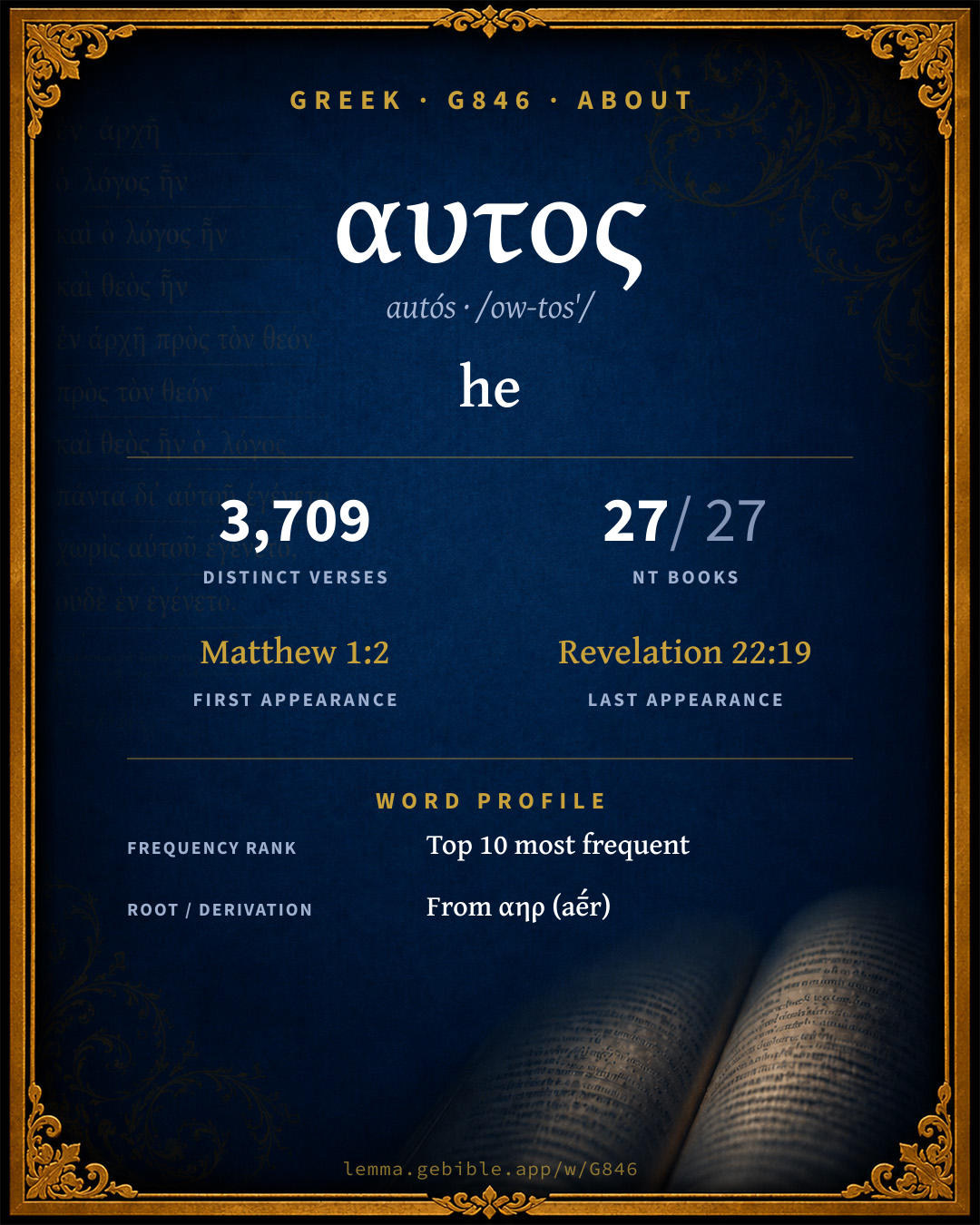
αὐτός
he
‘he’ is one of 3 main senses fuller range ↓
Full lexicon entry — Thayer's Greek Lexicon
From Thayer's Greek Lexicon
Where this word appears
See every Genitive-case word in the Greek New Testament →
Grammar key — what these labels mean
Part of speech
- Personal pronoun
- Stands in for a person already named (“I,” “you,” “he”).
Case
- Genitive
- The case of source, possession, or “of” — answers “whose / from what.”
- Accusative
- The case of the direct object and of extent.
- Dative
- The case of the indirect object, means, or location — “to / for / with / in.”
- Nominative
- The case of the subject (and the predicate nominative).
Gender
- Masculine
- Grammatically masculine.
- Feminine
- Grammatically feminine.
- Neuter
- Grammatically neuter.
Number
- Singular
- One.
- Plural
- More than one.
Page 2 of 2 — showing verses 201–320 of 320 distinct verses where G846 appears in the Genitive case in the Book of Luke. Filtered view — show all forms. Click any verse to open its interlinear word-by-word view. Verse text shown in the World English Bible for context — . Each verse’s Greek form is shown with its reference; the English is not keyword-highlighted, since the data carries no word-level English alignment. Use “Compare translations” on any verse to read it across multiple English versions. This concordance covers the Greek New Testament; Septuagint (Greek Old Testament) occurrences of this word are not indexed here.
Luke
- Luke 12:42 αὐτοῦ pron gen sg masc The Lord said, "Who then is the faithful and wise steward, whom his lord will set over his household, to give them their portion of food at the right times?
- Luke 12:43 αὐτοῦ pron gen sg masc Blessed is that servant whom his lord will find doing so when he comes.
- Luke 12:44 αὐτοῦ αὐτόν pron gen sg masc pron acc sg masc Truly I tell you, that he will set him over all that he has.
- Luke 12:45 αὐτοῦ pron gen sg masc But if that servant says in his heart, 'My lord delays his coming,' and begins to beat the menservants and the maidservants, and to eat and drink, and to be drunken,
- Luke 12:46 αὐτόν αὐτοῦ pron acc sg masc pron gen sg masc then the lord of that servant will come in a day when he isn't expecting him, and in an hour that he doesn't know, and will cut him in two, and place his portion with the unfaithful.
- Luke 12:47 αὐτοῦ αὐτοῦ pron gen sg masc pron gen sg masc That servant, who knew his lord's will, and didn't prepare, nor do what he wanted, will be beaten with many stripes,
- Luke 12:48 αὐτοῦ αὐτόν pron gen sg masc pron acc sg masc but he who didn't know, and did things worthy of stripes, will be beaten with few stripes. To whoever much is given, of him will much be required; and to whom much was entrusted, of him more will be asked.
- Luke 12:58 αὐτοῦ pron gen sg masc For when you are going with your adversary before the magistrate, try diligently on the way to be released from him, lest perhaps he drag you to the judge, and the judge deliver you to the officer, and the officer throw you into prison.
- Luke 13:1 αὐτῷ αὐτῷ αὐτῶν pron dat sg masc pron dat sg masc pron gen pl masc Now there were some present at the same time who told him about the Galileans, whose blood Pilate had mixed with their sacrifices.
- Luke 13:6 αὐτοῦ αὐτῇ pron gen sg masc pron dat sg fem He spoke this parable. "A certain man had a fig tree planted in his vineyard, and he came seeking fruit on it, and found none.
- Luke 13:15 αὐτῷ αὐτοῦ pron dat sg masc pron gen sg masc Therefore the Lord answered him, "You hypocrites! Doesn't each one of you free his ox or his donkey from the stall on the Sabbath, and lead him away to water?
- Luke 13:17 αὐτοῦ αὐτῷ αὐτοῦ pron gen sg masc pron dat sg masc pron gen sg masc As he said these things, all his adversaries were disappointed, and all the multitude rejoiced for all the glorious things that were done by him.
- Luke 13:19 αὐτοῦ pron gen sg neut It is like a grain of mustard seed, which a man took, and put in his own garden. It grew, and became a large tree, and the birds of the sky lodged in its branches."
- Luke 14:2 αὐτοῦ pron gen sg masc Behold, a certain man who had dropsy was in front of him.
- Luke 14:8 αὐτοῦ pron gen sg masc "When you are invited by anyone to a marriage feast, don't sit in the best seat, since perhaps someone more honorable than you might be invited by him,
- Luke 14:17 αὐτοῦ pron gen sg masc He sent out his servant at supper time to tell those who were invited, 'Come, for everything is ready now.'
- Luke 14:21 αὐτοῦ αὐτοῦ pron gen sg masc pron gen sg masc "That servant came, and told his lord these things. Then the master of the house, being angry, said to his servant, 'Go out quickly into the streets and lanes of the city, and bring in the poor, maimed, blind, and lame.'
- Luke 14:26 αὐτοῦ pron gen sg masc "If anyone comes to me, and doesn't hate his own father, mother, wife, children, brothers, and sisters, yes, and his own life also, he can't be my disciple.
- Luke 14:29 αὐτοῦ αὐτῷ pron gen sg masc pron dat sg masc Or perhaps, when he has laid a foundation, and is not able to finish, everyone who sees begins to mock him,
- Luke 14:32 αὐτοῦ pron gen sg masc Or else, while the other is yet a great way off, he sends an envoy, and asks for conditions of peace.
- Luke 15:1 αὐτῷ αὐτοῦ pron dat sg masc pron gen sg masc Now all the tax collectors and sinners were coming close to him to hear him.
- Luke 15:4 αὐτῶν αὐτό pron gen pl neut pron acc sg neut "Which of you men, if you had one hundred sheep, and lost one of them, wouldn't leave the ninety-nine in the wilderness, and go after the one that was lost, until he found it?
- Luke 15:5 αὐτοῦ pron gen sg masc When he has found it, he carries it on his shoulders, rejoicing.
- Luke 15:12 αὐτῶν αὐτοῖς pron gen pl masc pron dat pl masc The younger of them said to his father, 'Father, give me my share of your property.' He divided his livelihood between them.
- Luke 15:13 αὐτοῦ pron gen sg masc Not many days after, the younger son gathered all of this together and traveled into a far country. There he wasted his property with riotous living.
- Luke 15:14 αὐτοῦ αὐτὸς pron gen sg masc pron nom sg masc When he had spent all of it, there arose a severe famine in that country, and he began to be in need.
- Luke 15:15 αὐτὸν αὐτοῦ pron acc sg masc pron gen sg masc He went and joined himself to one of the citizens of that country, and he sent him into his fields to feed pigs.
- Luke 15:16 αὐτοῦ αὐτῷ pron gen sg masc pron dat sg masc He wanted to fill his belly with the husks that the pigs ate, but no one gave him any.
- Luke 15:20 αὐτοῦ αὐτοῦ αὐτὸν αὐτοῦ αὐτοῦ αὐτόν pron gen sg masc pron gen sg masc pron acc sg masc pron gen sg masc pron gen sg masc pron acc sg masc "He arose, and came to his father. But while he was still far off, his father saw him, and was moved with compassion, and ran, and fell on his neck, and kissed him.
- Luke 15:22 αὐτοῦ αὐτόν αὐτοῦ pron gen sg masc pron acc sg masc pron gen sg masc "But the father said to his servants, 'Bring out the best robe, and put it on him. Put a ring on his hand, and shoes on his feet.
- Luke 15:25 αὐτοῦ pron gen sg masc "Now his elder son was in the field. As he came near to the house, he heard music and dancing.
- Luke 15:28 αὐτοῦ αὐτόν pron gen sg masc pron acc sg masc But he was angry, and would not go in. Therefore his father came out, and begged him.
- Luke 16:1 αὐτῷ αὐτοῦ pron dat sg masc pron gen sg masc He also said to his disciples, "There was a certain rich man who had a manager. An accusation was made to him that this man was wasting his possessions.
- Luke 16:18 αὐτοῦ pron gen sg masc Everyone who divorces his wife, and marries another, commits adultery. He who marries one who is divorced from a husband commits adultery.
- Luke 16:20 αὐτοῦ pron gen sg masc A certain beggar, named Lazarus, was laid at his gate, full of sores,
- Luke 16:21 αὐτοῦ pron gen sg masc and desiring to be fed with the crumbs that fell from the rich man's table. Yes, even the dogs came and licked his sores.
- Luke 16:23 αὐτοῦ αὐτοῦ pron gen sg masc pron gen sg masc In Hades, he lifted up his eyes, being in torment, and saw Abraham far off, and Lazarus at his bosom.
- Luke 16:24 αὐτὸς αὐτοῦ pron nom sg masc pron gen sg masc He cried and said, 'Father Abraham, have mercy on me, and send Lazarus, that he may dip the tip of his finger in water, and cool my tongue! For I am in anguish in this flame.'
- Luke 16:29 αὐτῷ αὐτῶν pron dat sg masc pron gen pl masc "But Abraham said to him, 'They have Moses and the prophets. Let them listen to them.'
- Luke 17:1 αὐτοῦ pron gen sg masc He said to the disciples, "It is impossible that no occasions of stumbling should come, but woe to him through whom they come!
- Luke 17:2 αὐτῷ αὐτοῦ pron dat sg masc pron gen sg masc It would be better for him if a millstone were hung around his neck, and he were thrown into the sea, rather than that he should cause one of these little ones to stumble.
- Luke 17:12 αὐτοῦ αὐτῷ pron gen sg masc pron dat sg masc As he entered into a certain village, ten men who were lepers met him, who stood at a distance.
- Luke 17:15 αὐτῶν pron gen pl masc One of them, when he saw that he was healed, turned back, glorifying God with a loud voice.
- Luke 17:16 αὐτοῦ αὐτῷ αὐτὸς pron gen sg masc pron dat sg masc pron nom sg masc He fell on his face at Jesus' feet, giving him thanks; and he was a Samaritan.
- Luke 17:24 αὐτοῦ pron gen sg masc for as the lightning, when it flashes out of the one part under the sky, shines to the other part under the sky; so will the Son of Man be in his day.
- Luke 17:31 αὐτοῦ αὐτά pron gen sg masc pron acc pl neut In that day, he who will be on the housetop, and his goods in the house, let him not go down to take them away. Let him who is in the field likewise not turn back.
- Luke 17:33 αὐτοῦ αὐτήν αὐτήν pron gen sg masc pron acc sg fem pron acc sg fem Whoever seeks to save his life loses it, but whoever loses his life preserves it.
- Luke 18:7 αὐτοῦ αὐτῷ αὐτοῖς pron gen sg masc pron dat sg masc pron dat pl masc Won't God avenge his chosen ones, who are crying out to him day and night, and yet he exercises patience with them?
- Luke 18:8 αὐτῶν pron gen pl masc I tell you that he will avenge them quickly. Nevertheless, when the Son of Man comes, will he find faith on the earth?"
- Luke 18:13 αὐτοῦ pron gen sg masc But the tax collector, standing far away, wouldn't even lift up his eyes to heaven, but beat his breast, saying, 'God, be merciful to me, a sinner!'
- Luke 18:14 αὐτοῦ pron gen sg masc I tell you, this man went down to his house justified rather than the other; for everyone who exalts himself will be humbled, but he who humbles himself will be exalted."
- Luke 18:15 αὐτῷ αὐτῶν αὐτοῖς pron dat sg masc pron gen pl neut pron dat pl masc They were also bringing their babies to him, that he might touch them. But when the disciples saw it, they rebuked them.
- Luke 18:34 αὐτοὶ αὐτῶν pron nom pl masc pron gen pl masc They understood none of these things. This saying was hidden from them, and they didn't understand the things that were said.
- Luke 18:40 αὐτὸν αὐτόν αὐτοῦ αὐτόν pron acc sg masc pron acc sg masc pron gen sg masc pron acc sg masc Standing still, Jesus commanded him to be brought to him. When he had come near, he asked him,
- Luke 19:11 αὐτῶν αὐτὸν αὐτοὺς pron gen pl masc pron acc sg masc pron acc pl masc As they heard these things, he went on and told a parable, because he was near Jerusalem, and they supposed that the Kingdom of God would be revealed immediately.
- Luke 19:14 αὐτοῦ αὐτόν αὐτοῦ pron gen sg masc pron acc sg masc pron gen sg masc But his citizens hated him, and sent an envoy after him, saying, 'We don't want this man to reign over us.'
- Luke 19:24 αὐτοῦ pron gen sg masc He said to those who stood by, 'Take the mina away from him, and give it to him who has the ten minas.'
- Luke 19:31 αὐτοῦ pron gen sg masc If anyone asks you, 'Why are you untying it?' say to him: 'The Lord needs it.'"
- Luke 19:33 αὐτῶν αὐτοῦ αὐτούς pron gen pl masc pron gen sg masc pron acc pl masc As they were untying the colt, the owners of it said to them, "Why are you untying the colt?"
- Luke 19:34 αὐτοῦ pron gen sg masc They said, "The Lord needs it."
- Luke 19:35 αὐτὸν αὐτῶν pron acc sg masc pron gen pl masc They brought it to Jesus. They threw their cloaks on the colt, and set Jesus on them.
- Luke 19:36 αὐτοῦ αὐτῶν pron gen sg masc pron gen pl masc As he went, they spread their cloaks in the way.
- Luke 19:37 αὐτοῦ pron gen sg masc As he was now getting near, at the descent of the Mount of Olives, the whole multitude of the disciples began to rejoice and praise God with a loud voice for all the mighty works which they had seen,
- Luke 19:48 αὐτοῦ pron gen sg masc They couldn't find what they might do, for all the people hung on to every word that he said.
- Luke 20:1 αὐτοῦ pron gen sg masc It happened on one of those days, as he was teaching the people in the temple and preaching the Gospel, that the priests and scribes came to him with the elders.
- Luke 20:20 αὐτοῦ αὐτὸν pron gen sg masc pron acc sg masc They watched him, and sent out spies, who pretended to be righteous, that they might trap him in something he said, so as to deliver him up to the power and authority of the governor.
- Luke 20:23 αὐτῶν αὐτούς pron gen pl masc pron acc pl masc But he perceived their craftiness, and said to them, "Why do you test me?
- Luke 20:26 αὐτοῦ αὐτοῦ pron gen sg masc pron gen sg masc They weren't able to trap him in his words before the people. They marveled at his answer, and were silent.
- Luke 20:28 αὐτοῦ αὐτοῦ pron gen sg masc pron gen sg masc They asked him, "Teacher, Moses wrote to us that if a man's brother dies having a wife, and he is childless, his brother should take the wife, and raise up children for his brother.
- Luke 20:33 αὐτῶν αὐτὴν pron gen pl masc pron acc sg fem Therefore in the resurrection whose wife of them will she be? For the seven had her as a wife."
- Luke 20:44 αὐτὸν αὐτοῦ pron acc sg masc pron gen sg masc "David therefore calls him Lord, so how is he his son?"
- Luke 21:1 αὐτῶν pron gen pl masc He looked up, and saw the rich people who were putting their gifts into the treasury.
- Luke 21:4 αὐτοῖς αὐτῆς pron dat pl masc pron gen sg fem for all these put in gifts for God from their abundance, but she, out of her poverty, put in all that she had to live on."
- Luke 21:8 αὐτῶν pron gen pl masc He said, "Watch out that you don't get led astray, for many will come in my name, saying, 'I AM,' and, 'The time is at hand.' Therefore don't follow them.
- Luke 21:12 αὐτῶν pron gen pl masc But before all these things, they will lay their hands on you and will persecute you, delivering you up to synagogues and prisons, bringing you before kings and governors for my name's sake.
- Luke 21:20 αὐτῆς pron gen sg fem "But when you see Jerusalem surrounded by armies, then know that its desolation is at hand.
- Luke 21:21 αὐτῆς αὐτήν pron gen sg fem pron acc sg fem Then let those who are in Judea flee to the mountains. Let those who are in the midst of her depart. Let those who are in the country not enter therein.
- Luke 21:38 αὐτὸν αὐτοῦ pron acc sg masc pron gen sg masc All the people came early in the morning to him in the temple to hear him.
- Luke 22:23 αὐτοὶ αὐτῶν pron nom pl masc pron gen pl masc They began to question among themselves, which of them it was who would do this thing.
- Luke 22:24 αὐτοῖς αὐτῶν pron dat pl masc pron gen pl masc There arose also a contention among them, which of them was considered to be greatest.
- Luke 22:25 αὐτοῖς αὐτῶν αὐτῶν pron dat pl masc pron gen pl neut pron gen pl neut He said to them, "The kings of the Gentiles lord it over them, and those who have authority over them are called 'benefactors.'
- Luke 22:36 αὐτοῖς αὐτοῦ pron dat pl masc pron gen sg masc Then he said to them, "But now, whoever has a purse, let him take it, and likewise a wallet. Whoever has none, let him sell his cloak, and buy a sword.
- Luke 22:41 αὐτὸς αὐτῶν pron nom sg masc pron gen pl masc He was withdrawn from them about a stone's throw, and he knelt down and prayed,
- Luke 22:44 αὐτοῦ pron gen sg masc Being in agony he prayed more earnestly. His sweat became like great drops of blood falling down on the ground.
- Luke 22:47 αὐτοῦ αὐτούς αὐτόν pron gen sg masc pron acc pl masc pron acc sg masc While he was still speaking, behold, a multitude, and he who was called Judas, one of the twelve, was leading them. He came near to Jesus to kiss him.
- Luke 22:50 αὐτῶν αὐτοῦ pron gen pl masc pron gen sg masc A certain one of them struck the servant of the high priest, and cut off his right ear.
- Luke 22:55 αὐτῶν pron gen pl masc When they had kindled a fire in the middle of the courtyard, and had sat down together, Peter sat among them.
- Luke 22:58 αὐτὸν αὐτῶν pron acc sg masc pron gen pl masc After a little while someone else saw him, and said, "You also are one of them!" But Peter answered, "Man, I am not!"
- Luke 22:59 αὐτοῦ pron gen sg masc After about one hour passed, another confidently affirmed, saying, "Truly this man also was with him, for he is a Galilean!"
- Luke 22:60 αὐτοῦ pron gen sg masc But Peter said, "Man, I don't know what you are talking about!" Immediately, while he was still speaking, a rooster crowed.
- Luke 22:66 αὐτὸν αὐτῶν pron acc sg masc pron gen pl masc As soon as it was day, the assembly of the elders of the people was gathered together, both chief priests and scribes, and they led him away into their council, saying,
- Luke 22:71 αὐτοὶ αὐτοῦ pron nom pl masc pron gen sg masc They said, "Why do we need any more witness? For we ourselves have heard from his own mouth!"
- Luke 23:1 αὐτῶν αὐτὸν pron gen pl masc pron acc sg masc The whole company of them rose up and brought him before Pilate.
- Luke 23:2 αὐτοῦ pron gen sg masc They began to accuse him, saying, "We found this man perverting the nation, forbidding paying taxes to Caesar, and saying that he himself is Christ, a king."
- Luke 23:8 αὐτὸν αὐτοῦ αὐτοῦ pron acc sg masc pron gen sg masc pron gen sg masc Now when Herod saw Jesus, he was exceedingly glad, for he had wanted to see him for a long time, because he had heard many things about him. He hoped to see some miracle done by him.
- Luke 23:10 αὐτοῦ pron gen sg masc The chief priests and the scribes stood, vehemently accusing him.
- Luke 23:11 αὐτὸν αὐτοῦ αὐτὸν pron acc sg masc pron gen sg masc pron acc sg masc Herod with his soldiers humiliated him and mocked him. Dressing him in luxurious clothing, they sent him back to Pilate.
- Luke 23:14 αὐτούς αὐτοῦ pron acc pl masc pron gen sg masc and said to them, "You brought this man to me as one that perverts the people, and see, I have examined him before you, and found no basis for a charge against this man concerning those things of which you accuse him.
- Luke 23:23 αὐτὸν αὐτῶν pron acc sg masc pron gen pl masc But they were urgent with loud voices, asking that he might be crucified. Their voices and the voices of the chief priests prevailed.
- Luke 23:24 αὐτῶν pron gen pl masc Pilate decreed that what they asked for should be done.
- Luke 23:25 αὐτῶν pron gen pl masc He released him who had been thrown into prison for insurrection and murder, for whom they asked, but he delivered Jesus up to their will.
- Luke 23:34 αὐτοῖς αὐτοῦ pron dat pl masc pron gen sg masc Jesus said, "Father, forgive them, for they don't know what they are doing." Dividing his garments among them, they cast lots.
- Luke 23:51 αὐτῶν pron gen pl masc (he had not consented to their counsel and deed), from Arimathaea, a city of the Jews, who was also waiting for the Kingdom of God:
- Luke 23:55 αὐτῷ αὐτοῦ pron dat sg masc pron gen sg masc The women, who had come with him out of Galilee, followed after, and saw the tomb, and how his body was laid.
- Luke 24:5 αὐτῶν αὐτάς pron gen pl fem pron acc pl fem Becoming terrified, they bowed their faces down to the earth. They said to them, "Why do you seek the living among the dead?
- Luke 24:8 αὐτοῦ pron gen sg masc They remembered his words,
- Luke 24:11 αὐτῶν αὐταῖς pron gen pl masc pron dat pl fem These words seemed to them to be nonsense, and they didn't believe them.
- Luke 24:13 αὐτῶν αὐτῇ pron gen pl masc pron dat sg fem Behold, two of them were going that very day to a village named Emmaus, which was sixty stadia from Jerusalem.
- Luke 24:16 αὐτῶν αὐτόν pron gen pl masc pron acc sg masc But their eyes were kept from recognizing him.
- Luke 24:23 αὐτοῦ αὐτὸν pron gen sg masc pron acc sg masc and when they didn't find his body, they came saying that they had also seen a vision of angels, who said that he was alive.
- Luke 24:26 αὐτοῦ pron gen sg masc Didn't the Christ have to suffer these things and to enter into his glory?"
- Luke 24:30 αὐτὸν αὐτῶν αὐτοῖς pron acc sg masc pron gen pl masc pron dat pl masc It happened, that when he had sat down at the table with them, he took the bread and gave thanks. Breaking it, he gave to them.
- Luke 24:31 αὐτῶν αὐτόν αὐτὸς αὐτῶν pron gen pl masc pron acc sg masc pron nom sg masc pron gen pl masc Their eyes were opened, and they recognized him, and he vanished out of their sight.
- Luke 24:36 αὐτῶν αὐτὸς αὐτῶν pron gen pl masc pron nom sg masc pron gen pl masc As they said these things, Jesus himself stood among them, and said to them, "Peace be to you."
- Luke 24:41 αὐτῶν αὐτοῖς pron gen pl masc pron dat pl masc While they still didn't believe for joy, and wondered, he said to them, "Do you have anything here to eat?"
- Luke 24:43 αὐτῶν pron gen pl masc He took them, and ate in front of them.
- Luke 24:45 αὐτῶν pron gen pl masc Then he opened their minds, that they might understand the Scriptures.
- Luke 24:47 αὐτοῦ pron gen sg masc and that repentance and remission of sins should be preached in his name to all the nations, beginning at Jerusalem.
- Luke 24:50 αὐτοὺς αὐτοῦ αὐτούς pron acc pl masc pron gen sg masc pron acc pl masc He led them out as far as Bethany, and he lifted up his hands, and blessed them.
- Luke 24:51 αὐτὸν αὐτοὺς αὐτῶν pron acc sg masc pron acc pl masc pron gen pl masc It happened, while he blessed them, that he withdrew from them, and was carried up into heaven.
About this entry
At a glance — auto-summarized from this page’s data, not written by a person. Every figure links to its source below. This summary describes the numbers; it doesn’t interpret them.
αυτος (autós) is a Greek word most often rendered “he.” Scripture first uses it in Matthew 1:2. It turns up in 3,709 verses across 27 books, one of the most common footprint. Ranging over 3 senses, it is not a single-sense word. It clusters with αηρ, αετος and ανεμος under a shared root. For the data behind this summary, explore the sense tree and the renderings breakdown below.
Gloss history
Strong's 1890 vs modern scholarship

About this word
Strong's G846 catalogs a Greek word from the Greek New Testament.
These counts are not copied from any lexicon or concordance. They are computed here, from the morphology-tagged Greek New Testament. What Lemma adds →
- 3,709
- distinct verses
- The word appears in 3,709 distinct verses.
- 27 / 27
- NT books
- The word appears in 27 of 27 New Testament books.
- #3
- by frequency
- Top 10 most frequent Greek words (rank 3 of 5,347 Greek words by occurrence).
View all 3,709 occurrences in the concordance →
By section of the New Testament
By traditional corpus
Conventional, traditional groupings — biblical authorship is debated, so this is a traditional corpus grouping, not an authorship claim. Some books belong to more than one corpus (Luke is in both the Gospels and the Lukan corpus, and so on), so these shares overlap and need not total 100%. Each figure is a share of the word’s 3,709 distinct verses.
- Gospels 2,275 verses · 61%
- Lukan (Luke–Acts) 1,196 verses · 32%
- Johannine 831 verses · 22%
- Pauline corpus 429 verses · 12%
- Revelation 243 verses · 7%
- General (Catholic) Epistles 160 verses · 4%
- Hebrews 98 verses · 3%
How translations render this word
Counts come from each version’s own published word-to-Strong’s tagging or interlinear alignment — an approximate guide to how each version renders this word, not a word-level alignment the data otherwise carries. Because each total is that version’s own tagged count, the per-version totals vary from one another and need not match the appearance or distinct-verse counts above. These counts may also differ from a printed concordance because Lemma counts each distinctly tagged rendering and does not collapse phrase taggings into a single head-word total. This is a fixed set of word-tagged versions (KJV, ASV, BSB, ULT) and does not change with the reading translation you choose elsewhere. Each version’s license is shown beside its name below (and on Sources).
- King James Version: Him 1,940×, Them 1,129×, His 1,081×
- American Standard Version: Him 1,799×, Them 1,045×, His 997×
- Berean Standard Bible: Him 1,170×, His 883×, Them 707×
- unfoldingWord Literal Text: Him 1,901×, Them 1,133×, His 1,045×
King James Version Public Domain
Renders G846 across 5,665 tagged occurrences — most commonly:
Plus other, less common renderings. Plus 67 renderings that appear only once — usually multi-word phrases or single function words the recovered tagging swept in, not distinct renderings. Not rendered by a distinct English word in 122 further occurrences.
American Standard Version Public Domain
Renders G846 across 5,555 tagged occurrences — most commonly:
Plus other, less common renderings. Plus 208 renderings that appear only once — usually multi-word phrases or single function words the recovered tagging swept in, not distinct renderings. Not rendered by a distinct English word in 22 further occurrences.
Berean Standard Bible Public Domain
Renders G846 across 4,053 tagged occurrences — most commonly:
Plus other, less common renderings. Plus 61 renderings that appear only once — usually multi-word phrases or single function words the recovered tagging swept in, not distinct renderings. Not rendered by a distinct English word in 1,464 further occurrences.
unfoldingWord Literal Text CC BY-SA 4.0
Renders G846 across 5,591 tagged occurrences — most commonly:
Plus other, less common renderings. Plus 26 renderings that appear only once — usually multi-word phrases or single function words the recovered tagging swept in, not distinct renderings.
Senses in Thayer's
The 3 senses Thayer's distinguishes for this word, in lexicon order (not ranked by frequency or importance). The full entry — with sub-senses — is in the Lexicon Entry tab.
- himself, herself, themselves, itself
- he, she, it
- the same
Word origin
Derived from αηρ (aḗr) (G109) — air.
From the particle αὖ au (perhaps akin to the base of G109 through the idea of a baffling wind; backward ); the reflexive pronoun self used (alone or in the compound of G1438 ) of the third person and (with the proper personal pronoun) of the other persons : - her it (-self) one the other (mine) own said ([self-] the) same ([him- my- thy-]) self [your-] selves she that their (-s) them ([-selves]) there [-at -by -in -into -of -on -with] they (these) things this (man) those together very which. Compare G848 .
— Strong’s Exhaustive Concordance (1890), public domain.
Forms in the corpus
The 29 distinct written forms G846 takes in the Greek New Testament, most frequent first — each parse links to that case’s occurrences in the concordance.
Same root — word family
Other Thayer's entries built from the same root as G846, grouped by Strong’s listed origin. These share a root / origin per the lexicon — not necessarily a shared meaning. Each links to that word’s own entry.
Derives from
Shares the same root
- αετος aetós G105 eagle
- ανεμος ánemos G417 wind
- ατμις atmís G822 vapour
- αυλη aulḗ G833 courtyard
- αυλος aulós G836 pipe
- αυριον aúrion G839 tomorrow
- αυστηρος austērós G840 harsh
- αυχμηρος auchmērós G850 squalid
Derived from this word
- αυθαδης authádēs G829 self-willed
- αυθαιρετος authaíretos G830 voluntary
- αυθεντεω authentéō G831 autocrat
- αυταρκης autárkēs G842 self-sufficient
- αυτοκατακριτος autokatákritos G843 self-condemned
- αυτοματος autómatos G844 of itself
- αυτοπτης autóptēs G845 eyewitness
- αυτου autoû G847 there
- αυτοχειρ autócheir G849 with own hands
- εαυτου heautoû G1438 himself
Compare all same-root words → Showing 4 of 20 — not the complete family. They share a root, not necessarily a meaning.
Septuagint usage
The same Greek word αυτος appears 22,367 times in the Greek Old Testament (Septuagint), across 11,866 verses in 38 books.
- 22,367
- LXX occurrences
- Tagged occurrences of this Greek word in the Septuagint.
- 11,866
- verses
- Distinct Septuagint verses containing this word.
- 38 / 39
- OT books
- The word appears in 38 of the 39 Old Testament books.
Sample Septuagint occurrences
- Genesis 1:9 αὐτός
- Exodus 1:1 αὐτός
- Leviticus 1:1 αὐτός
- Numbers 1:1 αὐτός
- Deuteronomy 1:3 αὐτός
- Joshua 1:2 αὐτός
- Judges 1:1 αὐτός
- Ruth 1:1 αὐτός
- 1 Samuel 1:1 αὐτός
- 2 Samuel 1:2 αὐτός
- 1 Kings 1:1 αὐτός
- 2 Kings 1:2 αὐτός
Septuagint occurrences (same lexeme)
Every verse where the same Strong’s number (G846) appears in the Greek Septuagint — showing the first 50 of 11,866. Verse text shown in the World English Bible for context; the Greek form is the matched word — the English is not keyword-highlighted.
- Genesis 1:9 αὐτός God said, "Let the waters under the sky be gathered together to one place, and let the dry land appear," and it was so.
- Genesis 1:11 αὐτός God said, "Let the earth put forth grass, herbs yielding seed, and fruit trees bearing fruit after their kind, with its seed in it, on the earth," and it was so.
- Genesis 1:12 αὐτός The earth brought forth grass, herbs yielding seed after their kind, and trees bearing fruit, with its seed in it, after their kind: and God saw that it was good.
- Genesis 1:17 αὐτός God set them in the expanse of sky to give light to the earth,
- Genesis 1:21 αὐτός God created the large sea creatures, and every living creature that moves, with which the waters swarmed, after their kind, and every winged bird after its kind. God saw that it was good.
- Genesis 1:22 αὐτός God blessed them, saying, "Be fruitful, and multiply, and fill the waters in the seas, and let birds multiply on the earth."
- Genesis 1:25 αὐτός God made the animals of the earth after their kind, and the cattle after their kind, and everything that creeps on the ground after its kind. God saw that it was good.
- Genesis 1:27 αὐτός God created man in his own image. In God's image he created him; male and female he created them.
- Genesis 1:28 αὐτός God blessed them. God said to them, "Be fruitful, multiply, fill the earth, and subdue it. Have dominion over the fish of the sea, over the birds of the sky, and over every living thing that moves on the earth."
- Genesis 2:1 αὐτός The heavens and the earth were finished, and all the host of them.
- Genesis 2:2 αὐτός On the seventh day God finished his work which he had made; and he rested on the seventh day from all his work which he had made.
- Genesis 2:3 αὐτός God blessed the seventh day, and made it holy, because he rested in it from all his work which he had created and made.
- Genesis 2:7 αὐτός Yahweh God formed man from the dust of the ground, and breathed into his nostrils the breath of life; and man became a living soul.
- Genesis 2:15 αὐτός Yahweh God took the man, and put him into the garden of Eden to dress it and to keep it.
- Genesis 2:17 αὐτός but of the tree of the knowledge of good and evil, you shall not eat of it: for in the day that you eat of it you will surely die."
- Genesis 2:18 αὐτός Yahweh God said, "It is not good that the man should be alone; I will make him a helper suitable for him."
- Genesis 2:19 αὐτός Out of the ground Yahweh God formed every animal of the field, and every bird of the sky, and brought them to the man to see what he would call them. Whatever the man called every living creature, that was its name.
- Genesis 2:20 αὐτός The man gave names to all cattle, and to the birds of the sky, and to every animal of the field; but for man there was not found a helper suitable for him.
- Genesis 2:21 αὐτός Yahweh God caused a deep sleep to fall on the man, and he slept; and he took one of his ribs, and closed up the flesh in its place.
- Genesis 2:22 αὐτός He made the rib, which Yahweh God had taken from the man, into a woman, and brought her to the man.
- Genesis 2:23 αὐτός The man said, "This is now bone of my bones, and flesh of my flesh. She will be called Woman, because she was taken out of Man."
- Genesis 2:24 αὐτός Therefore a man will leave his father and his mother, and will join with his wife, and they will be one flesh.
- Genesis 2:25 αὐτός They were both naked, the man and his wife, and were not ashamed.
- Genesis 3:3 αὐτός but of the fruit of the tree which is in the midst of the garden, God has said, 'You shall not eat of it, neither shall you touch it, lest you die.'"
- Genesis 3:5 αὐτός for God knows that in the day you eat it, your eyes will be opened, and you will be like God, knowing good and evil."
- Genesis 3:6 αὐτός When the woman saw that the tree was good for food, and that it was a delight to the eyes, and that the tree was to be desired to make one wise, she took of the fruit of it, and ate; and she gave some to her husband with her, and he ate.
- Genesis 3:8 αὐτός They heard the voice of Yahweh God walking in the garden in the cool of the day, and the man and his wife hid themselves from the presence of Yahweh God among the trees of the garden.
- Genesis 3:9 αὐτός Yahweh God called to the man, and said to him, "Where are you?"
- Genesis 3:10 αὐτός The man said, "I heard your voice in the garden, and I was afraid, because I was naked; and I hid myself."
- Genesis 3:11 αὐτός God said, "Who told you that you were naked? Have you eaten from the tree that I commanded you not to eat from?"
- Genesis 3:15 αὐτός I will put enmity between you and the woman, and between your offspring and her offspring. He will bruise your head, and you will bruise his heel."
- Genesis 3:16 αὐτός To the woman he said, "I will greatly multiply your pain in childbirth. In pain you will bring forth children. Your desire will be for your husband, and he will rule over you."
- Genesis 3:17 αὐτός To Adam he said, "Because you have listened to your wife's voice, and have eaten of the tree, of which I commanded you, saying, 'You shall not eat of it,' cursed is the ground for your sake. In toil you will eat of it all the days of your life.
- Genesis 3:20 αὐτός The man called his wife Eve, because she was the mother of all living.
- Genesis 3:21 αὐτός Yahweh God made coats of skins for Adam and for his wife, and clothed them.
- Genesis 3:23 αὐτός Therefore Yahweh God sent him forth from the garden of Eden, to till the ground from whence he was taken.
- Genesis 3:24 αὐτός So he drove out the man; and he placed Cherubs at the east of the garden of Eden, and the flame of a sword which turned every way, to guard the way to the tree of life.
- Genesis 4:1 αὐτός The man knew Eve his wife. She conceived, and gave birth to Cain, and said, "I have gotten a man with Yahweh's help."
- Genesis 4:2 αὐτός Again she gave birth, to Cain's brother Abel. Abel was a keeper of sheep, but Cain was a tiller of the ground.
- Genesis 4:4 αὐτός Abel also brought some of the firstborn of his flock and of the fat of it. Yahweh respected Abel and his offering,
- Genesis 4:5 αὐτός but he didn't respect Cain and his offering. Cain was very angry, and the expression on his face fell.
- Genesis 4:7 αὐτός If you do well, will it not be lifted up? If you don't do well, sin crouches at the door. Its desire is for you, but you are to rule over it."
- Genesis 4:8 αὐτός Cain said to Abel, his brother, "Let's go into the field." It happened, when they were in the field, that Cain rose up against Abel, his brother, and killed him.
- Genesis 4:11 αὐτός Now you are cursed because of the ground, which has opened its mouth to receive your brother's blood from your hand.
- Genesis 4:12 αὐτός From now on, when you till the ground, it won't yield its strength to you. You shall be a fugitive and a wanderer in the earth."
- Genesis 4:15 αὐτός Yahweh said to him, "Therefore whoever slays Cain, vengeance will be taken on him sevenfold." Yahweh appointed a sign for Cain, lest any finding him should strike him.
- Genesis 4:17 αὐτός Cain knew his wife. She conceived, and gave birth to Enoch. He built a city, and called the name of the city, after the name of his son, Enoch.
- Genesis 4:21 αὐτός His brother's name was Jubal, who was the father of all who handle the harp and pipe.
- Genesis 4:22 αὐτός Zillah also gave birth to Tubal Cain, the forger of every cutting instrument of brass and iron. Tubal Cain's sister was Naamah.
- Genesis 4:25 αὐτός Adam knew his wife again. She gave birth to a son, and named him Seth. For, she said, "God has appointed me another child instead of Abel, for Cain killed him."
These are occurrences of the same Greek lexeme (G846) in the Septuagint — not a translation of any one Hebrew word. The store carries no word-level Hebrew↔Greek alignment, so no Hebrew original is asserted here. Counts come from the recovered LXX Strong's tagging — high-frequency vocabulary is well covered, while rare or late forms may be untagged — so they reflect tagged occurrences and may slightly undercount.