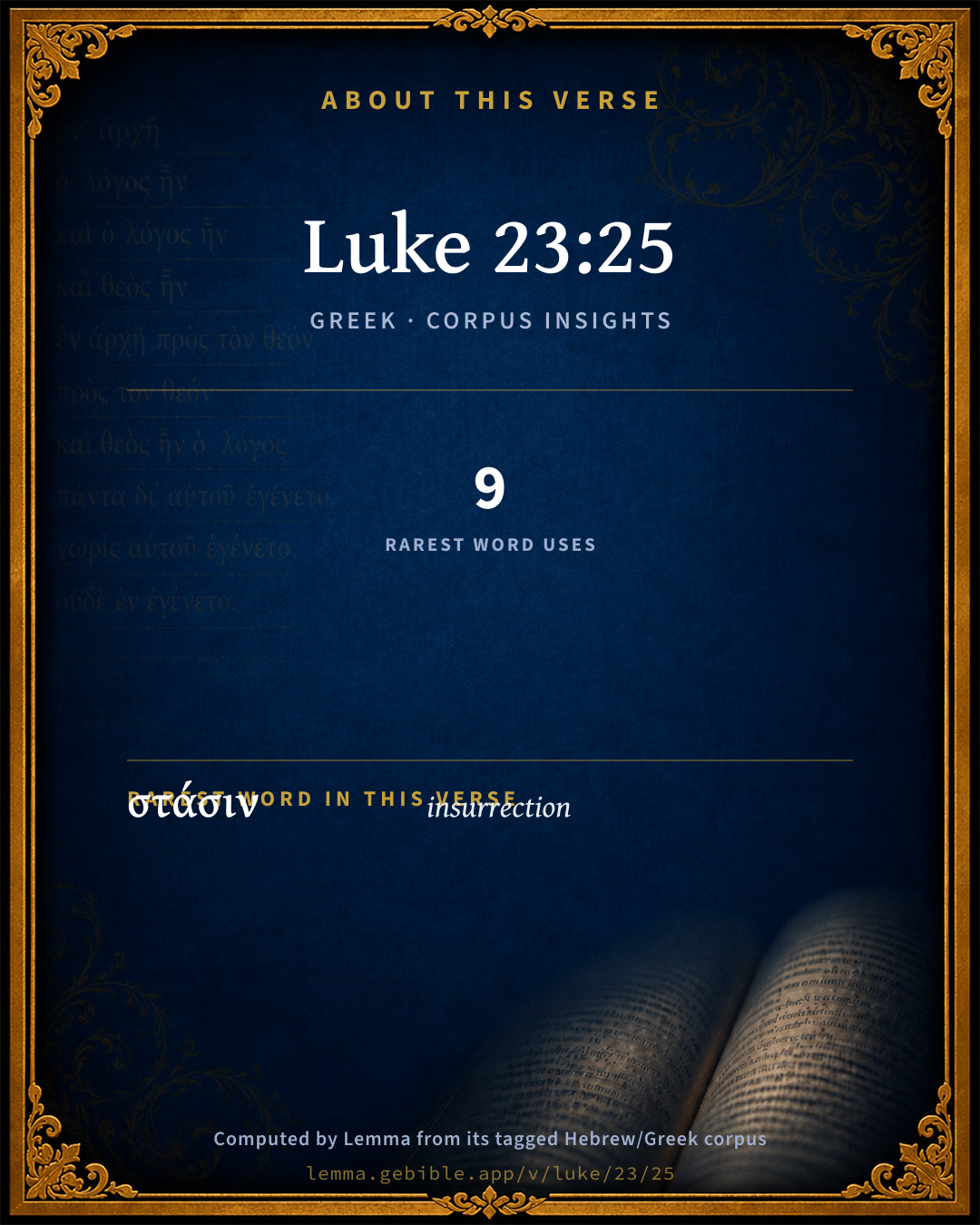
Luke 23:25

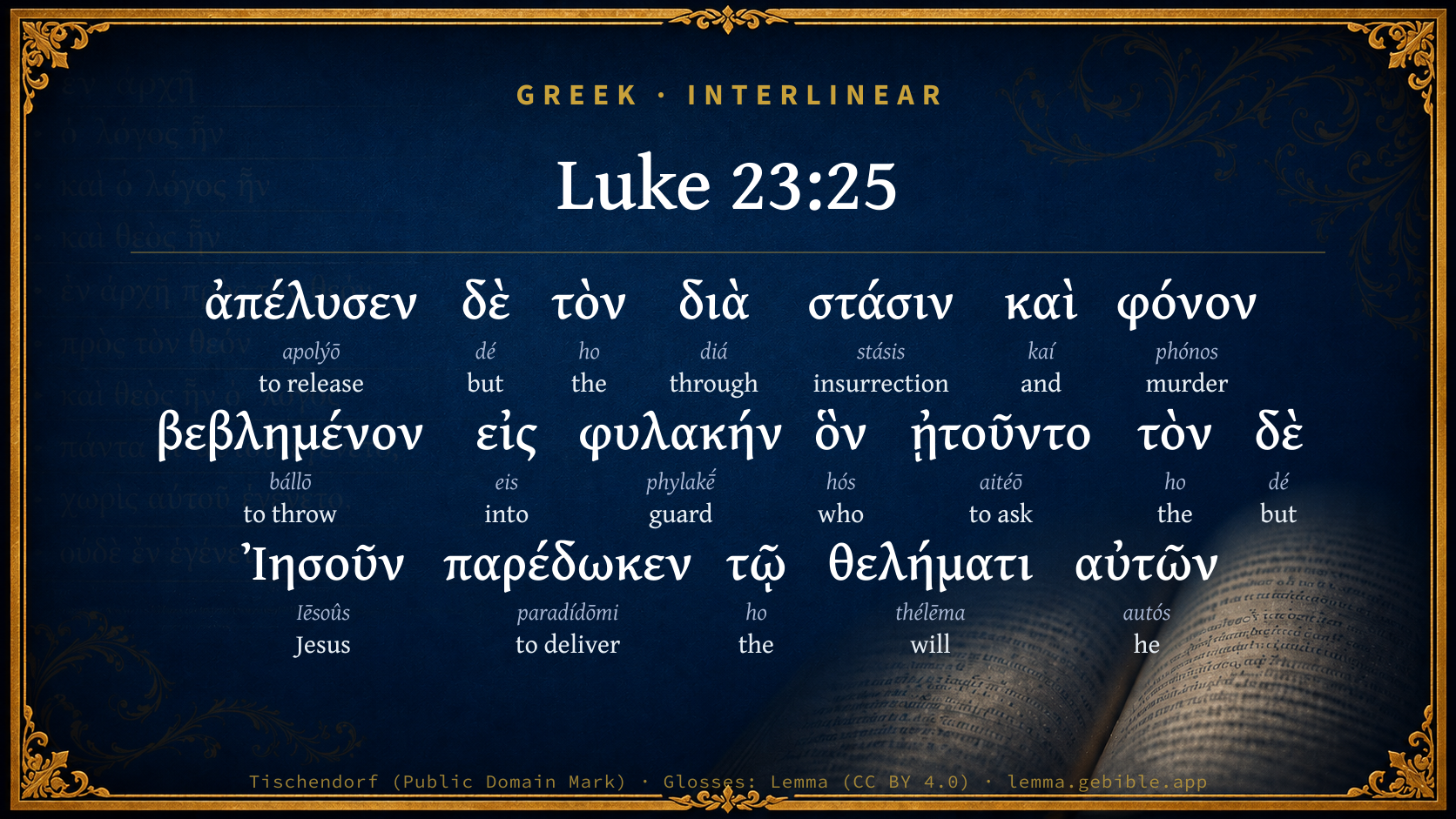
Greek (Tischendorf 8th ed.) Luke 23:25 appears in the Greek New Testament. The text above is from the Tischendorf 8th edition. Each word links to its Strong’s number and a concise gloss. Click any word for its full Thayer’s Greek Lexicon entry.
Download image
Cite this verse

Luke 23:25 (World English Bible). Public Domain. Lemma interlinear Bible study tool, https://lemma.gebible.app/v/luke/23/25.

Show BibTeX & RIS
BibTeX
RIS
English Translation
He released him who had been thrown into prison for insurrection and murder, for whom they asked, but he delivered Jesus up to their will.
World English Bible · Public Domain
Download a study sheet

One document with this verse’s original text, its word-by-word gloss line, the meaning frame, cross-references with their text, attributed commentary, and full source and license credits — printable, and it pastes into notes with its structure intact.

This verse Autodidact and up

Study sheet (.html) Plain text (.txt)

A passage Seminary Student

Up to 50 verses in one chapter. A passage sheet keeps up to 6 commentary sources and 12 cross-references per verse, in the order this page ranks them, and says so on the sheet whenever that leaves anything out. Ask for a single verse and you get the Autodidact verse sheet above.

Everything on this page stays free to read, with no account — the sheet is a download of what is already on screen, not access to it.

Want to remove ads? Support Godless Engineer
Compare translations 3

The same verse in 3 English versions, stacked beneath the original-language interlinear above. Click any original word for its lexicon entry.

Each is an independent rendering of the whole verse — the interlinear is not word-aligned to these translations.

Highlighted words mark where these versions differ — a whole-verse word diff, not a word-by-word alignment.

  • World English Bible Public Domain
    He released him who had been thrown into prison for insurrection and murder, for whom they asked, but he delivered Jesus up to their will.
  • King James Version Public Domain
    And he released unto them him that for sedition and murder was cast into prison, whom they had desired; but he delivered Jesus to their will.
  • unfoldingWord Literal Text CC BY-SA 4.0
    Then he released the one that had been put in prison for rebellion and murder, whom they were requesting, but he handed over Jesus to their will.

unfoldingWord Literal Text — © unfoldingWord, licensed CC BY-SA 4.0. Word-aligned USFM3 via Door43 (git.door43.org/unfoldingWord/en_ult).

Versions to compare (up to 4)

3 of 4 selected

Show all 19 translations

Every available English version of this verse, each an independent rendering of the whole verse.

  • World English Bible Public Domain
    He released him who had been thrown into prison for insurrection and murder, for whom they asked, but he delivered Jesus up to their will.
  • Berean Standard Bible Public Domain
    As they had requested, he released the one imprisoned for insurrection and murder, and handed Jesus over to their will.
  • Majority Standard Bible Public Domain
    As they had requested, he released the one imprisoned for insurrection and murder, and he handed Jesus over to their will.
  • King James Version Public Domain
    And he released unto them him that for sedition and murder was cast into prison, whom they had desired; but he delivered Jesus to their will.
  • American Standard Version (1901) Public Domain
    And he released him that for insurrection and murder had been cast into prison, whom they asked for; but Jesus he delivered up to their will.
  • Revised Version (1885) Public Domain
    And he released him that for insurrection and murder had been cast into prison, whom they asked for; but Jesus he delivered up to their will.
  • Geneva Bible (1599) Public Domain
    And he let loose vnto them him that for insurrection and murder was cast into prison, whome they desired, and deliuered Iesus to doe with him what they would.
  • Douay-Rheims (1899) Public Domain
    And he released unto them him who for murder and sedition, had been cast into prison, whom they had desired; but Jesus he delivered up to their will.
  • Young's Literal Translation Public Domain
    and he released him who because of sedition and murder hath been cast into the prison, whom they were asking, and Jesus he gave up to their will.
  • Literal Standard Version CC BY-SA 4.0
    and he released him who because of sedition and murder has been cast into the prison, whom they were asking for, and he gave up Jesus to their will.
  • Unlocked Literal Bible CC BY-SA 4.0
    He released the one they asked for who had been put in prison for rioting and murder. But he delivered up Jesus to their will.
  • unfoldingWord Literal Text CC BY-SA 4.0
    Then he released the one that had been put in prison for rebellion and murder, whom they were requesting, but he handed over Jesus to their will.
  • Darby Bible Public Domain
    And he released him who, for tumult and murder, had been cast into prison, whom they begged for, and Jesus he delivered up to their will.
  • World Messianic Bible Public Domain
    He released him who had been thrown into prison for insurrection and murder, for whom they asked, but he delivered Yeshua up to their will.
  • Webster's Bible Public Domain
    And he released to them him that for sedition and murder had been cast into prison, whom they had desired; but he delivered Jesus to their will.
  • Free Bible Version CC BY-SA 4.0
    He released the man imprisoned for rebellion and murder, but he sent Jesus to be put to death in accordance with their demands.
  • Bible in Basic English Public Domain
    And in answer to their request, he let that man go free who had been in prison for acting against the government and causing death, and Jesus he gave up to their pleasure.
  • Text-Critical English NT CC BY 4.0
    He released the man they had been asking for, who had been thrown into prison for insurrection and murder, but he handed Jesus over to their will.
  • Tyndale New Testament (1534) Public Domain
    and let lowse vnto them him that for insurreccion and morther was cast into preson whom they desyred: and delyvered Iesus to do with him what they wolde.

Literal Standard Version (2020), Covenant Press — licensed CC BY-SA 4.0. Text via the HelloAO Bible API (eBible.org). Unlocked Literal Bible (unfoldingWord) — licensed CC BY-SA 4.0. Text via the HelloAO Bible API (eBible.org). unfoldingWord Literal Text — © unfoldingWord, licensed CC BY-SA 4.0. Word-aligned USFM3 via Door43 (git.door43.org/unfoldingWord/en_ult). Free Bible Version, Dr. Jonathan Gallagher — licensed CC BY-SA 4.0. Text via the HelloAO Bible API (eBible.org).

Word by word

More ways to search: Search by grammar → Find every occurrence → Compare this word →

Practice this passage: Drill this verse → Learn its vocabulary →

στάσιν
stásis
G4714
“insurrection”
Noun, Accusative, Singular, Feminine
Part of Speech
Noun
Case
Accusative
Number
Singular
Gender
Feminine
Full Thayer's Definition

Origin: from the base of G2476

TDNT: 16:28,1

1. a standing, station, state 2. an insurrection 3. strife, insurrection
  1. ἀπέλυσεν apolýō G630 “to release” Verb, Aorist, Active, Indicative, 3rd person, Singular
  2. δὲ dé G1161 “but” Conjunction
  3. τὸν ho G3588 “the” Article, Accusative, Singular, Masculine
  4. διὰ diá G1223 “through” Preposition
  5. καὶ kaí G2532 “and” Conjunction
  6. φόνον phónos G5408 “murder” Noun, Accusative, Singular, Masculine
  7. βεβλημένον bállō G906 “to throw” Verb, Perfect, Passive, Participle, Accusative, Singular, Masculine
  8. εἰς eis G1519 “into” Preposition
  9. φυλακήν phylakḗ G5438 “guard” Noun, Accusative, Singular, Feminine
  10. ὃν hós G3739 “who” Relative pronoun, Accusative, Singular, Masculine
  11. ᾐτοῦντο aitéō G154 “to ask” Verb, Imperfect, Middle, Indicative, 3rd person, Plural
  12. τὸν ho G3588 “the” Article, Accusative, Singular, Masculine
  13. δὲ dé G1161 “but” Conjunction
  14. Ἰησοῦν Iēsoûs G2424 “Jesus” Noun, Accusative, Singular, Masculine
  15. παρέδωκεν paradídōmi G3860 “to deliver” Verb, Aorist, Active, Indicative, 3rd person, Singular
  16. τῷ ho G3588 “the” Article, Dative, Singular, Neuter
  17. θελήματι thélēma G2307 “will” Noun, Dative, Singular, Neuter
  18. αὐτῶν autós G846 “he” Personal pronoun, Genitive, Plural, Masculine

About this verse

These counts appear in no published source. They are computed here, from the morphology-tagged text and Lemma’s own curated glosses. What Lemma adds →

19
words
16
distinct lemmas
Gospels
section

Notable vocabulary

The rarest word here is στάσιν insurrection G4714 — appearing just 9 times in the whole Greek New Testament.

Shared distinctive vocabulary

στάσιν insurrection G4714 occurs in 9 verses of the Greek New Testament. Also found in:

Repetition

Words recur within this verse:

Cross-references

8

Topical passages linked to Luke 23:25 in the Treasury of Scripture Knowledge — connected by theme and wording, ordered by reader-vote popularity; previews shown in the World English Bible.

  • Acts 3:14 But you denied the Holy and Righteous One, and asked for a murderer to be granted to you,
  • Mark 15:6–7 Now at the feast he used to release to them one prisoner, whom they asked of him.
  • Mark 15:15 Pilate, wishing to please the multitude, released Barabbas to them, and handed over Jesus, when he had flogged him, to be crucified.
  • 1 Samuel 12:13 Now therefore see the king whom you have chosen, and whom you have asked for: and, behold, Yahweh has set a king over you.
  • Matthew 27:26 Then he released to them Barabbas, but Jesus he flogged and delivered to be crucified.
  • Luke 23:2 They began to accuse him, saying, "We found this man perverting the nation, forbidding paying taxes to Caesar, and saying that he himself is Christ, a king."
  • Luke 23:5 But they insisted, saying, "He stirs up the people, teaching throughout all Judea, beginning from Galilee even to this place."
  • John 18:40 Then they all shouted again, saying, "Not this man, but Barabbas!" Now Barabbas was a robber.

Cross-references courtesy of OpenBible.info (CC BY 4.0).

Commentary

Notes on Luke 23:25 from classic Christian and Jewish commentators (each source and its license shown beneath its notes). The classic Christian expositions comment on the surrounding passage and are grouped to its opening verse, so a note may address several verses; the Jewish commentaries on the Tanakh (Rashi and others) are per-verse, so they appear only where the commentator wrote on this verse.

Lemma curates 59 commentaries, every one of them public domain or Creative Commons licensed, each selected and text-cleaned for this edition rather than reprinted as found. About our sources →

The Biblical Illustrator

Joseph S. Exell

Luk_23:25

He delivered Jesus to their will--

The illegal trial and condemnation of our Lord

I.

THE TRIAL OF CHRIST FOR HIS LIFE WAS MANAGED MOST MALICIOUSLY AND ILLEGALLY AGAINST HIM, BY HIS UNRIGHTEOUS JUDGES.

1. Was Christ thus used when He stood before the great Council, the Scribes and Elders of Israel? Then surely great men are not always wise, neither do the aged understand judgment. (Job_32:9.)

2. Hence also we learn, that though we are not obliged to answer every captious, idle, or ensnaring question, yet we are bound faithfully to own and confess the truth, when we are solemnly called thereunto.

3. Once more, hence it follows, that to bear the revilings, contradictions, and abuses of men, with a meek, composed, and even spirit, is excellent and Christ-like.

II. ALTHOUGH NOTHING COULD BE PROVED AGAINST OUR LORD JESUS CHRIST WORTHY OF DEATH OR OF BONDS; YET WAS HE CONDEMNED TO BE NAILED TO THE CROSS, AND THERE TO HANG TILL HE DIED.

1. A most unjust and unrighteous sentence: the greatest perversion of judgment and equity that was ever known to the civilized world, since seats of judicature were first set up. Pilate should rather have come down from his seat of judgment, and adored Him, than sat there to judge Him. Oh! it was the highest piece of injustice that ever our ears heard of.

2. As it was an unrighteous, so it was a cruel sentence, delivering up Christ to their wills. This was that misery which David so earnestly deprecated--O deliver me not over to the will of mine enemies (Psa_27:12). But Pilate delivers Christ over to the will of His enemies; men full of enmity, rage, and malice.

3. It was also a rash and hasty sentence. Trial of many a mean man hath taken up ten times more debates and time than was spent about Christ. They that look but slightly into the cause, easily pronounce and give sentence.

4. As it was a rash and hasty, so it was an extorted, forced sentence. They squeeze it out of Pilate by mere clamour, importunity, and suggestions of danger. In courts of judicature, such arguments should signify but little; not importunity, but proof, should carry it. But timorous Pilate bends like a willow at this breath of the people; he had neither such a sense of justice, nor spirit of courage, as to withstand it.

5. As it was an extorted, so it was a hypocritical sentence, masking horrid murder under a pretence and formality of law.

6. As it was a hypocritical, so it was an unrevoked sentence. It admitted not of a reprieve, no, not for a day; nor doth Christ appeal to any other judicature, or once desire the least delay; but away He is hurried in haste to the execution. Blush, O ye heavens! and tremble, O earth! at such a sentence as this. In what manner did Christ receive this cruel and unrighteous sentence? He received it like Himself, with admirable meekness and patience.

He doth as it were wrap Himself up in His own innocency, and obedience to His Fathers will, and stands at the bar with invincible patience and meek submission.

1. Do you see what was here done against Christ, under pretence of law? What cause have we to pray for good laws, and righteous executioners of them?

2. Was Christ condemned in a court of judicature? How evident then is it, that there is a judgment to come after this life? When you see Jesus condemned, and Barabbas released, conclude that a time will come when innocency shall be vindicated, and wickedness shamed.

3. Here you see how conscience may be overborne and run down by a fleshly interest.

4. Did Christ stand arraigned and condemned at Pilates bar? Then the believer shall never be arraigned and condemned at Gods bar. Christ stood at this time before a higher Judge than Pilate; He stood at Gods bar as well as his. Pilate did but that which Gods own hand and counsel had before determined to be done. (J. Flavel.)

The act of a moment and its results

I. IT WAS ONLY THE ACT OF A MOMENT THIS DELIVERING OF JESUS TO THE JEWS, BUT IT SEALED THE DOOM OF PILATE. Of many important acts it may be said that they are done both suddenly and slowly. In one way or another the decision must be made in a moment: and yet these momentary acts are not so isolated from all the life as they seem. Our life is truly one; all parts and all events of it are closely joined together. Each event is at once a cause and an effect--a link which grows out of a former link, and out of which in turn a new link is formed. Thus it happens that we could account for any strange-seeming word a man speaks, or act he does, if we could only go back far enough into his history, and see deeply enough into his character. His life has been slowly moving round towards the point it now has reached. Into the house which bad been slowly preparing to receive him, the guest has suddenly stepped. There has been a removal of obstacles which would have hindered, or a heaping up of obstacles which make it impossible to proceed. In a word, character and habit decide a mans action at any moment of test and trial; and character and habit are not things of a moment. It is not always unfair, therefore, to judge a man by the act of a moment, or by his attitude under sore and sudden temptation. These things reveal the secrets of his character and life, perhaps to himself, certainly to other men; well if only he is willing to learn at the first lesson where his weakness is, and so make up the breach before the next assault. Peter was walking carelessly for hours, or days, before that terrible stumbling and fall in which his very heart was broken, and all his fancied righteousness and courage fell in a moment into ruins about him. In one of the western towns of the United States, a young man stood one day in the midst of a group of gay companions. A public house was open on the one side of the street, and the building of the Y.M.C.A. on the other. He was being pressed to go into the tavern, but suddenly he turned from all his companions, and amid their jests and laughter, entered the Y.M.C.A. rooms. From that moment his path in life was plain; he had committed himself on the right side. But was there no preparation for the sudden act? I am sure there was. If we knew all the story, we would find there was a godly home behind him. Many a warning conscience had given him. In a moment Pilate yielded to the request of the chief priest, and did this fatal act; but a whole life of selfishness and self-indulgence and cruelty had prepared him for that moment, and made it certain that when the time of trial came, he would do the wrong thing. Young men may be sure of it that there will come a time when they will be suddenly put to the test.

II. PILATE TRIED TO RID HIMSELF OF THE RESPONSIBILITY OF THIS ACT, BUT HE COULD NOT DO IT. There are some things of which we can easily divest ourselves. We can tear them off and throw them away in a few moments. I can change my dress and make myself, in outward appearance, another man. There are some things that cleave to us always and everywhere. I cannot destroy my personality; through all changes! remain myself, conscious of my own personal identity. One of the commonest excuses men make in such circumstances is, I did it under pressure. Some men are sensitive to the pressure of duty, of honour, of obligation, of truth, of love, of pity. This pressure is irresistible. When these influences are behind them, they must go on, no matter what lies in front. It was in this way that Christ was pressed to the cross, and many of Christs servants to the scaffold and the fire. I cannot do otherwise, God help me, were Luthers words when this pressure was strong upon him. There are many, however, who scarcely feel such pressure at all, but who are keenly alive to every touch of popular applause, of the blame of men, of the sharp edge of ridicule, of the fear of loss and pain. By the force of popular opinion, they could be pressed anywhere, into anything. It is putting the same thing in other words to say, that men try to get rid of their responsibility for wrong-doing by throwing the blame upon others, and upon God. It is the way I was brought up.

You see I was led into it. A man in my position must do such things. Every one does it, and you may as well be out of the world as out of the fashion. It is a weakness incidental to my constitution. Circumstances shut me in, so that I could do nothing else; as if a man should not rather die than do the wrong! Pilate washed his hands. He tried, in the most public and solemn way, to cast off his responsibility; but though he had a better excuse than thousands have who sin against conscience and a sense of duty, we see, as we look back upon his case, that it was impossible for him to put the blame on any one else. When he delivered Jesus to the Jews, it was his own deliberate act, done against his conscience, not to speak of any supernatural warning; and he must take the consequences. And Pilates future history was very sad and hopeless. Responsibility is a thing I cannot get rid of. The gospel of Christ does not remove it. Every man shall bear his own burden. Every one of us shall give account of himself unto God. If I have done wrong, let me bravely confess it, and seek the grace of God to avoid the temptation again. Thus out of weakness I shall rise to strength, and my very errors and mistakes may be stairs leading me up to God.

III. PILATES GUILT WAS GREAT, BUT NOT SO GREAT AS THAT OF THE JEWS, WHO CHOSE BARABBAS AND REJECTED JESUS. That there are degrees of guilt is clearly taught by our Lord Jesus. Some shall be beaten with many stripes, and some with few. Christ does not exculpate Pilate, but He tells him, He that delivered Me unto thee hath the greater sin. Such choices--not sudden decisions like Pilates on partial knowledge and under pressure, but calm, quiet, almost unconscious acts of choice--we are making day by day. (W. Park, M. A.)

Jesus delivered to their will

I. WHAT WAS THIS WILL? What was the moving spring of their fierce resolution that Jesus of Nazareth should die?

1. It was their will that this stern censor of their manners and morals should die.

2. They willed that the witness to the truth should die. The Lord belonged to another world, which they did not care to enter; a world which troubled their selfish, sensual lives. It distracted them with visions, it oppressed them with dread.

3. They willed that this teacher of the people, this friend of publicans and sinners, should die. They were a ruling class, almost a caste. And such rulers hate none so bitterly as those who speak loving, quickening, emancipating words to the poor. As society was then constituted in Judaea, that meant that He or the rulers must fall.

4. There was something deeper and more malignant than this. It was their will that their Saviour should die. One cannot shake off the impression, reading the gospel narrative, that the rulers knew Him. This was the will of the Jews. But--

II. WHAT, MEANWHILE, WAS THE WILL OF GOD? St. Peter explains it Act_2:23). To understand this, we must consider--

1. That it was not possible that the God-man should be holden of death. The flesh, the outer man, they killed. But what is the outer man, and what is death? They willed that He should die, but what He was, what they hated, could not die. God delivered it into their hands that they might see that they were powerless, that what they hated and had arrayed themselves against was eternal. His death made His life immortal, His witness to the truth eternal.

2. Through death the power of Christ, His witness to the truth, His witness against sin, His redemptive work for mankind, became living, nay, all-pervading and almighty realities in the world. Hidden for a moment by His death, the power reappeared, and reappeared to reign. Jesus delivered to their will was slain; but the world was soon filled with men who were charged with the spirit of Jesus, and who made His death the gospel of salvation to mankind. (J. B. Brown, B. A.)

The Biblical Illustrator, edited by Joseph S. Exell (c. 1880s–1900s) — public domain. Text from a community e-Sword module.

Bengel's Gnomon

Johann Albrecht Bengel

Luk 23:25. Θελήματι, to their will) that they might do to Him whatever they had wished or might wish. [If the same power Mere at the discretion of some of those who wish to be called Christians, what, think you, would be the result?—V. g.]

Bengel's Gnomon of the New Testament — English translation (T&T Clark, Edinburgh, 1860) — public domain. Text from a community e-Sword module.

Expositor's Greek Testament

ed. W. Robertson Nicoll

Luk 23:25 . τὸν διὰ σ .: the repetition of this description, instead of giving the name, is very expressive. τῷ θελήματι α ., to their will. Weak man and wicked people!

The Expositor's Greek Testament, edited by W. Robertson Nicoll (1897–1910) — public domain. Text from a community e-Sword module.

Ellicott's Commentary for English Readers

(25) Whom they had desired.—Better, whom they were asking for. The tense is imperfect, not pluperfect, and implies that the cries were still continuing.

A Bible Commentary for English Readers, edited by Charles John Ellicott (1878–1897) — public domain. Text from a community e-Sword module.

John Gill's Exposition

And as they led him away,.... From Pilate's hall, and out of the city of Jerusalem, towards Calvary; which was done by the Jews and Roman soldiers, after they had stripped him of his own clothes, and put on him a scarlet coat, and had platted a crown of thorn, and put it on his head, and a reed in his hand, and bowed the knee, and mocked him, saluting him as King of the Jews; after they had finished their sport and pastime with him, and had put on him his own clothes again:

they laid hold upon one Simon, a Cyrenian; father of Alexander and Rufus, Mar 15:21; see Gill on Mat 27:32.

coming out of the country; either out of the country part of Judea, to the city of Jerusalem; or out of the field where he had been about rural business, and was now returning home, and perhaps knew nothing of the matter, what had been doing at Jerusalem:

and on him they laid the cross; on which Jesus was to be crucified, and which he was bearing himself; but finding that he was weak, and languid, and unable to carry it himself, and fearing, should he die by the way, they should be disappointed of glutting their malice, and seeing him in shame and agony on the cross, and of triumphing over him there; and being in haste for the execution of their malicious designs, they put the cross, at least one end of it, upon this man's shoulders:

that he might bear it after Jesus: either the whole of it, following Jesus; or only one end of it, Jesus going before with the other end on his shoulder; which seems to be the order in which it was carried between them.

John Gill's Exposition of the Whole Bible (1746–1763) — public domain (CC PDM 1.0). Text via the HelloAO Bible API.

Trapp's Complete Commentary

John Trapp

25 And he released unto them him that for sedition and murder was cast into prison, whom they had desired; but he delivered Jesus to their will.

Ver. 25. Him that for sedition] The Jews, before they were banished out of this kingdom, threw bags of poison into the wells and fountains that the people were to drink of; and so endeavoured to poison them all. So deal those that sow sedition; these are the pests, the botches of human society.

John Trapp, A Commentary or Exposition upon All the Books of the Old and New Testament (1647–1656) — public domain. Text from a community e-Sword module.

Whedon's Commentary on the Bible

Daniel D. Whedon

§ 138.—DELIVERS JESUS TO BE CRUCIFIED, Luk_23:23-25.

See notes on Mat_27:24-31; Mar_15:15-20; Joh_19:1-16.

25. Released—Barabbas to their mercy, and delivered Jesus to their will. This is stated by Luke as a sad contrast. It marks the transition from the trial to the execution.

Daniel D. Whedon (gen. ed.), Commentary on the Old and New Testaments (1874–1909) — public domain. Text from a community e-Sword module.

Cambridge Greek Testament for Schools and Colleges

25. ὃν ᾐτοῦντο. ‘Whom they were demanding.’ Comp. Act 13:18.

Cambridge Greek Testament for Schools and Colleges (Cambridge University Press, 1896; 21 vols, various authors incl. Carr, Maclear, Plummer, Farrar, Lumby, Moule, M. R. James, Simcox) — public domain. Text from a community e-Sword module.

Alford’s Greek Testament

Henry Alford

25. τὸν δ. σ. κ.τ.λ.] The description is inserted for the sake of contrast;—see Act 3:14. Luke omits the scourging and mocking of Jesus. It is just possible that he might have omitted the mocking, because he had related a similar incident before Herod; but how shall we say this of the scourging, if he had seen any narratives which contained it? The break between vv. 25 and 26 is harsh in the extreme, and if Luke had any materials wherewith to fill it up, I have no doubt he would have done so.

Henry Alford, The Greek Testament (1849–1861) — public domain. Text from a community e-Sword module.

International Critical Commentary

25. ἀπέλυσεν … παρέδωκεν. This tragic contrast is in all three; and all four use παρέδωκεν of the final surrender. Comp. Act 3:14, and note the contrast between these aorists and the imperfect ᾐτοῦντο, “kept demanding.” Both the repetition of τὸν διὰ ατάσιν, κ.τ.λ. and the addition of τῷ θελήματι αὐτῶν are peculiar to Lk. The writer thus emphasizes the enormity of the transaction. In the Gospel of Peter Herod is present at this point and gives the sentence. He does not wash his hands, and the blame is transferred to him and the Jews. So also in the Acta Pilati (B. x.) it is the Jews who hastily execute the sentence, as soon as Pilate has pronounced it. Comp. Justin (Try. 108.) ὃν σταυρωσάντων ἡμῶν. See Hastings, D.B. 1. p. 245.

International Critical Commentary — older volumes (1896–1929), various authors — public domain. Text from a community e-Sword module.

Lesson kit

Teaching starters — assembled from the data on this page, not authored interpretation. Every prompt links to the verse data it draws on. Edit before teaching.

Luke, in the Gospels, opens this verse with 19 words (16 distinct Greek lemmas). Its most distinctive word is stásis (“insurrection”). A historical commentator’s framing appears above. Read the whole chapter for the surrounding context.

Discussion questions

  1. What does “insurrection” (stásis) contribute to the verse as a whole?
  2. How does Mark 15:7, which shares the word «insurrection», read alongside this verse?
  3. What does the repetition of “the” (3× in this one verse) do in this verse?
  4. These translations render this verse differently. What is at stake in choosing one wording over another?
  5. Compare how The Biblical Illustrator and Bengel's Gnomon read this verse. Where do they agree or differ?

Things to notice

Reading settings

Reading text

Shown beneath each verse's original-language words.

Old Testament
Old Testament edition

Read the OT as the Masoretic Hebrew (MT) or the Greek Septuagint (LXX).

English shown for the Greek Septuagint (in the Hebrew ↔ Greek comparison).

Comparing translations? Open the Compare panel on any verse page to stack up to four side by side.