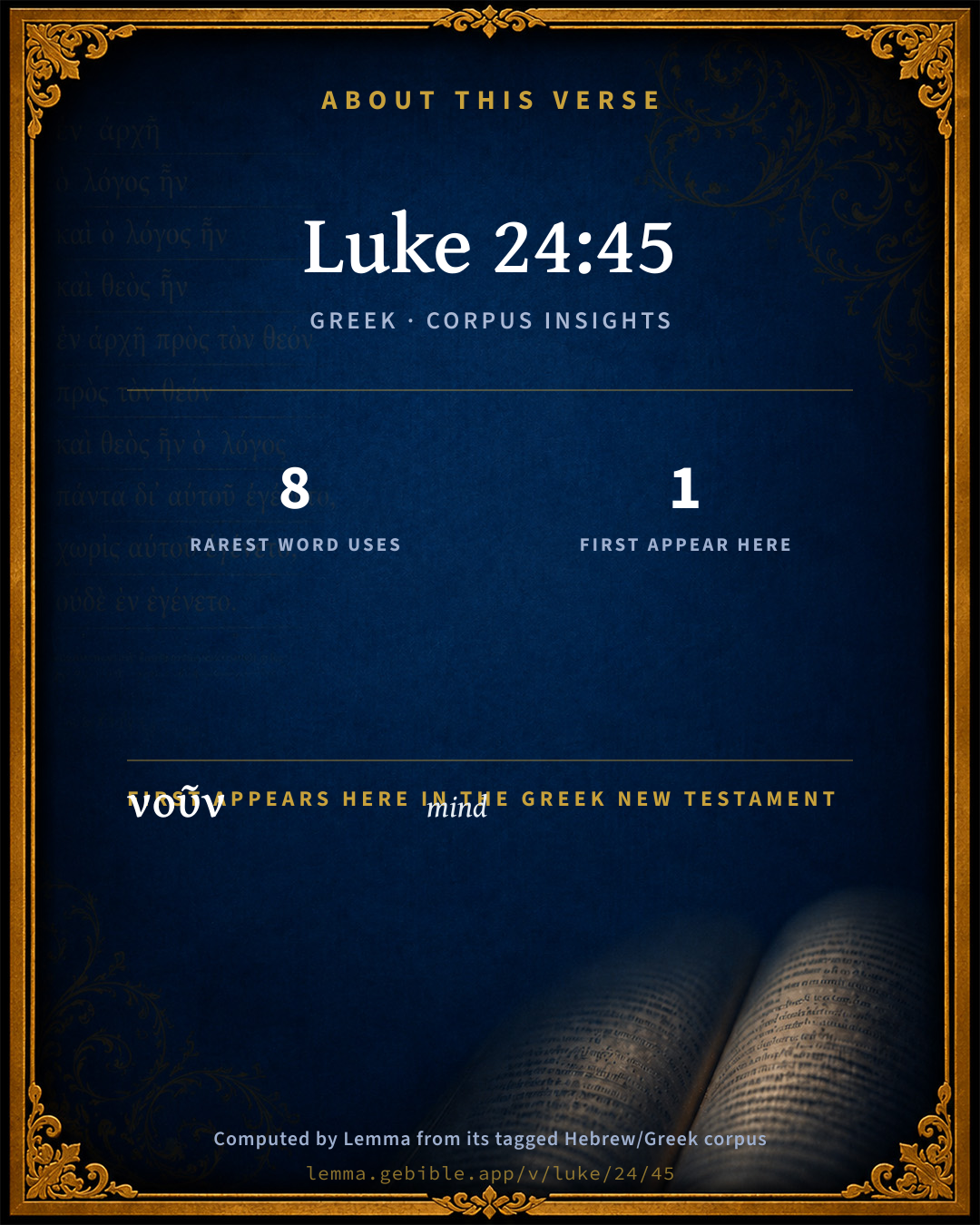
Luke 24:45

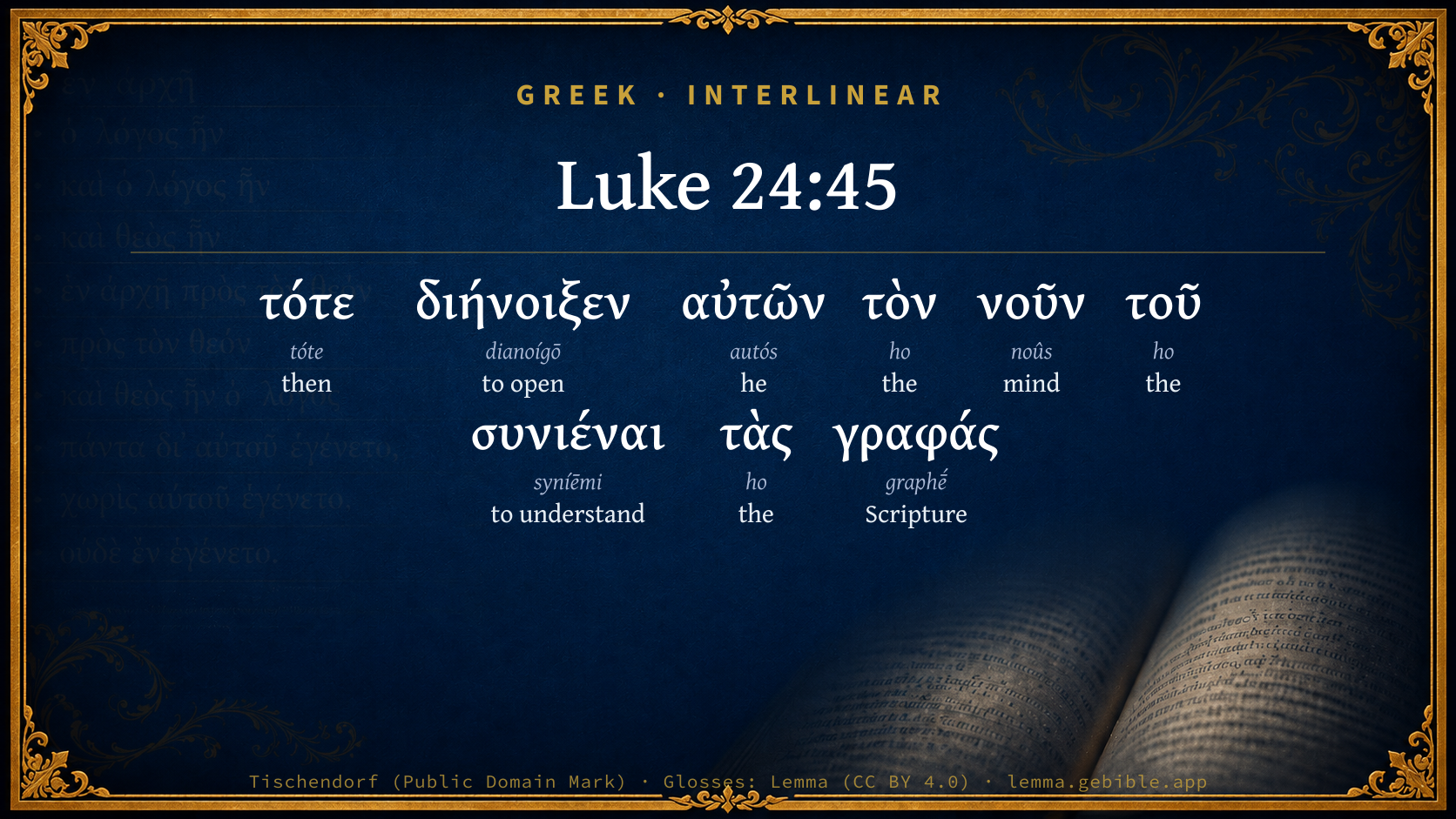
Greek (Tischendorf 8th ed.) Luke 24:45 appears in the Greek New Testament. The text above is from the Tischendorf 8th edition. Each word links to its Strong’s number and a concise gloss. Click any word for its full Thayer’s Greek Lexicon entry.
Download image
Cite this verse

Luke 24:45 (World English Bible). Public Domain. Lemma interlinear Bible study tool, https://lemma.gebible.app/v/luke/24/45.

Show BibTeX & RIS
BibTeX
RIS
English Translation
Then he opened their minds, that they might understand the Scriptures.
World English Bible · Public Domain
Highlights
  • 1 first appearance in the Greek New Testament
Full analysis ↓
Download a study sheet

One document with this verse’s original text, its word-by-word gloss line, the meaning frame, cross-references with their text, attributed commentary, and full source and license credits — printable, and it pastes into notes with its structure intact.

This verse Autodidact and up

Study sheet (.html) Plain text (.txt)

A passage Seminary Student

Up to 50 verses in one chapter. A passage sheet keeps up to 6 commentary sources and 12 cross-references per verse, in the order this page ranks them, and says so on the sheet whenever that leaves anything out. Ask for a single verse and you get the Autodidact verse sheet above.

Everything on this page stays free to read, with no account — the sheet is a download of what is already on screen, not access to it.

Want to remove ads? Support Godless Engineer
Compare translations 3

The same verse in 3 English versions, stacked beneath the original-language interlinear above. Click any original word for its lexicon entry.

Each is an independent rendering of the whole verse — the interlinear is not word-aligned to these translations.

Highlighted words mark where these versions differ — a whole-verse word diff, not a word-by-word alignment.

  • World English Bible Public Domain
    Then he opened their minds, that they might understand the Scriptures.
  • King James Version Public Domain
    Then opened he their understanding, that they might understand the scriptures,
  • unfoldingWord Literal Text CC BY-SA 4.0
    Then he opened their mind to understand the Scriptures, and he said to them,

unfoldingWord Literal Text — © unfoldingWord, licensed CC BY-SA 4.0. Word-aligned USFM3 via Door43 (git.door43.org/unfoldingWord/en_ult).

Versions to compare (up to 4)

3 of 4 selected

Show all 19 translations

Every available English version of this verse, each an independent rendering of the whole verse.

  • World English Bible Public Domain
    Then he opened their minds, that they might understand the Scriptures.
  • Berean Standard Bible Public Domain
    Then He opened their minds to understand the Scriptures.
  • Majority Standard Bible Public Domain
    Then He opened their minds to understand the Scriptures.
  • King James Version Public Domain
    Then opened he their understanding, that they might understand the scriptures,
  • American Standard Version (1901) Public Domain
    Then opened he their mind, that they might understand the scriptures;
  • Revised Version (1885) Public Domain
    Then opened he their mind, that they might understand the scriptures;
  • Geneva Bible (1599) Public Domain
    Then opened he their vnderstanding, that they might vnderstand the Scriptures,
  • Douay-Rheims (1899) Public Domain
    Then he opened their understanding, that they might understand the scriptures.
  • Young's Literal Translation Public Domain
    Then opened he up their understanding to understand the Writings,
  • Literal Standard Version CC BY-SA 4.0
    Then He opened up their understanding to understand the Writings,
  • Unlocked Literal Bible CC BY-SA 4.0
    Then he opened their minds, that they might understand the scriptures.
  • unfoldingWord Literal Text CC BY-SA 4.0
    Then he opened their mind to understand the Scriptures, and he said to them,
  • Darby Bible Public Domain
    Then he opened their understanding to understand the scriptures,
  • World Messianic Bible Public Domain
    Then he opened their minds, that they might understand the Scriptures.
  • Webster's Bible Public Domain
    Then he opened their understanding, that they might understand the scriptures,
  • Free Bible Version CC BY-SA 4.0
    Then he opened their minds so they were able to understand the Scriptures.
  • Bible in Basic English Public Domain
    Then he made the holy Writings clear to their minds.
  • Text-Critical English NT CC BY 4.0
    Then he opened their minds to understand the Scriptures
  • Tyndale New Testament (1534) Public Domain
    Then openned he their wyttes that they myght vnderstond the scriptures

Literal Standard Version (2020), Covenant Press — licensed CC BY-SA 4.0. Text via the HelloAO Bible API (eBible.org). Unlocked Literal Bible (unfoldingWord) — licensed CC BY-SA 4.0. Text via the HelloAO Bible API (eBible.org). unfoldingWord Literal Text — © unfoldingWord, licensed CC BY-SA 4.0. Word-aligned USFM3 via Door43 (git.door43.org/unfoldingWord/en_ult). Free Bible Version, Dr. Jonathan Gallagher — licensed CC BY-SA 4.0. Text via the HelloAO Bible API (eBible.org).

Word by word

More ways to search: Search by grammar → Find every occurrence → Compare this word →

Practice this passage: Drill this verse → Learn its vocabulary →

About this verse

These counts appear in no published source. They are computed here, from the morphology-tagged text and Lemma’s own curated glosses. What Lemma adds →

9
words
7
distinct lemmas
Gospels
section

Notable vocabulary

The rarest word here is διήνοιξεν to open G1272 — appearing just 8 times in the whole Greek New Testament.

First appearance in Scripture

This word makes its first canonical appearance in the Greek New Testament here:

Shared distinctive vocabulary

διήνοιξεν to open G1272 occurs in 8 verses of the Greek New Testament. Also found in:

Repetition

A word recurs within this verse:

Cross-references

13

Topical passages linked to Luke 24:45 in the Treasury of Scripture Knowledge — connected by theme and wording, ordered by reader-vote popularity; previews shown in the World English Bible.

  • Acts 16:14 A certain woman named Lydia, a seller of purple, of the city of Thyatira, one who worshiped God, heard us; whose heart the Lord opened to listen to the things which were spoken by Paul.
  • 1 John 5:20 We know that the Son of God has come, and has given us an understanding, that we know him who is true, and we are in him who is true, in his Son Jesus Christ. This is the true God, and eternal life.
  • Psalms 119:18 Open my eyes, That I may see wondrous things out of your law.
  • 2 Corinthians 3:14–18 But their minds were hardened, for until this very day at the reading of the old covenant the same veil remains, because in Christ it passes away.
  • Acts 26:18 to open their eyes, that they may turn from darkness to light and from the power of Satan to God, that they may receive remission of sins and an inheritance among those who are sanctified by faith in me.'
  • Isaiah 29:18–19 In that day shall the deaf hear the words of the book, and the eyes of the blind shall see out of obscurity and out of darkness.
  • 2 Corinthians 4:4–6 in whom the god of this world has blinded the minds of the unbelieving, that the light of the Gospel of the glory of Christ, who is the image of God, should not dawn on them.
  • Ephesians 5:14 Therefore he says, "Awake, you who sleep, and arise from the dead, and Christ will shine on you."
  • Exodus 4:11 Yahweh said to him, "Who made man's mouth? Or who makes one mute, or deaf, or seeing, or blind? Isn't it I, Yahweh?
  • Job 33:16 Then he opens the ears of men, And seals their instruction,
  • Luke 24:32 They said one to another, "Weren't our hearts burning within us, while he spoke to us along the way, and while he opened the Scriptures to us?"
  • Isaiah 29:10–12 For Yahweh has poured out on you the spirit of deep sleep, and has closed your eyes, the prophets; and your heads, the seers, has he covered.
  • Revelation 3:7 "To the angel of the assembly in Philadelphia write: "He who is holy, he who is true, he who has the key of David, he who opens and no one can shut, and who shuts and no one opens, says these things:

Cross-references courtesy of OpenBible.info (CC BY 4.0).

Commentary

Notes on Luke 24:45 from classic Christian and Jewish commentators (each source and its license shown beneath its notes). The classic Christian expositions comment on the surrounding passage and are grouped to its opening verse, so a note may address several verses; the Jewish commentaries on the Tanakh (Rashi and others) are per-verse, so they appear only where the commentator wrote on this verse.

Lemma curates 59 commentaries, every one of them public domain or Creative Commons licensed, each selected and text-cleaned for this edition rather than reprinted as found. About our sources →

Bengel's Gnomon

Johann Albrecht Bengel

Luk 24:45. Διήνοιξεν, He opened) Many obstacles which are in our mind need to be removed out of the way, in order that we may understand. See Act 16:14 [“The Lord opened the heart of Lydia, that she attended to the things which were spoken of Paul”]. He opened both by His power and by His words.—τὰς γραφὰς, the Scriptures) See with what power, not long after, Peter brought forward the Scriptures in Acts 2 et seqq.; as also with what wisdom in Act 1:16; Act 1:20 [the prophecy and direction of the psalm as to Judas].

Bengel's Gnomon of the New Testament — English translation (T&T Clark, Edinburgh, 1860) — public domain. Text from a community e-Sword module.

Expositor's Greek Testament

ed. W. Robertson Nicoll

Luk 24:45 points to detailed exposition of Messianic texts, generally referred to in Luk 24:44 , as in the case of the two brethren.

The Expositor's Greek Testament, edited by W. Robertson Nicoll (1897–1910) — public domain. Text from a community e-Sword module.

Jamieson, Fausset & Brown

Robert Jamieson, A. R. Fausset & David Brown

Then opened he, &c.--a statement of unspeakable value; expressing, on the one hand, Christ's immediate access to the human spirit and absolute power over it, to the adjustment of its vision, and permanent rectification for spiritual discernment (than which it is impossible to conceive a stronger evidence of His proper divinity); and, on the other hand, making it certain that the manner of interpreting the ld Testament which the apostles afterwards employed (see the Acts and Epistles), has the direct sanction of Christ Himself.

Jamieson, Fausset & Brown — Commentary Critical and Explanatory on the Whole Bible (1871) — public domain (CC PDM 1.0). Text via the HelloAO Bible API.

Adam Clarke's Commentary

Verse 45. Then opened he their understanding] διηνοιξεν, He fully opened. They had a measure of light before, so that they discerned the Scriptures to be the true word of God, and to speak of the Messiah; but they had not light sufficient to enable them to apply these Scriptures to their Lord and Master; but now, by the influence of Christ, they see, not only, the prophecies which pointed out the Messiah, but also the Messiah who was pointed out by these prophecies. The book of God may be received in general as a Divine revelation, but the proper meaning, reference, and application of the Scriptures can only be discerned by the light of Christ. Even the very plain word of God is a dead letter to those who are not enlightened by the grace of Christ; and why? because this word speaks of spiritual and heavenly things; and the carnal mind of man cannot discern them. They who receive not this inward teaching continue dark and dead while they live.

Adam Clarke's Commentary on the Bible (1810–1826) — public domain. Text from a community e-Sword/MySword module.

Ellicott's Commentary for English Readers

(45) Then opened he their understanding.—Assuming, as we must assume, that this was the same meeting of the Lord with His disciples as that reported in Joh_20:22, we have here that which corresponds with the gift of the Holy Spirit He then imparted to them. They were conscious of a new spiritual power of insight and knowledge which they had not possessed before. St. Luke’s report, as derived probably at second or third hand, through Joanna or others, is naturally more vague than that which comes from the eye-witness.

A Bible Commentary for English Readers, edited by Charles John Ellicott (1878–1897) — public domain. Text from a community e-Sword module.

The Cambridge Bible for Schools and Colleges

gen. ed. J. J. S. Perowne

45. opened he their understanding] Spiritual things can only be spiritually discerned, 1Co_2:10-13. On this most important truth see Mat_11:27; Mat_13:11; Mat_16:17; Joh_16:13; Act_16:14. “Open thou mine eyes, that I may behold wondrous things out of thy law,” Psa_119:18.

that they might understand the scriptures] Hence the power with which they—till this time so dull and slow of heart—henceforth explained them, Act_1:16; Act_1:20; Act_2:16; Act_2:25, &c.

The Cambridge Bible for Schools and Colleges (gen. ed. J. J. S. Perowne; Cambridge University Press, 1878–1918) — public domain. Text from a community e-Sword module.

John Gill's Exposition

And ye are witnesses of these things. As they were witnesses of the truth of his humanity, having seen, and heard, and handled him, both before, and after his resurrection from the dead, and of all that he did, of all the miracles that he wrought in Jerusalem, Judea, and Galilee, and of his transfiguration on the mount; so likewise of his sorrows in the garden, and of his sufferings in the palace of the high priest, and in Pilate's hall, and on the cross; and of his death, which was the death of the cross; and also of his resurrection from the dead, in the same body, to whom he showed himself alive by many infallible proofs; by showing them the print of the nails in his hands and feet; by being handled by them; by eating and drinking in their presence; and by conversing with them for the space of forty days: and their business was also to testify the doctrine of repentance, and remission of sins, in Jerusalem, in all Judea, and Samaria, and to the uttermost parts of the earth, which they accordingly did; see Act 1:8.

.

Luke 24:49

luk 24:49

luk 24:49

luk 24:49And behold, I send the promise of my Father upon you,.... By which is meant the promise of the Spirit, called the promise of the Father, because he was promised by the Father to be sent, and poured on the saints in the times of the Messiah, Isa 44:3 and because Christ promised to pray the Father for him, and to send him from him; and that the Father should send him in his name, who would fit and qualify them for, and assist them in bearing a testimony for him; since he would teach them all things, lead them into all truth, take of the things of Christ, and show them to them, and bring to their remembrance all things they had seen and heard: and this promise of the Father was to be sent in a very short time, in ten days time, as accordingly it was; and might be very properly said to be sent "upon" them, since, when he was sent down, he sat upon them in the appearance of fire; and this being a marvellous thing, as well as of great moment and importance, it is introduced with a "behold", as a note both of admiration and attention.

But tarry ye in the city of Jerusalem; for the space of ten days; here they were to continue during that time, and not depart thence; yea, they were to sit there, as the word used signifies: they were to sit still, and be silent; they were not to begin to preach; they were only to attend to prayer and Christian conversation, and to wait for the Spirit, the promise of the Father; and who also is designed in the following clause:

until ye be endued with power from on high; the Spirit of God is a spirit of might, and of power, as well as of knowledge, of understanding, of counsel, of love, and of a sound mind; whereby they were to be fortified, and inspired with courage and greatness of soul, so as to look their greatest adversaries in the face with boldness and intrepidity, and freely, and without fear, speak unto them; and whereby their ministrations would be succeeded to the conversion of many souls; and accordingly so it was: for after the Spirit was poured out upon them, they who before were timorous and fearful, came forth publicly, with undaunted courage, and resolution, and boldness, to the amazement of their adversaries; and their preaching was with the demonstration of the Spirit, and of power; who may be said to be "from on high", since he descended from heaven upon them; and they may be said to be "endued", or "clothed" with him, since there was such an extra ordinary and plentiful effusion of his gifts and graces on them: and now they were to wait in Jerusalem for this, that in the place where the Spirit had been dishonoured and blasphemed, and the unpardonable sin against him had been committed by the Scribes and Pharisees, the might be in a most visible and signal manner honoured; and also, because the doctrine of the Lord was to go out of Zion, and the word of the Lord out of Jerusalem. The Vulgate Latin version leaves out the word "Jerusalem", and reads only, "sit ye in the city until", &c. but then no other city can be designed.

John Gill's Exposition of the Whole Bible (1746–1763) — public domain (CC PDM 1.0). Text via the HelloAO Bible API.

Trapp's Complete Commentary

John Trapp

45 Then opened he their understanding, that they might understand the scriptures,

Ver. 45. Then opened he their understanding] He enlightened both organ and object, as Act 16:14.

John Trapp, A Commentary or Exposition upon All the Books of the Old and New Testament (1647–1656) — public domain. Text from a community e-Sword module.

Albert Barnes' Notes on the Bible

Opened he their understanding - Enabled them fully to comprehend the meaning of the prophecies which foretold his death and resurrection. They had seen him die, they now saw him risen. Their prejudices were now, by his instructions, and by the facts which they could no longer call in question, removed, and they no longer doubted that he was the Messiah, and that all the “facts” in the case which had before confounded them could be easily accounted for. Hence, we may learn:

That “facts,” or the farther disclosure of truth, will yet remove the “mysteries” that we now see in religion. That our prejudices and our preconceived opinions are one cause of our seeing so many mysteries in the Bible. If a man is willing to take the plain declarations of the Bible, he will commonly be little perplexed with mysteries. That God only can open the mind so as fully to comprehend the Scriptures. He only can overcome our prejudices, open our hearts, and dispose us to receive the ingrafted word with meekness, and with the simplicity of a child. See Act 16:14; Jam 1:21; Mar 10:15. The design of God’s opening the understanding is that we may be acquainted with the Scriptures. It is not that we may be made wise above what is written, but that we may submit ourselves wholly to the Word of God.

Albert Barnes' Notes on the Bible (1834–1885) — public domain. Text from a community e-Sword/MySword module.

Haydock's Catholic Bible Commentary

If, after all the extraordinary opportunities of instruction, which the apostles had had from the mouth of our divine Saviour, it was still necessary that he should instil into them a new light, by opening their minds to understand the Scriptures; what are we to think of the presumptuous attempts of the numerous tribe of modern self-inspired interpreters, who are always ready to descant on the word of the Lord; though so perfectly ignorant that their authority, so far from being admitted, would be laughed to scorn, were they to attempt to explain the slightest difficulty, on the most indifferent subject of profane literature? To such a degree has the spirit of seduction spread itself at the present day! (Haydock)

George Leo Haydock (1774–1849), Haydock's Catholic Family Bible and Commentary, 1859 edition — public domain. Excludes Psalms (Douay-Rheims chapter numbering differs from Protestant) and Deuterocanonical books (Catholic canon only).

Matthew Poole's English Annotations

He did not open their understanding without the Scriptures, he sends them thither; and he knew the Scriptures would not sufficiently give them a knowledge of him, and the things of God, without the influence and illumination of his Spirit: they are truly taught of God, who are taught by his Spirit to understand the Scriptures. Christ gives a great honour to the Scriptures. The devil cheats those souls whom he persuades to cast away the Scriptures in expectation of a teaching by the Spirit. The Spirit teacheth by, not without, not contrary to, the Holy Scriptures.

Matthew Poole's English Annotations on the Holy Bible (1683–1685) — public domain. Text from a community e-Sword/MySword module.

Whedon's Commentary on the Bible

Daniel D. Whedon

45. Then—As his discourse furnished a complete view of the whole system of Scripture fulfilments now accomplished.

Opened he their understanding—By a direct internal enlargement and enlivening of their spiritual faculties.

Understand the Scriptures—So that, as the final result, they might go from this wonderful interview better qualified for their future office, after the ascension, described in the following verses.

Daniel D. Whedon (gen. ed.), Commentary on the Old and New Testaments (1874–1909) — public domain. Text from a community e-Sword module.

The Pulpit Commentary

Then opened he their understanding, that they might understand the Scriptures. Assuming (as is most probably the case) that vers. 44 and 45 refer to words spoken by Jesus on the first Easter evening to the eleven and to Cleopas and his friend, then the way in which he opened their understanding is described by St. John (Joh_20:22) thus: "He breathed on them, and saith unto them, Receive ye the Holy Ghost." Among the new powers bestowed on them by this Divine gift, St. Luke especially dwells on the spiritual insight henceforth possessed by these men into the Scriptures of the Old Testament, hitherto only partly understood. This power was doubtless one of the great instruments of their success as preachers.

In the next four verses (46-49) St. Luke evidently briefly summarizes the Master"s great sayings, some probably spoken in the course of the walk to Emmaus, some on that first Easter evening, some on other occasions during the forty days which elapsed between the Resurrection and the Ascension. The introductory words, "and said unto them" (ver. 46), seem the commencement of. this summary.

The Divine Spirit and the human understanding.

It may be that we do not sufficiently recognize the very intimate connection between our human intelligence and the action of the Spirit of God. We may be seriously in danger of coming short in gratitude for all that God has wrought for us in this respect, and in prayer for his continued and especial help in the future.

I THE DIVINE ENDOWMENT WITH WHICH HE STARTS US ON OUR COURSE. We receive from his creative hand a kind and a measure of intellectual power which may be said to valor with each individual of the human race. To one he giveth five talents, to another two, to another one. And it is not only difference in measure, but also in kind. The human spirit has many faculties, and one man has a large share of one and another a goodly share of another, "as it pleaseth him." Most happily for us, there is every possible variety of human understanding resulting from the different capacities and dispositions with which our Creator endows us,

II THE BENEFICENT LAW OF EXPANSION HE HAS ORDAINED FOR US. The law under which we live, and under which our understanding grows, is this him that hath is given." We observe, we hear and read, we reflect, we reason, we construct and produce; and as we do this, we grow our intelligence is opened and enlarged. Thus by the operation of one of his wise and kind laws God is "opening our understanding" every day, but more particularly in the earlier days of curiosity and of study. Youth has but to do its rightful and proper work, and God will do his gracious, enlarging work; and thus he will "build up" a mind, well stored with knowledge and wisdom, capable of great and noble service.

III THE SPECIAL ILLUMINATIONS HE HAS GRANTED AND IS WILLING TO IMPART.

1. God has given to members of our race illumination or expansion of mindwhich we pronounce miraculous, i.e. not in accordance with known laws. Such was the inspiration he gave to Moses when he inspired him to write his books; or that he gave to Samuel, to Elijah, to Isaiah, to Zechariah, when he moved these prophets to remonstrate with or to exhort their contemporaries, or to write words that should live for all time on the sacred page; or that he gave to these two disciples when he opened their understanding that they might understand the Scriptures as they had never understood them before; or that he gave to the Apostles Peter and Paul and John when he prompted them to speak as they spoke and to write as they wrote. Here was an altogether unusual and supernatural enlightenment and enlargement of mind granted for the special purpose of making known his mind and will to the race of man.

2. God still imparts special illumination to us according to our need and in response to our prayer. The "age of miracles" may be past, but assuredly the age of Divine illumination is not passed. God remains, and will remain, in constant communication with his human children; he has, and ever will have, access to their understanding; he can touch and quicken us, can enlarge and equip our minds for special service in his Name and cause, can make clear to our minds those things which have been obscure, whether in his Word or in his providence, so that we can "understand the Scriptures," and also interpret his dealing with ourselves and his fashioning of our lives. Three things become us.

(1) A sense of our own insufficiency insufficiency both for comprehending what we are called upon both to consider and (as far as may be) to understand, and for doing the work of explanation and enforcement which is required of us.

(2) Faith in God in his observation of us; in his interest in our humble endeavours to take our part and do our work; in his power over us to "open our understanding" as well as to "open our heart". (see Act_16:4 Eph_1:18 2Ti_2:7)

(3) Prayer for Divine illumination. Lacking wisdom, let us ask of God, "who giveth to all men liberally, and upbraideth not. (Jam_1:5; see Col_1:9 Eph_1:16, Eph_1:17) Whenever we read the Scriptures that we may learn the "mind of Christ," whenever we stand up to speak in his Name, when ever we set ourselves to any effort that requires spiritual wisdom, we do well to pray in the spirit, if not in the language, of our great poet"Thou, O Spirit, that dost prefer Before all temples the upright heart and pure, Instruct me; for thou know"st:... What in me is dark, Illumine! What is low, raise and support! C.

The Pulpit Commentary (1880–1919), ed. H.D.M. Spence-Jones & Joseph S. Exell — public domain. Text from a community e-Sword module.

John Wesley's Explanatory Notes

Then opened he their understanding, to understand the Scriptures - He had explained them before to the two as they went to Emmaus. But still they understood them not, till he took off the veil from their hearts, by the illumination of his Spirit.

John Wesley, Explanatory Notes Upon the Whole Bible (1754–1765) — public domain. Text via the GEBible commentary corpus.

unfoldingWord translationNotes

Door43 World Missions Community

Then he opened their minds, that they might understand the scriptures

To "open the mind" is an idiom that means to enable someone to understand. AT: "Then he enabled them to understand the scriptures" (See: Idiom)

Thus it is written

This can be stated in active form. AT: "This is what people long ago wrote" (See: Active or Passive)

rise again from the dead

In this verse, "to rise" is to come alive again. The words "from the dead" speak of all dead people together in the underworld.

the third day

The Jews counted any portion of a day as a day. Therefore, the day Jesus was raised was the "third day" because it followed the day of his burial and the Sabbath day. See how you translated this in Luke 24:7. (See: Ordinal Numbers)

Repentance and forgiveness of sins should be preached in his name to all the nations

This can be stated in active form. AT: "Followers of the Christ should preach to people in all the nations that they need to repent and that they need God to forgive their sins through Jesus" (See: Active or Passive)

in his name

His "name" here refers to his authority. AT: "by the Christ's authority" (See: Metonymy)

all the nations

"all the ethnic communities" or "all the people groups"

beginning from Jerusalem

"starting in Jerusalem"

translationWords

mind

understand

word of God

written

Christ

suffer

raise

die

repent

forgive

sin

preach

name

nation

Jerusalem

unfoldingWord translationNotes — © Distant Shores Media and the Door43 World Missions Community, licensed CC BY-SA 4.0. Source: git.door43.org/Door43/en_tn.

Cambridge Greek Testament for Schools and Colleges

45. διήνοιξεν. Spiritual things can only be spiritually discerned, 1Co 2:10-13. On this most important truth see Mat 11:27; Mat 13:11; Mat 16:17; Joh 16:13; Act 16:14. “Open Thou mine eyes, that I may behold wondrous things out of Thy law,” Psa 119:18.

τοῦ συνιέναι τὰς γραφάς. Hence the power with which they—till this time so dull and slow of heart—henceforth explained them, Act 1:16; Act 1:20; Act 2:16; Act 2:25, &c.

Cambridge Greek Testament for Schools and Colleges (Cambridge University Press, 1896; 21 vols, various authors incl. Carr, Maclear, Plummer, Farrar, Lumby, Moule, M. R. James, Simcox) — public domain. Text from a community e-Sword module.

International Critical Commentary

45. This opening of their understanding is analogous to that in ver. 31. Comp. Act 14:14, Act 14:26:18; Act_2 Mal 1:4. Godet regards this as parallel to “He breathed on them, and with unto them, Receive ye the Holy Ghost” (Joh 20:22). It was by the gift of the Spirit that their minds were open to understand. Contrast 18:34. D has διήνυξεν (sic) αὐτῶν τὸν νοῦν, but d has adaperti sunt eorum sensus.

International Critical Commentary — older volumes (1896–1929), various authors — public domain. Text from a community e-Sword module.

Vincent's Word Studies in the New Testament

Marvin R. Vincent

Understanding [νουν] . Which had been closed. See on fools, ver. 25.

Marvin R. Vincent, Word Studies in the New Testament (1887–1900) — public domain. Text from a community e-Sword/MySword module.

Lesson kit

Teaching starters — assembled from the data on this page, not authored interpretation. Every prompt links to the verse data it draws on. Edit before teaching.

Luke, in the Gospels, opens this verse with 9 words (7 distinct Greek lemmas). Its most distinctive word is dianoígō (“to open”). A historical commentator’s framing appears above. Read the whole chapter for the surrounding context.

Discussion questions

  1. What does “to open” (dianoígō) contribute to the verse as a whole?
  2. The word “mind” first appears here in Scripture. What is being introduced at this debut?
  3. Mark 7:34 shares the word «to open» with this verse. How do the two illuminate each other?
  4. “the” occurs 3× in this one verse. What is the effect of the repetition?
  5. These translations render this verse differently; the difference is in the English rendering, not the original. What questions does that raise?
  6. Reading how Bengel's Gnomon and Expositor's Greek Testament read this verse, where do the two commentators agree and where do they part?

Things to notice

  • 1 word makes its first canonical appearance in Scripture here.
  • These translations choose different wording for 5 words in this verse.
  • “the” occurs 3× in this single verse.
  • 7 distinct Greek lemmas span 9 words in this verse.

Reading settings

Reading text

Shown beneath each verse's original-language words.

Old Testament
Old Testament edition

Read the OT as the Masoretic Hebrew (MT) or the Greek Septuagint (LXX).

English shown for the Greek Septuagint (in the Hebrew ↔ Greek comparison).

Comparing translations? Open the Compare panel on any verse page to stack up to four side by side.