
Luke 24:31

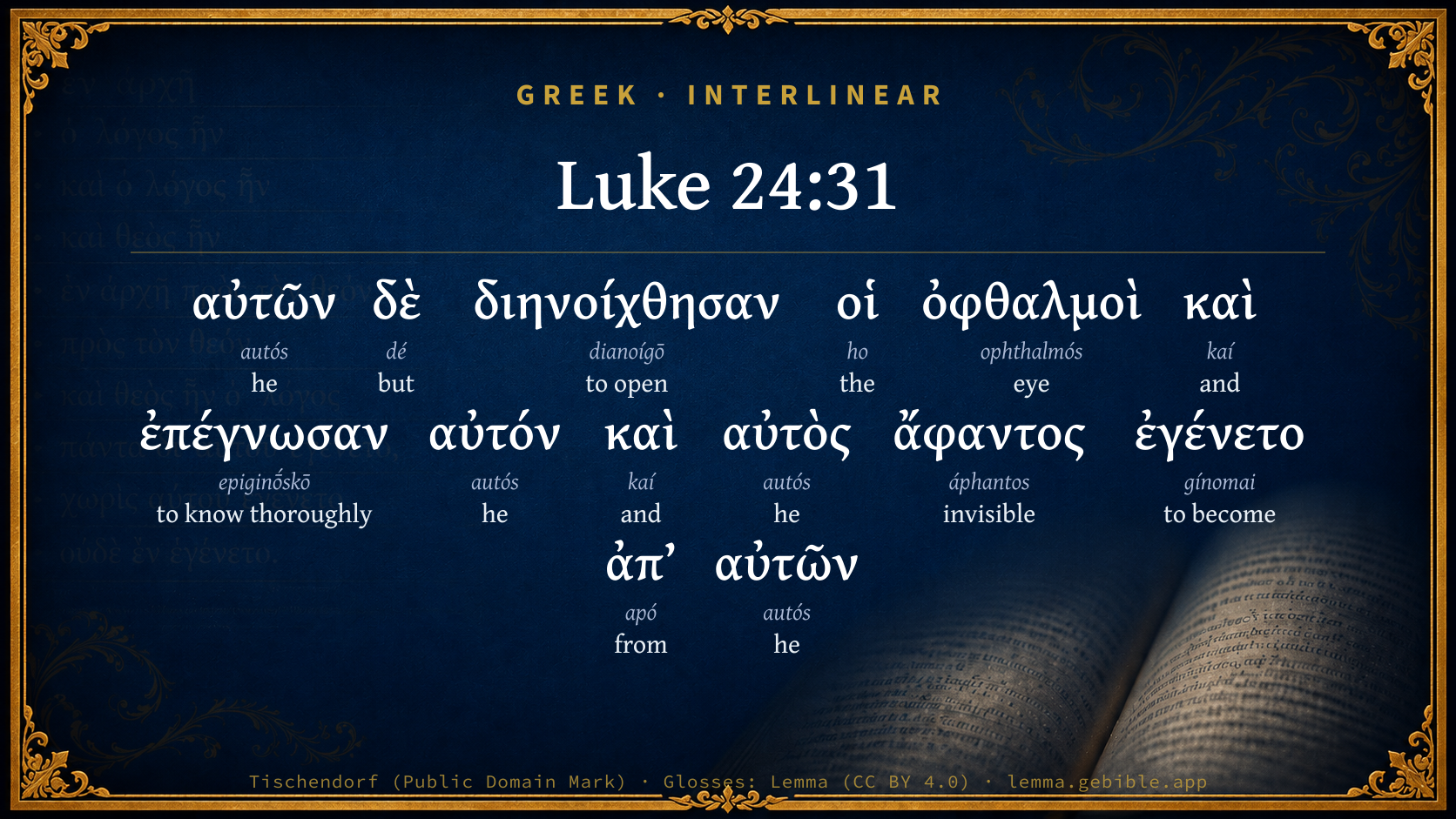
Greek (Tischendorf 8th ed.) Luke 24:31 appears in the Greek New Testament. The text above is from the Tischendorf 8th edition. Each word links to its Strong’s number and a concise gloss. Click any word for its full Thayer’s Greek Lexicon entry.
Download image
Cite this verse

Luke 24:31 (World English Bible). Public Domain. Lemma interlinear Bible study tool, https://lemma.gebible.app/v/luke/24/31.

Show BibTeX & RIS
BibTeX
RIS
English Translation
Their eyes were opened, and they recognized him, and he vanished out of their sight.
World English Bible · Public Domain
Highlights
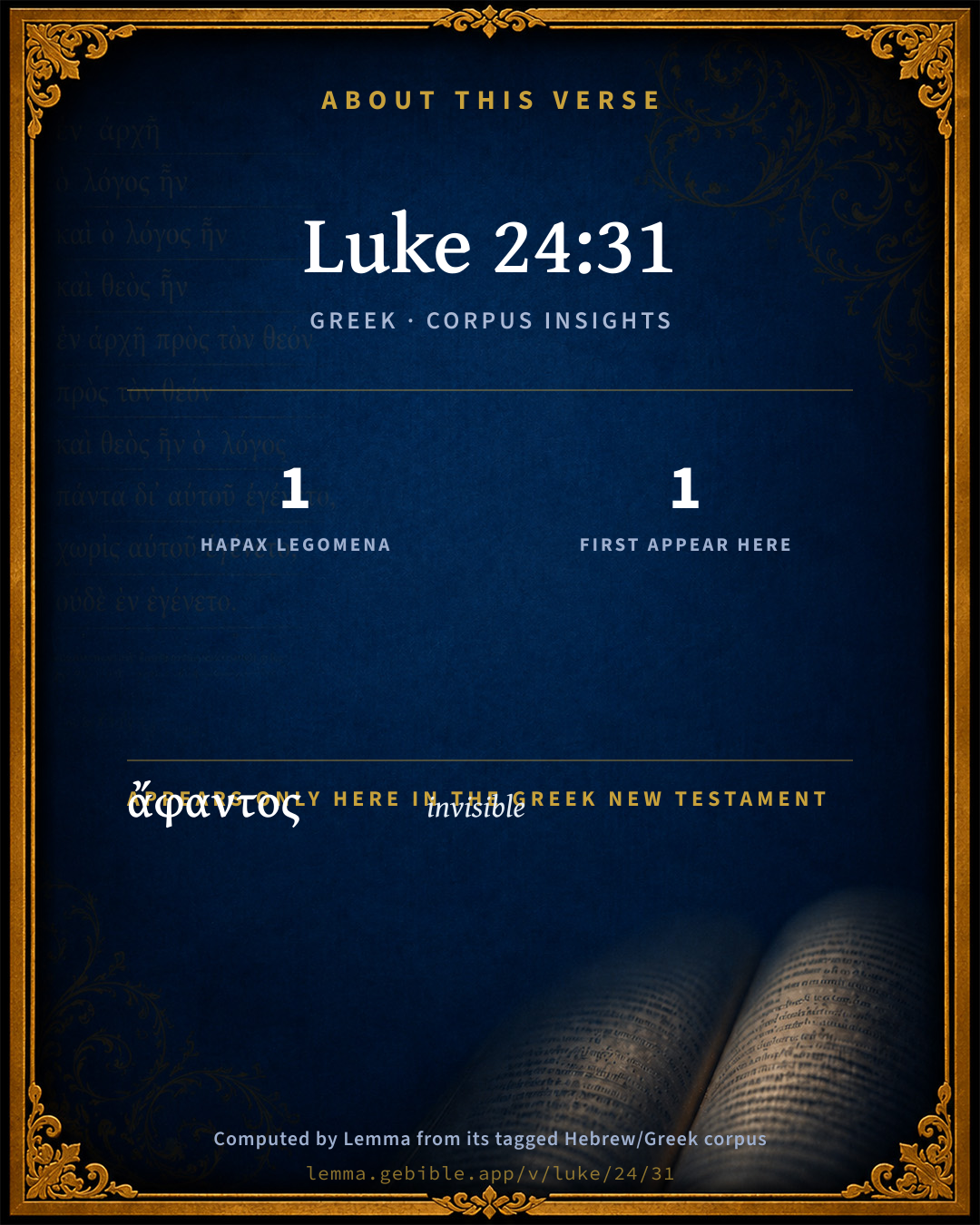
  • 1 hapax legomenon — only here in the Greek New Testament
  • 1 first appearance in the Greek New Testament
Full analysis ↓
Download a study sheet

One document with this verse’s original text, its word-by-word gloss line, the meaning frame, cross-references with their text, attributed commentary, and full source and license credits — printable, and it pastes into notes with its structure intact.

This verse Autodidact and up

Study sheet (.html) Plain text (.txt)

A passage Seminary Student

Up to 50 verses in one chapter. A passage sheet keeps up to 6 commentary sources and 12 cross-references per verse, in the order this page ranks them, and says so on the sheet whenever that leaves anything out. Ask for a single verse and you get the Autodidact verse sheet above.

Everything on this page stays free to read, with no account — the sheet is a download of what is already on screen, not access to it.

Want to remove ads? Support Godless Engineer
Compare translations 3

The same verse in 3 English versions, stacked beneath the original-language interlinear above. Click any original word for its lexicon entry.

Each is an independent rendering of the whole verse — the interlinear is not word-aligned to these translations.

Highlighted words mark where these versions differ — a whole-verse word diff, not a word-by-word alignment.

  • World English Bible Public Domain
    Their eyes were opened, and they recognized him, and he vanished out of their sight.
  • King James Version Public Domain
    And their eyes were opened, and they knew him; and he vanished out of their sight.
  • unfoldingWord Literal Text CC BY-SA 4.0
    Then their eyes were opened, and they recognized him, and he became invisible from them.

unfoldingWord Literal Text — © unfoldingWord, licensed CC BY-SA 4.0. Word-aligned USFM3 via Door43 (git.door43.org/unfoldingWord/en_ult).

Versions to compare (up to 4)

3 of 4 selected

Show all 19 translations

Every available English version of this verse, each an independent rendering of the whole verse.

  • World English Bible Public Domain
    Their eyes were opened, and they recognized him, and he vanished out of their sight.
  • Berean Standard Bible Public Domain
    Then their eyes were opened and they recognized Jesus—and He disappeared from their sight.
  • Majority Standard Bible Public Domain
    Then their eyes were opened and they recognized Jesus—and He disappeared from their sight.
  • King James Version Public Domain
    And their eyes were opened, and they knew him; and he vanished out of their sight.
  • American Standard Version (1901) Public Domain
    And their eyes were opened, and they knew him; and he vanished out of their sight.
  • Revised Version (1885) Public Domain
    And their eyes were opened, and they knew him; and he vanished out of their sight.
  • Geneva Bible (1599) Public Domain
    Then their eyes were opened, and they knewe him: and he was no more seene of them.
  • Douay-Rheims (1899) Public Domain
    And their eyes were opened, and they knew him: and he vanished out of their sight.
  • Young's Literal Translation Public Domain
    and their eyes were opened, and they recognized him, and he became unseen by them.
  • Literal Standard Version CC BY-SA 4.0
    and their eyes were opened, and they recognized Him, and He became unseen by them.
  • Unlocked Literal Bible CC BY-SA 4.0
    Then their eyes were opened, and they knew him, and he vanished out of their sight.
  • unfoldingWord Literal Text CC BY-SA 4.0
    Then their eyes were opened, and they recognized him, and he became invisible from them.
  • Darby Bible Public Domain
    And their eyes were opened, and they recognised him. And he disappeared from them.
  • World Messianic Bible Public Domain
    Their eyes were opened and they recognized him; then he vanished out of their sight.
  • Webster's Bible Public Domain
    And their eyes were opened, and they knew him: and he vanished out of their sight.
  • Free Bible Version CC BY-SA 4.0
    Their eyes were opened, and they recognized him. Then he disappeared from view.
  • Bible in Basic English Public Domain
    And then their eyes were open, and they had knowledge of him, but he went from their view.
  • Text-Critical English NT CC BY 4.0
    Then their eyes were opened, and they recognized him, but he disappeared from their sight.
  • Tyndale New Testament (1534) Public Domain
    And their eyes were openned and they knewe him: and he vnnisshed out of their syght.

Literal Standard Version (2020), Covenant Press — licensed CC BY-SA 4.0. Text via the HelloAO Bible API (eBible.org). Unlocked Literal Bible (unfoldingWord) — licensed CC BY-SA 4.0. Text via the HelloAO Bible API (eBible.org). unfoldingWord Literal Text — © unfoldingWord, licensed CC BY-SA 4.0. Word-aligned USFM3 via Door43 (git.door43.org/unfoldingWord/en_ult). Free Bible Version, Dr. Jonathan Gallagher — licensed CC BY-SA 4.0. Text via the HelloAO Bible API (eBible.org).

Word by word

More ways to search: Search by grammar → Find every occurrence → Compare this word →

Practice this passage: Drill this verse → Learn its vocabulary →

ἄφαντος
áphantos
G855
“invisible”
Adjective, Nominative, Singular, Masculine
Part of Speech
Adjective
Case
Nominative
Number
Singular
Gender
Masculine
Full Thayer's Definition

Origin: from G1 (as a negative particle) and a derivative of G5316

TDNT: None

1. taken out of sight, made invisible
  1. αὐτῶν autós G846 “he” Personal pronoun, Genitive, Plural, Masculine
  2. δὲ dé G1161 “but” Conjunction
  3. διηνοίχθησαν dianoígō G1272 “to open” Verb, Aorist, Passive, Indicative, 3rd person, Plural
  4. οἱ ho G3588 “the” Article, Nominative, Plural, Masculine
  5. ὀφθαλμοὶ ophthalmós G3788 “eye” Noun, Nominative, Plural, Masculine
  6. καὶ kaí G2532 “and” Conjunction
  7. ἐπέγνωσαν epiginṓskō G1921 “to know thoroughly” Verb, Aorist, Active, Indicative, 3rd person, Plural
  8. αὐτόν autós G846 “he” Personal pronoun, Accusative, Singular, Masculine
  9. καὶ kaí G2532 “and” Conjunction
  10. αὐτὸς autós G846 “he” Personal pronoun, Nominative, Singular, Masculine
  11. ἐγένετο gínomai G1096 “to become” Verb, Aorist, Middle deponent, Indicative, 3rd person, Singular
  12. ἀπ’ apó G575 “from” Preposition
  13. αὐτῶν autós G846 “he” Personal pronoun, Genitive, Plural, Masculine

About this verse

These counts appear in no published source. They are computed here, from the morphology-tagged text and Lemma’s own curated glosses. What Lemma adds →

14
words
10
distinct lemmas
Gospels
section

Notable vocabulary

1 hapax legomenon — a word that appears only here in the entire Greek New Testament:

  • ἄφαντος invisible G855

First appearance in Scripture

This word makes its first canonical appearance in the Greek New Testament here:

  • ἄφαντος invisible G855

Shared distinctive vocabulary

διηνοίχθησαν to open G1272 occurs in 8 verses of the Greek New Testament. Also found in:
Repetition

Words recur within this verse:

  • αὐτῶν he G846 ×4
  • καὶ and G2532 ×2

Cross-references

4

Topical passages linked to Luke 24:31 in the Treasury of Scripture Knowledge — connected by theme and wording, ordered by reader-vote popularity; previews shown in the World English Bible.

  • Luke 24:16 But their eyes were kept from recognizing him.
  • John 8:59 Therefore they took up stones to throw at him, but Jesus was hidden, and went out of the temple, having gone through the midst of them, and so passed by.
  • Luke 4:30 But he, passing through the midst of them, went his way.
  • John 20:13–16 They told her, "Woman, why are you weeping?" She said to them, "Because they have taken away my Lord, and I don't know where they have laid him."

Cross-references courtesy of OpenBible.info (CC BY 4.0).

Commentary

Notes on Luke 24:31 from classic Christian and Jewish commentators (each source and its license shown beneath its notes). The classic Christian expositions comment on the surrounding passage and are grouped to its opening verse, so a note may address several verses; the Jewish commentaries on the Tanakh (Rashi and others) are per-verse, so they appear only where the commentator wrote on this verse.

Lemma curates 59 commentaries, every one of them public domain or Creative Commons licensed, each selected and text-cleaned for this edition rather than reprinted as found. About our sources →

Tyndale Open Study Notes

Tyndale Open Resources

24:31 their eyes were opened: This is another example of the “divine passive” (see study note on 24:16); God opened their eyes at the breaking of the bread. • at that moment he disappeared! In his resurrected and transformed body, Jesus had abilities not realized before the resurrection (see 24:36; 1 Cor 15:20-23, 35-57).

Tyndale Open Study Notes — © Tyndale Open Resources, licensed CC BY-SA 4.0. Text via the HelloAO Bible API.

Bengel's Gnomon

Johann Albrecht Bengel

Luk 24:31. Ἄφαντος ἐγένετο) He vanished out of their sight. This too showed that it was He. The former appearances of Jesus after His resurrection were of shorter continuance, in order that the move room (scope) might be left for faith.

Bengel's Gnomon of the New Testament — English translation (T&T Clark, Edinburgh, 1860) — public domain. Text from a community e-Sword module.

Meyer's Critical & Exegetical Commentary

Heinrich August Wilhelm Meyer

Luk_24:31. Αὐτῶν δὲ διηνοίχθησαν οἱ ὀφθαλμοί] is the opposite of οἱ ὀφθαλμοὶ αὐτῶν ἐκρατοῦντο, Luk_24:16. As the latter, so also the former, according to Luke, is to be referred to extraordinary divine causation. This is opposed to the view (Paulus, Kuinoel, and others) that the disciples, only by means of the accustomed breaking of bread and giving of thanks by Jesus, wherein they had more attentively considered Him and had seen His pierced hands, arrived at the recognition of Him who until then had been unknown to them. Comp. on Luk_24:30.

αὐτῶν] with lively emphasis placed first. What Jesus did is previously described.

ἀνοίγειν] (more strongly διανοίγειν) τοὺς ὀφθαλμούς, which is often used of the healing of blind people (Mat_9:30; Mat_20:33; Joh_9:10; Joh_9:14; Joh_9:17; Joh_10:21; Joh_11:37), describes in a picturesque manner the endowing with a capacity, bodily or spiritual, of recognising what before was unknown, Gen_3:5; Gen_3:7; Gen_21:19; 2Ki_6:17; 2Ki_6:20; comp. Act_26:8

ἄφαντος ἐγένετο ἀπʼ αὐτῶν] He passed away from them invisibly. Comp. on γίνεσθαι ἀπό τινος, to withdraw from any one, Xen. Mem. i. 2. 25; Bar_3:21. Luke intends manifestly to narrate a sudden invisible withdrawal effected through divine agency; hence those do wrong to his intention and to the expression who, like Kuinoel, make out of it only a subito ah iis discessit, so that this departure would not have been observed till it occurred (Schleiermacher, L. J. p. 474). Beza well says that Luke has not said αὐτοῖς, but ἀπʼ αὐτῶν; ne quis existimet praesentem quidem Christum cum ipsis mansisse, sed corpore, quod cerni non posset. The Ubiquists supported the doctrine of the invisible presence of Christs body by the passage before us. Comp. Calovius.

On the word ἄφαντοςwhich is very frequent in the poets, but only rarely used in prose, and that of a late period, and, moreover, is not found in the LXX. and the Apocryphainstead of the classical prose word ἀφανής, see Wesseling, ad Diod. iv. 65.

Meyer — Critical and Exegetical Commentary on the New Testament — English translation by Peter Christie, edited by Frederick Crombie (T&T Clark, 1880) — public domain. Text from a community e-Sword module.

Expositor's Greek Testament

ed. W. Robertson Nicoll

Luk 24:31 . διηνοίχθησαν οἱ ὀφ ., their eyes were at length opened, a Divine effect, but having its psychological causes. Euthy. suggests the use of the well-known blessing by Jesus as aiding recognition. The opening of the mind to the prophetic teaching concerning Messiah’s suffering was the main preparation for the opening of the eyes. The wonder is they did not recognise Jesus sooner. ἄφαντος : an early poetical and late prose word = ἀφανής , not in Sept [207] , here only in N.T. After being recognised Jesus became invisible, ἀπʼ αὐτῶν , not to them ( αὐτοῖς ) but from them, implying departure from the house. Some take ἄφαντος adverbially as qualifying the departure = He departed from them in an invisible manner.

[207] Septuagint.

The Expositor's Greek Testament, edited by W. Robertson Nicoll (1897–1910) — public domain. Text from a community e-Sword module.

Geneva Bible (1599)

Geneva Bible translators

Suddenly taken away, and therefore we may not imagine that he was there in such a body as could not be seen, but believe indeed that he changed his place.

Geneva Bible (1599) marginal notes — public domain. Text via Bolls.life.

Adam Clarke's Commentary

Verse 31. Their eyes were opened] But we are not to imagine that he administered the holy eucharist at this time; there is not the most distant evidence of this. It was a mere family meal, and ended before it was well begun.

They knew him] His acting as father of the family, in taking, blessing, and distributing the bread among them, caused them to recollect those lips which they had often heard speak, and those hands by which they had often been fed. Perhaps he also threw off the disguise which he had before assumed; and now appeared in his own person.

He vanished out of their sight.] Probably, during their surprise, he took the opportunity of withdrawing from the place; leaving them to reflect and meditate on what they had heard and seen.

Adam Clarke's Commentary on the Bible (1810–1826) — public domain. Text from a community e-Sword/MySword module.

Ellicott's Commentary for English Readers

(31) And he vanished out of their sight.—Literally, He became invisible. The adjective does not occur elsewhere in the New Testament. In the order of time this is the first example of the new conditions of our Lord’s risen life. It was not that He rose and left the room in which they sat. In a moment they knew Him with all the fulness of recognition; and then they saw Him no more. The work for which He had come to them was done. He had imparted comfort and insight, and had brought them into communion with Himself, and then they were to be taught that that communion was no longer to depend, as before, on a visible and localised presence. (Comp. Luk_24:36, Joh_20:19; Joh_20:26.)

A Bible Commentary for English Readers, edited by Charles John Ellicott (1878–1897) — public domain. Text from a community e-Sword module.

The Cambridge Bible for Schools and Colleges

gen. ed. J. J. S. Perowne

31. he vanished] See on Luk_24:16.

The Cambridge Bible for Schools and Colleges (gen. ed. J. J. S. Perowne; Cambridge University Press, 1878–1918) — public domain. Text from a community e-Sword module.

John Gill's Exposition

And they rose up the same hour,.... Though it was now evening, and the day was spent and gone; and notwithstanding what business they might have to do at Emmaus, about which they came, and even might not have made an end of eating, or sufficiently refreshed themselves; and though they had had a walk of sixty furlongs that afternoon, yet being big with this appearance of Christ to them, and in haste to impart the joyful news to their fellow disciples, they immediately rose up from table:

and returned to Jerusalem; the same night, from whence they had come that day:

and found the eleven gathered together; at a certain house known to these two, and who met together in the night season, for the sake of privacy, and for fear of the Jews, and who were now up, though it was late: these are called "eleven", because Judas was now gone from them, and dead; and this being their whole number, it is used, though every one might not be present, as particularly Thomas was not; see Joh 20:19

and them that were with them; the seventy disciples, and other believers, both men and women; see Act 1:15.

John Gill's Exposition of the Whole Bible (1746–1763) — public domain (CC PDM 1.0). Text via the HelloAO Bible API.

Trapp's Complete Commentary

John Trapp

31 And their eyes were opened, and they knew him; and he vanished out of their sight.

Ver. 31. Their eyes were opened] The free and entire use of their inward and outward senses was restored unto them.

John Trapp, A Commentary or Exposition upon All the Books of the Old and New Testament (1647–1656) — public domain. Text from a community e-Sword module.

Albert Barnes' Notes on the Bible

Their eyes were opened - The obscurity was removed. They saw him to be the Messiah. Their doubts were gone, and they saw clearly that he was risen, and was truly, as they had long hoped, the Saviour of people. It is not meant that they were before “blind,” but that they did not know until then who he was.

He vanished out of their sight - He suddenly departed. It does not appear that there was anything miraculous in this, but, during their surprise, he took the opportunity suddenly to withdraw from them.

Albert Barnes' Notes on the Bible (1834–1885) — public domain. Text from a community e-Sword/MySword module.

Whedon's Commentary on the Bible

Daniel D. Whedon

31. And their eyes were opened—Utterly shallow and rationalistic is the interpretation of Alford, making these disciples discover Jesus by his mode of breaking bread! If neither voice, nor form, nor person, revealed the Lord, how absurd to suppose that his manner of breaking bread should accomplish the discovery. These two were not apostles, nor is it probable they were specially familiar with his style of breaking bread.

And they knew him—There he stood, this very Messiah, of whom all Scripture was the harbinger; the sufferer, the heir of glory, the judge of the earth. Before this moment he could not reveal himself without disturbing their minds so as to unfit their understanding of the Scripture. And now he could reveal himself, to show that his exposition was authoritative and divine, being his own.

He vanished—This finished the demonstration. He did not merely step out of the door. As they were beholding him, the place he occupied became at once vacant space. Then they knew that it was their Lord, and that their Lord was truly divine. Not Mary Magdalene, nor Peter, nor John, nor the whole college of apostles had as yet received such a favour as this vouchsafed to these two disciples, the one to us unnamed, and the other but a name!

Daniel D. Whedon (gen. ed.), Commentary on the Old and New Testaments (1874–1909) — public domain. Text from a community e-Sword module.

The Pulpit Commentary

He vanished out of their sight. Not here, not now, can we hope to understand the nature of the resurrection-body of the Lord; it is and must remain to us, in our present condition, a mystery. Certain facts have, however, been revealed to us:

(1) The Resurrection was a reality, not an appearance; for on more than one occasion the Lord permitted the test of touch. He also ate before his disciples of their ordinary food.

(2) Yet there was a manifest exemption flora the common conditions of bodily (corporeal) existence; for he comes through a closed door; he could withdraw himself when he would from touch as well as from sight; he could vanish in a moment from those looking on him; he could, as men gazed on him, rise by the exertion of his own will into the clouds of heaven.

(3) He was known just as he pleased and when he pleased; for at times during the "forty days" men and women looked on him without a gleam of recognition, at times they gazed at him, knowing well that it was the Lord. On the words, "he vanished out of their sight," Godet writes, "It must be remembered that Jesus, strictly speaking, was already no more with them (ver. 44), and that the miracle consisted rather in his appearing than in his disappearing." Dr. Westcott expresses the same truth in different language, "What was natural to him before was now miraculous, what was before miraculous is now natural."

The Pulpit Commentary (1880–1919), ed. H.D.M. Spence-Jones & Joseph S. Exell — public domain. Text from a community e-Sword module.

John Wesley's Explanatory Notes

Their eyes were opened - That is, the supernatural cloud was removed: And he vanished - Went away insensibly.

John Wesley, Explanatory Notes Upon the Whole Bible (1754–1765) — public domain. Text via the GEBible commentary corpus.

Cambridge Greek Testament for Schools and Colleges

31. ἄφαντος ἐγένετο. See on Luk 24:16. ἄφαντος is a poetic word for the Attic prose word ἀφανής. It does not occur in the LXX[421], Apocrypha, or elsewhere in the N. T.

[421] LXX. Septuagint.

Cambridge Greek Testament for Schools and Colleges (Cambridge University Press, 1896; 21 vols, various authors incl. Carr, Maclear, Plummer, Farrar, Lumby, Moule, M. R. James, Simcox) — public domain. Text from a community e-Sword module.

Alford’s Greek Testament

Henry Alford

31.] ἄφαντος, not αὐτοῖς, which would imply His Body to have remained, but invisible to them: but ἀπʼ αὐτῶν, implying, besides the supernatural disappearance, a real objective removal from them.

Henry Alford, The Greek Testament (1849–1861) — public domain. Text from a community e-Sword module.

International Critical Commentary

31. διηνοίχθησαν οἱ ὀφθαλμοί. This must be explained in harmony with ver. 16. If the one implies Divine interposition, so also does the other. These two had not been present at the Last Supper, but they had probably often seen Jesus preside at meals; and something in His manner of taking and breaking the bread, and of uttering the benediction, may have been the means employed to restore their power of recognizing Him. Wright’s conjecture that the eucharist was instituted long before the Last Supper is unnecessary. Comp. Gen 21:19; 2Ki 6:20 ; Gen 3:5, Gen 3:7.

For the augment see WH. 2. App. p.161, All three forms, ἠνοίχθην ἐνεῴχθην and ἠνεῴχθην, are found well attested in N.T. Gregory, prolegom, p.121. Syr-Cur. and Syr-Sin. add “immediately” to “were opened.”

ἀφαντος ἐγένετο.“He vanished, became invisible”: comp. ver 37, 6:36, 12:40, 16:11, 12, 19:17. It is very unnatural to take ἐγέετο with ἀπʼ αὐτῶν and make ἄφαντος adverbial: “He departed from them without being seen.” Something more than a sudden departure, or a departure which they did not notice until He was gone, is intended. We are to understand disappearance without physical locomotion: but we know too little about the properties of Christ’s risen body to say whether this was super natural or not. Nowhere else in bibl. Grk. does ἄφαντος occur: in class. Grk. it is poetical. In 2 Mac. 3:34 ἀφανεῖς ἐγένοντο is used of Angels ceasing to be visible. The ἀπʼ αὐτῶν implies no more than withdrawal from their sight: to what extent His presence was withdrawn we have no means of knowing. But His object was accomplished; viz. to convince them that He was the Messiah and still alive, and that their hopes had not been in vain. To abide with them in the old manner was not His object.

The Latin versions vary much, but none of them suggest a mere quiet withdrawal : nusquam comparit ab eis (c e ff2, ) non comparuit ab eis (dr),invisus factus est eis (bf),non apparens factus est ab eis (δevanuit ex oculis eorum (Vulg.). Syr-Sin. has “He was lifted away from them”: so also Syr-Cur. Respecting Jos. Ant. 20:8, 6 see p. 30.

International Critical Commentary — older volumes (1896–1929), various authors — public domain. Text from a community e-Sword module.

Vincent's Word Studies in the New Testament

Marvin R. Vincent

They knew [επεγνωσαν] . Clearly recognized.

And he vanished out of their sight [αυτος αφαντος εγενετο απ αυτων] . Lit., he, invisible, became away from them. It is not simply, he suddenly departed from them, but he passed away from them invisibly. The ejgeneto, became, is construed with ajp' aujtwn, from them. 10

Marvin R. Vincent, Word Studies in the New Testament (1887–1900) — public domain. Text from a community e-Sword/MySword module.

Lesson kit

Teaching starters — assembled from the data on this page, not authored interpretation. Every prompt links to the verse data it draws on. Edit before teaching.

Luke, in the Gospels, opens this verse with 14 words (10 distinct Greek lemmas). Its most distinctive word is áphantos (“invisible”). A historical commentator’s framing appears above. Read the whole chapter for the surrounding context.

Discussion questions

  1. The word áphantos carries the sense “invisible.” How does it shape the verse?
  2. 1 word here appears nowhere else in the Greek New Testament. Why might the author reach for such rare wording?
  3. This is the first place “invisible” appears in Scripture (first appears here). What does its debut here establish?
  4. How does Mark 7:34, which shares the word «to open», read alongside this verse?
  5. What does the repetition of “he” (4× in this one verse) do in this verse?
  6. These translations render this verse differently; the difference is in the English rendering, not the original. What questions does that raise?
  7. Compare how Tyndale Open Study Notes and Bengel's Gnomon read this verse. Where do they agree or differ?

Things to notice

  • 1 word in this verse appears nowhere else in the Greek New Testament.
  • 1 word makes its first canonical appearance in Scripture here.
  • These translations choose different wording for 7 words in this verse.
  • “he” occurs 4× in this single verse.
  • 10 distinct Greek lemmas span 14 words in this verse.

Reading settings

Reading text

Shown beneath each verse's original-language words.

Old Testament
Old Testament edition

Read the OT as the Masoretic Hebrew (MT) or the Greek Septuagint (LXX).

English shown for the Greek Septuagint (in the Hebrew ↔ Greek comparison).

Comparing translations? Open the Compare panel on any verse page to stack up to four side by side.