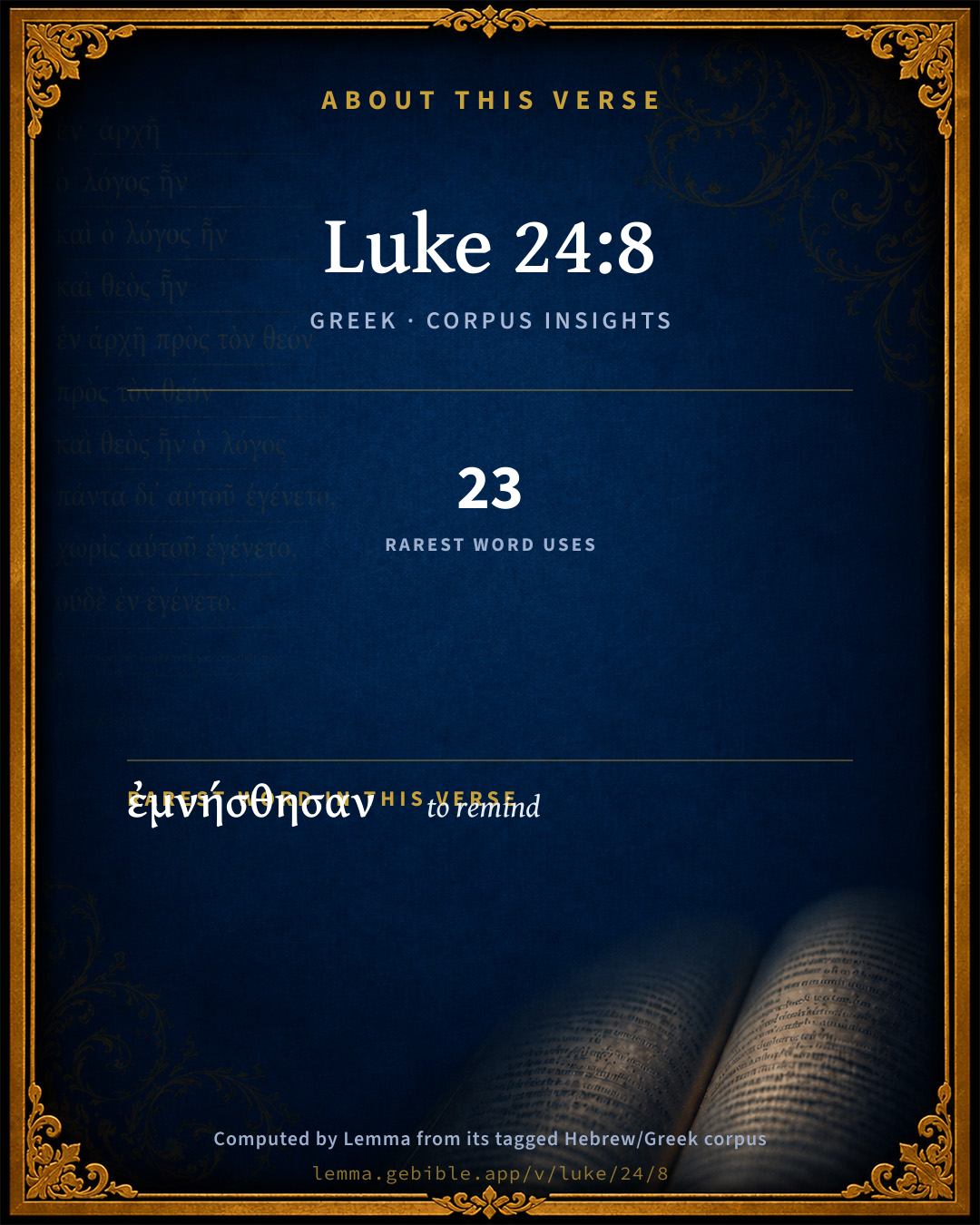
Luke 24:8

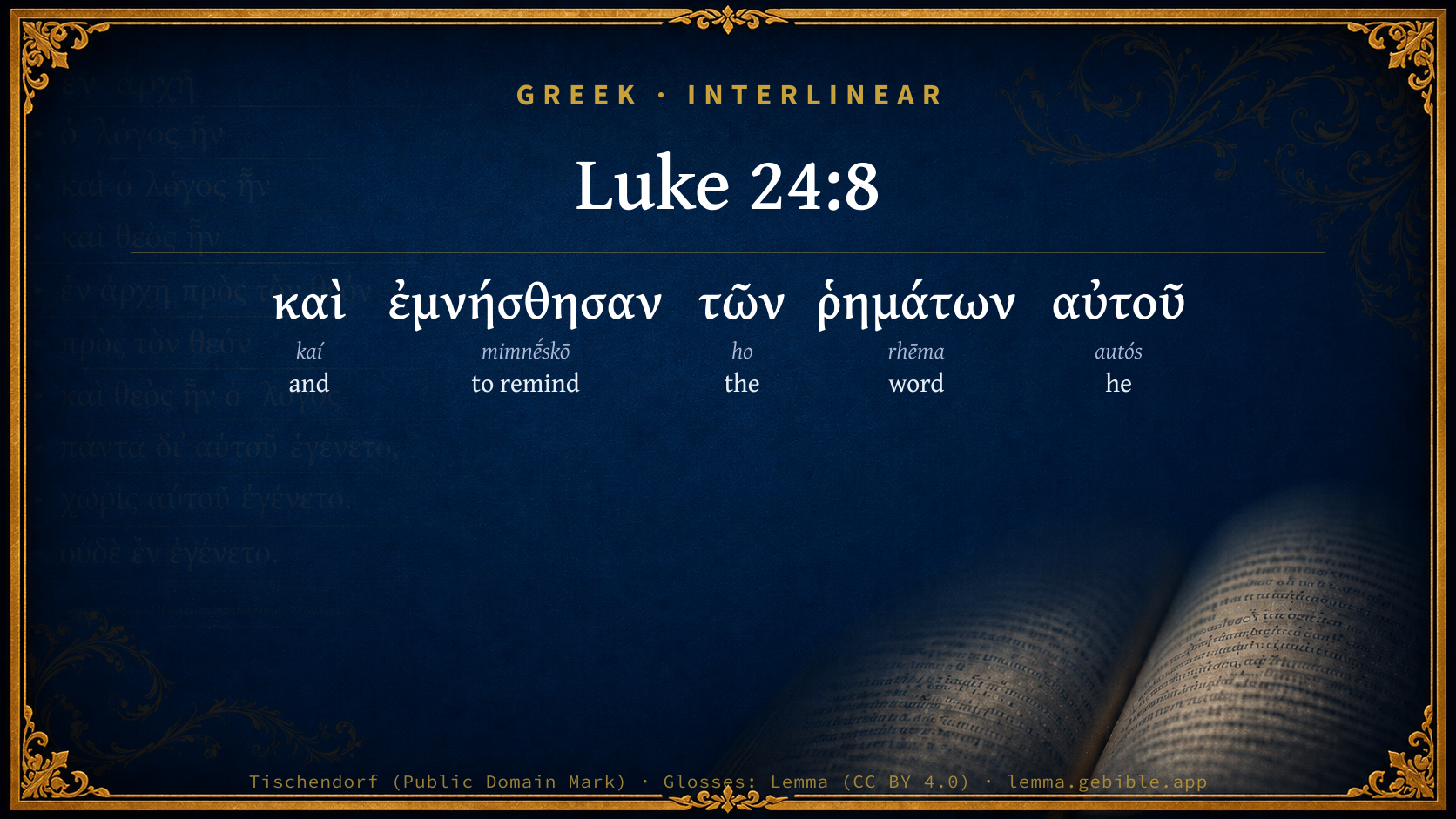
Greek (Tischendorf 8th ed.) Luke 24:8 appears in the Greek New Testament. The text above is from the Tischendorf 8th edition. Each word links to its Strong’s number and a concise gloss. Click any word for its full Thayer’s Greek Lexicon entry.
Download image
Cite this verse

Luke 24:8 (World English Bible). Public Domain. Lemma interlinear Bible study tool, https://lemma.gebible.app/v/luke/24/8.

Show BibTeX & RIS
BibTeX
RIS
English Translation
They remembered his words,
World English Bible · Public Domain
Download a study sheet

One document with this verse’s original text, its word-by-word gloss line, the meaning frame, cross-references with their text, attributed commentary, and full source and license credits — printable, and it pastes into notes with its structure intact.

This verse Autodidact and up

Study sheet (.html) Plain text (.txt)

A passage Seminary Student

Up to 50 verses in one chapter. A passage sheet keeps up to 6 commentary sources and 12 cross-references per verse, in the order this page ranks them, and says so on the sheet whenever that leaves anything out. Ask for a single verse and you get the Autodidact verse sheet above.

Everything on this page stays free to read, with no account — the sheet is a download of what is already on screen, not access to it.

Want to remove ads? Support Godless Engineer
Compare translations 3

The same verse in 3 English versions, stacked beneath the original-language interlinear above. Click any original word for its lexicon entry.

Each is an independent rendering of the whole verse — the interlinear is not word-aligned to these translations.

Highlighted words mark where these versions differ — a whole-verse word diff, not a word-by-word alignment.

  • World English Bible Public Domain
    They remembered his words,
  • King James Version Public Domain
    And they remembered his words,
  • unfoldingWord Literal Text CC BY-SA 4.0
    And they remembered his words,

unfoldingWord Literal Text — © unfoldingWord, licensed CC BY-SA 4.0. Word-aligned USFM3 via Door43 (git.door43.org/unfoldingWord/en_ult).

Versions to compare (up to 4)

3 of 4 selected

Show all 19 translations

Every available English version of this verse, each an independent rendering of the whole verse.

  • World English Bible Public Domain
    They remembered his words,
  • Berean Standard Bible Public Domain
    Then they remembered His words.
  • Majority Standard Bible Public Domain
    Then they remembered His words.
  • King James Version Public Domain
    And they remembered his words,
  • American Standard Version (1901) Public Domain
    And they remembered his words,
  • Revised Version (1885) Public Domain
    And they remembered his words,
  • Geneva Bible (1599) Public Domain
    And they remembred his wordes,
  • Douay-Rheims (1899) Public Domain
    And they remembered his words.
  • Young's Literal Translation Public Domain
    And they remembered his sayings,
  • Literal Standard Version CC BY-SA 4.0
    And they remembered His sayings,
  • Unlocked Literal Bible CC BY-SA 4.0
    The women remembered his words,
  • unfoldingWord Literal Text CC BY-SA 4.0
    And they remembered his words,
  • Darby Bible Public Domain
    And they remembered his words;
  • World Messianic Bible Public Domain
    They remembered his words,
  • Webster's Bible Public Domain
    And they remembered his words,
  • Free Bible Version CC BY-SA 4.0
    Then they remembered what he'd said.
  • Bible in Basic English Public Domain
    And his words came back into their minds,
  • Text-Critical English NT CC BY 4.0
    Then they remembered his words.
  • Tyndale New Testament (1534) Public Domain
    And they remembred his wordes

Literal Standard Version (2020), Covenant Press — licensed CC BY-SA 4.0. Text via the HelloAO Bible API (eBible.org). Unlocked Literal Bible (unfoldingWord) — licensed CC BY-SA 4.0. Text via the HelloAO Bible API (eBible.org). unfoldingWord Literal Text — © unfoldingWord, licensed CC BY-SA 4.0. Word-aligned USFM3 via Door43 (git.door43.org/unfoldingWord/en_ult). Free Bible Version, Dr. Jonathan Gallagher — licensed CC BY-SA 4.0. Text via the HelloAO Bible API (eBible.org).

Word by word

More ways to search: Search by grammar → Find every occurrence → Compare this word →

Practice this passage: Drill this verse → Learn its vocabulary →

ἐμνήσθησαν
mimnḗskō
G3403
“to remind”
Verb, Aorist, Passive, Indicative, 3rd person, Plural
Part of Speech
Verb
Tense
Aorist
Voice
Passive
Mood
Indicative
Person
3rd person
Number
Plural
Full Thayer's Definition

Origin: a prolonged form of G3415 (from which some of the tenses are borrowed)

TDNT: None

1. to remind a. to be recalled or to return to one's mind, to remind one's self of, to remember b. to be recalled to mind, to be remembered, had in remembrance c. to remember a thing d. be mindful of
  1. καὶ kaí G2532 “and” Conjunction
  2. τῶν ho G3588 “the” Article, Genitive, Plural, Neuter
  3. ῥημάτων rhēma G4487 “word” Noun, Genitive, Plural, Neuter
  4. αὐτοῦ autós G846 “he” Personal pronoun, Genitive, Singular, Masculine

About this verse

These counts appear in no published source. They are computed here, from the morphology-tagged text and Lemma’s own curated glosses. What Lemma adds →

5
words
5
distinct lemmas
Gospels
section

Notable vocabulary

The rarest word here is ἐμνήσθησαν to remind G3403 — appearing just 23 times in the whole Greek New Testament.

Shared distinctive vocabulary

ἐμνήσθησαν to remind G3403 occurs in 23 verses of the Greek New Testament. Also found in:

Cross-references

3

Topical passages linked to Luke 24:8 in the Treasury of Scripture Knowledge — connected by theme and wording, ordered by reader-vote popularity; previews shown in the World English Bible.

  • John 12:16 His disciples didn't understand these things at first, but when Jesus was glorified, then they remembered that these things were written about him, and that they had done these things to him.
  • John 14:26 But the Counselor, the Holy Spirit, whom the Father will send in my name, he will teach you all things, and will remind you of all that I said to you.
  • John 2:19–22 Jesus answered them, "Destroy this temple, and in three days I will raise it up."

Cross-references courtesy of OpenBible.info (CC BY 4.0).

Commentary

Notes on Luke 24:8 from classic Christian and Jewish commentators (each source and its license shown beneath its notes). The classic Christian expositions comment on the surrounding passage and are grouped to its opening verse, so a note may address several verses; the Jewish commentaries on the Tanakh (Rashi and others) are per-verse, so they appear only where the commentator wrote on this verse.

Lemma curates 59 commentaries, every one of them public domain or Creative Commons licensed, each selected and text-cleaned for this edition rather than reprinted as found. About our sources →

Godet's Commentaries

Frédéric Louis Godet

2. Visit of Peter to the Sepulchre: Luk 24:8-12.

Vers. 8-12. As we have found the account given, Joh 20:14-18, in Matthew’s narrative of the appearance to the women, so we recognise here the fact which is related more in detail in Joh 20:1-10.

Luke says, Luk 24:9, that on returning from the sepulchre the women related what they had seen and heard, while, according to Mark (ver. 8), they kept silence. This contradiction is explained by the fact that the two sayings refer to two different events: the first, to the account which Mary Magdalene gives to Peter and John, and which led them to the sepulchre (Luke, Luk 24:12; Luk 24:22-24),—a report which soon spread among the apostles and all the disciples; the other, to the first moments which followed the return of the other women, until, their fears having abated, they began to speak. But this contradiction in terms proves that at least up to Luk 24:8 Mark had not Luke before him.

The αἵ of the T. R., Luk 24:10, before ἔλεγον is indispensable.

The omission of Luk 24:12 in the Cantab. and some copies of the Latin and Syriac translations appeared so serious a matter to Tischendorf, that he rejected this verse in his eighth edition. But if it were an interpolation taken from John, it would not have mentioned Peter only, but Peter and John (or the other disciple). And the apparent contradiction would have been avoided between this verse and Luk 24:24, where it is not an apostle, but certain of them (τίνες), who repair to the sepulchre. The extreme caprice and carelessness which prevail throughout cod. D and the documents of the Itala which are connected with it are well known. The entire body of the other Mjj. and of the Mnn., as well as most of the copies of the ancient translations, support the T. R. Some such historical fact as that mentioned in this verse is required by the declaration of the two disciples (Luk 24:24).

There is, besides, a striking resemblance between the account of John and that of Luke. The terms παρακύψας, ὀθονία κείμενα, πρὸς ἑαυτὸν ἀπελθεῖν, are found in both.

Frédéric Louis Godet — Commentaries on Luke, John, Romans, and 1 Corinthians — English translation (T&T Clark, Edinburgh, 1870s–1890s) — public domain. Text from a community e-Sword module.

Adam Clarke's Commentary

Verse 8. They remembered his words.] Even the simple recollection of the words of Christ becomes often a source of comfort and support to those who are distressed or tempted: for his words are the words of eternal life.

Adam Clarke's Commentary on the Bible (1810–1826) — public domain. Text from a community e-Sword/MySword module.

Ellicott's Commentary for English Readers

(8) And they remembered his words.—It would be better to end the previous verse with a fullstop, and begin the next sentence, And they returned. . . .

A Bible Commentary for English Readers, edited by Charles John Ellicott (1878–1897) — public domain. Text from a community e-Sword module.

John Gill's Exposition

It was Mary Magdalene,.... Out of whom Christ had cast seven devils, who was a sincere penitent, a true believer in Christ, and an affectionate lover of him, and to whom he first appeared:

and Joanna; the wife of Chuza, Herod's steward, one that had been a follower of Christ, and had ministered to him of her substance; see Luk 8:2

and Mary the mother of James; called the less; and also of Joses, and Simon, and Judas, the brethren, or kinsmen of Christ; this Mary, being the wife of Cleophas, or Alphaeus, said (k) to be the brother of Joseph, the husband of Mary, the mother of our Lord:

and other women that were with them; as Salome, the mother of Zebedee's children, and others, that came from Galilee; Mar 15:40.

which told these things unto the apostles; before observed.

(k) Euseb. Eccl. Hist. l. 3. c. 11. 32. & 4. 22.

John Gill's Exposition of the Whole Bible (1746–1763) — public domain (CC PDM 1.0). Text via the HelloAO Bible API.

Trapp's Complete Commentary

John Trapp

8 And they remembered his words,

Ver. 8. And they remembered his words] Which at first hearing they understood not, heeded not. So the new birth of some is like the birth of the elephant, fourteen years after the seed injected into the womb.

John Trapp, A Commentary or Exposition upon All the Books of the Old and New Testament (1647–1656) — public domain. Text from a community e-Sword module.

Kretzmann's Popular Commentary

Paul E. Kretzmann

Belief of the women, unbelief of the apostles:

v. 8. And they remembered His words,

v. 9. and returned from the sepulcher, and told all these things unto the Eleven and to all the rest.

v. 10. It was Mary Magdalene, and Joanna, and Mary, the mother of James, and other women that were with them, which told these things unto the apostles.

v. 11. And their words seemed to them as idle tales, and they believed them not.

v. 12. Then arose Peter, and ran unto the sepulcher; and stooping down, he beheld the linen clothes laid by themselves, and departed, wondering in himself at that which was come to pass.

As the angels delivered their message, the women recalled the saying of Jesus perfectly. And there was no longer doubt in their minds, nor any uncertainty, but joyful trust and belief in the resurrection of their Lord. Christ was risen from the dead; God had raised His Child Jesus. The Master of life had taken His life out of death. He had reared up the temple of His body, which the Jews had destroyed, in three days. And thus He has been declared to be the Son of God with power, by the resurrection from the dead, Rom 1:4. And therefore He has also been proved to be the Savior of the world. He has torn asunder the fetters of death, He has destroyed the power of death. There is no need for the believers to fear death, for they may gladly say: Grave, where is thy victory? Death, where is thy sting? 1Co 15:55-57. Death has been conquered, and the sting of death, sin, has been taken away, 1Co 15:18-20. Christ was delivered for our offenses, and raised again for our justification, Rom 4:25. All these gifts belonged to the believing women by faith on that first great Easter morning. But this same faith caused them to turn back from the grave, to return to the city, not all together, but in different groups, and to bring the message of all these wonderful things to the eleven apostles first of all, but also to the other disciples. There had been a considerable number of women at the grave, not only the three Marys, Mar 16:1, but also Joanna, Luk 8:3, and others. And they all, although at first almost stunned by the joyful news, proclaimed it to the followers of the Master. But on that morning the apostles were still too deep in the misery of their disappointment and in their grief at the death of Jesus. The words of the women seemed to them as idle tales, as nonsense and superstitious gossip, as foolish talk, which must not be taken seriously. Only Peter (and John, Joh 20:1-31: determined to see for himself just what the meaning of all this talk was. He arose and ran with all speed to the tomb. There he bent his body forward, without entering into the sepulcher, and saw the linen grave-clothes carefully laid away by themselves. The evidence was all against grave-robbery and the application of force. The situation was such as to set Peter thinking seriously and to wonder about what had really happened as he slowly returned to the city. The speech of the women and the evidence of the tomb spoke strongly in favor of the resurrection, but he was not quite ready yet to believe. Note: The resurrection of Jesus is the basis of the Christian’s hope and faith, but it is very hard for the Christian to put his trust in this glorious truth at all times. It means simple, childlike reliance upon the Word of God under all circumstances, and that is a gift of God, for which we must daily plead in importunate prayer.

Paul E. Kretzmann, Popular Commentary of the Bible (1921–1924) — public domain. Text from a community e-Sword module.

unfoldingWord translationNotes

Door43 World Missions Community

Connecting Statement:

The women go to tell the apostles about what they found at the tomb.

remembered his words

Here "words" refers to the statement that Jesus made. AT: "remembered what Jesus said" (See: Metonymy)

the eleven and all the rest

"the eleven apostles and all the rest of the disciples who were with them"

the eleven

This is Luke's first reference to the eleven, because Judas left the twelve and betrayed Jesus.

Now

This word is used here to mark a break in the main story line. Here Luke gives the names of some of the women who came from the tomb and told the apostles what had happened there.

translationWords

word

grave

the twelve

Mary Magdalene

apostle

unfoldingWord translationNotes — © Distant Shores Media and the Door43 World Missions Community, licensed CC BY-SA 4.0. Source: git.door43.org/Door43/en_tn.

Cambridge Greek Testament for Schools and Colleges

8. To five hundred on a hill of Galilee. Mat 28:16-20; Mar 16:15-18; 1Co 15:6.

Cambridge Greek Testament for Schools and Colleges (Cambridge University Press, 1896; 21 vols, various authors incl. Carr, Maclear, Plummer, Farrar, Lumby, Moule, M. R. James, Simcox) — public domain. Text from a community e-Sword module.

Lesson kit

Teaching starters — assembled from the data on this page, not authored interpretation. Every prompt links to the verse data it draws on. Edit before teaching.

Luke, in the Gospels, opens this verse with 5 words (5 distinct Greek lemmas). Its most distinctive word is mimnḗskō (“to remind”). A historical commentator’s framing appears above. Read the whole chapter for the surrounding context.

Discussion questions

  1. How does “to remind” (mimnḗskō) shape what this verse is saying?
  2. How does Matthew 5:23, which shares the word «to remind», read alongside this verse?
  3. Compare how Godet's Commentaries and Adam Clarke's Commentary read this verse. Where do they agree or differ?

Reading settings

Reading text

Shown beneath each verse's original-language words.

Old Testament
Old Testament edition

Read the OT as the Masoretic Hebrew (MT) or the Greek Septuagint (LXX).

English shown for the Greek Septuagint (in the Hebrew ↔ Greek comparison).

Comparing translations? Open the Compare panel on any verse page to stack up to four side by side.