
Luke 16:21

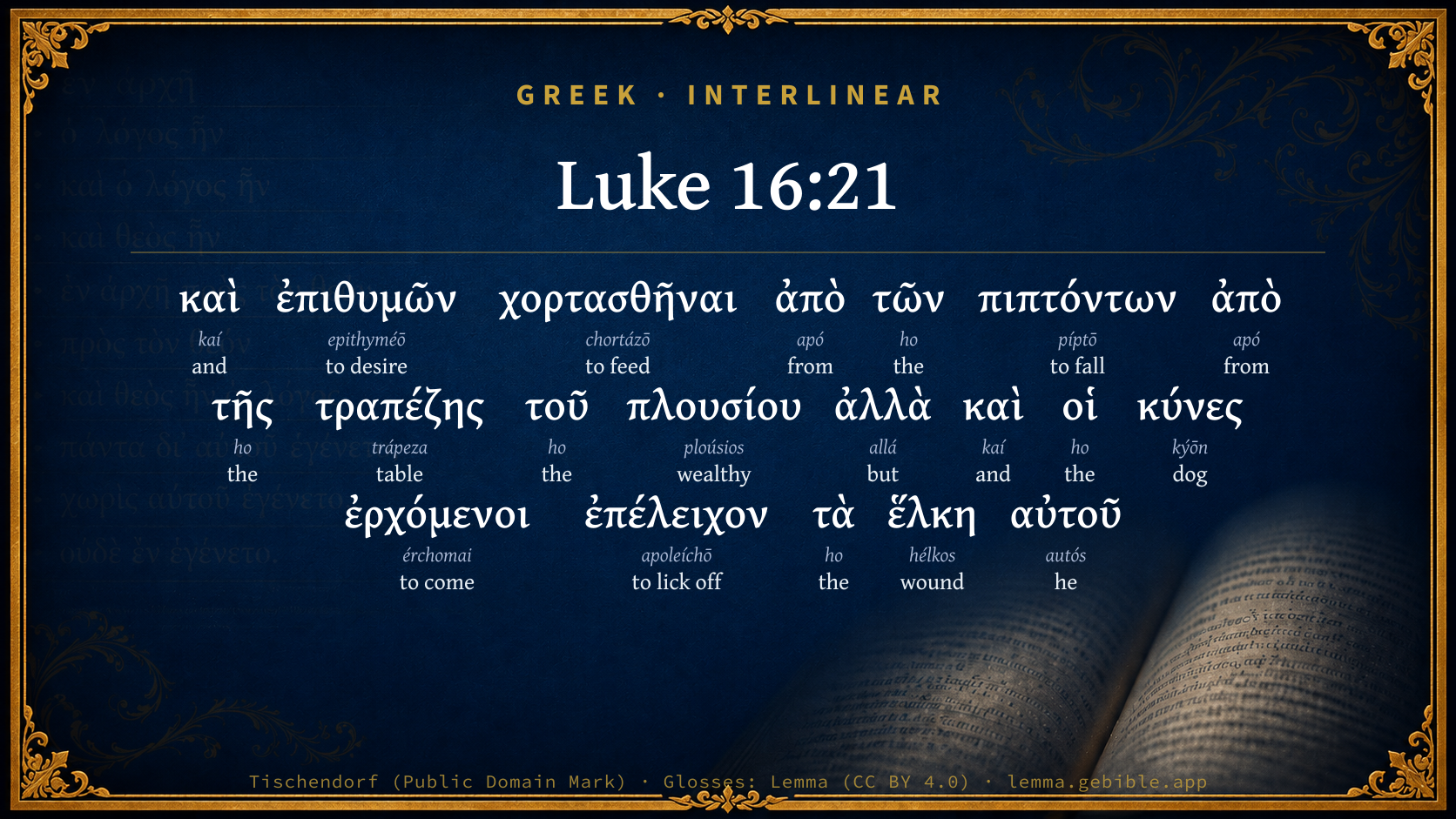
Greek (Tischendorf 8th ed.) Luke 16:21 appears in the Greek New Testament. The text above is from the Tischendorf 8th edition. Each word links to its Strong’s number and a concise gloss. Click any word for its full Thayer’s Greek Lexicon entry.
Download image
Cite this verse

Luke 16:21 (World English Bible). Public Domain. Lemma interlinear Bible study tool, https://lemma.gebible.app/v/luke/16/21.

Show BibTeX & RIS
BibTeX
RIS
English Translation
and desiring to be fed with the crumbs that fell from the rich man's table. Yes, even the dogs came and licked his sores.
World English Bible · Public Domain
Highlights
  • 1 hapax legomenon — only here in the Greek New Testament
  • 2 first appearances in the Greek New Testament
Full analysis ↓
Download a study sheet

One document with this verse’s original text, its word-by-word gloss line, the meaning frame, cross-references with their text, attributed commentary, and full source and license credits — printable, and it pastes into notes with its structure intact.

This verse Autodidact and up

Study sheet (.html) Plain text (.txt)

A passage Seminary Student

Up to 50 verses in one chapter. A passage sheet keeps up to 6 commentary sources and 12 cross-references per verse, in the order this page ranks them, and says so on the sheet whenever that leaves anything out. Ask for a single verse and you get the Autodidact verse sheet above.

Everything on this page stays free to read, with no account — the sheet is a download of what is already on screen, not access to it.

Want to remove ads? Support Godless Engineer
Compare translations 3

The same verse in 3 English versions, stacked beneath the original-language interlinear above. Click any original word for its lexicon entry.

Each is an independent rendering of the whole verse — the interlinear is not word-aligned to these translations.

Highlighted words mark where these versions differ — a whole-verse word diff, not a word-by-word alignment.

  • World English Bible Public Domain
    and desiring to be fed with the crumbs that fell from the rich man's table. Yes, even the dogs came and licked his sores.
  • King James Version Public Domain
    And desiring to be fed with the crumbs which fell from the rich man's table: moreover the dogs came and licked his sores.
  • unfoldingWord Literal Text CC BY-SA 4.0
    and longing to be fed from the things falling from the table of the rich man. But even the dogs were coming licking his sores.

unfoldingWord Literal Text — © unfoldingWord, licensed CC BY-SA 4.0. Word-aligned USFM3 via Door43 (git.door43.org/unfoldingWord/en_ult).

Versions to compare (up to 4)

3 of 4 selected

Show all 19 translations

Every available English version of this verse, each an independent rendering of the whole verse.

  • World English Bible Public Domain
    and desiring to be fed with the crumbs that fell from the rich man's table. Yes, even the dogs came and licked his sores.
  • Berean Standard Bible Public Domain
    and longing to be fed with the crumbs that fell from the rich man’s table. Even the dogs came and licked his sores.
  • Majority Standard Bible Public Domain
    and longing to be fed with the crumbs that fell from the rich man’s table. Even the dogs came and licked his sores.
  • King James Version Public Domain
    And desiring to be fed with the crumbs which fell from the rich man's table: moreover the dogs came and licked his sores.
  • American Standard Version (1901) Public Domain
    and desiring to be fed with the `crumbs' that fell from the rich man's table; yea, even the dogs come and licked his sores.
  • Revised Version (1885) Public Domain
    and desiring to be fed with the crumbs that fell from the rich man’s table; yea, even the dogs came and licked his sores.
  • Geneva Bible (1599) Public Domain
    And desired to bee refreshed with the crommes that fell from the riche mans table: yea, and the dogges came and licked his sores.
  • Douay-Rheims (1899) Public Domain
    Desiring to be filled with the crumbs that fell from the rich man's table, and no one did give him; moreover the dogs came, and licked his sores.
  • Young's Literal Translation Public Domain
    and desiring to be filled from the crumbs that are falling from the table of the rich man; yea, also the dogs, coming, were licking his sores.
  • Literal Standard Version CC BY-SA 4.0
    and desiring to be filled from the crumbs that are falling from the table of the rich man; indeed, also the dogs, coming, were licking his sores.
  • Unlocked Literal Bible CC BY-SA 4.0
    and longing to eat what fell from the rich man's table. Even the dogs came and licked his sores.
  • unfoldingWord Literal Text CC BY-SA 4.0
    and longing to be fed from the things falling from the table of the rich man. But even the dogs were coming licking his sores.
  • Darby Bible Public Domain
    and desiring to be filled with the crumbs which fell from the table of the rich man; but the dogs also coming licked his sores.
  • World Messianic Bible Public Domain
    and desiring to be fed with the crumbs that fell from the rich man’s table. Yes, even the dogs came and licked his sores.
  • Webster's Bible Public Domain
    And desiring to be fed with the crumbs which fell from the rich man's table: moreover, the dogs came and licked his sores.
  • Free Bible Version CC BY-SA 4.0
    longing to eat the leftovers from the rich man's table. Even the dogs came and licked his sores.
  • Bible in Basic English Public Domain
    Desiring the broken bits of food which came from the table of the man of wealth; and even the dogs came and put their tongues on his wounds.
  • Text-Critical English NT CC BY 4.0
    He longed to be filled with the crumbs that fell from the rich man's table, but instead the dogs would come and lick his sores.
  • Tyndale New Testament (1534) Public Domain
    desyringe to be refresshed with the cromes whiche fell from the ryche manes borde. Neverthelesse the dogges came and licked his soores.

Literal Standard Version (2020), Covenant Press — licensed CC BY-SA 4.0. Text via the HelloAO Bible API (eBible.org). Unlocked Literal Bible (unfoldingWord) — licensed CC BY-SA 4.0. Text via the HelloAO Bible API (eBible.org). unfoldingWord Literal Text — © unfoldingWord, licensed CC BY-SA 4.0. Word-aligned USFM3 via Door43 (git.door43.org/unfoldingWord/en_ult). Free Bible Version, Dr. Jonathan Gallagher — licensed CC BY-SA 4.0. Text via the HelloAO Bible API (eBible.org).

Word by word

More ways to search: Search by grammar → Find every occurrence → Compare this word →

Practice this passage: Drill this verse → Learn its vocabulary →

ἐπέλειχον
apoleíchō
G621
“to lick off”
Verb, Imperfect, Active, Indicative, 3rd person, Plural
Part of Speech
Verb
Tense
Imperfect
Voice
Active
Mood
Indicative
Person
3rd person
Number
Plural
Full Thayer's Definition

Origin: "from G575 and leicho (to "lick")"

TDNT: None

1. to lick off, lick up
  1. καὶ kaí G2532 “and” Conjunction
  2. ἐπιθυμῶν epithyméō G1937 “to desire” Verb, Present, Active, Participle, Nominative, Singular, Masculine
  3. χορτασθῆναι chortázō G5526 “to feed” Verb, Aorist, Passive, Infinitive
  4. ἀπὸ apó G575 “from” Preposition
  5. τῶν ho G3588 “the” Article, Genitive, Plural, Neuter
  6. πιπτόντων píptō G4098 “to fall” Verb, Present, Active, Participle, Genitive, Plural, Neuter
  7. ἀπὸ apó G575 “from” Preposition
  8. τῆς ho G3588 “the” Article, Genitive, Singular, Feminine
  9. τραπέζης trápeza G5132 “table” Noun, Genitive, Singular, Feminine
  10. τοῦ ho G3588 “the” Article, Genitive, Singular, Masculine
  11. πλουσίου ploúsios G4145 “wealthy” Adjective, Genitive, Singular, Masculine
  12. ἀλλὰ allá G235 “but” Conjunction
  13. καὶ kaí G2532 “and” Conjunction
  14. οἱ ho G3588 “the” Article, Nominative, Plural, Masculine
  15. κύνες kýōn G2965 “dog” Noun, Nominative, Plural, Masculine
  16. ἐρχόμενοι érchomai G2064 “to come” Verb, Present, Middle or Passive deponent, Participle, Nominative, Plural, Masculine
  17. τὰ ho G3588 “the” Article, Accusative, Plural, Neuter
  18. ἕλκη hélkos G1668 “wound” Noun, Accusative, Plural, Neuter
  19. αὐτοῦ autós G846 “he” Personal pronoun, Genitive, Singular, Masculine

About this verse

These counts appear in no published source. They are computed here, from the morphology-tagged text and Lemma’s own curated glosses. What Lemma adds →

20
words
14
distinct lemmas
Gospels
section

Notable vocabulary

1 hapax legomenon — a word that appears only here in the entire Greek New Testament:

  • ἐπέλειχον to lick off G621

First appearance in Scripture

These words make their first canonical appearance in the Greek New Testament here:

  • ἐπέλειχον to lick off G621
  • ἕλκη wound G1668

Shared distinctive vocabulary

ἕλκη wound G1668 occurs in 3 verses of the Greek New Testament. Also found in:
Repetition

Words recur within this verse:

Cross-references

5

Topical passages linked to Luke 16:21 in the Treasury of Scripture Knowledge — connected by theme and wording, ordered by reader-vote popularity; previews shown in the World English Bible.

  • Matthew 15:27 But she said, "Yes, Lord, but even the dogs eat the crumbs which fall from their masters' table."
  • Mark 7:28 But she answered him, "Yes, Lord. Yet even the dogs under the table eat the children's crumbs."
  • John 6:12 When they were filled, he said to his disciples, "Gather up the broken pieces which are left over, that nothing be lost."
  • 1 Corinthians 4:11 Even to this present hour we hunger, thirst, are naked, are beaten, and have no certain dwelling place.
  • 2 Corinthians 11:27 in labor and travail, in watchings often, in hunger and thirst, in fastings often, and in cold and nakedness.

Cross-references courtesy of OpenBible.info (CC BY 4.0).

Where the printed editions differ

1 variant

Places in this verse where the major printed Greek editions disagree on the wording in a way that affects the translation — a comparison of editions, not a manuscript-by-manuscript collation. The editions are the modern critical texts (Nestlé-Aland 28/27, SBL, Westcott-Hort, Tregelles, Tyndale House) and the traditional texts behind the KJV (the Textus Receptus and the Byzantine/Majority text). It is not a claim about which reading is original.

  1. Extra text
    τῶν ψιχίων

    “<the> crumbs”

    In TregTRByz Not in NA28NA27TynSBLWH

    τῶν ψιχίων (tōn psichiōn) ' crumbs' is only in traditional manuscripts (Treg+TR+Byz)

Textual data: Translators Amalgamated Greek New Testament (STEPBible TAGNT) · CC BY 4.0.

Commentary

Notes on Luke 16:21 from classic Christian and Jewish commentators (each source and its license shown beneath its notes). The classic Christian expositions comment on the surrounding passage and are grouped to its opening verse, so a note may address several verses; the Jewish commentaries on the Tanakh (Rashi and others) are per-verse, so they appear only where the commentator wrote on this verse.

Lemma curates 59 commentaries, every one of them public domain or Creative Commons licensed, each selected and text-cleaned for this edition rather than reprinted as found. About our sources →

Tyndale Open Study Notes

Tyndale Open Resources

16:21 the dogs would come and lick his open sores: This is an image of misery and poverty. In Jewish culture, dogs were detestable, unclean scavengers.

Tyndale Open Study Notes — © Tyndale Open Resources, licensed CC BY-SA 4.0. Text via the HelloAO Bible API.

Bengel's Gnomon

Johann Albrecht Bengel

Luk 16:21. Ἐπιθυμῶν, desiring) So far was he from having in his spirit aught that was lofty [τὸ ἐν ἀνθρώποις ὑψηλόν], Luk 16:15.—[ἀπὸ τῶν ψιχίων, of the crumbs) The freedom (immunity) which Lazarus enjoyed from every worldly desire is hereby indicated.—V. g.]—ἀλλὰ καὶ) nay (but) even. This particle, the words, not only so, having to be supplied in the former member, usually intensifies the force of the words which follow.—οἱ κύνες) the dogs, strictly so called [not figuratively]. The utter desertion of the naked and outcast Lazarus is herein denoted. The words, the angels, in Luk 16:22, form a powerful antithesis to the dogs here.—ἑρχόμενοι, coming) not for Lazarus’ sake, but for their own; as if he were a corpse [a carcase for them to prey upon].—ἀπέλειχον, began to lick off) The structure of the dog’s tongue and its saliva impart relief to a body that is not much diseased; but these exasperate the pain of a body covered over with ulcers (‘sores’).—ἓλκη) sores, full of matter.

Bengel's Gnomon of the New Testament — English translation (T&T Clark, Edinburgh, 1860) — public domain. Text from a community e-Sword module.

Expositor's Greek Testament

ed. W. Robertson Nicoll

Luk 16:21 . ἐπιθυμῶν , desiring, perhaps not intended to suggest that his desire was not gratified. Suppose morsels did come to him from the rich man’s table, not meant for him specially, but for the hungry without, including the wild street dogs , would that exhaust the duty of Dives to his poor brother? But the trait is introduced to depict the poor man’s extreme misery rather than the rich man’s sin. ἀλλὰ καὶ : no ellipse implied such as that supplied by the Vulgate: et nemo illi dabat . Bornemann supplies: “not only was he filled with the crumbs,” etc., but also, etc. ( οὐ μόνον ἐχορτάσθη ἀπὸ τῶν ψιχίων πλουσίου , ἀλλὰ , etc.). ἀλλὰ simply introduces a new feature, and heightens the picture of misery (so Schanz) = he was dependent on casual scraps for his food, and moreover, etc. ἐπέλειχον , licked (here only in N.T.); was this an aggravation or a mitigation? Opinion is much divided. Or is the point that dogs were his companions, now licking his sores (whether a benefit or otherwise), now scrambling with him for the morsels thrown out? The scramble was as much a fact as the licking. Furrer speaks of witnessing dogs and lepers waiting together for the refuse ( Wanderungen , p. 40).

The Expositor's Greek Testament, edited by W. Robertson Nicoll (1897–1910) — public domain. Text from a community e-Sword module.

Jamieson, Fausset & Brown

Robert Jamieson, A. R. Fausset & David Brown

desiring to be fed with--but was not [GROTIUS, BENGEL, MEYER, TRENCH, &c.]. The words may mean indeed "was fain to feed on," or "gladly fed on," as in Luk 15:16 [ALFORD, WEBSTER and WILKINSON, &c.]. But the context rather favors the former.

licked, &c.--a touching act of brute pity, in the absence of human relief. It is a case of heartless indifference, amidst luxuries of every kind, to one of God's poorest and most afflicted ones, presented daily before the eye.

Jamieson, Fausset & Brown — Commentary Critical and Explanatory on the Whole Bible (1871) — public domain (CC PDM 1.0). Text via the HelloAO Bible API.

Adam Clarke's Commentary

Verse 21. And desiring to be fed with the crumbs] And it is likely this desire was complied with, for it is not intimated that he spurned away the poor man from the gate, or that his suit was rejected. And as we find, Lu 16:24, that the rich man desired that Lazarus should be sent with a little water to him, it is a strong intimation that he considered him under some kind of obligation to him; for, had he refused him a few crumbs in his lifetime, it is not reasonable to suppose that he would now have requested such a favour from him; nor does Abraham glance at any such uncharitable conduct on the part of the rich man.

We may now observe,

II. In what the punishment of this man consisted.

1. Lazarus dies and is carried into Abraham's bosom. By the phrase, Abraham's bosom, an allusion is made to the custom at Jewish feasts, when three persons reclining on their left elbows on a couch, the person whose head came near the breast of the other, was said to lie in his bosom. So it is said of the beloved disciple, Joh 13:25. Abraham's bosom was a phrase used among the Jews to signify the paradise of God. See Josephus's account of the Maccabees, chap. xiii.

Adam Clarke's Commentary on the Bible (1810–1826) — public domain. Text from a community e-Sword/MySword module.

Ellicott's Commentary for English Readers

(21) And desiring to be fed with the crumbs.—The habits of the East, the absence of knives and forks and the like, made the amount of waste of this kind larger than do the habits of modern Europe. (Comp. the language of the Syro-Phœnician woman, in Mar_7:28.) Here the picture is heightened by two touches. The dogs are there, and get the crumbs, which the man fails to get, and then they come and lick the open sores. The question has been raised whether this touch is meant to intensify the sufferings of the beggar, or to contrast the almost human sympathy of the brute with the brutal apathy of the man. In a European apologue the latter might, perhaps, be a legitimate explanation of the fact thus stated; but with the Eastern feelings, that see in the dog an unclean beast, the scavenger of the streets, we cannot doubt that the beggar would have shrunk from their licking, even assuming, which is doubtful, that it brought with it some relief from merely physical pain. It may be noted, too, that the word for “dogs” is not the diminutive form used in Mat_15:27, and Mar_7:28 (where see Note), which implied tameness, but that which is always associated with the idea of abhorrence (Mat_7:6; Php_3:2; 2Pe_2:22; Rev_22:15).

A Bible Commentary for English Readers, edited by Charles John Ellicott (1878–1897) — public domain. Text from a community e-Sword module.

The Cambridge Bible for Schools and Colleges

gen. ed. J. J. S. Perowne

21. with the crumbs] The same word as in Mat_15:27. It is not said that such fragments were refused him.

the dogs] The only dogs in the East are the wild and neglected Pariah dogs, which run about masterless and are the common scavengers.

came and licked his sores] The incident is only added to give in one touch the abjectness of his misery, and therefore to enhance the rich man’s neglect. The fault of Dives was callous selfishness.

The Cambridge Bible for Schools and Colleges (gen. ed. J. J. S. Perowne; Cambridge University Press, 1878–1918) — public domain. Text from a community e-Sword module.

John Gill's Exposition

And it came to pass that the beggar died,.... The death of Christ was not a casual thing, a fortuitous event; it was agreed unto, and settled in the covenant of grace; it was spoken of by the prophets of the Old Testament; it was typified by the sacrifices of the law, and other things; it was foretold by Christ himself, and was the end of his coming into this world, wherein the great love, both of him and of his Father, is expressed; and is the main article of the Christian faith; so that this came to pass according to the decrees of God, the counsel, and covenant of peace, the will of Christ, and his predictions, and as the accomplishment of the law, and prophets: it was not a natural, but violent death which Christ died; and yet it was both voluntary and necessary; it was but once, and is of an eternal efficacy, and is a sacrifice acceptable to God; it was not for himself, or any sin of his, who knew none, nor for the angels, and their redemption, whose nature he did not assume; but for men, and for their sins. Christ died not merely as an example to them, or only to confirm his doctrines; but as a substitute, in the room and stead of his people; to atone for their sins, and satisfy divine justice; to procure the pardon of them in a way of justice; to take them away, and utterly abolish them; to bring in an everlasting righteousness; to obtain eternal redemption, and bring such nigh to God who were afar off, and that men might live through him now, and have eternal life by him hereafter:

and was carried by the angels into Abraham's bosom: by Abraham's bosom is meant heaven, a phrase well known to the Jews, by which they commonly expressed the happiness of the future state: of Abraham's happy state they had no doubt; and when they spake of the happiness of another's, they sometimes signified it by going to Abraham; as when the mother of the seven sons, slain by Caesar, saw her youngest going to be sacrificed (p).

"she fell upon him, and embraced him, and kissed him, and said unto him, my son, , "go to Abraham, your father", and tell him, thus saith my mother, &c.''

and sometimes, as here, by being in his bosom. So it is said (q), that Eliezer his servant (Abraham's, the same name with Lazarus) , "is laid in his bosom": and which may refer to the account in the Talmud (r), that when R. Benaah, the painter of caves, came to the cave of Abraham, he found Eliezer, the servant of Abraham, , "standing before him". And it is also said (s) of Rabbi, when he died, , "this day he sits in the bosom of Abraham"; for as it was usual with them to represent the joys of heaven by a feast, so the partaking of them, by sitting down at a table with Abraham, Isaac, and Jacob; see Mat 8:11 and as their manner at meals was by lying along on couches at eating; he that lay next another might be said to lie, or lean, in his bosom: hence Abraham's bosom came to signify the near and intimate enjoyment of happiness with him in the other world. The ascension of Christ is expressed by a being "carried up into heaven", Luk 24:51 and here he is entered, and has been received, and will be retained, until the time of the restitution of all things; here he is glorified in human nature, sits at the right hand of God, and appears in his presence, on the behalf of his people; and indeed, the ends of his going there, were to receive gifts for them, to be their advocate and intercessor, to take possession of heaven in their name, and prepare that for them, and them for that; and hither "he was carried by angels": these were the chariots in which he rode; and these the guard that attended him, when he was seen, looked upon, and gazed at by them with adoration, faith, and wonder; which shows the ministration of angels to him, and seems to set forth the glory and magnificence in which he ascended; and this agrees with the notions of the Jews, that when good men die, their souls are immediately received by angels, and taken under their care, and carried to heaven. So one of their paraphrasts (t) having mentioned the garden of Eden, which is but another name for heaven with them, adds,

"into which no man can enter but the righteous, whose souls are "carried" thither, , "in the hand", or "by the means" of angels.''

And elsewhere they say (u),

"with the Shekinah come three ministering angels to receive the soul of a righteous man.''

Particularly it is said of Moses, at the time of his death (w), that

"the holy blessed God descended from the highest heavens, to take the soul of Moses, and three ministering angels with him.''

And sometimes they say (x), not only three angels, but three companies of angels attend at such a time: their words are these;

"when a righteous man departs out of the world, three companies of ministering angels meet him; one says to him, "come in peace"; and another says, "walking in his uprightness" and the other says, "he shall enter into peace", &c.''

No mention is made in this parable of the burial of this man, nor any words used expressive of it, or that in the least hint it. The reason is, because Christ lay so short a time in the grave, and he was not left there, nor did he see corruption; but in a very little while was raised from the dead, and delivered from the power of the grave; when, after some stay on earth, he was attended by angels to the highest heavens: for this is to be understood, not of his soul being had to paradise immediately upon his separation from the body; but of his ascension to heaven after his resurrection, when he was escorted by angels thither.

The rich man also died. This may be understood both of the natural death of the Scribes and Pharisees; who, though they were dignified persons, were as gods, yet were mortal, and died like men; see Psa 82:6 compared with Joh 10:34 and they died in their sins, in their unbelief of the Messiah, and so were damned; in their impenitence and hardness of heart, for as they thought they needed no repentance, they were not called unto it; and in the sin against the Holy Ghost, blaspheming the miracles of Christ done by him, and which was a sin unto death; and under the power and guilt of all their other sins, and so were lost and perished. And it may also be understood of the political and ecclesiastical death of the Jewish people; which lay in the destruction of the city of Jerusalem, and of the temple, and in the abolition of the temple worship, and of the whole ceremonial law; a "Lo-ammi" was written upon their church state, and the covenant between God and them was broken; the Gospel was removed from them, which was as death, as the return of it, and their call by it, will be as life from the dead; as well as their place and nation, their civil power and authority were taken away from them by the Romans: and a death of afflictions, by captivity and calamities, of every kind, have attended them ever since. And it is to be observed, that Lazarus died before the rich man, as Christ died before the destruction of the Jewish polity and church state: the city and sanctuary were not destroyed, nor the daily sacrifice made to cease, nor the consummation, and that determined, poured upon the desolate, until some time after the Messiah was cut off, according to the prophecy in Dan 7:26. Moreover, no mention is made of the rich man being carried by angels, as Lazarus was; and if he was, he was carried, not by the good, but by the evil angels, and not into Abraham's bosom, but to hell. So the Jews (y) say,

"if a soul is worthy, how many holy troops, or companies, are ready to join it, and bring it up into paradise? but if not worthy, how many strange troops are ready to bring it in the way of hell? these are the troops of the destroying angels.''

However, this is said of him, as is not of Lazarus,

and was buried: as wicked men are, when sometimes the saints are not; see Ecc 8:10. The Scribes and Pharisees, who were so diligent to build and garnish the sepulchres of the prophets, among their other instances of pride and vanity, took care, no doubt, to provide and erect stately monuments for themselves: and who were buried in great pomp and splendour. Though this may respect their church state, service, and ceremonies, which received their death blow at the crucifixion of Christ, but remained for some time unburied, it being with difficulty that these things were got under the feet of the church; and may also refer to the political state of the Jews, who, as a nation, are represented as in their graves, where they are to this day, and will be until they shall be turned unto the Lord, when they shall be brought out of their graves, and shall live and return to their own land, Eze 37:12. The Vulgate Latin adds, "in hell"; but this belongs to the following verse.

(p) Echa Rabbati, fol. 49. 4. (q) In Sepher Emanah, c. 1. p. 20. (r) T. Bab. Bava Bathra, fol. 58. 1. (s) T. Bab. Kiddushin, fol. 72. 2. Juchasin, fol. 75. 2. (t) Targum in Cant. iv. 12. (u) Midrash Haneelam in Zohar in Gen. fol. 65. 1. (w) Debarim Rabba, sect. 11. fol. 245. 4. (x) T. Bab. Cetubot, fol. 104. 1. (y) Zohar in Exod. fol. 39. 3.

John Gill's Exposition of the Whole Bible (1746–1763) — public domain (CC PDM 1.0). Text via the HelloAO Bible API.

Trapp's Complete Commentary

John Trapp

21 And desiring to be fed with the crumbs which fell from the rich man’s table: moreover the dogs came and licked his sores.

Ver. 21. And desiring to be fed with the crumbs] Many poor folk have but prisoners’ pittances, which will neither keep them alive nor suffer them to die.

The dogs came and licked his sores] When Sabinus was put to death for whispering against Sejanus, his dog lay down by his dead body, brought to his mouth the bread that was cast to him; and when Sabinus was thrown into the river Tiber, the dog leapt after him, endeavouring to keep him up, that he might not sink into the bottom. Pliny.

John Trapp, A Commentary or Exposition upon All the Books of the Old and New Testament (1647–1656) — public domain. Text from a community e-Sword module.

Whedon's Commentary on the Bible

Daniel D. Whedon

21. Desiring to be fed—Jesus does not say being fed; but introduces the dogs as showing a kindness for which he gives no credit to the man. The dogs—The street dogs of the city where the rich man resided. See note on Mat_7:6. These ferocious and ravening brutes softened to tenderness; but the man had no pity.

Daniel D. Whedon (gen. ed.), Commentary on the Old and New Testaments (1874–1909) — public domain. Text from a community e-Sword module.

The People's New Testament

B. W. Johnson

21. The dogs … licked his sores. How abject his lot! Helpless, a beggar, glad to get crumbs, the dogs around him licking his sores! Such a lot the world would despise.

B. W. Johnson's The People's New Testament with Notes (1889–1891) — public domain. Electronic text from the Christian Classics Ethereal Library (CCEL) ThML edition.

Cambridge Greek Testament for Schools and Colleges

21. The words ψιχίων τῶν are omitted with אBL.

21. ἀπὸ τῶν πιπτόντων. ‘From the things that fell.’ The word ψιχίων in some MSS. is a reminiscence of Mat 15:27. The clause καὶ οὐδεὶς ἐδίδου αὐτῷ in some MSS. is a gloss from Luk 15:16. It is not said that such fragments were refused him.

οἱ κύνες. There was no one to look after him. He was left to these unclean beasts. This seems to be involved in ἀλλὰ καί. The only dogs in the East are the wild and neglected Pariah dogs, which run about masterless and are the common scavengers.

ἐρχόμενοι ἐπέλειχον. The ἐρχόμενοι adds to the vividness of the picture. The incident is only added to give in one touch the abjectness of his misery, and therefore to enhance the rich man’s neglect. The fault of Dives was callous selfishness.

Cambridge Greek Testament for Schools and Colleges (Cambridge University Press, 1896; 21 vols, various authors incl. Carr, Maclear, Plummer, Farrar, Lumby, Moule, M. R. James, Simcox) — public domain. Text from a community e-Sword module.

Alford’s Greek Testament

Henry Alford

21.] It would seem that he did obtain this wish, and that, as in ch. 15:16, the ἐπιθ. must mean, he looked for it, willingly took it.

The ἀλλὰ καί seems also to imply, that he got the crumbs: this verse, relating the two points of contrast to the rich man: his only food, the crumbs, with which he longed to fill his belly, but could not:—his only clothing, nakedness and sores, and instead of the boon companions of the rich man, none to pity him but the dogs, who ἐπέλειχον—certainly in pity, not ‘dolorem exasperantes’ (Bengel)—his sores, as they do their own. Such was the state of the two in this world.

Henry Alford, The Greek Testament (1849–1861) — public domain. Text from a community e-Sword module.

International Critical Commentary

21. ἐπιθυμῶν χορτασθῆναι . This does not imply (Iren. ii. 34, 1) that his desire was not gratified. His being allowed to remain there daily, and his caring to remain there daily, rather indicates that he did get the broken meat. He shared with the dogs (Mar 7:28). But perhaps it does imply that what was given to him did not satisfy his hunger. Some authorities insert from 15:16 καὶ οὐδεὶς ἐδίδου αὐτῷ et nemo illi dabat, which even as a gloss seems to be false.

The silence of Lazarus throughout the parable is very im pressive. He never murmurs against God’s distribution of wealth, nor against the rich man’s abuse of it, in this world. And in Hades he neither exults over the change of relations between himself and Dives, nor protests against being asked to wait upon him in the place of torment, or to go errands for him to the visible world.

ἀλλὰ καὶ οἱ κύνες . “Nay, even the dogs.” This shows his want and his helplessness. Not only was his hunger unsatisfied, but even the dogs came and increased his misery. He was scantily clad, and his sores were not bound up; and he was unable to drive away the unclean dogs when they came to lick them. The suggestion that the dogs were kinder to him than the rich man was, is probably not intended; although the main point of vv. 20, 21 is to continue the description of Dives rather than to make a contrast to him. Here was a constant opportunity of making a good use of his wealth, and he did not avail himself of it.

ἐπέλειχον. “Licked the surface of.” Here only in bibl. Greek. The reading ἀπέλειχον has very little authority. For ἀλλὰ καί comp. 12:7, 24:22.

International Critical Commentary — older volumes (1896–1929), various authors — public domain. Text from a community e-Sword module.

Vincent's Word Studies in the New Testament

Marvin R. Vincent

Desiring [επιθυμων] . Eagerly, and not receiving what he desired. The same thing is implied in the story of the prodigal, where the same word is used, "he would fain have been filled" (ch. 14 16), but the pods did not satisfy his hunger.

The crumbs that fell [των πιπτοντων] . Lit., the things falling. The best texts omit yiciwn, crumbs.

Moreover [αλλα και] . Lit., but even. "But (instead of finding compassion), even the dogs," etc.

Licked [επελειχον] . Only here in New Testament. Cyril, cited by Hobart, says : "The only attention, and, so to speak, medical dressing, which his sores received, was from the dogs who came and licked them."

Marvin R. Vincent, Word Studies in the New Testament (1887–1900) — public domain. Text from a community e-Sword/MySword module.

Lesson kit

Teaching starters — assembled from the data on this page, not authored interpretation. Every prompt links to the verse data it draws on. Edit before teaching.

Luke, in the Gospels, opens this verse with 20 words (14 distinct Greek lemmas). Its most distinctive word is apoleíchō (“to lick off”). A historical commentator’s framing appears above. Read the whole chapter for the surrounding context.

Discussion questions

  1. The word apoleíchō carries the sense “to lick off.” How does it shape the verse?
  2. 1 word here appears nowhere else in the Greek New Testament. Why might the author reach for such rare wording?
  3. 2 words make their first appearance in Scripture here. What does this debut establish?
  4. How does Revelation 16:2, which shares the word «wound», read alongside this verse?
  5. What does the repetition of “the” (5× in this one verse) do in this verse?
  6. The translations on this page render this verse differently — a whole-verse word diff, not a word-by-word alignment. What might account for the different wordings?
  7. Compare how Tyndale Open Study Notes and Bengel's Gnomon read this verse. Where do they agree or differ?

Things to notice

  • 1 word in this verse appears nowhere else in the Greek New Testament.
  • 2 words make their first canonical appearance in Scripture here.
  • These translations choose different wording for 16 words in this verse.
  • “the” occurs 5× in this single verse.
  • 14 distinct Greek lemmas span 20 words in this verse.

Reading settings

Reading text

Shown beneath each verse's original-language words.

Old Testament
Old Testament edition

Read the OT as the Masoretic Hebrew (MT) or the Greek Septuagint (LXX).

English shown for the Greek Septuagint (in the Hebrew ↔ Greek comparison).

Comparing translations? Open the Compare panel on any verse page to stack up to four side by side.