Luke 23:10

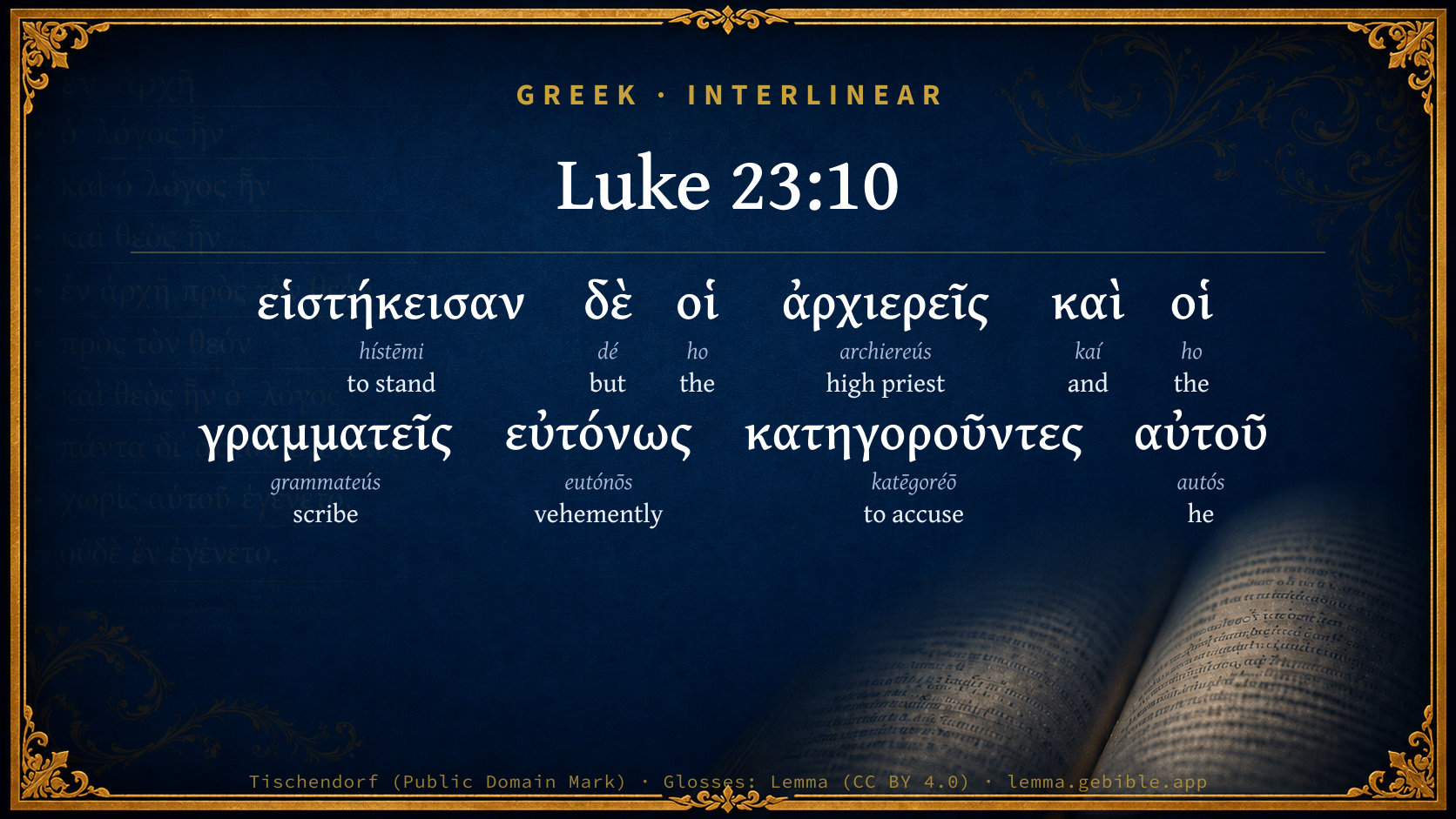
Greek (Tischendorf 8th ed.) Luke 23:10 appears in the Greek New Testament. The text above is from the Tischendorf 8th edition. Each word links to its Strong’s number and a concise gloss. Click any word for its full Thayer’s Greek Lexicon entry.
Download image
Cite this verse

Luke 23:10 (World English Bible). Public Domain. Lemma interlinear Bible study tool, https://lemma.gebible.app/v/luke/23/10.

Show BibTeX & RIS
BibTeX
RIS
English Translation
The chief priests and the scribes stood, vehemently accusing him.
World English Bible · Public Domain
Highlights
  • 1 first appearance in the Greek New Testament
Full analysis ↓
Download a study sheet

One document with this verse’s original text, its word-by-word gloss line, the meaning frame, cross-references with their text, attributed commentary, and full source and license credits — printable, and it pastes into notes with its structure intact.

This verse Autodidact and up

Study sheet (.html) Plain text (.txt)

A passage Seminary Student

Up to 50 verses in one chapter. A passage sheet keeps up to 6 commentary sources and 12 cross-references per verse, in the order this page ranks them, and says so on the sheet whenever that leaves anything out. Ask for a single verse and you get the Autodidact verse sheet above.

Everything on this page stays free to read, with no account — the sheet is a download of what is already on screen, not access to it.

Want to remove ads? Support Godless Engineer
Compare translations 3

The same verse in 3 English versions, stacked beneath the original-language interlinear above. Click any original word for its lexicon entry.

Each is an independent rendering of the whole verse — the interlinear is not word-aligned to these translations.

Highlighted words mark where these versions differ — a whole-verse word diff, not a word-by-word alignment.

  • World English Bible Public Domain
    The chief priests and the scribes stood, vehemently accusing him.
  • King James Version Public Domain
    And the chief priests and scribes stood and vehemently accused him.
  • unfoldingWord Literal Text CC BY-SA 4.0
    And the chief priests and the scribes stood by, vehemently accusing him.

unfoldingWord Literal Text — © unfoldingWord, licensed CC BY-SA 4.0. Word-aligned USFM3 via Door43 (git.door43.org/unfoldingWord/en_ult).

Versions to compare (up to 4)

3 of 4 selected

Show all 19 translations

Every available English version of this verse, each an independent rendering of the whole verse.

  • World English Bible Public Domain
    The chief priests and the scribes stood, vehemently accusing him.
  • Berean Standard Bible Public Domain
    Meanwhile, the chief priests and scribes stood there, vehemently accusing Him.
  • Majority Standard Bible Public Domain
    Meanwhile, the chief priests and scribes stood there, vehemently accusing Him.
  • King James Version Public Domain
    And the chief priests and scribes stood and vehemently accused him.
  • American Standard Version (1901) Public Domain
    And the chief priests and the scribes stood, vehemently accusing him.
  • Revised Version (1885) Public Domain
    And the chief priests and the scribes stood, vehemently accusing him.
  • Geneva Bible (1599) Public Domain
    The hie Priests also and Scribes stood forth, and accused him vehemently.
  • Douay-Rheims (1899) Public Domain
    And the chief priests and the scribes stood by, earnestly accusing him.
  • Young's Literal Translation Public Domain
    And the chief priests and the scribes stood vehemently accusing him,
  • Literal Standard Version CC BY-SA 4.0
    And the chief priests and the scribes stood vehemently accusing Him,
  • Unlocked Literal Bible CC BY-SA 4.0
    The chief priests and the scribes stood, violently accusing him.
  • unfoldingWord Literal Text CC BY-SA 4.0
    And the chief priests and the scribes stood by, vehemently accusing him.
  • Darby Bible Public Domain
    And the chief priests and the scribes stood and accused him violently.
  • World Messianic Bible Public Domain
    The chief priests and the scribes stood, vehemently accusing him.
  • Webster's Bible Public Domain
    And the chief priests and scribes stood and vehemently accused him.
  • Free Bible Version CC BY-SA 4.0
    The chief priests and religious teachers stood there, angrily accusing him.
  • Bible in Basic English Public Domain
    And the chief priests and the scribes were there, making statements against him violently.
  • Text-Critical English NT CC BY 4.0
    Meanwhile, the chief priests and the scribes stood there, vehemently accusing him.
  • Tyndale New Testament (1534) Public Domain
    The hye prestes and scribes stode forthe and accused him straytly.

Literal Standard Version (2020), Covenant Press — licensed CC BY-SA 4.0. Text via the HelloAO Bible API (eBible.org). Unlocked Literal Bible (unfoldingWord) — licensed CC BY-SA 4.0. Text via the HelloAO Bible API (eBible.org). unfoldingWord Literal Text — © unfoldingWord, licensed CC BY-SA 4.0. Word-aligned USFM3 via Door43 (git.door43.org/unfoldingWord/en_ult). Free Bible Version, Dr. Jonathan Gallagher — licensed CC BY-SA 4.0. Text via the HelloAO Bible API (eBible.org).

Word by word

More ways to search: Search by grammar → Find every occurrence → Compare this word →

Practice this passage: Drill this verse → Learn its vocabulary →

About this verse

These counts appear in no published source. They are computed here, from the morphology-tagged text and Lemma’s own curated glosses. What Lemma adds →

10
words
9
distinct lemmas
Gospels
section

Notable vocabulary

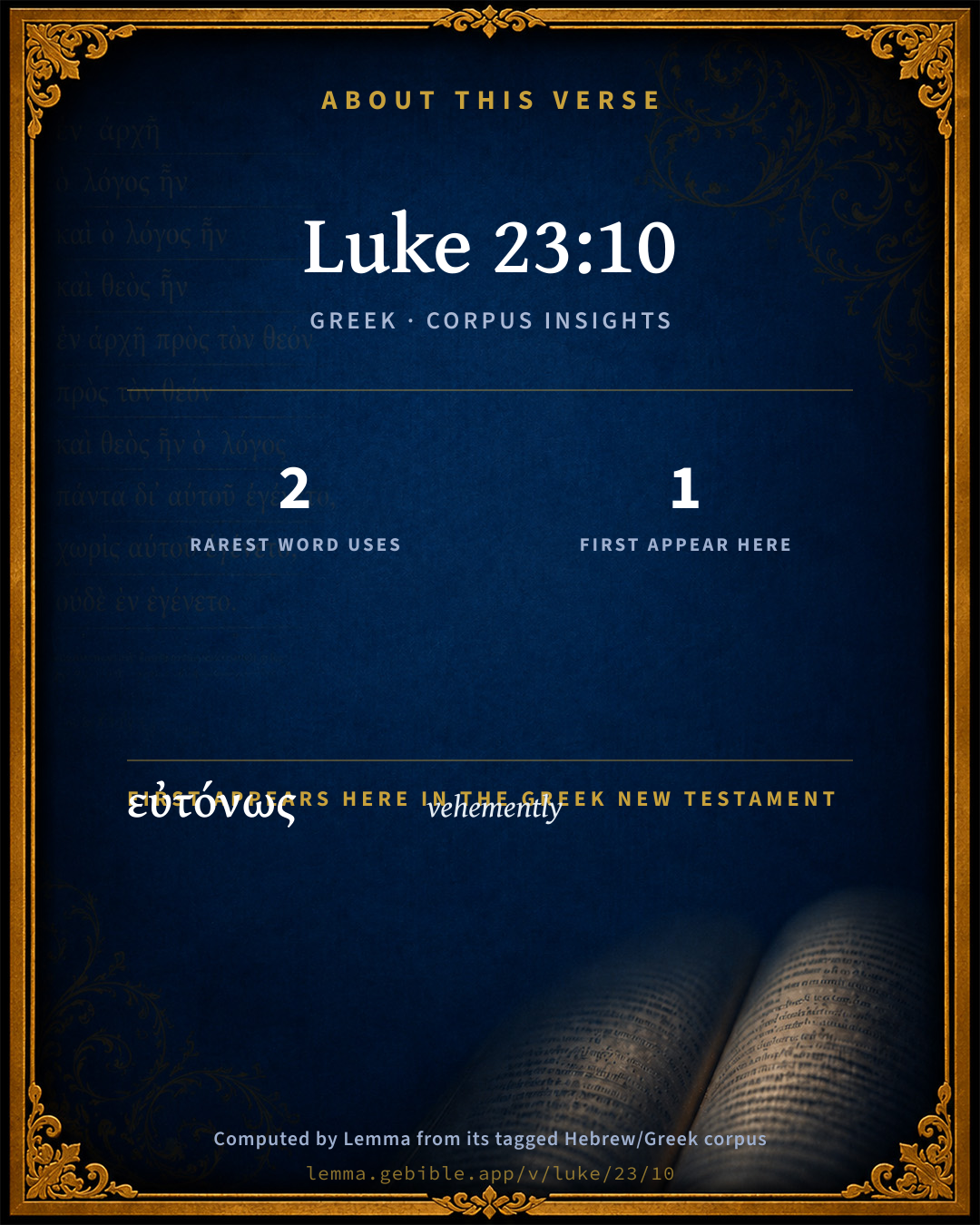
The rarest word here is εὐτόνως vehemently G2159 — appearing just 2 times in the whole Greek New Testament.

First appearance in Scripture

This word makes its first canonical appearance in the Greek New Testament here:

  • εὐτόνως vehemently G2159

Shared distinctive vocabulary

εὐτόνως vehemently G2159 occurs in 2 verses of the Greek New Testament. Also found in:

Repetition

A word recurs within this verse:

Cross-references

5

Topical passages linked to Luke 23:10 in the Treasury of Scripture Knowledge — connected by theme and wording, ordered by reader-vote popularity; previews shown in the World English Bible.

  • Luke 11:53 As he said these things to them, the scribes and the Pharisees began to be terribly angry, and to draw many things out of him;
  • Luke 23:2 They began to accuse him, saying, "We found this man perverting the nation, forbidding paying taxes to Caesar, and saying that he himself is Christ, a king."
  • Luke 23:5 But they insisted, saying, "He stirs up the people, teaching throughout all Judea, beginning from Galilee even to this place."
  • Luke 23:14–15 and said to them, "You brought this man to me as one that perverts the people, and see, I have examined him before you, and found no basis for a charge against this man concerning those things of which you accuse him.
  • Acts 24:5 For we have found this man to be a plague, an instigator of insurrections among all the Jews throughout the world, and a ringleader of the sect of the Nazarenes.

Cross-references courtesy of OpenBible.info (CC BY 4.0).

Commentary

Notes on Luke 23:10 from classic Christian and Jewish commentators (each source and its license shown beneath its notes). The classic Christian expositions comment on the surrounding passage and are grouped to its opening verse, so a note may address several verses; the Jewish commentaries on the Tanakh (Rashi and others) are per-verse, so they appear only where the commentator wrote on this verse.

Lemma curates 59 commentaries, every one of them public domain or Creative Commons licensed, each selected and text-cleaned for this edition rather than reprinted as found. About our sources →

Joseph Benson's Commentary

Luk 23:10-12. And the chief priests and scribes — Whose malice had brought them to attend him thither; stood — In the presence of the king; and vehemently accursed him — Doubtless as an enemy to Cesar, and guilty of seditious practices, crimes which they had laid to his charge before Pilate. Observe, reader, it is no new thing for good men and good ministers, who are real and useful friends to the civil government, to be falsely accused as factious and seditious, and enemies to the government. Herod, with his men of war — Namely, those of his soldiers who now attended him as his life-guard; set him at naught — Treated him in a very contemptuous manner, as a despicable person beneath their notice; and who no way answered the account they had heard of him, as he neither said nor did any thing to gratify their curiosity. And arrayed him in a gorgeous robe — Herod, finding himself disappointed in his expectation of seeing Jesus work miracles, ordered him to be clothed with a robe, in colour like those which kings used to wear, and permitted his attendants to insult him. Thus Herod, who had been acquainted with John the Baptist, and had more knowledge of Christ too, and of religion, than Pilate had, was more abusive to Christ than Pilate was: for knowledge without grace does but make men more ingeniously wicked. Our Lord’s being dressed in this manner by Herod’s order, shows, that here also the priests had accused him of having assumed the titles and honours belonging to the Messiah; for the affront put upon him was plainly in derision of that pretension. The other head of accusation, his having attempted to raise a sedition in Galilee, on account of the tribute, they durst not touch upon, because Herod could not fail to know the gross falsehood of it. Herod’s usage of our Lord was exceedingly insolent, but, perhaps, the remorse of conscience, which he had felt on account of the murder of John the Baptist, might render him cautious how he joined in any attempt on the life of Jesus, which we do not find that he ever did. The expression, εσθητα λαμπραν, which we render, a gorgeous robe, is translated in the Vulgate, veste alba, a white garment, and by Erasmus, Castalio, Beza, and in the Zurich translation, veste splendida, a shining garment. “Though the Greek word may be rendered either way,” says Dr. Campbell, “I prefer the latter, as denoting that quality of the garment which was the most remarkable; for this epithet was most properly given to those vestments, wherein both qualities, white and shining, were united. Such white and splendid robes were worn in the East by sovereigns.” And he sent him again to Pilate — Without further injury, thereby intimating, that he left him to do what he pleased with his prisoner, but that, for his own part, he apprehended his pretensions to royalty worthy of derision rather than serious resentment. And the same day Herod and Pilate were made friends together — Whatever Pilate’s real intentions were, in sending Jesus to Herod to be examined by him, his doing this was so well taken by the latter; and Herod’s sending him back to the Roman governor was, on the other hand, such a public instance of regard to him, that this mutual obligation, with the messages that passed between them on this occasion, brought them to a better understanding one of another, than there had been of late between them. For before they were at enmity between themselves — The cause of this enmity can only be conjectured: perhaps it might be the slaughter which Pilate had made of some of the Galileans, who had come up to offer sacrifices at Jerusalem, spoken of Luk 13:1; or, perhaps, Pilate had encroached upon Herod’s jurisdiction, by giving judgment in causes which concerned his subjects: and therefore Herod, looking upon the sending of Jesus to him to be judged, because he was a Galilean, as a reparation for former offences, was forthwith reconciled to Pilate. Observe, reader, how those who quarrelled with one another, could yet unite against Christ, as Gebal, and Ammon, and Amalek, though divided among themselves, were confederate against the Israel of God, Psa 83:7.

Joseph Benson's Commentary on the Old and New Testaments (1811–1818) — public domain. Text from a community e-Sword module.

Bengel's Gnomon

Johann Albrecht Bengel

Luk 23:10. Εὐτόνως [vehemently, Engl. Vers.], severely[253]) Act 18:28. Priests often have zeal, though a false zeal; courtiers have none at all: owing to which fact the latter often assail the truth more lightly than do the former. Herod had it in his power at the time, and therefore ought to have let Jesus go free.

[253] ‘Rigide.’ Εὐτόνως from τείνω, straining every nerve. Wahl translates it ‘acriter,’ “cum contentione,” with bitter eagerness. It occurs only here and Act 18:28, in the New Testament. In the latter place it is said of Apollos, “He mightily” or rather, “with stern earnestness, convinced the Jews.”—E. and T.

Bengel's Gnomon of the New Testament — English translation (T&T Clark, Edinburgh, 1860) — public domain. Text from a community e-Sword module.

Meyer's Critical & Exegetical Commentary

Heinrich August Wilhelm Meyer

Luk_23:10-12. Εἱστήκεισαν] they stood there. They had brought Him to Herod.

εὐτόνως] with passionate energy. Comp. 2Ma_12:23; Act_18:28, often in the Greek writers.

Luk_23:11. Prudently enough Herod does not enter into the charges,frivolously enough he thinks that justice will be done to the obstinate enthusiast as to a fool, not by means of investigation and punishment, but by contempt and mockery.

σὺν τοῖς στρατεύμασιν αὐτοῦ] These troops are the body of satellites by whom He is surrounded.

ἐσθῆτα λαμπρ.] a gorgeous robe, which is not to be defined more strictly. A toga candida (Polyb. x. 4. 8, x. 5. 1), which Beza, Kuinoel, Lange, and others suppose, is less in accordance with the situation, in which Jesus was to be caricatured, not as a candidate, but as a king. As such He was to appear again before Pilate splendidly clothed (but whether actually in purple or not is not expressed in the word). Comp. Xen. Cyrop. ii. 4. 5. Bengel, moreover, aptly remarks: Herodes videtur contemtim voluisse significare, se nil metuere ab hoc rege.

Luk_23:12. ὄντες] along with ὑπάρχειν, for the, sake of making the situation more strongly prominent. See Dissen, ad Dem. de Cor. p. 258 f.

πρὸς ἑαυτούς] not ἀλλήλους this time, simply ut varietur oratio, Kühner, ad Xen. Mem. 2. 6. 20. The cause of the previous enmity is unknown; possibly, however, it had originated from disputes about jurisdiction, since that consideration of Herods jurisdiction (of the fori originis), even although Herod prudently made no further use of it, but sent back the accused, brought about the reconciliation. According to Justin, c. Tr. 103, Pilate sent Jesus to Herod to please him (χαριζόμενος).

REMARK.

The narrative of the sending to Herod (comp. Act_4:27) has the stamp of originality, and might as an interlude, having no bearing on the further course of the history, easily disappear from the connection of the tradition, so that its preservation is only due to Lukes investigation; and even John, in his narrative of the trial before Pilate, leaves it entirely out of consideration. He leaps over it after the words: ἐγὼ οὐδεμίαν αἰτίαν εὑρίσκω ἐν αὐτῷ, Luk_18:38 (not after Luk_23:40, Tholuck, Olshausen), and hence makes Pilate immediately connect the words of Luk_23:39, which in the narrative of Luke correspond to the words of Luk_23:16. But not as though John had not known the intervening incident (de Wette; a conclusion in itself wholly improbable, and going much too far; such, for example, as might be applied equally to the Lords Supper, to the agony in the garden, etc.); but, on the contrary, in accordance with the freedom of his peculiar composition, since all the evangelists did their work eclectically. Lightly Strauss, II. p. 500, satisfied himself with the conjecture that the anecdote arose from the endeavour to place Jesus before all possible judgment-seats in Jerusalem. Baur, however (Evang. p. 489), derives the narrative from the endeavour to have the innocence of Jesus attested as conspicuously as possible in the anti-Judaic interest, to lay the guilt on Judaism, and to relieve Pilate as much as possible from the burden (so also Schenkel, p. 405); comp. Eichthals frivolous judgment, ii. p. 308.

Meyer — Critical and Exegetical Commentary on the New Testament — English translation by Peter Christie, edited by Frederick Crombie (T&T Clark, 1880) — public domain. Text from a community e-Sword module.

Expositor's Greek Testament

ed. W. Robertson Nicoll

Luk 23:10 . οἱ ἀρχιερεῖς , etc., priests and scribes, there too, having followed Jesus, afraid that the case might take an unfavourable turn in their absence. εὐτόνως , eagerly (Act 18:28 ).

The Expositor's Greek Testament, edited by W. Robertson Nicoll (1897–1910) — public domain. Text from a community e-Sword module.

Jamieson, Fausset & Brown

Robert Jamieson, A. R. Fausset & David Brown

stood and vehemently accused him--no doubt both of treason before the king, and of blasphemy, for the king was a Jew.

Jamieson, Fausset & Brown — Commentary Critical and Explanatory on the Whole Bible (1871) — public domain (CC PDM 1.0). Text via the HelloAO Bible API.

Adam Clarke's Commentary

Verse 10. The chief priests - vehemently accused him.] Corrupt priests and teachers are generally the most implacable enemies of Christ and his truth. Evil passions betray those who are slaves to them. An affected moderation would have rendered these accusers less suspected, their accusations more probable, and the envy less visible than this vehemence: but envy seldom or never consults prudence: and God permits this to be so for the honour of truth and innocence. Quesnel.

Adam Clarke's Commentary on the Bible (1810–1826) — public domain. Text from a community e-Sword/MySword module.

Ellicott's Commentary for English Readers

(10) The chief priests and scribes.—The accusers seem to have accompanied the Accused. There was nothing strange in the presence of the Sadducean members of the higher priestly order, always courting the favour of the powerful, at the court of the Tetrarch. Among the scribes may have been some of the Herodian section (see Notes on Mat_22:16), who were likely to gain a hearing there, and had probably come up with their prince from Galilee.

A Bible Commentary for English Readers, edited by Charles John Ellicott (1878–1897) — public domain. Text from a community e-Sword module.

The Cambridge Bible for Schools and Colleges

gen. ed. J. J. S. Perowne

10. and vehemently accused him] They were now bent on securing their purpose, and perhaps feared that Herod’s well-known weakness and superstition might rob them of their prey;—especially as he was much less afraid of them than Pilate was, having strong influence in Rome.

The Cambridge Bible for Schools and Colleges (gen. ed. J. J. S. Perowne; Cambridge University Press, 1878–1918) — public domain. Text from a community e-Sword module.

John Gill's Exposition

And the chief priests and Scribes,.... The sanhedrim that followed him from Pilate's hall, to Herod's palace; fearing, lest Herod should be disposed to let him go, should he gratify him by working a miracle:

stood; before Herod; so witnesses, and accusers, used to do; See Gill on Mar 14:57.

and vehemently accused him; of the same things they had accused him before Pilate, with great bitterness and constancy, increasing, and aggravating the charges against him.

John Gill's Exposition of the Whole Bible (1746–1763) — public domain (CC PDM 1.0). Text via the HelloAO Bible API.

Trapp's Complete Commentary

John Trapp

10 And the chief priests and scribes stood and vehemently accused him.

Ver. 10. Vehemently accused him] Gr. ευτονως, with great intention of spirit, and contention of speech. Clamant, ut Stentora vincant.

John Trapp, A Commentary or Exposition upon All the Books of the Old and New Testament (1647–1656) — public domain. Text from a community e-Sword module.

Albert Barnes' Notes on the Bible

Vehemently accused him - Violently or unjustly accused him, endeavoring to make it appear that he had been guilty of sedition in Herod’s province.

Albert Barnes' Notes on the Bible (1834–1885) — public domain. Text from a community e-Sword/MySword module.

Whedon's Commentary on the Bible

Daniel D. Whedon

10. Chief priests… vehemently accused—Seizing, apparently, the favorable moment when the chagrin of Herod disposed him to listen.

Daniel D. Whedon (gen. ed.), Commentary on the Old and New Testaments (1874–1909) — public domain. Text from a community e-Sword module.

MacLaren's Expositions of Holy Scripture

Alexander MacLaren

Luke

‘THE RULERS TAKE COUNSEL TOGETHER’

Luk 23:1 - Luk 23:12.

Luke’s canvas is all but filled by the persecutors, and gives only glimpses of the silent Sufferer. But the silence of Jesus is eloquent, and the prominence of the accusers and judges heightens the impression of His passive endurance. We have in this passage the Jewish rulers with their murderous hate; Pilate contemptuously indifferent, but perplexed and wishing to shirk responsibility; and Herod with his frivolous curiosity. They present three types of unworthy relations to Jesus Christ.

I. We see first the haters of Jesus.

So fierce is their hatred that they swallow the bitter pill of going to Pilate for the execution of their sentence. John tells us that they began by trying to get Pilate to decree the crucifixion without knowing Jesus’ crime; but that was too flagrant injustice, and too blind confidence in them, for Pilate to grant. So they have to manufacture a capital charge on the spot, and they are equal to the occasion. By the help of two lies, and one truth so twisted as to be a lie, they get up an indictment, which they think will be grave enough to compel the procurator to do as they wish.

Their accusation, if it had been ever so true, would have been ludicrous on their lips; and we may be sure that, if it had been true, they would have been Jesus’ partisans, not His denouncers.’ The Gracchi complaining of sedition’ are nothing to the Sanhedrim accusing a Jew of rebellion against Rome. Every man in that crowd was a rebel at heart, and would have liked nothing better than to see the standard of revolt lifted in a strong hand. Pilate was not so simple as to be taken in by such an accusation from such accusers, and it fails. They return to the charge, and the ‘more urgent’ character of the second attempt is found in its statement of the widespread extent of Christ’s teaching, but chiefly in the cunning introduction of Galilee, notoriously a disaffected and troublesome district.

What a hideous and tragic picture we have here of the ferocity of the hatred, which turned the very fountains of justice and guardians of a nation into lying plotters against innocence, and sent these Jewish rulers cringing before Pilate, pretending loyalty and acknowledging his authority! They were ready for any falsehood and any humiliation, if only they could get Jesus crucified. And what had excited their hatred? Chiefly His teachings, which brushed aside the rubbish both of ceremonial observance and of Rabbinical casuistry, and placed religion in love to God and consequent love to man; then His attitude of opposition to them as an order; and finally His claim, which they never deigned to examine, to be the Son of God. That, they said, was blasphemy, as it was, unless it were true,-an alternative which they did not look at. So blinded may men be by prejudice, and so mastered by causeless hatred of Him who loves them all!

These Jewish rulers were men like ourselves. Instead of shuddering at their crime, as if it were something far outside of anything possible for us, we do better if we learn from it the terrible depths of hostility to Jesus, the tragic blindness to His character and love, and the degradation of submission to usurpers, which must accompany denial of His right to rule over us. ‘They hated Me without a cause,’ said Christ; but He pointed to that hatred as sure to be continued towards Him and His servants as long as ‘the world’ continues the world.

II. We have Pilate, indifferent and perplexed.

Luke’s very brief account should be supplemented by John’s, which shows us how important the conversation, so much abbreviated by Luke, was. Of course Pilate knew the priests and rulers too well to believe for a moment that the reason they gave for bringing Jesus to him was the real one, and his taking Jesus apart to speak with Him shows a wish to get at the bottom of the case. So far he was doing his duty, but then come the faults. These may easily be exaggerated, and we should remember that Pilate was the most ignorant, and therefore the least guilty, of all the persons mentioned in this passage. He had probably never heard the name of Jesus till that day, and saw nothing but an ordinary Jewish peasant, whom his countrymen, like the incomprehensible and troublesome people they were, wished, for some fantastic reason, to get killed.

But that dialogue with his Prisoner should have sunk deeper into his mind and heart. He was in long and close enough contact with Jesus to have seen glimpses of the light, which, if followed, would have led to clear recognition. His first sin was indifference, not unmingled with scorn, and it blinded him. Christ’s lofty and wonderful explanation of the nature of His kingdom and His mission to bear witness to the truth fell on entirely preoccupied ears, which were quick enough to catch the faintest whispers of treason, but dull towards ‘truth.’ When Jesus tried to reach his conscience by telling him that every lover of truth would listen to His voice, he only answered by the question, to which he waited not for an answer, ‘What is truth?’

That was not the question of a theoretical sceptic, but simply of a man who prided himself on being ‘practical,’ and left all talk about such abstractions to dreamers. The limitations of the Roman intellect and its characteristic over-estimate of deeds and contempt for pure thought, as well as the spirit of the governor, who would let men think what they chose, as long as they did not rebel, spoke in the question. Pilate is an instance of a man blinded to all lofty truth and to the beauty and solemn significance of Christ’s words, by his absorption in outward life. He thinks of Jesus as a harmless fanatic. Little did he know that the truth, which he thought moonshine, would shatter the Empire, which he thought the one solid reality. So called practical men commit the same mistake in every generation. ‘All flesh is as grass;. . . the word of the Lord endureth for ever.’

Further, Pilate sinned in prostituting his office by not setting free the prisoner when he was convinced of His innocence. ‘I find no fault in this man,’ should have been followed by immediate release. Every moment afterwards, in which He was kept captive, was the condemnation of the unjust judge. He was clearly anxious to keep his troublesome subjects in good humour, and thought that the judicial murder of one Jew was a small price to pay for popularity. Still he would have been glad to have escaped from what his official training had taught him to recoil from, and what some faint impression, made by his patient prisoner, gave him a strange dread of. So he grasps at the mention of Galilee, and tries to gain two good ends at once by handing Jesus over to Herod.

The relations between Antipas and him were necessarily delicate, like those between the English officials and the rajahs of native states in India; and there had been some friction, perhaps about ‘the Galileans, whose blood’ he ‘had mingled with their sacrifices.’ If there had been difficulties in connection with such a question of jurisdiction, the despatch of Jesus to Herod would be a graceful way of making the amende honorable, and would also shift an unpleasant decision on to Herod’s shoulders. Pilate would not be displeased to get rid of embarrassment, and to let Herod be the tool of the priests’ hate.

How awful the thought is of the contrast between Pilate’s conceptions of what he was doing and the reality! How blind to Christ’s beauty it is possible to be, when engrossed with selfish aims and outward things! How near a soul may be to the light, and yet turn away from it and plunge into darkness! How patient that silent prisoner, who lets Himself be bandied about from one tyrant to another, not because they had power, but because He loved the world, and would bear the sins of every one of us! How terrible the change when these unjust judges and He will change places, and Pilate and Herod stand at His judgment-seat!

III. We have the wretched, frivolous Herod.

This is the murderer of John Baptist-’that fox,’ a debauchee, a coward, and as cruel as sensuous. He had all the vices of his worthless race, and none of the energy of its founder. He is by far the most contemptible of the figures in this passage. Note his notion of, and his feeling to, Jesus. He thought of our Lord as of a magician or juggler, who might do some wonders to amuse the vacuous ennui of his sated nature. Time was when he had felt some twinge of conscience in listening to the Baptist, and had almost been lifted to nobleness by that strong arm. Time was, too, when he had trembled at hearing of Jesus, and taken Him for his victim risen from a bloody grave. But all that is past now. The sure way to stifle conscience is to neglect it. Do that long and resolutely enough, and it will cease to utter unheeded warnings. There will be a silence which may look like peace, but is really death. Herod’s gladness was more awful and really sad than Herod’s fear. Better to tremble at God’s word than to treat it as an occasion for mirth. He who hates a prophet because he knows him to be a prophet and himself to be a sinner, is not so hopeless as he who only expects to get sport out of the messenger of God.

Then note the Lord’s silence. Herod plies Jesus with a battery of questions, and gets no answer. If there had been a grain of earnestness in them all, Christ would have spoken. He never is silent to a true seeker after truth. But it is fitting that frivolous curiosity should be unanswered, and there is small likelihood of truth being found at the goal when there is nothing more noble than that temper at the starting-point. Christ’s silence is the penalty of previous neglect of Christ’s and His forerunner’s words. Jesus guides His conduct by His own precept, ‘Give not that which is holy unto the dogs’; and He knows, as we never can, who come into that terrible list of men to whom it would only add condemnation to speak of even His love. The eager hatred of the priests followed Jesus to Herod’s palace, but no judicial action is recorded as taking place there. Their fierce earnestness of hate seems out of place in the frivolous atmosphere. The mockery, in which Herod is not too dignified to join his soldiers, is more in keeping. But how ghastly it sounds to us, knowing whom they ignorantly mocked! Cruelty, inane laughter, hideous pleasure in an innocent man’s pain, disregard of law and justice-all these they were guilty of; and Herod, at any rate, knew enough of Jesus to give a yet darker colouring to his share in the coarse jest.

But how the loud laugh would have fallen silent if some flash had told who Jesus was! Is there any of our mirth, perhaps at some of His servants, or at some phase of His gospel, which would in like manner stick in our throats if His judgment throne blazed above us? Ridicule is a dangerous weapon. It does more harm to those who use it than to those against whom it is directed. Herod thought it an exquisite jest to dress up his prisoner as a king; but Herod has found out, by this time, whether he or the Nazarene was the sham monarch, and who is the real one. Christ was as silent under mockery as to His questioner. He bears all, and He takes account of all. He bears it because He is the world’s Sacrifice and Saviour. He takes account of it, and will one day recompense it, because He is the world’s King, and will be its Judge. Where shall we stand then-among the silenced mockers, or among the happy trusters in His Passion and subjects of His dominion?

Alexander MacLaren, Expositions of Holy Scripture (1904–1910) — public domain. Text from a community e-Sword module.

Cambridge Greek Testament for Schools and Colleges

10. εὐτόνως κατηγοροῦντες. Comp. Act 18:28. They were now bent on securing their purpose, and perhaps feared that Herod’s well-known weakness and superstition might rob them of their prey;—especially as he was much less afraid of them than Pilate was, having strong influence in Rome.

Cambridge Greek Testament for Schools and Colleges (Cambridge University Press, 1896; 21 vols, various authors incl. Carr, Maclear, Plummer, Farrar, Lumby, Moule, M. R. James, Simcox) — public domain. Text from a community e-Sword module.

Alford’s Greek Testament

Henry Alford

10.] The accusations, of worldly kingship and of blasphemy, would probably be here united, as Herod was a Jew, and able to appreciate the latter.

Henry Alford, The Greek Testament (1849–1861) — public domain. Text from a community e-Sword module.

International Critical Commentary

10. ἱστήκεισαν. This, and not εἱστήκειν, is the pluperf. of ἵσταμαι. The evidence varies in the fourteen places; but ἱστήκειν is never a more itacism, and is freq. in LXX. Even B, which often prefers ει to ι, supports ἱστήκει five times (WH. ii. App. p. 162).

εὐτόνως. “At full stretch, vehemently,” in N. T. only here and Act 18:28: comp. Jos 6:8; Jos_2 Mac. 12:23. In Latin texts we have instanter (c), fortiter (d), vehementer (a r), constanter (f Vulg.). Apparently they had kept silence while Herod was questioning Jesus; but his silence had exasperated them. Syr-Sin. omits vv. 10-12.

International Critical Commentary — older volumes (1896–1929), various authors — public domain. Text from a community e-Sword module.

Vincent's Word Studies in the New Testament

Marvin R. Vincent

Vehemently [ευτονως] . Only here and Act 18:28, of the preaching of Apollos. Originally the word means well - strung; hence, in medical language, of a well - toned body.

Marvin R. Vincent, Word Studies in the New Testament (1887–1900) — public domain. Text from a community e-Sword/MySword module.

Lesson kit

Teaching starters — assembled from the data on this page, not authored interpretation. Every prompt links to the verse data it draws on. Edit before teaching.

Luke, in the Gospels, opens this verse with 10 words (9 distinct Greek lemmas). Its most distinctive word is eutónōs (“vehemently”). A historical commentator’s framing appears above. Read the whole chapter for the surrounding context.

Discussion questions

  1. How does “vehemently” (eutónōs) shape what this verse is saying?
  2. This is the first place “vehemently” appears in Scripture (first appears here). What does its debut here establish?
  3. How does Acts 18:28, which shares the word «vehemently», read alongside this verse?
  4. What does the repetition of “the” (2× in this one verse) do in this verse?
  5. These translations render this verse differently; the difference is in the English rendering, not the original. What questions does that raise?
  6. Compare how Joseph Benson's Commentary and Bengel's Gnomon read this verse. Where do they agree or differ?

Things to notice

  • 1 word makes its first canonical appearance in Scripture here.
  • These translations choose different wording for 2 words in this verse.
  • “the” occurs 2× in this single verse.
  • 9 distinct Greek lemmas span 10 words in this verse.

Reading settings

Reading text

Shown beneath each verse's original-language words.

Old Testament
Old Testament edition

Read the OT as the Masoretic Hebrew (MT) or the Greek Septuagint (LXX).

English shown for the Greek Septuagint (in the Hebrew ↔ Greek comparison).

Comparing translations? Open the Compare panel on any verse page to stack up to four side by side.