Luke 18:40

Greek (Tischendorf 8th ed.) Luke 18:40 appears in the Greek New Testament. The text above is from the Tischendorf 8th edition. Each word links to its Strong’s number and a concise gloss. Click any word for its full Thayer’s Greek Lexicon entry.
Download image
Cite this verse

Luke 18:40 (World English Bible). Public Domain. Lemma interlinear Bible study tool, https://lemma.gebible.app/v/luke/18/40.

Show BibTeX & RIS
BibTeX
RIS
English Translation
Standing still, Jesus commanded him to be brought to him. When he had come near, he asked him,
World English Bible · Public Domain
Download a study sheet

One document with this verse’s original text, its word-by-word gloss line, the meaning frame, cross-references with their text, attributed commentary, and full source and license credits — printable, and it pastes into notes with its structure intact.

This verse Autodidact and up

Study sheet (.html) Plain text (.txt)

A passage Seminary Student

Up to 50 verses in one chapter. A passage sheet keeps up to 6 commentary sources and 12 cross-references per verse, in the order this page ranks them, and says so on the sheet whenever that leaves anything out. Ask for a single verse and you get the Autodidact verse sheet above.

Everything on this page stays free to read, with no account — the sheet is a download of what is already on screen, not access to it.

Want to remove ads? Support Godless Engineer
Compare translations 3

The same verse in 3 English versions, stacked beneath the original-language interlinear above. Click any original word for its lexicon entry.

Each is an independent rendering of the whole verse — the interlinear is not word-aligned to these translations.

Highlighted words mark where these versions differ — a whole-verse word diff, not a word-by-word alignment.

  • World English Bible Public Domain
    Standing still, Jesus commanded him to be brought to him. When he had come near, he asked him,
  • King James Version Public Domain
    And Jesus stood, and commanded him to be brought unto him: and when he was come near, he asked him,
  • unfoldingWord Literal Text CC BY-SA 4.0
    Then having stood still, Jesus commanded him to be brought to him. Then he had come near, he asked him,

unfoldingWord Literal Text — © unfoldingWord, licensed CC BY-SA 4.0. Word-aligned USFM3 via Door43 (git.door43.org/unfoldingWord/en_ult).

Versions to compare (up to 4)

3 of 4 selected

Show all 19 translations

Every available English version of this verse, each an independent rendering of the whole verse.

  • World English Bible Public Domain
    Standing still, Jesus commanded him to be brought to him. When he had come near, he asked him,
  • Berean Standard Bible Public Domain
    Jesus stopped and directed that the man be brought to Him. When he had been brought near, Jesus asked him,
  • Majority Standard Bible Public Domain
    Jesus stopped and directed that the man be brought to Him. When he had come near, Jesus asked him,
  • King James Version Public Domain
    And Jesus stood, and commanded him to be brought unto him: and when he was come near, he asked him,
  • American Standard Version (1901) Public Domain
    And Jesus stood, and commanded him to be brought unto him: and when he was come near, he asked him,
  • Revised Version (1885) Public Domain
    And Jesus stood, and commanded him to be brought unto him: and when he was come near, he asked him,
  • Geneva Bible (1599) Public Domain
    And Iesus stoode stil, and commanded him to be brought vnto him. And when he was come neere, he asked him,
  • Douay-Rheims (1899) Public Domain
    And Jesus standing, commanded him to be brought unto him. And when he was come near, he asked him,
  • Young's Literal Translation Public Domain
    And Jesus having stood, commanded him to be brought unto him, and he having come nigh, he questioned him,
  • Literal Standard Version CC BY-SA 4.0
    And Jesus having stood, commanded him to be brought to Him, and he having come near, He questioned him,
  • Unlocked Literal Bible CC BY-SA 4.0
    Jesus stood still and commanded that the man be brought to him. Then when the blind man was near, Jesus asked him,
  • unfoldingWord Literal Text CC BY-SA 4.0
    Then having stood still, Jesus commanded him to be brought to him. Then he had come near, he asked him,
  • Darby Bible Public Domain
    And Jesus stood still, and commanded him to be led to him. And when he drew nigh he asked him [saying],
  • World Messianic Bible Public Domain
    Standing still, Yeshua commanded him to be brought to him. When he had come near, he asked him,
  • Webster's Bible Public Domain
    And Jesus stood and commanded him to be brought to him: and when he had come near, he asked him,
  • Free Bible Version CC BY-SA 4.0
    Jesus stopped and told them to bring the blind man to him. As he came over, Jesus asked him,
  • Bible in Basic English Public Domain
    And Jesus, stopping, gave orders that he was to come to him, and when he came near, he said to him,
  • Text-Critical English NT CC BY 4.0
    So Jesus stopped and ordered the man to be brought to him. When the man drew near, Jesus asked him,
  • Tyndale New Testament (1534) Public Domain
    And Iesus stode styll and commaunded him to be brought vnto him. And when he was come neare he axed him

Literal Standard Version (2020), Covenant Press — licensed CC BY-SA 4.0. Text via the HelloAO Bible API (eBible.org). Unlocked Literal Bible (unfoldingWord) — licensed CC BY-SA 4.0. Text via the HelloAO Bible API (eBible.org). unfoldingWord Literal Text — © unfoldingWord, licensed CC BY-SA 4.0. Word-aligned USFM3 via Door43 (git.door43.org/unfoldingWord/en_ult). Free Bible Version, Dr. Jonathan Gallagher — licensed CC BY-SA 4.0. Text via the HelloAO Bible API (eBible.org).

Word by word

More ways to search: Search by grammar → Find every occurrence → Compare this word →

Practice this passage: Drill this verse → Learn its vocabulary →

ἐκέλευσεν
keleúō
G2753
“to command”
Verb, Aorist, Active, Indicative, 3rd person, Singular
Part of Speech
Verb
Tense
Aorist
Voice
Active
Mood
Indicative
Person
3rd person
Number
Singular
Full Thayer's Definition

Origin: from a primary kello (to urge on)

TDNT: None

1. to command, to order
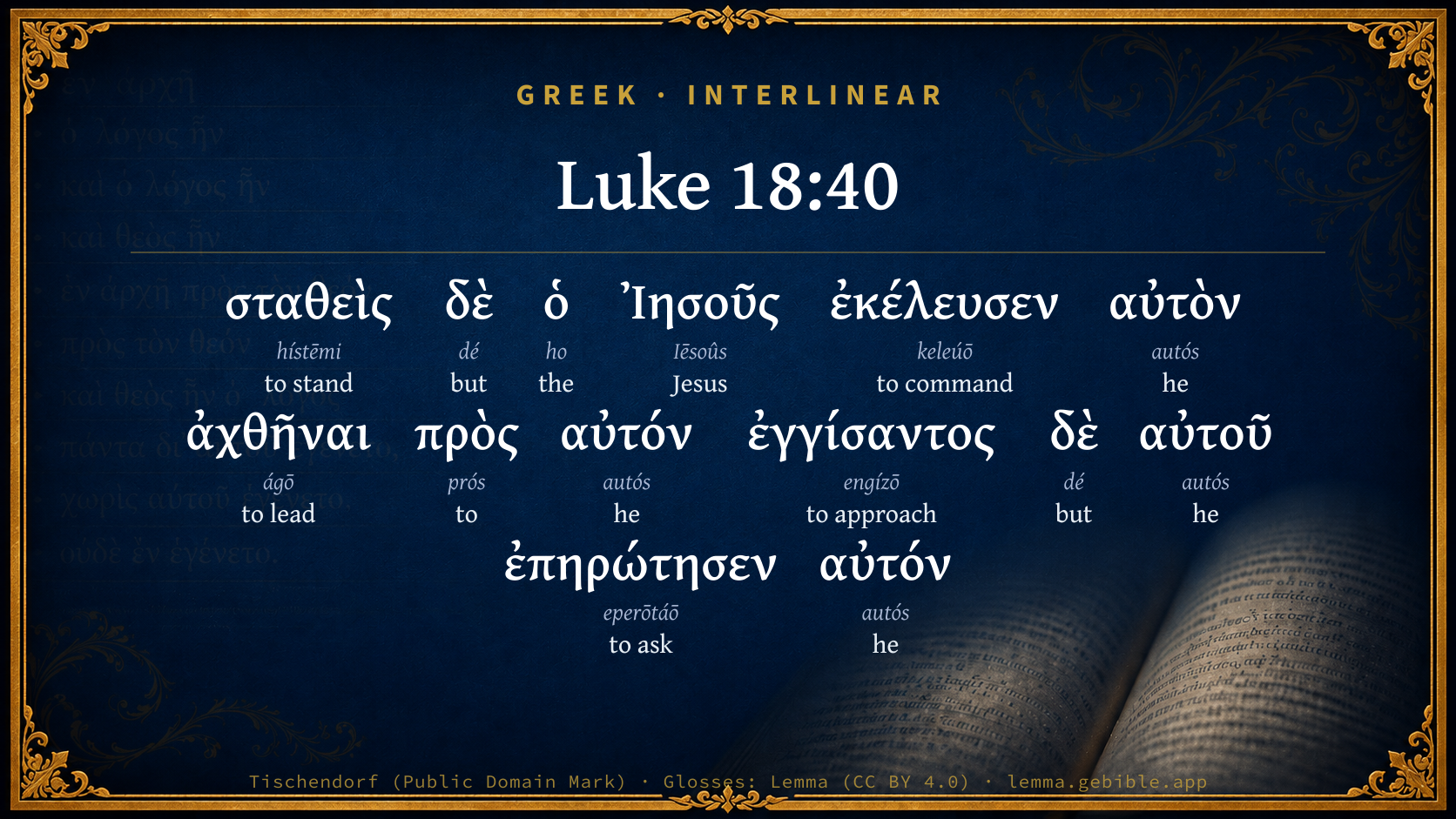
  1. σταθεὶς hístēmi G2476 “to stand” Verb, Aorist, Passive, Participle, Nominative, Singular, Masculine
  2. δὲ dé G1161 “but” Conjunction
  3. ὁ ho G3588 “the” Article, Nominative, Singular, Masculine
  4. Ἰησοῦς Iēsoûs G2424 “Jesus” Noun, Nominative, Singular, Masculine
  5. αὐτὸν autós G846 “he” Personal pronoun, Accusative, Singular, Masculine
  6. ἀχθῆναι ágō G71 “to lead” Verb, Aorist, Passive, Infinitive
  7. πρὸς prós G4314 “to” Preposition
  8. αὐτόν autós G846 “he” Personal pronoun, Accusative, Singular, Masculine
  9. ἐγγίσαντος engízō G1448 “to approach” Verb, Aorist, Active, Participle, Genitive, Singular, Masculine
  10. δὲ dé G1161 “but” Conjunction
  11. αὐτοῦ autós G846 “he” Personal pronoun, Genitive, Singular, Masculine
  12. ἐπηρώτησεν eperōtáō G1905 “to ask” Verb, Aorist, Active, Indicative, 3rd person, Singular
  13. αὐτόν autós G846 “he” Personal pronoun, Accusative, Singular, Masculine

About this verse

These counts appear in no published source. They are computed here, from the morphology-tagged text and Lemma’s own curated glosses. What Lemma adds →

14
words
10
distinct lemmas
Gospels
section

Notable vocabulary

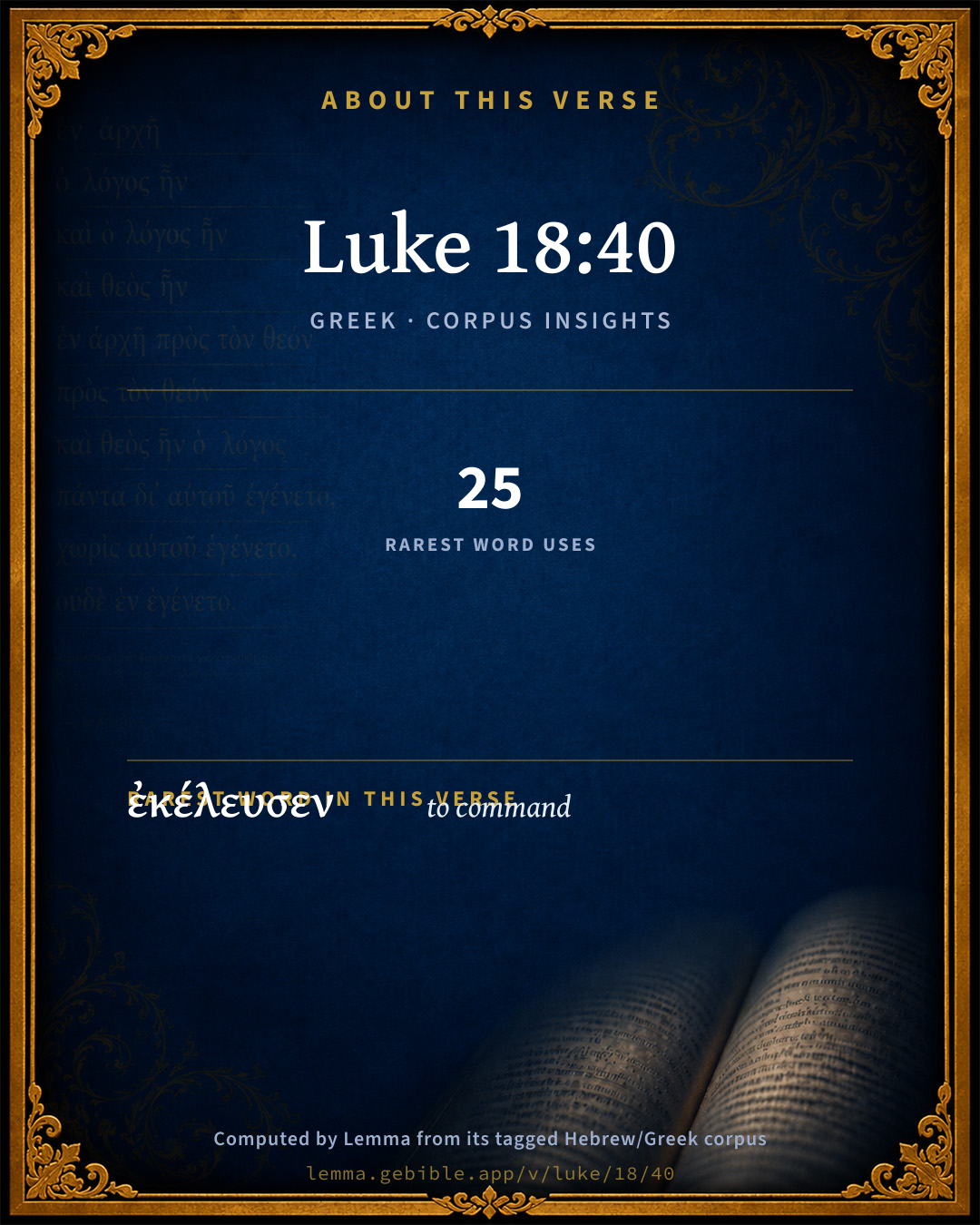
The rarest word here is ἐκέλευσεν to command G2753 — appearing just 25 times in the whole Greek New Testament.

Shared distinctive vocabulary

ἐκέλευσεν to command G2753 occurs in 25 verses of the Greek New Testament. Also found in:

Repetition

Words recur within this verse:

  • αὐτὸν he G846 ×4
  • δὲ but G1161 ×2

Cross-references

2

Topical passages linked to Luke 18:40 in the Treasury of Scripture Knowledge — connected by theme and wording, ordered by reader-vote popularity; previews shown in the World English Bible.

  • Matthew 20:31–34 The multitude rebuked them, telling them that they should be quiet, but they cried out even more, "Lord, have mercy on us, you son of David!"
  • Mark 10:48–52 Many rebuked him, that he should be quiet, but he cried out much more, "You son of David, have mercy on me!"

Cross-references courtesy of OpenBible.info (CC BY 4.0).

Commentary

Notes on Luke 18:40 from classic Christian and Jewish commentators (each source and its license shown beneath its notes). The classic Christian expositions comment on the surrounding passage and are grouped to its opening verse, so a note may address several verses; the Jewish commentaries on the Tanakh (Rashi and others) are per-verse, so they appear only where the commentator wrote on this verse.

Lemma curates 59 commentaries, every one of them public domain or Creative Commons licensed, each selected and text-cleaned for this edition rather than reprinted as found. About our sources →

MacLaren's Expositions of Holy Scripture

Alexander MacLaren

Luke

THE MAN THAT STOPPED JESUS

Luk 18:40 f11 - Luk 18:41.

This story of the man that stopped Christ is told by the three ‘Synoptic’ Evangelists, and it derives a special value from having occurred within a week of the Crucifixion. You remember how graphically Mark tells how the blind man hears who is passing and immediately begins to cry with a loud voice to Christ to have mercy upon him; how the officious disciples-a great deal more concerned for the Master’s dignity than He was Himself-tried to silence him; and how, with a sturdy persistence and independence of externals which often goes along with blindness, ‘he cried the more a great deal’ because they did try, and then how he won the distinction of being the man that stopped Christ. When Jesus stood still, and commanded him to be called, the crowd wheeled right round at once, and instead of hindering, encumbered him with help, and bade him to ‘rise, and be of good cheer.’ Then he flings away some poor rag that he had had to cover himself sitting there, and wearing his under-garment only, comes to Christ, and Jesus asks, ‘What do you want?’ A promise in the shape of a question. Bartimaeus knows what he wants, and answers without hesitation, and so he gets his request.

Now, I think in all this incident, and especially in its centre part, which I have read, there are great lessons for us. And the first of them is, I see here a wonderful revelation of Christ’s quick sympathy at a moment when He was most absorbed.

I said that all this occurred within a week of our Lord’s Crucifixion. If you will recall the way in which that last journey to Jerusalem is described in the Evangelists, you will see that there was something very extraordinary about the determination and tension of spirit which impelled Jesus along the road, all the way from Galilee. Mark says that the disciples followed and were amazed. There was something quite unlike what they had been accustomed to, in His face and bearing, and it was so strange to them that they were puzzled and frightened. We read, too, that their amazement and fright prevented them from going very near Him on the road; ‘as they followed they were afraid.’ Then the story goes on to tell how James and John, with their arrogant wish, did draw closer to Him, the rest of them lagging behind, conscious of a certain unaccustomed distance between Him and them, which only the ambitious two dared to diminish. Further, one of the Evangelists speaks of His face being ‘set’ to go to Jerusalem, the gentle lineaments fixed in a new expression of resolution and absorption. The Cross was flinging its shadow over Him. He was bracing Himself up for the last struggle. If ever there was a moment of His life when we might have supposed that He would be oblivious of externals, and especially of the individual sorrows of one poor blind beggar sitting by the roadside, it was that moment. But however plunged in great thoughts about the agonising suffering that He was going to front, and the grand work that He was going to do, and the great victory that He was going to win so soon, He had

‘A heart at leisure from itself

To soothe and sympathise.’

Even at that supreme hour He stood still and commanded him to be called. I wonder if it is saying too much to say that in the exercise of that power of healing and helping Bartimaeus, Jesus found some relief from the pressure of impending sorrow.

Brethren, is not that a lesson for us all? It is not spiritualising, allegorising, cramming meanings into an incident that are not in it, when we say-Think of Jesus Christ as one of ourselves, knowing that He was going to His death within a week, and then think of Him turning to this poor man. Is not that a pattern for us? We are often more selfish in our sorrows than in our joys. Many of us are inclined, when we are weighed down by personal sorrows, to say, ‘As long as I have this heavy weight lying on my heart, how can you expect me to take an interest in the affairs of others, or to do Christian work, or to rise to the calls of benevolence and the cries of need?’ We do not expect you to do it; but Jesus Christ did it, ‘leaving us an example that we should follow in His steps.’ Next to the blessed influences of God’s own Spirit, and the peace-bringing act of submission, there is no such comfort for sorrow, as to fling ourselves into others’ griefs, and to bear others’ burdens. Our Lord, with His face set like a flint, on the road to the Cross, but yet sufficiently free of heart to turn to Bartimaeus, reads a lesson that rebukes us all, and should teach us all.

Further, do we not see here a beautiful concrete instance, on the lower plane, of the power of earnest desire.

No enemy could have stopped Christ on that road; no opposition could have stopped Him, no beseeching on the part of loving and ignorant friends, repeating the temptation in the wilderness-or the foolish words of Peter, ‘This shall not be unto Thee,’ could have stopped Him. He would have trodden down all such flimsy obstacles, as a lion ‘from the thickets of Jordan’ crashes through the bulrushes, but this cry stopped Him, ‘Jesus, thou Son of David, have mercy on me, and the Cross and all else that He was hastening to, great as it was for the world, had to wait its turn, for something else had to be done first. There was noise enough on the road, the tramp of many feet, the clatter of many eager tongues, but the voice of one poor man sitting in the dust there by the roadside, found its way through all the noise to Christ’s ears. ‘Which things are an allegory.’ There is an ocean of praise always, as I might so say breaking upon Christ’s Throne, but the little stream of my petitions flows distinguishable through all that sea. As one of our poets says, we may even think of Him as ‘missing my little human praise’ when the voice of one poor boy was not heard. Surely amidst all the encouragements that we have to believe that our cry is not sent up into an empty heaven, nor into deaf ears, and that all the multitude of creatures that wait before that Throne do not prevent the individualising knowledge and the individualising love of Jesus Christ from coming straight to every one of us, this little incident is not the least instructive and precious. He that heard Bartimaeus will hear us.

In like manner, may I not say that here we have an illustration of how Christ, who has so much besides to do, would suspend other work, if it were needful, in order to do what we need? As I have said, the rest had to wait. Bartimaeus stopped Christ. And our hand, if it be the hand of faith, put out to the hem of the garment as Jesus of Nazareth passeth by, will so far stop Him as that He will do what we wish, if what we wish is in accordance with our highest good. There was another man in Jericho who stopped Christ, on that same journey; for not only the petition of Bartimaeus, but the curiosity-which was more than curiosity-of Zacchaeus, stopped Him, and He who stood still, though He had His face set like a flint to go to Jerusalem, because Bartimaeus cried, stood still and looked up into the sycamore tree where the publican was-the best fruit that ever it bore-and said, ‘Zacchaeus; come down, I must abide at thy house.’ Why must He abide? Because He discerned there a soul that He could help and save, and that arrested Him on His road to the Cross.

So, dear friends, amidst all the work of administering the universe which He does, and of guiding and governing and inspiring His Church, which He does, if you ask for the supply of your need He would put that work aside for a moment, if necessary, to attend to you. That is no exaggeration; it is only a strong way of putting the plain truth that Christ’s love individualises each of its objects; and lavishes itself upon each one of us; as if there were no other beings in the universe but only our two selves.

And then, remember too, that what Bartimaeus got was not taken from anyone else. Nobody suffered because Jesus paused to help him. They sat down in ranks, five thousand of them, and as they began to eat, those that were first served would be looked upon with envious eye by the last ‘ranks,’ who would be wondering if the bits of bread and the two small fishes were enough to go round. But the first group was fed full and the last group had as much, and they took up ‘of the fragments that remained, twelve baskets full.’

‘Enough for all, enough for each,

Enough for evermore.’

There is one more thought rising out of this story. It teaches a wonderful lesson as to the power which Christ puts into the hand of believing prayer.

‘What wilt thou that I shall do unto thee?’ He had asked the same question a little while before, under very different circumstances. When James and John came and tried to beguile Him into a blind promise, because they knew that It was not likely that they would get what they asked if they said it out at first. He avoided the snare with that same question, To them the question was a refusal; they had said: ‘Master, we will that Thou wouldst do whatever we should desire’; and He said: ‘What is it that ye desire? Let Me know that first.’ But when blind Bartimaeus cried, Jesus smiled down upon him-though his sightless eyeballs could not see the smile, there would be a smile in the cadence of His words-and He said: ‘What wouldst thou that I should do for thee?’ To this suppliant that question was a promise-’I will do what you want.’ He puts the key of the royal treasure-house into the hand of faith, and says, ‘Go in and help yourself. Take what you will.’

Only, of course, we must remember that there are limitations in the very nature of the case, imposed not arbitrarily, but because the very nature of the truest gifts creates them, and these limitations to some of us sound as if they took all the blessedness out of the act of prayer. ‘We know,’ says one of the Apostles, ‘that if we ask anything according to His will He heareth us.’ Some of us think that that is a very poor kind of charter, but it sets the necessary limit to the omnipotence of faith. ‘What wouldst thou that I should do for thee?’ Unless our answer always, and at bottom, is, ‘Not my will, but Thine,’ we have not yet learnt the highest blessing, nor the truest meaning, of prayer. For to pray does not mean to insist, to press our wishes on God, but it means, first, to desire that our wills may be brought into harmony with His. The old Rabbis hit upon great truths now and then, and one of them said, ‘Make God’s will thy will, that He may make thy will His will.’ If any poor, blind Bartimaeus remembers that, and asks accordingly, he has the key to the royal treasury in his possession, and he may go in and plunge his hand up to the wrist in jewels and diamonds, and carry away bars of gold, and it will all be his.

When this man, who had no sight in his eyeballs, knew that whatever he wanted he should have, he did not need to pause long to consider what it was that he wanted most. If you and I had that Aladdin’s lamp given to us, and had only to rub it for a mighty spirit to come that would fulfil our wishes, I wonder if we should be as sure of what we wanted. If we were as conscious of our need as the blind man was of his, we should pause as little in our response to the question: ‘What wouldst thou that I should do for thee?’ ‘Lord! Dost Thou not see that mine eyes are dark? What else but sight can I want?’ Jesus still comes to us with the same question. God grant that we may all say; ‘Lord, how canst Thou ask us? Dost Thou not see that my soul is stained, my love wandering, my eyeballs dim? Give me Thyself!’ If we thus ask, then the answer will come as quickly to us as it did to this blind man: ‘Go thy way! Thy faith hath saved thee,’ and that ‘Go thy way’ will not be dismissal from the Presence of our Benefactor, but our ‘way’ will be the same as Bartimaeus’ was, when he received his sight, and ‘followed Jesus in the way.’

Alexander MacLaren, Expositions of Holy Scripture (1904–1910) — public domain. Text from a community e-Sword module.

Expositor's Greek Testament

ed. W. Robertson Nicoll

Luk 18:40 . ἀχθῆναι , to be led to Him; Lk. again careful to bring out the fact of blindness, all the more noticeable when his narrative is compared with parallels. The omission of the interesting particulars in Mk., ver. 49, 50, has been remarked on (Hahn) as proving that Lk. did not know Mk. Again a precarious inference. It is Lk.’s habit to magnify the miracle, therefore he tells the story so as to bring out that it was a case of total blindness, which does not clearly appear in Mk., vide ver. 50.

The Expositor's Greek Testament, edited by W. Robertson Nicoll (1897–1910) — public domain. Text from a community e-Sword module.

Jamieson, Fausset & Brown

Robert Jamieson, A. R. Fausset & David Brown

commanded, &c.--Mark (Mar 10:49) has this interesting addition: "And they call the blind man, saying unto him, Be of good comfort, rise, He calleth thee"--just as one earnestly desiring an interview with some exalted person, but told by one official after another that it is vain to wait, as he will not succeed (they know it), yet persists in waiting for some answer to his suit, and at length the door opens, and a servant appears, saying, "You will be admitted--he has called you." And are there no other suitors to Jesus who sometimes fare thus? "And he, casting away his garment"--how lively is this touch, evidently of an eye-witness, expressive of his earnestness and joy--"came to Jesus" (Mar 10:49-50).

Jamieson, Fausset & Brown — Commentary Critical and Explanatory on the Whole Bible (1871) — public domain (CC PDM 1.0). Text via the HelloAO Bible API.

Adam Clarke's Commentary

Verse 40. And when he was come near] See the remarkable account of the negro and white man, related on Mr 10:50.

Adam Clarke's Commentary on the Bible (1810–1826) — public domain. Text from a community e-Sword/MySword module.

The Cambridge Bible for Schools and Colleges

gen. ed. J. J. S. Perowne

40. and when he was come near] The narrative of St Mark, which is evidently derived from an immediate eye-witness, describes Bartimaeus as ‘springing to his feet and flinging away his outer robe,’ when he was told that Jesus had called him.

The Cambridge Bible for Schools and Colleges (gen. ed. J. J. S. Perowne; Cambridge University Press, 1878–1918) — public domain. Text from a community e-Sword module.

John Gill's Exposition

And Jesus said unto him, receive thy sight,.... Be it to thee as thou desirest, look up and see: thus by a word speaking, and power going along with it, without making use of any means, he fulfilled his desire.

Thy faith hath saved thee; or has obtained salvation for thee, a temporal salvation; and it may be also a spiritual and an eternal one: for that is the concern faith has in salvation; it is the means of obtaining and enjoying it: Christ, the object of faith, is the author of it.

John Gill's Exposition of the Whole Bible (1746–1763) — public domain (CC PDM 1.0). Text via the HelloAO Bible API.

The Pulpit Commentary

Vers. 40, 41. And Jesus stood, and commanded him to be brought unto him. St. Mark here adds, "And they call the blind man, saying unto him, Be of good comfort, rise; he calleth thee." These kindly sympathizing words of the disciples to the beggar, doing their loving Master"s behest, were one of Peter"s own memories of the scene under the walls of Jericho.

And when he was come near, he asked him, saying, What wilt thou that I shall do unto thee? Many besides the governor Pilate, who a few days later put the query to him, "Art thou a King, then?" during this period must have often asked silently the same question. We shall soon see the whole multitude carried away with enthusiasm, giving him a royal welcome as he entered the city. Here, with a majesty truly royal, as Godet well remarks, Jesus seems to open up to the beggar the treasures of Divine power in "What wilt thou that I shall do unto thee?" and to give him, as it were, carte blanche. And he said, Lord, that I may receive my sight. There is a curious variation in the terms of this request in that ancient Syriac Version known as "the Cure-tonian," in the account of St. Matthew, "That our eyes might be opened, and we shall see thee."

The Pulpit Commentary (1880–1919), ed. H.D.M. Spence-Jones & Joseph S. Exell — public domain. Text from a community e-Sword module.

Kretzmann's Popular Commentary

Paul E. Kretzmann

The healing:

v. 40. And Jesus stood, and commanded him to be brought unto Him; and when he was come near, He asked him,

v. 41. saying, What wilt thou that I shall do unto thee? And he said, Lord, that I may receive my sight.

v. 42. And Jesus said unto him, Receive thy sight; thy faith hath saved thee.

v. 43. And immediately he received his sight, and followed Him, glorifying God; and all the people, when they saw it, gave praise unto God.

Jesus, as soon as He heard the plaintive cry, stood still in the road and commanded that the blind man be brought to Him. And now willing hands were found without trouble to render the service required. In order to hear the prayer of faith, Jesus asked the man what he desired Him to do for him. The request of the blind man was incidentally a confession, for he called Jesus Lord, confessing Him to be God, just as he had previously expressed his belief that Jesus was the Messiah. Here was a full confession of faith in the person and in the office of Jesus. In the strength of this faith he made his prayer that he might be able to see, that his eyes might be opened. And Jesus, in the depth of His sympathy for all men, in whatever trouble they may be, spoke the almighty word which opened his eyes: Receive thy sight. His faith had gained the boon of the merciful healing for him. "As soon as the word sounds: Receive thy sight, he believes it; therefore, what he believed now happens to him. That is the first lesson which we should learn from this gospel, namely, to believe the Word of God with complete, trustful heart, without wavering. " At once he received his sight and followed after Jesus, with his mouth overflowing with praise to God. Trusting in God’s mercy and Christ’s love for sinners and His sympathy for those suffering in any way from the curse of sin, he was made whole without delay. And all the people that saw this miracle likewise gave praise to God. Note: A Christian that has received any evidence of the mercy of God, in the countless benefits conferred through the means of God, really never has cause to complain, but should always be found with his mouth singing the praises of Him who has led him out of the darkness of sin and unbelief into His marvelous light.

Summary.Jesus tells the parable s

of the importunate widow an d

of the Pharisee and the publican, blesses little children that are brought

to Him, speaks to the rich young ruler concerning sacrifices for His sake, gives His disciples the third prediction

of His Passion, and heals the blind man of Jericho.

Paul E. Kretzmann, Popular Commentary of the Bible (1921–1924) — public domain. Text from a community e-Sword module.

unfoldingWord translationNotes

Door43 World Missions Community

that the man be brought to him

This can be stated in active form. AT: "the people to bring the blind man to him" (See: Active or Passive)

to receive my sight

"to be able to see"

translationWords

command

lord

unfoldingWord translationNotes — © Distant Shores Media and the Door43 World Missions Community, licensed CC BY-SA 4.0. Source: git.door43.org/Door43/en_tn.

Cambridge Greek Testament for Schools and Colleges

40. ἐγγίσαντος δὲ αὐτοῦ. The narrative of St Mark, which is evidently derived from an immediate eye-witness, describes Bartimaeus as ‘springing to his feet and flinging away his outer robe,’ when he was told that Jesus had called him.

Cambridge Greek Testament for Schools and Colleges (Cambridge University Press, 1896; 21 vols, various authors incl. Carr, Maclear, Plummer, Farrar, Lumby, Moule, M. R. James, Simcox) — public domain. Text from a community e-Sword module.

International Critical Commentary

40. σταθείς. See on ver. 11: the others have στάς. Excepting in Mt. and Acts, where the verb is common, κελεύω occurs here only in N.T. In LXX it is found only in the Apocrypha. Mk. here describes the man’s casting away1 his ἱμάτιον and leaping up to come to Jesus, when the people had passed on to him Christ’s command. Christ’s making those who had rebuked him to be the bearers of His invitation to him is to be noted.

With the constr., ἐγγίσαντος … αὐτόν instead of ἐγγίσαντα, comp. 12:36, 15:20, 17:12, 22:10, 53; Act 4:1, Act 21:17.

International Critical Commentary — older volumes (1896–1929), various authors — public domain. Text from a community e-Sword module.

Lesson kit

Teaching starters — assembled from the data on this page, not authored interpretation. Every prompt links to the verse data it draws on. Edit before teaching.

Luke, in the Gospels, opens this verse with 14 words (10 distinct Greek lemmas). Its most distinctive word is keleúō (“to command”). A historical commentator’s framing appears above. Read the whole chapter for the surrounding context.

Discussion questions

  1. What does “to command” (keleúō) contribute to the verse as a whole?
  2. Matthew 8:18 shares the word «to command» with this verse. How do the two illuminate each other?
  3. “he” occurs 4× in this one verse. What is the effect of the repetition?
  4. These translations render this verse differently. What is at stake in choosing one wording over another?
  5. Reading how MacLaren's Expositions of Holy Scripture and Expositor's Greek Testament read this verse, where do the two commentators agree and where do they part?

Things to notice

Reading settings

Reading text

Shown beneath each verse's original-language words.

Old Testament
Old Testament edition

Read the OT as the Masoretic Hebrew (MT) or the Greek Septuagint (LXX).

English shown for the Greek Septuagint (in the Hebrew ↔ Greek comparison).

Comparing translations? Open the Compare panel on any verse page to stack up to four side by side.