
Luke 23:11

Greek (Tischendorf 8th ed.) Luke 23:11 appears in the Greek New Testament. The text above is from the Tischendorf 8th edition. Each word links to its Strong’s number and a concise gloss. Click any word for its full Thayer’s Greek Lexicon entry.
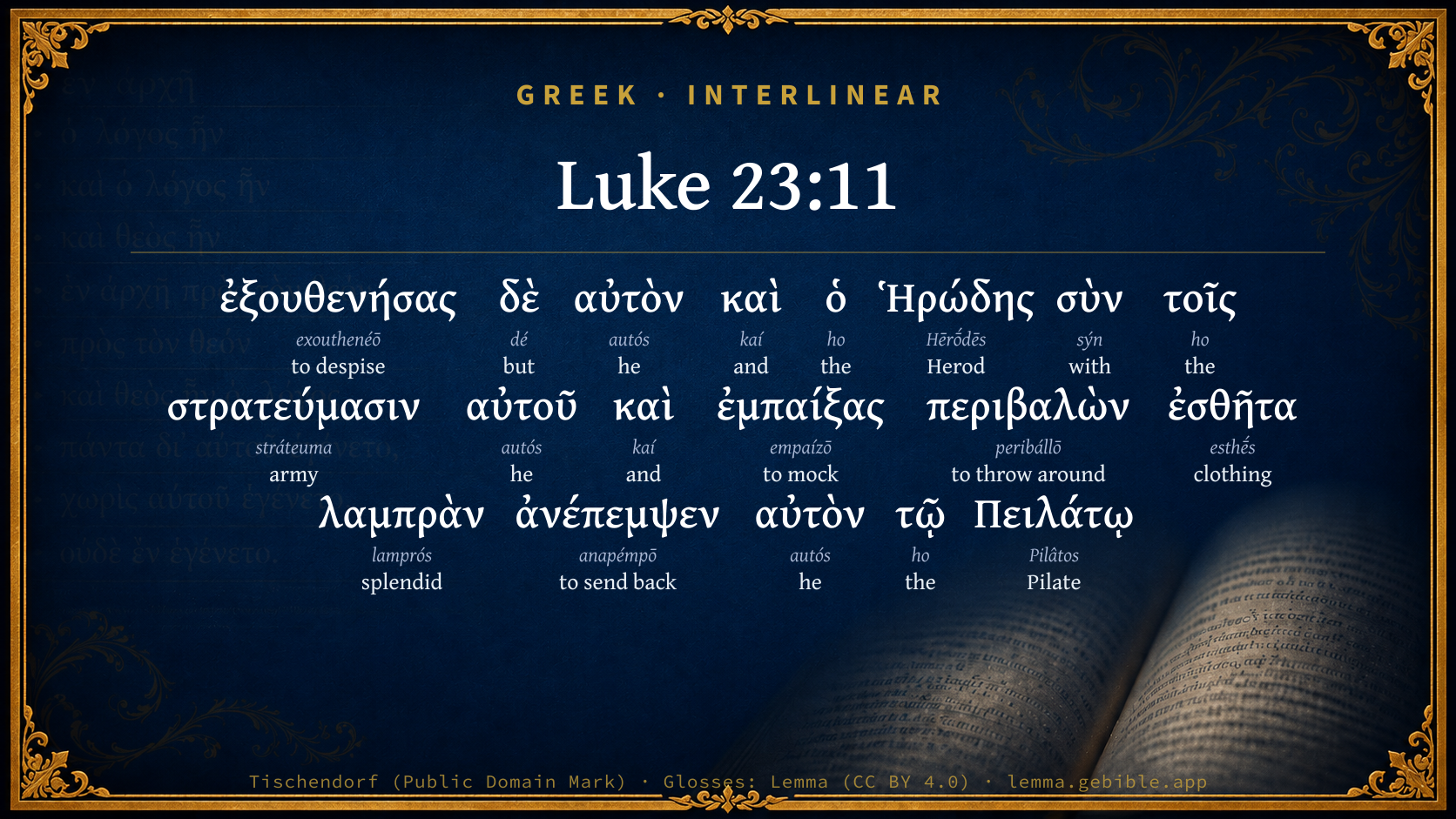
Download image
Cite this verse

Luke 23:11 (World English Bible). Public Domain. Lemma interlinear Bible study tool, https://lemma.gebible.app/v/luke/23/11.

Show BibTeX & RIS
BibTeX
RIS
English Translation
Herod with his soldiers humiliated him and mocked him. Dressing him in luxurious clothing, they sent him back to Pilate.
World English Bible · Public Domain
Highlights
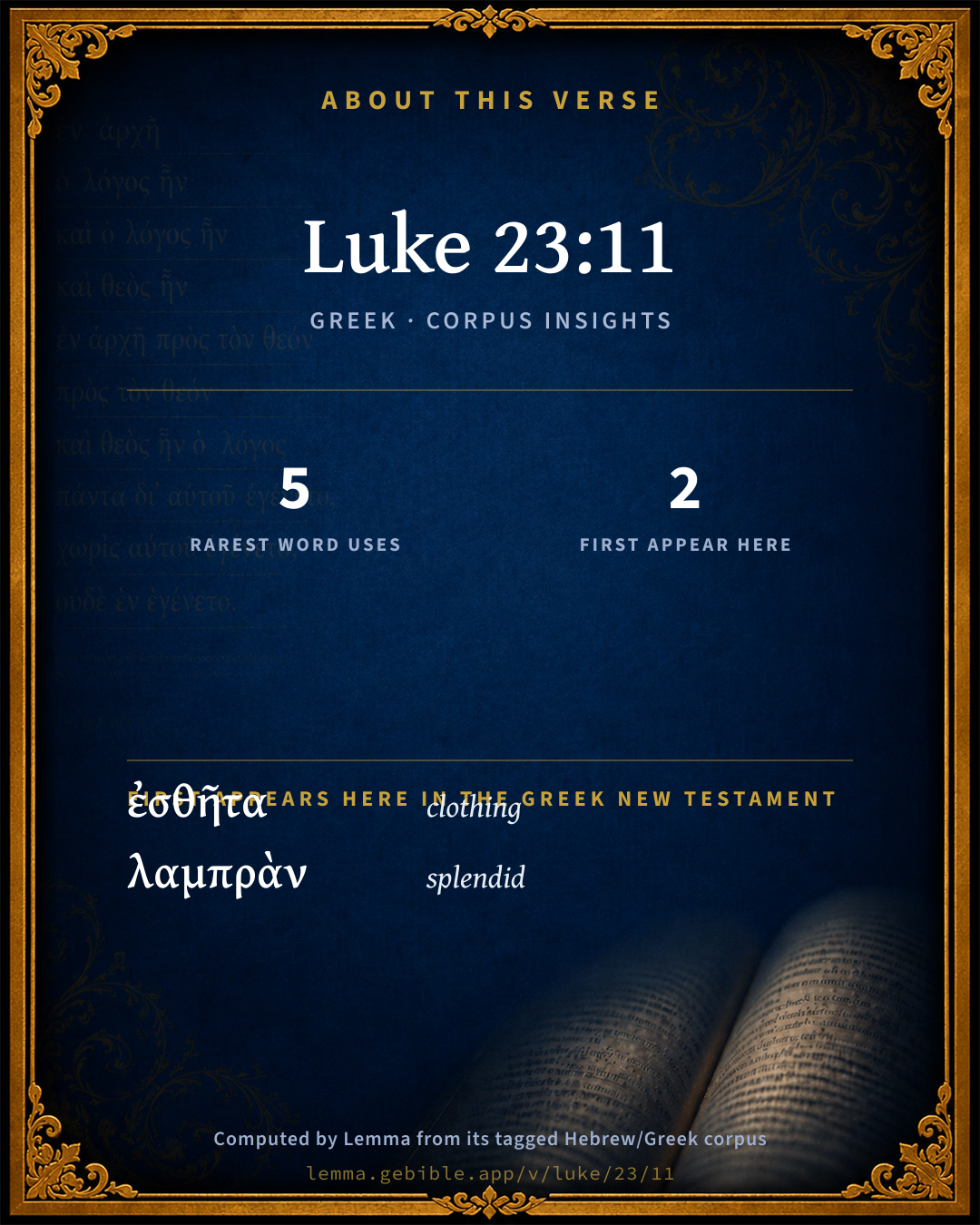
  • 2 first appearances in the Greek New Testament
Full analysis ↓
Download a study sheet

One document with this verse’s original text, its word-by-word gloss line, the meaning frame, cross-references with their text, attributed commentary, and full source and license credits — printable, and it pastes into notes with its structure intact.

This verse Autodidact and up

Study sheet (.html) Plain text (.txt)

A passage Seminary Student

Up to 50 verses in one chapter. A passage sheet keeps up to 6 commentary sources and 12 cross-references per verse, in the order this page ranks them, and says so on the sheet whenever that leaves anything out. Ask for a single verse and you get the Autodidact verse sheet above.

Everything on this page stays free to read, with no account — the sheet is a download of what is already on screen, not access to it.

Want to remove ads? Support Godless Engineer
Compare translations 3

The same verse in 3 English versions, stacked beneath the original-language interlinear above. Click any original word for its lexicon entry.

Each is an independent rendering of the whole verse — the interlinear is not word-aligned to these translations.

Highlighted words mark where these versions differ — a whole-verse word diff, not a word-by-word alignment.

  • World English Bible Public Domain
    Herod with his soldiers humiliated him and mocked him. Dressing him in luxurious clothing, they sent him back to Pilate.
  • King James Version Public Domain
    And Herod with his men of war set him at nought, and mocked him, and arrayed him in a gorgeous robe, and sent him again to Pilate.
  • unfoldingWord Literal Text CC BY-SA 4.0
    Then Herod, with his soldiers, also despised him and mocked. Having put elegant clothing around, he sent him back to Pilate.

unfoldingWord Literal Text — © unfoldingWord, licensed CC BY-SA 4.0. Word-aligned USFM3 via Door43 (git.door43.org/unfoldingWord/en_ult).

Versions to compare (up to 4)

3 of 4 selected

Show all 19 translations

Every available English version of this verse, each an independent rendering of the whole verse.

  • World English Bible Public Domain
    Herod with his soldiers humiliated him and mocked him. Dressing him in luxurious clothing, they sent him back to Pilate.
  • Berean Standard Bible Public Domain
    And even Herod and his soldiers ridiculed and mocked Him. Dressing Him in a fine robe, they sent Him back to Pilate.
  • Majority Standard Bible Public Domain
    And even Herod and his soldiers ridiculed and mocked Him. Dressing Him in a fine robe, they sent Him back to Pilate.
  • King James Version Public Domain
    And Herod with his men of war set him at nought, and mocked him, and arrayed him in a gorgeous robe, and sent him again to Pilate.
  • American Standard Version (1901) Public Domain
    And Herod with his soldiers set him at nought, and mocked him, and arraying him in gorgeous apparel sent him back to Pilate.
  • Revised Version (1885) Public Domain
    And Herod with his soldiers set him at nought, and mocked him, and arraying him in gorgeous apparel sent him back to Pilate.
  • Geneva Bible (1599) Public Domain
    And Herod with his men of warre, despised him, and mocked him, and arayed him in white, and sent him againe to Pilate.
  • Douay-Rheims (1899) Public Domain
    And Herod with his army set him at nought, and mocked him, putting on him a white garment, and sent him back to Pilate.
  • Young's Literal Translation Public Domain
    and Herod with his soldiers having set him at nought, and having mocked, having put around him gorgeous apparel, did send him back to Pilate,
  • Literal Standard Version CC BY-SA 4.0
    and Herod with his soldiers having set Him at nothing, and having mocked, having cast radiant apparel around Him, sent Him back to Pilate,
  • Unlocked Literal Bible CC BY-SA 4.0
    Herod with his soldiers insulted Jesus and they mocked him. Then they dressed him in elegant clothes and sent him back to Pilate.
  • unfoldingWord Literal Text CC BY-SA 4.0
    Then Herod, with his soldiers, also despised him and mocked. Having put elegant clothing around, he sent him back to Pilate.
  • Darby Bible Public Domain
    And Herod with his troops having set him at nought and mocked him, having put a splendid robe upon him, sent him back to Pilate.
  • World Messianic Bible Public Domain
    Herod with his soldiers humiliated him and mocked him. Dressing him in luxurious clothing, they sent him back to Pilate.
  • Webster's Bible Public Domain
    And Herod with his troops set him at naught, and mocked him, and arrayed him in a gorgeous robe, and sent him again to Pilate.
  • Free Bible Version CC BY-SA 4.0
    Herod and his soldiers treated Jesus with contempt and mocked him. Then they placed a royal robe on him and sent him back to Pilate.
  • Bible in Basic English Public Domain
    And Herod, with the men of his army, put shame on him and made sport of him, and dressing him in shining robes, he sent him back to Pilate.
  • Text-Critical English NT CC BY 4.0
    Herod also treated him with contempt and mocked him, as did his soldiers. Then, after dressing Jesus in fine clothing, Herod sent him back to Pilate.
  • Tyndale New Testament (1534) Public Domain
    And Herod with his men of warre despysed him and mocked him and arayed him in whyte and sent him agayne to Pylate.

Literal Standard Version (2020), Covenant Press — licensed CC BY-SA 4.0. Text via the HelloAO Bible API (eBible.org). Unlocked Literal Bible (unfoldingWord) — licensed CC BY-SA 4.0. Text via the HelloAO Bible API (eBible.org). unfoldingWord Literal Text — © unfoldingWord, licensed CC BY-SA 4.0. Word-aligned USFM3 via Door43 (git.door43.org/unfoldingWord/en_ult). Free Bible Version, Dr. Jonathan Gallagher — licensed CC BY-SA 4.0. Text via the HelloAO Bible API (eBible.org).

Word by word

More ways to search: Search by grammar → Find every occurrence → Compare this word →

Practice this passage: Drill this verse → Learn its vocabulary →

ἀνέπεμψεν
anapémpō
G375
“to send back”
Verb, Aorist, Active, Indicative, 3rd person, Singular
Part of Speech
Verb
Tense
Aorist
Voice
Active
Mood
Indicative
Person
3rd person
Number
Singular
Full Thayer's Definition

Origin: from G303 and G3992

TDNT: None

1. to send up a. to a higher place b. to a person higher in office, authority, or power 2. to send back
  1. ἐξουθενήσας exouthenéō G1848 “to despise” Verb, Aorist, Active, Participle, Nominative, Singular, Masculine
  2. δὲ dé G1161 “but” Conjunction
  3. αὐτὸν autós G846 “he” Personal pronoun, Accusative, Singular, Masculine
  4. καὶ kaí G2532 “and” Conjunction
  5. ὁ ho G3588 “the” Article, Nominative, Singular, Masculine
  6. Ἡρώδης Hērṓdēs G2264 “Herod” Noun, Nominative, Singular, Masculine
  7. σὺν sýn G4862 “with” Preposition
  8. τοῖς ho G3588 “the” Article, Dative, Plural, Neuter
  9. στρατεύμασιν stráteuma G4753 “army” Noun, Dative, Plural, Neuter
  10. αὐτοῦ autós G846 “he” Personal pronoun, Genitive, Singular, Masculine
  11. καὶ kaí G2532 “and” Conjunction
  12. ἐμπαίξας empaízō G1702 “to mock” Verb, Aorist, Active, Participle, Nominative, Singular, Masculine
  13. περιβαλὼν peribállō G4016 “to throw around” Verb, Aorist, Active, Participle, Nominative, Singular, Masculine
  14. ἐσθῆτα esthḗs G2066 “clothing” Noun, Accusative, Singular, Feminine
  15. λαμπρὰν lamprós G2986 “splendid” Adjective, Accusative, Singular, Feminine
  16. αὐτὸν autós G846 “he” Personal pronoun, Accusative, Singular, Masculine
  17. τῷ ho G3588 “the” Article, Dative, Singular, Masculine
  18. Πειλάτῳ Pilâtos G4091 “Pilate” Noun, Dative, Singular, Masculine

About this verse

These counts appear in no published source. They are computed here, from the morphology-tagged text and Lemma’s own curated glosses. What Lemma adds →

19
words
14
distinct lemmas
Gospels
section

Notable vocabulary

The rarest word here is ἀνέπεμψεν to send back G375 — appearing just 5 times in the whole Greek New Testament.

First appearance in Scripture

These words make their first canonical appearance in the Greek New Testament here:

  • ἐσθῆτα clothing G2066
  • λαμπρὰν splendid G2986

Shared distinctive vocabulary

ἀνέπεμψεν to send back G375 occurs in 5 verses of the Greek New Testament. Also found in:
Repetition

Words recur within this verse:

Cross-references

6

Topical passages linked to Luke 23:11 in the Treasury of Scripture Knowledge — connected by theme and wording, ordered by reader-vote popularity; previews shown in the World English Bible.

  • Mark 15:16–20 The soldiers led him away within the court, which is the Praetorium; and they called together the whole cohort.
  • Matthew 27:27–30 Then the governor's soldiers took Jesus into the Praetorium, and gathered the whole garrison together against him.
  • Psalms 69:19–20 You know my reproach, my shame, and my dishonor. My adversaries are all before you.
  • Isaiah 53:3 He was despised, and rejected by men; a man of suffering, and acquainted with disease: and as one from whom men hide their face he was despised; and we didn't respect him.
  • Mark 9:12 He said to them, "Elijah indeed comes first, and restores all things. How is it written about the Son of Man, that he should suffer many things and be despised?
  • John 19:5 Jesus therefore came out, wearing the crown of thorns and the purple garment. Pilate said to them, "Behold, the man!"

Cross-references courtesy of OpenBible.info (CC BY 4.0).

Commentary

Notes on Luke 23:11 from classic Christian and Jewish commentators (each source and its license shown beneath its notes). The classic Christian expositions comment on the surrounding passage and are grouped to its opening verse, so a note may address several verses; the Jewish commentaries on the Tanakh (Rashi and others) are per-verse, so they appear only where the commentator wrote on this verse.

Lemma curates 59 commentaries, every one of them public domain or Creative Commons licensed, each selected and text-cleaned for this edition rather than reprinted as found. About our sources →

Bengel's Gnomon

Johann Albrecht Bengel

Luk 23:11. Ἐξουθενήσας, having set at nought) He did not think Jesus of sufficient importance to give himself any trouble about Him, as respects the allegations, whatever they might be, which the priests were making. He thought at the time that he had stripped Jesus of His wisdom and of His power.—ἐσθῆτα λαμπρὰν, a gorgeous robe) A royal vestment. [Such as he himself may be supposed either to have worn, or to have wished to wear.—V. g.] Herod seems to have meant contemptuously to indicate that he has no fears from such a king as this. But in reality he honoured Him unconsciously by the robe, as Pilate did by the inscription on the cross. [The elder Herod gave way to fears sooner than there was just reason for: this Herod, on the other hand, when the kingdom of Christ was now more immediately imminent, gives way to careless security. Such is the perverse way of the world.—V. g.]—ἀνέπεμψεν, sent Him back) He had it in his power, and ought to have rather let Him go free. [Therefore in sending back the innocent to Pilate, he involved himself in the guilt of Pilate. Act 4:27 (“Against thy holy child Jesus—both Herod and Pontius Pilate—were gathered together”).—Harm., p. 548].

Bengel's Gnomon of the New Testament — English translation (T&T Clark, Edinburgh, 1860) — public domain. Text from a community e-Sword module.

Expositor's Greek Testament

ed. W. Robertson Nicoll

Luk 23:11 . ἐξουθενήσας : on this verb and kindred forms, vide at Mar 9:12 . Herod, feeling slighted by Jesus, slights Him in turn, inciting his bodyguards ( τοῖς στρατεύμασιν , which cannot here mean armies) to mock Him, and having Him invested with a costly robe, probably a cast-off royal mantle of his own, and so sending Him back a mock king to Pilate, a man to be laughed at, not to be feared or punished. ἐσθῆτα λαμπρὰν , a splendid robe; of what colour, purple or white, commentators vainly inquire. ἀνέπεμψεν , “sent Him again” (A.V [194] ), or “back” (R.V [195] ). The verb may mean here, as in Luk 23:7 , sent Him to Pilate as the proper person to try the case. The two magnates compliment each other, and shirk unpleasant work by sending Jesus hither and thither from tribunal to tribunal, the plaything and sport of unprincipled men.

[194] Authorised Version.

[195] Revised Version.

The Expositor's Greek Testament, edited by W. Robertson Nicoll (1897–1910) — public domain. Text from a community e-Sword module.

Geneva Bible (1599)

Geneva Bible translators

Accompanied with his nobles and soldiers which followed him from Galilee.

Geneva Bible (1599) marginal notes — public domain. Text via Bolls.life.

Jamieson, Fausset & Brown

Robert Jamieson, A. R. Fausset & David Brown

his men of war--his bodyguard.

set him at naught, &c.--stung with disappointment at His refusal to amuse him with miracles or answer any of his questions.

gorgeous robe--bright robe. If this mean (as sometimes) of shining white, this being the royal color among the Jews, it may have been in derision of His claim to be "King of the Jews." But if so, "He in reality honored Him, as did Pilate with His true title blazoned on the cross" [BENGEL].

sent him again to Pilate--instead of releasing him as he ought, having established nothing against Him (Luk 23:14-15). "Thus he implicated himself with Pilate in all the guilt of His condemnation, and with him accordingly he is classed" (Act 4:27) [BENGEL].

at enmity--perhaps about some point of disputed jurisdiction, which this exchange of the Prisoner might tend to heal.

Jamieson, Fausset & Brown — Commentary Critical and Explanatory on the Whole Bible (1871) — public domain (CC PDM 1.0). Text via the HelloAO Bible API.

Adam Clarke's Commentary

Verse 11. A gorgeous robe] εσθητα λαμπραν. It probably means a white robe, for it was the custom of the Jewish nobility to wear such. Hence, in Re 3:4, it is said of the saints, They shall walk with me in WHITE (garments,) because they are WORTHY. In such a robe, Herod, by way of mockery, caused our Lord to be clothed; but, the nobility among the Romans wearing purple for the most part, Pilate's soldiers, who were Romans, put on Jesus a purple robe, Mr 15:17; Joh 19:2; both of them following the custom of their own country, when, by way of mocking our Lord as a king, they clothed him in robes of state. See Bishop PEARCE.

Adam Clarke's Commentary on the Bible (1810–1826) — public domain. Text from a community e-Sword/MySword module.

Ellicott's Commentary for English Readers

(11) Herod with his men of war.—Better, perhaps, troops, or soldiers. The word is the same as that translated “armies” in Mat_22:7, Act_23:27; “soldiers” in Act_23:10.

Arrayed him in a gorgeous robe.—Literally, bright. The word is used of the angel’s garment, in Act_10:30; of fine linen, in Rev_15:6; Rev_18:4; of crystal, in Rev_22:1; of a star, in Rev_22:16. It may have been such as Josephus describes Herod Agrippa as wearing, in the incident which he records (Ant. xix. 8, § 4) in common with Act_12:21—a robe of white tissue of some kind richly embroidered with silver. We may, perhaps, venture to trace in the outrage, a vindictive retaliation for the words which the Prophet had once spoken of those who were “gorgeously apparelled.” (See Notes on Mat_11:8; Luk_7:25.)

A Bible Commentary for English Readers, edited by Charles John Ellicott (1878–1897) — public domain. Text from a community e-Sword module.

The Cambridge Bible for Schools and Colleges

gen. ed. J. J. S. Perowne

11. with his men of war] Literally, “with his armies f i.e. with his soldiers.

set him at nought] treating Him not as a criminal, but only as a person worthy of contempt. “He is despised and rejected of men;” “he was despised and we esteemed him not,” Isa_53:3.

in a gorgeous robe] Literally, “bright raiment,” Act_10:30. Probably a white festal garment.

sent him again] anepempsen as before—remisit in forum apprchensionis. This involved a second distinct acquittal of our Lord from every political charge brought against Him. Had He in any way been guilty of either (r) perverting the people, (2) forbidding to pay tribute, or (3) claiming to be a king, it would have been Herod’s duty, and still more his interest, to punish Him. His dismissal of the case was a deliberate avowal of His innocence.

The Cambridge Bible for Schools and Colleges (gen. ed. J. J. S. Perowne; Cambridge University Press, 1878–1918) — public domain. Text from a community e-Sword module.

John Gill's Exposition

And Herod, with his men of war,.... Or his soldiers, his bodyguards that attended his person, who came with him from Galilee, and were both for his security and service, and for his pomp and magnificence:

set him at nought; made nothing of him; had him in no account; treated him as a silly, and contemptible creature, that could not do any thing that was reported of him; nor able to say any thing for himself; but took him to be a mere fool and idiot; and so they used him:

and mocked him; as a king, and made sport and pastime with him:

and arrayed him in a gorgeous robe. The Vulgate Latin renders it, "a white robe"; a token of his innocence, though not so designed by them, but rather by way of derision, as a symbol of his simplicity and folly. The Syriac version renders it, "scarlet"; and the Arabic and Persic versions, "red". It is very likely that it was an old worn-out robe of one of the officers, or soldiers, which they put on him; in contempt of his being a king, as the Roman soldiers afterwards did, upon the same account:

and sent him again to Pilate; uncondemned, not knowing what to make of him, or the charge against him, and he might be unwilling to have any hand in his death, not having forgotten the case of John the Baptist; and therefore remits him to Pilate, to do as he thought fit with him.

John Gill's Exposition of the Whole Bible (1746–1763) — public domain (CC PDM 1.0). Text via the HelloAO Bible API.

Trapp's Complete Commentary

John Trapp

11 And Herod with his men of war set him at nought, and mocked him, and arrayed him in a gorgeous robe, and sent him again to Pilate.

Ver. 11. Set him at nought] Gr. εξουθενησας, made nobody of him.

Arrayed him in a gorgeous robe] Or a white robe, as the old interpreter hath it, λαμπραν. Pilate’s soldiers clad our Saviour in purple (a colour more affected by the Romans), Herod in white, as more affected by the Jewish nobility.

Mocked him] Gr. εμπαιξας, handled him like a boy, or made a baby of him, made sport with him.

John Trapp, A Commentary or Exposition upon All the Books of the Old and New Testament (1647–1656) — public domain. Text from a community e-Sword module.

Albert Barnes' Notes on the Bible

Herod with his men of war - With his soldiers, or his body-guard. It is probable that in traveling he had “a guard” to attend him constantly.

Set him at nought - Treated him with contempt and ridicule.

A gorgeous robe - A white or shining robe, for this is the meaning of the original. The Roman princes wore “purple” robes, and “Pilate,” therefore, put such a robe on Jesus. The Jewish kings wore a “white” robe, which was often rendered very shining or gorgeous by much tinsel or silver interwoven. Josephus says that the robe which Agrippa wore was so bright with silver that when the sun shone on it, it so dazzled the eyes that it was difficult to look on it. The Jews and Romans, therefore, decked him in the manner appropriate to their own country, for purposes of mockery. All this was unlawful and malicious, as there was not the least evidence of his guilt.

Sent him to Pilate - It was by the interchange of these civilities that they were made friends. It would seem that Pilate sent him to Herod as a token of civility and respect, and with a design, perhaps, of putting an end to their quarrel. Herod returned the civility, and it resulted in their reconciliation.

Albert Barnes' Notes on the Bible (1834–1885) — public domain. Text from a community e-Sword/MySword module.

Haydock's Catholic Bible Commentary

And mocked him. It is evident from the behaviour of Herod on this occasion, that he was far from believing him to be that seditious person he was represented; otherwise he would have undoubtedly treated his prisoner with less ridicule, and paid more serious attention to the accusations of his enemies. (Theophylactus) --- Putting on him a white garment. The Greek signifies not only a white, but a shining splendid robe: perhaps with some resemblance to royal garments, but at the same time through scorn and derision. (Witham)

George Leo Haydock (1774–1849), Haydock's Catholic Family Bible and Commentary, 1859 edition — public domain. Excludes Psalms (Douay-Rheims chapter numbering differs from Protestant) and Deuterocanonical books (Catholic canon only).

Whedon's Commentary on the Bible

Daniel D. Whedon

11. Set him at nought—Treated him as an impostor and a nothing. In so doing Herod gratified both his own disappointment and the malice of the Jews.

In a gorgeous robe—Clearly, as a mock symbol of his royalty; this was the purple; and probably that same robe which was afterwards used by the soldiers of Pilate.

Daniel D. Whedon (gen. ed.), Commentary on the Old and New Testaments (1874–1909) — public domain. Text from a community e-Sword module.

The Pulpit Commentary

And Herod with his men of war set him at nought, and mocked him, and arrayed him in a gorgeous robe, and sent him again to Pilate. He treated him, not as a criminal, but as a mischievous religious Enthusiast, worthy only of contempt and scorn. The "gorgeous robe," more accurately, "bright raiment," was a white festal mantle such as Jewish kings and Roman nobles wore on great occasions. It was probably an old robe of white tissue of some kind, embroidered with silver. Dean Plumptre suggests that we might venture to trace in this outrage a vindictive retaliation for the words which the Teacher had once spoken with evident allusion to Herod"s court of those who were gorgeously appareled. (Luk_7:25) It was this Herod of whom the Lord had spoken so recently with for him a rare bitterness, "Go ye, and tell that fox literally, "she-fox Herod". (Luk_13:32)

The Pulpit Commentary (1880–1919), ed. H.D.M. Spence-Jones & Joseph S. Exell — public domain. Text from a community e-Sword module.

John Wesley's Explanatory Notes

Herod set him at nought - Probably judging him to be a fool, because he answered nothing. In a splendid robe - In royal apparel; intimating that he feared nothing from this king.

John Wesley, Explanatory Notes Upon the Whole Bible (1754–1765) — public domain. Text via the GEBible commentary corpus.

unfoldingWord translationNotes

Door43 World Missions Community

Herod with his soldiers

"Herod and his soldiers"

dressed him in elegant clothes

"put beautiful clothes on him." The translation should not imply that this was done to honor or care for Jesus. They did it to mock Jesus and to make fun of him.

Herod and Pilate had become friends with each other that very day

The implied information is that they became friends because Herod appreciated Pilate allowing him to judge Jesus. AT: "Herod and Pilate became friends with each other that very day because Pilate had sent Jesus to Herod for judgment" (See: Assumed Knowledge and Implicit Information)

before this they had been enemies with each other

This information is enclosed in parentheses to show that it is background information. Use a format that your audience would understand. (See: Background Information)

translationWords

soldier

mock

Pilate

adversary

unfoldingWord translationNotes — © Distant Shores Media and the Door43 World Missions Community, licensed CC BY-SA 4.0. Source: git.door43.org/Door43/en_tn.

Cambridge Greek Testament for Schools and Colleges

11. ἐξουθενήσας. Treating Him not as a criminal, but only as a person worthy of contempt. Isa 53:3.

σὺν τοῖς στρατεύμασιν αὐτοῦ. “With his armies,” i.e. with his soldiers.

ἐσθῆτα λαμπράν. Literally, “bright raiment,” Act 10:30. Probably a white festal garment. Vulg[401] veste albâ.

[401] Vulg. Vulgate.

ἀνέπεμψεν. As before—remisit in forum apprehensionis. This involved a second distinct acquittal of our Lord from every political charge brought against Him. Had He in any way been guilty of either (1) perverting the people, (2) forbidding to pay tribute, or (3) claiming to be a king, it would have been Herod’s duty, and still more his interest, to punish Him. His dismissal of the case was a deliberate avowal of His innocence.

Cambridge Greek Testament for Schools and Colleges (Cambridge University Press, 1896; 21 vols, various authors incl. Carr, Maclear, Plummer, Farrar, Lumby, Moule, M. R. James, Simcox) — public domain. Text from a community e-Sword module.

Alford’s Greek Testament

Henry Alford

11.] στρατ. are the bodyguard in attendance upon Herod.

ἐσθῆτα λαμπρ.] Variously interpreted:—either purple, as befitting a king,—and why should this not be the very χλαμὺς κοκκίνη afterwards used by Pilate’s soldiers (Mat 27:28; ἱμάτιον πορφυροῦν, Joh 19:2)?—or white, as λαμπρ. is rendered by some (but see note), Act 10:30.

Henry Alford, The Greek Testament (1849–1861) — public domain. Text from a community e-Sword module.

International Critical Commentary

11. ἐξουθενήσας … ἐμπαίξας. These participles are put first in their clauses with emphasis. Herod’s baffled curiosity takes this despicable revenge: comp. 18:9; Gal 4:14. We need not suppose that Antipas formally pronounced Him innocent, but that he did not condemn Him to death. He evaded the responsibility, as Pilate tried to do. In the Gospel of Peter Herod sentences the Lord; and when “Joseph, the friend of Pilate and of the Lord,” asks Pilate before the crucifixion for the Lord’s body, Pilate sends to ask Herod for it. The chief guilt throughout is transferred from Pilate to Herod and the Jews.

σὺν τοῖς στρατεύμασιν. Probably a guard of honour: cum militibus suis (f). It was one of these perhaps that he had sent to behead John in the prison (Mar 6:27; Mat 14:10). It was fitting that the prince who had murdered the Baptist should mock the Christ.

ἐμπαίξας. He treats Him as a crazy enthusiast, and gives a mock assent to His claim to be a king, which the scribes no doubt reported. Latin texts have irrisit (c), inludens (d), deludens (r), delusum (a), inlusit (Vulg.).

ἐσθῆτα λαμπράν. “A bright robe,” splendidum (c), rather than “a white robe,” candida (a), alba (f Vulg.). That it was a toga candida to mark Him as a candidate for royalty, is not likely: it was to mark Him as already king. The epithet does not indicate its colour, but its “gorgeous” character: comp. Jas 2:2, Jas 2:3. In Act 10:30 it is used of angelic apparel. Elsewhere in N.T. ἐσθής occurs only 24:4; Act 1:10, Act 12:21: comp. 2 Mac. 8:35, 11:8.

International Critical Commentary — older volumes (1896–1929), various authors — public domain. Text from a community e-Sword module.

Vincent's Word Studies in the New Testament

Marvin R. Vincent

Gorgeous [λαμπραν] . Lit., bright or brilliant. Compare Act 10:30; Rev 14:6. Wyc. and Tynd., white. Mark has purple (porfuran), and Matthew scarlet [κοκκινην] .

Apparel [εδθητα] . The general term for raiment. Matthew specifies the garment (xxvii. 28). Mark has simply purple (xv. 17).

13 - 25. Compare Mt 27:15 - 26; Mr 14:6 - 15.

Marvin R. Vincent, Word Studies in the New Testament (1887–1900) — public domain. Text from a community e-Sword/MySword module.

Lesson kit

Teaching starters — assembled from the data on this page, not authored interpretation. Every prompt links to the verse data it draws on. Edit before teaching.

Luke, in the Gospels, opens this verse with 19 words (14 distinct Greek lemmas). Its most distinctive word is anapémpō (“to send back”). A historical commentator’s framing appears above. Read the whole chapter for the surrounding context.

Discussion questions

  1. The word anapémpō carries the sense “to send back.” How does it shape the verse?
  2. 2 words here appear for the first time in Scripture. What is being introduced at this debut?
  3. Luke 23:7 shares the word «to send back» with this verse. How do the two illuminate each other?
  4. “he” occurs 3× in this one verse. What is the effect of the repetition?
  5. These translations render this verse differently. What is at stake in choosing one wording over another?
  6. Reading how Bengel's Gnomon and Expositor's Greek Testament read this verse, where do the two commentators agree and where do they part?

Things to notice

  • 2 words make their first canonical appearance in Scripture here.
  • These translations choose different wording for 20 words in this verse.
  • “he” occurs 3× in this single verse.
  • 14 distinct Greek lemmas span 19 words in this verse.

Reading settings

Reading text

Shown beneath each verse's original-language words.

Old Testament
Old Testament edition

Read the OT as the Masoretic Hebrew (MT) or the Greek Septuagint (LXX).

English shown for the Greek Septuagint (in the Hebrew ↔ Greek comparison).

Comparing translations? Open the Compare panel on any verse page to stack up to four side by side.