

Luke 19:37
Greek (Tischendorf 8th ed.) Luke 19:37 appears in the Greek New Testament. The text above is from the Tischendorf 8th edition. Each word links to its Strong’s number and a concise gloss. Click any word for its full Thayer’s Greek Lexicon entry.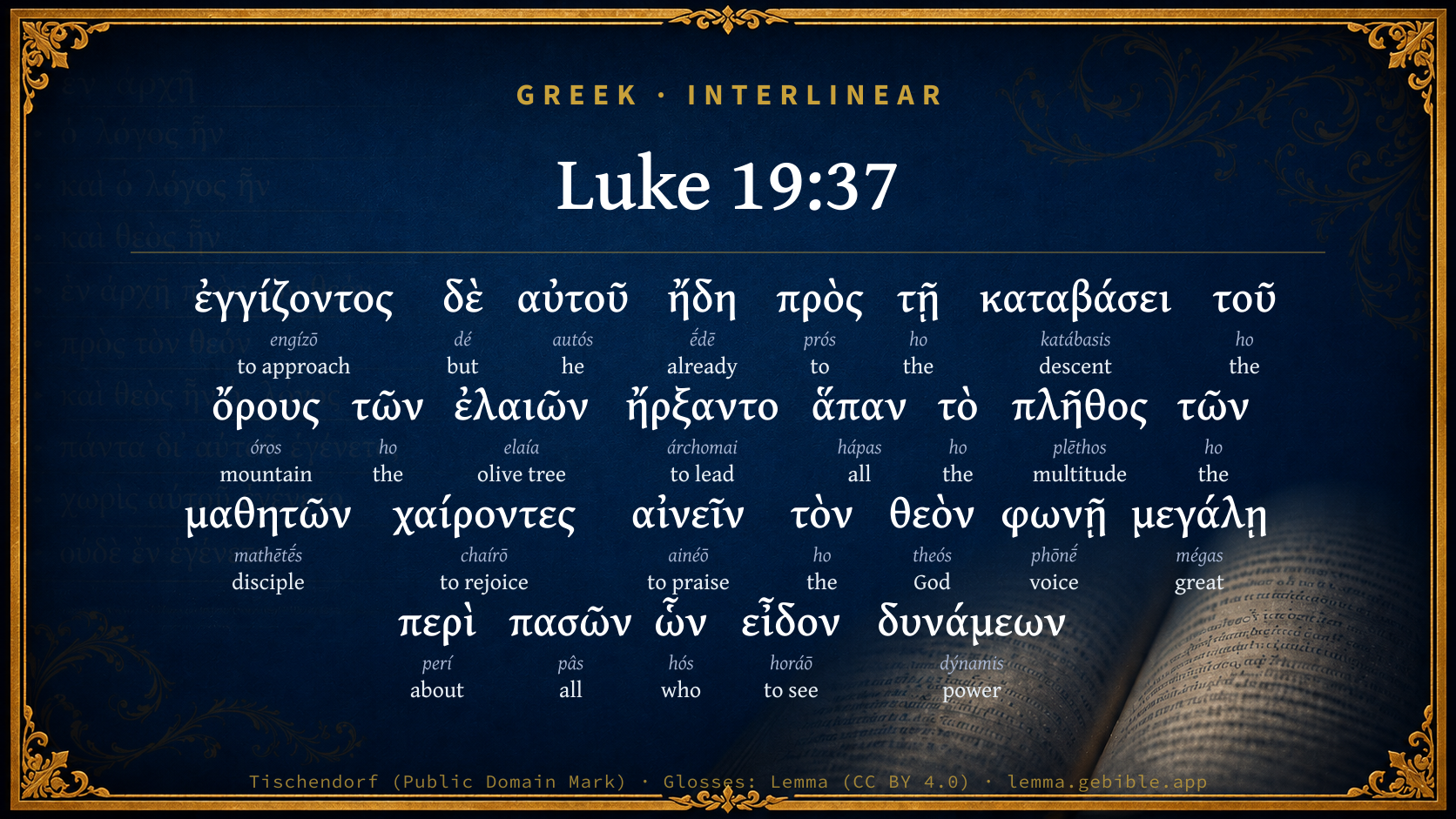
As he was now getting near, at the descent of the Mount of Olives, the whole multitude of the disciples began to rejoice and praise God with a loud voice for all the mighty works which they had seen,
- 1 hapax legomenon — only here in the Greek New Testament
- 1 first appearance in the Greek New Testament
Download a study sheet
One document with this verse’s original text, its word-by-word gloss line, the meaning frame, cross-references with their text, attributed commentary, and full source and license credits — printable, and it pastes into notes with its structure intact.
This verse Autodidact and up
A passage Seminary Student
Up to 50 verses in one chapter. A passage sheet keeps up to 6 commentary sources and 12 cross-references per verse, in the order this page ranks them, and says so on the sheet whenever that leaves anything out. Ask for a single verse and you get the Autodidact verse sheet above.
Everything on this page stays free to read, with no account — the sheet is a download of what is already on screen, not access to it.
Compare translations 3
The same verse in 3 English versions, stacked beneath the original-language interlinear above. Click any original word for its lexicon entry.
Each is an independent rendering of the whole verse — the interlinear is not word-aligned to these translations.
Highlighted words mark where these versions differ — a whole-verse word diff, not a word-by-word alignment.
-
World English Bible Public Domain
As he was now getting near, at the descent of the Mount of Olives, the whole multitude of the disciples began to rejoice and praise God with a loud voice for all the mighty works which they had seen,
-
King James Version Public Domain
And when he was come nigh, even now at the descent of the mount of Olives, the whole multitude of the disciples began to rejoice and praise God with a loud voice for all the mighty works that they had seen;
-
unfoldingWord Literal Text CC BY-SA 4.0
And he was already coming near to the descent of the Mount of Olives, the whole multitude of the disciples began to rejoice praise God with a loud voice concerning all of the mighty works that they had seen,
unfoldingWord Literal Text — © unfoldingWord, licensed CC BY-SA 4.0. Word-aligned USFM3 via Door43 (git.door43.org/unfoldingWord/en_ult).
Show all 19 translations
Every available English version of this verse, each an independent rendering of the whole verse.
-
World English Bible Public Domain
As he was now getting near, at the descent of the Mount of Olives, the whole multitude of the disciples began to rejoice and praise God with a loud voice for all the mighty works which they had seen,
-
Berean Standard Bible Public Domain
And as He approached the descent from the Mount of Olives, the whole multitude of disciples began to praise God joyfully in a loud voice for all the miracles they had seen:
-
Majority Standard Bible Public Domain
And as He approached the descent from the Mount of Olives, the whole multitude of disciples began to praise God joyfully in a loud voice for all the miracles they had seen:
-
King James Version Public Domain
And when he was come nigh, even now at the descent of the mount of Olives, the whole multitude of the disciples began to rejoice and praise God with a loud voice for all the mighty works that they had seen;
-
American Standard Version (1901) Public Domain
And as he was now drawing nigh, `even' at the descent of the mount of Olives, the whole multitude of the disciples began to rejoice and praise God with a loud voice for all the mighty works which they had seen;
-
Revised Version (1885) Public Domain
And as he was now drawing nigh, even at the descent of the mount of Olives, the whole multitude of the disciples began to rejoice and praise God with a loud voice for all the mighty works which they had seen;
-
Geneva Bible (1599) Public Domain
And when he was nowe come neere to the going downe of the mount of Oliues, the whole multitude of the disciples began to reioyce, and to prayse God with a loude voyce, for all the great workes that they had seene,
-
Douay-Rheims (1899) Public Domain
And when he was now coming near the descent of mount Olivet, the whole multitude of his disciples began with joy to praise God with a loud voice, for all the mighty works they had seen,
-
Young's Literal Translation Public Domain
and as he is coming nigh now, at the descent of the mount of the Olives, the whole multitude of the disciples began rejoicing to praise God with a great voice for all the mighty works they had seen,
-
Literal Standard Version CC BY-SA 4.0
and as He is coming near now, at the descent of the Mount of Olives, the whole multitude of the disciples began rejoicing to praise God with a great voice for all the mighty works they had seen,
-
Unlocked Literal Bible CC BY-SA 4.0
As he was now approaching the place where the Mount of Olives descends, the whole multitude of the disciples began to rejoice and praise God with a loud voice for all the mighty works which they had seen,
-
unfoldingWord Literal Text CC BY-SA 4.0
And he was already coming near to the descent of the Mount of Olives, the whole multitude of the disciples began to rejoice praise God with a loud voice concerning all of the mighty works that they had seen,
-
Darby Bible Public Domain
And as he drew near, already at the descent of the mount of Olives, all the multitude of the disciples began, rejoicing, to praise God with a loud voice for all the works of power which they had seen,
-
World Messianic Bible Public Domain
As he was now getting near, at the descent of the Mount of Olives, the whole multitude of the disciples began to rejoice and praise God with a loud voice for all the mighty works which they had seen,
-
Webster's Bible Public Domain
And when he had come nigh, even now at the descent of the mount of Olives, the whole multitude of the disciples began to rejoice and praise God with a loud voice, for all the mighty works that they had seen.
-
Free Bible Version CC BY-SA 4.0
As he approached Jerusalem, right where the road goes down from the Mount of Olives, the crowd of disciples all began shouting joyful praises to God at the top of their voices for all the miracles they had seen.
-
Bible in Basic English Public Domain
And when he came near the foot of the Mountain of Olives, all the disciples with loud voices gave praise to God with joy, because of all the great works which they had seen;
-
Text-Critical English NT CC BY 4.0
And as he drew near to the descent of the Mount of Olives, the whole multitude of the disciples began to praise God joyfully with a loud voice for all the miracles they had seen,
-
Tyndale New Testament (1534) Public Domain
And when he was now come wheare he shuld goo doune from the moute olivete the whole multitude of the disciples began to reioyce and to lawde God with a loude voyce for all the miracles that they had sene
Literal Standard Version (2020), Covenant Press — licensed CC BY-SA 4.0. Text via the HelloAO Bible API (eBible.org). Unlocked Literal Bible (unfoldingWord) — licensed CC BY-SA 4.0. Text via the HelloAO Bible API (eBible.org). unfoldingWord Literal Text — © unfoldingWord, licensed CC BY-SA 4.0. Word-aligned USFM3 via Door43 (git.door43.org/unfoldingWord/en_ult). Free Bible Version, Dr. Jonathan Gallagher — licensed CC BY-SA 4.0. Text via the HelloAO Bible API (eBible.org).
Word by word
More ways to search: Search by grammar → Find every occurrence → Compare this word →
Practice this passage: Drill this verse → Learn its vocabulary →
- Appears 1× in the Greek New Testament
- First appears here
- Part of Speech
- Noun
- Case
- Dative
- Number
- Singular
- Gender
- Feminine
Full Thayer's Definition
- ἐγγίζοντος engízō G1448 “to approach” Verb, Present, Active, Participle, Genitive, Singular, Masculine
- δὲ dé G1161 “but” Conjunction
- αὐτοῦ autós G846 “he” Personal pronoun, Genitive, Singular, Masculine
- ἤδη ḗdē G2235 “already” Adverb
- πρὸς prós G4314 “to” Preposition
- τῇ ho G3588 “the” Article, Dative, Singular, Feminine
- καταβάσει katábasis G2600 “descent” Noun, Dative, Singular, Feminine
- τοῦ ho G3588 “the” Article, Genitive, Singular, Neuter
- ὄρους óros G3735 “mountain” Noun, Genitive, Singular, Neuter
- τῶν ho G3588 “the” Article, Genitive, Plural, Feminine
- ἐλαιῶν elaía G1636 “olive tree” Noun, Genitive, Plural, Feminine
- ἤρξαντο árchomai G756 “to lead” Verb, Aorist, Middle deponent, Indicative, 3rd person, Plural
- ἅπαν hápas G537 “all” Adjective, Nominative, Singular, Neuter
- τὸ ho G3588 “the” Article, Nominative, Singular, Neuter
- πλῆθος plēthos G4128 “multitude” Noun, Nominative, Singular, Neuter
- τῶν ho G3588 “the” Article, Genitive, Plural, Masculine
- μαθητῶν mathētḗs G3101 “disciple” Noun, Genitive, Plural, Masculine
- χαίροντες chaírō G5463 “to rejoice” Verb, Present, Active, Participle, Nominative, Plural, Masculine
- αἰνεῖν ainéō G134 “to praise” Verb, Present, Active, Infinitive
- τὸν ho G3588 “the” Article, Accusative, Singular, Masculine
- θεὸν theós G2316 “God” Noun, Accusative, Singular, Masculine
- φωνῇ phōnḗ G5456 “voice” Noun, Dative, Singular, Feminine
- μεγάλῃ mégas G3173 “great” Adjective, Dative, Singular, Feminine
- περὶ perí G4012 “about” Preposition
- πασῶν pâs G3956 “all” Adjective, Genitive, Plural, Feminine
- ὧν hós G3739 “who” Relative pronoun, Genitive, Plural, Feminine
- εἶδον horáō G3708 “to see” Verb, Aorist, Active, Indicative, 3rd person, Plural
- δυνάμεων dýnamis G1411 “power” Noun, Genitive, Plural, Feminine
About this verse
These counts appear in no published source. They are computed here, from the morphology-tagged text and Lemma’s own curated glosses. What Lemma adds →
- 28
- words
- 23
- distinct lemmas
- Gospels
- section
Notable vocabulary
1 hapax legomenon — a word that appears only here in the entire Greek New Testament:
- καταβάσει descent G2600
First appearance in Scripture
This word makes its first canonical appearance in the Greek New Testament here:
- καταβάσει descent G2600
Shared distinctive vocabulary
αἰνεῖν to praise G134 occurs in 9 verses of the Greek New Testament. Also found in:
Repetition
A word recurs within this verse:
- τῇ the G3588 ×6
Cross-references
17Topical passages linked to Luke 19:37 in the Treasury of Scripture Knowledge — connected by theme and wording, ordered by reader-vote popularity; previews shown in the World English Bible.
- Ezra 3:10–13 When the builders laid the foundation of the temple of Yahweh, they set the priests in their clothing with trumpets, and the Levites the sons of Asaph with cymbals, to praise Yahweh, after the order of David king of Israel.
- John 12:12–13 On the next day a great multitude had come to the feast. When they heard that Jesus was coming to Jerusalem,
- Matthew 21:1 When they drew near to Jerusalem, and came to Bethsphage, to the Mount of Olives, then Jesus sent two disciples,
- Exodus 15:1–18 Then Moses and the children of Israel sang this song to Yahweh, and said, "I will sing to Yahweh, for he has triumphed gloriously: The horse and his rider he has thrown into the sea.
- Judges 5:1–31 Then sang Deborah and Barak the son of Abinoam on that day, saying,
- 2 Samuel 6:2–6 David arose, and went with all the people who were with him, from Baale Judah, to bring up from there the ark of God, which is called by the Name, even the name of Yahweh of Hosts who sits [above] the cherubim.
- 1 Kings 8:55–56 He stood, and blessed all the assembly of Israel with a loud voice, saying,
- 1 Chronicles 15:28 Thus all Israel brought up the ark of the covenant of Yahweh with shouting, and with sound of the cornet, and with trumpets, and with cymbals, sounding aloud with psalteries and harps.
- 1 Chronicles 16:4–7 He appointed certain of the Levites to minister before the ark of Yahweh, and to celebrate and to thank and praise Yahweh, the God of Israel:
- 2 Chronicles 29:28–30 All the assembly worshiped, and the singers sang, and the trumpeters sounded; all this [continued] until the burnt offering was finished.
- 2 Chronicles 29:36 Hezekiah rejoiced, and all the people, because of that which God had prepared for the people: for the thing was done suddenly.
- Psalms 106:12–13 Then they believed his words. They sang his praise.
- Mark 14:26 When they had sung a hymn, they went out to the Mount of Olives.
- Luke 7:16 Fear took hold of all, and they glorified God, saying, "A great prophet has arisen among us!" and, "God has visited his people!"
- Luke 18:43 Immediately he received his sight, and followed him, glorifying God. All the people, when they saw it, praised God.
- Mark 13:3 As he sat on the Mount of Olives opposite the temple, Peter, James, John, and Andrew asked him privately,
- Luke 19:20 Another came, saying, 'Lord, behold, your mina, which I kept laid away in a handkerchief,
Cross-references courtesy of OpenBible.info (CC BY 4.0).
Lesson kit
Teaching starters — assembled from the data on this page, not authored interpretation. Every prompt links to the verse data it draws on. Edit before teaching.
Luke, in the Gospels, opens this verse with 28 words (23 distinct Greek lemmas). Its most distinctive word is katábasis (“descent”). A historical commentator’s framing appears above. Read the whole chapter for the surrounding context.
Discussion questions
- What does “descent” (katábasis) contribute to the verse as a whole?
- 1 word here appears nowhere else in the Greek New Testament. Why might the author reach for such rare wording?
- This is the first place “descent” appears in Scripture (first appears here). What does its debut here establish?
- How does Luke 2:13, which shares the word «to praise», read alongside this verse?
- What does the repetition of “the” (6× in this one verse) do in this verse?
- The translations on this page render this verse differently — a whole-verse word diff, not a word-by-word alignment. What might account for the different wordings?
- Compare how MacLaren's Expositions of Holy Scripture and Bengel's Gnomon read this verse. Where do they agree or differ?
Things to notice
- 1 word in this verse appears nowhere else in the Greek New Testament.
- 1 word makes its first canonical appearance in Scripture here.
- These translations choose different wording for 11 words in this verse.
- “the” occurs 6× in this single verse.
- 23 distinct Greek lemmas span 28 words in this verse.
Commentary
Notes on Luke 19:37 from classic Christian and Jewish commentators (each source and its license shown beneath its notes). The classic Christian expositions comment on the surrounding passage and are grouped to its opening verse, so a note may address several verses; the Jewish commentaries on the Tanakh (Rashi and others) are per-verse, so they appear only where the commentator wrote on this verse.
Lemma curates 59 commentaries, every one of them public domain or Creative Commons licensed, each selected and text-cleaned for this edition rather than reprinted as found. About our sources →
MacLaren's Expositions of Holy Scripture
Alexander MacLaren
Alexander MacLaren, Expositions of Holy Scripture (1904–1910) — public domain. Text from a community e-Sword module.
Bengel's Gnomon
Johann Albrecht Bengel
Bengel's Gnomon of the New Testament — English translation (T&T Clark, Edinburgh, 1860) — public domain. Text from a community e-Sword module.
Expositor's Greek Testament
ed. W. Robertson Nicoll
The Expositor's Greek Testament, edited by W. Robertson Nicoll (1897–1910) — public domain. Text from a community e-Sword module.
Godet's Commentaries
Frédéric Louis Godet
Frédéric Louis Godet — Commentaries on Luke, John, Romans, and 1 Corinthians — English translation (T&T Clark, Edinburgh, 1870s–1890s) — public domain. Text from a community e-Sword module.
Jamieson, Fausset & Brown
Robert Jamieson, A. R. Fausset & David Brown
Jamieson, Fausset & Brown — Commentary Critical and Explanatory on the Whole Bible (1871) — public domain (CC PDM 1.0). Text via the HelloAO Bible API.
Ellicott's Commentary for English Readers
A Bible Commentary for English Readers, edited by Charles John Ellicott (1878–1897) — public domain. Text from a community e-Sword module.
The Cambridge Bible for Schools and Colleges
gen. ed. J. J. S. Perowne
The Cambridge Bible for Schools and Colleges (gen. ed. J. J. S. Perowne; Cambridge University Press, 1878–1918) — public domain. Text from a community e-Sword module.
John Gill's Exposition
John Gill's Exposition of the Whole Bible (1746–1763) — public domain (CC PDM 1.0). Text via the HelloAO Bible API.
The Pulpit Commentary
The Pulpit Commentary (1880–1919), ed. H.D.M. Spence-Jones & Joseph S. Exell — public domain. Text from a community e-Sword module.
John Wesley's Explanatory Notes
John Wesley, Explanatory Notes Upon the Whole Bible (1754–1765) — public domain. Text via the GEBible commentary corpus.
unfoldingWord translationNotes
Door43 World Missions Community
unfoldingWord translationNotes — © Distant Shores Media and the Door43 World Missions Community, licensed CC BY-SA 4.0. Source: git.door43.org/Door43/en_tn.
Cambridge Greek Testament for Schools and Colleges
Cambridge Greek Testament for Schools and Colleges (Cambridge University Press, 1896; 21 vols, various authors incl. Carr, Maclear, Plummer, Farrar, Lumby, Moule, M. R. James, Simcox) — public domain. Text from a community e-Sword module.
Alford’s Greek Testament
Henry Alford
Henry Alford, The Greek Testament (1849–1861) — public domain. Text from a community e-Sword module.
International Critical Commentary
International Critical Commentary — older volumes (1896–1929), various authors — public domain. Text from a community e-Sword module.
Vincent's Word Studies in the New Testament
Marvin R. Vincent
Marvin R. Vincent, Word Studies in the New Testament (1887–1900) — public domain. Text from a community e-Sword/MySword module.