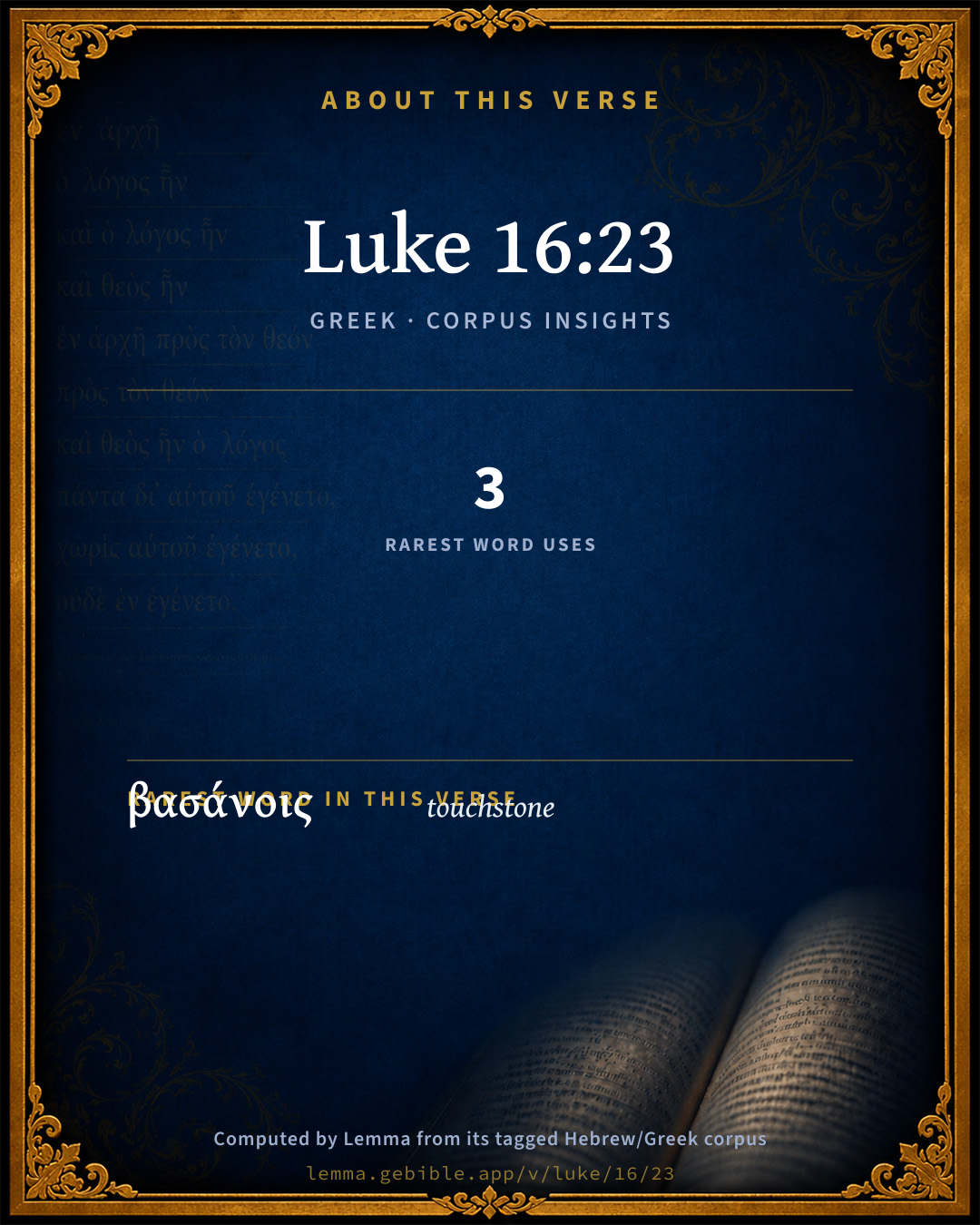
Luke 16:23

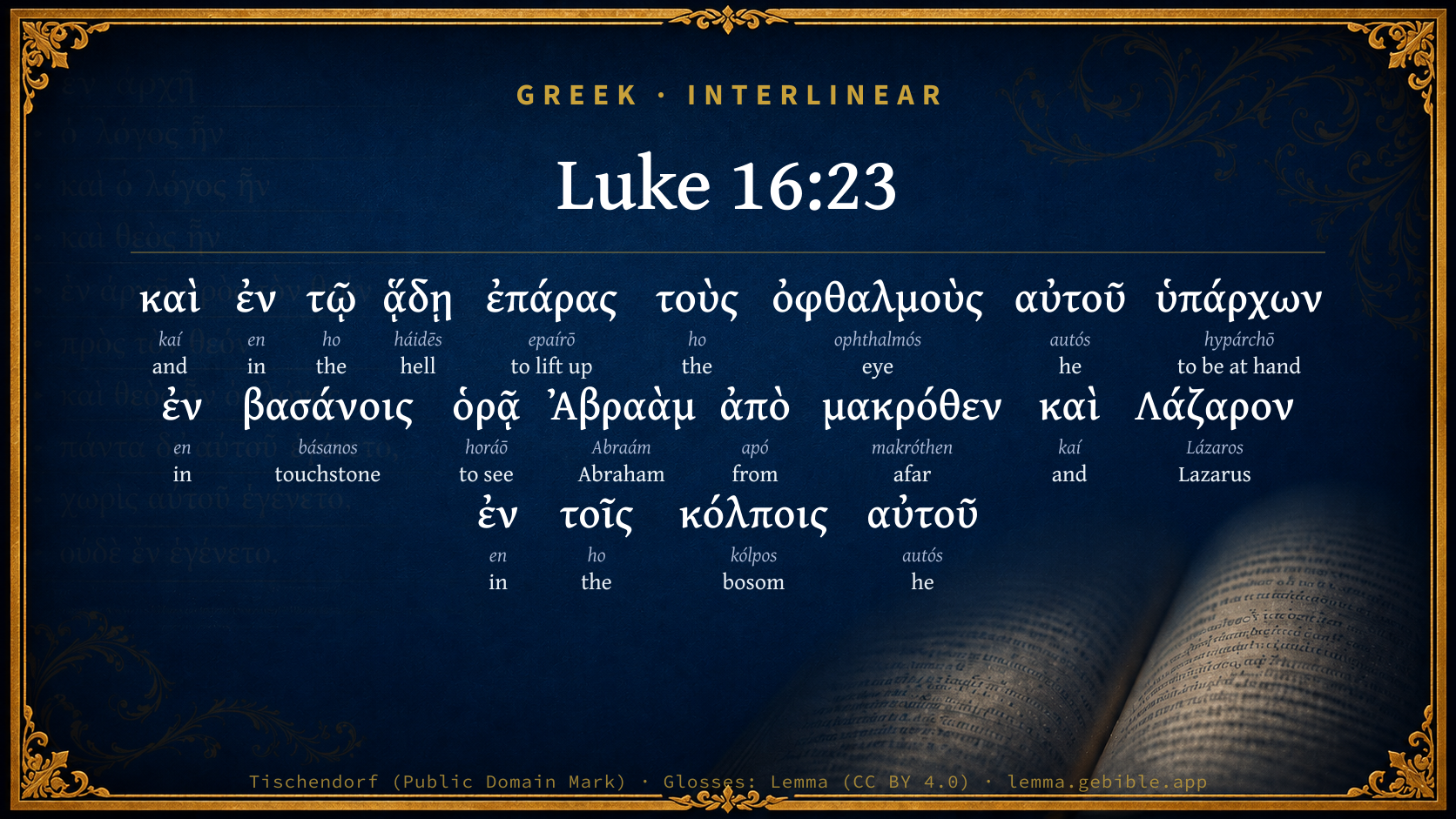
Greek (Tischendorf 8th ed.) Luke 16:23 appears in the Greek New Testament. The text above is from the Tischendorf 8th edition. Each word links to its Strong’s number and a concise gloss. Click any word for its full Thayer’s Greek Lexicon entry.
Download image
Cite this verse

Luke 16:23 (World English Bible). Public Domain. Lemma interlinear Bible study tool, https://lemma.gebible.app/v/luke/16/23.

Show BibTeX & RIS
BibTeX
RIS
English Translation
In Hades, he lifted up his eyes, being in torment, and saw Abraham far off, and Lazarus at his bosom.
World English Bible · Public Domain
Download a study sheet

One document with this verse’s original text, its word-by-word gloss line, the meaning frame, cross-references with their text, attributed commentary, and full source and license credits — printable, and it pastes into notes with its structure intact.

This verse Autodidact and up

Study sheet (.html) Plain text (.txt)

A passage Seminary Student

Up to 50 verses in one chapter. A passage sheet keeps up to 6 commentary sources and 12 cross-references per verse, in the order this page ranks them, and says so on the sheet whenever that leaves anything out. Ask for a single verse and you get the Autodidact verse sheet above.

Everything on this page stays free to read, with no account — the sheet is a download of what is already on screen, not access to it.

Want to remove ads? Support Godless Engineer
Compare translations 3

The same verse in 3 English versions, stacked beneath the original-language interlinear above. Click any original word for its lexicon entry.

Each is an independent rendering of the whole verse — the interlinear is not word-aligned to these translations.

Highlighted words mark where these versions differ — a whole-verse word diff, not a word-by-word alignment.

  • World English Bible Public Domain
    In Hades, he lifted up his eyes, being in torment, and saw Abraham far off, and Lazarus at his bosom.
  • King James Version Public Domain
    And in hell he lift up his eyes, being in torments, and seeth Abraham afar off, and Lazarus in his bosom.
  • unfoldingWord Literal Text CC BY-SA 4.0
    and in Hades, lifting up his eyes, being in torment, he sees Abraham from afar, and Lazarus in his bosom.

unfoldingWord Literal Text — © unfoldingWord, licensed CC BY-SA 4.0. Word-aligned USFM3 via Door43 (git.door43.org/unfoldingWord/en_ult).

Versions to compare (up to 4)

3 of 4 selected

Show all 19 translations

Every available English version of this verse, each an independent rendering of the whole verse.

  • World English Bible Public Domain
    In Hades, he lifted up his eyes, being in torment, and saw Abraham far off, and Lazarus at his bosom.
  • Berean Standard Bible Public Domain
    In Hades, where he was in torment, he looked up and saw Abraham from afar, with Lazarus by his side.
  • Majority Standard Bible Public Domain
    In Hades, where he was in torment, he looked up and saw Abraham from afar, with Lazarus by his side.
  • King James Version Public Domain
    And in hell he lift up his eyes, being in torments, and seeth Abraham afar off, and Lazarus in his bosom.
  • American Standard Version (1901) Public Domain
    And in Hades he lifted up his eyes, being in torments, and seeth Abraham afar off, and Lazarus in his bosom.
  • Revised Version (1885) Public Domain
    And in Hades he lifted up his eyes, being in torments, and seeth Abraham afar off, and Lazarus in his bosom.
  • Geneva Bible (1599) Public Domain
    And being in hell in torments, he lift vp his eyes, and sawe Abraham a farre off, and Lazarus in his bosome.
  • Douay-Rheims (1899) Public Domain
    And lifting up his eyes when he was in torments, he saw Abraham afar off, and Lazarus in his bosom:
  • Young's Literal Translation Public Domain
    and in the hades having lifted up his eyes, being in torments, he doth see Abraham afar off, and Lazarus in his bosom,
  • Literal Standard Version CC BY-SA 4.0
    and having lifted up his eyes in Hades, being in torments, he sees Abraham far off, and Lazarus in his bosom,
  • Unlocked Literal Bible CC BY-SA 4.0
    and in Hades, being in torment, he lifted up his eyes and saw Abraham far away and Lazarus at his side.
  • unfoldingWord Literal Text CC BY-SA 4.0
    and in Hades, lifting up his eyes, being in torment, he sees Abraham from afar, and Lazarus in his bosom.
  • Darby Bible Public Domain
    And in hades lifting up his eyes, being in torments, he sees Abraham afar off, and Lazarus in his bosom.
  • World Messianic Bible Public Domain
    In Sheol, he lifted up his eyes, being in torment, and saw Abraham far off, and Lazarus at his bosom.
  • Webster's Bible Public Domain
    And in hell he lifted up his eyes, being in torments, and seeth Abraham afar off, and Lazarus in his bosom.
  • Free Bible Version CC BY-SA 4.0
    In Hades, where he was in torment, he looked up and saw Abraham in the far distance, with Lazarus beside him.
  • Bible in Basic English Public Domain
    And in hell, being in great pain, lifting up his eyes he saw Abraham, far away, and Lazarus on his breast.
  • Text-Critical English NT CC BY 4.0
    As he was in torment in Hades, he lifted up his eyes and saw Abraham far off, and Lazarus at his side.
  • Tyndale New Testament (1534) Public Domain
    And beinge in hell in tormentes he lyfte vp his eyes and sawe Abraham a farre of and Lazarus in his bosome

Literal Standard Version (2020), Covenant Press — licensed CC BY-SA 4.0. Text via the HelloAO Bible API (eBible.org). Unlocked Literal Bible (unfoldingWord) — licensed CC BY-SA 4.0. Text via the HelloAO Bible API (eBible.org). unfoldingWord Literal Text — © unfoldingWord, licensed CC BY-SA 4.0. Word-aligned USFM3 via Door43 (git.door43.org/unfoldingWord/en_ult). Free Bible Version, Dr. Jonathan Gallagher — licensed CC BY-SA 4.0. Text via the HelloAO Bible API (eBible.org).

Word by word

More ways to search: Search by grammar → Find every occurrence → Compare this word →

Practice this passage: Drill this verse → Learn its vocabulary →

βασάνοις
básanos
G931
“touchstone”
Noun, Dative, Plural, Feminine
Part of Speech
Noun
Case
Dative
Number
Plural
Gender
Feminine
Full Thayer's Definition

Origin: perhaps remotely from the same as G939 (through the notion of going to the bottom)

TDNT: 10:22,0

1. a touchstone, which is a black siliceous stone used to test the purity of gold or silver by the colour of the streak produced on it by rubbing it with either metal 2. the rack or instrument of torture by which one is forced to divulge the truth 3. torture, torment, acute pains a. of the pains of a disease b. of those in hell after death
  1. καὶ kaí G2532 “and” Conjunction
  2. ἐν en G1722 “in” Preposition
  3. τῷ ho G3588 “the” Article, Dative, Singular, Masculine
  4. ᾅδῃ háidēs G86 “hell” Noun, Dative, Singular, Masculine
  5. ἐπάρας epaírō G1869 “to lift up” Verb, Aorist, Active, Participle, Nominative, Singular, Masculine
  6. τοὺς ho G3588 “the” Article, Accusative, Plural, Masculine
  7. ὀφθαλμοὺς ophthalmós G3788 “eye” Noun, Accusative, Plural, Masculine
  8. αὐτοῦ autós G846 “he” Personal pronoun, Genitive, Singular, Masculine
  9. ὑπάρχων hypárchō G5225 “to be at hand” Verb, Present, Active, Participle, Nominative, Singular, Masculine
  10. ἐν en G1722 “in” Preposition
  11. ὁρᾷ horáō G3708 “to see” Verb, Present, Active, Indicative, 3rd person, Singular
  12. Ἀβραὰμ Abraám G11 “Abraham” Noun, Proper, indeclinable
  13. ἀπὸ apó G575 “from” Preposition
  14. μακρόθεν makróthen G3113 “afar” Adverb
  15. καὶ kaí G2532 “and” Conjunction
  16. Λάζαρον Lázaros G2976 “Lazarus” Noun, Accusative, Singular, Masculine
  17. ἐν en G1722 “in” Preposition
  18. τοῖς ho G3588 “the” Article, Dative, Plural, Masculine
  19. κόλποις kólpos G2859 “bosom” Noun, Dative, Plural, Masculine
  20. αὐτοῦ autós G846 “he” Personal pronoun, Genitive, Singular, Masculine

About this verse

These counts appear in no published source. They are computed here, from the morphology-tagged text and Lemma’s own curated glosses. What Lemma adds →

21
words
15
distinct lemmas
Gospels
section

Notable vocabulary

The rarest word here is βασάνοις touchstone G931 — appearing just 3 times in the whole Greek New Testament.

Shared distinctive vocabulary

βασάνοις touchstone G931 occurs in 3 verses of the Greek New Testament. Also found in:

Repetition

Words recur within this verse:

Cross-references

24

Topical passages linked to Luke 16:23 in the Treasury of Scripture Knowledge — connected by theme and wording, ordered by reader-vote popularity; previews shown in the World English Bible.

  • 2 Peter 2:4 For if God didn't spare angels when they sinned, but cast them down to Tartarus, and committed them to pits of darkness, to be reserved to judgment;
  • Matthew 18:9 If your eye causes you to stumble, pluck it out, and cast it from you. It is better for you to enter into life with one eye, rather than having two eyes to be cast into the Gehenna of fire.
  • Matthew 23:33 You serpents, you offspring of vipers, how will you escape the judgment of Gehenna?
  • Luke 16:28 for I have five brothers, that he may testify to them, so they won't also come into this place of torment.'
  • Psalms 9:17 The wicked shall be turned back to Sheol, Even all the nations that forget God.
  • Matthew 8:11–12 I tell you that many will come from the east and the west, and will sit down with Abraham, Isaac, and Jacob in the Kingdom of Heaven,
  • Revelation 14:10–11 he also will drink of the wine of the wrath of God, which is prepared unmixed in the cup of his anger. He will be tormented with fire and sulfur in the presence of the holy angels, and in the presence of the Lamb.
  • Isaiah 14:9 Sheol from beneath is moved for you to meet you at your coming; it stirs up the dead for you, even all the chief ones of the earth; it has raised up from their thrones all the kings of the nations.
  • Isaiah 14:15 Yet you shall be brought down to Sheol, to the uttermost parts of the pit.
  • Matthew 5:22 But I tell you, that everyone who is angry with his brother without a cause shall be in danger of the judgment; and whoever shall say to his brother, 'Raca!' shall be in danger of the council; and whoever shall say, 'You fool!' shall be in danger of the fire of Gehenna.
  • Matthew 5:29 If your right eye causes you to stumble, pluck it out and throw it away from you. For it is more profitable for you that one of your members should perish, than for your whole body to be cast into Gehenna.
  • Luke 8:28 When he saw Jesus, he cried out, and fell down before him, and with a loud voice said, "What do I have to do with you, Jesus, you Son of the Most High God? I beg you, don't torment me!"
  • Revelation 20:10 The devil who deceived them was thrown into the lake of fire and sulfur, where the beast and the false prophet are also. They will be tormented day and night forever and ever.
  • Revelation 20:13–14 The sea gave up the dead who were in it. Death and Hades gave up the dead who were in them. They were judged, each one according to his works.
  • Psalms 49:15 But God will redeem my soul from the power of Sheol, For he will receive me. Selah.
  • Psalms 86:13 For your loving kindness is great toward me. You have delivered my soul from the lowest Sheol.
  • Proverbs 5:5 Her feet go down to death. Her steps lead straight to Sheol.
  • Proverbs 7:27 Her house is the way to Sheol, Going down to the chambers of death.
  • Proverbs 9:18 But he doesn't know that the dead are there, That her guests are in the depths of Sheol.
  • Proverbs 15:24 The path of life leads upward for the wise, To keep him from going downward to Sheol.
  • Matthew 8:29 Behold, they cried out, saying, "What do we have to do with you, Jesus, Son of God? Have you come here to torment us before the time?"
  • Matthew 11:23 You, Capernaum, who are exalted to Heaven, you will go down to Hades. For if the mighty works had been done in Sodom which were done in you, it would have remained until this day.
  • Luke 13:28–29 There will be weeping and gnashing of teeth, when you see Abraham, Isaac, Jacob, and all the prophets, in the Kingdom of God, and yourselves being thrown outside.
  • 1 Corinthians 15:55 "Death, where is your sting? Hades, where is your victory?"

Cross-references courtesy of OpenBible.info (CC BY 4.0).

Commentary

Notes on Luke 16:23 from classic Christian and Jewish commentators (each source and its license shown beneath its notes). The classic Christian expositions comment on the surrounding passage and are grouped to its opening verse, so a note may address several verses; the Jewish commentaries on the Tanakh (Rashi and others) are per-verse, so they appear only where the commentator wrote on this verse.

Lemma curates 59 commentaries, every one of them public domain or Creative Commons licensed, each selected and text-cleaned for this edition rather than reprinted as found. About our sources →

Joseph Benson's Commentary

Luk 16:23. And in hell — Εν τω αδη, in hades; that is, in the unseen, or invisible world. It must be observed, that both the rich man and Lazarus were in hades, though in different regions of it: he lifted up his eyes, being in torments — Our Saviour adapts this circumstance of the parable, says Lightfoot, to the popular opinion of the Jews. The rabbins say, that the place of torment and paradise are so situated, that what is done in the one may be seen from the other. “Because the opinions, as well as the language, of the Greeks,” says Dr. Macknight, “had by this time made their way into Judea, some imagine that our Lord had their fictions about the abodes of departed souls in his eye when he formed this parable: but the argument is not conclusive. At the same time it must be acknowledged, that his descriptions of those things are not drawn from the writings of the Old Testament; but have a remarkable affinity to the descriptions which the Grecian poets have given of them. They, as well as our Lord, represent the abodes of the blessed as lying contiguous to the regions of the damned, and separated only by a great impassable river, or deep gulf, in such a sort that the ghosts could talk with one another from its opposite banks. In the parable, souls, whose bodies were buried, know each other, and converse together, as if they had been imbodied. In like manner, the Pagans introduce departed souls talking together, and represent them as having pains and pleasures analogous to what we feel in this life. It seems, they thought the shades [spirits] of the dead had an exact resemblance to their bodies. The parable says, the souls of wicked men are tormented in flames; the Grecian mythologists tell us they lie in a river of fire, where they suffer the same torments they would have suffered while alive had their bodies been burned.” It will not, however, at all follow from these resemblances, that the parable is formed on the Grecian mythology, or that our Lord approved of what the common people thought or spake concerning those matters, agreeably to the notions and language of the Greeks. “In parabolical discourses provided the doctrines inculcated are strictly true, the terms in which they are inculcated may be such as are most familiar to the ears of mankind, and the images made use of such as they are best acquainted with.” What we are here taught with certainty is, that as the souls of the faithful, immediately after they are delivered from the burden of the flesh, are in joy and felicity; so, unholy and unsanctified souls, immediately after they are forced from the pleasures of the flesh by death, are in misery and torment, ceaseless, remediless, and endless torment, to be much increased and completed at the general resurrection. And seeth Abraham afar off — And yet knew him at that distance; and shall not Abraham’s children, when they are together in paradise, know each other? and Lazarus in his bosom — Having a view of the seats of the blessed at a distance, the first object that he beheld was Lazarus, the beggar, (who had so often been laid naked, and hungry, and covered with sores, at his gate,) sitting next to Abraham, in the chief place of felicity. In consequence of which, doubtless, the stings of his conscience were greatly multiplied, and he was racked with envy and self-accusing reproaches.

Joseph Benson's Commentary on the Old and New Testaments (1811–1818) — public domain. Text from a community e-Sword module.

Tyndale Open Study Notes

Tyndale Open Resources

16:23 The place of the dead (Greek Hades) can refer to the grave (death) generally, or to the place where the wicked go after death, as here.

Tyndale Open Study Notes — © Tyndale Open Resources, licensed CC BY-SA 4.0. Text via the HelloAO Bible API.

Bengel's Gnomon

Johann Albrecht Bengel

Luk 16:23. ᾼδη, hell) [‘inferno’]. Neither Abraham nor Lazarus were ἐν τῷ ᾅδῃ, although the death and descent of Christ [to hell] had not yet taken place.

ᾍδης and Gehenna differ,

As a whole, and a part differ;

As a thing present, and a thing about to be, viz. after the day of Judgment;

As a receptacle of individuals, and a receptacle of all the bad without exception.

ᾍδης is much wider in its meaning, than Gehenna, Comp. Gen 37:35 [“I will go down into the grave (εἰς ᾍδου, to Hades) unto my son mourning”], where certainly Jacob is not expressing despair as to[the salvation of] his soul or that of Joseph [but merely his desire to follow Joseph to the unseen world of Hades]. In the first distinction which we have given between the words, ᾍδης itself and Gehenna itself are had regard to; in the third, it is the dwellers in each that are regarded. Abraham was ἐν τῷ ᾍδῃ in the widest sense of the term, as ᾍδῃς is used in the passage above quoted from Gen. But in Luke ᾍδῃς and the bosom of Abraham are opposed to one another.—ἐπᾴρας, having lifted up) A lamentable spectacle, presenting itself from the abyss.—[ἐν βασάνοις, in torments) And this, at a long interval before the last day; nay even preceding the death of Christ.—V. g.]—τὸν Ἀβραὰμ, Abraham) but not God Himself. For which reason also he cannot cry unto God, Have mercy on me.—κόλποις) The plural expressing the space from the breast to the knees.

Bengel's Gnomon of the New Testament — English translation (T&T Clark, Edinburgh, 1860) — public domain. Text from a community e-Sword module.

Expositor's Greek Testament

ed. W. Robertson Nicoll

Luk 16:23-26 . In the other world . ἐν τῷ ᾅδῃ : from the O.T. point of view Hades means simply the state of the dead. Thus both the dead men would be in Hades. But here Hades seems = hell, the place of torment, and of course Lazarus is not there, but in Paradise. ἀπὸ μακρόθεν : Paradise dimly visible, yet within speaking distance; this is not dogmatic teaching but popular description; so throughout. ἐν τοῖς κόλποις : plural here ( cf. Luk 16:22 ); so often in classics.

The Expositor's Greek Testament, edited by W. Robertson Nicoll (1897–1910) — public domain. Text from a community e-Sword module.

Godet's Commentaries

Frédéric Louis Godet

The scene from beyond the tomb, Luk 16:23-31, offers a contrast exactly corresponding to the terrestrial scene. We do not attempt to distinguish in the representation what should be taken in a figurative sense and what strictly. The realities of the spiritual world can only be expressed by figures; but, as has been said, those figures are the figures of something. The colours are almost all borrowed from the palette of the Rabbins; but the thought which clothes itself in those figures that it may become palpable, is, as we shall see, the original and personal thought of Jesus.

Of the two interviews forming this scene, the first relates to the rich man’s lot (Luk 16:23-26), the second to that of his brethren (Luk 16:27-31).

Vers. 23-26. After the short sleep of death, what an awakening! The idea of suffering does not lie in the words ἐν τῷ ᾅδῃ, which our versions render by: in hell. Scheol (Heb.), Hades (Gr.), the Inferi or infernal regions (Lat.), simply denote the abode of the dead, without distinguishing the different conditions which it may include, in opposition to the land of the living. Paradise (Luk 23:43) as well as Gehenna (Luk 12:5) forms part of it. Hence, also, from the midst of his punishment the rich man can behold Abraham and Lazarus. The notion of pain is actually found only in the words: being in torments.

On Abraham in the abode of the dead, comp. Joh 8:56, where Jesus speaks without figure.

The plural τοῖς κόλποις, substituted for the singular (Luk 16:22), denotes fulness; a whole region is meant where a company is gathered together.

The situation, Luk 16:24 et seq., is very similar to that of the dialogues of the dead found in the ancients, and particularly in the Rabbins. Φωνήσας, calling in a loud voice, corresponds to μακρόθεν, afar off, Luk 16:23. Nothing more severe for those Pharisees, who made a genealogical tree the foundation of their salvation, than this address put into the mouth of the poor condemned man: Father Abraham! “All the circumcised are safe,” said the Rabbins; therefore, was not circumcised equivalent to son of Abraham? In this situation, there arises in the mind of the rich man a thought which had never occurred to him while he was on the earth, namely, that the contrast between abundance and destitution may have its utility for him who is in want. He expresses his discovery with a simplicity in which shamelessness disputes the palm with innocence. The gen. ὕδατος with βάπτειν: to drop water; this expression denotes water falling drop by drop from the finger which has been immersed in it; it thus corresponds to the word crumbs, Luk 16:21.

On flame, comp. Mar 9:43-49. Lustful desires, inflamed and fed by boundless gratification, change into torture for the soul as soon as it is deprived of the external objects which correspond to them, and from the body by which it communicates with them.

The address: my son, in the mouth of Abraham, is more poignant still than that of: Father Abraham in that of the rich man. Abraham acknowledges the reality of the civil state appealed to, and yet this man is and remains in Gehenna!

The word remember is the central one of the parable; for it forms the bond between the two scenes, that of the earth and that of Hades. “Recall the contrast which thou didst leave unbroken on the earth..., and thou shalt understand that the present corresponding contrast cannot be alleviated without injustice. Thou hast let the time pass for making Lazarus thy friend (Luk 16:8-9); he can now do nothing for thee.” In ἀπέλαβες, thou receivedst, there is, as in the ἀπέχειν, Mat 6:2; Mat 6:5; Mat 6:16, the notion of receiving by appropriating greedily for the purpose of enjoyment. The selfish appropriation of goods was not tempered in him by the free munificence of love. He thought only of draining to the very bottom the cup of pleasure which was at his lips. The same idea is expressed by the pronoun σοῦ added to ἀγαθά, “thy good things;” this qualification is not added to κακά, in the second clause; Abraham says simply: “evil things.” God trains the human soul by joys and by sorrows. The education of every soul demands a certain sum of both. This thought forms the foundation of Luk 16:25. It refers exclusively to the pedagogical economy here below or in the world above. The words comforted and tormented are not the equivalents of saved and damned, absolutely taken. Nothing could be final among the members of the ancient covenant till they had been brought into contact with Jesus Christ. “The gospel,” says St. Peter (1 Eph 4:6), “was preached to them that are dead, that they might be [capable of being] judged.” The knowledge of Jesus Christ is the condition on which the pronouncing of the final sentence on every soul is based. The hour of this judgment has not yet struck for the rich man. Consequently this verse neither teaches salvation by poverty nor damnation by riches; ὧδε, here, which is read by all the Mjj., is preferable to ὅδε, he. Here is opposed to: in his lifetime.

Ver. 26. But even supposing that some concession might be made in respect of justice, there is another reason which cuts off all hope — the impossibility of the thing. The Rabbins represent the two parts of Hades as separated by a wall; Jesus here substitutes a gulf, a figure which agrees better with the entire description. It is the emblem of God’s inflexible decree. Only from the fact that this gulf cannot be crossed at present, it does not follow that it may not be so one day by means of a bridge offered to repentant Jews (comp. Mat 12:32). The omission of οἱ before ἐκεῖθεν, by the Alex., identifies those who pass with those who repass.

Frédéric Louis Godet — Commentaries on Luke, John, Romans, and 1 Corinthians — English translation (T&T Clark, Edinburgh, 1870s–1890s) — public domain. Text from a community e-Sword module.

Geneva Bible (1599)

Geneva Bible translators

Heavenly and spiritual things are expressed, and set forth under colors and resemblances fit for our senses.

Geneva Bible (1599) marginal notes — public domain. Text via Bolls.life.

Jamieson, Fausset & Brown

Robert Jamieson, A. R. Fausset & David Brown

in hell--not the final place of the lost (for which another word is used), but as we say "the unseen world." But as the object here is certainly to depict the whole torment of the one and the perfect bliss of the other, it comes in this case to much the same.

seeth Abraham--not God, to whom therefore he cannot cry [BENGEL].

Jamieson, Fausset & Brown — Commentary Critical and Explanatory on the Whole Bible (1871) — public domain (CC PDM 1.0). Text via the HelloAO Bible API.

Ellicott's Commentary for English Readers

(23) And in hell.—The Greek word is Hades, not Gehenna; the unseen world of the dead, not the final prison of the souls of the lost. (See Note on Mat_5:22.) It lies almost on the surface of the parable that it describes an earlier stage of the life after death than that in Mat_25:31-46. There is no mention here of the Advent of the Judge. As far as the parable itself is concerned, there is nothing to exclude the thought that the torments might have in part the character of a discipline as well as of retribution.

In torments.—The Greek word was applied originally to the test or touchstone of metals, then to the torture to which men had recourse as the one sure test of the veracity of witnesses, than to torments generally. The nature of the “torments” here is suggested by the “flame” of the next verse, but that word has to be taken with all its symbolic associations, and does not necessarily imply the material element of fire. (See Notes on Mar_9:43-49.) What is meant is that there shall be for the soul of the evil-doer, when brought face to face with that holiness of God which is as a consuming fire (Heb_12:29), an anguish as intolerable as the touch of earthly flame is to the nerves of the mortal body. The thought is expressed with great beauty in Dr. Newman’s Dream of Gerontius:—

“And these two pains, so counter and so keen,—

The longing for Him, when thou seest Him not;

The shame of self at thought of seeing Him,—

Will be thy veriest, sharpest purgatory.”

Seeth Abraham afar off, and Lazarus in his bosom.—Here again we are in a region of symbolic imagery, under which we discern the truth that the souls of those who have yielded to selfish indulgence will discover after death that those whom they have scorned and neglected during their life are admitted, if worthy of admission, to the enjoyment of a rest and refreshment from which they themselves are, by their own act and deed, excluded.

A Bible Commentary for English Readers, edited by Charles John Ellicott (1878–1897) — public domain. Text from a community e-Sword module.

The Cambridge Bible for Schools and Colleges

gen. ed. J. J. S. Perowne

23. in hell] Rather, in Hades. Hades, which is represented as containing both Paradise and Gehenna, and is merely the Greek equivalent of the Hebrew Sheol, ‘the grave,’ is the intermediate condition of the dead between death and the final judgment. The scene on earth is contrasted with the reversed conditions of the other world. The entire scenery and phraseology are Jewish, and are borrowed from those which were current among the Rabbis of Christ’s day. Beyond the awful truth that death brings no necessary forgiveness, and therefore that the retribution must continue beyond the grave, we are not warranted in pressing the details of the imagery which was used as part of the vivid picture. And since the scene is in Hades, we cannot draw from it any safe inferences as to the final condition of the lost. The state of Dives may be, as

Tertullian says, a praelibatio sententiae, but it is not as yet the absolute sentence.

The Cambridge Bible for Schools and Colleges (gen. ed. J. J. S. Perowne; Cambridge University Press, 1878–1918) — public domain. Text from a community e-Sword module.

John Gill's Exposition

And he cried and said, father Abraham,.... The Jews used to call Abraham their father, and were proud of their descent from him, Mat 3:9 and so persons are after death represented by them, as speaking to, and discoursing with him; as in the passage cited in the note See Gill on Luk 16:22 to which the following may be added (c);

"says R. Jonathan, from whence does it appear that the dead discourse with each other? it is said, Deu 34:4 "And the Lord said unto him, this is the land which I sware unto Abraham, unto Isaac, and unto Jacob, saying", &c. what is the meaning of the word "saying?" the holy blessed God said to Moses, "go say to Abraham", &c.''

And here the Jews, in their distress, are represented as applying to him, saying,

have mercy on me, and send Lazarus; which seems to have respect to the mercy promised to Abraham, the covenant made with him, and the oath swore unto him, to send the Messiah, Luk 1:70 and which now, too late, these wretched Jews plead, the Messiah being sent already:

that he may dip the tip of his finger in water; in allusion to the washings and purifications among the Jews, and the sprinkling of blood by the finger of the high priest; which were typical of cleansing, pardon, comfort, and refreshment, by the grace and blood of Christ:

and cool my tongue; which had spoken so many scurrilous and blasphemous things of Christ; saying that he was a sinner, a glutton, and a winebibber, a Samaritan, and had a devil; that he cast out devils by Beelzebub, the prince of devils; and that he was a seditious person, and guilty of blasphemy: so the Jews represent persons in hell, desirous of cooling water, and as sometimes favoured with it, and sometimes not: they say (d), he that reads "Keriat Shema, (i.e. hear, O Israel", &c.) and very accurately examines the letters of it, "they cool hell for him", as it is said, Psa 68:14. And elsewhere (e), they speak of a disciple, or good man, that was seen after death amidst gardens, and orchards, and fountains of water; and of a publican, or wicked man, seen standing by the bank of a river, seeking , "to come to the water, but could not come at it". So Mahomet (f) has a passage that is somewhat like to this text;

"the inhabitants of hell fire, shall call to the inhabitants of paradise, saying, pour upon us some water, or of those refreshments God hath bestowed on you.''

This man could not so much as get a drop of water to cool his tongue, not the least refreshment, nor mitigation of the anguish of his conscience, for the sins of his tongue:

for I am tormented in this flame; in the destruction of Jerusalem, and calamities at Bither, and other afflictions; together with the wrath of God poured into the conscience, and the bitter remorses of that for speaking against the Messiah; and which are still greater in hell, where the worm dies not, and the fire is not quenched.

(c) T. Bab. Beracot, fol. 18. 2. (d) Ib. fol. 15. 2. (e) T. Hieros. Sanhedrin, fol. 23. 3. & Chagiga, fol, 77. 4. (f) Koran, c. 7. p. 121. (sura 7:50)

John Gill's Exposition of the Whole Bible (1746–1763) — public domain (CC PDM 1.0). Text via the HelloAO Bible API.

Trapp's Complete Commentary

John Trapp

23 And in hell he lift up his eyes, being in torments, and seeth Abraham afar off, and Lazarus in his bosom.

Ver. 23. Being in torments] Having punishment without pity, misery without mercy, sorrow without succour, crying without compassion, mischief without measure, torments without end, and past imagination.

And Lazarus in his bosom] Which more vexed him than his own torments, saith Chrysostom.

He lifted up his eyes] So often lifted up (saith one) in a false devotion.

John Trapp, A Commentary or Exposition upon All the Books of the Old and New Testament (1647–1656) — public domain. Text from a community e-Sword module.

Albert Barnes' Notes on the Bible

In hell - The word here translated hell (“Hades”) means literally a dark, obscure place; the place where departed spirits go, but especially the place where “wicked” spirits go. See the Job 10:21-22 notes; Isa 14:9 note. The following circumstances are related of it in this parable:

It is “far off” from the abodes of the righteous. Lazarus was seen “afar off.” It is a place of torment. There is a great gulf fixed between that and heaven, Luk 16:26. The suffering is great. It is represented by “torment” in a flame, Luk 16:24. There will be no escape from it, Luk 16:26.

The word “hell” here means, therefore, that dark, obscure, and miserable place, far from heaven, where the wicked shall be punished forever.

He lifted up his eyes - A phrase in common use among the Hebrews, meaning “he looked,” Gen 13:10; Gen 18:2; Gen 31:10; Deu 8:3; Luk 6:20.

Being in torment - The word “torment” means “pain, anguish” Mat 4:24; particularly the pain inflicted by the ancients in order to induce people to make confession of their crimes. These “torments” or tortures were the keenest that they could inflict, such as the rack, or scourging, or burning; and the use of the word here denotes that the sufferings of the wicked can be represented only by the extremest forms of human suffering.

And seeth Abraham ... - This was an aggravation of his misery. One of the first things that occurred in hell was to look up, and see the poor man that lay at his gate completely happy. What a contrast! Just now he was rolling in wealth, and the poor man was at his gate. He had no expectation of these sufferings: now they have come upon him, and Lazarus is happy and forever fixed in the paradise of God. It is more, perhaps, than we are authorized to infer, that the wicked will “see” those who are in paradise. That they will “know” that they are there is certain; but we are not to suppose that they will be so near together as to be seen, or as to make conversation possible. These circumstances mean that there will be “a separation,” and that the wicked in hell will be conscious that the righteous, though on earth they were poor or despised, will be in heaven. Heaven and hell will be far from each other, and it will be no small part of the misery of the one that it is far and forever removed from the other.

Albert Barnes' Notes on the Bible (1834–1885) — public domain. Text from a community e-Sword/MySword module.

Matthew Poole's English Annotations

καὶ ἐν τῷ ᾅδῃ, And in hell. The world hath been filled with disputes about the true signification of the word αδης, which is here translated hell. The most probably true notion of it is, that it signifies, the state of the dead, both of the dead body, and so it often signifieth the grave, and of the departed soul. A very learned man saith, that if he mistakes not, this is the only text in Scripture in which by it is to be understood the place of torments. The Hebrew word which is translated by this, far more often signifying the place of the blessed, whither the saints and patriarchs went when they died, than the place whither sinners went; but Luk 16:24 makes it appear, that here it signifies hell, properly so called, as it imports the place of the damned. We must understand our Saviour in this whole διατυπωσις to speak to us figuratively, that by things which we understand we might comprehend spiritual things. Heaven and hell are at too great a distance for souls in each to discourse one with another: neither have souls any eyes to lift up. We are by this taught:

1. That as the souls of good men, when they leave their bodies, go into a state of eternal bliss, where are Abraham, Isaac, and Jacob, and enjoy a felicity which we are not able to express, but is set out to us under the notion of Abraham’s bosom, to let us know that it is a place of rest, and communion with saints, and the same felicity which Abraham the friend of God doth enjoy: so the souls of wicked men, when they leave their bodies, shall go into a place of torments, the greatness of which being such as we are not able to conceive, they are expressed to us under the notion of being tormented by fire.

2. That it will be a great part of the misery of damned souls, to understand those to be in a state of happiness whom they in this life have scorned, despised, and abused, and, it may be, have been instruments to hasten them to those blessed mansions.

3. That there will come a time when the proudest sinners will be glad of the help of the meanest saints, if they could obtain it. Father Abraham, ( saith the rich man), send Lazarus, that Lazarus whom when alive I suffered to lie at my gate full of sores, and would not relieve.

4. That the state of the damned will be void of the least degrees of comfort and satisfaction. The rich man desireth but a cooling of his tongue with so much water as could be brought upon the tip of Lazarus’s finger.

5. That the tongue is a member, the abuse of which will in another life lie very heavy upon lost souls.

Matthew Poole's English Annotations on the Holy Bible (1683–1685) — public domain. Text from a community e-Sword/MySword module.

Whedon's Commentary on the Bible

Daniel D. Whedon

23. In hell—In hades, or the great unseen. That is, the invisible place or region of disembodied spirits. While the body of man is in the grave, his soul is in hades. So taught the Jewish Church; and Jesus here confirms the teaching. But hades, it is said, consists of two regions, namely, Paradise, or Abraham’s bosom, the abode of the righteous; and Tartarus, the abode of the wicked. But though hades is thus the abode of the blessed spirits, still it is overshadowed by the power of death, and the happiness of the blessed is incomplete until the resurrection. And because it is thus under the power of death, and is the place of detention, even for the good, the word hades is sometimes, as here, used as the proper name of the compartment of the wicked only. But when the day of resurrection shall come, the righteous shall, after the judgment, ascend body and soul to heaven, and the wicked be cast into the lake of fire, gehenna, or the second death. And death and hades shall be merged into the same lake of fire. Rev_20:14.

These views of future retribution, more or less clearly, have been taught among all the nations of the earth; as if they were written by the finger of God upon the human heart. It is not, indeed, possible in the present parable to draw the line between the figurative and the literal. The conversation between the two parties embraces doubtless the truths it suggests in dialogue form. But the true conclusion is, that the Great Teacher here opens as true a picture of the world beyond death as our present inexperienced minds can receive, conceive, and truly understand. The commentator who by a natural unforced construction arrives at the most literal interpretation, attains probably the nearest to the essential if not to the physical truth.

Eyes—But has the disembodied spirit eyes, tongue, finger, etc.? We answer, a spirit possesses sight; for even in life it is the soul that sees, and the eye is but its instrument. So also it is the soul that hears, feels, tastes, and smells, through its sensorial organs. And so our entire present sensitive system is in the human form, extending from within to the surface of the body. Our sensitive skin is a dress of and in the human form; our bone system is a skeleton in human form; and so our nerve system and blood system are so many outline sketches of the same figure. The sensible soul, extending its power and apparent presence, is limited by the skin to the same shape. How know we that it carries the same limitations and the same shape when emancipated from the outward world?

He lifted up his eyes— No angel bearers carry him to hades; but, as if the transition were instant, as soon as he closes the eyes of the body upon earth, he opens those of the soul in hell.

Being in torments—The word here rendered torments is used in Matt, Mat_4:24 and signifies bodily pangs from disease. The rich man is not in the final hell, but in the place of intermediate woe.

And seeth Abraham— The Jewish Church believed Abraham to be the master-spirit of the blessed Israelite dead. “In the future world,” says one of their writers, “Abraham will sit at the gate of hell; nor will he permit a circumcised man to descend thither.” Jesus teaches that no Abrahamic descent will save a man from woe.

Afar off—The Jews believed that Paradise and Hades were so near as to be in sight.

And Lazarus in his bosom—We are not to figure here one man as in another’s bosom; but both as reclining at table, in such a way as that the guest next to the host reclines his head on the bosom of the host.

In order to unfold the lesson of the parable, our Lord uses the conception of an actual banquet, with the actual Abraham at the head and Lazarus next. The lesson is, that the poorest being on earth may be exalted by the purest piety to the highest place in Paradise. He sits not only at the banquet, but after his first arrival he at least takes his turn in occupying the highest seat. Yet more truly we may say that Lazarus represents humble Christianity on its way to eternal glory; while Abraham represents the ancestral Church of past ages. The humble latter-day Church joins the eternal banquet and reclines in the bosom of the Church that has gone before.

Daniel D. Whedon (gen. ed.), Commentary on the Old and New Testaments (1874–1909) — public domain. Text from a community e-Sword module.

The Pulpit Commentary

And in hell he lift up his eyes, being in torments; more accurately, in Hades (the unseen world of the dead) he lift up his eyes. The idea of suffering does not lie in these first words, but in the participle "being in torments," which immediately follows. It is noticeable that, in this Divine picture of unhappy life in the other world there is no coarse, vulgar word-painting such as we meet with so often in mediaeval human works. The very fact of the man"s being unhappy is gently represented. The graver aspect of the torments we learn from the hapless one"s own words. Still, it is all very awful, though the facts are so gently told us. "Being in torments:" How could it be otherwise for such a one as Dives? The home of the loving, where Abraham was, would be no home for that selfish man who had never really loved or cared for any one save himself. What were the torments? men with hushed voices ask. A little further on the doomed one speaks of a flame and of his tongue apparently burning, owing to the scorching heat; but it would be a mistake to think of a material flame being intended here. There is nothing in the description of the situation to suggest this; it is rather the burning never to be satisfied, longing for something utterly beyond his reach, that the unhappy man describes as an inextinguishable flame. Were it desirable to dwell on these torments, we should remind men how lustful desires change rapidly into torture for the soul when the means for gratifying them exist not. In the case of Dives, his delight on earth seems to have been society, pleasant jovial company, the being surrounded by a crowd of admiring friends, the daily banquet, the gorgeous apparel, the stately house, these details more than hint at the pleasure he found in the society of courtier-friends; but in the other world he seems to have been quite alone. Whereas among the blessed there appears to be a sweet companionship. Lazarus is in the company of Abraham, who, of course, only represents a great and goodly gathering. "Abraham"s bosom" is simply the well-known expression for that feast or banquet of the happy souls judged worthy of an entrance into Paradise. But in that place where the rich man lifted up his eyes there seems a strange and awful solitariness. A total absence of everything, even of external causes of trouble, is very noticeable. He was alone; alone with his thoughts. And seeth Abraham afar off, and Lazarus in his bosom.

The Pulpit Commentary (1880–1919), ed. H.D.M. Spence-Jones & Joseph S. Exell — public domain. Text from a community e-Sword module.

John Wesley's Explanatory Notes

He seeth Abraham afar off - And yet knew him at that distance: and shall not Abraham's children, when they are together in paradise, know each other!

John Wesley, Explanatory Notes Upon the Whole Bible (1754–1765) — public domain. Text via the GEBible commentary corpus.

Scofield Reference Notes

C. I. Scofield

hell

(Greek - ᾅδης, "the unseen world," is revealed as the place of departed human spirits between death and resurrection). The word occurs, Mat 11:23; Mat 16:18; Luk 10:15; Act 2:27; Act 2:31; Rev 1:18; Rev 6:8; Rev 20:13; Rev 20:14 and is the equivalent of the O.T. "sheol." (See Scofield "Hab 2:5"). The Septuagint invariably renders sheol by hades.

Summary:

(1) Hades before the ascension of Christ. The passages in which the word occurs make it clear that hades was formerly in two divisions, the abodes respectively of the saved and of the lost. The former was called "paradise" and "Abraham’s bosom." Both designations were Talmudic, but adopted by Christ in Luk 16:22; Luk 23:43. The blessed dead were with Abraham, they were conscious and were "comforted" Luk 16:25. The believing malefactor was to be, that day, with Christ in "paradise." The lost were separated from the saved by a "great gulf fixed" Luk 16:26. The representative man of the lost who are now in hades is the rich man of Luk 16:19-31. He was alive, conscious, in the full exercise of his faculties, memory, etc., and in torment.

(2) Hades since the ascension of Christ. So far as the unsaved dead are concerned, no change of their place or condition is revealed in Scripture. At the judgment of the great white throne, hades will give them up, they will be judged, and will pass into the lake of fire Rev 20:13; Rev 20:14. But a change has taken place which affects paradise. Paul was "caught up to the third heaven.. .into paradise" 2Co 12:1-4. Paradise, therefore, is now in the immediate presence of God. It is believed that Eph 4:8-10 indicates the time of the change. "When he ascended up on high he led a multitude of captives." It is immediately added that He had previously "descended first into the lower parts of the earth," i.e. the paradise division of Hades. During the present church-age the saved who died are "absent from the body, at home with the Lord." The wicked dead in hades, and the righteous dead "at home with the Lord," alike await the resurrection; Job 19:25; 1Co 15:52. (See Scofield "Mat 5:22").

The Scofield Reference Bible (1917 edition), notes by C. I. Scofield — public domain. Text from a community e-Sword module.

The People's New Testament

B. W. Johnson

23. In Hades. The abode of departed spirits, and to the wicked, a place of punishment. Being in torments. His wealth has failed him; his good things have departed. Seeth Abraham … and Lazarus. A proof of recognition beyond the grave. Afar off. Widely apart in condition, character, and space.

B. W. Johnson's The People's New Testament with Notes (1889–1891) — public domain. Electronic text from the Christian Classics Ethereal Library (CCEL) ThML edition.

Cambridge Greek Testament for Schools and Colleges

23. ἐν τῷ ᾅδῃ. ‘In Hades.’ See Luk 10:15. Hades, which is represented as containing both Paradise and Gehenna, and is merely the Greek equivalent of the Hebrew Sheol, ‘the grave,’ is the intermediate condition of the dead between death and the final judgment. The scene on earth is contrasted with the reversed conditions of the other world. The entire imagery and phraseology are Jewish, and are borrowed from those which were current among the Rabbis of Christ’s day. Beyond the awful truth that death brings no necessary forgiveness, and therefore that the retribution must continue beyond the grave, we are not warranted in pressing the details of the parable which were used as part of the vivid picture. And since the scene is in Hades, we cannot draw from it any safe inferences as to the final condition of the lost. The state of Dives may be, as Tertullian says, a praelibatio sententiae, but it is not as yet the absolute sentence.

ἀπὸ μακρόθεν. One of the numerous mixtures of analytic and synthetic expressions (see my Brief Greek Syntax, pp. 1–6) which we find in the decadent stages of a language. Μακρόθεν alone means ‘from afar,’ but is helped out by ἀπό, and the pleonasm is unconscious, as in Mon cher Monsieur.

ἐν τοῖς κόλποις. The plur. is often used for ‘bosom’ because the word properly means the folds of the robe (sinus). For the meaning of the metaphoric expression see Joh 1:18; Joh 13:23.

Cambridge Greek Testament for Schools and Colleges (Cambridge University Press, 1896; 21 vols, various authors incl. Carr, Maclear, Plummer, Farrar, Lumby, Moule, M. R. James, Simcox) — public domain. Text from a community e-Sword module.

Alford’s Greek Testament

Henry Alford

23. ἐν τ. ᾅδῃ] Hades, שְׁאוֹל, is the abode of all disembodied spirits till the resurrection; not, the place of torment,—much less hell, as understood commonly, in the E. V.

Lazarus was also in Hades, but separate from Dives; one on the blissful, the other on the baleful side. It is the gates of Hades, the imprisonment of death, which shall not prevail against the Church (Mat 16:18);—the Lord holds the key of Hades, (Rev 1:18);—Himself went into the same Hades, of which Paradise is a part.

ἐν βασάνοις—not eternal condemnation;—for the judgment has not yet taken place; men can only be judged in the body, for the deeds done in the body:—but, the certainty and anticipation of it.

ἐπάρας, not necessarily to a higher place, though that may be meant:—see reff.

Henry Alford, The Greek Testament (1849–1861) — public domain. Text from a community e-Sword module.

International Critical Commentary

23. καὶ ἐν τῷ ᾅδῃ. “In Hades,” the receptacle of all the departed until the time of final judgment, and including both paradise and Gehenna. That Hades does not mean “hell” as a place of punishment is manifest from Act 2:27, Act 2:31; Gen 37:35, 42:38, 44:29; Job 14:13, Job 17:13, etc. That Hades includes a place of punishment is equally clear from this passage. In the Psalms of Solomon Hades is mentioned only in connexion with the idea of punishment (14:6, 15:11, 16:2). See Suicer, s.v. The distinction between Hades and Gehenna is one of the many great advantages of RV. Dives “lifts up his eyes,” not to look for help, but to learn the nature of his changed condition.

ὑπάρχων ἐν βασάνοις. Torment is now his habitual condition: not ὤν, but ὑπάρχων. That he is punished for his heartless neglect of great opportunities of benevolence, and not simply for being rich, is clear from the position of Abraham, who was rich. Comp. μέγας γὰρ ψυχῆς ἀγὼν καὶ κίνδυνος ἐν αἰωνίῳ βασάνῳ κείμενος τοῖς παραβᾶσι τὴν ἐντολὴν τοῦ Θεοῦ (4 Mac. 13:15); and contrast δικαίων δὲ ψυχαὶ ἐν χειρὶ Θεοῦ, καὶ οὐ μὴ ἅψηται αὐτῶν βάσανος (Wisd. 3:1). Luxurioso carere deliciis poena est (Ambr).

ὁρᾷ Ἀβραάμ. The Jews believed that Gehenna and paradise are close to one another: Edersh. Hist. of Jewish Nation, p. 432 ed. 1896. We need not suppose that the parable teaches us to believe this. The details of the picture cannot be insisted upon.

ἀπὸ μακρόθεν. The ἀπό is pleonastic, and marks a, late use, when the force of the adverbial termination has become weakened: Mat 27:51; Mar 5:6, Mar 14:54, Mar 15:40, etc. In LXX we have ἀπὸ ὄπισθεν (freq. in 1 and 2 Sam.), ἀπὸ ἐπάνωθεν, ἀπὸ πρωΐθεν: and in Aq. ἀπὸ ἀρχῆθεν and ἀπὸ κυκλόθεν.

With κόλποις comp. ἱμάτια of a single garment (Act 18:6; Joh 13:4, Joh 19:23) and γάμοι of a single wedding (12:36). We have similar plurals in late class. Grk.

International Critical Commentary — older volumes (1896–1929), various authors — public domain. Text from a community e-Sword module.

Vincent's Word Studies in the New Testament

Marvin R. Vincent

Hell. Rev., Hades. Where Lazarus also was, but in a different region. See on Mt 16:18.

Marvin R. Vincent, Word Studies in the New Testament (1887–1900) — public domain. Text from a community e-Sword/MySword module.

Lesson kit

Teaching starters — assembled from the data on this page, not authored interpretation. Every prompt links to the verse data it draws on. Edit before teaching.

Luke, in the Gospels, opens this verse with 21 words (15 distinct Greek lemmas). Its most distinctive word is básanos (“touchstone”). A historical commentator’s framing appears above. Read the whole chapter for the surrounding context.

Discussion questions

  1. What does “touchstone” (básanos) contribute to the verse as a whole?
  2. How does Matthew 4:24, which shares the word «touchstone», read alongside this verse?
  3. What does the repetition of “in” (3× in this one verse) do in this verse?
  4. These translations render this verse differently. What is at stake in choosing one wording over another?
  5. Compare how Joseph Benson's Commentary and Tyndale Open Study Notes read this verse. Where do they agree or differ?

Things to notice

Reading settings

Reading text

Shown beneath each verse's original-language words.

Old Testament
Old Testament edition

Read the OT as the Masoretic Hebrew (MT) or the Greek Septuagint (LXX).

English shown for the Greek Septuagint (in the Hebrew ↔ Greek comparison).

Comparing translations? Open the Compare panel on any verse page to stack up to four side by side.