Luke 24:51

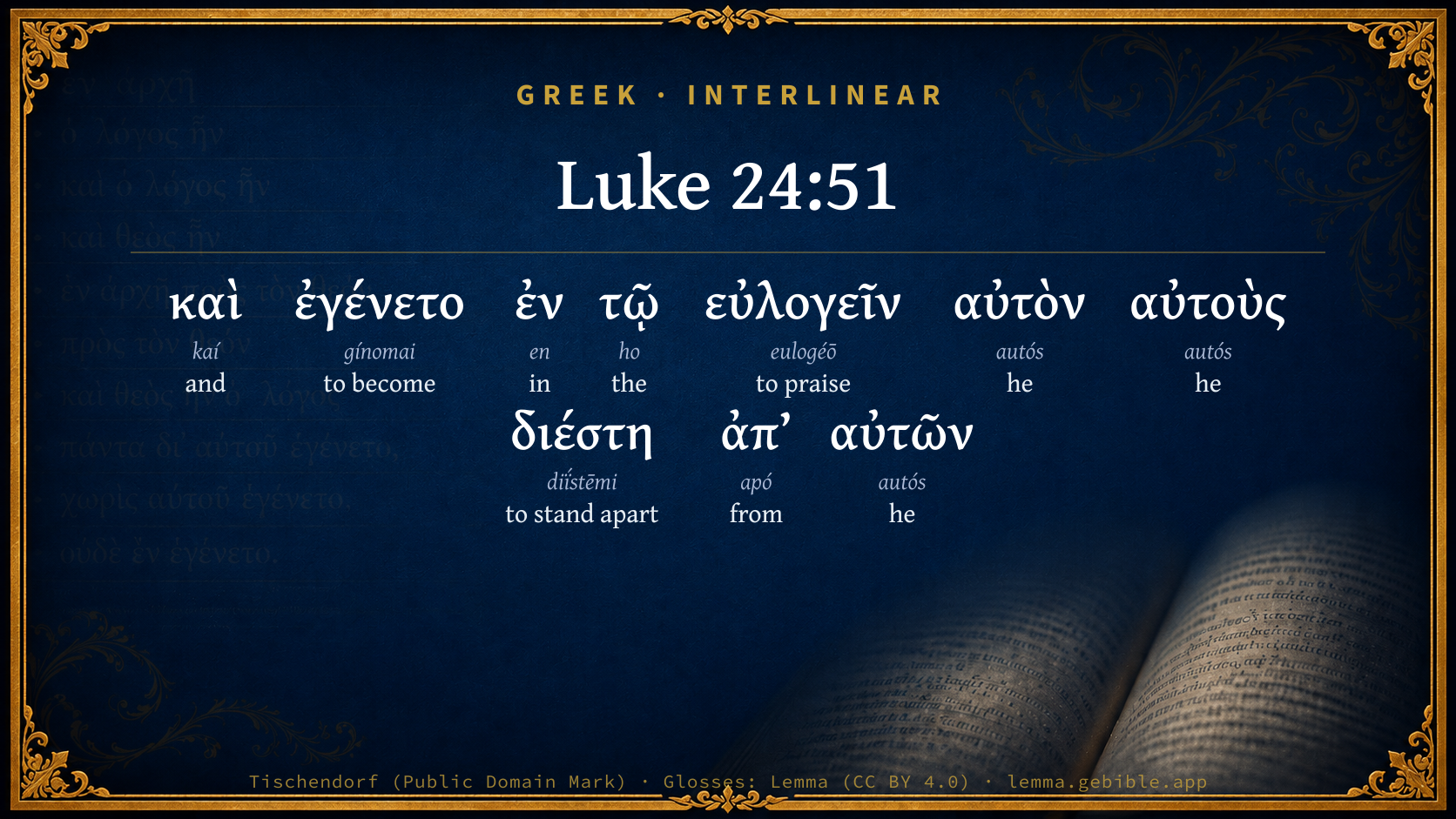
Greek (Tischendorf 8th ed.) Luke 24:51 appears in the Greek New Testament. The text above is from the Tischendorf 8th edition. Each word links to its Strong’s number and a concise gloss. Click any word for its full Thayer’s Greek Lexicon entry.
Download image
Cite this verse

Luke 24:51 (World English Bible). Public Domain. Lemma interlinear Bible study tool, https://lemma.gebible.app/v/luke/24/51.

Show BibTeX & RIS
BibTeX
RIS
English Translation
It happened, while he blessed them, that he withdrew from them, and was carried up into heaven.
World English Bible · Public Domain
Download a study sheet

One document with this verse’s original text, its word-by-word gloss line, the meaning frame, cross-references with their text, attributed commentary, and full source and license credits — printable, and it pastes into notes with its structure intact.

This verse Autodidact and up

Study sheet (.html) Plain text (.txt)

A passage Seminary Student

Up to 50 verses in one chapter. A passage sheet keeps up to 6 commentary sources and 12 cross-references per verse, in the order this page ranks them, and says so on the sheet whenever that leaves anything out. Ask for a single verse and you get the Autodidact verse sheet above.

Everything on this page stays free to read, with no account — the sheet is a download of what is already on screen, not access to it.

Want to remove ads? Support Godless Engineer
Compare translations 3

The same verse in 3 English versions, stacked beneath the original-language interlinear above. Click any original word for its lexicon entry.

Each is an independent rendering of the whole verse — the interlinear is not word-aligned to these translations.

Highlighted words mark where these versions differ — a whole-verse word diff, not a word-by-word alignment.

  • World English Bible Public Domain
    It happened, while he blessed them, that he withdrew from them, and was carried up into heaven.
  • King James Version Public Domain
    And it came to pass, while he blessed them, he was parted from them, and carried up into heaven.
  • unfoldingWord Literal Text CC BY-SA 4.0
    And it happened that, while he was blessing them, he separated from them and was carried up into heaven.

unfoldingWord Literal Text — © unfoldingWord, licensed CC BY-SA 4.0. Word-aligned USFM3 via Door43 (git.door43.org/unfoldingWord/en_ult).

Versions to compare (up to 4)

3 of 4 selected

Show all 19 translations

Every available English version of this verse, each an independent rendering of the whole verse.

  • World English Bible Public Domain
    It happened, while he blessed them, that he withdrew from them, and was carried up into heaven.
  • Berean Standard Bible Public Domain
    While He was blessing them, He left them and was carried up into heaven.
  • Majority Standard Bible Public Domain
    While He was blessing them, He left them and was carried up into heaven.
  • King James Version Public Domain
    And it came to pass, while he blessed them, he was parted from them, and carried up into heaven.
  • American Standard Version (1901) Public Domain
    And it came to pass, while he blessed them, he parted from them, and was carried up into heaven.
  • Revised Version (1885) Public Domain
    And it came to pass, while he blessed them, he parted from them, and was carried up into heaven.
  • Geneva Bible (1599) Public Domain
    And it came to passe, that as he blessed them, he departed from them, and was caried vp into heauen.
  • Douay-Rheims (1899) Public Domain
    And it came to pass, whilst he blessed them, he departed from them, and was carried up to heaven.
  • Young's Literal Translation Public Domain
    and it came to pass, in his blessing them, he was parted from them, and was borne up to the heaven;
  • Literal Standard Version CC BY-SA 4.0
    and it came to pass, in His blessing them, He was parted from them, and was carried up into Heaven;
  • Unlocked Literal Bible CC BY-SA 4.0
    It happened that, while he was blessing them, he left them and was carried up into heaven.
  • unfoldingWord Literal Text CC BY-SA 4.0
    And it happened that, while he was blessing them, he separated from them and was carried up into heaven.
  • Darby Bible Public Domain
    And it came to pass as he was blessing them, he was separated from them and was carried up into heaven.
  • World Messianic Bible Public Domain
    While he blessed them, he withdrew from them and was carried up into heaven.
  • Webster's Bible Public Domain
    And it came to pass, while he was blessing them, he was parted from them, and carried up into heaven.
  • Free Bible Version CC BY-SA 4.0
    While he was blessing them, he left them, and was taken up to heaven.
  • Bible in Basic English Public Domain
    And while he was doing so, he went from them and was taken up into heaven.
  • Text-Critical English NT CC BY 4.0
    While he was blessing them, he parted from them and was carried up into heaven.
  • Tyndale New Testament (1534) Public Domain
    And it cam to passe as he blessed the he departed from the and was caryed vp in to heven.

Literal Standard Version (2020), Covenant Press — licensed CC BY-SA 4.0. Text via the HelloAO Bible API (eBible.org). Unlocked Literal Bible (unfoldingWord) — licensed CC BY-SA 4.0. Text via the HelloAO Bible API (eBible.org). unfoldingWord Literal Text — © unfoldingWord, licensed CC BY-SA 4.0. Word-aligned USFM3 via Door43 (git.door43.org/unfoldingWord/en_ult). Free Bible Version, Dr. Jonathan Gallagher — licensed CC BY-SA 4.0. Text via the HelloAO Bible API (eBible.org).

Word by word

More ways to search: Search by grammar → Find every occurrence → Compare this word →

Practice this passage: Drill this verse → Learn its vocabulary →

About this verse

These counts appear in no published source. They are computed here, from the morphology-tagged text and Lemma’s own curated glosses. What Lemma adds →

10
words
8
distinct lemmas
Gospels
section

Notable vocabulary

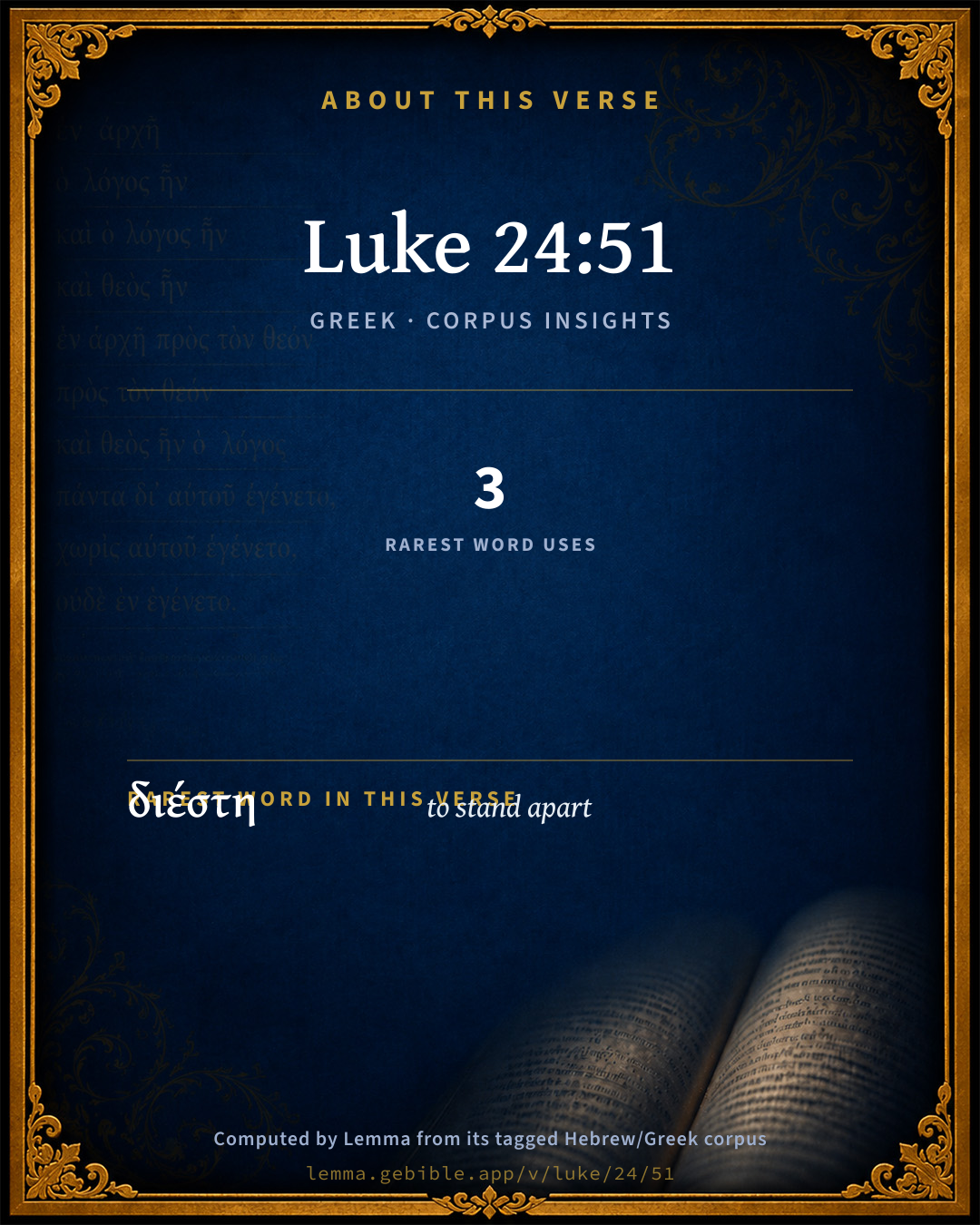
The rarest word here is διέστη to stand apart G1339 — appearing just 3 times in the whole Greek New Testament.

Shared distinctive vocabulary

διέστη to stand apart G1339 occurs in 3 verses of the Greek New Testament. Also found in:

Repetition

A word recurs within this verse:

  • αὐτὸν he G846 ×3

Cross-references

7

Topical passages linked to Luke 24:51 in the Treasury of Scripture Knowledge — connected by theme and wording, ordered by reader-vote popularity; previews shown in the World English Bible.

  • Acts 1:9 When he had said these things, as they were looking, he was taken up, and a cloud received him out of their sight.
  • 2 Kings 2:11 It happened, as they still went on, and talked, that behold, [there appeared] a chariot of fire, and horses of fire, which parted them both apart; and Elijah went up by a whirlwind into heaven.
  • Mark 16:19 So then the Lord Jesus, after he had spoken to them, was received up into heaven, and sat down at the right hand of God.
  • John 20:17 Jesus said to her, "Don't touch me, for I haven't yet ascended to my Father; but go to my brothers, and tell them, 'I am ascending to my Father and your Father, to my God and your God.'"
  • Ephesians 4:8–10 Therefore he says, "When he ascended on high, he led captivity captive, and gave gifts to men."
  • Hebrews 1:3 His Son is the radiance of his glory, the very image of his substance, and upholding all things by the word of his power, when he had by himself made purification for our sins, sat down on the right hand of the Majesty on high;
  • Hebrews 4:14 Having then a great high priest, who has passed through the heavens, Jesus, the Son of God, let us hold tightly to our confession.

Cross-references courtesy of OpenBible.info (CC BY 4.0).

Commentary

Notes on Luke 24:51 from classic Christian and Jewish commentators (each source and its license shown beneath its notes). The classic Christian expositions comment on the surrounding passage and are grouped to its opening verse, so a note may address several verses; the Jewish commentaries on the Tanakh (Rashi and others) are per-verse, so they appear only where the commentator wrote on this verse.

Lemma curates 59 commentaries, every one of them public domain or Creative Commons licensed, each selected and text-cleaned for this edition rather than reprinted as found. About our sources →

MacLaren's Expositions of Holy Scripture

Alexander MacLaren

2 Kings - Luke

WAS, IS, IS TO COME

THE ASCENSION

THE TRIUMPHANT END

THE TRANSLATION OF ELIJAH AND THE ASCENSION OF CHRIST

2Ki 2:11. - Luk 24:51.

These two events, the translation of Elijah and the Ascension of our Lord, have sometimes been put side by side in order to show that the latter narrative is nothing but a ‘variant’ of the former. See, it is said, the source of your New Testament story is only the old legend shaped anew by the wistful regrets of the early disciples. But to me it seems that the simple comparison of the two narratives is sufficient to bring out such fundamental difference in the ideas which they respectively embody as amount to opposition, and make any such theory of the origin of the latter absurdly improbable, I could wish no better foil for the history of the Ascension than the history of Elijah’s rapture. The comparison brings out contrasts at every step, and there is no readier way of throwing into strong relief the meaning and purpose of the former, than holding up beside it the story of the latter. The real parallel makes the divergences the more remarkable, for likeness sharpens our perception of unlikeness, and no contrast is so forcible as the contrast of things that correspond. I am much mistaken if we shall not find almost every truth of importance connected with our Lord’s Ascension emphasised for us by the comparison to which we now proceed.

I. The first point which may be mentioned is the contrast between the manner of Elijah’s translation, and that of our Lord’s Ascension.

It is perhaps not without significance that the place of the one event was on the uplands or in some of the rocky gorges beyond Jordan, and that of the other, the slopes of Olivet above Bethany. The lonely prophet, who had burst like a meteor on Israel from the solitudes of Gilead, whose fervour had ever and again been rekindled by return to the wilderness, whose whole career had isolated him from men, found the fitting place for that last wonder amidst the stern silence where he had so often sought asylum and inspiration. He was close to the scenes of mighty events in the past. There, on that overhanging peak, the lawgiver whose work he was continuing, and with whom he was to be so strangely associated on the Mount of Transfiguration, had made himself ready for his lonely grave. Here at his feet, the river had parted for the victorious march of Israel. Away down on his horizon the sunshine gleamed on the waters of the Dead Sea; and thus, on his native soil, surrounded by memorials of the Law which he laboured to restore, and of the victories which he would fain have brought back, and of the judgments which he saw again impending over Israel, the stern, solitary ascetic, the prophet of righteousness, whose single arm stayed the downward course of a nation, passed from his toil and his warfare.

What a different set of associations cluster round the place of Christ’s Ascension-’Bethany,’ or, as it is more particularly specified in the Acts, ‘Olivet’! In the very heart of the land, close by and yet out of sight of the great city, in no wild solitude, but perhaps in some dimple of the hill, neither shunning nor courting spectators, with the quiet home where He had rested so often in the little village at their feet there, and Gethsemane a few furlongs off, in such scenes did the Christ ‘whose delights were with the sons of men,’ and His life lived in closest companionship with His brethren, choose the place whence He should ‘ascend to their Father and His Father.’ Nor perhaps was it without a meaning that the Mount which received the last print of His ascending footstep was that which a mysterious prophecy designated as destined to receive the first print of the footstep of the Lord coming at a future day to end the long warfare with evil.

But more important than the localities is the contrasted manner of the two ascents. The prophet’s end was like the man. It was fitting that he should be swept up the skies in tempest and fire. The impetuosity of his nature, and the stormy energy of his career, had already been symbolised in the mighty and strong wind which rent the rocks, and in the fire that followed the earthquake; and similarly nothing could be more appropriate than that sudden rapture in storm and whirlwind, escorted by the flaming chivalry of heaven.

Nor is it only as appropriate to the character of the prophet and his work that this tempestuous translation is noteworthy. It also suggests very plainly that Elijah was lifted to the skies by power acting on him from without. He did not ascend; he was carried up; the earthly frame and the human nature had no power to rise. ‘No man hath ascended into heaven.’ The two men of whom the Old Testament speaks were alike in this, that ‘God took them.’ The tempest and the fiery chariot tell us how great was the exercise of divine power which bore the gross mortality thither, and how unfamiliar was the sphere into which it passed.

How full of the very spirit of Christ’s whole life is the contrasted manner of His Ascension! The silent gentleness, which did not strive nor cry nor cause His voice to be heard in the streets, marks Him even in that hour of lofty and transcendent triumph. There is no outward sign to accompany His slow upward movement through the quiet air. No blaze of fiery chariots, nor agitation of tempest is needed to bear Him heavenwards. The outstretched hands drop the dew of His benediction on the little company, and so He floats upward, His own will and indwelling power the royal chariot which bears Him, and calmly ‘leaves the world and goes unto the Father.’ The slow, continuous movement of ascent is emphatically made prominent in the brief narratives, both by the phrase in Luke, ‘He was carried up,’ which expresses continuous leisurely motion, and by the picture in the Acts, of the disciples gazing into heaven ‘as He went up,’ in which latter word is brought out, not only the slowness of the movement, but its origin in His own will and its execution by His own power.

Nor is this absence of any vehicle or external agency destroyed by the fact that ‘a cloud’ received Him out of their sight, for its purpose was not to raise Him heavenward, but to hide Him from the gazers’ eyes, that He might not seem to them to dwindle into distance, but that their last look and memory might be of His clearly discerned and loving face. Possibly, too, it may be intended to remind us of the cloud which guided Israel, the glory which dwelt between the cherubim, the cloud which overshadowed the Mount of Transfiguration, and to set forth a symbol of the Divine Presence welcoming to itself, His battle fought, the Son of His love.

Be that as it may, the manner of our Lord’s Ascension by His own inherent power is brought into boldest relief when contrasted with Elijah’s rapture, and is evidently the fitting expression, as it is the consequence, of His sole and singular divine nature. It accords with His own mode of reference to the Ascension, while He was on earth, which ever represents Him not as being taken, but as going: ‘I leave the world and go to the Father.’ ‘I ascend to My Father and your Father.’ The highest hope of the devoutest souls before Him had been, ‘Thou wilt afterwards take me to glory.’ The highest hope of devout souls since Him has been, ‘We shall be caught up to meet the Lord.’ But this Man ever speaks of Himself as able when He will, by His own power, to rise where no man hath ascended. His divine nature and pre-existence shine clearly forth, and as we stand gazing at Him blessing the world as He rises into the heavens, we know that we are looking on no mere mysterious elevation of a mortal to the skies, but are beholding the return of the Incarnate Lord, who willed to tarry among our earthly tabernacles for a time, to the glory where He was before, ‘His own calm home, His habitation from eternity.’

II. Another striking point of contrast embraces the relation which these two events respectively bear to the life’s work which had preceded them.

The falling mantle of Elijah has become a symbol known to all the world, for the transference of unfinished tasks and the appointment of successors to departed greatness. Elisha asked that he might have a double portion of his master’s spirit, not meaning twice as much as his master had had, but the eldest son’s share of the father’s possessions, the double of the other children’s portion. And, though his master had no power to bestow the gift, and had to reply as one who has nothing that he has not received, and cannot dispose of the grace that dwells in him, the prayer was answered, and the feebler nature of Elisha was fitted for the continuance of the work which Elijah left undone.

The mantle that passed from one to the other was the symbol of office and authority transferred; the functions were the same, whilst the holders had changed. The sons of the prophets bow before the new master; ‘the spirit of Elijah doth rest on Elisha.’

So the world goes on. Man after man serves his generation by the will of God, and is gathered to his fathers; and a new arm grasps the mantle to smite Jordan, and a new voice speaks from his empty place, and men recognise the successor, and forget the predecessor.

We turn to Christ’s Ascension, and there we meet with nothing analogous to this transference of office. No mantle falling from His shoulders lights on any of that group, none are hailed as His successors. What He has done bears and needs no repetition whilst time shall roll, whilst eternity shall last. His work is unique: ‘the help that is done on earth, He doeth it all Himself.’ His Ascension completed the witness of heaven, begun at His resurrection, that ‘He has offered one sacrifice for sins, for ever.’ He has left no unfinished work which another may perfect. He has done no work which another may do again for new generations. He has spoken all truth, and none may add to His words. He has fulfilled all righteousness, and none may better His pattern. He has borne all the world’s sin, and no time can waste the power of that sacrifice, nor any man add to its absolute sufficiency. This King of men wears a crown to which there is no heir. This Priest has a priesthood which passes to no other. This ‘Prophet’ does ‘live for ever,’ The world sees all other guides and helpers pass away, and every man’s work is caught up by other hands and carried on after he drops it, and the short memories and shorter gratitudes of men turn to the rising sun; but one Name remains undimmed by distance, and one work remains unapproached and unapproachable, and one Man remains whose office none other can hold, whose bow none but He can bend, whose mantle none can wear. Christ has ascended up on high and left a finished work for all men to trust, for no man to continue.

III. Whilst our Lord’s Ascension is thus marked as the seal of a work in which He has no successor, it is also emphatically set forth, by contrast with Elijah’s translation, as the transition to a continuous energy for and in the world.

Clearly the other narrative derives all its pathos from the thought that Elijah’s work is done. His task is over, and nothing more is to be hoped for from him. But that same absence from the history of Christ’s Ascension, of any hint of a successor, to which we have referred in the previous remarks, has an obvious bearing on His present relation to the world as well as on the completeness of His unique past work.

When Christ ascended up on high, He relinquished nothing of His activity for us, but only cast it into a new form, which in some sense is yet higher than that which it took on earth. His work for the world is in one aspect completed on the Cross, but in another it will never be completed until all the blessings which that Cross has lodged in the midst of humanity, have reached their widest possible diffusion and their highest possible development. Long ages ago He cried, ‘It is finished,’ but we may be far yet from the time when He shall say, ‘It is done’; and for all the slow years between His own word gives us the law of His activity, ‘My Father worketh hitherto, and I work.’

Christ’s Ascension is no withdrawal of the Captain of our salvation from the field where we are left to fight, nor has He gone up to the mountain, leaving us alone to tug at the oar, and shiver in the cold night air. True, there may seem a strange contrast between the present condition of the Lord who ‘was received up into heaven, and sitteth on the right hand of God,’ and that of the servants wandering through the world on His business; but the contrast is harmonised by the next words, ‘the Lord also working with them.’ Yes, He has gone up to sit at the right hand of God. That session at God’s right hand to which the Ascension is chiefly of importance as the transition, means the repose of a perfected redemption, the communion of the Son with the Father, the exercise of all the omnipotence of God, the administration of the world’s history. He has ascended that He might fill all things, that He might pour out His Spirit upon us, that the path to God may be trodden by our lame feet, that the whole resources of the divine nature may be wielded by the hands that were nailed to the Cross, that the mighty purpose of salvation may be fulfilled.

Elijah knew not whether his spirit could descend upon his follower. But Christ, though, as we have said, He left no legacy of falling mantle to any, left His Spirit to His people. What Elisha gained, Elijah lost. What Elisha desired, Elijah could not give nor guarantee. How firm and assured beside Elijah’s dubious ‘Thou hast asked a hard thing,’ and his ‘If thou see me, it shall be so,’ is Christ’s ‘It is expedient for you that I go away. For if I go not away the Comforter will not come, but if I depart, I will send Him unto you.’

Manifold are the forms of that new and continuous activity of Christ into which He passed when He left the earth: and as we contrast these with the utter helplessness any longer to counsel, rebuke or save, to which death reduces those who love us best, and to which even his glorious rapture into the heavens brought the strong prophet of fire, we can take up, with a new depth of meaning, the ancient words that tell of Christ’s exclusive prerogative of succouring and inspiring from within the veil: ‘Thou hast ascended on high; Thou hast led captivity captive; Thou hast received gifts for men.’

IV. The Ascension of Christ is still further set forth, in its very circumstances, by contrast with Elijah’s translation, as bearing on the hopes of humanity for the future.

The prophet is caught up to the glory and repose for himself alone, and the sole share which the gazing follower or the sons of the prophets straining their eyes there at Jericho, had in his triumph, was a deepened conviction of his prophetic mission, and perhaps some clearer faith in a future life. Their wonder and sorrow, Elisha’s immediate exercise of his new power, the prophets’ immediate transference of their allegiance to their new head, show that on both sides it was felt that they had no part in the event beyond that of awe-struck beholders. No light streamed from it on their own future. The path they had to tread was still the common road into the great darkness, as solitary and unknown as before. The chariot of fire parted their master from the common experience of humanity as from their fellowship, making him an exception to the sad rule of death, which frowned the grimmer and more inexorable by contrast with his radiant translation.

The very reverse is true of Christ’s Ascension. In Him our nature is taken up to the throne of God. His Resurrection assures us that ‘them which sleep in Jesus will God bring with Him,’ His passage to the heavens assures us that ‘they who are alive and remain shall be caught up together with them,’ and that all of both companies shall with Him live and reign, sharing His dominion, and moulded to His image.

If we would know of what our manhood is capable, if we would rise to the height of the hopes which God means that we should cherish, if we would gain a living grasp of the power that fulfils them, we have to stand there, gazing on the piled cloud that sails slowly upwards, the pure floor for our Brother’s feet. As we watch it rising with a motion which is rest, we have the right to think, ‘Thither the Forerunner is for us entered.’ We see there what man is meant for, what men who love Him attain. True, the world is still full of death and sorrow, man’s dominion seems a futile dream and a hope that mocks, but ‘we see Jesus,’ ascended up on high, and in Him we too are ‘made to sit together in heavenly places.’ The Breaker is gone up before them. Their King shall pass before them, and the Lord at the head of them.’

There is yet another aspect in which our Lord’s Ascension bears on our hopes for the future, namely, as connected with His coming again. In that respect, too, the contrast of Elijah’s translation may serve to emphasise the truth. Prophecy, indeed, in its latest voice, spoke of sending Elijah the prophet before the coming of the day of the Lord, and Rabbinical legends delighted to tell how he had been carried to the Garden of Eden, whence he would come again, in Israel’s sorest need. But the prophecy had no thought of a personal reappearance, and the dreams are only dreams such as we find in the legendary history of many nations. As Elisha recrossed the Jordan, he bore with him only a mantle and a memory, not a hope.

‘Ye men of Galilee, why stand ye gazing up into heaven? This same Jesus, which is taken up from you into heaven, shall so come in like manner as ye have seen Him go into heaven.’ How grand is the use in these mighty words of the name Jesus, the name that speaks of His true humanity, with all its weakness, limitations, and sorrow, with all its tenderness and brotherhood! The man who died and rose again, has gone up on high. He will so come as He has gone. ‘So’-that is to say, personally, corporeally, visibly, on clouds, perhaps to that very spot, ‘and His feet shall stand in that day upon the Mount of Olives.’ Thus Scripture teaches us ever to associate together the departure and the coming of the Lord, and always when we meditate on His Ascension to prepare a place for us, to think of His real presence with us through the ages, and of His coming again to receive us to Himself.

That parting on Olivet cannot be the end. Such a leave-taking is the prophecy of happy greetings and an inseparable reunion. The King has gone to receive a kingdom, and to return. Memory and hope coalesce, as we think of Him who is passed into the heavens, and the heart of the Church has to cherish at once the glad thought that its Head and helper has entered within the veil, and the still more joyous one, which lightens the days of separation and widowhood, that the Lord will come again.

So let us take our share in the ‘great joy’ with which the disciples returned to Jerusalem, left like sheep in the midst of wolves as they were, and ‘let us set our affection on things above, where Christ is, sitting at the right hand of God.’

Alexander MacLaren, Expositions of Holy Scripture (1904–1910) — public domain. Text from a community e-Sword module.

Tyndale Open Study Notes

Tyndale Open Resources

24:51 Cp. 2 Kgs 2:11. Jesus’ ascension was his exaltation to a position of authority over all creation (see Acts 2:32-36; 5:31; Eph 1:19-23; Phil 2:9-11; Heb 1:13).

Tyndale Open Study Notes — © Tyndale Open Resources, licensed CC BY-SA 4.0. Text via the HelloAO Bible API.

Meyer's Critical & Exegetical Commentary

Heinrich August Wilhelm Meyer

Luk_24:51. Ἐν τῷ εὐλογ.] therefore still during the blessing,not immediately after, but actually engaged in the discourse and attitude of blessing on parting from them. According to the usual reading: διέστη ἀπʼ αὐτῶν κ. ἀνεφέρ. εἰς τ. οὐραν., He separated Himself from them, and (more specific statement of this separation) was taken up into heaven. The passive voice does not require us to assume that there were any agents to carry Him up (according to de Wette, probably angels or a cloud). The imperfect is pictorial. Luke thinks of the ascension as a visible incident, which he has more fully represented at Acts 1. According to Paulus, indeed, κ. ἀνεφέρ. εἰς τ. οὐρ. is held to be only an inference! Moreover, if the words κ. ἀνεφέρ. εἰς τ. οὐρ. are not genuine (see the critical remarks), then the ascension is certainly meant even by the mere διέστη ἀπʼ αὐτῶν; but here it is not yet definitely indicated, which indication, together with the detailed description, Luke reserves for the beginning of his second book,till then, that διέστη ἀπʼ αὐτῶν was sufficient,the matter of fact of which was already incidentally mentioned at Luk_9:51, and was elsewhere familiar. On διέστη, secessit, comp. Hom. Il. xii. 86, xvi. 470; Valckenaer, Schol. in loc.

REMARK.

On the subject of the ascension[281] the following considerations are to be noted:(1) Considered in general, it is incontestably established as an actual fact by means of the testimony of the New Testament.[282] For, besides that in the passage before us it is historically narrated (comp. with Acts 1 and Mark 16.), it is also expressly predicted by Jesus Himself, Joh_20:17 (comp. as early as the suggestion in Joh_6:62); it is expressly mentioned by the apostles as having happened (Act_2:32-33; Act_3:21; 1Pe_3:22; Col_3:1 ff.; Eph_2:6; Eph_4:10. Comp. Act_7:56; 1Ti_3:16; Heb_9:24); and it formsand that, too, as a bodily exaltation into heaven to the throne of the glory of Godthe necessary historical presupposition of the whole preaching of the Parousia (which is a real and bodily return) as of the resuscitation of the dead and transformation of the living (which changes have their necessary condition in the glorified body of Him who is to accomplish them, viz. Christ, 1Co_15:5 ff., 1Co_15:8; 1Co_15:16; 1Co_15:22-23; Php_3:20-21, and elsewhere). (2) But the idea of a visibly, yea, sensibly glorious event must the rather be considered as an addition of subsequent tradition which grew up as a reflection of the idea of the Parousia, Act_1:11, since only Luke, and that certainly merely in the Acts (Mark not at all, Luk_16:18), expressly relates an event of that kind; but the first and fourth evangelists, although John had been an eye-witness, are wholly silent on the subject (including Joh_6:62), which they hardly either morally could have been or historically would have ventured to be, since such a highest and final external glorification would have incontrovertibly made good, even from a literary point of view, the forcible impression which that event would have necessarily produced upon the faithful, and would have just as naturally and incontrovertibly put forward this most splendid Messianic σημεῖον as the worthiest and most glorious copestonethe return to heaven corresponding to the heavenly origin. The reasons by which it has been sought to explain and justify their silence (see e.g. in Flatts Magaz. VIII. p. 67; Olshausen; Krabbe, p. 532 f.; Hug, Gutacht. II. p. 254 ff.; Ebrard, p. 602; Lange, II. p. 1762 ff.) are nothing more than forced, feeble, and even psychologically untenable evasions. Comp. Strauss, II. p. 657 f. (3) The body of the risen Lord was not yet in the state of glorification (it has flesh and bones, still bears the scars of the wounds, is touched, breathes, eats, speaks, walks, etc., in opposition to Theophylact, Augustine,[283] Krabbe, Ewald, Thomasius, Keim, and the old dogmatic writers); but, moreover, no longer of the same constitution as before the resurrection (Schleiermacher), but, as Origen already perceived, in a condition standing midway between[284] mundane corporeality and supra-mundane glorificationand immortal (Rom_6:9-10). Although, on account of the want of any analogy within our experience, such a condition of necessity does not admit of a more exact representation, yet still it explains in general the sort of estrangement between the risen Lord and His disciples,the partial doubt of the latter as to His identity, His not being hindered by the crucifixion wounds, His marvellous appearance and disappearance, and the like; moreover, by the consideration that Jesus rose again in a changed bodily constitution, the physiological scruples which have been raised against His rising from not merely apparent death are removed. The actual glorification whereby His body became the σῶμα πνευματικόν (1Co_15:45-47), the σῶμα τῆς δόξης αὐτοῦ (Php_3:21), first began in the moment of the ascension, when His body was transformed into the spiritual body, as they who are still living at the time of the Parousia shall be transformed (1Co_15:51-52), still with this difference, that the body of the latter up to that moment is still mortal (1Co_15:53), whereas the body of Christ, even from the time of the resurrection, was immortal; hence also an appeal to the marvellous healing power of Jesus, which was powerfully exercised on Himself (Hase, L. J. § 118), is here insufficient and inapplicable. The perfecting of this glorification of the body of Christ is not to be regarded as a matter to be perceived by the senses, since in general a glorified bodily organ does not fall into the category of things perceptible by human sense. The same is the case with the taking up of the glorified Christ into heaven, which, according to the analogy of Luk_24:31, is perhaps conceivable in the form of a vanishing. (4) Of the two traditions which had grown up in regard to the time of the ascension (see on Luk_24:50), in any case the one bearing that after His resurrection Jesus still abode on earth for a series of days, is decidedly to be preferred to the other, that even as early as the day of resurrection He also ascended. And this preference is to be given on the preponderating authority of John, with which is associated also Paul, by his account of the appearances of the risen Lord, 1Co_15:5-7,[285] and the notices of Act_10:41; Act_13:31.[286] Still there must remain a doubt therein whether the definite specification of forty days does not owe its origin to tradition, which fixed the approximate time (comp. Act_13:31) at this sacred number. The remarkable testimony of Barnabas, Ep. 15 (ἄγομεν τὴν ἡμέραν τὴν ὀγδόην εἰς εὐφροσύνην, ἐν ᾗ καὶ ὁ Ἰησοῦς ἀνέστη ἐκ νεκρῶν καὶ φανερωθεὶς ἀνέβη εἰς τοὺς οὐρανούς), in no way agrees with the forty days.[287] (5) If the appearances of the risen Lord are transferred as products of the imaginative faculty into the subjective region (Strauss, Holsten, and others), or if, in spite of the unanimous attestation of the third day as being that on which they first began, they are viewed as spiritual visions of the glorified One in the deepest excitement of aspiration and prayer (Ewald, Gesch. d. Apost. Zeitalt. p. 68 ff.); then, on the one hand, instead of the resurrection, in the sense of the New Testament, as an historical starting-point, there remains only the personal continuance of the exalted One (Schenkel); and, on the other hand, the ascension does not appear as an objective fact, but just as nothing more than the end of that powerful excitement, and this must carry with it the conclusion that from him to whom He in such wise appeared, the glorified One vanished again tranquilly into His everlasting glorification with God (Ewald, l.c. p. 95 ff.). Every spiritualizing of those appearances into internal experiences, into glorifications of the image of His character in the hearts of His faithful people (Schenkel), and the like, must convert a strange, widespread fanaticism into the fruitful mother of the mighty apostolic work, and into the foundation of the ecclesiastical edifice, but must regard the Gospel narratives on the matter as products and representations of self-deceptions, or as a kind of ghost stories,a view which the narratives of the Apostle John in reference thereto most decisively forbid. Comp. on Matt., Remark after Mat_28:10. This, withal, is opposed to the generalization of the concrete appearances into continued influences of the Lord, who still lived, and of His Spirit (Weizsäcker), in which for the ascension, as such, there is left nothing historical. Weisses view, moreover, is absolutely irreconcileable with the New Testament narratives, identifying as it does the ascension with the resurrection, so that, according to apostolic view, the fact was no going forth of the body from the grave, but the taking up of the soul (with a spiritual corporeality) out of Hades into heaven, whence the exalted One announced Himself in visions (see also Weisse, Evangelienfrage, p. 272 ff.; Gebhardt, Auferst. Chr. p. 72). To make out of the ascension absolutely the actual death which Jesus, being awakened from apparent death, soon after died (Paulus), could only be attained at the height of naturalistic outrage on the New Testament, but is not avoided also by Schleiermacher in his wavering expressions. The mythical construction out of Old Testament recollections (Strauss), and the directly hostile crumbling and destruction of the Gospel narratives (Bruno Bauer), amount to subjective assumptions contradictory of history; whilst, on the other hand, the revival of the Socinian opinion of a repeated ascension (Kinkel in the Stud. u. Krit. 1841, p. 597 ff.[288]) depended on erroneous interpretations of single passages (especially Joh_20:17). Finally, the abandoning of all attempts historically to ascertain the fact (de Wette on Luk_24:53) does justice neither to the accounts and intimations of the New Testament itself, nor to the demands which science must make on the ground of those intimations.

[281] Heaven is not herein to be taken in the sense of the omnipresence of the courts of God, as the old Lutheran orthodoxy, in the interest of the doctrine of Christs ubiquity, would have it (thus also Thomasius, Christi Pers. u. Werk, II. p. 282 ff.), or of the unextended ground of life which bears the entire expanse of space (Schoeberlen, Grundl. d. Heils, p. 67), but locally, of the dwelling place of the glory of God; see on Mat_6:9; Mar_16:18; Act_3:21. Erroneously, likewise in the sense of ubiquity, says Gess, Pers. Chr. p. 265: Where Jesus, according to His divinity, chooses to be essentially present, there He will also be according to His human corporeality. No; according to the New Testament view, it must mean: He there effectuates this His presence by the Holy Spirit in whom He communicates Himself. See, especially, John 14-16.; Rom_8:9-10. A becoming bodily present is a marvellous exception, as in the case of Pauls conversion, see on Act_9:3. Calvin, Inst. II. 16, rightly designates the being of Christ in heaven as a corporalis absentia from the earth.

[282] Against the denial of the capability of historical testimony to prove the actuality of miracles in general, see, especially, Rothe, zur Dogmat. p. 84 ff.

[283] Claritas in Christi corpore, cum resurrexit, ab oculis discipulorum potius abscondita fuisse, quam defuisse credenda est, Augustine, De civ. Dei, xxii. 9.

[284] Comp. Martensens Dogmat. § 172; Schmid, Bibl. Theol. I. p. 118; Hasse, Leben d. verklärt. Erlös. p. 113, who, however, mingling truth and error, represents the resurrection body of Christ already as σῶμα πνευματικόν (a confluence of spirit and body, p. 123). More accurately, Taute, Religions-philosophie, 1852, II. 1, p. 340 ff.

[285] Although at 1 Corinthians 15. it is not possible definitely to recognise whether all the appearances, which are specified before ver. 8, occurred before or after the ascension. Very little to the point, moreover, does Strauss (Christus des Glaubens, p. 179) lay stress on the fact that Paul knows nothing of touching and eating proofs. These, indeed, did not at all belong to the purpose and connection of his representation, as little as in the Acts at the narrative of the conversion of Paul broiled fish and honeycomb could find a place.

[286] But to seek to make out an agreement between the narrative of Luke about the appearances of the risen Lord with that of Paul (see e.g. Holtzmann) can in no way be successful.

[287] It may be supposed, with Weisse, that the ascension was here placed on the resurrection Sunday, or, with Ebrard, Lange, and many others, that it was generally placed on a Sunday. In respect of the latter supposition, indeed, the number forty has been given up, and it has been taken as a round number and increased to forty-two. But if, with Dressel, Patr. Ap. p. 36, a point be put after νεκρῶν, and what follows be taken as an independent clause, this is a very unfortunate evasion, by means of which καὶ φανερωθεὶς κ.τ.λ. is withdrawn from all connection, and is placed in the air. Not better is Gebhardts notion, Auferst. Chr. p. 52, that Barnabas, in mentioning also the ascension, did not intend to make specification of date at all for it.

[288] Comp. moreover, Taute, Religionsphilosophie, II. 1, p. 380 ff., according to whom the resurrection of Christ is said to have been His first descent out of the intelligible region of the existence of all things, but the ascension His last resurrection appearance, so that resurrection and ascension are so related to one another as special epoch-making appearances of the Lord before the brethren after His death. With such extravagant imaginations of historical details of faith is the philosophy of Herbart, even against its will, driven forth far beyond the characteristic limits which by Herbart himself are clearly and definitely laid down.

Meyer — Critical and Exegetical Commentary on the New Testament — English translation by Peter Christie, edited by Frederick Crombie (T&T Clark, 1880) — public domain. Text from a community e-Sword module.

Expositor's Greek Testament

ed. W. Robertson Nicoll

Luk 24:51 . διέστη , parted; taken by itself the verb might point merely to a temporary separation, but even apart from the next clause, referring to the ascension, it is evidently meant to denote a final leave-taking. καὶ ἀνεφέρετο , etc.: the absence of this clause from [211] [212] and some old Latin codd. may justify suspicion of a gloss, meant to bring the Gospel statement into line with Acts. But on the other hand, that the author of both books should make a distinct statement concerning the final departure of Jesus from the world in the one as well as in the other was to be expected.

[211] Codex Sinaiticus (sæc. iv.), now at St. Petersburg, published in facsimile type by its discoverer, Tischendorf, in 1862.

[212] Codex Bezae

The Expositor's Greek Testament, edited by W. Robertson Nicoll (1897–1910) — public domain. Text from a community e-Sword module.

Jamieson, Fausset & Brown

Robert Jamieson, A. R. Fausset & David Brown

while he blessed . . . parted, &c.--Sweet intimation! Incarnate Love, Crucified Love, Risen Love, now on the wing for heaven, waiting only those odorous gales which were to waft Him to the skies, goes away in benedictions, that in the character of Glorified, Enthroned Love, He might continue His benedictions, but in yet higher form, until He come again! And oh, if angels were so transported at His birth into this scene of tears and death, what must have been their ecstasy as they welcomed and attended Him "far above all heavens" into the presence-chamber, and conducted Him to the right hand of the Majesty on High! Thou hast an everlasting right, O my Saviour, to that august place. The brightness of the Father's glory, enshrined in our nature, hath won it well; for He poured out His soul unto death, and led captivity captive, receiving gifts for men, yea for the rebellious, that the Lord God might dwell among them. Thou art the King of glory, O Christ. Lift up your heads, O ye gates, be lifted up, ye everlasting doors, that the King of glory may come in! Even so wilt Thou change these vile bodies of ours, that they may be like unto Thine own glorious body; and then with gladness and rejoicing shall they be brought, they shall enter into the King's palace!

Jamieson, Fausset & Brown — Commentary Critical and Explanatory on the Whole Bible (1871) — public domain (CC PDM 1.0). Text via the HelloAO Bible API.

Adam Clarke's Commentary

Verse 51. Carried up into heaven.] ανεφερετο - into that heaven from which he had descended, Joh 1:18; Joh 3:13. This was forty days after his resurrection, Ac 1:3, during which time he had given the most convincing proofs of that resurrection, not only to the apostles, but to many others-to upwards of five hundred at one time, 1Co 15:6.

As in his life they had seen the way to the kingdom, and in his death the price of the kingdom, so in his ascension they had the fullest proof of the immortality of the soul, the resurrection of the human body, and of his continual intercession at the right hand of God.

There are some remarkable circumstances relative to this ascension mentioned in Ac 1:4-12.

Adam Clarke's Commentary on the Bible (1810–1826) — public domain. Text from a community e-Sword/MySword module.

Ellicott's Commentary for English Readers

(51) The words “and was carried up into heaven” are wanting in some of the best MSS., and are omitted accordingly by some recent editors.

A Bible Commentary for English Readers, edited by Charles John Ellicott (1878–1897) — public domain. Text from a community e-Sword module.

The Cambridge Bible for Schools and Colleges

gen. ed. J. J. S. Perowne

51. he was parted front them] “A cloud received Him out of their sight,” Act_1:9. The original however conveys a clearer impression.

He stood apart from them (aorist) and was gradually borne into heaven. The latter words are not found in א, D.

carried up into heaven] See Eph_4:8. The withdrawal of His Bodily Presence preceded His Spiritual Omnipresence. The omission of the Ascension by St Matthew and St John would be more remarkable if it was not assumed by them both (Joh_3:13; Joh_6:62; Joh_20:17; Mat_24:30).

The Cambridge Bible for Schools and Colleges (gen. ed. J. J. S. Perowne; Cambridge University Press, 1878–1918) — public domain. Text from a community e-Sword module.

Trapp's Complete Commentary

John Trapp

51 And it came to pass, while he blessed them, he was parted from them, and carried up into heaven.

Ver. 51. And it came to pass] See Mar 16:19; Act 1:9.

John Trapp, A Commentary or Exposition upon All the Books of the Old and New Testament (1647–1656) — public domain. Text from a community e-Sword module.

Haydock's Catholic Bible Commentary

Like a second Elias he was taken into heaven, but in a much more glorious manner. Elias was taken up in a mortal and corruptible body: but our divine Saviour, in a glorious, impassible, and immortal state; where now he is our head, having taken upon himself the nature of man, and is crowned with more than angel’s glory. (Theophylactus) --- What a glory this for us! Our head is clothed with everlasting glory; so shall we, his members, receive a share in his eternal kingdom. (St. John Chrysostom)

====================

George Leo Haydock (1774–1849), Haydock's Catholic Family Bible and Commentary, 1859 edition — public domain. Excludes Psalms (Douay-Rheims chapter numbering differs from Protestant) and Deuterocanonical books (Catholic canon only).

Whedon's Commentary on the Bible

Daniel D. Whedon

51. Parted from them—By his already commenced upward movement. It interrupted, as it were, his benediction, so that he ascended with hands outspread in blessing them. By a cloud upborne, he soon disappeared from sight; but for such a departure his apostles felt not grief, but abounding

joy. Up into heaven—See note on Mar_16:19. The picture of the ascension, with its results upon their minds, is at once exquisitely beautiful and perfectly natural.

Daniel D. Whedon (gen. ed.), Commentary on the Old and New Testaments (1874–1909) — public domain. Text from a community e-Sword module.

The Pulpit Commentary

And it came to pass, while he blessed them, he was parted from them, and carried up into heaven; more accurately rendered, while he blessed them, he parted from them, and was carried up into heaven. The last clause, "was carried up into heaven," is absent from some, but not from the majority of the older authorities. The Acts (Act_1:9) describe the act of ascension thus: "As they were looking, he was taken up; and a cloud received him out of their sight." The eleven and those chosen to witness the last earthly scene of the Lord"s ministry came together, in obedience probably to some command of their Master, to some meeting-place in Jerusalem, possibly the well-known upper room. Thence he led them forth from the sacred city, past the scene of the agony and the scene of the weeping, on to some quiet spot hard by loved Bethany, talking to them as they went; and as he spoke, suddenly he lifted up his pierced hands and blessed them; and in the very act of performing this deed of love, he rose, they still gazing on him rose, as it appears, by the exercise of his own will into the air, and, while they still gazed, a cloud came and veiled him from their sight. He was parted from them, and carried up into heaven. Among the appearances of the Risen to his followers during the forty days (ten of these distinct appearances are related in the Gospels and Epistles), this last notably differs from all that preceded it. As at other times when he showed himself to his friends during these forty days, so on the "Ascension" day Jesus apparently came forth suddenly from the invisible world; but not, as on former occasions, did he suddenly vanish from sight, as if he might shortly return as he had done before. But on this fortieth day he withdrew in a different way; as they gazed he rose up into the air, and so he parted from them, thus solemnly suggesting to them that not only was he "no more with them" (ver. 44), but that even those occasional and supernatural appearances vouchsafed to them since the Resurrection were now at an end. Nor were they grieved at this final parting; for we read

The Pulpit Commentary (1880–1919), ed. H.D.M. Spence-Jones & Joseph S. Exell — public domain. Text from a community e-Sword module.

John Wesley's Explanatory Notes

And while he was blessing them, he was parted from them - It was much more proper that our Lord should ascend into heaven, than that he should rise from the dead, in the sight of the apostles. For his resurrection was proved when they saw him alive after his passion: but they could not see him in heaven while they continued on earth. Please see Notes at Matt. i, 1

John Wesley, Explanatory Notes Upon the Whole Bible (1754–1765) — public domain. Text via the GEBible commentary corpus.

Scofield Reference Notes

C. I. Scofield

while he blessed them

The attitude of our Lord here characterizes this age. It is one of grace; an ascended Lord is blessing a believing people with spiritual blessings. The Jewish age was marked by temporal blessings as the reward of an obedient people. Deu 28:1-15.

In the kingdom-age spiritual and temporal blessings unite.

heaven

The Scriptures distinguish three heavens: first, the lower heavens, or the region of the clouds; secondly, the second or planetary heavens; and, thirdly, the heaven of heavens, the abode of God.

The Scofield Reference Bible (1917 edition), notes by C. I. Scofield — public domain. Text from a community e-Sword module.

Cambridge Greek Testament for Schools and Colleges

51. καὶ ἀνεφέρετο εἰς τὸν οὐρανόν. אBC. It is omitted in D.

51. διέστη. ‘He parted.’ Vulg[423] recessit. Not “was parted” (A.V[424]). The verb occurs (in the N.T.) only in Luk 22:59; Act 27:28. “A cloud received Him out of their sight,” Act 1:9. This passage however conveys a clearer impression. He stood apart from them (aorist) and was gradually borne into heaven. The latter words are not found in אD.

[423] Vulg. Vulgate.

[424] A.V. Authorised Version.

εἰς τὸν οὐρανόν. See Eph 4:8. The withdrawal of His Bodily Presence preceded His Spiritual Omnipresence. The omission of the Ascension by St Matthew and St John would be more remarkable if it was not assumed by them both (Joh 3:13; Joh 6:62; Joh 20:17; Mat 24:30).

Cambridge Greek Testament for Schools and Colleges (Cambridge University Press, 1896; 21 vols, various authors incl. Carr, Maclear, Plummer, Farrar, Lumby, Moule, M. R. James, Simcox) — public domain. Text from a community e-Sword module.

Alford’s Greek Testament

Henry Alford

51.] διέστη—not, ‘He went a little distance from them previous to His ascension,’—as Meyer would interpret it; but the two verbs belong to one and the same incident,—He was parted from them and borne up into heaven. We need not understand, ‘by an angel,’ or ‘by a cloud,’ nor need ἀνεφ. be middle; the absolute passive is best.

The tense is imperfect, signifying the continuance of the going up during the προσκυν. of the next verse.

The more particular account of the Ascension is given Act 1:9-12, where see notes. That account is in perfect accordance with this, but supplementary to it.

Henry Alford, The Greek Testament (1849–1861) — public domain. Text from a community e-Sword module.

International Critical Commentary

51. διέστη ἀπʼ αὐτῶν. “Parted, withdrew from them.” The verb is peculiar to Lk. in N. T. (22:59; Act 27:28). This refers to the Ascension, whatever view we take of the disputed words which follow. Weiss holds that, if the doubtful words are rejected, we must interpret διέστη of mere withdrawal, as after previous a appearances; and that Lk. purposely reserves the narrative of the Ascension for the Acts. But at least a final departure is meant. It is evident that ver. 50 is preparatory to a final withdrawal, and that vv. 52, 53 are subsequent to such an event. And was there ever a time when Lk. could have known of Christ’s final withdrawal without knowing of the Ascension? In the Acts (1:1, 2) he expressly states that ὁ πρῶτος λόγος contained an account of the work of Jesus ἄχρι ἧς ἡμέρας … ἀνελήμφθη. He himself, therefore, considered that he had recorded the Ascension in his Gospel. See Hastings, D.B. i. p. 161; D.C.G. i. p. 124.

καὶ ἀνεφέρετο εἰς τὸν οὐρανόν. The important witnesses which omit the disputed words in vv. 3, 6, 9, 36, 40 are here joined by א* and Aug. No motive for their omission, if they were in the original document, can be suggested. They look like a gloss on διέστη: but it is conceivable that Lk. himself (or Theophilus) may added them in a second edition of the Gospel, in order to make it quite clear what διέστη ἀπʼ αὐτῶν meant. See p. 569. Note the change from aor. to imperf.

προσκυνήσαντες αὐτόν. This again is either a very ancient gloss or an insertion made by the Evangelist in a second copy. See the note at the end of the chapter. Comp. Mat 28:17.

ὑπέστρεψαν εἰς Ἰερουσαλήμ: in obedience to καθίσατε ἐν τῇ πόλει (ver. 49).

μετὰ χαρᾶς μεγάλης. A writer of fiction would have made them lament the departure of their Master: comp, Joh 14:28, Joh 14:16:6, Joh 14:7, Joh 14:20, Joh 14:22, Joh 14:24.

Note how the marks of Lk.’s style continue to the end. In ver. 51 we have ἐγένετο, ἐν τῷ εὐλογεῖν, διέστη: in ver. 52 καὶ αὐτοί, ὑπέστρεψαν, and the addition of μέγας to an expression of emotion (2:9, 10, 8:37; Act 5:11, Act 15:3).

International Critical Commentary — older volumes (1896–1929), various authors — public domain. Text from a community e-Sword module.

Vincent's Word Studies in the New Testament

Marvin R. Vincent

And was carried up into heaven. Some texts omit.

Marvin R. Vincent, Word Studies in the New Testament (1887–1900) — public domain. Text from a community e-Sword/MySword module.

Lesson kit

Teaching starters — assembled from the data on this page, not authored interpretation. Every prompt links to the verse data it draws on. Edit before teaching.

Luke, in the Gospels, opens this verse with 10 words (8 distinct Greek lemmas). Its most distinctive word is diḯstēmi (“to stand apart”). A historical commentator’s framing appears above. Read the whole chapter for the surrounding context.

Discussion questions

  1. The word diḯstēmi carries the sense “to stand apart.” How does it shape the verse?
  2. How does Luke 22:59, which shares the word «to stand apart», read alongside this verse?
  3. What does the repetition of “he” (3× in this one verse) do in this verse?
  4. These translations render this verse differently; the difference is in the English rendering, not the original. What questions does that raise?
  5. Compare how MacLaren's Expositions of Holy Scripture and Tyndale Open Study Notes read this verse. Where do they agree or differ?

Things to notice

  • These translations choose different wording for 8 words in this verse.
  • “he” occurs 3× in this single verse.
  • 8 distinct Greek lemmas span 10 words in this verse.

Reading settings

Reading text

Shown beneath each verse's original-language words.

Old Testament
Old Testament edition

Read the OT as the Masoretic Hebrew (MT) or the Greek Septuagint (LXX).

English shown for the Greek Septuagint (in the Hebrew ↔ Greek comparison).

Comparing translations? Open the Compare panel on any verse page to stack up to four side by side.