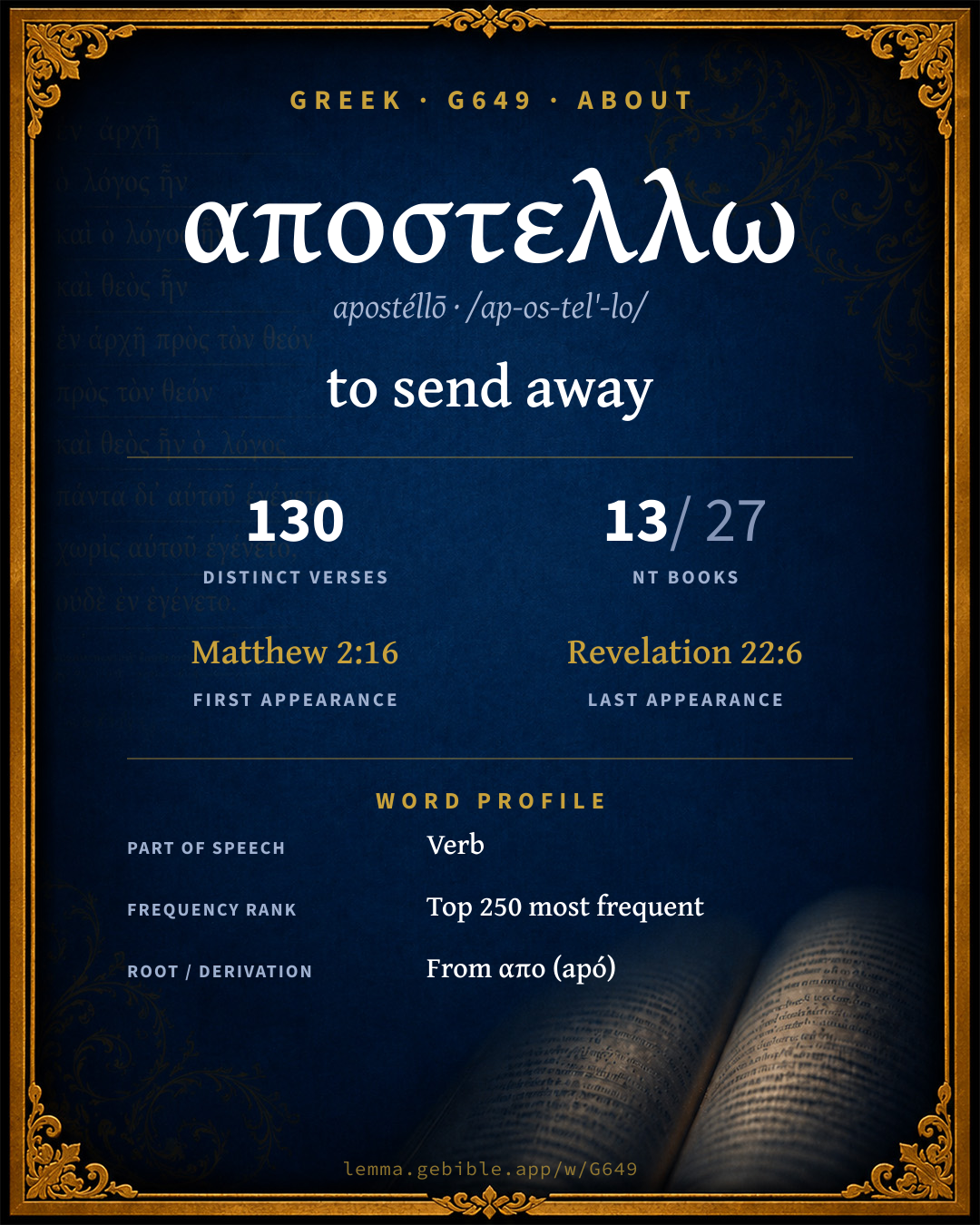
ἀποστέλλω
to send away
‘to send away’ is one of 4 main senses fuller range ↓
Full lexicon entry — Thayer's Greek Lexicon
From Thayer's Greek Lexicon
Where this word appears
See every Aorist-tense verb in the Greek New Testament →
Grammar key — what these labels mean
Part of speech
- Verb
- An action or state-of-being word.
Tense
- Aorist
- Action viewed as a simple whole, without regard to duration — often past (perfective aspect).
- Perfect
- A completed past action with continuing present results.
- Present
- Ongoing or general action in present time (imperfective aspect).
- Future
- Action expected in future time.
Voice
- Active
- The subject performs the action.
- Passive
- The subject receives the action.
Mood
- Indicative
- States a fact or asks a factual question (the mood of reality).
- Participle
- A verbal adjective (“writing,” “having written”).
- Imperative
- Expresses a command or request.
- Subjunctive
- Expresses probability, purpose, or possibility (the mood of contingency).
- Infinitive
- A verbal noun (“to write”), unmarked for person or number.
Case
- Nominative
- The case of the subject (and the predicate nominative).
- Accusative
- The case of the direct object and of extent.
- Dative
- The case of the indirect object, means, or location — “to / for / with / in.”
Person
- 3rd person
- The one spoken about (“he / she / it / they”).
- 2nd person
- The one addressed (“you”).
- 1st person
- The speaker (“I / we”).
Gender
- Masculine
- Grammatically masculine.
- Neuter
- Grammatically neuter.
Number
- Singular
- One.
- Plural
- More than one.
Grammatical forms 33 distinct
- Verb, Aorist, Active, Indicative, 3rd person, Singular 36 times (27%)
- Verb, Aorist, Active, Indicative, 3rd person, Plural 13 times (10%)
- Verb, Perfect, Active, Indicative, 3rd person, Singular 9 times (7%)
- Verb, Aorist, Active, Indicative, 2nd person, Singular 7 times (5%)
- Verb, Aorist, Active, Participle, Nominative, Singular, Masculine 7 times (5%)
- Verb, Present, Active, Indicative, 1st person, Singular 7 times (5%)
- Verb, Aorist, Active, Participle, Accusative, Singular, Masculine 4 times (3%)
- Verb, Future, Active, Indicative, 3rd person, Singular 4 times (3%)
+25 more forms (44 occurrences)
Parsed forms decoded from the imported morphology (Robinson–Tischendorf, public domain), counted across 131 parsed occurrences — not distinct verses.
Every verse where G649 appears — 130 distinct verses across 13 books. Click any verse to open its interlinear word-by-word view. Verse text shown in the World English Bible for context — . Each verse’s Greek form is shown with its reference; the English is not keyword-highlighted, since the data carries no word-level English alignment. Use “Compare translations” on any verse to read it across multiple English versions. This concordance covers the Greek New Testament; Septuagint (Greek Old Testament) occurrences of this word are not indexed here.
Matthew 22 verses
- Matthew 2:16 ἀποστείλας aor act ptcp nom sg masc Then Herod, when he saw that he was mocked by the wise men, was exceedingly angry, and sent out, and killed all the male children who were in Bethlehem and in all the surrounding countryside, from two years old and under, according to the exact time which he had learned from the wise men.
- Matthew 8:31 ἀπόστειλον aor act impv 2sg The demons begged him, saying, "If you cast us out, permit us to go away into the herd of pigs."
- Matthew 10:5 ἀπέστειλεν aor act ind 3sg Jesus sent these twelve out, and charged them, saying, "Don't go among the Gentiles, and don't enter into any city of the Samaritans.
- Matthew 10:16 ἀποστέλλω pres act ind 1sg "Behold, I send you out as sheep in the midst of wolves. Therefore be wise as serpents, and harmless as doves.
- Matthew 10:40 ἀποστείλαντά aor act ptcp acc sg masc He who receives you receives me, and he who receives me receives him who sent me.
- Matthew 11:10 ἀποστέλλω pres act ind 1sg For this is he, of whom it is written, 'Behold, I send my messenger before your face, who will prepare your way before you.'
- Matthew 13:41 ἀποστελεῖ fut act ind 3sg The Son of Man will send out his angels, and they will gather out of his Kingdom all things that cause stumbling, and those who do iniquity,
- Matthew 14:35 ἀπέστειλαν aor act ind 3pl When the men of that place recognized him, they sent into all that surrounding region, and brought to him all who were sick,
- Matthew 15:24 ἀπεστάλην aor pass ind 1sg But he answered, "I wasn't sent to anyone but the lost sheep of the house of Israel."
- Matthew 20:2 ἀπέστειλεν aor act ind 3sg When he had agreed with the laborers for a denarius a day, he sent them into his vineyard.
- Matthew 21:1 ἀπέστειλεν aor act ind 3sg When they drew near to Jerusalem, and came to Bethsphage, to the Mount of Olives, then Jesus sent two disciples,
- Matthew 21:3 ἀποστελεῖ fut act ind 3sg If anyone says anything to you, you shall say, 'The Lord needs them,' and immediately he will send them."
- Matthew 21:34 ἀπέστειλεν aor act ind 3sg When the season for the fruit drew near, he sent his servants to the farmers, to receive his fruit.
- Matthew 21:36 ἀπέστειλεν aor act ind 3sg Again, he sent other servants more than the first: and they treated them the same way.
- Matthew 21:37 ἀπέστειλεν aor act ind 3sg But afterward he sent to them his son, saying, 'They will respect my son.'
- Matthew 22:3 ἀπέστειλεν aor act ind 3sg and sent out his servants to call those who were invited to the marriage feast, but they would not come.
- Matthew 22:4 ἀπέστειλεν aor act ind 3sg Again he sent out other servants, saying, 'Tell those who are invited, "Behold, I have made ready my dinner. My oxen and my fatlings are killed, and all things are ready. Come to the marriage feast!"'
- Matthew 22:16 ἀποστέλλουσιν pres act ind 3pl They sent their disciples to him, along with the Herodians, saying, "Teacher, we know that you are honest, and teach the way of God in truth, no matter who you teach, for you aren't partial to anyone.
- Matthew 23:34 ἀποστέλλω pres act ind 1sg Therefore, behold, I send to you prophets, wise men, and scribes. Some of them you will kill and crucify; and some of them you will scourge in your synagogues, and persecute from city to city;
- Matthew 23:37 ἀπεσταλμένους perf pass ptcp acc pl masc "Jerusalem, Jerusalem, who kills the prophets, and stones those who are sent to her! How often would I have gathered your children together, even as a hen gathers her chickens under her wings, and you would not!
- Matthew 24:31 ἀποστελεῖ fut act ind 3sg He will send out his angels with a great sound of a trumpet, and they will gather together his chosen ones from the four winds, from one end of the sky to the other.
- Matthew 27:19 ἀπέστειλεν aor act ind 3sg While he was sitting on the judgment seat, his wife sent to him, saying, "Have nothing to do with that righteous man, for I have suffered many things this day in a dream because of him."
Mark 20 verses
- Mark 1:2 ἀποστέλλω pres act ind 1sg As it is written in the prophets, "Behold, I send my messenger before your face, Who will prepare your way before you.
- Mark 3:14 ἀποστέλλῃ pres act subj 3sg He appointed twelve, that they might be with him, and that he might send them out to preach,
- Mark 3:31 ἀπέστειλαν aor act ind 3pl His mother and his brothers came, and standing outside, they sent to him, calling him.
- Mark 4:29 ἀποστέλλει pres act ind 3sg But when the fruit is ripe, immediately he puts forth the sickle, because the harvest has come."
- Mark 5:10 ἀποστείλῃ aor act subj 3sg He begged him much that he would not send them away out of the country.
- Mark 6:7 ἀποστέλλειν pres act inf He called to himself the twelve, and began to send them out two by two; and he gave them authority over the unclean spirits.
- Mark 6:17 ἀποστείλας aor act ptcp nom sg masc For Herod himself had sent out and arrested John, and bound him in prison for the sake of Herodias, his brother Philip's wife, for he had married her.
- Mark 6:27 ἀποστείλας aor act ptcp nom sg masc Immediately the king sent out a soldier of his guard, and commanded to bring John's head, and he went and beheaded him in the prison,
- Mark 8:26 ἀπέστειλεν aor act ind 3sg He sent him away to his house, saying, "Don't enter into the village, nor tell anyone in the village."
- Mark 9:37 ἀποστείλαντά aor act ptcp acc sg masc "Whoever receives one such little child in my name, receives me, and whoever receives me, doesn't receive me, but him who sent me."
- Mark 11:1 ἀποστέλλει pres act ind 3sg When they drew near to Jerusalem, to Bethsphage and Bethany, at the Mount of Olives, he sent two of his disciples,
- Mark 11:3 ἀποστέλλει pres act ind 3sg If anyone asks you, 'Why are you doing this?' say, 'The Lord needs him;' and immediately he will send him back here."
- Mark 12:2 ἀπέστειλεν aor act ind 3sg When it was time, he sent a servant to the farmer to get from the farmer his share of the fruit of the vineyard.
- Mark 12:3 ἀπέστειλαν aor act ind 3pl They took him, beat him, and sent him away empty.
- Mark 12:4 ἀπέστειλεν aor act ind 3sg Again, he sent another servant to them; and they threw stones at him, wounded him in the head, and sent him away shamefully treated.
- Mark 12:5 ἀπέστειλεν aor act ind 3sg Again he sent another; and they killed him; and many others, beating some, and killing some.
- Mark 12:6 ἀπέστειλεν aor act ind 3sg Therefore still having one, his beloved son, he sent him last to them, saying, 'They will respect my son.'
- Mark 12:13 ἀποστέλλουσιν pres act ind 3pl They sent some of the Pharisees and of the Herodians to him, that they might trap him with words.
- Mark 13:27 ἀποστελεῖ fut act ind 3sg Then he will send out his angels, and will gather together his chosen ones from the four winds, from the ends of the earth to the ends of the sky.
- Mark 14:13 ἀποστέλλει pres act ind 3sg He sent two of his disciples, and said to them, "Go into the city, and there you will meet a man carrying a pitcher of water. Follow him,
Luke 25 verses
- Luke 1:19 ἀπεστάλην aor pass ind 1sg The angel answered him, "I am Gabriel, who stands in the presence of God. I was sent to speak to you, and to bring you this good news.
- Luke 1:26 ἀπεστάλη aor pass ind 3sg Now in the sixth month, the angel Gabriel was sent from God to a city of Galilee, named Nazareth,
- Luke 4:18 ἀπέσταλκέν perf act ind 3sg "The Spirit of the Lord is on me, Because he has anointed me to preach good news to the poor. He has sent me to heal the brokenhearted, To proclaim release to the captives, Recovering of sight to the blind, To deliver those who are crushed,
- Luke 4:19 ἀποστεῖλαι aor act inf And to proclaim the acceptable year of the Lord."
- Luke 4:43 ἀπεστάλην aor pass ind 1sg But he said to them, "I must preach the good news of the Kingdom of God to the other cities also. For this reason I have been sent."
- Luke 7:3 ἀπέστειλεν aor act ind 3sg When he heard about Jesus, he sent to him elders of the Jews, asking him to come and save his servant.
- Luke 7:20 ἀπέσταλκεν perf act ind 3sg When the men had come to him, they said, "John the Baptizer has sent us to you, saying, 'Are you he who comes, or should we look for another?'"
- Luke 7:27 ἀποστέλλω pres act ind 1sg This is he of whom it is written, 'Behold, I send my messenger before your face, Who will prepare your way before you.'
- Luke 9:2 ἀπέστειλεν aor act ind 3sg He sent them forth to preach the Kingdom of God, and to heal the sick.
- Luke 9:48 ἀποστείλαντά aor act ptcp acc sg masc and said to them, "Whoever receives this little child in my name receives me. Whoever receives me receives him who sent me. For whoever is least among you all, this one will be great."
- Luke 9:52 ἀπέστειλεν aor act ind 3sg and sent messengers before his face. They went, and entered into a village of the Samaritans, so as to prepare for him.
- Luke 10:1 ἀπέστειλεν aor act ind 3sg Now after these things, the Lord also appointed seventy others, and sent them two by two ahead of him into every city and place, where he was about to come.
- Luke 10:3 ἀποστέλλω pres act ind 1sg Go your ways. Behold, I send you out as lambs among wolves.
- Luke 10:16 ἀποστείλαντά aor act ptcp acc sg masc Whoever listens to you listens to me, and whoever rejects you rejects me. Whoever rejects me rejects him who sent me."
- Luke 11:49 ἀποστελῶ fut act ind 1sg Therefore also the wisdom of God said, 'I will send to them prophets and apostles; and some of them they will kill and persecute,
- Luke 13:34 ἀπεσταλμένους perf pass ptcp acc pl masc "Jerusalem, Jerusalem, that kills the prophets, and stones those who are sent to her! How often I wanted to gather your children together, like a hen gathers her own brood under her wings, and you refused!
- Luke 14:17 ἀπέστειλεν aor act ind 3sg He sent out his servant at supper time to tell those who were invited, 'Come, for everything is ready now.'
- Luke 14:32 ἀποστείλας aor act ptcp nom sg masc Or else, while the other is yet a great way off, he sends an envoy, and asks for conditions of peace.
- Luke 19:14 ἀπέστειλαν aor act ind 3pl But his citizens hated him, and sent an envoy after him, saying, 'We don't want this man to reign over us.'
- Luke 19:29 ἀπέστειλεν aor act ind 3sg It happened, when he drew near to Bethsphage and Bethany, at the mountain that is called Olivet, he sent two of his disciples,
- Luke 19:32 ἀπεσταλμένοι perf pass ptcp nom pl masc Those who were sent went away, and found things just as he had told them.
- Luke 20:10 ἀπέστειλεν aor act ind 3sg At the proper season, he sent a servant to the farmers to collect his share of the fruit of the vineyard. But the farmers beat him, and sent him away empty.
- Luke 20:20 ἀπέστειλαν aor act ind 3pl They watched him, and sent out spies, who pretended to be righteous, that they might trap him in something he said, so as to deliver him up to the power and authority of the governor.
- Luke 22:8 ἀπέστειλεν aor act ind 3sg He sent Peter and John, saying, "Go and prepare the Passover for us, that we may eat."
- Luke 22:35 ἀπέστειλα aor act ind 1sg He said to them, "When I sent you out without purse, and wallet, and shoes, did you lack anything?" They said, "Nothing."
John 27 verses
- John 1:6 ἀπεσταλμένος perf pass ptcp nom sg masc There came a man, sent from God, whose name was John.
- John 1:19 ἀπέστειλαν aor act ind 3pl This is John's testimony, when the Jews sent priests and Levites from Jerusalem to ask him, "Who are you?"
- John 1:24 ἀπεσταλμένοι perf pass ptcp nom pl masc The ones who had been sent were from the Pharisees.
- John 3:17 ἀπέστειλεν aor act ind 3sg For God didn't send his Son into the world to judge the world, but that the world should be saved through him.
- John 3:28 ἀπεσταλμένος perf pass ptcp nom sg masc You yourselves testify that I said, 'I am not the Christ,' but, 'I have been sent before him.'
- John 3:34 ἀπέστειλεν aor act ind 3sg For he whom God has sent speaks the words of God; for God gives the Spirit without measure.
- John 4:38 ἀπέσταλκα perf act ind 1sg I sent you to reap that for which you haven't labored. Others have labored, and you have entered into their labor."
- John 5:33 ἀπεστάλκατε perf act ind 2pl You have sent to John, and he has testified to the truth.
- John 5:36 ἀπέσταλκεν perf act ind 3sg But the testimony which I have is greater than that of John, for the works which the Father gave me to accomplish, the very works that I do, testify about me, that the Father has sent me.
- John 5:38 ἀπέστειλεν aor act ind 3sg You don't have his word living in you; because you don't believe him whom he sent.
- John 6:29 ἀπέστειλεν aor act ind 3sg Jesus answered them, "This is the work of God, that you believe in him whom he has sent."
- John 6:57 ἀπέστειλέν aor act ind 3sg As the living Father sent me, and I live because of the Father; so he who feeds on me, he will also live because of me.
- John 7:29 ἀπέσταλκεν perf act ind 3sg I know him, because I am from him, and he sent me."
- John 7:32 ἀπέστειλαν aor act ind 3pl The Pharisees heard the multitude murmuring these things concerning him, and the chief priests and the Pharisees sent officers to arrest him.
- John 8:42 ἀπέστειλεν aor act ind 3sg Therefore Jesus said to them, "If God were your Father, you would love me, for I came out and have come from God. For I haven't come of myself, but he sent me.
- John 9:7 ἀπεσταλμένος perf pass ptcp nom sg masc and said to him, "Go, wash in the pool of Siloam" (which means "Sent"). So he went away, washed, and came back seeing.
- John 10:36 ἀπέστειλεν aor act ind 3sg Do you say of him whom the Father sanctified and sent into the world, 'You blaspheme,' because I said, 'I am the Son of God?'
- John 11:3 ἀπέστειλαν aor act ind 3pl The sisters therefore sent to him, saying, "Lord, behold, he for whom you have great affection is sick."
- John 11:42 ἀπέστειλας aor act ind 2sg I know that you always listen to me, but because of the multitude that stands around I said this, that they may believe that you sent me."
- John 17:3 ἀπέστειλας aor act ind 2sg This is eternal life, that they should know you, the only true God, and him whom you sent, Jesus Christ.
- John 17:8 ἀπέστειλας aor act ind 2sg for the words which you have given me I have given to them, and they received them, and knew for sure that I came forth from you, and they have believed that you sent me.
- John 17:18 ἀπέστειλας ἀπέστειλα aor act ind 2sg aor act ind 1sg As you sent me into the world, even so I have sent them into the world.
- John 17:21 ἀπέστειλας aor act ind 2sg that they may all be one; even as you, Father, are in me, and I in you, that they also may be one in us; that the world may believe that you sent me.
- John 17:23 ἀπέστειλας aor act ind 2sg I in them, and you in me, that they may be perfected into one; that the world may know that you sent me, and loved them, even as you loved me.
- John 17:25 ἀπέστειλας aor act ind 2sg Righteous Father, the world hasn't known you, but I knew you; and these knew that you sent me.
- John 18:24 ἀπέστειλεν aor act ind 3sg Annas sent him bound to Caiaphas, the high priest.
- John 20:21 ἀπέσταλκέν perf act ind 3sg Jesus therefore said to them again, "Peace be to you. As the Father has sent me, even so I send you."
Acts 24 verses
- Acts 3:20 ἀποστείλῃ aor act subj 3sg and that he may send Christ Jesus, who was ordained for you before,
- Acts 3:26 ἀπέστειλεν aor act ind 3sg God, having raised up his servant, Jesus, sent him to you first, to bless you, in turning away everyone of you from your wickedness."
- Acts 5:21 ἀπέστειλαν aor act ind 3pl When they heard this, they entered into the temple about daybreak, and taught. But the high priest came, and those who were with him, and called the council together, and all the senate of the children of Israel, and sent to the prison to have them brought.
- Acts 7:14 ἀποστείλας aor act ptcp nom sg masc Joseph sent, and summoned Jacob, his father, and all his relatives, seventy-five souls.
- Acts 7:34 ἀποστείλω aor act subj 1sg I have surely seen the affliction of my people that is in Egypt, and have heard their groaning. I have come down to deliver them. Now come, I will send you into Egypt.'
- Acts 7:35 ἀπέσταλκεν perf act ind 3sg "This Moses, whom they refused, saying, 'Who made you a ruler and a judge?'--God has sent him as both a ruler and a deliverer by the hand of the angel who appeared to him in the bush.
- Acts 8:14 ἀπέστειλαν aor act ind 3pl Now when the apostles who were at Jerusalem heard that Samaria had received the word of God, they sent Peter and John to them,
- Acts 9:17 ἀπέσταλκέν perf act ind 3sg Ananias departed, and entered into the house. Laying his hands on him, he said, "Brother Saul, the Lord, who appeared to you on the road by which you came, has sent me, that you may receive your sight, and be filled with the Holy Spirit."
- Acts 9:38 ἀπέστειλαν aor act ind 3pl As Lydda was near Joppa, the disciples, hearing that Peter was there, sent two men to him, imploring him not to delay in coming to them.
- Acts 10:8 ἀπέστειλεν aor act ind 3sg Having explained everything to them, he sent them to Joppa.
- Acts 10:17 ἀπεσταλμένοι perf pass ptcp nom pl masc Now while Peter was very perplexed in himself what the vision which he had seen might mean, behold, the men who were sent by Cornelius, having made inquiry for Simon's house, stood before the gate,
- Acts 10:20 ἀπέσταλκα perf act ind 1sg But arise, get down, and go with them, doubting nothing; for I have sent them."
- Acts 10:36 ἀπέστειλεν aor act ind 3sg The word which he sent to the children of Israel, preaching good news of peace by Jesus Christ--he is Lord of all--
- Acts 11:11 ἀπεσταλμένοι perf pass ptcp nom pl masc Behold, immediately three men stood before the house where I was, having been sent from Caesarea to me.
- Acts 11:13 ἀπόστειλον aor act impv 2sg He told us how he had seen the angel standing in his house, and saying to him, 'Send to Joppa, and get Simon, whose surname is Peter,
- Acts 11:30 ἀποστείλαντες aor act ptcp nom pl masc which they also did, sending it to the elders by the hands of Barnabas and Saul.
- Acts 13:15 ἀπέστειλαν aor act ind 3pl After the reading of the law and the prophets, the rulers of the synagogue sent to them, saying, "Brothers, if you have any word of exhortation for the people, speak."
- Acts 15:27 ἀπεστάλκαμεν perf act ind 1pl We have sent therefore Judas and Silas, who themselves will also tell you the same things by word of mouth.
- Acts 15:33 ἀποστείλαντας aor act ptcp acc pl masc After they had spent some time there, they were sent back with greetings from the brothers to the apostles.
- Acts 16:35 ἀπέστειλαν aor act ind 3pl But when it was day, the magistrates sent the sergeants, saying, "Let those men go."
- Acts 16:36 ἀπέσταλκαν perf act ind 3pl The jailer reported these words to Paul, saying, "The magistrates have sent to let you go; now therefore come out, and go in peace."
- Acts 19:22 ἀποστείλας aor act ptcp nom sg masc Having sent into Macedonia two of those who ministered to him, Timothy and Erastus, he himself stayed in Asia for a while.
- Acts 26:17 ἀποστέλλω pres act ind 1sg delivering you from the people, and from the Gentiles, to whom I send you,
- Acts 28:28 ἀπεστάλη aor pass ind 3sg "Be it known therefore to you, that the salvation of God is sent to the Gentiles. They will also listen."
Romans 1 verse
1 Corinthians 1 verse
2 Corinthians 1 verse
2 Timothy 1 verse
Hebrews 1 verse
1 Peter 1 verse
1 John 3 verses
- 1 John 4:9 ἀπέσταλκεν perf act ind 3sg By this was God's love revealed in us, that God has sent his one and only Son into the world that we might live through him.
- 1 John 4:10 ἀπέστειλεν aor act ind 3sg In this is love, not that we loved God, but that he loved us, and sent his Son as the atoning sacrifice for our sins.
- 1 John 4:14 ἀπέσταλκεν perf act ind 3sg We have seen and testify that the Father has sent the Son as the Savior of the world.
Revelation 3 verses
- Revelation 1:1 ἀποστείλας aor act ptcp nom sg masc This is the Revelation of Jesus Christ, which God gave him to show to his servants the things which must happen soon, which he sent and made known by his angel to his servant, John,
- Revelation 5:6 ἀπεσταλμένα perf pass ptcp nom pl neut I saw in the midst of the throne and of the four living creatures, and in the midst of the elders, a Lamb standing, as though it had been slain, having seven horns, and seven eyes, which are the seven Spirits of God, sent out into all the earth.
- Revelation 22:6 ἀπέστειλεν aor act ind 3sg He said to me, "These words are faithful and true. The Lord God of the spirits of the prophets sent his angel to show to his bondservants the things which must happen soon."
About this entry
At a glance — auto-summarized from this page’s data, not written by a person. Every figure links to its source below. This summary describes the numbers; it doesn’t interpret them.
αποστελλω (apostéllō) is a Greek verb most often rendered “to send away.” Its lexical range runs to 4 senses. With 130 verses in 13 books, it is a common word in the Greek New Testament. Debuting at Matthew 2:16, it then recurs through the corpus. From the same root come απο, απαγγελλω and απαγχομαι. For the data behind this summary, explore the sense tree and the renderings breakdown below.
Gloss history
Strong's 1890 vs modern scholarship

About this word
Strong's G649 catalogs a Greek word from the Greek New Testament.
These counts are not copied from any lexicon or concordance. They are computed here, from the morphology-tagged Greek New Testament. What Lemma adds →
- 130
- distinct verses
- The word appears in 130 distinct verses.
- 13 / 27
- NT books
- The word appears in 13 of 27 New Testament books.
- #128
- by frequency
- Top 250 most frequent Greek words (rank 128 of 5,347 Greek words by occurrence).
View all 130 occurrences in the concordance →
By section of the New Testament
By traditional corpus
Conventional, traditional groupings — biblical authorship is debated, so this is a traditional corpus grouping, not an authorship claim. Some books belong to more than one corpus (Luke is in both the Gospels and the Lukan corpus, and so on), so these shares overlap and need not total 100%. Each figure is a share of the word’s 130 distinct verses.
- Gospels 94 verses · 72%
- Lukan (Luke–Acts) 49 verses · 38%
- Johannine 33 verses · 25%
- Pauline corpus 4 verses · 3%
- General (Catholic) Epistles 4 verses · 3%
- Revelation 3 verses · 2%
- Hebrews 1 verse · 1%
How translations render this word
Counts come from each version’s own published word-to-Strong’s tagging or interlinear alignment — an approximate guide to how each version renders this word, not a word-level alignment the data otherwise carries. Because each total is that version’s own tagged count, the per-version totals vary from one another and need not match the appearance or distinct-verse counts above. These counts may also differ from a printed concordance because Lemma counts each distinctly tagged rendering and does not collapse phrase taggings into a single head-word total. This is a fixed set of word-tagged versions (KJV, ASV, BSB, ULT) and does not change with the reading translation you choose elsewhere. Each version’s license is shown beside its name below (and on Sources).
- King James Version: Sent 37×, He sent 17×, Send 11×
- American Standard Version: Sent 37×, He sent 16×, Send 9×
- Berean Standard Bible: Sent 44×, He sent 17×, Has sent 6×
- unfoldingWord Literal Text: Sent 34×, He sent 19×, Has sent 8×
King James Version Public Domain
Renders G649 across 143 tagged occurrences — most commonly:
Plus other, less common renderings. Plus 27 renderings that appear only once — usually multi-word phrases or single function words the recovered tagging swept in, not distinct renderings.
American Standard Version Public Domain
Renders G649 across 138 tagged occurrences — most commonly:
Plus other, less common renderings. Plus 35 renderings that appear only once — usually multi-word phrases or single function words the recovered tagging swept in, not distinct renderings.
Berean Standard Bible Public Domain
Renders G649 across 132 tagged occurrences — most commonly:
Plus other, less common renderings. Plus 35 renderings that appear only once — usually multi-word phrases or single function words the recovered tagging swept in, not distinct renderings.
unfoldingWord Literal Text CC BY-SA 4.0
Renders G649 across 147 tagged occurrences — most commonly:
Plus other, less common renderings. Plus 27 renderings that appear only once — usually multi-word phrases or single function words the recovered tagging swept in, not distinct renderings.
Senses in Thayer's
The 4 senses Thayer's distinguishes for this word, in lexicon order (not ranked by frequency or importance). The full entry — with sub-senses — is in the Lexicon Entry tab.
- to order (one) to go to a place appointed
- to allow one to depart, that he may be in a state of liberty
- to order one to depart, send off
- to drive away
Word origin
Derived from απο (apó) (G575) — from.
Forms in the corpus
The 35 distinct written forms G649 takes in the Greek New Testament, most frequent first — each parse links to that tense’s occurrences in the concordance.
Same root — word family
Other Thayer's entries built from the same root as G649, grouped by Strong’s listed origin. These share a root / origin per the lexicon — not necessarily a shared meaning. Each links to that word’s own entry.
Derives from
Shares the same root
- απαγγελλω apangéllō G518 to report
- απαγχομαι apánchomai G519 to strangle
- απαγω apágō G520 to lead away
- απαιρω apaírō G522 to take away
- απαιτεω apaitéō G523 to demand back
- απαλγεω apalgéō G524 to cease grieving
- απαλλασσω apallássō G525 to depart
- απαλλοτριοω apallotrióō G526 to estrange
- απανταω apantáō G528 to meet
- απαρνεομαι aparnéomai G533 to deny
- απαρτι apárti G534 henceforth
- απαρχη aparchḗ G536 to offer firstfruits
- απαυγασμα apaúgasma G541 brightness
- απειδω apeídō G542 to look away
- απειμι ápeimi G548 to depart
- απειμι ápeimi G549 to depart
- απειπομην apeipómēn G550 to declare
- απεκδεχομαι apekdéchomai G553 waiting for
- απεκδυομαι apekdýomai G554 to despoil
- απελαυνω apelaúnō G556 to drive away
- απελεγμος apelegmós G557 censure
- απελευθερος apeleútheros G558 freedman
- απελπιζω apelpízō G560 not despairing
- απεναντι apénanti G561 opposite
+85 more words share this root (not shown).
Derived from this word
Compare all same-root words → Showing 4 of 113 — not the complete family. They share a root, not necessarily a meaning.
Septuagint usage
The same Greek word αποστελλω appears 761 times in the Greek Old Testament (Septuagint), across 710 verses in 33 books.
- 761
- LXX occurrences
- Tagged occurrences of this Greek word in the Septuagint.
- 710
- verses
- Distinct Septuagint verses containing this word.
- 33 / 39
- OT books
- The word appears in 33 of the 39 Old Testament books.
Sample Septuagint occurrences
- Genesis 3:23 ἀποστέλλω
- Exodus 2:5 ἀποστέλλω
- Leviticus 14:7 ἀποστέλλω
- Numbers 5:2 ἀποστέλλω
- Deuteronomy 1:22 ἀποστέλλω
- Joshua 1:16 ἀποστέλλω
- Judges 1:25 ἀποστέλλω
- 1 Samuel 4:4 ἀποστέλλω
- 2 Samuel 2:5 ἀποστέλλω
- 1 Kings 1:44 ἀποστέλλω
- 2 Kings 1:2 ἀποστέλλω
- 1 Chronicles 8:8 ἀποστέλλω
Septuagint occurrences (same lexeme)
Every verse where the same Strong’s number (G649) appears in the Greek Septuagint — showing the first 50 of 710. Verse text shown in the World English Bible for context; the Greek form is the matched word — the English is not keyword-highlighted.
- Genesis 3:23 ἀποστέλλω Therefore Yahweh God sent him forth from the garden of Eden, to till the ground from whence he was taken.
- Genesis 8:7 ἀποστέλλω and he sent forth a raven. It went back and forth, until the waters were dried up from off the earth.
- Genesis 8:8 ἀποστέλλω He sent forth a dove from him, to see if the waters were abated from off the surface of the ground,
- Genesis 8:10 ἀποστέλλω He stayed yet another seven days; and again he sent forth the dove out of the ark.
- Genesis 8:12 ἀποστέλλω He stayed yet another seven days, and sent forth the dove; and she didn't return to him any more.
- Genesis 19:13 ἀποστέλλω for we will destroy this place, because the cry of them is grown great before Yahweh. Yahweh has sent us to destroy it."
- Genesis 19:29 ἀποστέλλω It happened, when God destroyed the cities of the plain, that God remembered Abraham, and sent Lot out of the midst of the overthrow, when he overthrew the cities in which Lot lived.
- Genesis 20:2 ἀποστέλλω Abraham said about Sarah his wife, "She is my sister." Abimelech king of Gerar sent, and took Sarah.
- Genesis 21:14 ἀποστέλλω Abraham rose up early in the morning, and took bread and a bottle of water, and gave it to Hagar, putting it on her shoulder, and gave her the child, and sent her away. She departed, and wandered in the wilderness of Beersheba.
- Genesis 24:7 ἀποστέλλω Yahweh, the God of heaven, who took me from my father's house, and from the land of my birth, who spoke to me, and who swore to me, saying, 'I will give this land to your seed.' He will send his angel before you, and you shall take a wife for my son from there.
- Genesis 24:40 ἀποστέλλω He said to me, 'Yahweh, before whom I walk, will send his angel with you, and prosper your way. You shall take a wife for my son of my relatives, and of my father's house.
- Genesis 25:6 ἀποστέλλω but to the sons of the concubines who Abraham had, Abraham gave gifts. He sent them away from Isaac his son, while he yet lived, eastward, to the east country.
- Genesis 26:27 ἀποστέλλω Isaac said to them, "Why have you come to me, since you hate me, and have sent me away from you?"
- Genesis 26:29 ἀποστέλλω that you will do us no harm, as we have not touched you, and as we have done to you nothing but good, and have sent you away in peace.' You are now the blessed of Yahweh."
- Genesis 26:31 ἀποστέλλω They rose up some time in the morning, and swore one to another. Isaac sent them away, and they departed from him in peace.
- Genesis 27:45 ἀποστέλλω until your brother's anger turn away from you, and he forgets what you have done to him. Then I will send, and get you from there. Why should I be bereaved of you both in one day?"
- Genesis 28:5 ἀποστέλλω Isaac sent Jacob away. He went to Paddan Aram to Laban, son of Bethuel the Syrian, Rebekah's brother, Jacob's and Esau's mother.
- Genesis 30:25 ἀποστέλλω It happened, when Rachel had borne Joseph, that Jacob said to Laban, "Send me away, that I may go to my own place, and to my country.
- Genesis 31:4 ἀποστέλλω Jacob sent and called Rachel and Leah to the field to his flock,
- Genesis 31:27 ἀποστέλλω Why did you flee secretly, and deceive me, and didn't tell me, that I might have sent you away with mirth and with songs, with tambourine and with harp;
- Genesis 31:42 ἀποστέλλω Unless the God of my father, the God of Abraham, and the fear of Isaac, had been with me, surely now you would have sent me away empty. God has seen my affliction and the labor of my hands, and rebuked you last night."
- Genesis 32:4 ἀποστέλλω He commanded them, saying, "This is what you shall tell my lord, Esau: 'This is what your servant, Jacob, says. I have lived as a foreigner with Laban, and stayed until now.
- Genesis 32:6 ἀποστέλλω The messengers returned to Jacob, saying, "We came to your brother Esau. Not only that, but he comes to meet you, and four hundred men with him."
- Genesis 32:14 ἀποστέλλω two hundred female goats and twenty male goats, two hundred ewes and twenty rams,
- Genesis 32:19 ἀποστέλλω He commanded also the second, and the third, and all that followed the herds, saying, "This is how you shall speak to Esau, when you find him.
- Genesis 32:27 ἀποστέλλω He said to him, "What is your name?" He said, "Jacob."
- Genesis 37:13 ἀποστέλλω Israel said to Joseph, "Aren't your brothers feeding the flock in Shechem? Come, and I will send you to them." He said to him, "Here I am."
- Genesis 37:14 ἀποστέλλω He said to him, "Go now, see whether it is well with your brothers, and well with the flock; and bring me word again." So he sent him out of the valley of Hebron, and he came to Shechem.
- Genesis 37:32 ἀποστέλλω They took the coat of many colors, and they brought it to their father, and said, "We have found this. Examine it, now, whether it is your son's coat or not."
- Genesis 38:17 ἀποστέλλω He said, "I will send you a kid of the goats from the flock." She said, "Will you give me a pledge, until you send it?"
- Genesis 38:20 ἀποστέλλω Judah sent the kid of the goats by the hand of his friend, the Adullamite, to receive the pledge from the woman's hand, but he didn't find her.
- Genesis 38:23 ἀποστέλλω Judah said, "Let her keep it, lest we be shamed. Behold, I sent this kid, and you haven't found her."
- Genesis 38:25 ἀποστέλλω When she was brought forth, she sent to her father-in-law, saying, "By the man, whose these are, I am with child." She also said, "Please discern whose are these-- the signet, and the cords, and the staff."
- Genesis 41:8 ἀποστέλλω It happened in the morning that his spirit was troubled, and he sent and called for all the magicians of Egypt, and all the wise men of it. Pharaoh told them his dream, but there was no one who could interpret them to Pharaoh.
- Genesis 41:14 ἀποστέλλω Then Pharaoh sent and called Joseph, and they brought him hastily out of the dungeon. He shaved himself, changed his clothing, and came in to Pharaoh.
- Genesis 42:4 ἀποστέλλω But Jacob didn't send Benjamin, Joseph's brother, with his brothers; for he said, "Lest perhaps harm happen to him."
- Genesis 42:16 ἀποστέλλω Send one of you, and let him get your brother, and you shall be bound, that your words may be tested, whether there is truth in you, or else by the life of Pharaoh surely you are spies."
- Genesis 43:4 ἀποστέλλω If you will send our brother with us, we will go down and buy you food,
- Genesis 43:5 ἀποστέλλω but if you will not send him, we will not go down, for the man said to us, 'You shall not see my face, unless your brother is with you.'"
- Genesis 43:8 ἀποστέλλω Judah said to Israel, his father, "Send the boy with me, and we will arise and go, so that we may live, and not die, both we, and you, and also our little ones.
- Genesis 43:14 ἀποστέλλω May God Almighty give you mercy before the man, that he may release to you your other brother and Benjamin. If I am bereaved of my children, I am bereaved."
- Genesis 44:3 ἀποστέλλω As soon as the morning was light, the men were sent away, they and their donkeys.
- Genesis 45:1 ἀποστέλλω Then Joseph couldn't control himself before all those who stood before him, and he cried, "Cause every man to go out from me!" There stood no man with him, while Joseph made himself known to his brothers.
- Genesis 45:5 ἀποστέλλω Now don't be grieved, nor angry with yourselves, that you sold me here, for God sent me before you to preserve life.
- Genesis 45:7 ἀποστέλλω God sent me before you to preserve you a remnant in the earth, and to save you alive by a great deliverance.
- Genesis 45:8 ἀποστέλλω So now it wasn't you who sent me here, but God, and he has made me a father to Pharaoh, lord of all his house, and ruler over all the land of Egypt.
- Genesis 45:23 ἀποστέλλω To his father, he sent after this manner: ten donkeys loaded with the good things of Egypt, and ten female donkeys loaded with grain and bread and provision for his father by the way.
- Genesis 45:24 ἀποστέλλω So he sent his brothers away, and they departed. He said to them, "See that you don't quarrel on the way."
- Genesis 45:27 ἀποστέλλω They told him all the words of Joseph, which he had said to them. When he saw the wagons which Joseph had sent to carry him, the spirit of Jacob, their father, revived.
- Genesis 46:5 ἀποστέλλω Jacob rose up from Beersheba, and the sons of Israel carried Jacob, their father, their little ones, and their wives, in the wagons which Pharaoh had sent to carry him.
These are occurrences of the same Greek lexeme (G649) in the Septuagint — not a translation of any one Hebrew word. The store carries no word-level Hebrew↔Greek alignment, so no Hebrew original is asserted here. Counts come from the recovered LXX Strong's tagging — high-frequency vocabulary is well covered, while rare or late forms may be untagged — so they reflect tagged occurrences and may slightly undercount.